door lock VOLVO S90 TWIN ENGINE 2020 Owners Manual
[x] Cancel search | Manufacturer: VOLVO, Model Year: 2020, Model line: S90 TWIN ENGINE, Model: VOLVO S90 TWIN ENGINE 2020Pages: 655, PDF Size: 12.54 MB
Page 8 of 655
6
Activating and deactivating the ventilated rear seats* 213
Activating and deactivating theheated steering wheel *214
Activating and deactivating auto-matic steering wheel heating *215
Activating auto climate control 215
Activating and deactivating recir- culation 216
Activating and deactivating therecirculation timer setting 216
Activating and deactivating maxdefroster 217
Activating and deactivating theheated rear window and door mirrors 218
Automatically activating and deac-tivating the heated rear windowand door mirrors 218
Setting the blower speed for thefront seats 219
Setting the blower speed for therear seats 219
Setting the temperature for thefront seats 221
Setting the temperature for therear seats 221
Synchronize temperature 223
Activating and deactivating airconditioning 223
Parking climate
224
Preconditioning 224
Starting and stopping preconditioning 225
Preconditioning timer 226
Adding and editing timer settings for preconditioning 226
Activating and deactivating pre-conditioning timer 227
Deleting preconditioning timersettings 228
Climate comfort retaining function 229
Starting and switching off the cli-mate retaining function when parking 229
Parking climate symbols and mes-sages 230
Heater 231
Parking heater 231
Additional heater 231
Activating and deactivating theauxiliary heater 232
KEY, LOCKS AND ALARM
Lock indication
234
Lock confirmation settings 235
Remote key 236
Locking and unlocking using the remote key 238
Settings for remote and insidedoor unlock 239
Remote key range 239
Replacing the remote key's battery 240
Ordering additional remote keys 243
Red Key - restricted remote key *
244
Settings for Red Key *
245
Detachable key blade 246
Locking and unlocking withdetachable key blade 247
Electronic immobilizer 248
Start and lock system type desig-nations 249
Keyless and touch-sensitive surfaces *
250
Keyless locking and unlocking *
251
Keyless unlock settings *
252
Keyless trunk lid unlock *
253
Antenna locations for the startand lock system 253
Locking and unlocking from insidethe vehicle 254
Page 12 of 655

10
Using the steering wheel paddles*
to shift 415
Shiftlock 416
The kickdown function 417
All Wheel Drive (AWD) 417
Drive systems 418
Starting and stopping the com- bustion engine in Twin Enginevehicles 419
Drive modes 419
Changing drive mode 423
Energy distribution in hybrid mode using map data *424
Leveling control * and suspension
425
Leveling control settings *
428
Economical driving 428
Factors affecting electric motor range 429
Hold and Charge functions 431
Preparing for a long trip 432
Winter driving 432
Driving through standing water 433
Opening/closing the fuel filler door 434
Refueling 435
Fuel 436
Octane rating 437
Emission controls 439
Overheating of engine and trans- mission439
Battery drain 440
Jump starting using another battery 441
Towing using a towline 443
Attaching and removing the tow-ing eyelet 443
Recovery 444
HomeLink ®
* 445
Programming HomeLink ®
* 446
Using HomeLink ®
* 448
Type approval for HomeLink ®
* 448
Compass *
449
Activating and deactivating the compass * 449
Calibrating the compass *
450
AUDIO, MEDIA AND INTERNET
Audio, media and Internet
452
Sound settings 452
Sound experience *
453
Apps 454
Download apps 455
Updating apps 455
Deleting apps 456
Radio 456
Starting the radio 457
Changing waveband and radio station 458
Searching for a radio station 458
Storing radio channels in the Radio favorites app 459
Radio settings 460
RBDS 460
HD Radio ™
461
Activating and deactivating the HDRadio ™ 462
HD Radio ™ sub-channels
462
HD Radio ™ limitations
463
SiriusXM ®
Satellite radio *
464
Using SiriusXM ®
Satellite radio *
465
Settings for SiriusXM ®
Satellite radio *
466
SiriusXM Travel Link ®
* 468
SiriusXM Travel Link ®
* - Weather
469
Page 50 of 655

||
SAFETY
48
WARNING
Never repair the belt yourself. Repairs should only be performed by a trainedand qualified Volvo service technician.
Any device used to induce slack intothe shoulder belt portion of the three-point belt system will have a detrimen-tal effect on the amount of protectionavailable in the event of a collision.
The seat back should not be tilted toofar back. The shoulder belt must betaut in order to function properly.
Do not use any type of child restraint inthe front passenger seat. We recom-mend that children who have outgrownthese devices sit in the rear seat withthe seat belt properly fastened.
Related information
Safety (p. 42)
Seat belt tensioners (p. 50)
Buckling and unbuckling seat belts(p. 48)
Door and seat belt reminders (p. 51)
Buckling and unbuckling seat belts Make sure that all passengers have buckled their seat belts before starting to drive.Buckling seat belts1. Pull out the belt slowly and make sure it is
not twisted or damaged.
NOTE
The seat belt is equipped with a seat belt retractor that will lock up in the followingsituations: if the belt is pulled out too quickly.
during braking and acceleration.
if the vehicle is leaning excessively.
when driving in turns.
if the automatic locking retractor/emer- gency locking retractor (ALR/ELR) isactivated. Each seat belt (except for thedriver's) is equipped with an ALR func-tion, which is designed to keep the seatbelt taut when installing a childrestraint. ALR is activated when the seatbelt is pulled out as far as possible. Ifthis is done, a sound from the seat beltretractor will be audible, which is nor-mal. The seat belt can now only be fedinto the retractor, not pulled out. Thisfunction is automatically disabled whenthe seat belt is unbuckled and fullyretracted.
Page 62 of 655

||
SAFETY
60
WARNING
Do not place any type of object on the front passenger's seat in such a waythat jamming, pressing, or squeezingoccurs between the object and thefront seat, other than as a direct resultof the correct use of the AutomaticLocking Retractor/Emergency LockingRetractor (ALR/ELR) seat belt.
No objects should be placed under thefront passenger's seat. This could inter-fere with the OWS system's function.
Related information
Driver/passenger-side airbags (p. 53)
Side airbags
The side airbags, on the driver's and passen- ger sides, protect the chest and hip in a colli-sion.
The side airbags are located in the front seats' outer backrest frames and help protect thedriver and front seat passenger. A collision of a sufficiently violent force will trigger the sensors and one or more side air-bags will inflate. The side airbags inflate between the seat occupant and the door panel to help cushion the initial impact of the colli- sion. The airbag deflates when compressed by the collision. The side airbags are normally only deployed on the side of the vehicle impacted by the collision.
WARNING
Volvo recommends contacting an author- ized Volvo workshop for repairs. Incorrectlyperformed repairs to the side airbag sys-tem could impair function and lead to seri-ous injury.
WARNING
Do not place any objects in the area between the outer edges of the seats andthe door panels, as this could impair thefunction of the side airbags. Volvo recommends only using seat covers approved by Volvo. Other seat covers couldprevent the side airbags from functioningproperly.
WARNING
The side airbag is a supplement to the seat belt. Always wear your seat belt.
Related information
Airbags (p. 53)
Page 66 of 655

||
SAFETY
64ejected from the vehicle during a sudden maneuver or impact. The same can also hap-pen if the infant or child rides unrestrained onthe seat. Other occupants should also beproperly restrained to help reduce the chanceof injuring or increasing the injury of a child. All states and provinces have legislation gov- erning how and where children should be car-ried in a vehicle. Find out the regulations exist-ing in your state or province. Recent accidentstatistics have shown that children are safer inrear seating positions than front seating posi-tions when properly restrained. A childrestraint system can help protect a child in avehicle. Here's what to look for when selectinga child restraint system: It should have a label certifying that it meets applicable Federal Motor Vehicle SafetyStandards (FMVSS 213) - or in Canada,CMVSS 213. Make sure the child restraint system is approved for the child's height, weight anddevelopment - the label required by the stand-ard or regulation, or instructions for infantrestraints, typically provide this information. In using any child restraint system, we urge you to carefully look over the instructions thatare provided with the restraint. Be sure youunderstand them and can use the device prop-erly and safely in this vehicle. A misused childrestraint system can result in increased inju-
ries for both the infant or child and other occu-pants in the vehicle. When a child has outgrown the child safety seat, you should use the rear seat with thestandard seat belt fastened. The best way tohelp protect the child here is to place the childon a cushion so that the seat belt is properlylocated on the hips. Legislation in your state orprovince may mandate the use of a child seator cushion in combination with the seat belt,depending on the child's age and/or size.Please check local regulations. A specially designed and tested booster cush- ion and backrest can be obtained from yourVolvo retailer. See also the article "Integratedbooster cushion."
WARNING
Do not use child safety seats or child booster cushions/backrests in the frontpassenger's seat. We also recommendthat children under 140 cm (4 feet7 inches) in height who have outgrownthese devices sit in the rear seat withthe seat belt fastened.
Sedan models: Keep vehicle doors andtrunk locked and keep remote controlsout of a child's reach. Unsupervisedchildren could lock themselves in anopen trunk and risk injury. Childrenshould be taught not to play in vehi-cles.
On hot days, the temperature in thevehicle interior can rise very quickly.Exposure to these high temperaturesfor even a short period of time cancause heat-related injury or death.Small children are particularly at risk.Never leave children unattended in avehicle.
Child seats should always be registered.
Volvo's recommendationsWhy does Volvo believe that no child shouldsit in the front seat of a vehicle? It's quite sim-ple really. A front airbag is a very powerful
Page 81 of 655

DISPLAYS AND VOICE CONTROL
* Option/accessory.79
Driver's door
Memory for power front seat settings *,
door mirrors and head-up display *
Central locking
Power windows, door mirrors, electric child safety locks*
Controls for front seat
Related information
Manual front seats (p. 184)
Adjusting the power
* front seats (p. 185)
Adjusting the steering wheel (p. 195)
Lighting control and panel (p. 150)
Starting the vehicle (p. 398)
Instrument panel (p. 80)
Center display overview (p. 107)
Transmission (p. 412)
Page 82 of 655
DISPLAYS AND VOICE CONTROL
* Option/accessory.
80
Instrument panel The instrument panel displays information related to the vehicle and driving.
The instrument panel contains gauges, indica- tors and monitoring and warning symbols.What is shown in the instrument panel variesdepending on the equipment, settings andfunctions currently active. The instrument panel is activated as soon as a door is opened, i.e. in ignition mode 0. The
panel will power down after a short period oftime if it is not used. To reactivate it, do one ofthe following:
Depress the brake pedal.
Activate ignition mode
I.
Open one of the doors.
WARNING
If the instrument panel turns off, does not activate when the ignition is switched on,or part/all of the panel cannot be read, donot drive the vehicle. Consult a workshopimmediately. Volvo recommends anauthorized Volvo workshop.
WARNING
If the instrument panel is not functioning properly, information about brakes, airbagsor other safety-related systems may not bedisplayed. The driver will then not be ableto check the status of the vehicle systemsor receive relevant warnings and informa-tion.
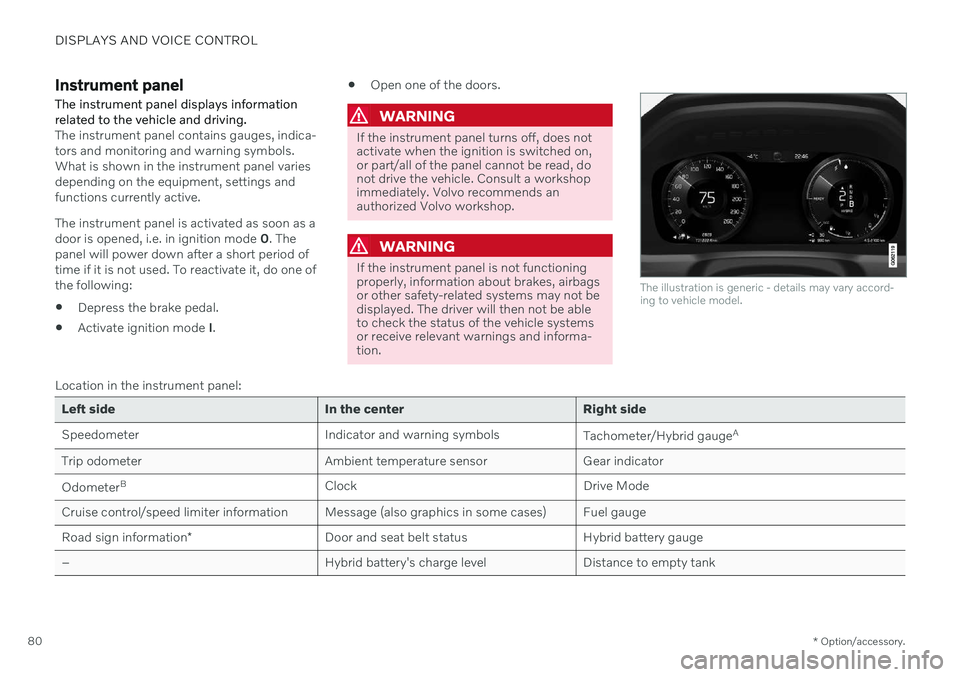
The illustration is generic - details may vary accord- ing to vehicle model.
Location in the instrument panel:
Left side In the center Right side
Speedometer Indicator and warning symbols
Tachometer/Hybrid gaugeA
Trip odometer Ambient temperature sensor Gear indicator Odometer B
Clock Drive Mode
Cruise control/speed limiter information Message (also graphics in some cases) Fuel gauge Road sign information * Door and seat belt status Hybrid battery gauge
– Hybrid battery's charge level Distance to empty tank
Page 144 of 655

||
DISPLAYS AND VOICE CONTROL
* Option/accessory.
142
Raising position
Lowering position
Confirm
The brightness of the graphic is automatically adapted to the light conditions in its back-ground. Brightness is also affected by adjust-ments to the brightness of the other displaysin the vehicle. The height position can be stored in the front power seat's * memory function using the key-
pad in the driver's door.
Calibrating the horizontal positionIf the windshield or display unit has been replaced, the head-up display's horizontalposition may need to be calibrated. Calibrationmeans that the projected image is rotatedclockwise or counterclockwise. 1. Tap
Settings in the center display's Top
view.
2. Select
My CarDisplaysHead-Up
Display Options
Head-Up Display
Calibration.
3. Calibrate the horizontal position of the image using the right-side steering wheel keypad.
Rotate counterclockwise
Rotate clockwise
Confirm
Related information
Head-up display
* (p. 139)
Activating and deactivating the head-up display
* (p. 141)
Driver profiles (p. 133)
Storing positions for seats, mirrors andhead-up display
* (p. 186)
Voice Control
Voice control 14
allows you to control func-
tions in the vehicle, e.g. the climate control system, radio or a Bluetooth-connectedphone, using spoken commands. In vehicles equipped with Sensus Navigation *, the navi-
gation system can also be controlled using voice commands.
What is voice control?Voice control is a driver support function that can simplify the use of various commands inyour vehicle. It works in general like a regularapplication in which you input information in aset order in order to perform a task, butinstead of typing on a keypad, you use voicecommands. It can therefore be a good idea tofamiliarize yourself with how, and in whatorder, a voice command should be spoken toget the desired result. You can control certain infotainment and cli- mate control functions through the voice con-trol system by using voice commands. Thesystem can respond verbally and by displayinginformation in the instrument panel.
14 Certain markets only.
Page 161 of 655

LIGHTING
}}
* Option/accessory.159
Using home safe lighting
Some of the exterior lights remain on to illu- minate the area around the vehicle. This iscalled home safe lighting.
To activate home safe lighting:
1. Switch off the ignition.
2. Push the left-side steering wheel lever toward the dashboard and release.
3. Exit the vehicle and lock the doors. > A symbol in the instrument panel illumi-nates to indicate that the function is activated and exterior lighting switcheson: Parking lights, headlights, licenseplate lighting and outer door handle lighting *.
The length of time home safe lighting remains illuminated can be set in the center display.
Related information
Adjusting light functions via the centerdisplay (p. 151)
Welcome Light (p. 159)
Welcome Light
Approach lighting is activated when the vehi- cle is unlocked and can be used to providelight as you walk toward the vehicle.
The function is activated when the remote key is used for unlocking. The parking lights, ceil-ing lights, footwell lights and trunk/cargocompartment lights are activated in daylightconditions. In weak daylight or dark condi-tions, the license plate lighting and outer door handle lighting * will also be activated, with the
light directed toward the ground. If no door is opened, the lights will remain illu- minated for approx. 2 minutes. If a door isopened while the function is activated, the interior lighting and outer door handle lighting *
will remain on for a longer period of time. This function can be activated and deactivated in the center display.
Related information
Adjusting light functions via the centerdisplay (p. 151)
Using home safe lighting (p. 159)
Remote key (p. 236)
Interior Lighting
The passenger compartment is equipped with several different types of lighting, e.g.general lighting, adjustable ambient lightingand reading lights.
All lighting in the passenger compartment can be turned on and off manually within5 minutes after:
the engine has been switched off and theignition is in mode
0.
the vehicle is unlocked but has not yetbeen started.
Front ceiling lighting
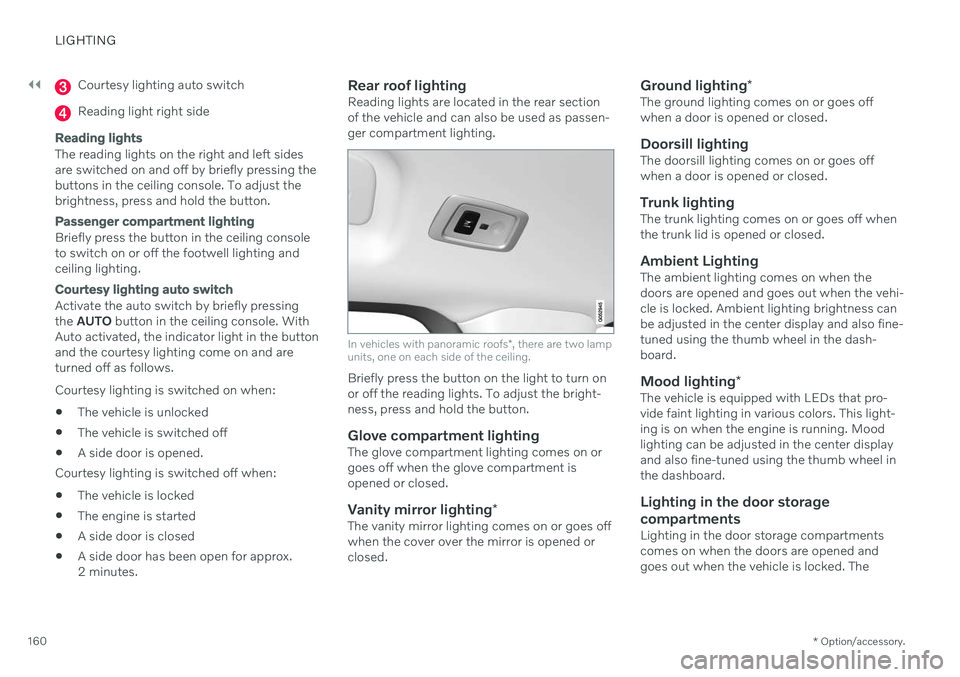
The controls in the ceiling console for the front read- ing lights and courtesy lighting.
Reading light left side
Passenger compartment lighting
Page 162 of 655
||
LIGHTING
* Option/accessory.
160
Courtesy lighting auto switch
Reading light right side
Reading lights
The reading lights on the right and left sides are switched on and off by briefly pressing thebuttons in the ceiling console. To adjust thebrightness, press and hold the button.
Passenger compartment lighting
Briefly press the button in the ceiling console to switch on or off the footwell lighting andceiling lighting.
Courtesy lighting auto switch
Activate the auto switch by briefly pressing the AUTO button in the ceiling console. With
Auto activated, the indicator light in the buttonand the courtesy lighting come on and areturned off as follows. Courtesy lighting is switched on when:
The vehicle is unlocked
The vehicle is switched off
A side door is opened.
Courtesy lighting is switched off when: The vehicle is locked
The engine is started
A side door is closed
A side door has been open for approx. 2 minutes.
Rear roof lightingReading lights are located in the rear sectionof the vehicle and can also be used as passen-ger compartment lighting.
In vehicles with panoramic roofs
*, there are two lamp
units, one on each side of the ceiling.
Briefly press the button on the light to turn on or off the reading lights. To adjust the bright-ness, press and hold the button.
Glove compartment lightingThe glove compartment lighting comes on orgoes off when the glove compartment isopened or closed.
Vanity mirror lighting *The vanity mirror lighting comes on or goes offwhen the cover over the mirror is opened orclosed.
Ground lighting*The ground lighting comes on or goes offwhen a door is opened or closed.
Doorsill lightingThe doorsill lighting comes on or goes offwhen a door is opened or closed.
Trunk lightingThe trunk lighting comes on or goes off whenthe trunk lid is opened or closed.
Ambient LightingThe ambient lighting comes on when thedoors are opened and goes out when the vehi-cle is locked. Ambient lighting brightness canbe adjusted in the center display and also fine-tuned using the thumb wheel in the dash-board.
Mood lighting*The vehicle is equipped with LEDs that pro-vide faint lighting in various colors. This light-ing is on when the engine is running. Moodlighting can be adjusted in the center displayand also fine-tuned using the thumb wheel inthe dashboard.
Lighting in the door storage compartments
Lighting in the door storage compartments comes on when the doors are opened andgoes out when the vehicle is locked. The