door lock VOLVO V4 2001 User Guide
[x] Cancel search | Manufacturer: VOLVO, Model Year: 2001, Model line: V4, Model: VOLVO V4 2001Pages: 87, PDF Size: 2.34 MB
Page 34 of 87
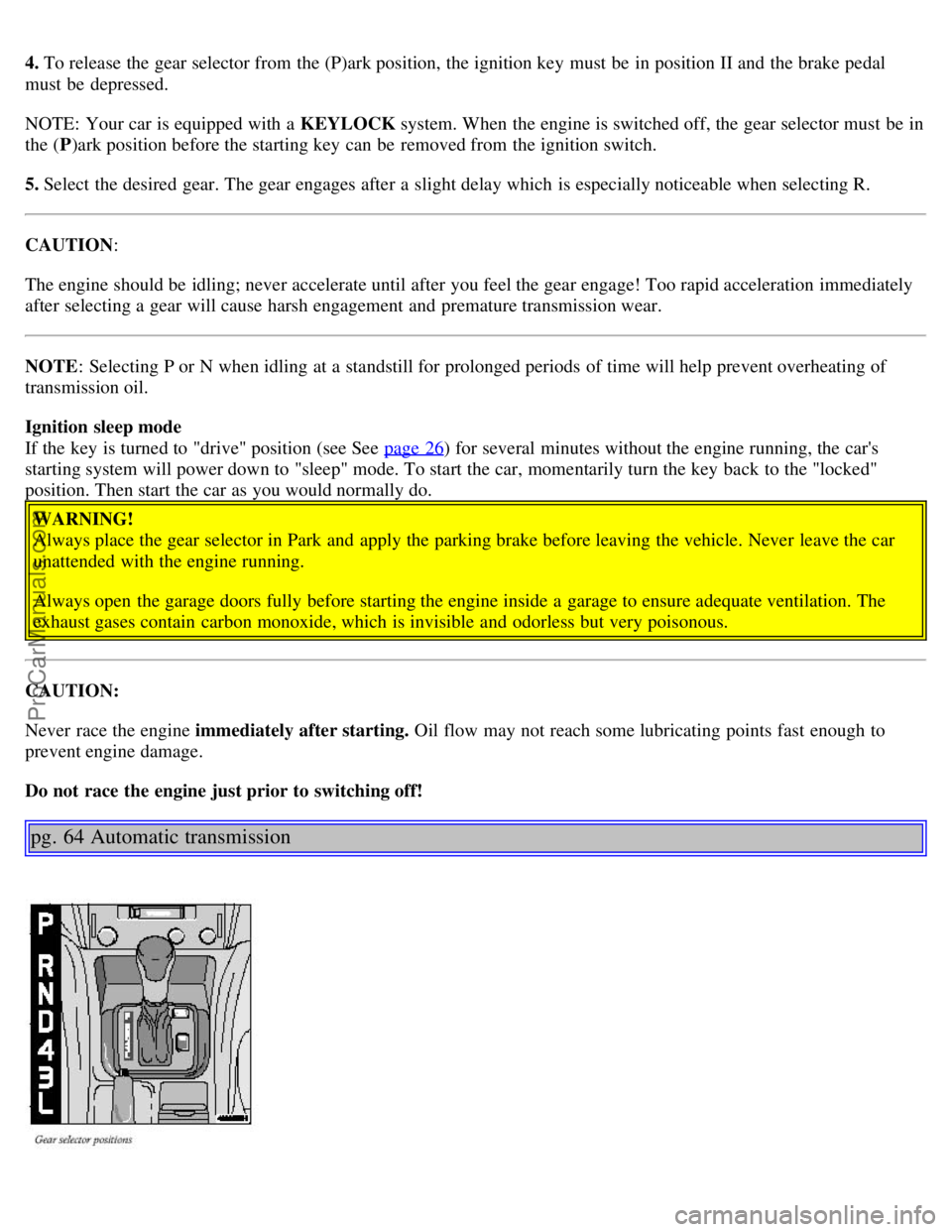
4. To release the gear selector from the (P)ark position, the ignition key must be in position II and the brake pedal
must be depressed.
NOTE: Your car is equipped with a KEYLOCK system. When the engine is switched off, the gear selector must be in
the (P)ark position before the starting key can be removed from the ignition switch.
5. Select the desired gear. The gear engages after a slight delay which is especially noticeable when selecting R.
CAUTION :
The engine should be idling; never accelerate until after you feel the gear engage! Too rapid acceleration immediately
after selecting a gear will cause harsh engagement and premature transmission wear.
NOTE : Selecting P or N when idling at a standstill for prolonged periods of time will help prevent overheating of
transmission oil.
Ignition sleep mode
If the key is turned to "drive" position (see See page 26
) for several minutes without the engine running, the car's
starting system will power down to "sleep" mode. To start the car, momentarily turn the key back to the "locked"
position. Then start the car as you would normally do.
WARNING!
Always place the gear selector in Park and apply the parking brake before leaving the vehicle. Never leave the car
unattended with the engine running.
Always open the garage doors fully before starting the engine inside a garage to ensure adequate ventilation. The
exhaust gases contain carbon monoxide, which is invisible and odorless but very poisonous.
CAUTION:
Never race the engine immediately after starting. Oil flow may not reach some lubricating points fast enough to
prevent engine damage.
Do not race the engine just prior to switching off!
pg. 64 Automatic transmission
ProCarManuals.com
Page 45 of 87
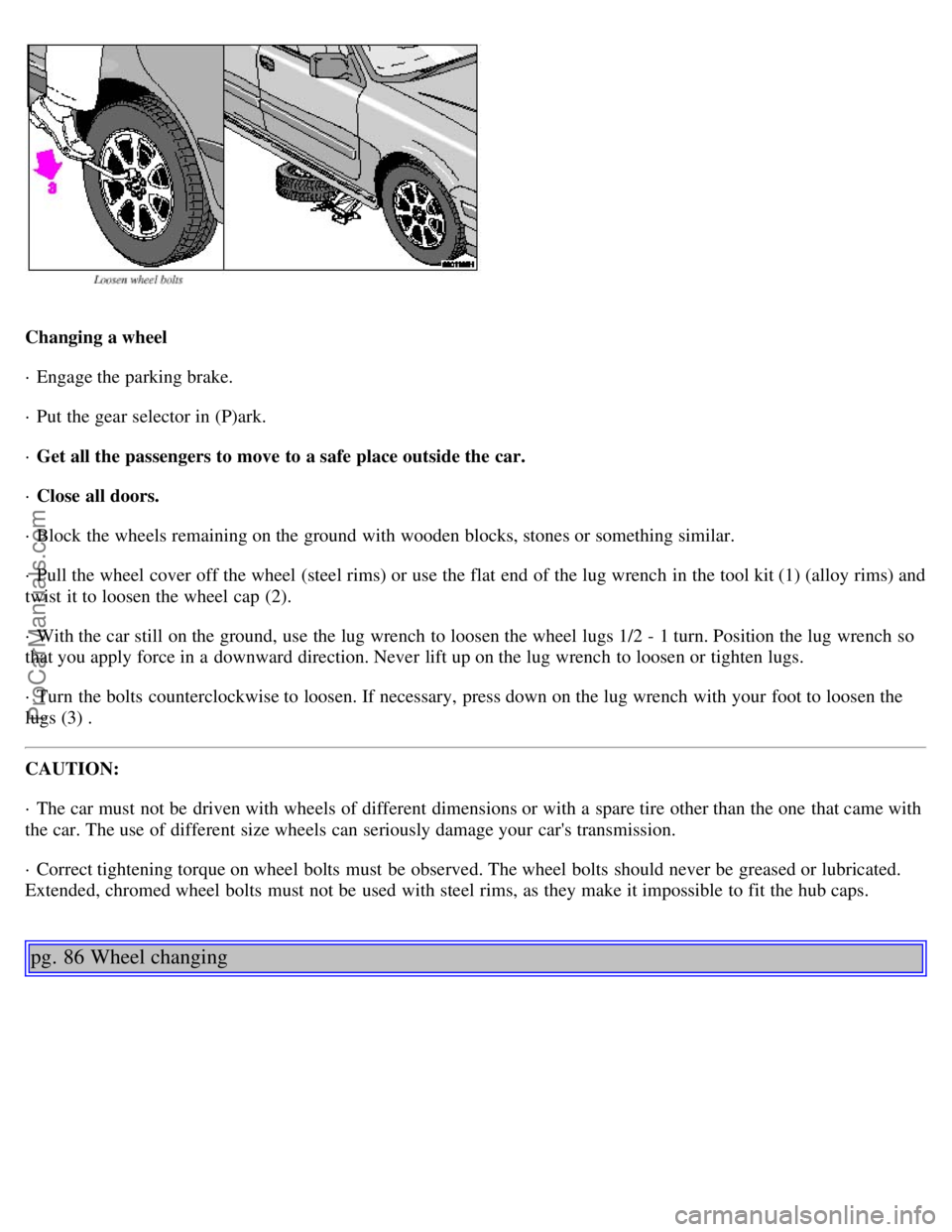
Changing a wheel
· Engage the parking brake.
· Put the gear selector in (P)ark.
· Get all the passengers to move to a safe place outside the car.
· Close all doors.
· Block the wheels remaining on the ground with wooden blocks, stones or something similar.
· Pull the wheel cover off the wheel (steel rims) or use the flat end of the lug wrench in the tool kit (1) (alloy rims) and
twist it to loosen the wheel cap (2).
· With the car still on the ground, use the lug wrench to loosen the wheel lugs 1/2 - 1 turn. Position the lug wrench so
that you apply force in a downward direction. Never lift up on the lug wrench to loosen or tighten lugs.
· Turn the bolts counterclockwise to loosen. If necessary, press down on the lug wrench with your foot to loosen the
lugs (3) .
CAUTION:
· The car must not be driven with wheels of different dimensions or with a spare tire other than the one that came with
the car. The use of different size wheels can seriously damage your car's transmission.
· Correct tightening torque on wheel bolts must be observed. The wheel bolts should never be greased or lubricated.
Extended, chromed wheel bolts must not be used with steel rims, as they make it impossible to fit the hub caps.
pg. 86 Wheel changing
ProCarManuals.com
Page 46 of 87
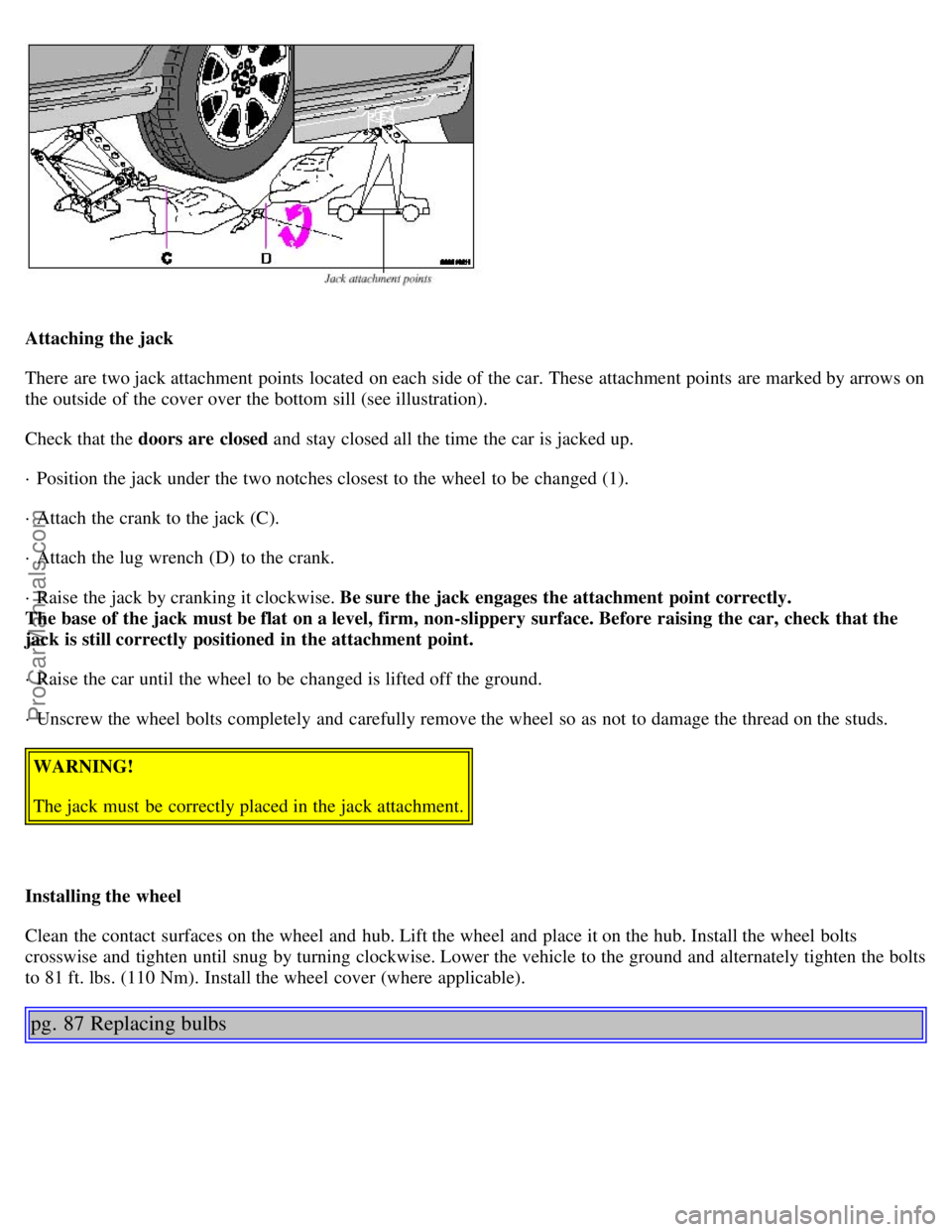
Attaching the jack
There are two jack attachment points located on each side of the car. These attachment points are marked by arrows on
the outside of the cover over the bottom sill (see illustration).
Check that the doors are closed and stay closed all the time the car is jacked up.
· Position the jack under the two notches closest to the wheel to be changed (1).
· Attach the crank to the jack (C).
· Attach the lug wrench (D) to the crank.
· Raise the jack by cranking it clockwise. Be sure the jack engages the attachment point correctly.
The base of the jack must be flat on a level, firm, non-slippery surface. Before raising the car, check that the
jack is still correctly positioned in the attachment point.
· Raise the car until the wheel to be changed is lifted off the ground.
· Unscrew the wheel bolts completely and carefully remove the wheel so as not to damage the thread on the studs.
WARNING!
The jack must be correctly placed in the jack attachment.
Installing the wheel
Clean the contact surfaces on the wheel and hub. Lift the wheel and place it on the hub. Install the wheel bolts
crosswise and tighten until snug by turning clockwise. Lower the vehicle to the ground and alternately tighten the bolts
to 81 ft. lbs. (110 Nm). Install the wheel cover (where applicable).
pg. 87 Replacing bulbs
ProCarManuals.com
Page 54 of 87
· Tar spots can be removed with kerosene or tar remover after the car has been washed.
· A stiff-bristle brush and lukewarm soapy water can be used to clean the wiper blades. Frequent cleaning improves
visibility considerably.
· Wash off the dirt from the underside (wheel housings fenders, etc.).
· In areas of high industrial fallout, more frequent washing is recommended.
CAUTION: During high pressure washing, the spray nozzle must never be closer to the vehicle than 13" (30 cm). Do
not spray into the locks.
· When washing or steam cleaning the engine, avoid spraying water or steam directly on the electrical components or
toward the rear side of the engine.
· After cleaning the engine, the spark plug wells should be inspected for water and blown dry if necessary.
Suitable detergents
Special car washing detergents should be used. A suitable mixture is about 2.5 fl. oz. (8.5 cl) of detergent to 2.6 US
gal. (10 liters) of warm water. After washing with a detergent the car should be well rinsed with clean water.
WARNING!
· When the car is driven immediately after being washed, apply the brakes several times in order to remove any
moisture from the brake linings.
· Engine cleaning agents should not be used when the engine is warm. This may constitute a fire risk.
NOTE: When washing the car, remember to remove dirt from the drain holes in the doors and sills. Bumpers: Wash
the bumpers with the same cleaning agent used on the rest of the car. Never clean the bumpers with gasoline or paint
thinner. Difficult spots can be removed with denatured alcohol. To avoid scratches, do not dry the bumpers with paper.
pg. 102 Automatic car washing, Polishing and waxing
Automatic washing simple and quick
Brushless car washes are recommended. An automatic wash is a simple and quick way to clean your car, but it is
worth remembering that it may not be as thorough as when you yourself go over the car with sponge and water.
Keeping the underbody clean is most important, especially in the winter. Some automatic washers do not have
facilities for washing the underbody.
Before driving into an automatic wash, make sure that side view mirrors, auxiliary lamps, etc., are secure, otherwise
there is risk of the machine dislodging them. You should also lower the antenna (sedans).
We do NOT recommend washing your car in an automatic wash during the first six months because the paint
will not have hardened sufficiently.
Polishing and waxing
Normally, polishing is not required during the first year after delivery, however, waxing is recommended.
ProCarManuals.com
Page 83 of 87
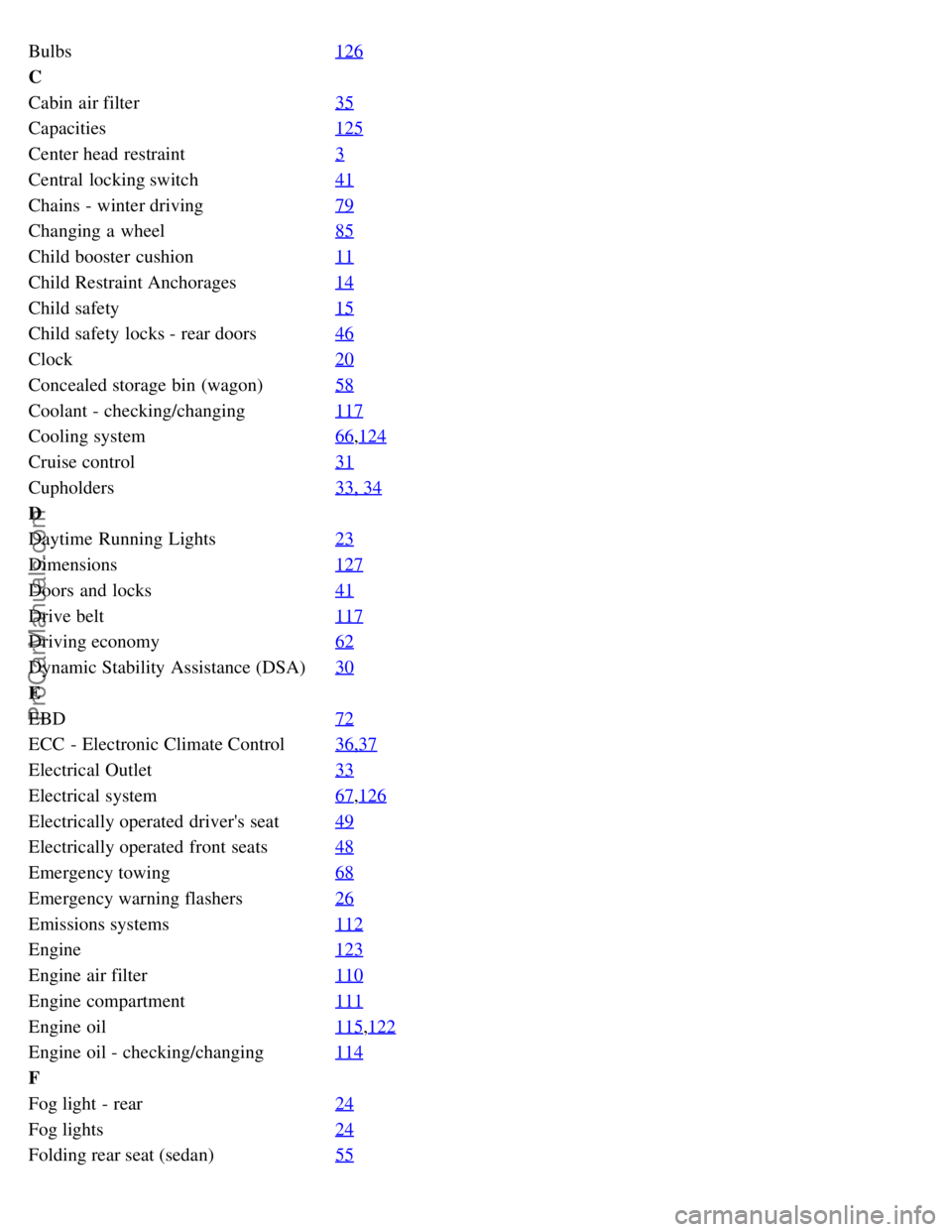
Bulbs126
C
Cabin air filter35
Capacities125
Center head restraint3
Central locking switch41
Chains - winter driving79
Changing a wheel85
Child booster cushion11
Child Restraint Anchorages14
Child safety15
Child safety locks - rear doors46
Clock20
Concealed storage bin (wagon)58
Coolant - checking/changing117
Cooling system66,124
Cruise control31
Cupholders33, 34
D
Daytime Running Lights23
Dimensions127
Doors and locks41
Drive belt117
Driving economy62
Dynamic Stability Assistance (DSA)30
E
EBD72
ECC - Electronic Climate Control36,37
Electrical Outlet33
Electrical system67,126
Electrically operated driver's seat49
Electrically operated front seats48
Emergency towing68
Emergency warning flashers26
Emissions systems112
Engine123
Engine air filter110
Engine compartment111
Engine oil115,122
Engine oil - checking/changing114
F
Fog light - rear24
Fog lights24
Folding rear seat (sedan)55
ProCarManuals.com