fuel VOLVO V4 2001 User Guide
[x] Cancel search | Manufacturer: VOLVO, Model Year: 2001, Model line: V4, Model: VOLVO V4 2001Pages: 87, PDF Size: 2.34 MB
Page 33 of 87
· Avoid using automatic transmission kickdown feature unless necessary.
· Avoid using the air conditioning when it is not required. When engaged, the air conditioner's compressor places an
additional load on the engine. However, please note that fuel consumption is lower with the air conditioning on than it
is when driving with the air conditioning switched off and the windows down.
· Utilizing the fuel consumption modes in the Trip Computer can help you "learn" how to drive more economically.
Other factors which decrease gas mileage are:
· Worn or dirty spark plugs
· Incorrect spark plug gap
· Dirty air cleaner
· Dirty engine oil and clogged oil filter
· Dragging brakes
· Incorrect front end alignment
Some of the above mentioned items and others are checked at the standard Maintenance Service intervals.
NOTE : The automatic transmission's ( D)rive position should be used as often as possible to help improve fuel
economy.
WARNING!
It is recommended that tires of the same make and dimensions be used on all four wheels (including the use of snow
tires). Do not use bias ply tires as this will adversely alter vehicle handling characteristics. Maintain correct tire
pressure.
WARNING!
Do not drive with trunk lid open! A warning light in the instrument panel will indicate that the trunk is open.
Poisonous exhaust gases may enter via the open trunk lid. If the trunk lid/tailgate must be kept open for any reason,
proceed as follows:
· Close the windows.
· Set the ventilation system control to air flow to floor, windshield and side windows and blower control to its
highest setting.
pg. 63 Starting the engine
Starting and stopping
1. Fasten the seat belt.WARNING!
Before starting, check that the seat, steering wheel and mirrors are adjusted properly. Make sure the brake pedal can
be depressed completely. Move the seat closer if necessary. Refer to section "front seats".
2. Make sure the gear selector is in the Park position.
3. Without touching the accelerator pedal, turn the ignition key to the starting position. Allow the starter to operate
for up to 5 seconds. Release the key as soon as the engine starts. If the engine fails to start, repeat step 3.
For cold starts at altitudes above 6000 ft (1800 meters), depress the accelerator pedal halfway and turn the key to the
starting position. Release the pedal slowly when the engine starts. Depress the brake pedal and release the parking
brake.
ProCarManuals.com
Page 36 of 87
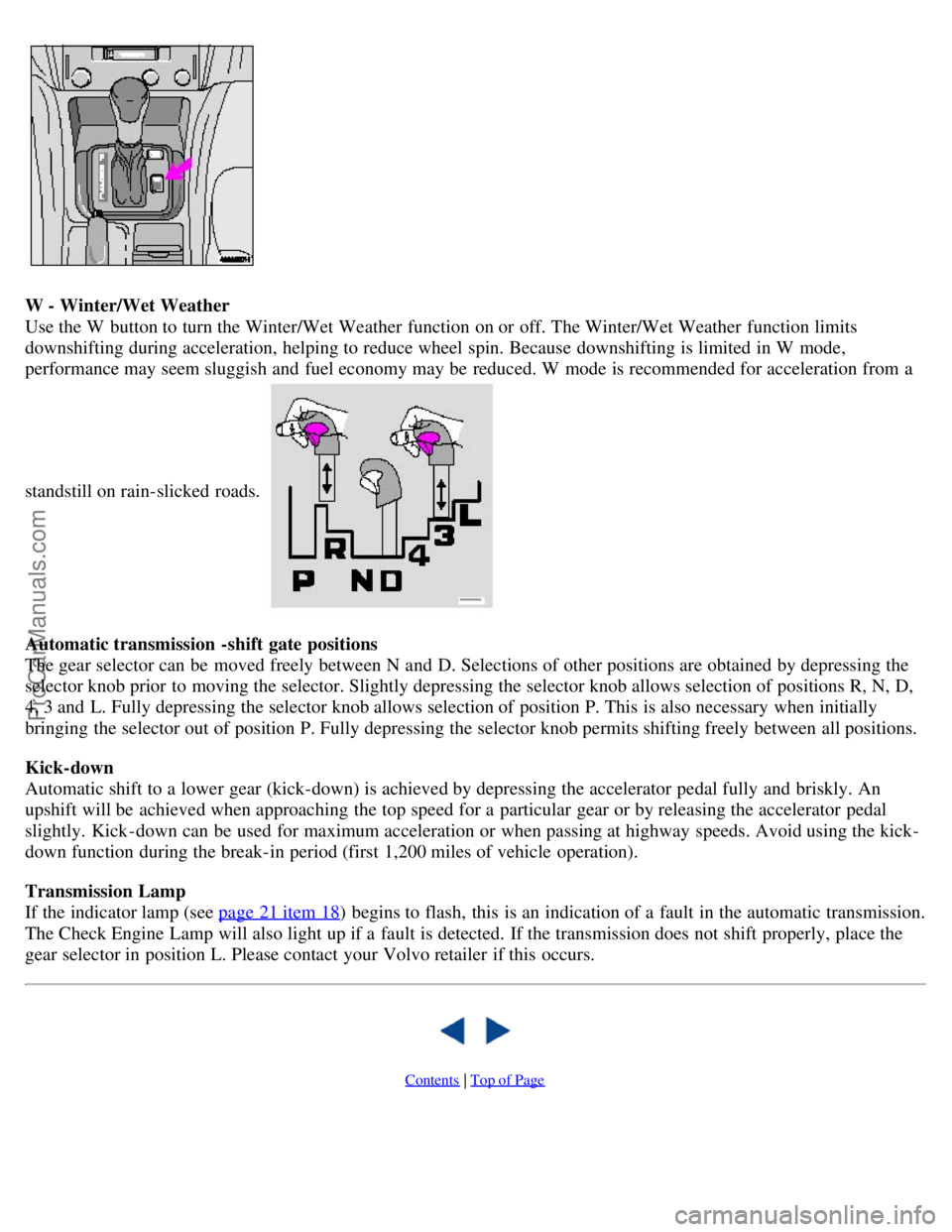
W - Winter/Wet Weather
Use the W button to turn the Winter/Wet Weather function on or off. The Winter/Wet Weather function limits
downshifting during acceleration, helping to reduce wheel spin. Because downshifting is limited in W mode,
performance may seem sluggish and fuel economy may be reduced. W mode is recommended for acceleration from a
standstill on rain-slicked roads.
Automatic transmission -shift gate positions
The gear selector can be moved freely between N and D. Selections of other positions are obtained by depressing the
selector knob prior to moving the selector. Slightly depressing the selector knob allows selection of positions R, N, D,
4, 3 and L. Fully depressing the selector knob allows selection of position P. This is also necessary when initially
bringing the selector out of position P. Fully depressing the selector knob permits shifting freely between all positions.
Kick-down
Automatic shift to a lower gear (kick-down) is achieved by depressing the accelerator pedal fully and briskly. An
upshift will be achieved when approaching the top speed for a particular gear or by releasing the accelerator pedal
slightly. Kick -down can be used for maximum acceleration or when passing at highway speeds. Avoid using the kick-
down function during the break-in period (first 1,200 miles of vehicle operation).
Transmission Lamp
If the indicator lamp (see page 21 item 18
) begins to flash, this is an indication of a fault in the automatic transmission.
The Check Engine Lamp will also light up if a fault is detected. If the transmission does not shift properly, place the
gear selector in position L. Please contact your Volvo retailer if this occurs.
Contents | Top of Page
ProCarManuals.com
Page 37 of 87
2 0 0 1
VOLVO
S40 & V40
Chapter 5 - Wheels and tires
pg. 77 Wheels and tires
Wheels and tires
The handling and riding comfort of the vehicle is dependent on the inflation pressure and the type of tires fitted. Read
the following pages carefully. General information, Wear indicator, Tire economy, Flat spots
78
Snow chains, Snow tires, Studded tires79
Inflation pressure80
Uniform tire quality grading81
"Special spare" tire82
pg. 78 Wheels and tires
General information
Your vehicle is equipped with tires according to the tire information label located on the inside of the fuel filler
door
The following is an example of a tire designation code 195/60R15:
195 = tire width in mm.
60 = tire profile. This is the relationship (in percent) between the section height and width of the tire.
R = radial tires.
15 = diameter in inches.
The tires have good road holding characteristics and offer good handling on dry and wet surfaces. It should be noted
however that the tires have been developed to give these features on snow/icefree surfaces. However, for optimum road
holding on icy or snow covered roads we recommend suitable winter tires on all four wheels. When replacing tires,
be sure that the new tires are the same size designation, type (radial) and from the same manufacturer, on all four
wheels. Otherwise there is a risk of altering the car's roadholding and handling characteristics.
NOTE: When storing wheel/tire assemblies (e.g. winter tires and wheels), either stand the assemblies upright, or
suspend them off the ground. Laying wheel/tire assemblies on their sides for prolonged periods can cause wheel and/or
ProCarManuals.com
Page 38 of 87
tire damage.
Wear indicator
The tires have a so-called "wear indicator" in the form of a number of narrow strips running across or parallel to the
tread. When approx. 1/16" (1.6 mm) is left on the tread, these strips become visible and indicate that the tire should be
replaced.
Tires with less than 1/16" (1.6 mm) tread have a very poor grip in rain or snow.
When replacing worn tires, it is recommended that the tire be identical in type (radial) and size as the one being
replaced. Using a tire of the same make (manufacturer) will prevent alteration of the driving characteristics of the
vehicle.
To improve tire economy:
· Maintain correct tire pressure. See the tire pressure label on the inside of the fuel filler door.
· Drive smoothly: avoid fast starts, hard braking and tire screeching.
· Tire wear increases with speed.
· Correct front wheel alignment is very important.
· Unbalanced wheels impair tire economy and driving comfort.
· If the wheels are rotated, they should be kept on the same side of the car so that they revolve in the same direction as
prior to rotation.
· Hitting curbs or potholes can damage the tires and/or wheels permanently.
Flat spots
All tires become warm during use. After cooling, when the vehicle is parked, the tires have a tendency to distort
slightly, forming flat spots. These flat spots can cause vibrations similar to the vibrations caused by unbalanced wheels.
They do, however, disappear when the tire warms up. The degree to which flat spots form depends on the type of cord
used in the tire. Remember that, in cold weather, it takes longer for the tire to warm up and consequently longer for the
flat spot to disappear.
CAUTION: The car must not be driven with wheels of different dimensions or with a spare tire other than the one that
came with the car. The use of different size wheels can seriously damage your car's transmission.
pg. 79 Wheels and tires
Snow chains
Snow chains can be used on your Volvo with the following restrictions:
· Snow chains should be installed on front wheels only. Use only Volvo approved snow chains.
· Snow chains may only be mounted on approved snow tires 195/55 R15. Consult your Volvo retailer.
ProCarManuals.com
Page 40 of 87
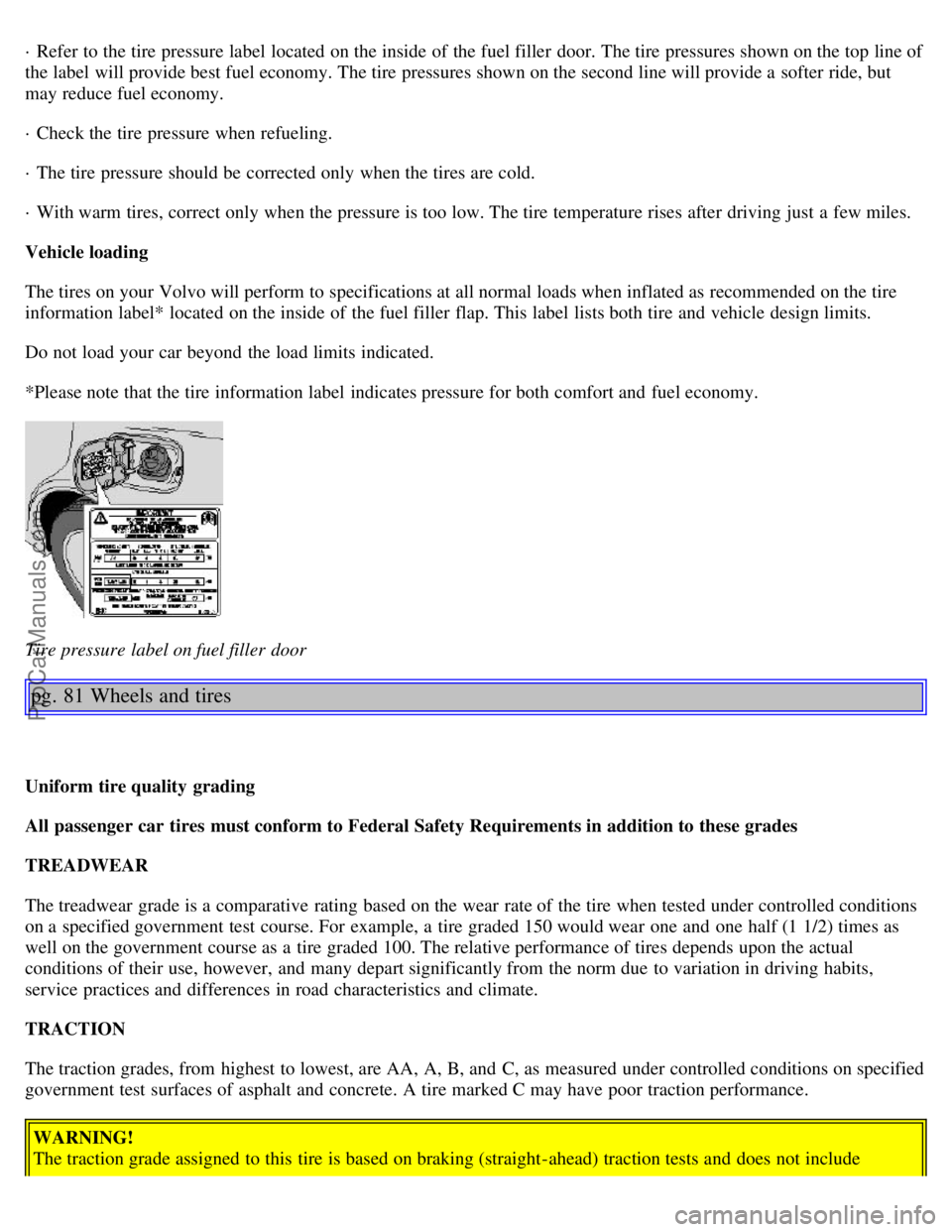
· Refer to the tire pressure label located on the inside of the fuel filler door. The tire pressures shown on the top line of
the label will provide best fuel economy. The tire pressures shown on the second line will provide a softer ride, but
may reduce fuel economy.
· Check the tire pressure when refueling.
· The tire pressure should be corrected only when the tires are cold.
· With warm tires, correct only when the pressure is too low. The tire temperature rises after driving just a few miles.
Vehicle loading
The tires on your Volvo will perform to specifications at all normal loads when inflated as recommended on the tire
information label* located on the inside of the fuel filler flap. This label lists both tire and vehicle design limits.
Do not load your car beyond the load limits indicated.
*Please note that the tire information label indicates pressure for both comfort and fuel economy.
Tire pressure label on fuel filler door
pg. 81 Wheels and tires
Uniform tire quality grading
All passenger car tires must conform to Federal Safety Requirements in addition to these grades
TREADWEAR
The treadwear grade is a comparative rating based on the wear rate of the tire when tested under controlled conditions
on a specified government test course. For example, a tire graded 150 would wear one and one half (1 1/2) times as
well on the government course as a tire graded 100. The relative performance of tires depends upon the actual
conditions of their use, however, and many depart significantly from the norm due to variation in driving habits,
service practices and differences in road characteristics and climate.
TRACTION
The traction grades, from highest to lowest, are AA, A, B, and C, as measured under controlled conditions on specified
government test surfaces of asphalt and concrete. A tire marked C may have poor traction performance.WARNING!
The traction grade assigned to this tire is based on braking (straight-ahead) traction tests and does not include
ProCarManuals.com
Page 41 of 87
cornering (turning) traction.
TEMPERATURE
The temperature grades are AA (the highest), A, B, and C, representing the tire's resistance to the generation of heat
and its ability to dissipate heat when tested under controlled conditions on a specified indoor laboratory test wheel.
Sustained high temperature can cause the material of the tire to degenerate and reduce tire life, and excessive
temperature can lead to sudden tire failure. The grade C corresponds to a level of performance which all passenger car
tires must meet under the Federal Motor Safety Standard No. 109. Grades B and A represent higher levels of
performance on the laboratory test wheel than the minimum required by law.
UNIFORM TIRE QUALITY GRADING LOCATING THE GRADE
Quality grades can be found where applicable on the tire sidewall between tread shoulder and maximum section width.
Treadware 200 Traction AA Temperature AWARNING!
The temperature grade for this tire is established for a tire that is properly inflated and not overloaded. Excessive
speed, underinflation, or excessive loading, either separately or in combination, can cause heat buildup and possible
tire failure.
pg. 82 Spare tire
Special Spare
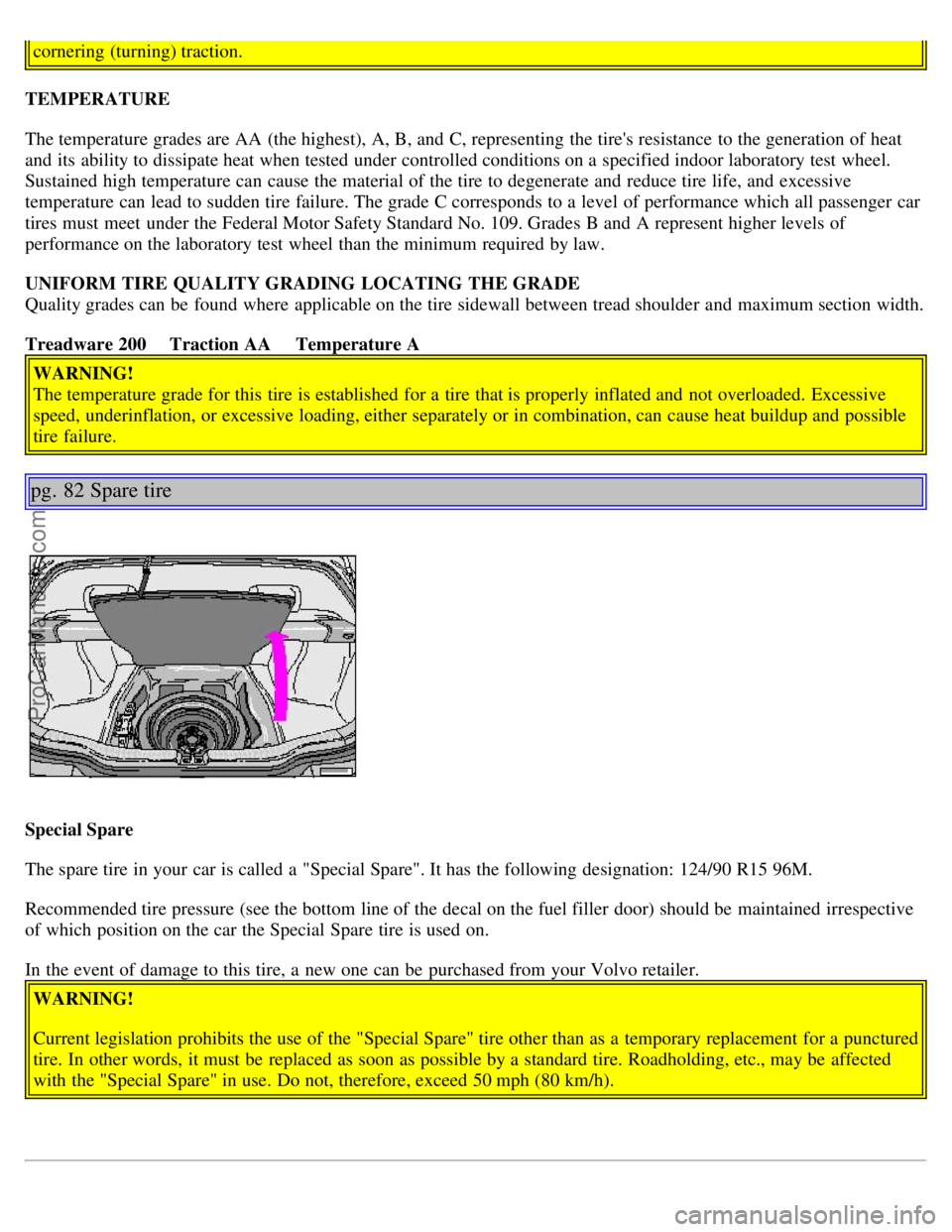
The spare tire in your car is called a "Special Spare". It has the following designation: 124/90 R15 96M.
Recommended tire pressure (see the bottom line of the decal on the fuel filler door) should be maintained irrespective
of which position on the car the Special Spare tire is used on.
In the event of damage to this tire, a new one can be purchased from your Volvo retailer.WARNING!
Current legislation prohibits the use of the "Special Spare" tire other than as a temporary replacement for a punctured
tire. In other words, it must be replaced as soon as possible by a standard tire. Roadholding, etc., may be affected
with the "Special Spare" in use. Do not, therefore, exceed 50 mph (80 km/h).
ProCarManuals.com
Page 57 of 87
2 0 0 1
VOLVO
S40 & V 40
Chapter 8 - Volvo Service
pg. 105 Volvo Service
Service - an investment
An investment which will pay dividends in the form of improved reliability, durability and resale value. Label information
106
Maintenance service, Warranty107
Maintenance schedule108
Servicing110
Engine compartment111
Fuel/emissions systems112
Lubrication113
Engine oil114
Power steering fluid, Brake fluid reservoir116
Coolant, drive belt117
Washer fluid reservoir118
Battery maintenance119
Proposition 65 Battery Warning119
pg. 106 Label information
1 Vehicle Emission Control Information
Your Volvo is designed to meet all applicable emission standards, as evidenced by the certification label on the
underside of the hood. For further information regarding these regulations, please consult your Volvo retailer.
2 Vacuum hose routing
ProCarManuals.com
Page 58 of 87
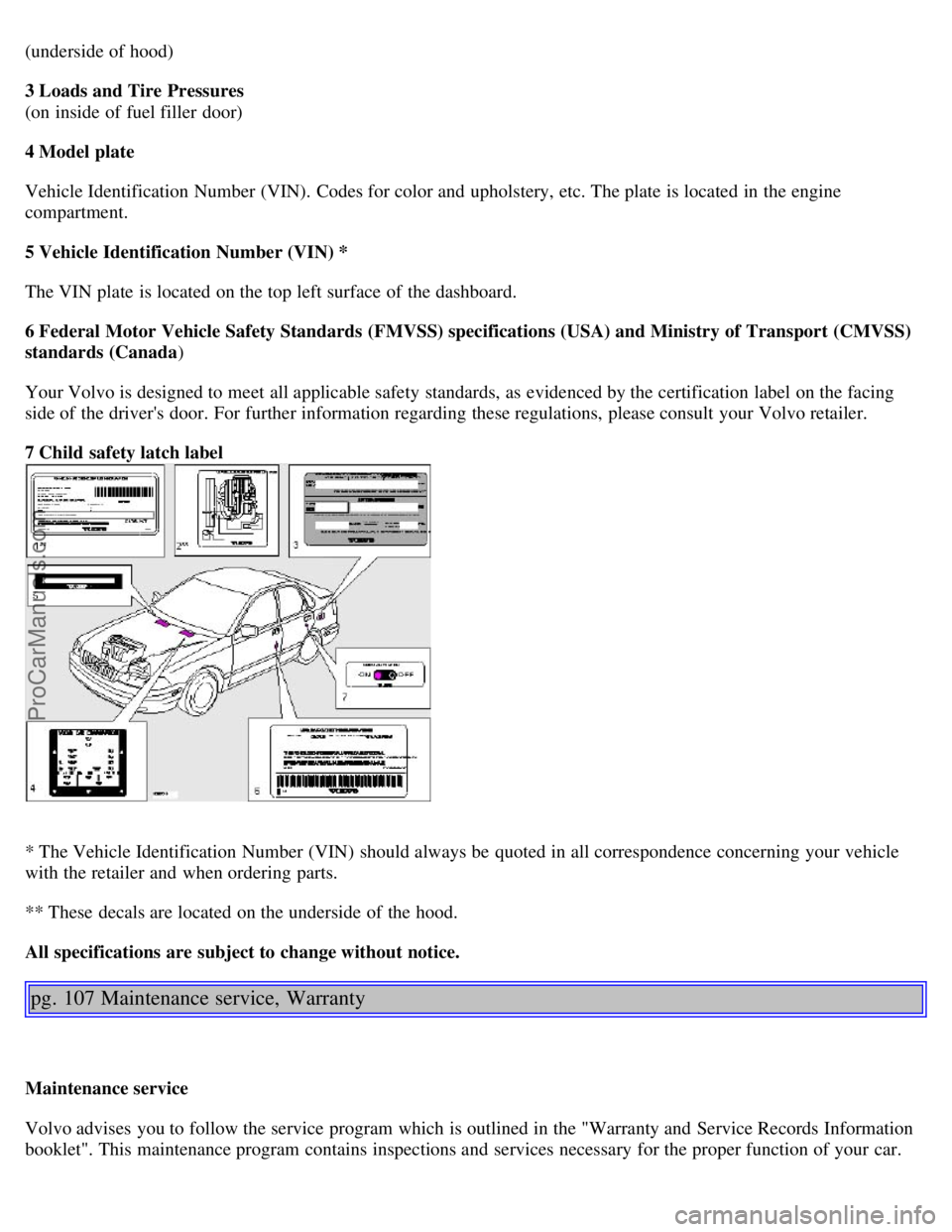
(underside of hood)
3 Loads and Tire Pressures
(on inside of fuel filler door)
4 Model plate
Vehicle Identification Number (VIN). Codes for color and upholstery, etc. The plate is located in the engine
compartment.
5 Vehicle Identification Number (VIN) *
The VIN plate is located on the top left surface of the dashboard.
6 Federal Motor Vehicle Safety Standards (FMVSS) specifications (USA) and Ministry of Transport (CMVSS)
standards (Canada)
Your Volvo is designed to meet all applicable safety standards, as evidenced by the certification label on the facing
side of the driver's door. For further information regarding these regulations, please consult your Volvo retailer.
7 Child safety latch label
* The Vehicle Identification Number (VIN) should always be quoted in all correspondence concerning your vehicle
with the retailer and when ordering parts.
** These decals are located on the underside of the hood.
All specifications are subject to change without notice.
pg. 107 Maintenance service, Warranty
Maintenance service
Volvo advises you to follow the service program which is outlined in the "Warranty and Service Records Information
booklet". This maintenance program contains inspections and services necessary for the proper function of your car.
ProCarManuals.com
Page 61 of 87
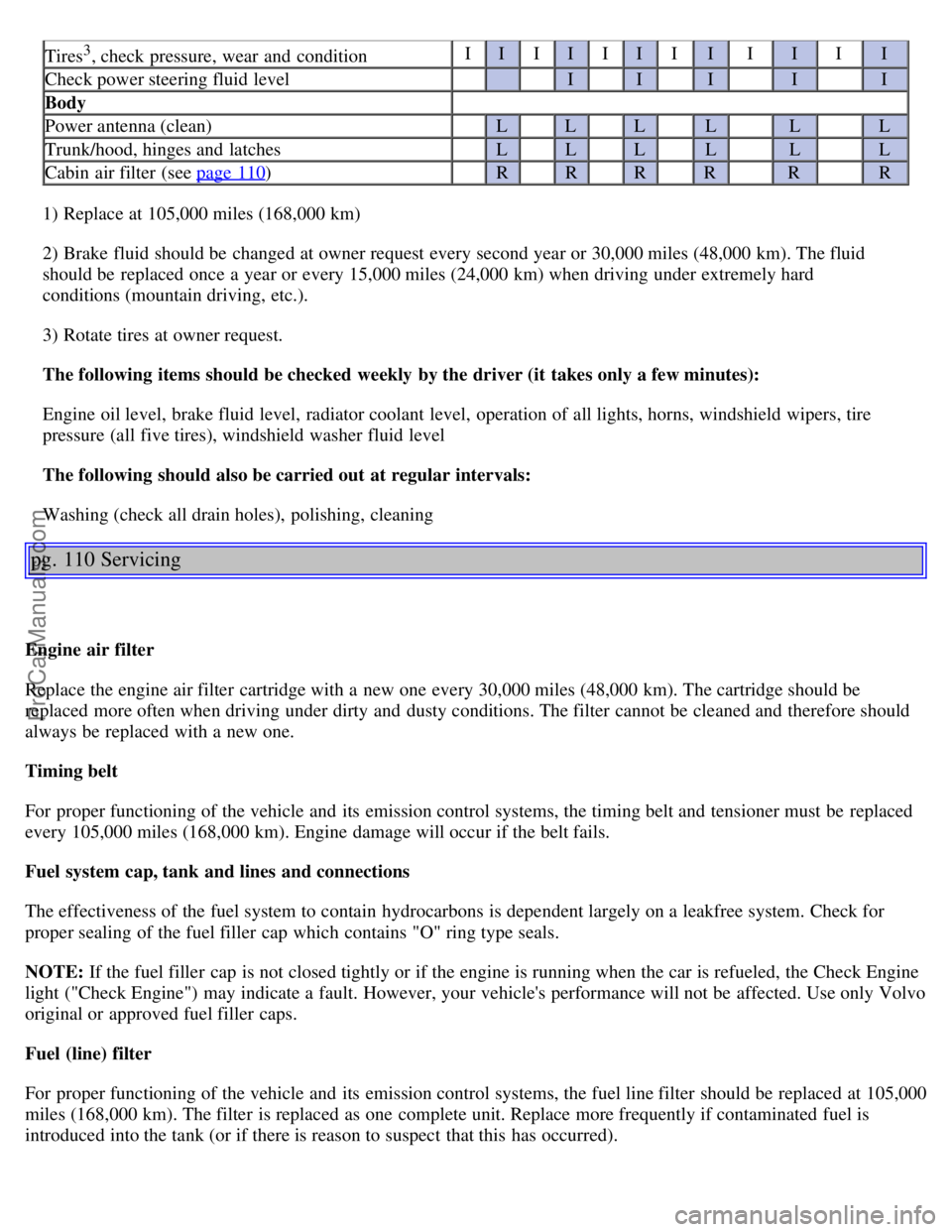
Tires3, check pressure, wear and conditionII II II I I I II I
Check power steering fluid level I I I I I
Body
Power antenna (clean) L L L L L L
Trunk/hood, hinges and latches L L L L L L
Cabin air filter (see page 110
) R R R R R R
1) Replace at 105,000 miles (168,000 km)
2) Brake fluid should be changed at owner request every second year or 30,000 miles (48,000 km). The fluid
should be replaced once a year or every 15,000 miles (24,000 km) when driving under extremely hard
conditions (mountain driving, etc.).
3) Rotate tires at owner request.
The following items should be checked weekly by the driver (it takes only a few minutes):
Engine oil level, brake fluid level, radiator coolant level, operation of all lights, horns, windshield wipers, tire
pressure (all five tires), windshield washer fluid level
The following should also be carried out at regular intervals:
Washing (check all drain holes), polishing, cleaning
pg. 110 Servicing
Engine air filter
Replace the engine air filter cartridge with a new one every 30,000 miles (48,000 km). The cartridge should be
replaced more often when driving under dirty and dusty conditions. The filter cannot be cleaned and therefore should
always be replaced with a new one.
Timing belt
For proper functioning of the vehicle and its emission control systems, the timing belt and tensioner must be replaced
every 105,000 miles (168,000 km). Engine damage will occur if the belt fails.
Fuel system cap, tank and lines and connections
The effectiveness of the fuel system to contain hydrocarbons is dependent largely on a leakfree system. Check for
proper sealing of the fuel filler cap which contains "O" ring type seals.
NOTE: If the fuel filler cap is not closed tightly or if the engine is running when the car is refueled, the Check Engine
light ("Check Engine") may indicate a fault. However, your vehicle's performance will not be affected. Use only Volvo
original or approved fuel filler caps.
Fuel (line) filter
For proper functioning of the vehicle and its emission control systems, the fuel line filter should be replaced at 105,000
miles (168,000 km). The filter is replaced as one complete unit. Replace more frequently if contaminated fuel is
introduced into the tank (or if there is reason to suspect that this has occurred).
ProCarManuals.com
Page 63 of 87
WARNING!
The coolant fan may start or continue to operate (for up to 6 minutes) after the engine has been switched off.
pg. 112 Fuel/emissions systems
Fuel system
The fuel system is all electronic and is microprocessor controlled. It can continually compensate for variation in engine
load, speed and temperature to give the best economy and power. A mass air flow sensor measures the inducted air. In
this way the system can make instantaneous adjustments for changes in air temperature or density, thus always
assuring the best economy with the lowest possible exhaust emissions.
Heated oxygen sensor
This is an emission control system designed to reduce emissions and improve fuel economy. The heated oxygen sensor
monitors the composition of the exhaust gases leaving the engine. The exhaust gas analysis is fed into an electronic
module. This adjusts the air-fuel ratio to provide optimum conditions for combustion and efficient reduction of the
three major pollutants (hydrocarbons, carbon monoxide and oxides of nitrogen (NOx) by a three-way catalytic
converter.
Crankcase ventilation
The engine is provided with positive crankcase ventilation which prevents crankcase gases from being released into the
atmosphere. Instead, the crankcase gases are admitted to the intake manifold and cylinders.
Evaporative control system
The car is equipped with an evaporative control system which prevents gasoline vapor from being released into the
atmosphere.
The system consists of a fuel tank with filler pipe and cap, a rollover valve, a Fill Limit Vent Valve (FLVV), vapor
vent lines, a charcoal canister, a purge line, a purge control valve and engine connections*.
In addition, there is a pressure sensor connected to the fuel tank and a filter -protected Canister Close Valve (CCV) on
the atmospheric side of the canister, for system diagnosis.
The gasoline vapor is channeled through the rollover valve and the FLVV via the vapor vent lines into the charcoal
canister, where it is
stored. When the engine is started, the gasoline vapor is drawn from the charcoal canister to the engine's air intake
system and into the combustion process.
NOTE:
· If the fuel filler cap is not closed tightly or if the engine is running when the car is refueled, the Malfunction Indicator
light may indicate a fault.
· During a transitional period, a small number of service stations may still have fuel nozzles that are not compatible
with the fuel filler neck on cars equipped with the evaporative control system (ORVR) mandated by the U.S.
Environmental Protection Agency and the California Air Resources Board. If you experience difficulties in refueling
your vehicle, please ask the gas station attendant for assistance.
ProCarManuals.com