fuel VOLVO V4 2002 Owner's Manual
[x] Cancel search | Manufacturer: VOLVO, Model Year: 2002, Model line: V4, Model: VOLVO V4 2002Pages: 88, PDF Size: 2.34 MB
Page 61 of 88
Fuel filter
The fuel filter should be replaced at 105,000 miles (168,000 km). The filter is replaced as a complete unit. Replace
more frequently if contaminated fuel is introduced into the tank, or if there is reason to suspect that this has occurred.
Fuel system, including filler cap, tank and lines and connections
The ability of the fuel system to contain hydrocarbons depends upon a leak-free system. Inspect fuel lines every
30,000 miles (48,000 km).Check for proper sealing of the fuel filler cap which contains "O" ring seals.
NOTE: If the fuel filler cap is not closed tightly or if the engine is running when the car is refueled, the Check Engine
light ("Malfunction indicator") may indicate a fault. However, your vehicle's performance will not be affected. Use
only Volvo original or approved fuel filler caps.
Timing belt
For proper functioning of the vehicle and its emission control systems, the timing belt and belt tensioner must be
replaced every 105,000 miles (168,000 km). Engine damage will occur if the belt fails.
PCV system
(on turbocharged models)
The nipple in the intake manifold and the filter at the end of the PCV hose in the air cleaner should be inspected and
cleaned at 105,000 miles (168,000 km) and thereafter, again at 150,000 mile (240,000 km) intervals.
Spark plugs
The spark plugs should be replaced every 45,000 miles (72,000 km) under normal driving conditions. City driving or
fast highway driving may necessitate replacement sooner.
Under normal driving conditions, spark plugs require no maintenance between replacement intervals. When installing
new plugs, be sure to use the right type and to tighten them correctly. When changing the plugs, clean the terminals
and rubber seals. Also check that the suppressor connectors are in good condition. Cracked or damaged connectors
should be replaced.
pg. 111 Engine compartment
Engine compartment S40/V40
1 Power brakes
2 Brake fluid reservoir
3 Fusebox
4 Air cleaner
5 Battery
7 Radiator
8 Oil filter
10 Engine oil dipstick
11 Generator
12 Windshield/headlight washer fluid reservoir
13 Power steering pump
14 Power steering fluid reservoir
15 Engine oil filler cap
ProCarManuals.com
Page 62 of 88
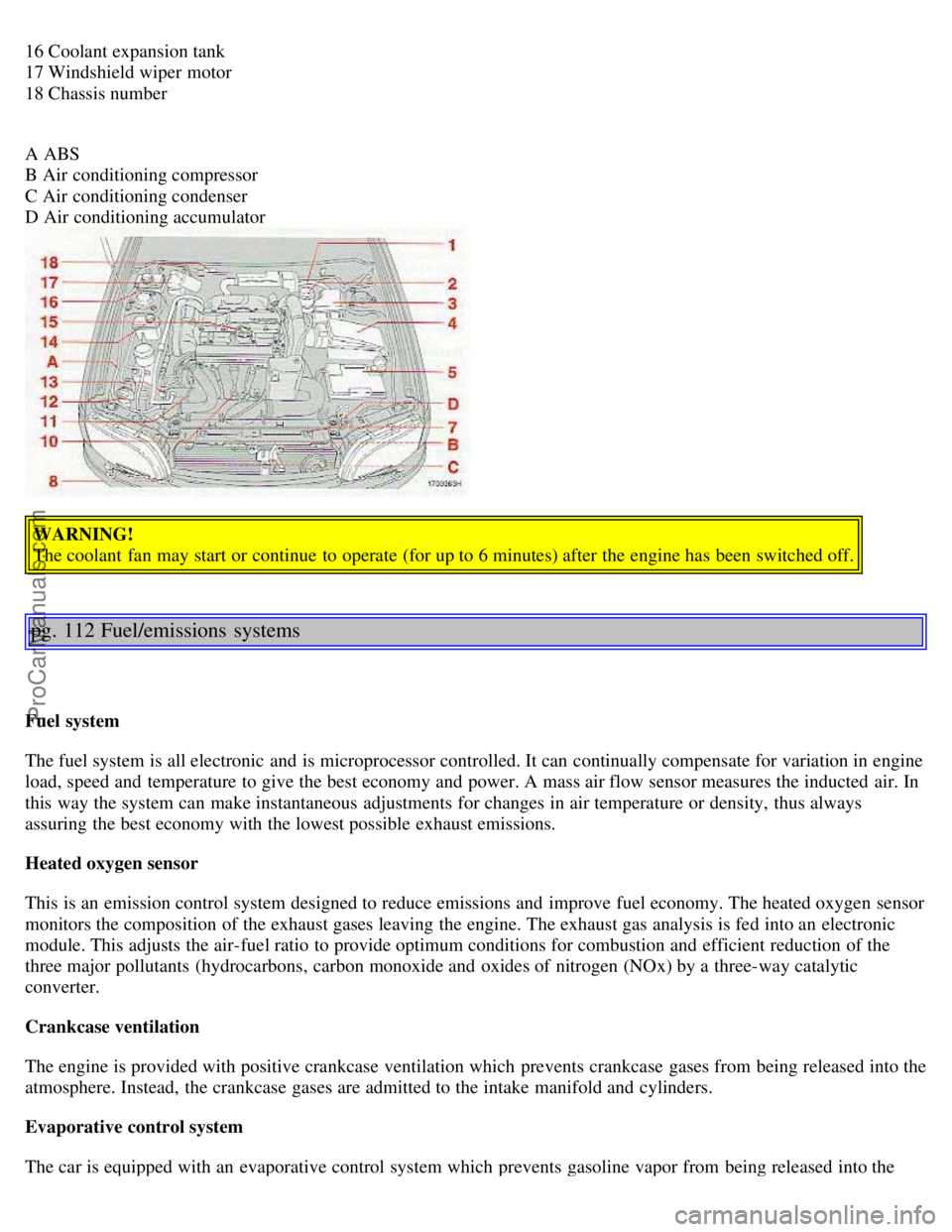
16 Coolant expansion tank
17 Windshield wiper motor
18 Chassis number
A ABS
B Air conditioning compressor
C Air conditioning condenser
D Air conditioning accumulator
WARNING!
The coolant fan may start or continue to operate (for up to 6 minutes) after the engine has been switched off.
pg. 112 Fuel/emissions systems
Fuel system
The fuel system is all electronic and is microprocessor controlled. It can continually compensate for variation in engine
load, speed and temperature to give the best economy and power. A mass air flow sensor measures the inducted air. In
this way the system can make instantaneous adjustments for changes in air temperature or density, thus always
assuring the best economy with the lowest possible exhaust emissions.
Heated oxygen sensor
This is an emission control system designed to reduce emissions and improve fuel economy. The heated oxygen sensor
monitors the composition of the exhaust gases leaving the engine. The exhaust gas analysis is fed into an electronic
module. This adjusts the air-fuel ratio to provide optimum conditions for combustion and efficient reduction of the
three major pollutants (hydrocarbons, carbon monoxide and oxides of nitrogen (NOx) by a three-way catalytic
converter.
Crankcase ventilation
The engine is provided with positive crankcase ventilation which prevents crankcase gases from being released into the
atmosphere. Instead, the crankcase gases are admitted to the intake manifold and cylinders.
Evaporative control system
The car is equipped with an evaporative control system which prevents gasoline vapor from being released into the
ProCarManuals.com
Page 63 of 88

atmosphere.
The system consists of a fuel tank with filler pipe and cap, a rollover valve, a Fill Limit Vent Valve (FLVV), vapor
vent lines, a charcoal canister, a purge line, a purge control valve and engine connections*.
In addition, there is a pressure sensor connected to the fuel tank and a filter -protected Canister Close Valve (CCV) on
the atmospheric side of the canister, for system diagnosis.
The gasoline vapor is channeled through the rollover valve and the FLVV via the vapor vent lines into the charcoal
canister, where it is
stored. When the engine is started, the gasoline vapor is drawn from the charcoal canister to the engine's air intake
system and into the combustion process.
NOTE:
· If the fuel filler cap is not closed tightly or if the engine is running when the car is refueled, the Malfunction Indicator
light may indicate a fault.
· During a transitional period, a small number of service stations may still have fuel nozzles that are not compatible
with the fuel filler neck on cars equipped with the evaporative control system (ORVR) mandated by the U.S.
Environmental Protection Agency and the California Air Resources Board. If you experience difficulties in refueling
your vehicle, please ask the gas station attendant for assistance.
CAUTION:
Fuel must not be siphoned from the fuel tank. This will damage the Evaporative control system.
Contents | Top of Page
ProCarManuals.com
Page 64 of 88
2 0 0 2
VOLVO
S40 & V40
Chapter 9 - Specifications
pg. 121 Specifications
Specifications
This chapter contains facts and figures pertaining to the technical specifications of your car. Oil/fluids specifications
122
Engine specifications123
Cooling/fuel/distributor ignition systems124
Front/rear suspensions124
Transmission, Capacities, Vehicle loading125
Electrical system/bulbs126
Dimensions/weights127
Volvo ON CALL roadside assistance128
pg. 122 Oil/fluid specifications
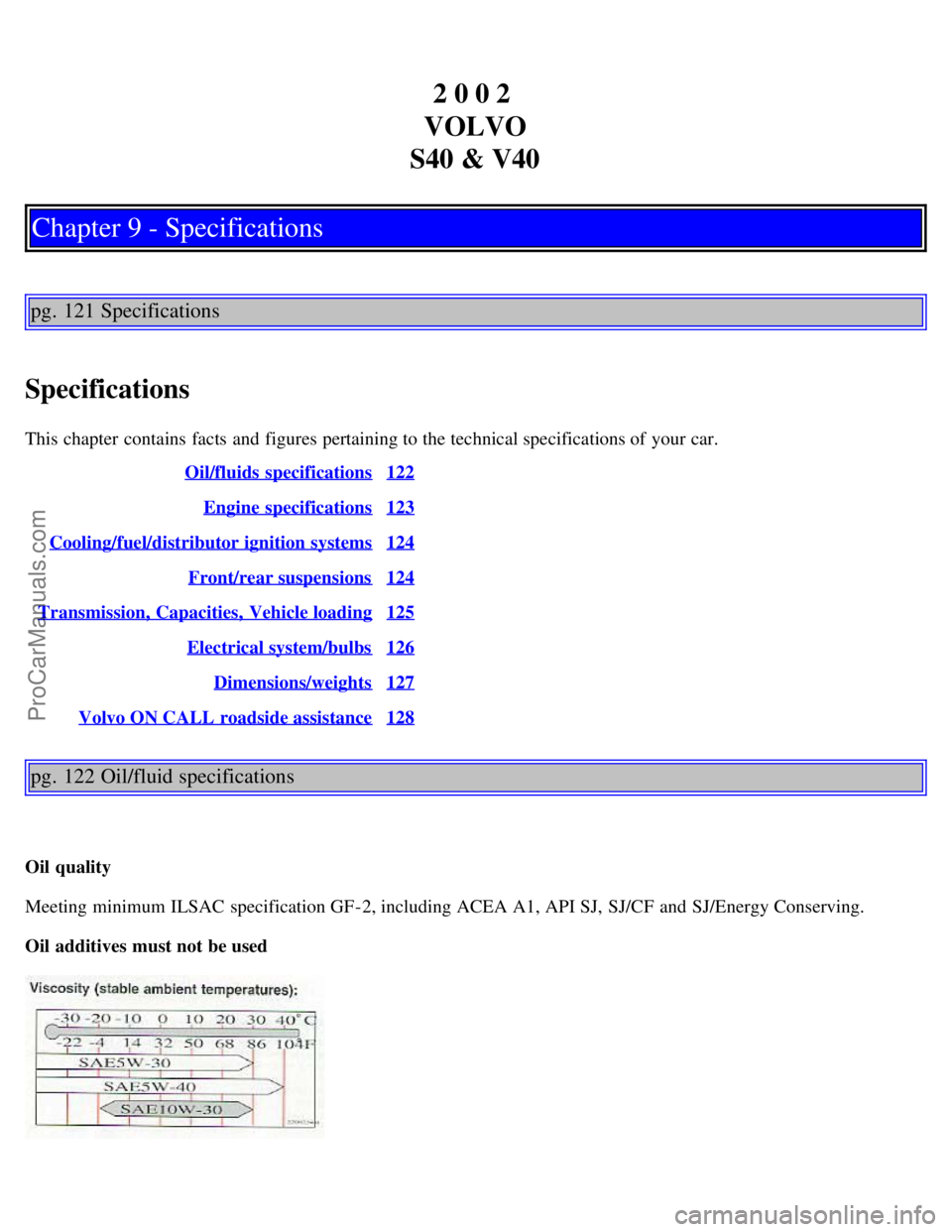
Oil quality
Meeting minimum ILSAC specification GF-2, including ACEA A1, API SJ, SJ/CF and SJ/Energy Conserving.
Oil additives must not be used
ProCarManuals.com
Page 65 of 88
Engine oilQuality:
Meeting minimum ILSAC specification GF-2, including
ACEA A1, API SJ, SJ/CF and SJ/Energy Conserving.
Capacity (incl. filter) : 5.7
US qts (5.4 liters).
Capacity (excl. filter) : 5.3
US qts (5.0 liters)
Automatic
transmission
fluid Quality:
JWS-3309 P/N 1161540 Capacity:
8 US qts. (7.6
liters)
Power steering
fluid Quality:
ATF oil Capacity:
1.05 US qts. (1
liters)
Brake fluid Quality: DOT 4+ boiling point >536°F (280°C), P/N 9437433 Capacity:
0.42 US qts.
(0.4 liters)
All specifications are subject to change without notice.
pg. 123 Engine
Engine
Liquid-cooled, gasoline, inline, 4-cylinder, turbocharged engine. Aluminum alloy cylinder block with cast-iron
cylinder liners cast directly into the block. Aluminum alloy cylinder head with double overhead camshafts and separate
intake and outlet channels.
Engine lubrication is provided by an eccentric pump driven from the crankshaft. Full-flow type oil filter. Exhaust
emission control is accomplished by multiport fuel injection, a heated oxygen sensor and a three-way catalytic
converter. Designation: Volvo B 4204 T3
Output 162 hp at 5100 rpm (121 kw at 5100 rpm)
Max torque 177 ft. lbs. at 1800-4800 rpm (240 Nm at 1800-4800 rpm)
Number of cylinders 4
Bore 3.27" (83 mm)
Stroke 3.54" (90 mm)
Displacement 1.95 liters
Compression ratio 9.0:1
Number of valves 16
Valve clearance mechanical
All specifications are subject to change without notice.
pg. 124 Specifications
Cooling system
Type: Positive pressure, closed system
Thermostat begins to open at 186° F (90° C)
Coolant: Volvo original coolant/antifreeze
ProCarManuals.com
Page 66 of 88

Capacity: 6 US qts. (5.7 liters)
Fuel system
The engine is equipped with a multipoint fuel injection system.
Distributor ignition system
Firing order: 13-4-2
Distributor ignition setting: Not adjustable
Spark plugs: Champion RC8PYP or equivalent
Spark plug gap: 0.03" (0.75 mm)
Tightening torque: 18.4 ft. lbs. (25 Nm)WARNING!
The distributor ignition system operates at very high voltages. Special safety precautions must be followed to
prevent injury. Always turn the ignition off when:
· Replacing distributor ignition components e.g. plugs, coil, etc.
· Do not touch any part of the distributor ignition system while the engine is running. This may result in unintended
movements and body injury.
All specifications are subject to change without notice.
Front suspension
Spring strut suspension with integrated shock absorbers and control arms linked to the support frame. Power assisted
rack and pinion steering. Safety type steering column.
The alignment specifications apply to a car at curb weight (without passengers or cargo).
Toe-in measured on the wheel rims: 1.4 mm + - 0.2 mm
Toe-in measured on tire sides: 2.0 mm + - 0.4 mm
Rear suspension
Multilink individual rear wheel suspension with longitudinal support arms, double link arms and track rods.
Toe-in measured on the tire sides: 2.6 mm + - 0.8 mm
pg. 125 Specifications
Power transmission
Automatic transmission: AW 50-50
ProCarManuals.com
Page 67 of 88
4speed automatic electronically controlled gearbox comprising a hydraulic torque converter with a lockup function;
planetary gear, integrated final drive.
Operation via a floor mounted gear selector lever. Drive shafts with symmetrical joint location. Overdrive.
Final drive ratio 2.70:1
Reduction ratios
1st gear 3.61:1
2nd gear 2.06:1
3rd gear 1.37:1
4th gear 0.98:1
Reverse 3.96:1
Capacities
Fuel tank : 16 US gal. (60 liters)
Cooling system : 6 US qts. (5,7 liters)
Engine oil (incl. filter) : 5.7 US qts. ( 5.4 liters)
Engine oil (excl. filter) : 5.3 US qts. ( 5.0 liters)
Automatic transmission : 8 US qts (7.6 liters)
Power steering fluid : 1.05 US qts (1 liters)
Washer fluid reservoir : 3.9 US qts. (3.75 liters)
Brake system : 0.42 US qts (0.4 liters)
Vehicle loading
The tires on your Volvo should perform to specifications at all normal loads when inflated as recommended on the tire
information label. The label is located on the inside of the fuel filler flap. The label lists both tire and vehicle design
limits. Do not load your car beyond the load limits indicated.
WARNING!
Improperly inflated tires will reduce tire life, adversely affect vehicle handling and can possibly lead to failure
resulting in loss of vehicle control without prior warning.
All specifications are subject to change without notice.
pg. 126 Specifications
ProCarManuals.com
Page 82 of 88
Fog lights24
Folding rear seat (sedan)55
Folding rear seat55
Front seats47,48
Front seats - heated32
Front suspension124
Fuel gauge20
Fuel system112,124
Fuel tank cover - opening63
Fusebox, Passenger compartment96
Fuses95,96,97
Fuses in engine compartment97
G
Gas tank cover - opening63
Generator126
H
Hand brake32
Handling59
Hazard warning flashers26
Headlight bulbs, replacing90
Heated front seats32
Heating37
Heating and air conditioning35
Home Safe lighting25
Hood53
I
IC system10
Ignition switch26
Immobilizer (start inhibitor)40
Instruments18,19
Integrated booster cushion11
ISOFIX fasteners12
J
Jack86
Jack (sedan)57
Jump starting72
K
Keyless entry system41
Keylock65
Keys40
Kick -down67
L
Label information108
Locks42
ProCarManuals.com
Page 83 of 88

Long distance trips75
Lubrication113
Luggage strap (V40)56
Lumbar support47,48
M
Maintenance service109
Malfunction indicator lamp23
Manual transmission fluid122
Manually closing the sun roof100
Mirrors - rear/side view50
O
Occupant safety16
Octane rating63
Odometer20
Oil - engine115
Oil pressure warning light22
Opening the trunk from the inside S406
P
Paint touchup102
Parking brake32
Parking brake reminder light22
Polishing104
Power seats48
Power steering fluid116,122
PROPOSITION 65 WARNING72,119
R
Radio tuning modes - changing142
Rear fog light24
Rear suspension124
Rear waste bin34
Refueling63
Remote control (central locking system)41
Remote keyless entry system41
Replacing bulbs90, 92, 93, 94
Replacing fuses95
Replacing number plate lighting - V4094
Reporting safety defects16
Road assistance128
Roadholding59
Roof rails/racks59
S
Safety defects - reporting16
Safety locks - child49
Seat belt maintenance16
ProCarManuals.com
Page 87 of 88

the vehicle and others sharing the roadway. Avoiding distractions is part of that responsibility.
Octane rating, see page 63
The following should be checked regularly: *
1 Washer fluid reservoir should be filled with water and solvent (wintertime: windshield washer anti-freeze). See
page 118
.
2 Coolant level should be between the expansion tank marks. Mixture: 50% anti-freeze and 50% water. See page 117
.
3 Power steering - When cold, the level must not be above the MAX mark. Top up if necessary with ATF fluid. See
page 116
.
4 Engine oil level should be between the dipstick marks. The distance between the marks represents approx. 2 US qts.
(1.9 liters). See page 114
.
5 Oil filler cap
6 Brake fluid - check, without removing the cap, that the level is above the MIN mark. Use brake fluid DOT 4+. See
page 116
.
* Engine oil should be checked each time the car is refuelled.
Tire pressure, see label located on inside of fuel filler door.
ProCarManuals.com