lock VOLVO V4 2002 Owners Manual
[x] Cancel search | Manufacturer: VOLVO, Model Year: 2002, Model line: V4, Model: VOLVO V4 2002Pages: 88, PDF Size: 2.34 MB
Page 3 of 88
Shiftlock
When your car is parked, the gear selector is locked in the (P)ark position. To release the selector from this position,
turn the ignition key to position II (or start the engine), depress the brake pedal, press the button on the front of the
gear selector knob and move the selector from (P)ark.
If it is necessary to manually override the shiftlock system:
· Turn the starting (ignition) key to position I
· Press firmly on the "SHIFTLOCK OVERRIDE" button located at the base of the gear selector
· While holding the override button down, press the button on the front of the gear selector
· Move the selector from the (P)ark position.
Keylock
When you switch off the ignition, the gear selector must be in the (P)ark position before the key can be removed.
Anti-lock Brake System (ABS)
The ABS system in your car performs a self -diagnostic test when the vehicle first reaches the speed of approximately
4 mph (6 km/h). The brake pedal will pulsate several times and a sound may be audible from the ABS control module.
This is normal.
Fuel filler door
When you lock the doors, the fuel filler door also locks, with a delay of 10 minutes. When all doors are unlocked, the
fuel filler door is also unlocked. Your key, keyless remote, and the door lock button in the driver's door control pod
will all unlock the fuel filler door. To open the unlocked fuel filler door, press at the forward edge of the door. See
pages 42
for information about locking and unlocking features.
© 2001 Volvo Cars of North America Inc.
Volvo and the environment
Volvo is committed to the well being of our customers. As a natural part of this commitment, we care about the
environment in which we all live. Caring for the environment means an everyday involvement in reducing our
environmental impact.
Volvo's environmental activities are based on a holistic view, which means we consider the overall environmental
impact of a product throughout its complete life cycle. In this context, design, production, product use, and recycling
are all important considerations.
In production, Volvo has partly or completely phased out several chemicals including freons, lead chromates,
naphtanates, asbestos, mercury and cadmium; and reduced the amount of chemicals used in our plants 50% since 1991.
In use, Volvo was the first in the world to introduce into production a three-way catalytic converter with a Lambda
ProCarManuals.com
Page 6 of 88
Seat belts
Always fasten the seat belts before you drive or ride.
Two lights above the rear view mirror will be illuminated for 4-8 seconds after the starting (ignition) key is turned to
the driving position. A chime will sound at the same time if the driver has not fastened his seat belt. The rear seats are
provided with self -retracting inertial reel belts. The front seats are provided with single roller belts with tensioners.
To buckle:
Pull the belt out far enough to insert the latch plate into the buckle until a distinct snapping sound is heard. The seat
belt retractor is normally "unlocked" and you can move freely, provided that the shoulder belt is not pulled out too far.
The retractor will lock up as follows:
· if the belt is pulled out rapidly
· during braking and acceleration
· if the vehicle is leaning excessively
· when driving in turns
For the seat belt to provide maximum protection in the event of an accident, it must be worn correctly. When wearing
the seat belt remember:
· The belt should not be twisted or turned.
· The lap belt must be positioned low on the hips (not pressing against the abdomen).
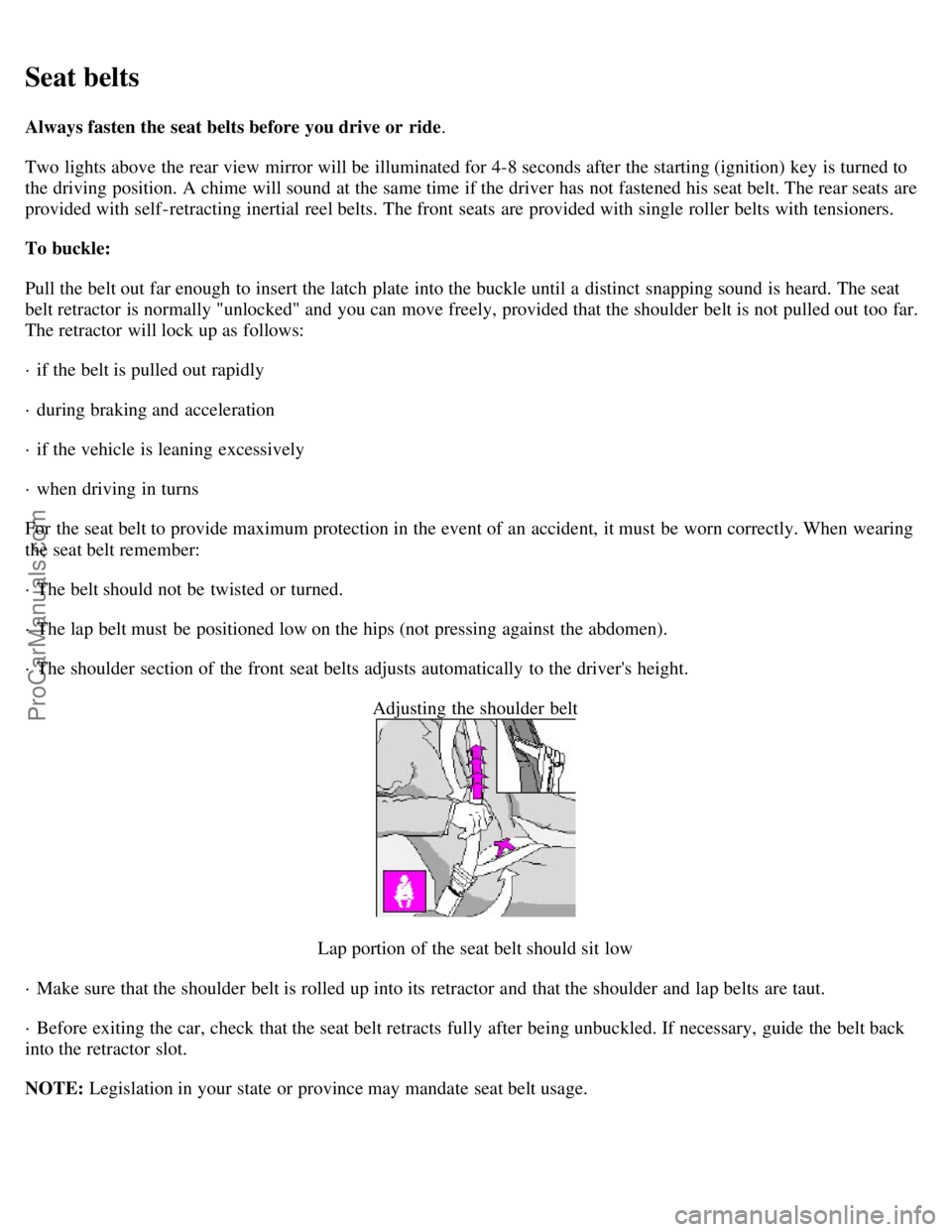
· The shoulder section of the front seat belts adjusts automatically to the driver's height. Adjusting the shoulder belt
Lap portion of the seat belt should sit low
· Make sure that the shoulder belt is rolled up into its retractor and that the shoulder and lap belts are taut.
· Before exiting the car, check that the seat belt retracts fully after being unbuckled. If necessary, guide the belt back
into the retractor slot.
NOTE: Legislation in your state or province may mandate seat belt usage.
ProCarManuals.com
Page 12 of 88
Not all frontal collisions activate the SRS system. If the collision involves a nonrigid object (e.g., a snow drift or
bush), or a rigid, fixed object at a low speed, the SRS system will not necessarily deploy. Front airbags do not
normally deploy in a side impact collision, in a collision from the rear or in a rollover situation. The amount of
damage to the bodywork does not reliably indicate if the airbags should have deployed or not.
Seat belts the heart of the Volvo safety system
The heart of the Volvo safety system is the threepoint seat belt (a Volvo invention)! In order for the SRS system to
provide the protection intended, seat belts must be worn at all times by everyone in the car. The SRS system is a
supplement to the seat belts.
WARNING!
If your car has been subjected to flood conditions (e.g. soaked carpeting/standing water on the floor of the vehicle)
or if your car has become flood damaged in any way, do not attempt to start the vehicle or put the key in the ignition
before disconnecting the battery (see below). This may cause airbag deployment which could result in personal
injury. Have the car towed to an authorized Volvo retailer for repairs.
Before attempting to tow the car, use the following procedure to override the shiftlock system to move the gear
selector to the neutral position.
· Disconnect the battery
· Wait at least one minute
· Insert the key in the ignition and turn it to position 1
· Press firmly on the shiftlock override button (located near the base of the gear selector).
· While holding the override button down, move the gear selector from the park position.
WARNING!
Never drive with the airbags deployed. The fact that they hang out can impair the steering of your car. Other safety
systems can also be damaged. The smoke and dust formed when the airbags are deployed can cause skin and eye
irritation in the event of prolonged exposure.
Contents | Top of Page
ProCarManuals.com
Page 13 of 88
2 0 0 2
VOLVO
S40 & V40
Chapter 2 - Instruments, switches and controls
pg. 17 Instruments, switches and controls
Instruments, switches and controls
Instruments, switches, controls etc. are described on the following pages. Instruments
18
Indicator and warning lights21
Headlights, Parking lights, Instrument illumination, Fog lights24
Turn signals, home Safe lighting, Wipers/washers25
Ignition switch/steering wheel locks, Flashers, Heated rear window/mirrors26
Trip Computer27
Dynamic Stability Assistance30
Cruise control31
Heated seats, Parking brake32
Auxiliary socket, Cupholder33
Steering wheel adjustment34
Heating, Ventilation and Air Conditioning35
Electrcaly operated windows38
pg. 18 Instruments, switches and controls
ProCarManuals.com
Page 15 of 88
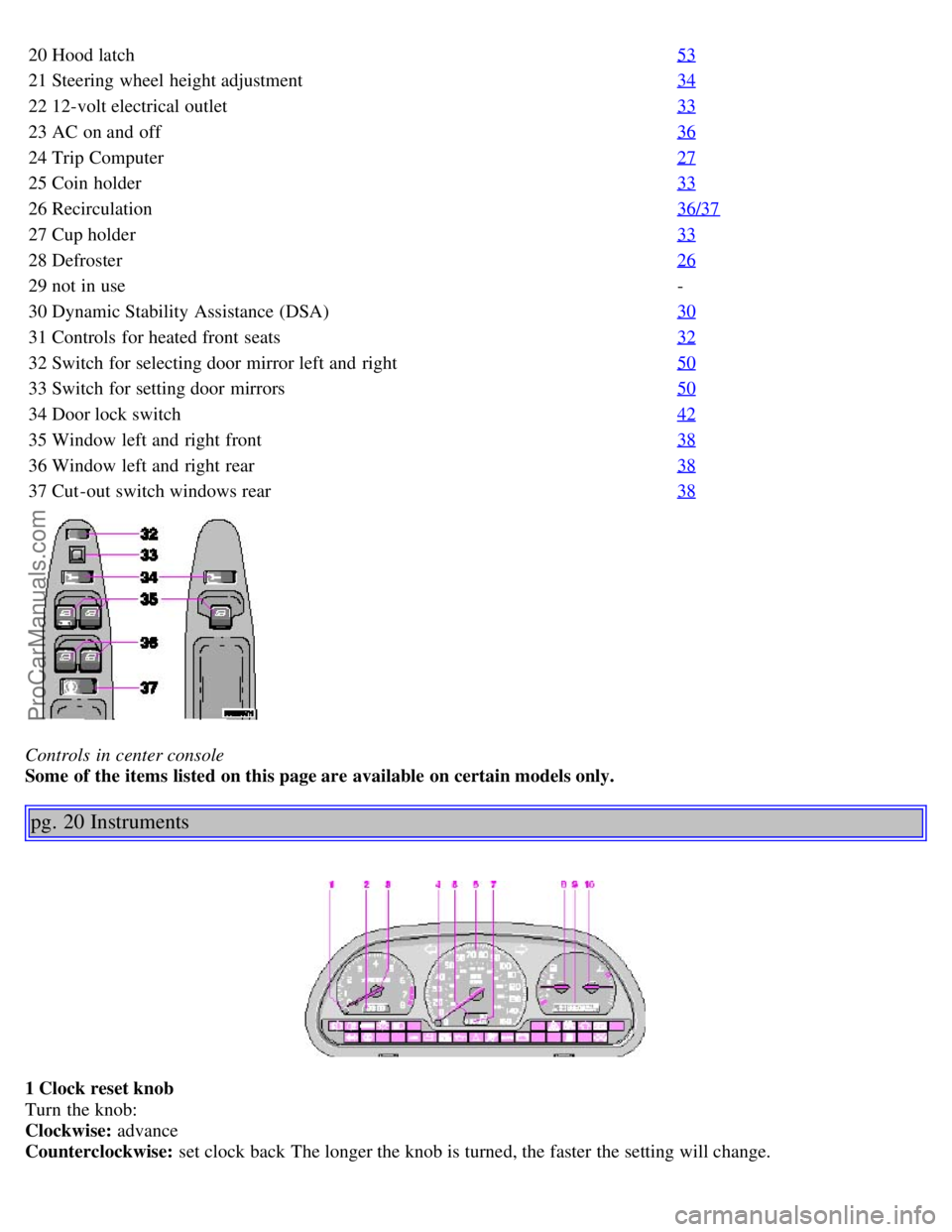
20Hood latch 53
21Steering wheel height adjustment 34
2212-volt electrical outlet 33
23AC on and off 36
24Trip Computer 27
25Coin holder 33
26Recirculation 36/37
27Cup holder 33
28Defroster 26
29not in use -
30 Dynamic Stability Assistance (DSA) 30
31Controls for heated front seats 32
32Switch for selecting door mirror left and right 50
33Switch for setting door mirrors 50
34Door lock switch 42
35Window left and right front 38
36Window left and right rear 38
37Cut -out switch windows rear 38
Controls in center console
Some of the items listed on this page are available on certain models only.
pg. 20 Instruments
1 Clock reset knob
Turn the knob:
Clockwise: advance
Counterclockwise: set clock back The longer the knob is turned, the faster the setting will change.
ProCarManuals.com
Page 16 of 88
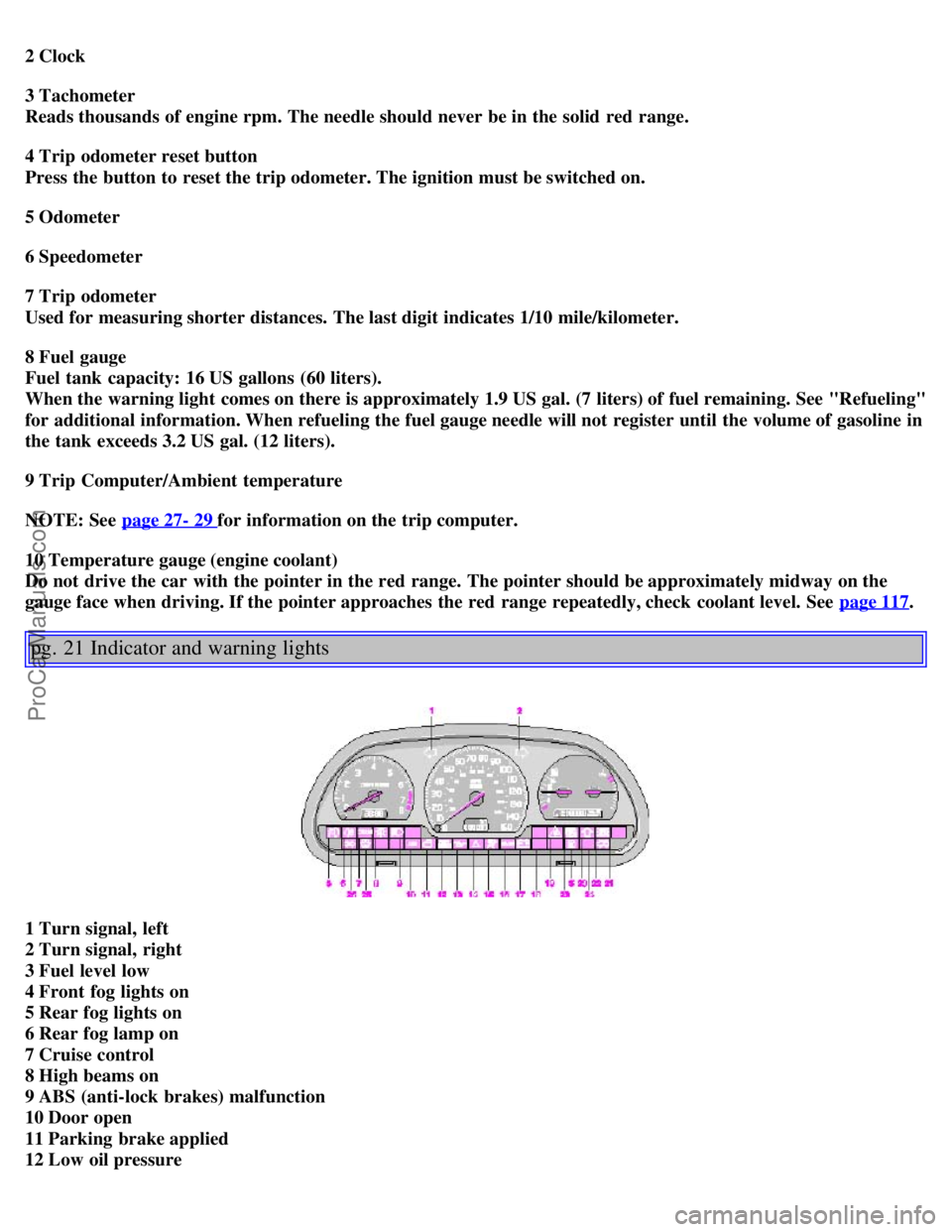
2 Clock
3 Tachometer
Reads thousands of engine rpm. The needle should never be in the solid red range.
4 Trip odometer reset button
Press the button to reset the trip odometer. The ignition must be switched on.
5 Odometer
6 Speedometer
7 Trip odometer
Used for measuring shorter distances. The last digit indicates 1/10 mile/kilometer.
8 Fuel gauge
Fuel tank capacity: 16 US gallons (60 liters).
When the warning light comes on there is approximately 1.9 US gal. (7 liters) of fuel remaining. See "Refueling"
for additional information. When refueling the fuel gauge needle will not register until the volume of gasoline in
the tank exceeds 3.2 US gal. (12 liters).
9 Trip Computer/Ambient temperature
NOTE: See page 27- 29
for information on the trip computer.
10 Temperature gauge (engine coolant)
Do not drive the car with the pointer in the red range. The pointer should be approximately midway on the
gauge face when driving. If the pointer approaches the red range repeatedly, check coolant level. See page 117
.
pg. 21 Indicator and warning lights
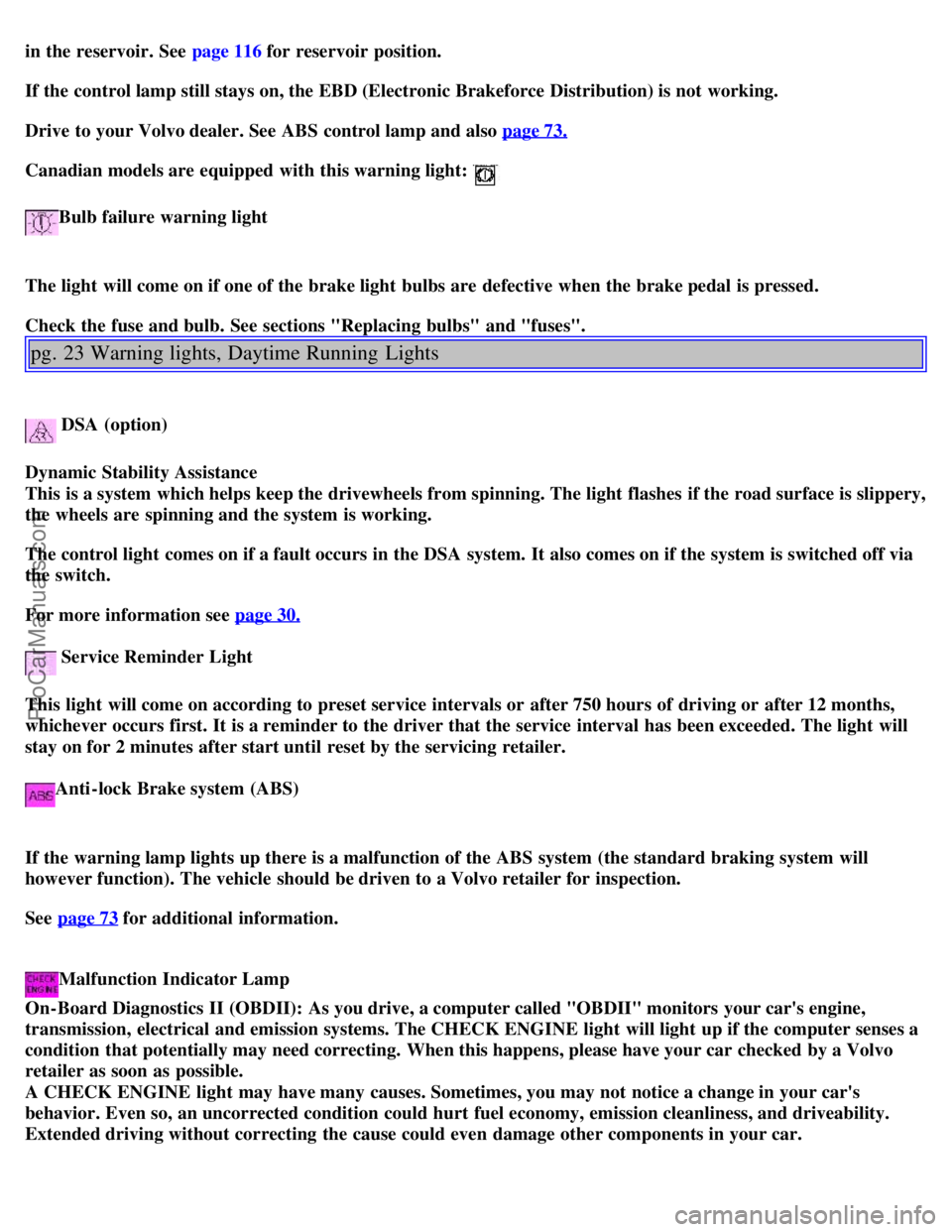
1 Turn signal, left
2 Turn signal, right
3 Fuel level low
4 Front fog lights on
5 Rear fog lights on
6 Rear fog lamp on
7 Cruise control
8 High beams on
9 ABS (anti-lock brakes) malfunction
10 Door open
11 Parking brake applied
12 Low oil pressure
ProCarManuals.com
Page 18 of 88
in the reservoir. See page 116 for reservoir position.
If the control lamp still stays on, the EBD (Electronic Brakeforce Distribution) is not working.
Drive to your Volvo dealer. See ABS control lamp and also page 73.
Canadian models are equipped with this warning light:
Bulb failure warning light
The light will come on if one of the brake light bulbs are defective when the brake pedal is pressed.
Check the fuse and bulb. See sections "Replacing bulbs" and "fuses".
pg. 23 Warning lights, Daytime Running Lights
DSA (option)
Dynamic Stability Assistance
This is a system which helps keep the drivewheels from spinning. The light flashes if the road surface is slippery,
the wheels are spinning and the system is working.
The control light comes on if a fault occurs in the DSA system. It also comes on if the system is switched off via
the switch.
For more information see page 30.
Service Reminder Light
This light will come on according to preset service intervals or after 750 hours of driving or after 12 months,
whichever occurs first. It is a reminder to the driver that the service interval has been exceeded. The light will
stay on for 2 minutes after start until reset by the servicing retailer.
Anti-lock Brake system (ABS)
If the warning lamp lights up there is a malfunction of the ABS system (the standard braking system will
however function). The vehicle should be driven to a Volvo retailer for inspection.
See page 73
for additional information.
Malfunction Indicator Lamp
On-Board Diagnostics II (OBDII): As you drive, a computer called "OBDII" monitors your car's engine,
transmission, electrical and emission systems. The CHECK ENGINE light will light up if the computer senses a
condition that potentially may need correcting. When this happens, please have your car checked by a Volvo
retailer as soon as possible.
A CHECK ENGINE light may have many causes. Sometimes, you may not notice a change in your car's
behavior. Even so, an uncorrected condition could hurt fuel economy, emission cleanliness, and driveability.
Extended driving without correcting the cause could even damage other components in your car.
ProCarManuals.com
Page 23 of 88

2 0 0 2
VOLVO
S40 & V40
Chapter 3 - Body and interior
pg. 39 Body and interior
Body and interior
The seats, sun roof, mirrors, etc. are described on the following pages. Keys
40
Remote keyless entry system41
Doors and locks42
Alarm43
Trunk/Tailgate/Glove compartment45
Opening the trunk from the inside (S40)46
Front seats47
Child safety locks49
Rear/side view mirrors/Vanity mirrors50
Interior lights, Sunroof51
Sunroof52
Hood/Luggage cover53
Storage compartments54
Folding rear seat55
Securing carge56
Cargo space/Trunk light, Spare tire, Jack57
Side cargo net, Cargo net58
Weight distribution, Handling, Roadholding, Roof rack59
pg. 40 Keys
ProCarManuals.com
Page 24 of 88

Key
The key activates all locks (ignition switch/steering wheel lock, all doors including the fuel filler door, trunk/tailgate,
and the glove compartment).
Immobilizer (start inhibitor)
Each of the keys supplied with your car is electronically coded. When the key is inserted into the ignition switch, the
code is transmitted to and compared with a code stored in the start inhibitor module. The car can only be started if a
properly coded key is used.
If you misplace a key, take the other keys to an authorized Volvo retailer. The existing code in the start inhibitor
module and all the keys will be erased as an antitheft measure and a new code will be programmed in.
NOTE:
You should never keep more than one of your ignition keys on the ring at the same time. This could cause conflicting
signals to be transmitted to the ignition switch, making it impossible to start the car.
This device complies with part 15 of the FCC rules. Operation is subject to the following condition: (1) This device
may not cause harmful interference, and (2) this device must accept any interference received, including interference
that may cause undesired operation.
pg. 41 Remote keyless entry system
Remote keyless entry system
Your car is equipped with a remote control transmitter. This transmitter uses a radio frequency which will allow
"keyless" entry into the passenger compartment or the trunk. You will be supplied with two coded key ring
transmitters, which will enable you to lock/unlock all doors and the trunk/tailgate and fuel filler door from a distance
of 10-15 feet (3-5 meters).
ProCarManuals.com
Page 25 of 88

The Remote also activates/deactivates the alarm system that comes standard with this car.
The car can also be locked/unlocked with the key.
Using the remote control
· Press the LOCK button once to lock all doors and trunk/tailgate.
· Press the UNLOCK button once to unlock the driver's door and the fuel filler door only. Press this button again
(within 10 seconds) to unlock other doors, trunk/tailgate.
· Press the OPEN trunk/tailgate button to unlock the tailgate/trunk.
NOTE : If only the driver's door is unlocked, the lock will automatically reengage (re-lock) and the alarm will be set
after 2 minutes unless the door has been opened.
The lock/unlock and alarm features can also be utilized by using the keys. See section: Doors and Locks on page 42.
WARNING!
Volvo does not recommend using the transmitter to lock the doors from inside the car. The alarm would be activated
and would sound when one of the doors is opened. The doors must not be locked using the remote transmitter while
the vehicle is occupied. In case of an accident, this may hinder rapid access to the occupants of the vehicle.
Remote control not functioning.
If the remote control is not functioning the car can be started as follows:
Open the driver's door with the key.
Note: The remote control will not function if a key is left in the ignition switch.
FCC ID:LQNP2T-APU
This device complies with part 15 of the FCC rules. Operation is subject to the following conditions: (1) This device
may not cause harmful interference, and (2) this device must accept any interference received, including interference
that may cause undesired operation.
Canadian 2306104388
Model 504 2927 by Donnelly Operation is subject to the following conditions: (1) this device may not cause
interference, and (2) this device must accept any interference, including interference that may cause undesired
operation of the device
Canadian 2306104388A
Model 509 977 by Connaught Electronics Operation is subject to the following conditions: (1) this device may not
cause interference, and (2) this device must accept any interference, including interference that may cause undesired
operation of the device
pg. 42 Doors and locks
Doors and locks
ProCarManuals.com