transmission VOLVO V50 2009 Owner´s Manual
[x] Cancel search | Manufacturer: VOLVO, Model Year: 2009, Model line: V50, Model: VOLVO V50 2009Pages: 286, PDF Size: 7.12 MB
Page 160 of 286
06 Starting and drivingTowing a trailer
06160
General information•
Volvo recommends the use of Volvo trailer
hitches that are specially designed for the
vehicle.CAUTION
Models equipped with the B5244S7 engine
(engine code 39 , which is the 6th and
7th digits from the left in your vehicle's VIN
number, see page 262 for the location of
the VIN plate), may not be used to tow trail-
ers or vehicles of any kind. This could cause
damage to the vehicle's emission control
systems.Maximum trailer weights recommended by
Volvo are:•
Trailers without brakes: 1,540 lbs
(700 kg).
•
Trailers with brakes: 2,000 lbs (900 kg)
Observe the legal requirements of the
state/province in which the vehicles are
registered.
•
The maximum recommended hitch
tongue load is 165 lbs (75 kg).
•
All Volvo models are equipped with
energy-absorbing shock-mounted bump-
ers. Trailer hitch installation should not
interfere with the proper operation of this
bumper system.Trailer towing does not normally present any
particular problems, but take into considera-
tion:
•
Increase tire pressure to recommended
full. See the chapter "Wheels and tires."
•
When your vehicle is new, avoid towing
heavy trailers during the first 620 miles
(1,000 km).
•
Maximum speed when towing a trailer:
50 mph (80 km/h).
•
Engine and transmission are subject to
increased loads. Therefore, engine coolant
temperature should be closely watched
when driving in hot climates or hilly terrain.
Use a lower gear and turn off the air con-
ditioner if the temperature gauge needle
enters the red range.
•
If the automatic transmission begins to
overheat, a message will be displayed in
the information display.
•
Avoid overload and other abusive opera-
tion.
•
Hauling a trailer affects handling, durabil-
ity, and economy.
•
It is necessary to balance trailer brakes
with the towing vehicle brakes to provide a
safe stop (check and observe state/local
regulations).
•
Do not connect the trailer's brake system
directly to the vehicle's brake system.
•
More frequent vehicle maintenance is
required.
•
Remove the ball and drawbar assembly
when the hitch is not being used.
•
Volvo recommends the use of synthetic
engine oil when towing a trailer over long
distances or in mountainous areas.WARNING
•
Bumper-attached trailer hitches must
not be used on Volvos, nor should
safety chains be attached to the
bumper.
•
Trailer hitches attaching to the vehicle's
rear axle must not be used.
•
Never connect a trailer's hydraulic
brake system directly to the vehicle
brake system, nor a trailer's lighting
system directly to the vehicle lighting
system. Consult your nearest trained
and qualified Volvo service technician
for correct installation.
•
When towing a trailer, the trailer's safety
wire must be correctly fastened to the
hole or hook provided in the trailer hitch
on the vehicle. The safety wire should
never be fastened to or wound around
the drawbar ball.
Page 161 of 286
06 Starting and driving
Towing a trailer
06
161
NOTE
•
When parking the vehicle with a trailer
on a hill, apply the parking brake before
putting the gear selector in Park (P) or
in reverse on models with a manual
transmission. Always follow the trailer
manufacturer's recommendations for
wheel chocking.
•
If you use the manual (Geartronic) shift
positions while towing a trailer, or if the
vehicle is equipped with a manual trans-
mission, make sure the gear you select
does not put too much strain on the
engine (using too high a gear).
•
The drawbar assembly/trailer hitch may
be rated for trailers heavier than the
vehicle is designed to tow. Please
adhere to Volvo's recommended trailer
weights.
•
Avoid driving with a trailer on inclines
exceeding 15%.
Page 187 of 286
07 Wheels and tires
Temporary spare
07
187 Temporary spare
The spare tire in your car is called a "Temporary
Spare".
Recommended tire pressure (see the placard
on the B-pillar or on the fuel filler door) should
be maintained irrespective of which position on
the car the temporary spare tire is used on.
In the event of damage to this tire, a new one
can be purchased from your Volvo retailer.
WARNING
Current legislation prohibits the use of the
"Temporary Spare" tire other than as a tem-
porary replacement for a punctured tire. It
must be replaced as soon as possible by a
standard tire. Road holding and handling
may be affected with the "Temporary
Spare" in use. Do not exceed a speed of
50 mph (80 km/h) with the "Temporary
Spare" in use.
CAUTION
The car must not be driven with wheels of
different dimensions or with a spare tire
other than the one that came with the car.
The use of different size wheels can seri-
ously damage your car's transmission.
Page 190 of 286
07 Wheels and tiresChanging a wheel
07190
Changing a wheel
G020331
The spare tire, jack, and crank are located
under the carpet on the floor of the cargo area.
To change a tire:
1. Apply the parking brake.
2.
Put the gear selector in Park (P) or reverse
on models with a manual transmission.
3. Block the wheels that are on the ground
with wooden blocks or large stones.
4. Remove the wheel cap (where applicable)
using the lug wrench in the tool bag.
G020332
5. With the car still on the ground, use the lug
wrench to loosen the wheel nuts 1/2–1 turn
by exerting downward pressure. Turn the
nuts counterclockwise to loosen.
6. There are two jack attachment points on
each side of the car. Position the jack cor-
rectly in the attachment (see the illustration)
and crank while simultaneously guiding the
base of the jack to the ground. The base of
the jack must be flat on a level, firm, non-
slippery surface. Before raising the car,
check that the jack is still correctly posi-
tioned in the attachment.
G024531
Jack attachment points7. Raise the vehicle until the wheel to be
changed is lifted off the ground.
8. Unscrew the wheel nuts completely and
carefully remove the wheel so as not to
damage the threads on the studs.
Page 232 of 286
09 Maintenance and servicingFuses
09232
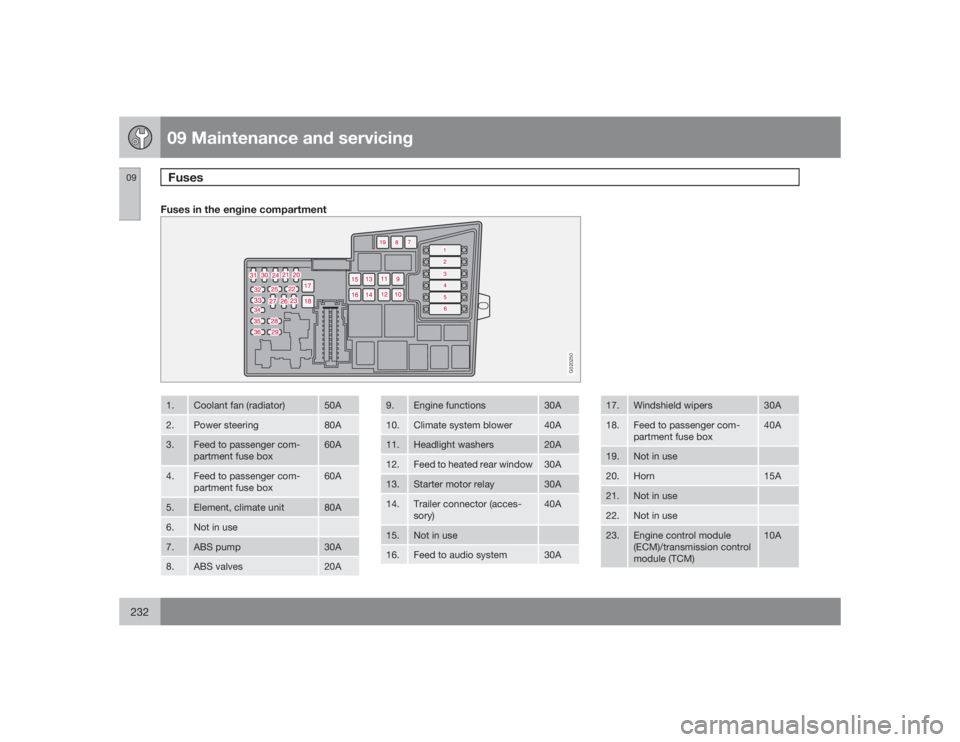
Fuses in the engine compartment
G020250
1.
Coolant fan (radiator)
50A
2.
Power steering
80A
3.
Feed to passenger com-
partment fuse box
60A
4.
Feed to passenger com-
partment fuse box
60A
5.
Element, climate unit
80A
6.
Not in use
7.
ABS pump
30A
8.
ABS valves
20A
9.
Engine functions
30A
10.
Climate system blower
40A
11.
Headlight washers
20A
12.
Feed to heated rear window
30A
13.
Starter motor relay
30A
14.
Trailer connector (acces-
sory)
40A
15.
Not in use
16.
Feed to audio system
30A
17.
Windshield wipers
30A
18.
Feed to passenger com-
partment fuse box
40A
19.
Not in use
20.
Horn
15A
21.
Not in use
22.
Not in use
23.
Engine control module
(ECM)/transmission control
module (TCM)
10A
Page 235 of 286

09 Maintenance and servicing
Fuses
09``235
Fuses in the passenger compartment
G020246
37.
Not in use
38.
Not in use
39.
Not in use
40.
Not in use
41.
Not in use
42.
Not in use
43.
Audio system, Volvo Navi-
gation system (option)
15A
44.
Supplemental Restrain Sys-
tem (SRS), engine control
module
10A
45.
12-volt socket in rear seat
15A
46.
Lighting – glove compart-
ment, instrument panel, and
footwells
5A
47.
Interior lighting
5A
48.
Tailgate window wiper/
washer
15A
49.
Supplemental Restrain Sys-
tem (SRS), Occupant
Weight Sensor (OWS)
10A
50.
Not in use
51.
AWD, fuel filter relay
10A
52.
Transmission control mod-
ule (TCM), ABS
5A
53.
Power steering
10A
54.
Park assist (option) Bi-
Xenon
Ÿ headlights (option)
10A
55.
Not in use
Page 267 of 286
11 Specifications
Fuel, oils, and fluids
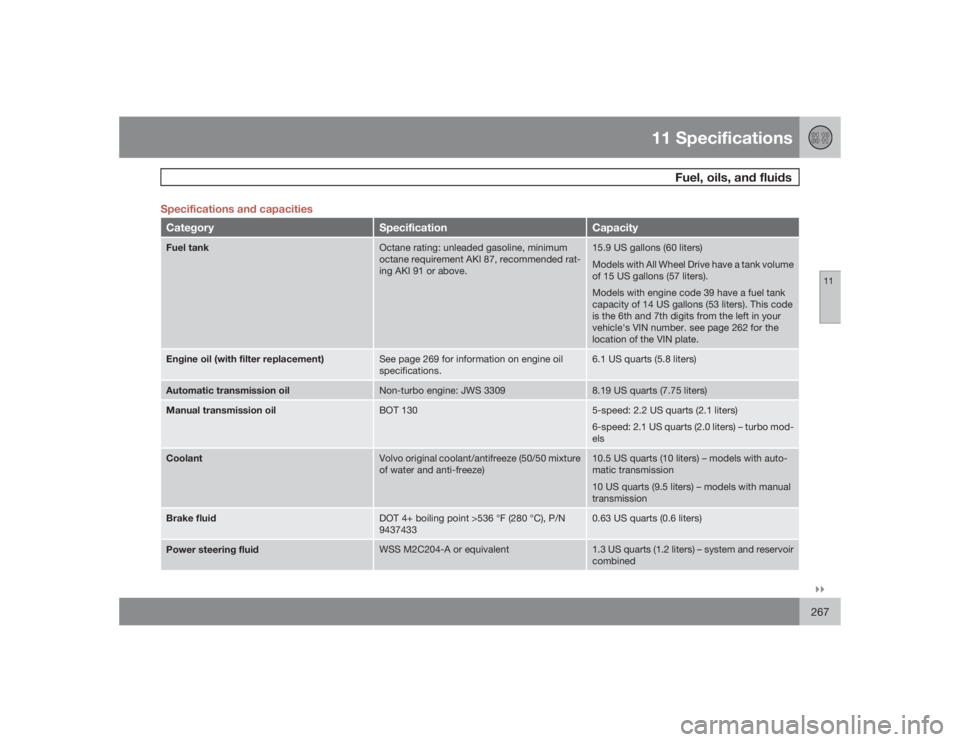
11``267 Specifications and capacities
Category
Specification
Capacity
Fuel tank
Octane rating: unleaded gasoline, minimum
octane requirement AKI 87, recommended rat-
ing AKI 91 or above.
15.9 US gallons (60 liters)
Models with All Wheel Drive have a tank volume
of 15 US gallons (57 liters).
Models with engine code 39 have a fuel tank
capacity of 14 US gallons (53 liters). This code
is the 6th and 7th digits from the left in your
vehicle's VIN number. see page 262 for the
location of the VIN plate.
Engine oil (with filter replacement)
See page 269 for information on engine oil
specifications.
6.1 US quarts (5.8 liters)
Automatic transmission oil
Non-turbo engine: JWS 3309
8.19 US quarts (7.75 liters)
Manual transmission oil
BOT 130
5-speed: 2.2 US quarts (2.1 liters)
6-speed: 2.1 US quarts (2.0 liters) – turbo mod-
els
Coolant
Volvo original coolant/antifreeze (50/50 mixture
of water and anti-freeze)
10.5 US quarts (10 liters) – models with auto-
matic transmission
10 US quarts (9.5 liters) – models with manual
transmission
Brake fluid
DOT 4+ boiling point >536 °F (280 °C), P/N
9437433
0.63 US quarts (0.6 liters)
Power steering fluid
WSS M2C204-A or equivalent
1.3 US quarts (1.2 liters) – system and reservoir
combined
Page 268 of 286
11 SpecificationsFuel, oils, and fluids
11268
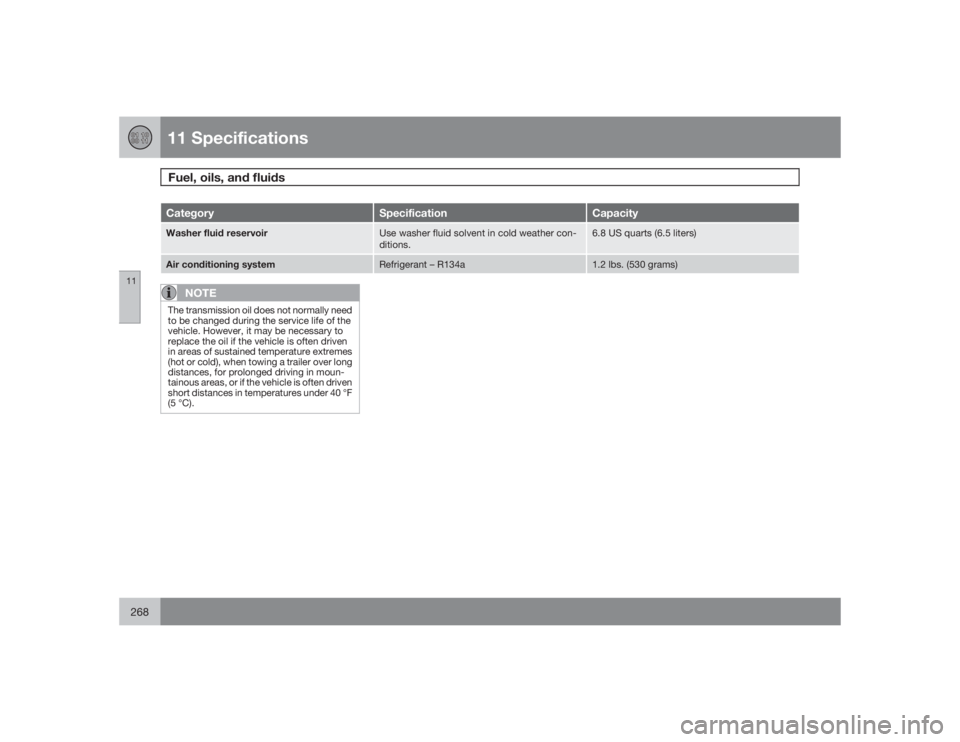
Category
Specification
Capacity
Washer fluid reservoir
Use washer fluid solvent in cold weather con-
ditions.
6.8 US quarts (6.5 liters)
Air conditioning system
Refrigerant – R134a
1.2 lbs. (530 grams)
NOTE
The transmission oil does not normally need
to be changed during the service life of the
vehicle. However, it may be necessary to
replace the oil if the vehicle is often driven
in areas of sustained temperature extremes
(hot or cold), when towing a trailer over long
distances, for prolonged driving in moun-
tainous areas, or if the vehicle is often driven
short distances in temperatures under 40 °F
(5 °C).
Page 276 of 286

12 Index
12276
1, 2, 3 ...12-volt sockets.......................................... 60AA/C (air conditioning)................................. 90
ABS (anti-lock brake system).................. 153
Active Bi-Xenon headlights........................ 61
Airbags
front...................................................... 22
inflatable curtain................................... 30
side impact........................................... 29
Airbag system............................................ 22
Air conditioning.......................................... 90
Air distribution table................................... 99
Air vents..................................................... 92
Alarm system........................................... 130
turning off sensors.............................. 131
All Wheel Drive......................................... 152
Anti-lock Brake System (ABS)................. 153
Approach lighting....................................... 83
Audio files................................................ 250Audio system
audio functions................................... 240
automatic sound control..................... 243
AUX port............................................. 240
CD changer......................................... 249
CD player/changer.............................. 249
compact disc care.............................. 251
Dolby Surround Pro Logic II............... 243
equalizer............................................. 243
menu settings..................................... 253
radio functions.................................... 244
selecting a sound source.................... 240
Sirius satellite radio............................ 245
sound settings.................................... 242
steering wheel keypad........................ 241
storing radio stations.......................... 244
subwoofer...........................................242
USB/iPOD connector.......................... 241
Auto-dim rearview mirror........................... 77
Autolock..................................................... 82
Automatic locking retractor....................... 35
Automatic sound control.........................243
Automatic transmission........................... 149
kickdown............................................ 150
oil........................................................ 267
shiftlock override................................ 151
Automatic transmission - Geartronic....... 150AUX port.................................................. 240
Axle weight......................................183, 265
BBackrest, rear seat, folding...................... 111
Bass......................................................... 242
Battery
maintenance....................................... 221
remote control, replacing................... 120
specifications...................................... 272
warning symbols................................. 221
Battery – replacing................................... 221
Bi-Xenon headlights.................................. 61
Black Box (Vehicle Event Data)............... 210
Blind Spot Information System (BLIS)..... 164
Booster cushion
accessory............................................. 41
Brake fluid........................................ 219, 267
Brake lights................................................ 62
Brake system
anti-lock brakes (ABS)........................ 153
emergency brake assistance.............. 154
Page 280 of 286
12 Index
12280
Long distance trips.................................. 138
Lug nuts (wheel nuts)............................... 188MMaintenance............................................ 210
performed by the owner.....................212
Manual climate control.............................. 93
Manual transmission........................ 147, 148
Mirrors.................................................. 77, 78
Model plate.............................................. 263
Moonroof................................................... 80
Motor oil........................................... 216, 269
checking............................................. 216NNet in cargo area.............................114, 115OOccupant safety........................................ 16
Occupant weight sensor............................ 26Octane recommendations.......................140
Oil............................................................. 216
changing............................................. 216
checking............................................. 216
On Call Roadside Assistance.................. 275
Opening the hood.................................... 214
Owner maintenance................................. 212
PPanel lighting, instrument.......................... 62
Park assist............................................... 168
Parking brake............................................. 74
Parking lights............................................. 61
Passenger’s side front airbag, disabling. . . 26
Periodic owner-performed maintenance. 212
Permissible axle weight........................... 183
Personal settings....................................... 82
Power door mirrors.................................... 78
Power front seat...................................... 103
memory function................................. 103
Power moonroof........................................ 80
Power steering fluid................................. 219Power windows......................................... 75
Pregnancy, using seat belts during........... 19
RRadio
Sirius satellite radio............................ 245
Radio functions........................................ 244
Rain sensor - windshield wipers................ 71
Rear fog light............................................. 62
Rear park assist....................................... 168
Rear seat backrests, folding down.......... 111
Rear seats
center head restraint........................... 111
Rearview mirror.......................................... 77
auto-dim function................................. 77
Rearview mirror with compass (option)..... 77
Recalls, child restraints.............................. 45
Refrigerant (A/C system).................... 90, 267
Refueling.................................................. 142
fuel tank volume.................................267
Registering child restraints........................ 45
Remote control........................................ 118
battery replacement............................ 120