weight VOLVO V50 2009 Owner´s Manual
[x] Cancel search | Manufacturer: VOLVO, Model Year: 2009, Model line: V50, Model: VOLVO V50 2009Pages: 286, PDF Size: 7.12 MB
Page 163 of 286
06 Starting and driving
Transporting loads
06
163 Loading the vehicle
Your vehicle's load-carrying capacity is affec-
ted by factors such as:•
the number of passengers
•
tire inflation
•
the amount of optional or accessory equip-
ment installed
•
the amount of cargo.
See the chapter "Wheels and tires" for more
detailed information.
Before loading the car, turn off the engine, and
apply the parking brake when loading or
unloading long objects. The gear selector can
be inadvertently knocked out of position by
long cargo, causing the car to move.
Keep the following in mind when
loading the vehicle:•
Load objects in the cargo area against the
rear seat backrest.
•
Load heavy cargo as low as possible.
•
Center wide loads.
•
Secure all cargo with restraining straps
anchored to the load securing eyelets.
•
Cover sharp edges on the load.
•
Seats can be folded down and head
restraints removed to extend the cargo
compartment, see page 111.
WARNING
•
Remember that an object weighing
44 lbs (20 kg) produces a force of
2,200 lbs (1,000 kg) in a head-on colli-
sion at 30 mph (50 km/h)!
•
When the rear backrest(s) are folded
down, the vehicle should not be loaded
to a level higher than 2 in. (5 cm) below
the upper edge of the rear side win-
dows. Objects placed higher than this
level could impede the function of the
Volvo Inflatable Curtain.
Load carriers (accessory)Load carriers are available as Volvo accesso-
ries. Follow the installation instructions sup-
plied with the load carriers.
Observe the following points when using load
carriers:•
To avoid damaging your car and to achieve
maximum safety when driving, we recom-
mend using the load carriers that Volvo has
developed especially for your car.
•
Volvo-approved removable roof racks are
designed to carry the maximum allowable
roof load for this vehicle: 165 lbs (75 kg).
For Non-Volvo roof racks, check the man-
ufacturer's weight limits for the rack.
•
Never exceed the rack manufacturer's
weigh limits and never exceed the maxi-
mum rated roof load of 165 lbs (75 kg).
•
Avoid single-point loads. Distribute loads
evenly.
•
Place heavier cargo at the bottom of the
load.
•
Secure the cargo correctly with appropri-
ate tie-down equipment.
•
Check periodically that the load carriers
and load are properly secured.
•
Remember that the car's center of gravity
and handling change when you carry a
load on the roof.
•
The car's wind resistance and fuel con-
sumption will increase with the size of the
load.
•
Drive smoothly. Avoid rapid starts, fast
cornering and hard braking.
Page 182 of 286
07 Wheels and tiresGlossary of tire terminology
07182
Terminology•
Tire information placard: A placard
showing the OE (Original Equipment) tire
sizes, recommended inflation pressure,
and the maximum weight the vehicle can
carry.
•
Tire Identification Number (TIN): A num-
ber on the sidewall of each tire providing
information about the tire brand and man-
ufacturing plant, tire size and date of man-
ufacturer.
•
Inflation pressure: A measure of the
amount of air in a tire.
•
Standard load: A class of P-metric or Met-
ric tires designed to carry a maximum load
at 35 psi [37 psi (2.5 bar) for Metric tires].
Increasing the inflation pressure beyond
this pressure will not increase the tires load
carrying capability.
•
Extra load: A class of P-metric or Metric
tires designed to carry a heavier maximum
load at 41 psi [43 psi (2.9 bar) for Metric
tires]. Increasing the inflation pressure
beyond this pressure will not increase the
tires load carrying capability.
•
kPa: Kilopascal, a metric unit of air pres-
sure.
•
PSI: Pounds per square inch, a standard
unit of air pressure.
•
B-pillar: The structural member at the side
of the vehicle behind the front door.
•
Bead area of the tire: Area of the tire next
to the rim.
•
Sidewall of the tire: Area between the
bead area and the tread.
•
Tread area of the tire: Area of the perim-
eter of the tire that contacts the road when
mounted on the vehicle.
•
Rim: The metal support (wheel) for a tire or
a tire and tube assembly upon which the
tire beads are seated.
•
Maximum load rating: a figure indicating
the maximum load in pounds and kilo-
grams that can be carried by the tire. This
rating is established by the tire manufac-
turer.
•
Maximum permissible inflation pres-
sure: the greatest amount of air pressure
that should ever be put in the tire. This limit
is set by the tire manufacturer.
•
Recommended tire inflation pressure:
inflation pressure, established by Volvo,
which is based on the type of tires that are
mounted on a vehicle at the factory. This
inflation pressure is affected by the number
of occupants in the car, the amount of
cargo, and the speed at which the vehicle
will be driven for a prolonged period. This
information can be found on the tire infla-
tion placard(s) located on the driver's sideB-pillar or on the inside of the fuel filler door
on Canadian models, and in the tire infla-
tion table in this chapter.
•
Cold tires: The tires are considered to be
cold when they have the same temperature
as the surrounding (ambient) air. This tem-
perature is normally reached after the car
has been parked for at least 3 hours.
Properly loading your vehicle will provide maxi-
mum return of vehicle design performance.
Page 183 of 286
07 Wheels and tires
Vehicle loading
07``183 Loading the vehicle
Before loading your vehicle, familiarize yourself
with the following terms for determining your
vehicle's weight ratings, with or without a
trailer, from the vehicle's Federal/Canadian
Motor Vehicle Safety Standards (FMVSS/
CMVSS) label, and the vehicle's tire informa-
tion placard:Curb weightThe weight of the vehicle including a full tank
of fuel and all standard equipment. It does not
include passengers, cargo, or optional equip-
ment.Capacity weightAll weight added to the curb weight, including
cargo and optional equipment. When towing,
trailer hitch tongue load is also part of cargo
weight.
NOTE
For trailer towing information, please refer to
the section "Towing a trailer", see
page 160.Permissible axle weightThe maximum allowable weight that can be
carried by a single axle (front or rear). These
numbers are shown on the Federal/CanadianMotor Vehicle Safety Standards (FMVSS/
CMVSS) label. The total load on each axle must
never exceed its maximum permissible weight.
Gross vehicle weight (GVW)The vehicle's curb weight + cargo + passen-
gers.
NOTE
•
The location of the various labels in your
vehicle can be found on page 262.
•
A table listing important weight limits for
your vehicle can be found on page
265.
Steps for Determining Correct Load
Limit(1) Locate the statement "the combined weight
of occupants and cargo should never exceed
XXX pounds" on your vehicle's placard.
(2) Determine the combined weight of the driver
and passengers that will be riding in your vehi-
cle.
(3) Subtract the combined weight of the driver
and passengers from XXX kilograms or XXX
pounds.(4) The resulting figure equals the available
amount of cargo and luggage load capacity.
For example, if the "XXX" amount equals
1400 lbs. and there will be five 150 lbs. pas-
sengers in your vehicle, the amount of available
cargo and luggage load capacity is 650 lbs.
(1400–750 (5×150) = 650 lbs.)
(5) Determine the combined weight of luggage
and cargo being loaded on the vehicle. That
weight may not safely exceed the available
cargo and luggage load capacity calculated in
Step 4.
(6) If your vehicle will be towing a trailer, load
from your trailer will be transferred to your vehi-
cle. Consult this manual
1 to determine how this
reduces the available cargo and luggage load
capacity of your vehicle.
1See "Towing a trailer"
Page 184 of 286
07 Wheels and tiresVehicle loading
07184
WARNING
•
Exceeding the permissible axle weight,
gross vehicle weight, or any other
weight rating limits can cause tire over-
heating resulting in permanent defor-
mation or catastrophic failure.
•
Do not use replacement tires with lower
load carrying capacities than the tires
that were original equipment on the
vehicle because this will lower the vehi-
cle's GVW rating. Replacement tires
with a higher limit than the originals do
not increase the vehicle's GVW rating
limitations.
Page 235 of 286

09 Maintenance and servicing
Fuses
09``235
Fuses in the passenger compartment
G020246
37.
Not in use
38.
Not in use
39.
Not in use
40.
Not in use
41.
Not in use
42.
Not in use
43.
Audio system, Volvo Navi-
gation system (option)
15A
44.
Supplemental Restrain Sys-
tem (SRS), engine control
module
10A
45.
12-volt socket in rear seat
15A
46.
Lighting – glove compart-
ment, instrument panel, and
footwells
5A
47.
Interior lighting
5A
48.
Tailgate window wiper/
washer
15A
49.
Supplemental Restrain Sys-
tem (SRS), Occupant
Weight Sensor (OWS)
10A
50.
Not in use
51.
AWD, fuel filter relay
10A
52.
Transmission control mod-
ule (TCM), ABS
5A
53.
Power steering
10A
54.
Park assist (option) Bi-
Xenon
Ÿ headlights (option)
10A
55.
Not in use
Page 260 of 286

G000000
260
Label information.................................................................................. 262
Dimensions and weights....................................................................... 264
Fuel, oils, and fluids..............................................................................267
Engine oil............................................................................................... 269
Engine specifications............................................................................ 270
Electrical system................................................................................... 272
Three-way catalytic converter............................................................... 274
Volvo programs..................................................................................... 275
Page 264 of 286
11 SpecificationsDimensions and weights
11264
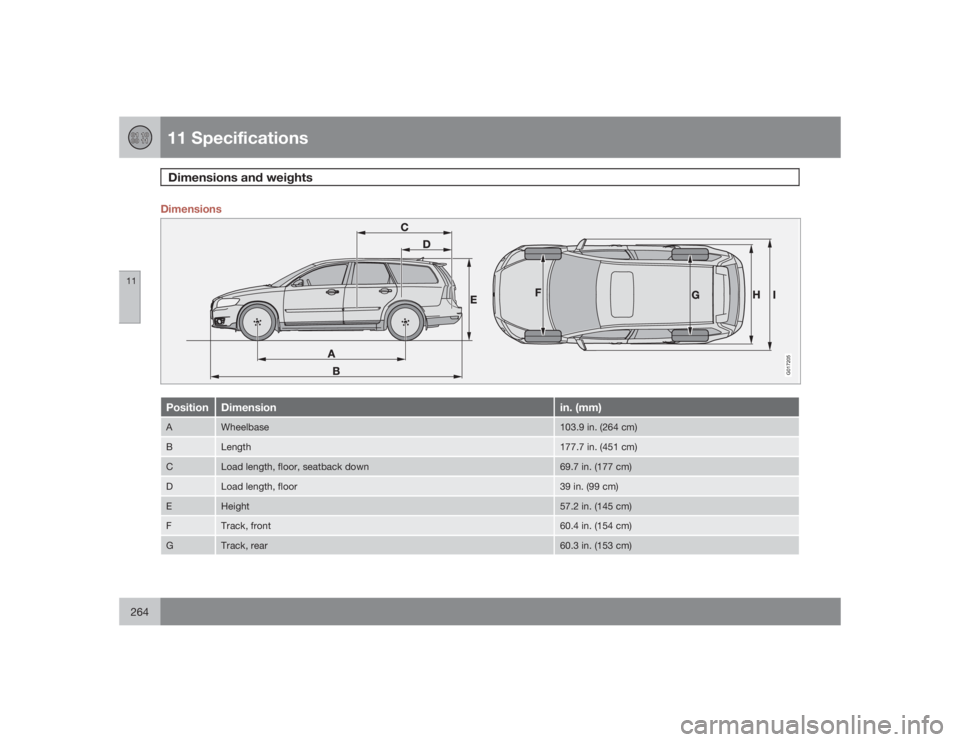
Dimensions
G017205
Position
Dimension
in. (mm)
A
Wheelbase
103.9 in. (264 cm)
B
Length
177.7 in. (451 cm)
C
Load length, floor, seatback down
69.7 in. (177 cm)
D
Load length, floor
39 in. (99 cm)
E
Height
57.2 in. (145 cm)
F
Track, front
60.4 in. (154 cm)
G
Track, rear
60.3 in. (153 cm)
Page 265 of 286
11 SpecificationsDimensions and weights
11``265
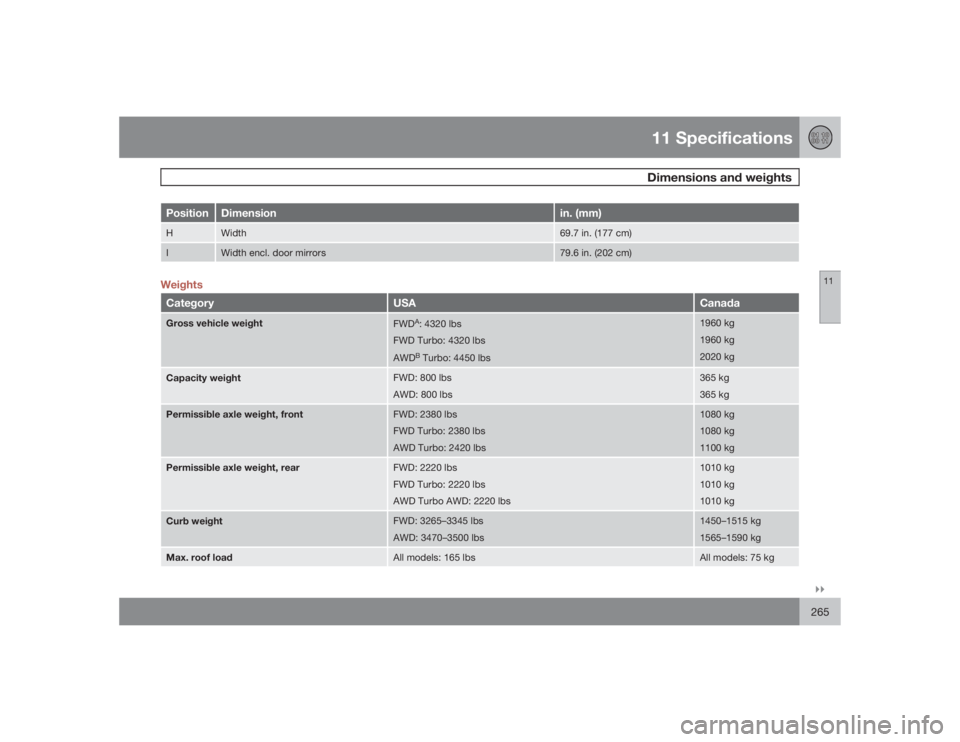
Position
Dimension
in. (mm)
H
Width
69.7 in. (177 cm)
I
Width encl. door mirrors
79.6 in. (202 cm)
WeightsCategory
USA
Canada
Gross vehicle weight
FWD
A: 4320 lbs
FWD Turbo: 4320 lbs
AWDB Turbo: 4450 lbs
1960 kg
1960 kg
2020 kg
Capacity weight
FWD: 800 lbs
AWD: 800 lbs
365 kg
365 kg
Permissible axle weight, front
FWD: 2380 lbs
FWD Turbo: 2380 lbs
AWD Turbo: 2420 lbs
1080 kg
1080 kg
1100 kg
Permissible axle weight, rear
FWD: 2220 lbs
FWD Turbo: 2220 lbs
AWD Turbo AWD: 2220 lbs
1010 kg
1010 kg
1010 kg
Curb weight
FWD: 3265–3345 lbs
AWD: 3470–3500 lbs
1450–1515 kg
1565–1590 kg
Max. roof load
All models: 165 lbs
All models: 75 kg
Page 266 of 286
11 SpecificationsDimensions and weights
11266
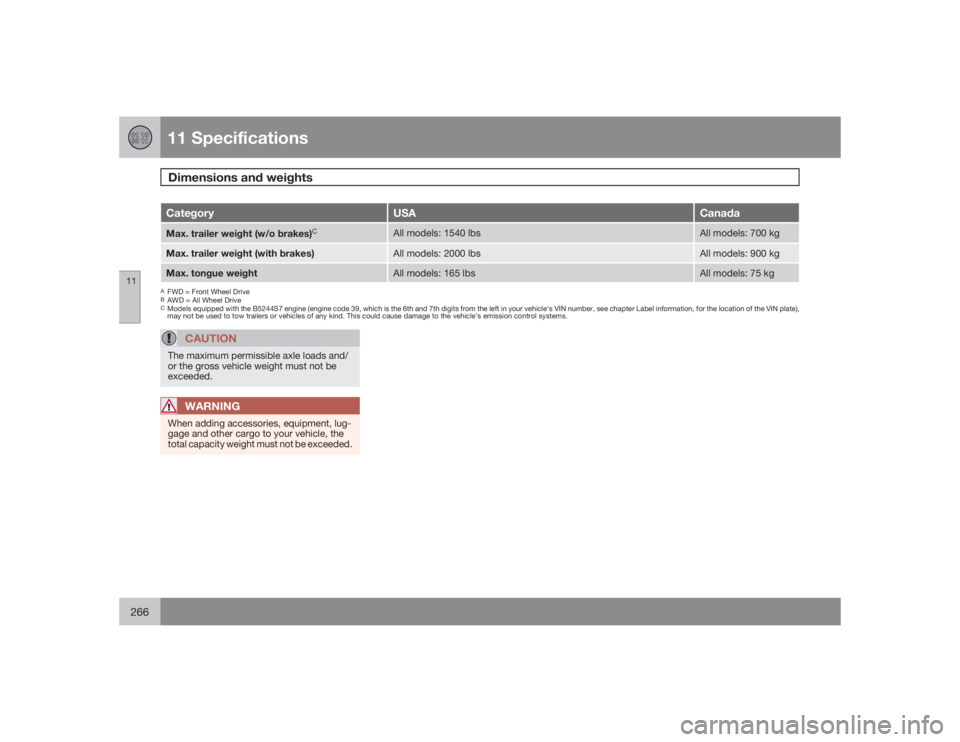
Category
USA
Canada
Max. trailer weight (w/o brakes)
C
All models: 1540 lbs
All models: 700 kg
Max. trailer weight (with brakes)
All models: 2000 lbs
All models: 900 kg
Max. tongue weight
All models: 165 lbs
All models: 75 kg
AFWD = Front Wheel DriveBAWD = All Wheel DriveCModels equipped with the B5244S7 engine (engine code 39, which is the 6th and 7th digits from the left in your vehicle's VIN number, see chapter Label information, for the location of the VIN plate),
may not be used to tow trailers or vehicles of any kind. This could cause damage to the vehicle's emission control systems.
CAUTION
The maximum permissible axle loads and/
or the gross vehicle weight must not be
exceeded.
WARNING
When adding accessories, equipment, lug-
gage and other cargo to your vehicle, the
total capacity weight must not be exceeded.
Page 269 of 286
11 Specifications
Engine oil
11
269 Oil specifications
Engine oil must meet the minimum ILSAC
specification GF-4, API SL, or ACEA A1/B1.
Lower quality oils may not offer the same fuel
economy, engine performance, or engine pro-
tection.
Volume: 6.1 US qts (5.8 liters).
Volume between the MIN and Max marks on
the dipstick: approximately 1.4 US qts (1.3 lit-
ers).
Volvo recommends Castrol.
Depending on your driving habits, premium or
synthetic oils may provide superior fuel econ-
omy and engine protection. Consult your Volvo
retailer or a trained and qualified Volvo service
technician for recommendations on premium
or synthetic oils.
Oil additives must not be used.
NOTE
Synthetic oil is not used when the oil is
changed at the normal service intervals.
This oil is only used at customer request, at
additional charge. Please consult a trained
and qualified Volvo service technician.
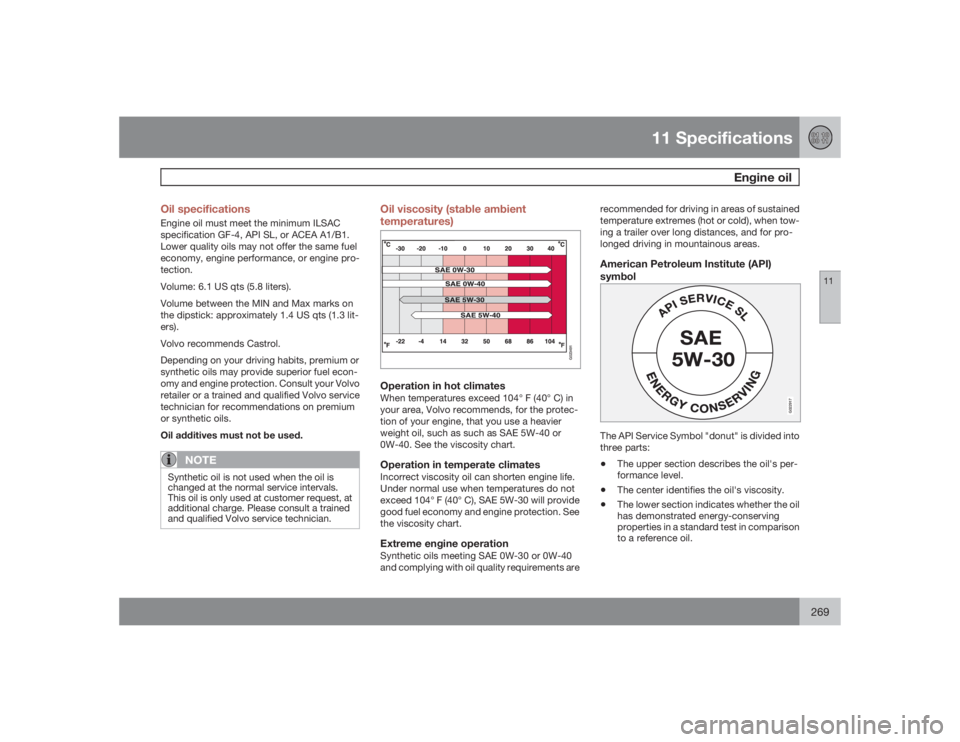
Oil viscosity (stable ambient
temperatures)
G023491
Operation in hot climatesWhen temperatures exceed 104° F (40° C) in
your area, Volvo recommends, for the protec-
tion of your engine, that you use a heavier
weight oil, such as such as SAE 5W-40 or
0W-40. See the viscosity chart.Operation in temperate climatesIncorrect viscosity oil can shorten engine life.
Under normal use when temperatures do not
exceed 104° F (40° C), SAE 5W-30 will provide
good fuel economy and engine protection. See
the viscosity chart.Extreme engine operationSynthetic oils meeting SAE 0W-30 or 0W-40
and complying with oil quality requirements arerecommended for driving in areas of sustained
temperature extremes (hot or cold), when tow-
ing a trailer over long distances, and for pro-
longed driving in mountainous areas.
American Petroleum Institute (API)
symbol
G022917
The API Service Symbol "donut" is divided into
three parts:•
The upper section describes the oil's per-
formance level.
•
The center identifies the oil's viscosity.
•
The lower section indicates whether the oil
has demonstrated energy-conserving
properties in a standard test in comparison
to a reference oil.