ignition VOLVO V50 2009 Owner´s Manual
[x] Cancel search | Manufacturer: VOLVO, Model Year: 2009, Model line: V50, Model: VOLVO V50 2009Pages: 286, PDF Size: 7.12 MB
Page 159 of 286
06 Starting and driving
Jump starting
06
159
G020298
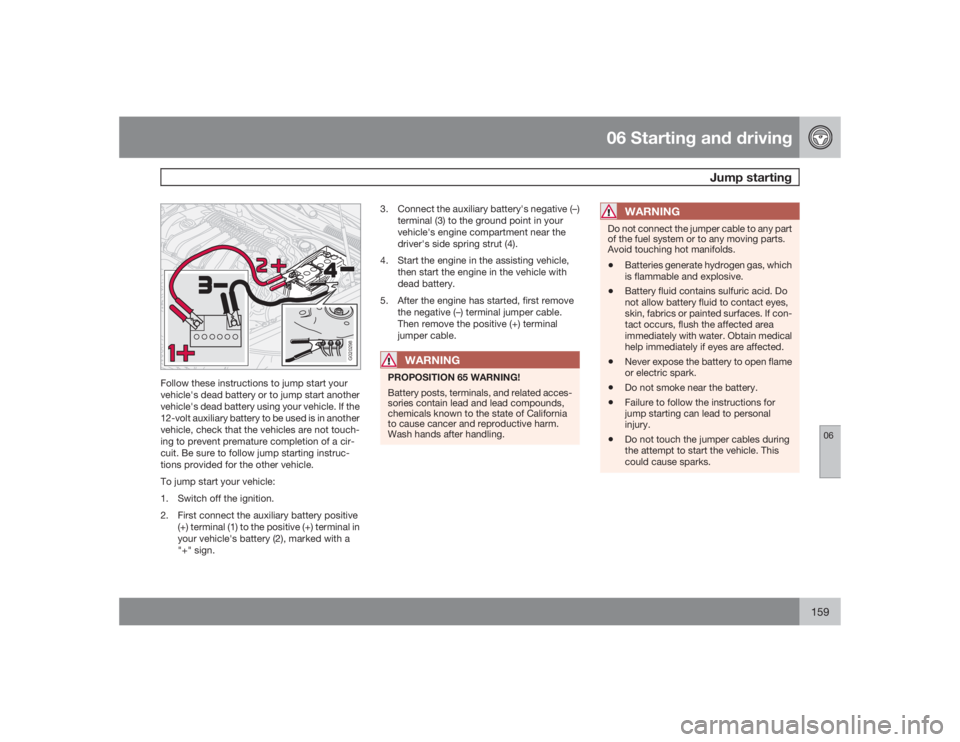
Follow these instructions to jump start your
vehicle's dead battery or to jump start another
vehicle's dead battery using your vehicle. If the
12-volt auxiliary battery to be used is in another
vehicle, check that the vehicles are not touch-
ing to prevent premature completion of a cir-
cuit. Be sure to follow jump starting instruc-
tions provided for the other vehicle.
To jump start your vehicle:
1. Switch off the ignition.
2. First connect the auxiliary battery positive
(+) terminal (1) to the positive (+) terminal in
your vehicle's battery (2), marked with a
"+" sign.3. Connect the auxiliary battery's negative (–)
terminal (3) to the ground point in your
vehicle's engine compartment near the
driver's side spring strut (4).
4. Start the engine in the assisting vehicle,
then start the engine in the vehicle with
dead battery.
5. After the engine has started, first remove
the negative (–) terminal jumper cable.
Then remove the positive (+) terminal
jumper cable.
WARNING
PROPOSITION 65 WARNING!
Battery posts, terminals, and related acces-
sories contain lead and lead compounds,
chemicals known to the state of California
to cause cancer and reproductive harm.
Wash hands after handling.
WARNING
Do not connect the jumper cable to any part
of the fuel system or to any moving parts.
Avoid touching hot manifolds.•
Batteries generate hydrogen gas, which
is flammable and explosive.
•
Battery fluid contains sulfuric acid. Do
not allow battery fluid to contact eyes,
skin, fabrics or painted surfaces. If con-
tact occurs, flush the affected area
immediately with water. Obtain medical
help immediately if eyes are affected.
•
Never expose the battery to open flame
or electric spark.
•
Do not smoke near the battery.
•
Failure to follow the instructions for
jump starting can lead to personal
injury.
•
Do not touch the jumper cables during
the attempt to start the vehicle. This
could cause sparks.
Page 198 of 286

07 Wheels and tiresTire Pressure Monitoring System (TPMS)
07198
NOTE
•
TPMS indicates low tire pressure but
does not replace normal tire mainte-
nance. For information on correct tire
pressure, please refer to the tables
beginning, see page 178, or consult
your Volvo retailer.
•
The tire pressure warning light will not
identify which tire is underinflated. Be
sure to check all four tires.
•
A certain amount of air seepage from
the tires occurs naturally and tire pres-
sure fluctuates with seasonal changes
in temperature. Always check tire pres-
sure regularly.
Erasing warning messagesWhen a low tire pressure warning message has
been displayed, and the tire pressure warning
light has come on:
1. Use a tire pressure gauge to check the
inflation pressure of all four tires.
2. Re-inflate the tire(s) to the correct pressure
(consult the tire pressure placard or the
tables, see page 178 ).
3. In certain cases, it may be necessary to
drive the vehicle for several minutes at a
speed of 20 mph (30 km/h) or faster. Thiswill erase the warning text and the warning
light will go out.
WARNING
Incorrect inflation pressure could lead to tire
failure, resulting in a loss of control of the
vehicle.Changing wheels with TPMSPlease note the following when changing or
replacing the factory installed TPMS wheels/
tires on the vehicle:•
Only the factory-mounted wheels are
equipped with TPMS sensors in the valves.
•
If the vehicle is equipped with a temporary
spare tire, this tire does not have a TPMS
sensor.
•
If wheels without TPMS sensors are moun-
ted on the vehicle,
TIRE PRESS SYST
SERVICE REQUIRED
will be displayed
each time the vehicle is driven above
25 mph (40 km/h) for 10 minutes or more.
•
Once TPMS sensors are properly installed,
the warning message should not reappear.
If the message is still displayed, drive the
vehicle for several minutes at a speed of
20 mph (30 km/h) or faster to erase the
message.
•
Volvo recommends that TPMS sensors be
fitted on all wheels used on the vehicle.Volvo does not recommend moving sen-
sors back and forth between sets of
wheels.
NOTE
•
If you change to tires with a different
recommended inflation pressure, the
TPMS system must be recalibrated to
these tires. This must be done by an
authorized Volvo retailer or workshop.
•
If a tire is changed, or if the TPMS sen-
sor is moved to another wheel, the sen-
sor's seal, nut, and valve core should be
replaced.
•
When installing TPMS sensors, the
vehicle must be parked for at least
15 minutes with the ignition off. If the
vehicle is driven within 15 minutes, a
TPMS error message will be displayed.CAUTION
When inflating tires with TPMS valves, press
the pump's mouthpiece straight onto the
valve to help avoid bending or otherwise
damaging the valve.
Page 221 of 286
09 Maintenance and servicing
Battery
09``221 Battery maintenance
Driving habits and conditions, climate, the
number of starts, etc., all affect the service life
and function of the battery. In order for your
battery to perform satisfactorily, keep the fol-
lowing in mind:
Check the fluid level in each cell in the battery
every 24 months or every 15,000
1 miles
(24,000 km), whichever is sooner.
•
Use a screw driver to open the caps or
cover and a flashlight to inspect the level.
•
If necessary, add distilled water. The level
should never be above the indicator.
•
The fluid level should be checked if the
battery has been recharged.
•
After inspection, be sure the cap over each
battery cell or the cover is securely in
place.
•
Check that the battery cables are correctly
connected and properly tightened.
•
Never disconnect the battery when the
engine is running, or when the key is in the
ignition. This could damage the vehicle's
electrical system.
•
The battery should be disconnected from
the vehicle when a battery charger is used
directly on the battery.
WARNING
PROPOSITION 65 WARNING!
Battery posts, terminals, and related acces-
sories contain lead and lead compounds,
chemicals known to the state of California
to cause cancer and reproductive harm.
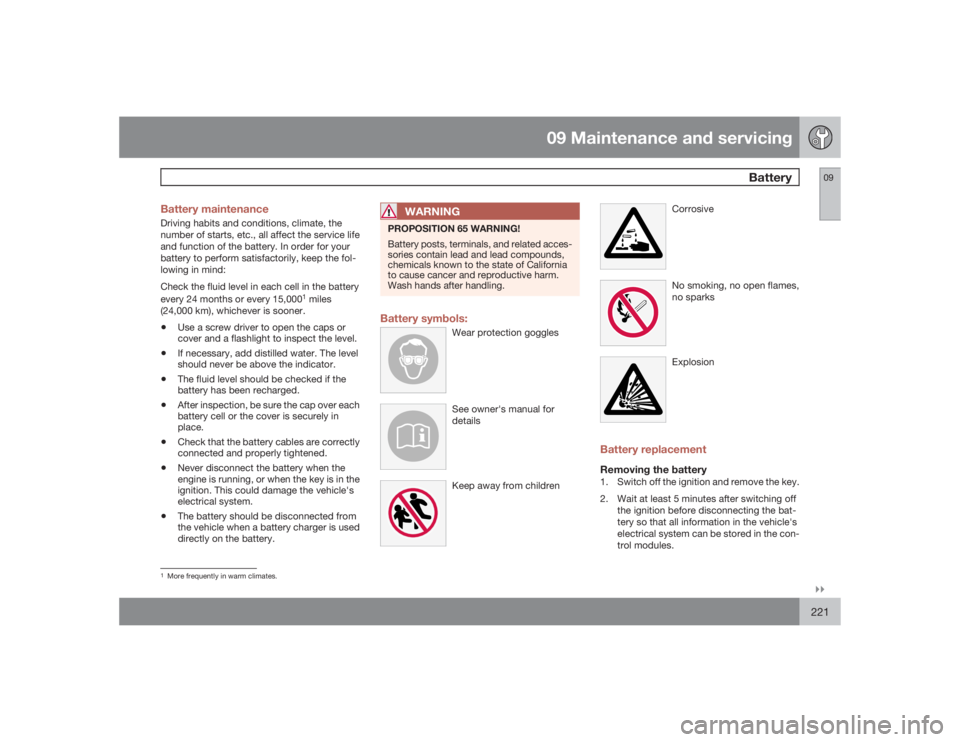
Wash hands after handling.Battery symbols:
Wear protection gogglesSee owner's manual for
detailsKeep away from children
CorrosiveNo smoking, no open flames,
no sparksExplosion
Battery replacementRemoving the battery1. Switch off the ignition and remove the key.
2. Wait at least 5 minutes after switching off
the ignition before disconnecting the bat-
tery so that all information in the vehicle's
electrical system can be stored in the con-
trol modules.
1More frequently in warm climates.
Page 223 of 286
09 Maintenance and servicing
Replacing bulbs
09``223 Introduction
Before replacing bulbs in your vehicle, please
keep the following points in mind:
NOTE
Never touch the glass of bulbs with your fin-
gers. Grease and oils from your fingers
vaporize in the heat and will leave a deposit
on the reflector, which will damage it.
The optional Bi-Xenon
Ÿ headlight bulbs
contain trace amounts of mercury. These
bulbs should always be disposed of by a
trained and qualified Volvo service techni-
cian.
Certain bulbs should only be replaced by a
trained and qualified Volvo service techni-
cian:
•
Courtesylighting
•
Reading lights
•
Glove compartment lights
•
Turn signals and courtesy lights in the
side door mirrors
•
Brake lights
•
Bi-Xenon
Ÿ headlights, Brake lights
Removing the headlight housing
WARNING
•
The engine should not be running when
changing bulbs.
•
When changing in the headlight hous-
ing, if the engine has been running just
prior to replacing bulbs, please be
aware that components in the engine
compartment will be hot.
G019599
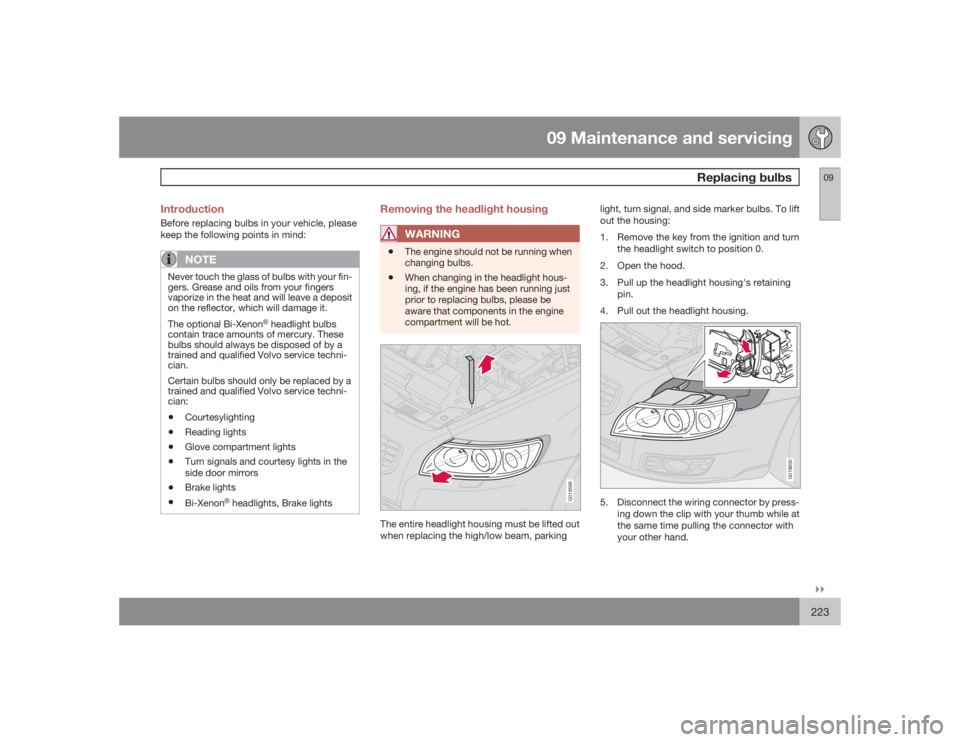
The entire headlight housing must be lifted out
when replacing the high/low beam, parkinglight, turn signal, and side marker bulbs. To lift
out the housing:
1. Remove the key from the ignition and turn
the headlight switch to position 0.
2. Open the hood.
3. Pull up the headlight housing's retaining
pin.
4. Pull out the headlight housing.
G019600
5. Disconnect the wiring connector by press-
ing down the clip with your thumb while at
the same time pulling the connector with
your other hand.
Page 233 of 286

09 Maintenance and servicing
Fuses
09``233
24.
Not in use
25.
Not in use
26.
Ignition switch
15A
27.
A/C compressor
10A
28.
Not in use
29.
Front fog lights (option)
15A
30.
Not in use
31.
Not in use
32.
Fuel injectors
10A
33.
Heated oxygen sensor, vac-
uum pump
20A
34.
Ignition coils, climate unit
pressure sensor
10A
35.
Engine sensor valves, A/C
relay, relay coil, PTC ele-
ment oil trap, canister, mass
air meter
15A
36.
Engine control module
(ECM), throttle sensor
10A
Page 248 of 286
10 AudioRadio functions
10248
2. Select a category in the list and press
ENTER.
3. Skip channels in the list presented by
pressingENTER or right arrow key.
Unskip all channels
This permanently removes all channels from
the skip list and makes them available for
selection.
Temp. unskip all ch.
This function will temporarily unskip all chan-
nels and make them available for selection. The
channels remain on the skip list and will again
be skipped the next time the ignition is
switched on.
Channel lock
Access to specific channels can be restricted
(locked). A locked channel will not provide
audio, song titles, or artist information.
NOTE
All channels are initially unlocked.Locking a channel1.
Select "
Sirius ID
" in the menu and select
LOCK OPTIONS
and press ENTER.2.
Select
CHANNEL LOCK LIST
and press
ENTER
3. Enter the channel access code and press
ENTER.
4. Select a category in the list and press
ENTER.
5. Lock channels in the list presented by
pressingENTER or right arrow.
The channel is now locked and a checked box
will be displayed to indicate this. It will be nec-
essary to enter the channel access code1 in
order to listen to a locked channel.
Unlocking a channel:A channel's access code1 is required to unlock
a channel.Unlock all channelsThis permanently removes all channels from
the locked list and makes them available for
selection.Temp. unlock all ch.This function will temporarily unlock all chan-
nels and make them available for selection. The
channels remain on the locked list and will
again be locked the next time the ignition is
switched on.
CHANGE CODEThis function makes it possible to change the
channel access code. The default code is
0000.
To change the code:
1.
Select
CHANGE CODE
and press
ENTER.
2.
Enter the current code and press ENTER.
3.
Enter the code and press ENTER.
4.
Confirm the new code and press ENTER.
If an incorrect code is entered, the text
WRONG CODE!
is displayed.
If you have forgotten the access code:
1.
Select "
SIRIUS ID
" in the Sirius settings
menu and press ENTER.
2.
Press and hold the ENTER button for
2 seconds.
3. The current code will be displayed.
Your Volvo retailer can also provide you with
assistance.
SIRUS IDThis function displays the 12-digit Sirius acti-
vation ID.
Page 255 of 286
10 Audio
Bluetooth hands-free connection
10``255
> The audio system will search for cell
phones that are in range. This search
takes approximately 30 seconds. Any
phones detected will be displayed with
their BluetoothŸ names. The hands-free
system’s BluetoothŸ name will appear
in the cell phone’s display as
My Car
.
4. Select one of the cell phones shown in the
audio system’s (center console) display.
5. Using the cell phone’s keypad, enter the
digits shown in the audio system’s display.
Alternative 2–using the cell phone’s menus
1. Activate the hands-free system by briefly
pressing the PHONE button in the center
console. If there is a cell phone connected,
disconnect it from the hands-free system
(by pressing PHONE in the center console
for several seconds).
2. Perform a search using the cell phone’s
BluetoothŸ function (consult the cell
phone’s owner’s manual if necessary).
3.
Select
My Car
in the list of devices shown
in the cell phone’s display.
4. When prompted, enter the PIN code 1234
in the cell phone.
5.
Connect to
My Car
from the cell phone.The cell phone will be registered and will be
connected automatically to the audio system
while the text
Synchronising
is displayed. For
more information on synchronizing a cell
phone, see page 257.
When a connection has been established, the
symbol and the cell phone’s BluetoothŸ
name will be displayed. The cell phone can
now be controlled from the audio system.Making a call1.
Ensure that
TELEPHONE
is shown at the
top of the center console display and that
the
symbol is visible (by pressing briefly
onPHONE on the center console).
2. Dial the desired phone number or use the
phone book (see page 257).
3.
PressENTER.
End the call by pressing EXIT.
Disconnecting the cell phoneThe cell phone is automatically disconnected
from the audio system if it is moved out of
range. For more information about connec-
tions, see page 254.
The cell phone can be manually disconnected
from the hands-free system by pressing
PHONE. The hands-free system is also deac-
tivated when the ignition is switched off (or ifthe driver’s door is opened on vehicles equip-
ped with the optional keyless drive).
When the cell phone is disconnected from the
hands-free system, a call in progress can be
continued using the cell phone’s own speaker
and microphone.
NOTE
Certain cell phones may require confirma-
tion from the phone’s keypad when a call is
transferred from hands-free to the cell
phone.Handling callsIncoming callsPressENTER to answer a call, even if the audio
system is currently in e.g., CD or FM mode.
PressEXIT to defer a call.Automatic answerThis function means that incoming calls will be
answered automatically. Activate or deactivate
the function in the menu system under Phone
settings
Call options
Automatic
answer.
Page 274 of 286
11 SpecificationsThree-way catalytic converter
11274
Three-way catalytic converter –
general information•
Keep your engine properly tuned. Certain
engine malfunctions, particularly involving
the electrical, fuel or distributor ignition
systems, may cause unusually high three-
way catalytic converter temperatures. Do
not continue to operate your vehicle if you
detect engine misfire, noticeable loss of
power or other unusual operating condi-
tions, such as engine overheating or back-
firing. A properly tuned engine will help
avoid malfunctions that could damage the
three-way catalytic converter.
•
Do not park your vehicle over combustible
materials, such as grass or leaves, which
can come into contact with the hot exhaust
system and cause such materials to ignite
under certain wind and weather condi-
tions.
•
Excessive starter cranking (in excess of
one minute), or an intermittently firing or
flooded engine can cause three-way cata-
lytic converter or exhaust system over-
heating.
•
Remember that tampering or unauthorized
modifications to the engine, the Electronic
Control Module, or the vehicle may be ille-
gal and can cause three-way catalytic con-
verter or exhaust system overheating. This
includes:
NOTE
Unleaded fuel is required for vehicles with
three-way catalytic converters.
Page 279 of 286
12 Index
12
279
HHand brake (parking brake)....................... 74
Hands-free connection (cell phone) (Cell
phone, hands-free connection)................ 254
Hazard warning flashers............................ 73
Headlights.................................................. 61
Active Bi-Xenon (option)....................... 61
changing bulbs................................... 223
high and low beams............................. 64
high beam flash.................................... 64
Headlight washers..................................... 70
Head restraints, rear seat........................111
High beam flash......................................... 64
High beams................................................ 64
Home safe lighting............................... 64, 83
Hood, opening......................................... 214IIgnition switch.......................................... 143
Immobilizer.............................................. 144
Immobilizer (start inhibitor)...................... 118
Indicator and warning symbols............ 51, 53Infant seats................................................ 37
Inflatable Curtain........................................ 30
Inflation pressure..................................... 176
Inflation pressure, checking..................... 177
Inflation pressure table
Canadian models................................ 179
US models.......................................... 178
Information display..............................51, 58
messages in.......................................... 58
Information symbol.................................... 53
Inspection, preparing for......................... 212
Inspection readiness................................ 212
Instrument overview.................................. 48
Instrument panel.................................. 48, 51
Instrument panel lighting........................... 62
Interior lighting......................................... 105
iPOD connector (audio system)...............241
ISOFIX/LATCH anchors............................. 42
JJacket hanger.......................................... 108
Jump starting........................................... 159
KKey blade.........................................120, 124
Keyless drive
location of antennas (pacemaker warn-
ing)...................................................... 125
locking and unlocking the vehicle...... 123
power seat memory............................ 124
starting the engine.............................. 146
Keylock.................................................... 144
Kickdown.................................................150LLabel information..................................... 262
LATCH (ISOFIX) anchors........................... 42
Lighting panel............................................ 61
Load anchoring eyelets........................... 115
Loading the vehicle
roof loads............................................ 163
Locking
from the inside.................................... 127
glove compartment............................. 127
Locking the vehicle.................................. 123
Locks, child safety................................... 129