ECU VOLVO V60 2012 User Guide
[x] Cancel search | Manufacturer: VOLVO, Model Year: 2012, Model line: V60, Model: VOLVO V60 2012Pages: 400, PDF Size: 9.28 MB
Page 218 of 400
04 Comfort and driving pleasure
Comfort inside the passenger compartment
04
216* Option/accessory, for more information, see Introduction.
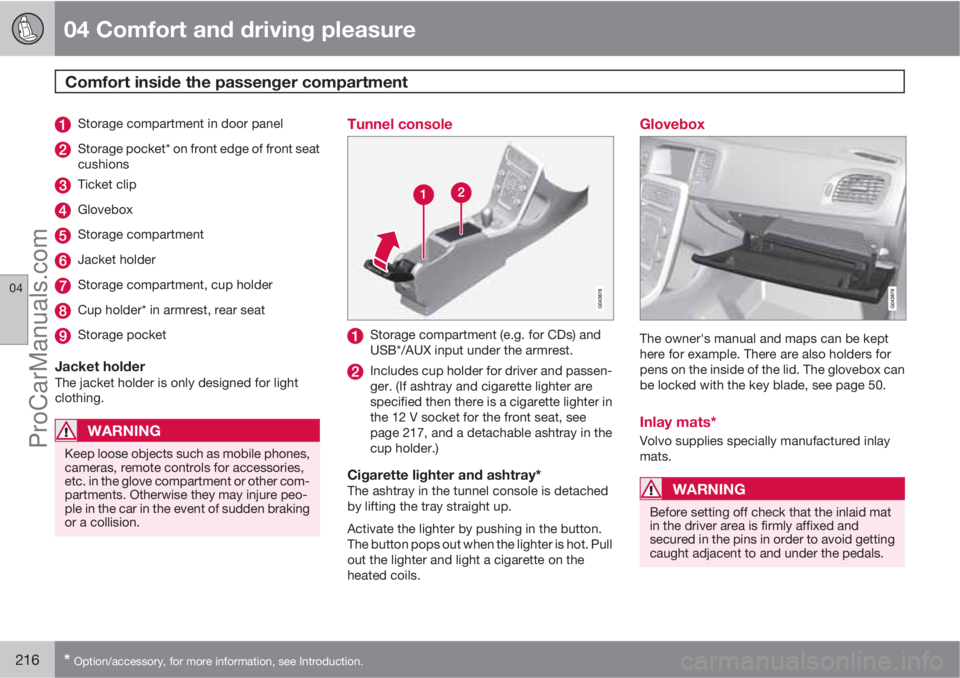
Storage compartment in door panel
Storage pocket* on front edge of front seat
cushions
Ticket clip
Glovebox
Storage compartment
Jacket holder
Storage compartment, cup holder
Cup holder* in armrest, rear seat
Storage pocket
Jacket holderThe jacket holder is only designed for light
clothing.
WARNING
Keep loose objects such as mobile phones,
cameras, remote controls for accessories,
etc. in the glove compartment or other com-
partments. Otherwise they may injure peo-
ple in the car in the event of sudden braking
or a collision.
Tunnel console
Storage compartment (e.g. for CDs) and
USB*/AUX input under the armrest.
Includes cup holder for driver and passen-
ger. (If ashtray and cigarette lighter are
specified then there is a cigarette lighter in
the 12 V socket for the front seat, see
page 217, and a detachable ashtray in the
cup holder.)
Cigarette lighter and ashtray*The ashtray in the tunnel console is detached
by lifting the tray straight up.
Activate the lighter by pushing in the button.
The button pops out when the lighter is hot. Pull
out the lighter and light a cigarette on the
heated coils.
Glovebox
The owner's manual and maps can be kept
here for example. There are also holders for
pens on the inside of the lid. The glovebox can
be locked with the key blade, see page 50.
Inlay mats*
Volvo supplies specially manufactured inlay
mats.
WARNING
Before setting off check that the inlaid mat
in the driver area is firmly affixed and
secured in the pins in order to avoid getting
caught adjacent to and under the pedals.
ProCarManuals.com
Page 277 of 400
06 During your journey
Fuel
06
275
IMPORTANT
•Always refuel with unleaded petrol so as
not to damage the catalytic converter.
•Do not use additives not recommended
by Volvo.
Bioethanol E85
Do not modify the fuel system or its compo-
nents, and do not replace components with
parts that are not specifically designed for use
with bioethanol.
WARNING
Methanol must not be used. A decal on the
inside of the fuel filler flap shows the correct
alternative fuel.
The use of components not designed for
bioethanol engines could cause fire, injury
or engine damage.
Reserve fuel canThe reserve fuel can should be filled with petrol,
see the NOTE box, page 114.
IMPORTANT
Make sure the reserve fuel can is securely
fastened and that its cap is sealed.
WARNING
Ethanol is sensitive to sparks, and explosive
gases could form in the reserve fuel can if it
is refuelled with ethanol.
Diesel
Only use diesel fuel from well-known produc-
ers. Never use diesel of dubious quality. Diesel
should fulfil the EN 590 or JIS K2204 stand-
ards. Diesel engines are sensitive to contami-
nants in the fuel, such as excessively high vol-
umes of sulphur particles for example.
At low temperatures (-6 °C to -40 °C), a paraffin
precipitate may form in the diesel fuel, which
may lead to ignition problems. Special diesel
fuel designed for low temperatures around
freezing point is available from the major oil
companies. This fuel is less viscous at low tem-
peratures and reduces the risk of paraffin pre-
cipitate.
The risk of condensation in the fuel tank is
reduced if the tank is kept well filled. Whenrefuelling, check that the area around the fuel
filler pipe is clean. Avoid spilling fuel onto the
paintwork. Wash off any spillage with deter-
gent and water.
IMPORTANT
Only ever use fuel that fulfils the European
diesel standard.
The sulphur content must be a maximum of
50 ppm.
IMPORTANT
Diesel type fuels that must not be used:
•Special additives
•Marine diesel fuel
•Heating oil
•FAME1 (Fatty Acid Methyl Ester) and
vegetable oil.
These fuels do not fulfil the requirements in
accordance with Volvo recommendations
and generate increased wear and engine
damage that is not covered by the Volvo
warranty.
Empty tankThe design of the fuel system in a diesel engine
means that if the vehicle runs out of fuel, the
1Diesel fuel may contain a certain amount of FAME, but further amounts must not be added.
ProCarManuals.com
Page 280 of 400
06 During your journey
Loading
06
278
General information on loading
Payload depends on the car's kerb weight. The
total of the weight of the passengers and all
accessories reduces the car's payload by a
corresponding weight. For more detailed infor-
mation on weights, see page 355.
The tailgate is opened via a button on
the lighting panel or the remote con-
trol key, see page 61.
WARNING
The car's driving characteristics change
depending on the weight and distribution of
the load.
To bear in mind when loading
•Position the load firmly against the rear
seat's backrest.
Note that objects must not prevent the function
of the WHIPS system for the front seats if any
of the rear seat's backrests is folded down,see
page 27.
•Centre the load.
•Heavy objects should be placed as low as
possible. Avoid placing heavy loads on
lowered backrests.
•Cover sharp edges with something soft to
avoid damaging the upholstery.
•Secure all loads to the load retaining eye-
lets with straps or web lashings.
WARNING
A loose object weighing 20 kg can, in a
frontal collision at a speed of 50 km/h, carry
the impact of an item weighing 1000 kg.
WARNING
The protection provided by the inflatable
curtain in the headlining may be compro-
mised or eliminated by high loads.
•Never load cargo above the backrest.
WARNING
Always secure the load. During heavy brak-
ing the load may otherwise shift, causing
injury to the car's occupants.
Cover sharp edges and sharp corners with
something soft.
Switch off the engine and apply the parking
brake when loading/unloading long items.
Otherwise you may accidentally knock the
gear lever or gear selector with the load into
a drive position - and the car could then
move off.
Front seat
The passenger seat backrest can also be
folded for an extra long load, see page 82.
Roof load
Using load carriersTo avoid damaging the car and for maximum
possible safety while driving, the load carriers
designed by Volvo are recommended.
Carefully follow the installation instructions
supplied with the carriers.
•Check periodically that the load carriers
and load are properly secured. Lash the
load securely with retaining straps.
•Distribute the load evenly over the load
carriers. Put the heaviest objects at the
bottom.
•The size of the area exposed to the wind,
and therefore fuel consumption, increase
with the size of the load.
•Drive gently. Avoid quick acceleration,
heavy braking and hard cornering.
WARNING
The car's centre of gravity and driving cha-
racteristics are altered by roof loads. For
information on maximum permitted roof
load, including load carriers and any space
box, see page 355.
ProCarManuals.com
Page 281 of 400
06 During your journey
Loading
06
* Option/accessory, for more information, see Introduction.279 Lowering the rear seat backrest
To simplify loading in the cargo area, the rear
seat backrest can be folded down, see
page 84.
Load retaining eyelets
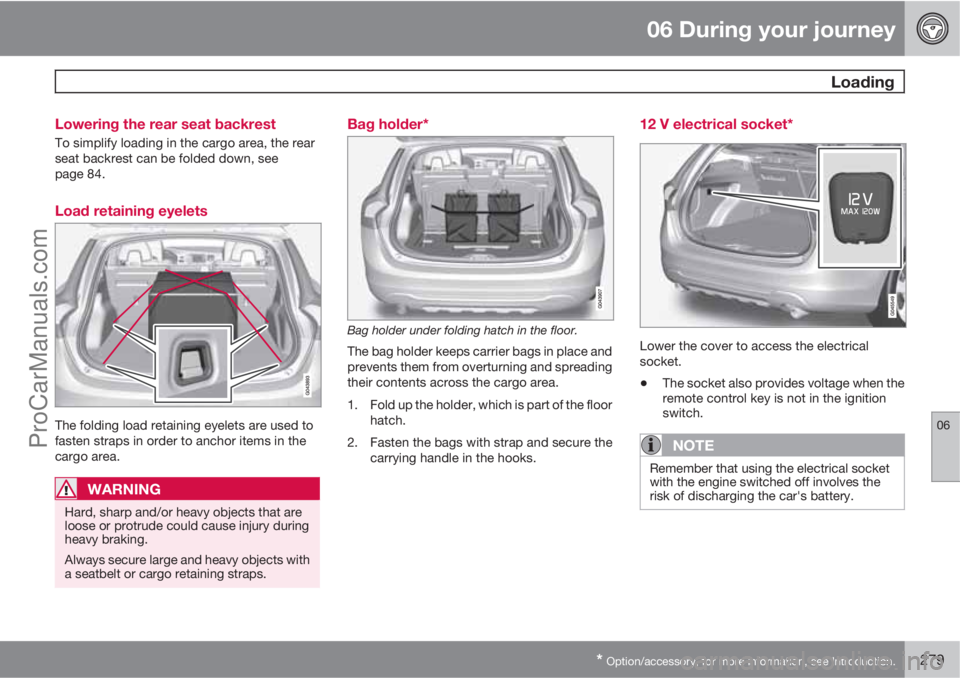
The folding load retaining eyelets are used to
fasten straps in order to anchor items in the
cargo area.
WARNING
Hard, sharp and/or heavy objects that are
loose or protrude could cause injury during
heavy braking.
Always secure large and heavy objects with
a seatbelt or cargo retaining straps.
Bag holder*
Bag holder under folding hatch in the floor.
The bag holder keeps carrier bags in place and
prevents them from overturning and spreading
their contents across the cargo area.
1. Fold up the holder, which is part of the floor
hatch.
2. Fasten the bags with strap and secure the
carrying handle in the hooks.
12 V electrical socket*
Lower the cover to access the electrical
socket.
•The socket also provides voltage when the
remote control key is not in the ignition
switch.
NOTE
Remember that using the electrical socket
with the engine switched off involves the
risk of discharging the car's battery.
ProCarManuals.com
Page 282 of 400
06 During your journey
Cargo area
06
280* Option/accessory, for more information, see Introduction.
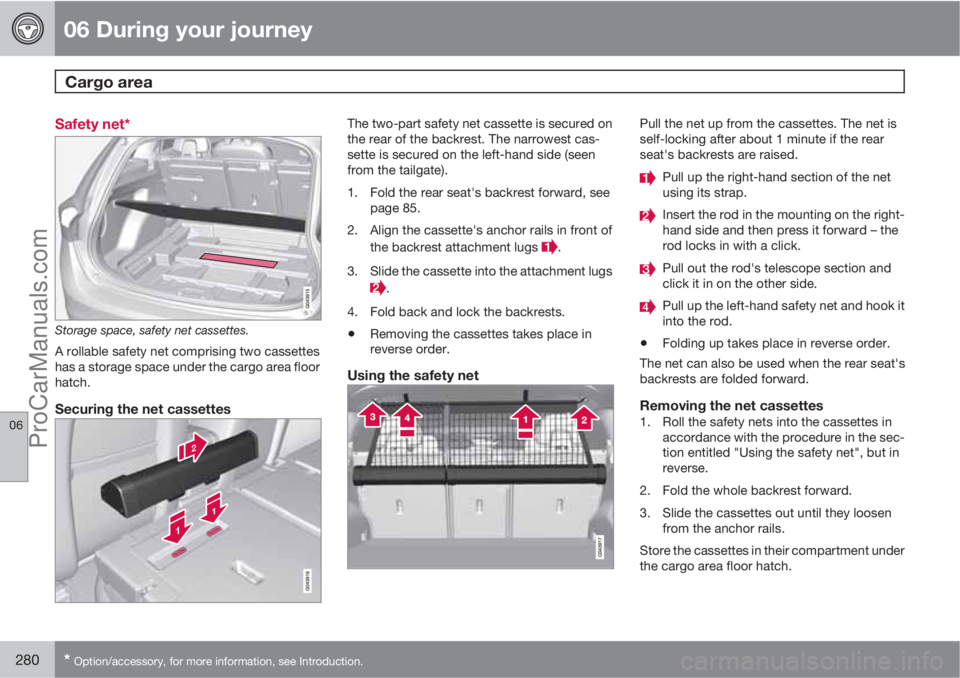
Safety net*
Storage space, safety net cassettes.
A rollable safety net comprising two cassettes
has a storage space under the cargo area floor
hatch.
Securing the net cassettes
The two-part safety net cassette is secured on
the rear of the backrest. The narrowest cas-
sette is secured on the left-hand side (seen
from the tailgate).
1. Fold the rear seat's backrest forward, see
page 85.
2. Align the cassette's anchor rails in front of
the backrest attachment lugs
.
3. Slide the cassette into the attachment lugs
.
4. Fold back and lock the backrests.
•Removing the cassettes takes place in
reverse order.
Using the safety net
Pull the net up from the cassettes. The net is
self-locking after about 1 minute if the rear
seat's backrests are raised.
Pull up the right-hand section of the net
using its strap.
Insert the rod in the mounting on the right-
hand side and then press it forward – the
rod locks in with a click.
Pull out the rod's telescope section and
click it in on the other side.
Pull up the left-hand safety net and hook it
into the rod.
•Folding up takes place in reverse order.
The net can also be used when the rear seat's
backrests are folded forward.
Removing the net cassettes1. Roll the safety nets into the cassettes in
accordance with the procedure in the sec-
tion entitled "Using the safety net", but in
reverse.
2. Fold the whole backrest forward.
3. Slide the cassettes out until they loosen
from the anchor rails.
Store the cassettes in their compartment under
the cargo area floor hatch.
ProCarManuals.com
Page 283 of 400
06 During your journey
Cargo area
06
* Option/accessory, for more information, see Introduction.281
WARNING
Loads in the cargo area must be firmly
secured, even if the safety net is correctly
fitted.
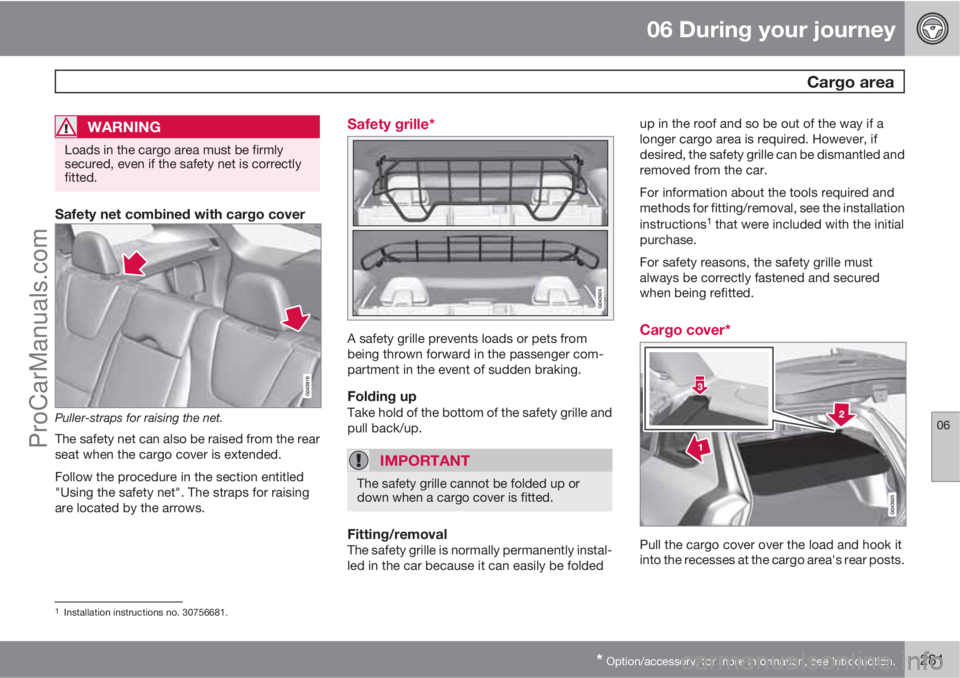
Safety net combined with cargo cover
Puller-straps for raising the net.
The safety net can also be raised from the rear
seat when the cargo cover is extended.
Follow the procedure in the section entitled
"Using the safety net". The straps for raising
are located by the arrows.
Safety grille*
A safety grille prevents loads or pets from
being thrown forward in the passenger com-
partment in the event of sudden braking.
Folding upTake hold of the bottom of the safety grille and
pull back/up.
IMPORTANT
The safety grille cannot be folded up or
down when a cargo cover is fitted.
Fitting/removalThe safety grille is normally permanently instal-
led in the car because it can easily be foldedup in the roof and so be out of the way if a
longer cargo area is required. However, if
desired, the safety grille can be dismantled and
removed from the car.
For information about the tools required and
methods for fitting/removal, see the installation
instructions
1 that were included with the initial
purchase.
For safety reasons, the safety grille must
always be correctly fastened and secured
when being refitted.
Cargo cover*
Pull the cargo cover over the load and hook it
into the recesses at the cargo area's rear posts.
1Installation instructions no. 30756681.
ProCarManuals.com
Page 289 of 400
06 During your journey
Driving with a trailer
06
287
G021494
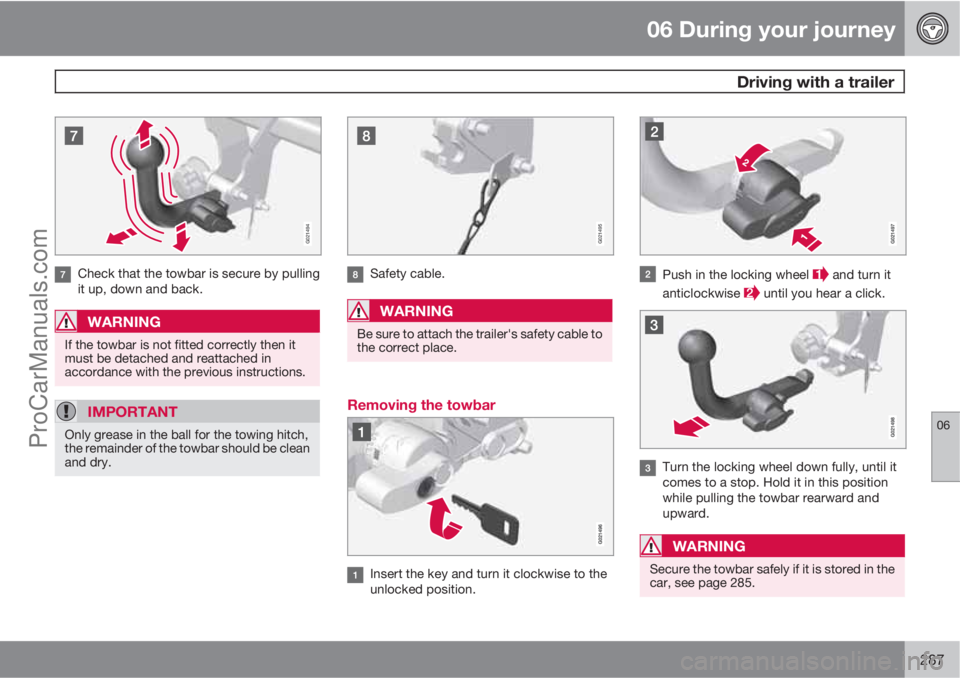
Check that the towbar is secure by pulling
it up, down and back.
WARNING
If the towbar is not fitted correctly then it
must be detached and reattached in
accordance with the previous instructions.
IMPORTANT
Only grease in the ball for the towing hitch,
the remainder of the towbar should be clean
and dry.
G021495
Safety cable.
WARNING
Be sure to attach the trailer's safety cable to
the correct place.
Removing the towbar
Insert the key and turn it clockwise to the
unlocked position.
Push in the locking wheel and turn it
anticlockwise
until you hear a click.
Turn the locking wheel down fully, until it
comes to a stop. Hold it in this position
while pulling the towbar rearward and
upward.
WARNING
Secure the towbar safely if it is stored in the
car, see page 285.
ProCarManuals.com
Page 302 of 400
07 Wheels and tyres
Changing wheels
07
300
IMPORTANT
Never drive faster than 80 km/h with a spare
wheel on the car.
IMPORTANT
The car must never be driven fitted with
more than one temporary spare wheel.
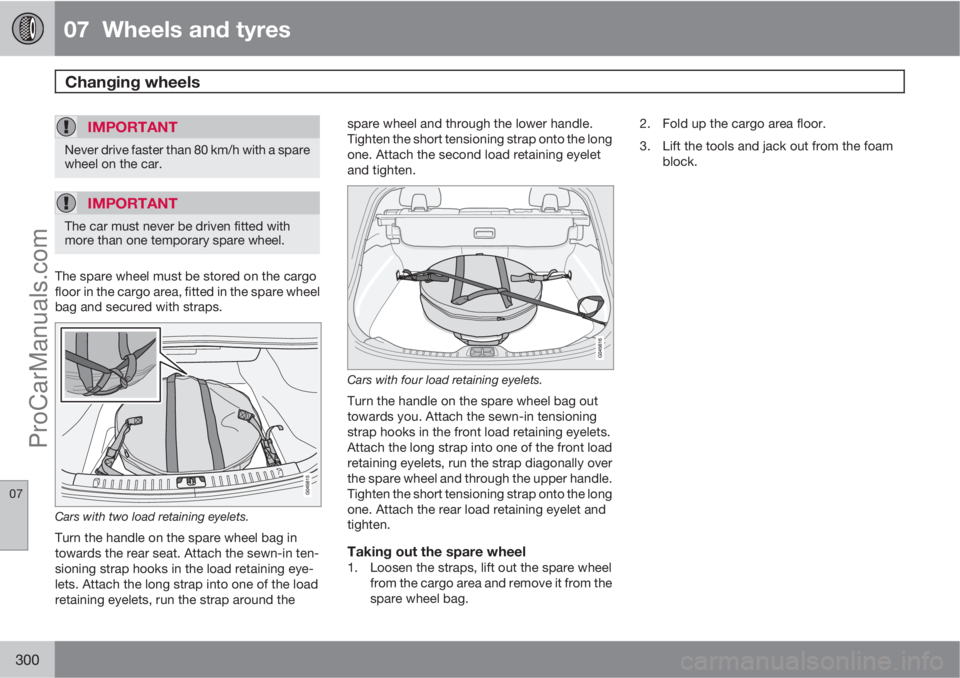
The spare wheel must be stored on the cargo
floor in the cargo area, fitted in the spare wheel
bag and secured with straps.
Cars with two load retaining eyelets.
Turn the handle on the spare wheel bag in
towards the rear seat. Attach the sewn-in ten-
sioning strap hooks in the load retaining eye-
lets. Attach the long strap into one of the load
retaining eyelets, run the strap around thespare wheel and through the lower handle.
Tighten the short tensioning strap onto the long
one. Attach the second load retaining eyelet
and tighten.
Cars with four load retaining eyelets.
Turn the handle on the spare wheel bag out
towards you. Attach the sewn-in tensioning
strap hooks in the front load retaining eyelets.
Attach the long strap into one of the front load
retaining eyelets, run the strap diagonally over
the spare wheel and through the upper handle.
Tighten the short tensioning strap onto the long
one. Attach the rear load retaining eyelet and
tighten.
Taking out the spare wheel1. Loosen the straps, lift out the spare wheel
from the cargo area and remove it from the
spare wheel bag.2. Fold up the cargo area floor.
3. Lift the tools and jack out from the foam
block.
ProCarManuals.com
Page 304 of 400
07 Wheels and tyres
Warning triangle and first-aid kit*
07
302* Option/accessory, for more information, see Introduction.
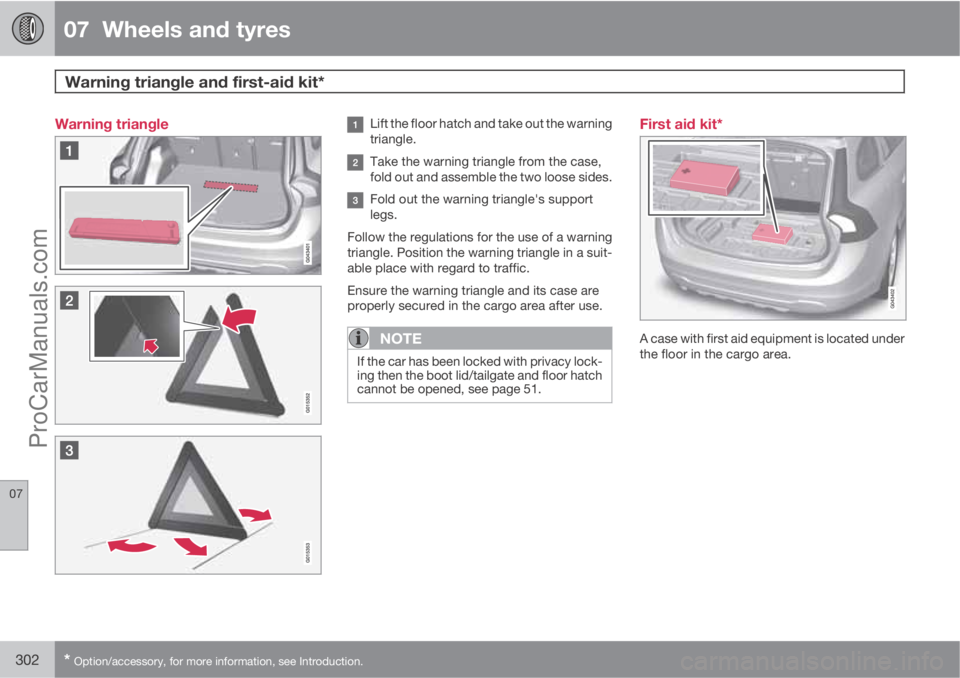
Warning triangleLift the floor hatch and take out the warning
triangle.
Take the warning triangle from the case,
fold out and assemble the two loose sides.
Fold out the warning triangle's support
legs.
Follow the regulations for the use of a warning
triangle. Position the warning triangle in a suit-
able place with regard to traffic.
Ensure the warning triangle and its case are
properly secured in the cargo area after use.
NOTE
If the car has been locked with privacy lock-
ing then the boot lid/tailgate and floor hatch
cannot be opened, see page 51.
First aid kit*
A case with first aid equipment is located under
the floor in the cargo area.
ProCarManuals.com
Page 322 of 400
08 Maintenance and service
Lamps
08
320
Pull out the headlamp's locking pins.
Release the headlamp by alternately
tilting and pulling it out.
IMPORTANT
Do not pull the electrical cable, only the con-
nector.
3. (Second illustration)
Detach the headlamp connector by
pressing down the clip with your thumb.
At the same time, guide out the con-
nector with your other hand.
4. Lift out the headlamp and place it on a soft
surface to avoid scratching the lens.
5. Replace the bulb in question.
Securing the headlamp
1. Plug in the connector, a clicking sound
should be heard.
2. Reinstall the headlamp and locking pins.
The short pin is fitted closest to the grille.
Check that they are correctly inserted.
3. Check the lighting.
The headlamp must be mounted and the con-
nector correctly installed before the lighting is
switched on or the remote control key is
inserted into the ignition switch.
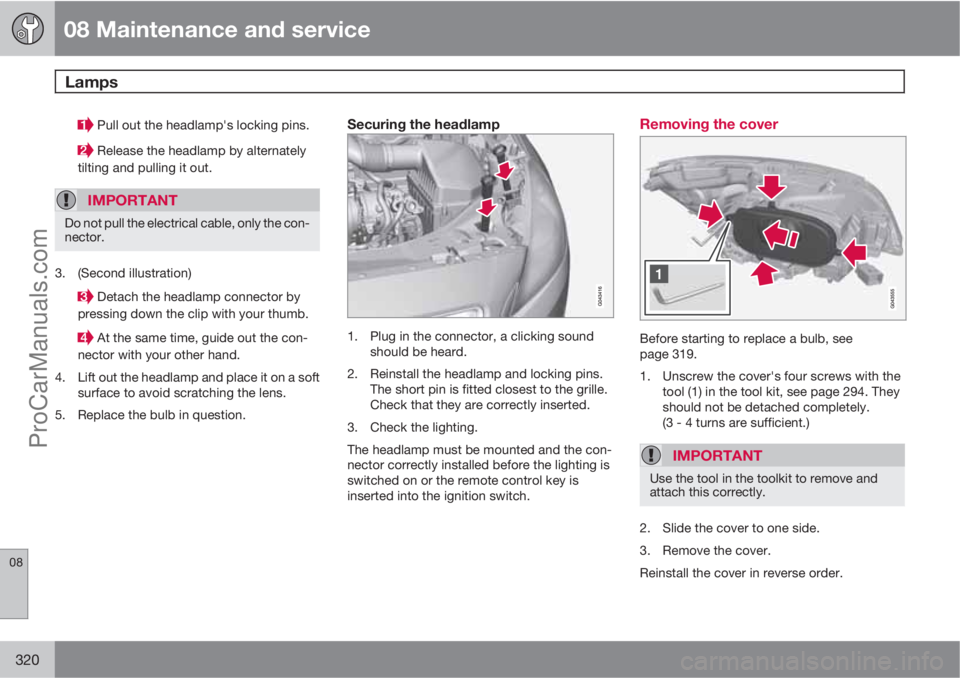
Removing the cover
Before starting to replace a bulb, see
page 319.
1. Unscrew the cover's four screws with the
tool (1) in the tool kit, see page 294. They
should not be detached completely.
(3 - 4 turns are sufficient.)
IMPORTANT
Use the tool in the toolkit to remove and
attach this correctly.
2. Slide the cover to one side.
3. Remove the cover.
Reinstall the cover in reverse order.
ProCarManuals.com