fuel pressure VOLVO V60 2012 Owners Manual
[x] Cancel search | Manufacturer: VOLVO, Model Year: 2012, Model line: V60, Model: VOLVO V60 2012Pages: 400, PDF Size: 9.28 MB
Page 6 of 400
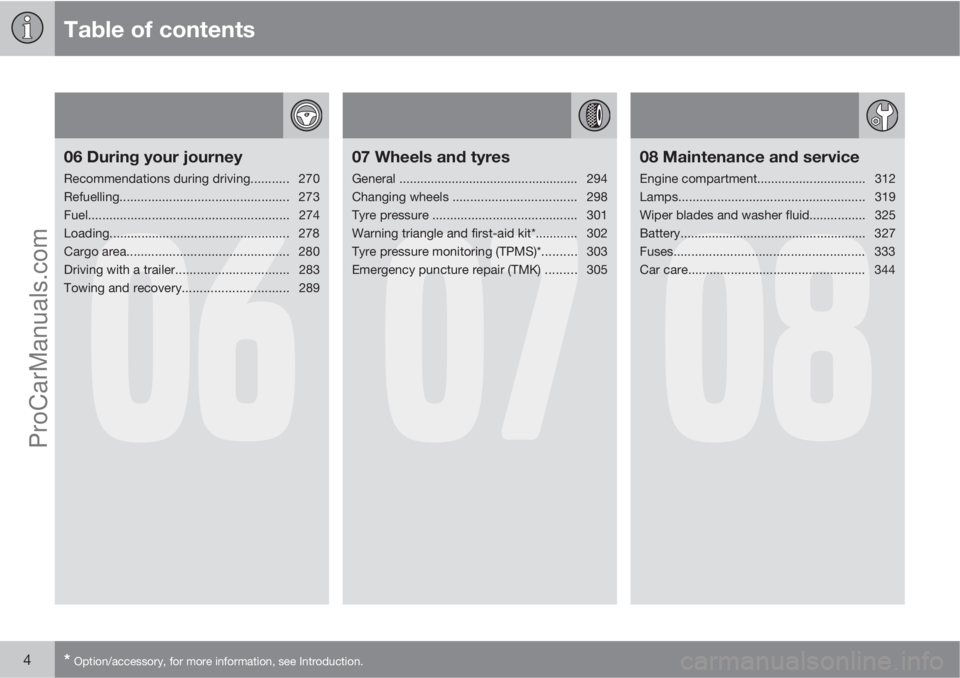
Table of contents
4* Option/accessory, for more information, see Introduction.
06
06 During your journey
Recommendations during driving........... 270
Refuelling................................................ 273
Fuel.........................................................274
Loading................................................... 278
Cargo area.............................................. 280
Driving with a trailer................................283
Towing and recovery..............................289
07
07 Wheels and tyres
General ................................................... 294
Changing wheels ................................... 298
Tyre pressure ......................................... 301
Warning triangle and first-aid kit*............ 302
Tyre pressure monitoring (TPMS)*.......... 303
Emergency puncture repair (TMK) ......... 305
08
08 Maintenance and service
Engine compartment............................... 312
Lamps.....................................................319
Wiper blades and washer fluid................ 325
Battery..................................................... 327
Fuses...................................................... 333
Car care.................................................. 344
ProCarManuals.com
Page 76 of 400
03 Your driving environment
Instruments and controls
03
74* Option/accessory, for more information, see Introduction.
Meters
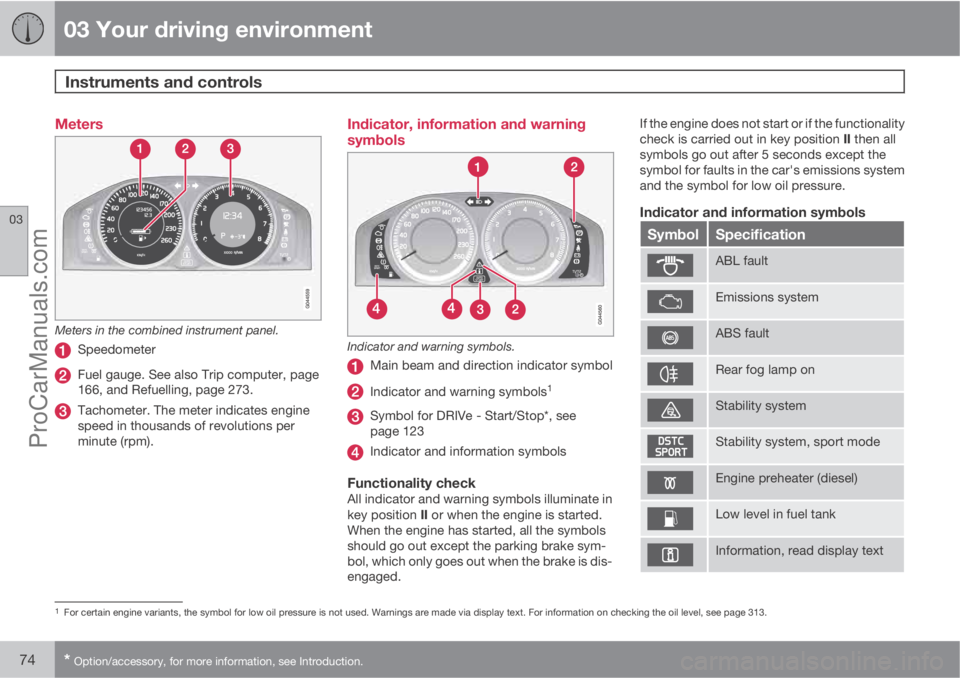
Meters in the combined instrument panel.
Speedometer
Fuel gauge. See also Trip computer, page
166, and Refuelling, page 273.
Tachometer. The meter indicates engine
speed in thousands of revolutions per
minute (rpm).
Indicator, information and warning
symbols
Indicator and warning symbols.
Main beam and direction indicator symbol
Indicator and warning symbols1
Symbol for DRIVe - Start/Stop*, see
page 123
Indicator and information symbols
Functionality checkAll indicator and warning symbols illuminate in
key position II or when the engine is started.
When the engine has started, all the symbols
should go out except the parking brake sym-
bol, which only goes out when the brake is dis-
engaged.If the engine does not start or if the functionality
check is carried out in key position II then all
symbols go out after 5 seconds except the
symbol for faults in the car's emissions system
and the symbol for low oil pressure.
Indicator and information symbols
SymbolSpecification
ABL fault
Emissions system
ABS fault
Rear fog lamp on
Stability system
Stability system, sport mode
Engine preheater (diesel)
Low level in fuel tank
Information, read display text
1For certain engine variants, the symbol for low oil pressure is not used. Warnings are made via display text. For information on checking the oil level, see page 313.
ProCarManuals.com
Page 275 of 400
06 During your journey
Refuelling
06
273 Refuelling
Opening/closing the fuel filler flap
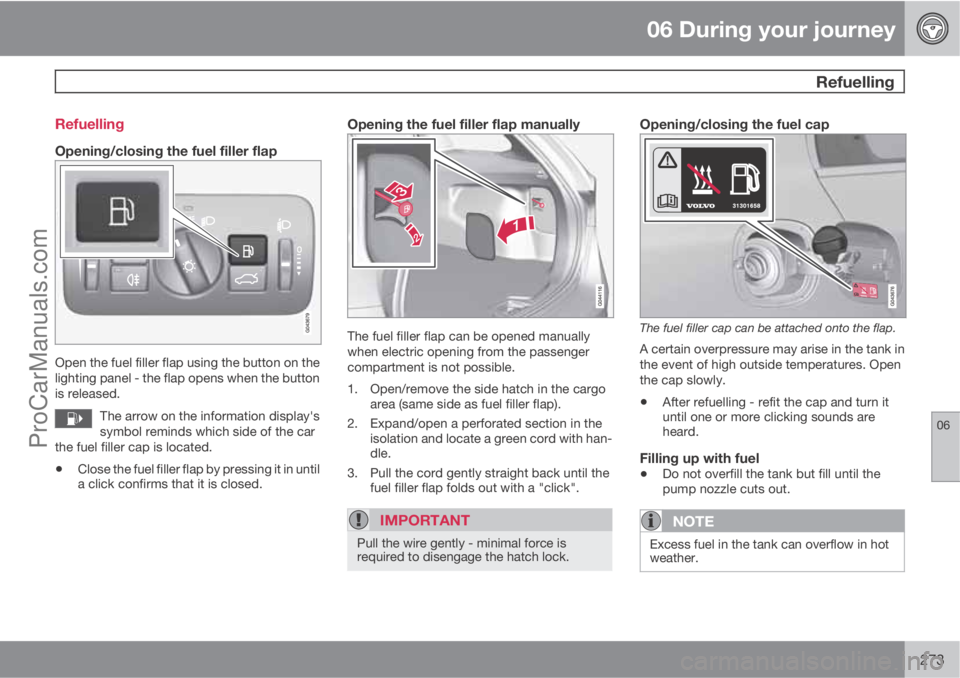
Open the fuel filler flap using the button on the
lighting panel - the flap opens when the button
is released.
The arrow on the information display's
symbol reminds which side of the car
the fuel filler cap is located.
•Close the fuel filler flap by pressing it in until
a click confirms that it is closed.
Opening the fuel filler flap manually
The fuel filler flap can be opened manually
when electric opening from the passenger
compartment is not possible.
1. Open/remove the side hatch in the cargo
area (same side as fuel filler flap).
2. Expand/open a perforated section in the
isolation and locate a green cord with han-
dle.
3. Pull the cord gently straight back until the
fuel filler flap folds out with a "click".
IMPORTANT
Pull the wire gently - minimal force is
required to disengage the hatch lock.
Opening/closing the fuel cap
The fuel filler cap can be attached onto the flap.
A certain overpressure may arise in the tank in
the event of high outside temperatures. Open
the cap slowly.
•After refuelling - refit the cap and turn it
until one or more clicking sounds are
heard.
Filling up with fuel
•Do not overfill the tank but fill until the
pump nozzle cuts out.
NOTE
Excess fuel in the tank can overflow in hot
weather.
ProCarManuals.com
Page 303 of 400
07 Wheels and tyres
Tyre pressure
07
301
Tyre pressure
G021830
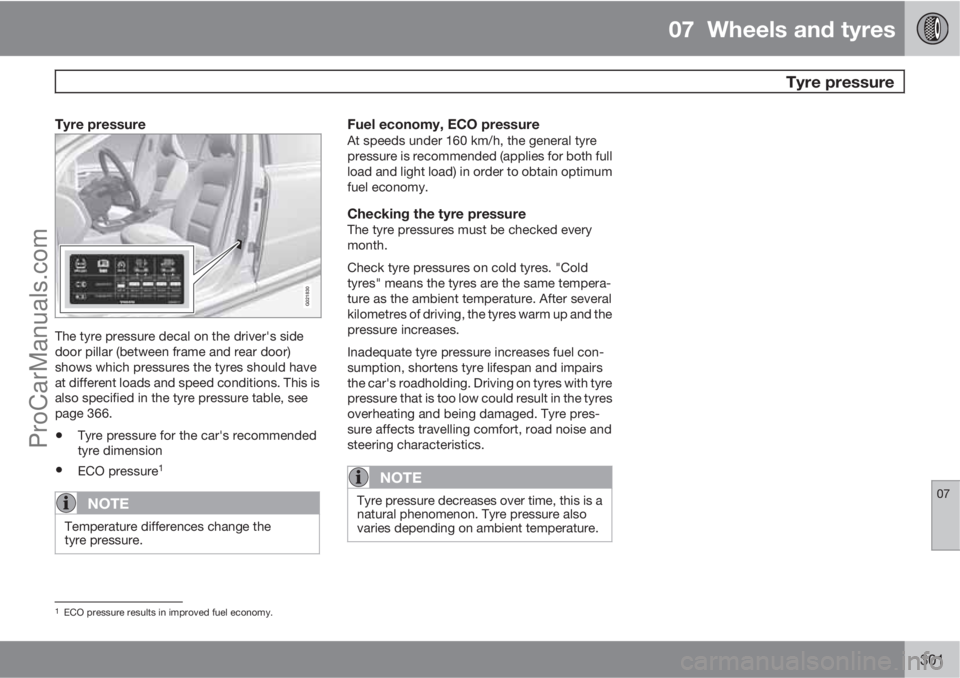
The tyre pressure decal on the driver's side
door pillar (between frame and rear door)
shows which pressures the tyres should have
at different loads and speed conditions. This is
also specified in the tyre pressure table, see
page 366.
•Tyre pressure for the car's recommended
tyre dimension
•ECO pressure1
NOTE
Temperature differences change the
tyre pressure.
Fuel economy, ECO pressureAt speeds under 160 km/h, the general tyre
pressure is recommended (applies for both full
load and light load) in order to obtain optimum
fuel economy.
Checking the tyre pressureThe tyre pressures must be checked every
month.
Check tyre pressures on cold tyres. "Cold
tyres" means the tyres are the same tempera-
ture as the ambient temperature. After several
kilometres of driving, the tyres warm up and the
pressure increases.
Inadequate tyre pressure increases fuel con-
sumption, shortens tyre lifespan and impairs
the car's roadholding. Driving on tyres with tyre
pressure that is too low could result in the tyres
overheating and being damaged. Tyre pres-
sure affects travelling comfort, road noise and
steering characteristics.
NOTE
Tyre pressure decreases over time, this is a
natural phenomenon. Tyre pressure also
varies depending on ambient temperature.
1ECO pressure results in improved fuel economy.
ProCarManuals.com
Page 316 of 400
08 Maintenance and service
Engine compartment
08
314
Volvo recommends Castrol oil products.
When driving under adverse conditions, see
page 359.
IMPORTANT
In order to fulfil the requirements for the
engine's service intervals all engines are
filled with a specially adapted synthetic
engine oil at the factory. The choice of oil
has been made very carefully with regard to
service life, starting characteristics, fuel
consumption and environmental impact.
An approved engine oil must be used in
order that the recommended service inter-
vals can be applied. Only use a prescribed
grade of oil for both filling and oil change,
otherwise you will risk affecting service life,
starting characteristics, fuel consumption
and environmental impact.
Volvo Car Corporation disclaims all war-
ranty liability if engine oil of the prescribed
grade and viscosity is not used.
Volvo recommends that oil changes are car-
ried out at an authorised Volvo workshop.
Volvo uses different systems for warning of
low/high oil level or low/high oil pressure. Cer-
tain variants have an oil pressure sensor, and
then the lamp for oil pressure is used. Other
variants have an oil level sensor, and then thedriver is informed via the warning symbol in the
centre of the instrument unit as well as by dis-
play texts. Certain models have both variants.
Contact a Volvo dealer for more information.
Change the engine oil and oil filter in accord-
ance with the intervals specified in the Service
and Warranty Booklet.
Using oil of a higher than specified grade is
permitted. If the car is driven in adverse con-
ditions, Volvo recommends using an oil of a
higher grade, see page 359.
For capacities, see page 360 and onwards.
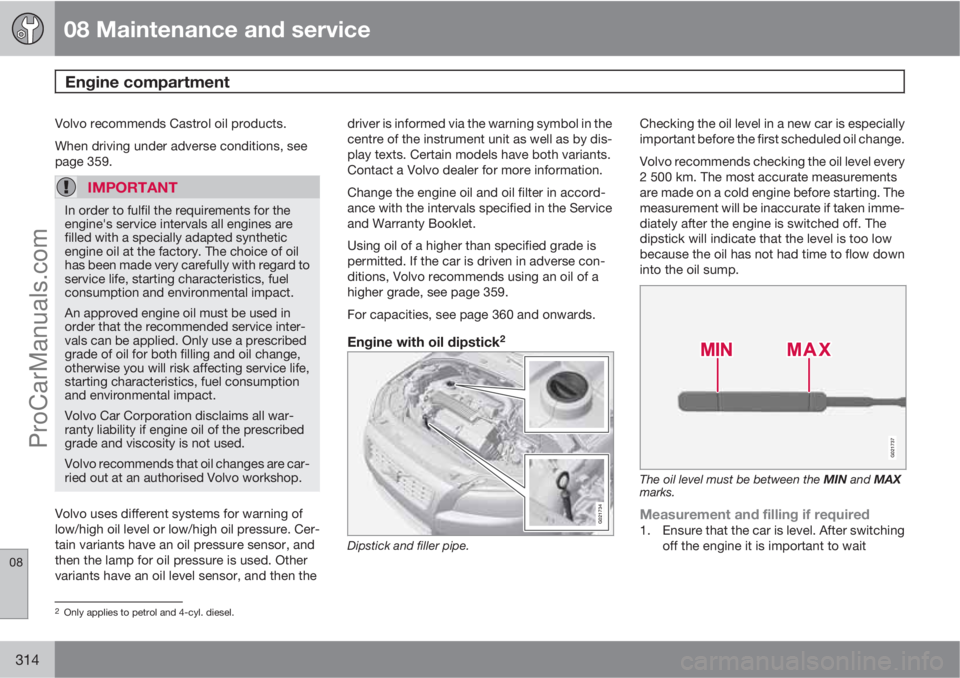
Engine with oil dipstick2
G021734
Dipstick and filler pipe.
Checking the oil level in a new car is especially
important before the first scheduled oil change.
Volvo recommends checking the oil level every
2 500 km. The most accurate measurements
are made on a cold engine before starting. The
measurement will be inaccurate if taken imme-
diately after the engine is switched off. The
dipstick will indicate that the level is too low
because the oil has not had time to flow down
into the oil sump.
G021737
The oil level must be between the MIN and MAX
marks.
Measurement and filling if required1. Ensure that the car is level. After switching
off the engine it is important to wait
2Only applies to petrol and 4-cyl. diesel.
ProCarManuals.com
Page 346 of 400
08 Maintenance and service
Car care
08
344
Washing the car
Wash the car as soon as it becomes dirty.
Wash the car in a car wash with oil separator.
Use car shampoo.
•Remove bird droppings from the paintwork
as soon as possible. Bird droppings con-
tain chemicals that affect and discolour
paintwork very quickly. An authorised
Volvo workshop is recommended for the
removal of any discoloration.
•Hose down the underbody.
•Rinse the entire car to remove loose dirt.
Do not spray directly onto the locks.
•Wash using a sponge, car shampoo and
plenty of lukewarm water.
•Clean the wiper blades with a lukewarm
soap solution or car shampoo.
•Use cold degreasing agent on very dirty
surfaces.
•Dry the car using a clean, soft chamois or
a water scraper.
WARNING
Always have the engine cleaned by a work-
shop. There is a risk of fire if the engine is
hot.
IMPORTANT
Dirty headlamps have impaired functional-
ity. Clean them regularly, when refuelling for
example.
NOTE
Outside lighting such as headlamps, fog
lamps and rear lamps may temporarily have
condensation on the inside of the lens. This
is normal, all exterior lighting is designed to
withstand this. Condensation is normally
vented out of the lamp housing when the
lamp has been switched on for a time.
Cleaning the wiper bladesAsphalt, dust and salt residue on wiper blades,
as well as insects, ice etc. on the windscreen,
impair the service life of wiper blades.
For cleaning:
–Set the wiper blades in service position,
see page 325.
NOTE
Wash the wiper blades and windscreen reg-
ularly with lukewarm soap solution or car
shampoo.
Do not use any strong solvents.
Automatic car washesAn automatic car wash is a simple and quick
way of washing the car, but it cannot reach
everywhere. Handwashing the car is recom-
mended for achieving optimum results.
NOTE
During the first few months a new car must
only be handwashed. This is because the
paintwork is more sensitive when it is new.
High-pressure washingWhen using high-pressure washing, use
sweeping movements and make sure that the
nozzle does not come closer than 30 cm to the
surface of the car (the distance applies to all
exterior parts). Do not spray directly onto the
locks.
Testing the brakes
WARNING
Always test the brakes after washing the
car, including the parking brake, to ensure
that moisture and corrosion do not attack
the brake linings and reduce braking per-
formance.
Lightly depress the brake pedal now and then
when driving long distances in rain or slush.
The heat from the friction causes the brake lin-
ProCarManuals.com
Page 352 of 400
350
Type designations................................................................................. 352
Dimensions and weights....................................................................... 354
Engine specifications............................................................................ 358
Engine oil............................................................................................... 359
Fluids and lubricants............................................................................. 361
Fuel....................................................................................................... 363
Wheel and tyres, dimensions and pressure ......................................... 366
Electrical system................................................................................... 369
Type approval....................................................................................... 370
Symbols in the display.......................................................................... 382
ProCarManuals.com
Page 367 of 400
09 Specifications
Fuel09
365
There are several reasons for increased fuel
consumption compared with the table's val-
ues. Examples of this are:
•The driver's driving style.
•If the customer has specified wheels larger
than those fitted as standard on the mod-
el's basic version, then resistance increa-
ses.
•High speed results in increased wind resis-
tance.
•Fuel quality, road and traffic conditions,
weather and the condition of the car.
Even a combination of the above-mentioned
examples can result in significantly improved
consumption. For further information, please
refer to the regulations referred to
1.
Large deviations in fuel consumption may arise
in a comparison with the EU driving cycles
1
which are used in the certification of the car
and on which the consumption figures in the
table are based.
To bear in mindTips that the driver can use in order to reduce
consumption:
•Drive gently and avoid unnecessary accel-
eration as well as braking too hard.
•Drive with the correct air pressure in the
tyres and check this regularly - select ECO
tyre pressure for best results, see the tyre
pressure table on page 366.
•Choice of tyres can affect fuel consump-
tion - seek advice on suitable tyres from a
dealer.
See further information and more advice on
pages 12 and 270.
See page 274 for general information on fuel.
1Official fuel consumption figures are based on two standardised driving cycles in a laboratory environment ("EU driving cycles") all in accordance with EU Directive 80/1268/EEC (Euro 4), EU Regulation
no 692/2008 (Euro 5) and UN ECE Regulation no 101. The regulations cover the driving cycles for urban driving and extra-urban driving. - Urban driving - the measurement starts with cold starting
the engine. The driving is simulated. - Extra-urban driving - the car is accelerated and braked at speeds between 0-120 km/h. The driving is simulated. - Cars with the D5 engine and 6-speed manual
transmission or DRIVe engine and 6-speed manual transmission, are started in 2nd gear. The value for combined driving, which is given in the table, according to legislation, is a combination of
urban driving and extra-urban driving. CO
2 emission - to calculate the carbon dioxide emissions from the two driving cycles, the exhaust gases are collected. These are then analysed and give the
value for CO2 emissions.
ProCarManuals.com