air condition VOLVO V60 2013 User Guide
[x] Cancel search | Manufacturer: VOLVO, Model Year: 2013, Model line: V60, Model: VOLVO V60 2013Pages: 422, PDF Size: 9.59 MB
Page 221 of 422
05 Comfort and driving pleasure
Climate control
05
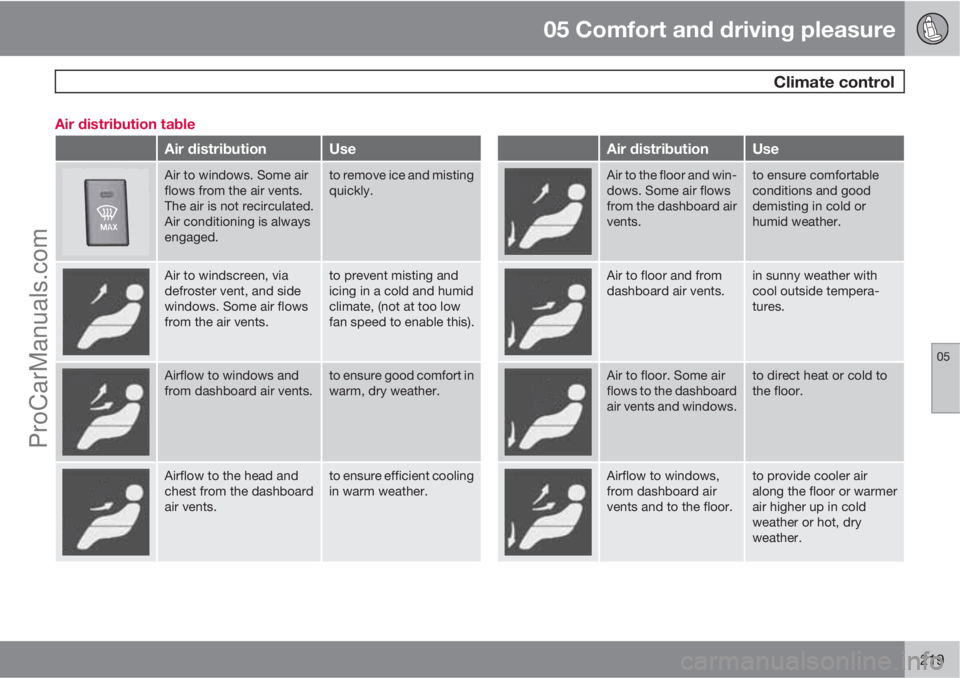
219 Air distribution table
Air distributionUseAir distributionUse
Air to windows. Some air
flows from the air vents.
The air is not recirculated.
Air conditioning is always
engaged.to remove ice and misting
quickly.Air to the floor and win-
dows. Some air flows
from the dashboard air
vents.to ensure comfortable
conditions and good
demisting in cold or
humid weather.
Air to windscreen, via
defroster vent, and side
windows. Some air flows
from the air vents.to prevent misting and
icing in a cold and humid
climate, (not at too low
fan speed to enable this).Air to floor and from
dashboard air vents.in sunny weather with
cool outside tempera-
tures.
Airflow to windows and
from dashboard air vents.to ensure good comfort in
warm, dry weather.Air to floor. Some air
flows to the dashboard
air vents and windows.to direct heat or cold to
the floor.
Airflow to the head and
chest from the dashboard
air vents.to ensure efficient cooling
in warm weather.Airflow to windows,
from dashboard air
vents and to the floor.to provide cooler air
along the floor or warmer
air higher up in cold
weather or hot, dry
weather.
ProCarManuals.com
Page 286 of 422
07 During your journey
Recommendations during driving
07
284
General
Economical drivingDriving economically means driving smoothly
while thinking ahead and adjusting your driving
style and speed to the prevailing conditions.
•Drive in the highest gear possible, adapted
to the current traffic situation and road -
lower engine speeds result in lower fuel
consumption.
•Avoid driving with open windows.
•Avoid sudden unnecessary acceleration
and heavy braking.
•Remove unnecessary items from the car -
the greater the load the higher the fuel con-
sumption.
•Use engine braking to slow down, when it
can take place without risk to other road
users.
•A roof load and ski box increase air resis-
tance, leading to higher fuel consumption
- remove the load carriers when not in use.
•Do not run the engine to operating tem-
perature at idling speed, but rather drive
with a light load as soon as possible - a
cold engine consumes more fuel than a
warm one.
•A car with D2, D3, D4 or D5 engine in com-
bination with a 6-speed manual gearbox is
started in 2nd gear.For more information and further advice, see
the pages 12 and 384.
WARNING
Never switch off the engine while moving,
such as downhill, this deactivates important
systems such as the power steering and
brake servo.
Driving in waterThe car can be driven through water at a maxi-
mum depth of 25 cm at a maximum speed of
10 km/h. Extra caution should be exercised
when passing through flowing water.
During driving in water, maintain a low speed
and do not stop the car. When the water has
been passed, depress the brake pedal lightly
and check that full brake function is achieved.
Water and mud for example can make the
brake linings wet resulting in delayed brake
function.
•Clean the electric contacts of the electric
engine block heater and trailer coupling
after driving in water and mud.
•Do not let the car stand with water over the
sills for any long period of time - this could
cause electrical malfunctions.
IMPORTANT
Engine damage can occur if water enters
the air filter.
In depths greater than 25 cm, water could
enter the transmission. This reduces the
lubricating ability of the oils and shortens
the service life of these systems.
In the event of the engine stalling in water,
do not try restart - tow the car from the water
to a workshop - an authorised Volvo work-
shop is recommended. Risk of engine
breakdown.
Engine, gearbox and cooling systemUnder special conditions, for example hard
driving in hilly terrain and hot climate, there is
a risk that the engine and drive system may
overheat - in particular with a heavy load.
For information about overheating when driv-
ing with a trailer, see page 298.
•Remove any auxiliary lamps from in front
of the grille when driving in hot climates.
•If the temperature in the engine's cooling
system is too high the instrument panel's
warning symbol is illuminated and there is
a text message displayed there
High
engine temp Stop safely - stop the car in
a safe way and allow the engine to run at
idling speed for several minutes to cool
down.
ProCarManuals.com
Page 287 of 422
07 During your journey
Recommendations during driving
07
285
•If the text message High engine temp
Stop engine or Coolant level low, Stop
engine is shown then the engine must be
switched off after stopping the car.
•In the event of overheating in the gearbox
a built-in protection function is activated
which, amongst other things, illuminates
the instrument panel's warning symbol and
there is a text message displayed there
Transmission hot Reduce speed orTransmission hot Stop safely - follow
the recommendation given and lower the
speed and stop the car in a safe way and
allow the engine to run at idling speed for
a few minutes to allow the gearbox to cool
down.
•If the car overheats, the air conditioning
may be switched off temporarily.
•Do not turn the engine off immediately you
stop after a hard drive.
NOTE
It is normal for the engine's cooling fan to
operate for a while after the engine has been
switched off.
Open tailgate
WARNING
Do not drive with the tailgate open. Toxic
exhaust fumes could be drawn into the car
through the cargo area.
Do not overload the batteryThe electrical functions in the car load the bat-
tery to varying degrees. Avoid using the key
position II when the engine is switched off.
Instead use the I mode - which uses less
power.
Also, be aware of different accessories that
load the electrical system. Do not use functions
which use a lot of power when the engine is
switched off. Examples of such functions are:
•ventilation fan
•headlamps
•windscreen wiper
•audio system (high volume).
If the battery voltage is low the information dis-
play shows the text
Low battery Power save
mode. The energy-saving function then shuts
down certain functions or reduces certain
functions such as the ventilation fan and/or
audio system.
–In which case, charge the battery by star-
ting the engine and then running it for atleast 15 minutes - battery charging is more
effective during driving than running the
engine at idling speed while stationary.
Before a long journey
•Check that the engine is working normally
and that fuel consumption is normal.
•Make sure that there are no leaks (fuel, oil
or other fluid).
•Check all bulbs and tyre tread depths.
•Carrying a warning triangle is a legal
requirement in certain countries.
Winter drivingCheck the following in particular before the
cold season:
•The engine coolant must contain at least
50% glycol. This mixture protects the
engine against frost erosion down to
approximately –35 °C. To achieve optimum
antifreeze protection, different types of gly-
col must not be mixed.
•The fuel tank must be kept filled to prevent
condensation.
•Engine oil viscosity is important. Oils with
lower viscosity (thinner oils) facilitate star-
ting in cold weather and also reduce fuel
consumption while the engine is cold. For
more information on suitable oils, see
page 379.
ProCarManuals.com
Page 290 of 422
07 During your journey
Fuel
07
288
General information on fuel
Fuel of a lower quality than that recommended
by Volvo must not be used as engine power
and fuel consumption is negatively affected.
WARNING
Always avoid inhaling fuel vapour and get-
ting fuel splashes in the eyes.
In the event of fuel in the eyes, remove any
contact lenses and rinse the eyes in plenty
of water for at least 15 minutes and seek
medical attention.
Never swallow fuel. Fuels such as petrol,
bioethanol and mixtures of them and diesel
are highly toxic and could cause permanent
injury or be fatal if swallowed. Seek medical
attention immediately if fuel has been swal-
lowed.
WARNING
Fuel which spills onto the ground can be
ignited.
Switch off the fuel-driven heater before star-
ting to refuel.
Never carry an activated mobile phone
when refuelling. The ring signal could cause
spark build-up and ignite petrol fumes,
leading to fire and injury.
IMPORTANT
Mixing different types of fuel or the use of
fuel not recommended invalidates Volvo's
guarantees, and any associated service
agreement. This applies to all engines.
NOTE: It does not apply to cars with engines
that are adapted to run on ethanol fuel (E85).
NOTE
Extreme weather conditions, driving with a
trailer or driving at high altitudes in combi-
nation with fuel grade are factors that could
affect the car's performance.
Catalytic convertersThe purpose of the catalytic converters is to
purify exhaust gases. They are located close to
the engine so that operating temperature is
reached quickly.
The catalytic converters consist of a monolith
(ceramic or metal) with channels. The channel
walls are lined with a thin layer of platinum/rho-
dium/palladium. These metals act as catalysts,
i.e. they participate in and accelerate a chem-
ical reaction without being used up them-
selves.
Lambda-sondTM oxygen sensorThe Lambda-sond is part of a control system
intended to reduce emissions and improve fuel
economy.
An oxygen sensor monitors the oxygen content
of the exhaust gases leaving the engine. This
value is fed into an electronic system that con-
tinuously controls the injectors. The ratio of fuel
to air directed to the engine is continuously
adjusted. These adjustments create optimal
conditions for efficient combustion, and
together with the three-way catalytic converter
reduce harmful emissions (hydrocarbons, car-
bon monoxide and nitrous oxides).
Petrol
Petrol must fulfil the EN 228 standard. Most
engines can be run with octane ratings of 95
and 98 RON. Only in exceptional cases should
91 RON be used.
•95 RON can be used for normal driving.
•98 RON is recommended for optimum per-
formance and minimum fuel consumption.
When driving in temperatures above +38 °C,
fuel with the highest possible octane rating is
recommended for optimum performance and
fuel economy.
ProCarManuals.com
Page 319 of 422
08 Wheels and tyres
Tyre pressure
08
317
Tyre pressure
G021830
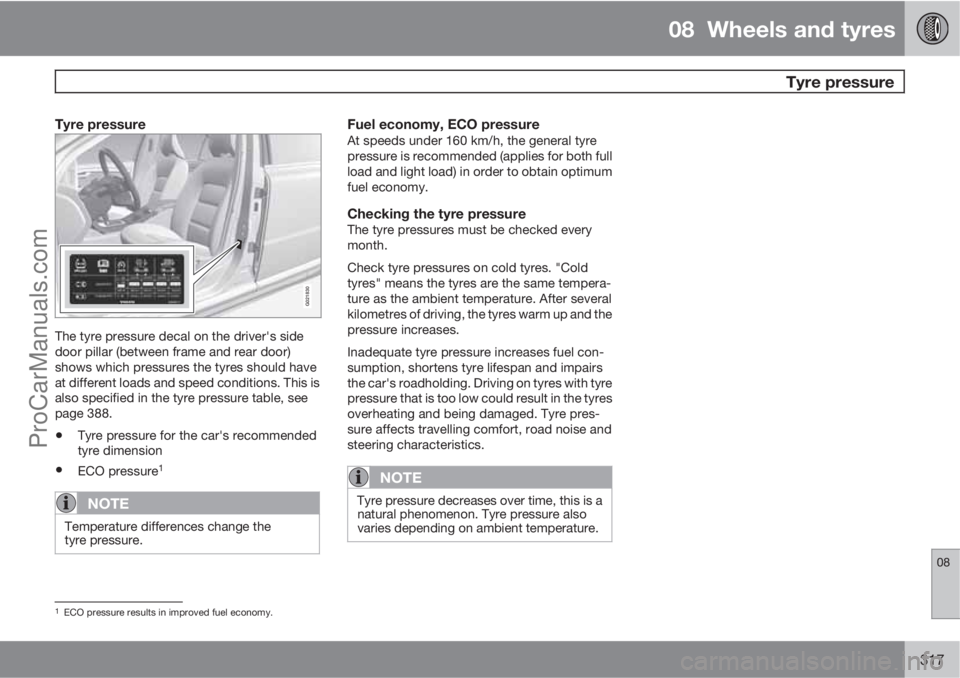
The tyre pressure decal on the driver's side
door pillar (between frame and rear door)
shows which pressures the tyres should have
at different loads and speed conditions. This is
also specified in the tyre pressure table, see
page 388.
•Tyre pressure for the car's recommended
tyre dimension
•ECO pressure1
NOTE
Temperature differences change the
tyre pressure.
Fuel economy, ECO pressureAt speeds under 160 km/h, the general tyre
pressure is recommended (applies for both full
load and light load) in order to obtain optimum
fuel economy.
Checking the tyre pressureThe tyre pressures must be checked every
month.
Check tyre pressures on cold tyres. "Cold
tyres" means the tyres are the same tempera-
ture as the ambient temperature. After several
kilometres of driving, the tyres warm up and the
pressure increases.
Inadequate tyre pressure increases fuel con-
sumption, shortens tyre lifespan and impairs
the car's roadholding. Driving on tyres with tyre
pressure that is too low could result in the tyres
overheating and being damaged. Tyre pres-
sure affects travelling comfort, road noise and
steering characteristics.
NOTE
Tyre pressure decreases over time, this is a
natural phenomenon. Tyre pressure also
varies depending on ambient temperature.
1ECO pressure results in improved fuel economy.
ProCarManuals.com
Page 336 of 422
09 Maintenance and service
Engine compartment 09
334
Filling
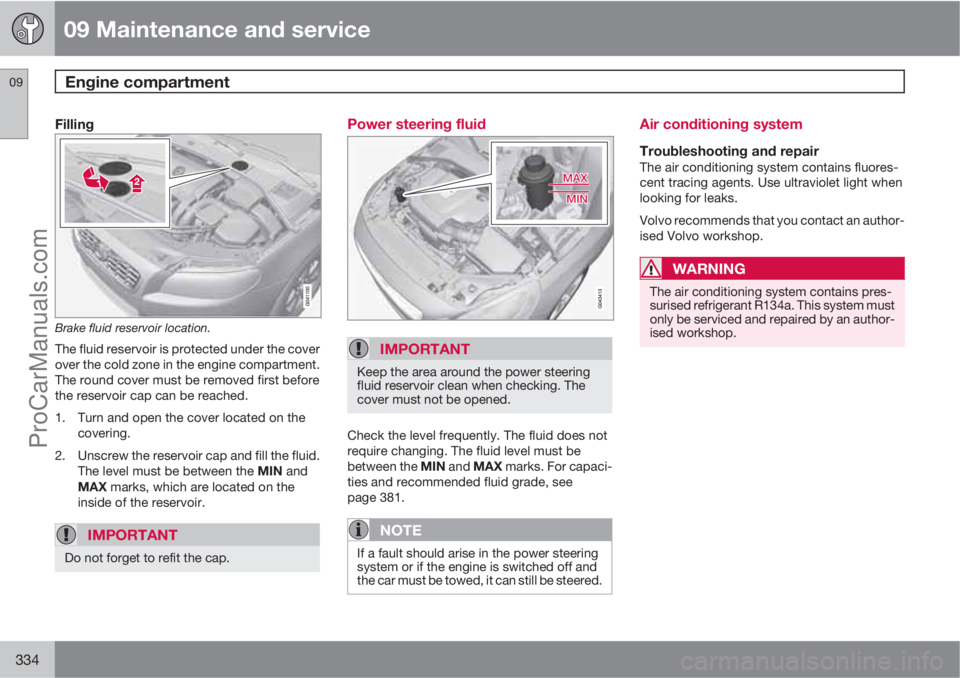
Brake fluid reservoir location.
The fluid reservoir is protected under the cover
over the cold zone in the engine compartment.
The round cover must be removed first before
the reservoir cap can be reached.
1. Turn and open the cover located on the
covering.
2. Unscrew the reservoir cap and fill the fluid.
The level must be between the MIN and
MAX marks, which are located on the
inside of the reservoir.
IMPORTANT
Do not forget to refit the cap.
Power steering fluid
IMPORTANT
Keep the area around the power steering
fluid reservoir clean when checking. The
cover must not be opened.
Check the level frequently. The fluid does not
require changing. The fluid level must be
between the MIN and MAX marks. For capaci-
ties and recommended fluid grade, see
page 381.
NOTE
If a fault should arise in the power steering
system or if the engine is switched off and
the car must be towed, it can still be steered.
Air conditioning system
Troubleshooting and repairThe air conditioning system contains fluores-
cent tracing agents. Use ultraviolet light when
looking for leaks.
Volvo recommends that you contact an author-
ised Volvo workshop.
WARNING
The air conditioning system contains pres-
surised refrigerant R134a. This system must
only be serviced and repaired by an author-
ised workshop.
ProCarManuals.com
Page 365 of 422
09 Maintenance and service
Car care09
363
order to maintain the water-repellent proper-
ties. This should be used first after three years
and then each year.
Rustproofing – inspection and
maintenance
The car received a thorough and complete
rustproofing at the factory. Parts of the body
are made of galvanised sheet metal. The
underbody is protected by a wear-resistant
anti-corrosion compound. A thin, penetrating
rustproofing fluid was sprayed into the
exposed members, cavities, closed sections
and side doors.
Under normal conditions the rustproofing does
not require treatment for approximately 12
years. After this period, it should be treated at
three-year intervals. Volvo recommends that
you engage an authorised Volvo workshop for
assistance if the car needs further treatment.
Dirt and road salt can lead to corrosion so it is
important to keep the car clean. The car's rust-
proofing needs to be checked regularly and
touched-up if necessary in order for it to be
maintained.
Cleaning the interior
Only use cleaning agents and car care prod-
ucts recommended by Volvo. Clean regularly
and follow the instructions included with the
car care product.
Vacuuming is important prior to using cleaning
agents.
Carpets and cargo areaRemove inlaid carpets for separate cleaning of
the floor carpet and the inlaid carpets. Use a
vacuum cleaner to remove dust and dirt.
Each inlay mat is secured with pins.
–Take hold of the inlay mat at each pin and
lift the mat straight up.
Fit the inlay mat in place by pressing it in at
each pin.
WARNING
Before setting off check that the inlaid mat
in the driver area is firmly affixed and
secured in the pins in order to avoid getting
caught adjacent to and under the pedals.
A special textile cleaner is recommended for
stains on the floor mat after vacuuming. Floor
mats should be cleaned with agents recom-
mended by your Volvo dealer!
Stains on fabric upholstery and roof
upholstery
A special fabric cleaning agent, available from
authorised Volvo dealers, is recommended to
avoid impairing the fire retardant qualities of
the upholstery.
IMPORTANT
Sharp objects and Velcro may damage the
fabric upholstery.
Treating stains on leather upholsteryVolvo's leather upholstery is chromium-free
and is treated to preserve its original appear-
ance.
Leather upholstery ages and acquires a beau-
tiful patina over time. The leather is refined and
processed so that it retains its natural charac-
teristics. It is given a protective coating, but
regular cleaning is required in order to maintain
both characteristics and appearance. Volvo
offers a comprehensive product for the clean-
ing and treatment of leather upholstery which,
when used in accordance with the instructions,
preserves the leather's protective coating.
After a period of use the natural appearance of
the leather will nevertheless emerge, depend-
ing more or less on the surface texture of the
leather. This is a natural maturing of the leather
and shows that it is a natural product.
ProCarManuals.com
Page 389 of 422
10 Specifications
Fuel
10
387
There are several reasons for increased fuel
consumption compared with the table's val-
ues. Examples of this are:
•The driver's driving style.
•If the customer has specified wheels larger
than those fitted as standard on the mod-
el's basic version, then resistance increa-
ses.
•High speed results in increased wind resis-
tance.
•Fuel quality, road and traffic conditions,
weather and the condition of the car.
Even a combination of the above-mentioned
examples can result in significantly improved
consumption. For further information, please
refer to the regulations referred to
1.
Large deviations in fuel consumption may arise
in a comparison with the EU driving cycles
1
which are used in the certification of the car
and on which the consumption figures in the
table are based.
To bear in mindTips that the driver can use in order to reduce
consumption:
•Drive gently and avoid unnecessary accel-
eration as well as braking too hard.
•Drive with the correct air pressure in the
tyres and check this regularly - select ECO
tyre pressure for best results, see the tyre
pressure table on page 388.
•Choice of tyres can affect fuel consump-
tion - seek advice on suitable tyres from a
dealer.
See further information and more advice on
pages 12 and 284.
See page 288 for general information on fuel.
1Official fuel consumption figures are based on two standardised driving cycles in a laboratory environment ("EU driving cycles") all in accordance with EU Directive 80/1268/EEC (Euro 4), EU Regulation
no 692/2008 (Euro 5) and UN ECE Regulation no 101. The regulations cover the driving cycles for urban driving and extra-urban driving. - Urban driving - the measurement starts with cold starting
the engine. The driving is simulated. - Extra-urban driving - the car is accelerated and braked at speeds between 0 and 120 km/h. The driving is simulated. - A car with D2, D3, D4 or D5 engine and
6-speed manual gearbox is started in 2nd gear. The combined driving value given in the table is a combination of urban driving and extra-urban driving, in accordance with applicable legislation.
CO
2 emissions - the exhaust gases are collected in order to calculate the carbon dioxide emissions during the two driving cycles. These are then analysed and give the value for CO2 emissions.
ProCarManuals.com
Page 410 of 422
11 Alphabetical Index
11
408
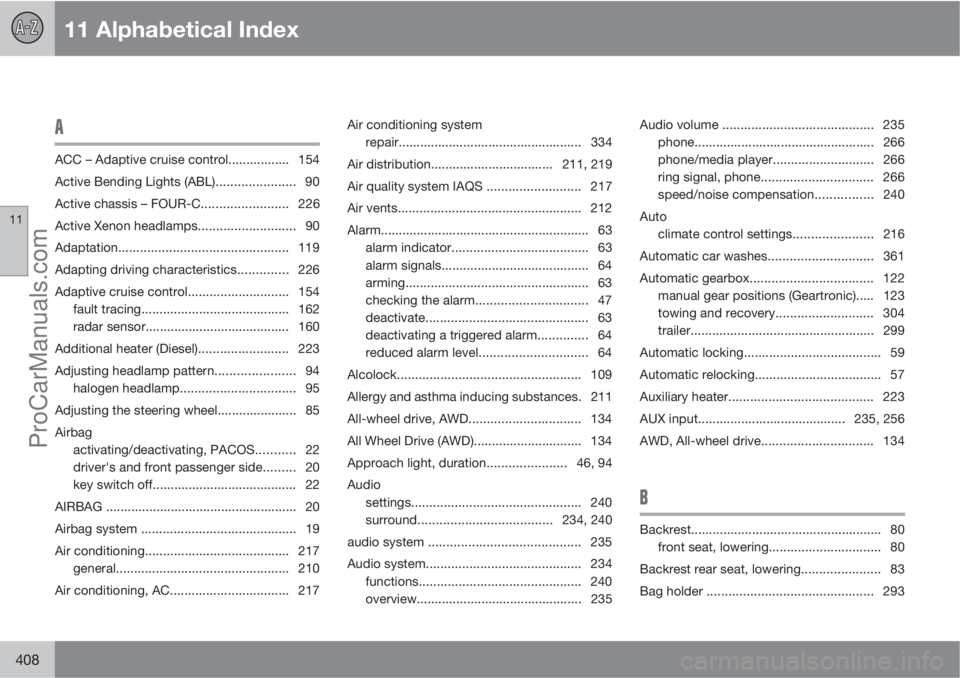
A
ACC – Adaptive cruise control................. 154
Active Bending Lights (ABL)...................... 90
Active chassis – FOUR-C........................226
Active Xenon headlamps........................... 90
Adaptation............................................... 119
Adapting driving characteristics.............. 226
Adaptive cruise control............................ 154
fault tracing......................................... 162
radar sensor........................................ 160
Additional heater (Diesel)......................... 223
Adjusting headlamp pattern...................... 94
halogen headlamp................................ 95
Adjusting the steering wheel...................... 85
Airbag
activating/deactivating, PACOS........... 22
driver's and front passenger side......... 20
key switch off........................................ 22
AIRBAG ..................................................... 20
Airbag system ........................................... 19
Air conditioning........................................ 217
general................................................ 210
Air conditioning, AC................................. 217Air conditioning system
repair................................................... 334
Air distribution.................................. 211, 219
Air quality system IAQS .......................... 217
Air vents................................................... 212
Alarm.......................................................... 63
alarm indicator...................................... 63
alarm signals......................................... 64
arming................................................... 63
checking the alarm............................... 47
deactivate............................................. 63
deactivating a triggered alarm.............. 64
reduced alarm level.............................. 64
Alcolock................................................... 109
Allergy and asthma inducing substances. 211
All-wheel drive, AWD............................... 134
All Wheel Drive (AWD).............................. 134
Approach light, duration......................46, 94
Audio
settings............................................... 240
surround.....................................234, 240
audio system .......................................... 235
Audio system........................................... 234
functions............................................. 240
overview.............................................. 235Audio volume .......................................... 235
phone.................................................. 266
phone/media player............................ 266
ring signal, phone............................... 266
speed/noise compensation................ 240
Auto
climate control settings...................... 216
Automatic car washes.............................361
Automatic gearbox.................................. 122
manual gear positions (Geartronic)..... 123
towing and recovery........................... 304
trailer................................................... 299
Automatic locking...................................... 59
Automatic relocking................................... 57
Auxiliary heater........................................ 223
AUX input......................................... 235, 256
AWD, All-wheel drive............................... 134
B
Backrest..................................................... 80
front seat, lowering............................... 80
Backrest rear seat, lowering...................... 83
Bag holder .............................................. 293
ProCarManuals.com
Page 413 of 422
11 Alphabetical Index
11
411
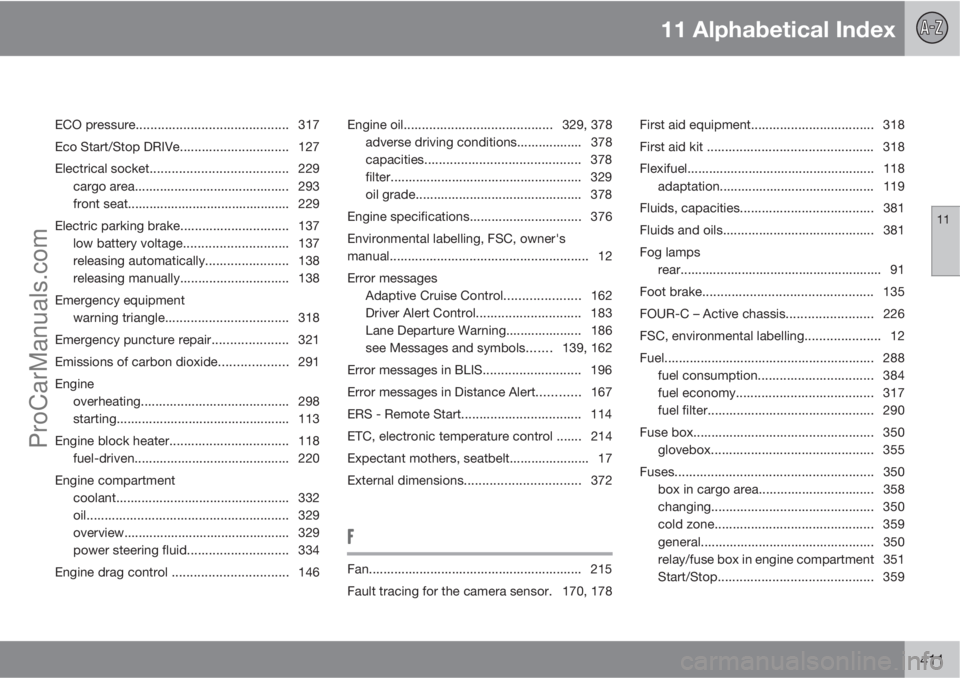
ECO pressure.......................................... 317
Eco Start/Stop DRIVe.............................. 127
Electrical socket......................................229
cargo area........................................... 293
front seat............................................. 229
Electric parking brake.............................. 137
low battery voltage.............................137
releasing automatically....................... 138
releasing manually.............................. 138
Emergency equipment
warning triangle.................................. 318
Emergency puncture repair..................... 321
Emissions of carbon dioxide................... 291
Engine
overheating......................................... 298
starting................................................ 113
Engine block heater................................. 118
fuel-driven........................................... 220
Engine compartment
coolant................................................ 332
oil........................................................ 329
overview.............................................. 329
power steering fluid............................ 334
Engine drag control ................................146Engine oil.........................................329, 378
adverse driving conditions.................. 378
capacities........................................... 378
filter..................................................... 329
oil grade.............................................. 378
Engine specifications............................... 376
Environmental labelling, FSC, owner's
manual.......................................................12
Error messages
Adaptive Cruise Control..................... 162
Driver Alert Control............................. 183
Lane Departure Warning..................... 186
see Messages and symbols.......139, 162
Error messages in BLIS........................... 196
Error messages in Distance Alert............ 167
ERS - Remote Start................................. 114
ETC, electronic temperature control ....... 214
Expectant mothers, seatbelt...................... 17
External dimensions................................372
F
Fan........................................................... 215
Fault tracing for the camera sensor. 170, 178First aid equipment.................................. 318
First aid kit .............................................. 318
Flexifuel.................................................... 118
adaptation........................................... 119
Fluids, capacities..................................... 381
Fluids and oils.......................................... 381
Fog lamps
rear........................................................ 91
Foot brake............................................... 135
FOUR-C – Active chassis........................226
FSC, environmental labelling..................... 12
Fuel.......................................................... 288
fuel consumption................................ 384
fuel economy...................................... 317
fuel filter.............................................. 290
Fuse box.................................................. 350
glovebox............................................. 355
Fuses.......................................................350
box in cargo area................................ 358
changing............................................. 350
cold zone............................................ 359
general................................................ 350
relay/fuse box in engine compartment 351
Start/Stop........................................... 359
ProCarManuals.com