lock VOLVO V60 2013 Owners Manual
[x] Cancel search | Manufacturer: VOLVO, Model Year: 2013, Model line: V60, Model: VOLVO V60 2013Pages: 422, PDF Size: 9.59 MB
Page 4 of 422
Table of contents
2* Option/accessory, for more information, see Introduction.
00
00 Introduction
Important information................................. 6
Volvo and the environment....................... 11
01
01 Safety
Seatbelts .................................................. 16
Airbags...................................................... 19
Activating/deactivating the airbag*........... 22
Side airbags (SIPS bags) ......................... 24
Inflatable Curtain (IC) ............................... 26
WHIPS ...................................................... 27
When the systems deploy ........................ 29
Safety mode.............................................. 30
Child safety............................................... 31
02
02 Locks and alarm
Remote control key/key blade.................. 44
Privacy locking*......................................... 49
Battery replacement, remote control key/
PCC*.........................................................51
Keyless drive*............................................ 53
Locking/unlocking..................................... 57
Child safety locks...................................... 62
Alarm*....................................................... 63
ProCarManuals.com
Page 5 of 422
Table of contents
* Option/accessory, for more information, see Introduction.3
03
03 Your driving environment
Instruments and controls.......................... 68
Volvo Sensus ........................................... 77
Key positions............................................ 78
Seats......................................................... 80
Steering wheel.......................................... 85
Lighting..................................................... 86
Wipers and washing.................................. 98
Windows, rearview and door mirrors...... 101
Compass*............................................... 106
Power sunroof*....................................... 107
Alcolock*................................................. 109
Starting the engine.................................. 113
Starting the engine – Flexifuel.................118
Starting the engine – external battery..... 120
Gearboxes............................................... 121
DRIVe Start/Stop*................................... 127
All-wheel drive – AWD*...........................134
Foot brake............................................... 135
Parking brake.......................................... 137
HomeLink
Ÿ *............................................ 141
04
04 Driver support
DSTC – Stability and traction control sys-
tem.......................................................... 146
Road sign information - RSI*.................. 148
Speed limiter*.......................................... 150
Cruise control*........................................ 152
Adaptive cruise control*.......................... 154
Distance Warning*..................................165
City Safety™........................................... 168
Collision Warning with Auto Brake &
Pedestrian Protection*............................ 173
Driver Alert System*................................ 181
Driver Alert System - DAC*.....................182
Driver Alert System - LDW*..................... 185
Park assist syst*...................................... 188
Park assist camera*................................ 191
BLIS* – Blind Spot Information System. . 194
05
05 Comfort and driving pleasure
Menus and messages............................. 200
Menu source MY CAR............................202
Climate control........................................ 210
Fuel-driven engine block heater and pas-
senger compartment heater*.................. 220
Additional heater*.................................... 223
Trip computer......................................... 224
Adapting driving characteristics............. 226
Comfort inside the passenger compart-
ment........................................................ 227
ProCarManuals.com
Page 14 of 422
Introduction
Volvo and the environment
12* Option/accessory, for more information, see Introduction.
the level of certain unhealthy gases such as
carbon monoxide then the air intake is closed.
Such a situation may arise in heavy traffic,
queues and tunnels for example.
The entry of nitrous oxides, ground-level ozone
and hydrocarbons is prevented by the carbon
filter.
InteriorThe interior of a Volvo is designed to be plea-
sant and comfortable, even for people with
contact allergies and for asthma sufferers.
Extreme attention has been given to choosing
environmentally-compatible materials.
Volvo workshops and the environmentRegular maintenance creates the conditions
for a long service life and low fuel consumption
for your car. In this way you contribute to a
cleaner environment. When Volvo's workshops
are entrusted with the service and mainte-
nance of your car it becomes part of our sys-
tem. Volvo makes clear demands regarding the
way in which our workshops are designed in
order to prevent spills and discharges into the
environment. Our workshop staff have the
knowledge and the tools required to guarantee
good environmental care.
Reducing environmental impactYou can easily help reduce environmental
impact - here are a few tips:
•Avoid letting the engine idle - switch off the
engine when stationary for longer periods.
Pay attention to local regulations.
•Drive economically - think ahead.
•Perform service and maintenance in
accordance with the owner's manual's
instructions - follow the Service and War-
ranty Booklet's recommended intervals.
•If the car is equipped with an engine block
heater*, use it before starting from cold - it
improves starting capacity and reduces
wear in cold weather and the engine rea-
ches normal operating temperature more
quickly, which lowers consumption and
reduces emissions.
•High speed increases consumption con-
siderably due to increased wind resistance
- a doubling of speed increases wind resis-
tance 4 times.
•Always dispose of environmentally hazar-
dous waste, such as batteries and oils, in
an environmentally safe manner. Consult a
workshop in the event of uncertainty about
how this type of waste should be discarded
- an authorised Volvo workshop is recom-
mended.
Following this advice can save money, the
planet's resources are saved, and the car's
durability is extended. For more information
and further advice, see the pages 284 and
384.
RecyclingAs a part of Volvo's environmental work, it is
important that the car is recycled in an envi-
ronmentally sound manner. Almost all of the
car can be recycled. The last owner of the car
is therefore requested to contact a dealer for
referral to a certified/approved recycling
facility.
The owner's manual and the
environment
The Forest Stewardship CouncilŸ symbol
shows that the paper pulp in this publication
comes from FSC
Ÿ certified forests or other
controlled sources.
ProCarManuals.com
Page 18 of 422
01 Safety
Seatbelts 01
16
General information
Heavy braking can have serious consequences
if the seatbelts are not used. Ensure that all
passengers use their seatbelts.
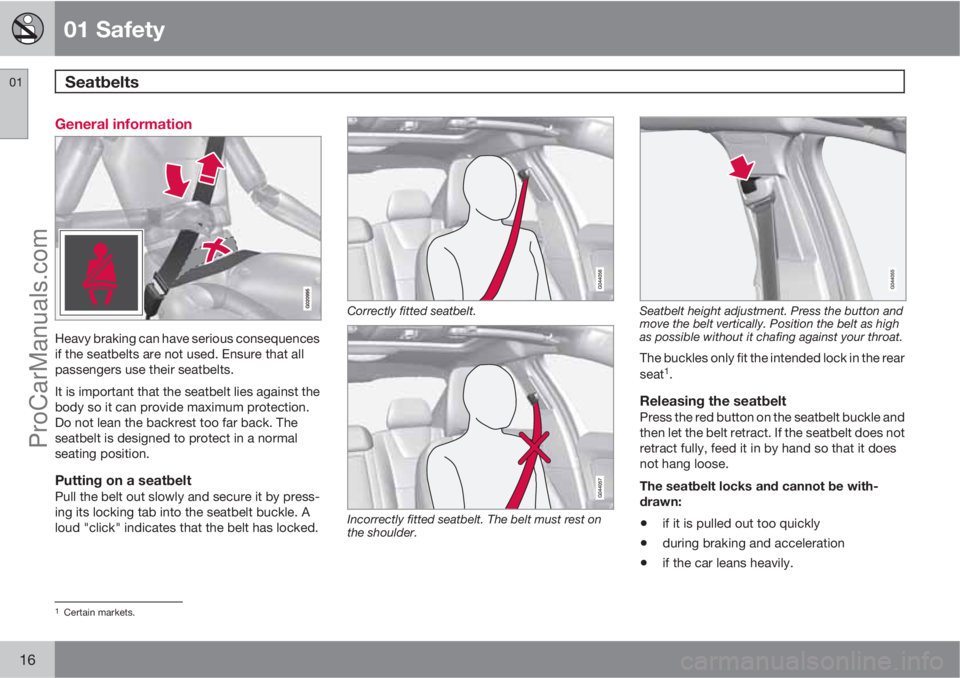
It is important that the seatbelt lies against the
body so it can provide maximum protection.
Do not lean the backrest too far back. The
seatbelt is designed to protect in a normal
seating position.
Putting on a seatbeltPull the belt out slowly and secure it by press-
ing its locking tab into the seatbelt buckle. A
loud "click" indicates that the belt has locked.
Correctly fitted seatbelt.
Incorrectly fitted seatbelt. The belt must rest on
the shoulder.
Seatbelt height adjustment. Press the button and
move the belt vertically. Position the belt as high
as possible without it chafing against your throat.
The buckles only fit the intended lock in the rear
seat1.
Releasing the seatbeltPress the red button on the seatbelt buckle and
then let the belt retract. If the seatbelt does not
retract fully, feed it in by hand so that it does
not hang loose.
The seatbelt locks and cannot be with-
drawn:
•if it is pulled out too quickly
•during braking and acceleration
•if the car leans heavily.
1Certain markets.
ProCarManuals.com
Page 38 of 422
01 Safety
Child safety 01
36* Option/accessory, for more information, see Introduction.
Integrated two-stage booster
cushions*
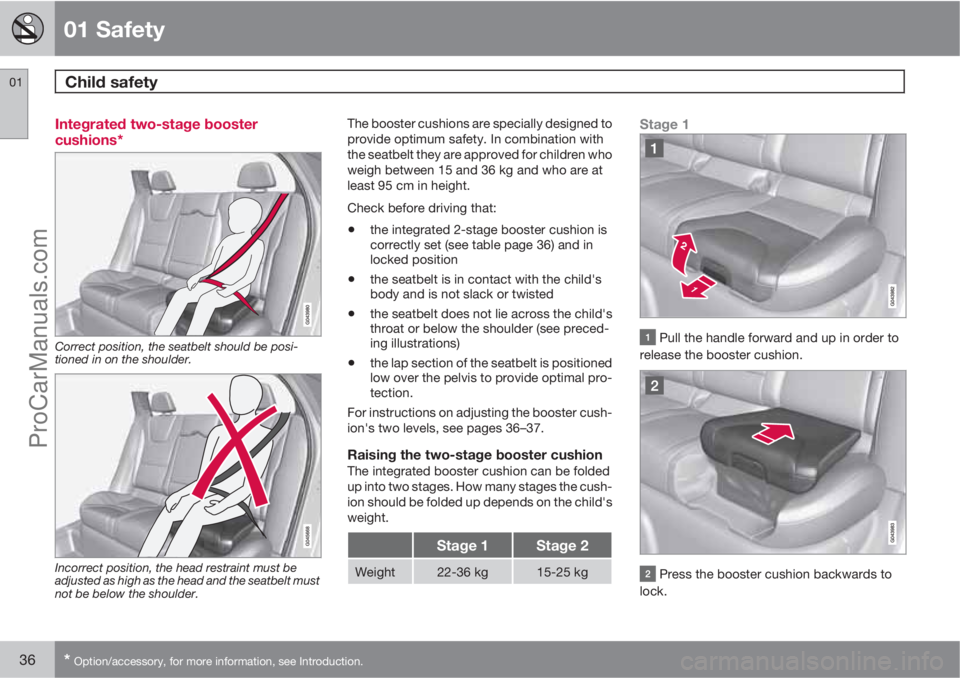
Correct position, the seatbelt should be posi-
tioned in on the shoulder.
Incorrect position, the head restraint must be
adjusted as high as the head and the seatbelt must
not be below the shoulder.
The booster cushions are specially designed to
provide optimum safety. In combination with
the seatbelt they are approved for children who
weigh between 15 and 36 kg and who are at
least 95 cm in height.
Check before driving that:
•the integrated 2-stage booster cushion is
correctly set (see table page 36) and in
locked position
•the seatbelt is in contact with the child's
body and is not slack or twisted
•the seatbelt does not lie across the child's
throat or below the shoulder (see preced-
ing illustrations)
•the lap section of the seatbelt is positioned
low over the pelvis to provide optimal pro-
tection.
For instructions on adjusting the booster cush-
ion's two levels, see pages 36–37.
Raising the two-stage booster cushionThe integrated booster cushion can be folded
up into two stages. How many stages the cush-
ion should be folded up depends on the child's
weight.
Stage 1Stage 2
Weight22-36 kg15-25 kg
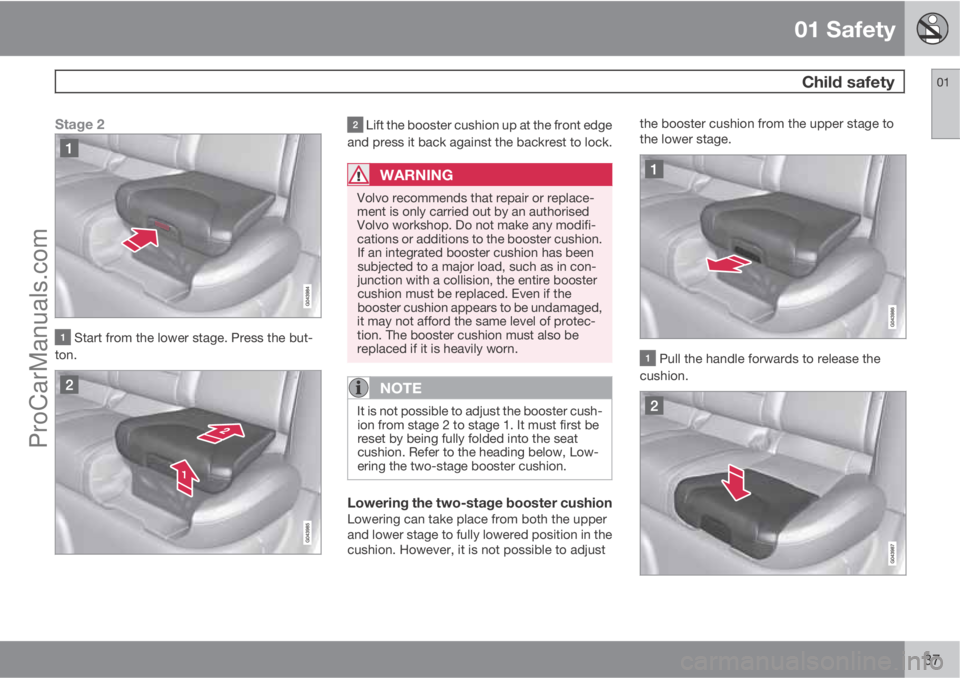
Stage 1
Pull the handle forward and up in order to
release the booster cushion.
Press the booster cushion backwards to
lock.
ProCarManuals.com
Page 39 of 422
01 Safety
Child safety01
37
Stage 2
Start from the lower stage. Press the but-
ton.
Lift the booster cushion up at the front edge
and press it back against the backrest to lock.
WARNING
Volvo recommends that repair or replace-
ment is only carried out by an authorised
Volvo workshop. Do not make any modifi-
cations or additions to the booster cushion.
If an integrated booster cushion has been
subjected to a major load, such as in con-
junction with a collision, the entire booster
cushion must be replaced. Even if the
booster cushion appears to be undamaged,
it may not afford the same level of protec-
tion. The booster cushion must also be
replaced if it is heavily worn.
NOTE
It is not possible to adjust the booster cush-
ion from stage 2 to stage 1. It must first be
reset by being fully folded into the seat
cushion. Refer to the heading below, Low-
ering the two-stage booster cushion.
Lowering the two-stage booster cushionLowering can take place from both the upper
and lower stage to fully lowered position in the
cushion. However, it is not possible to adjustthe booster cushion from the upper stage to
the lower stage.
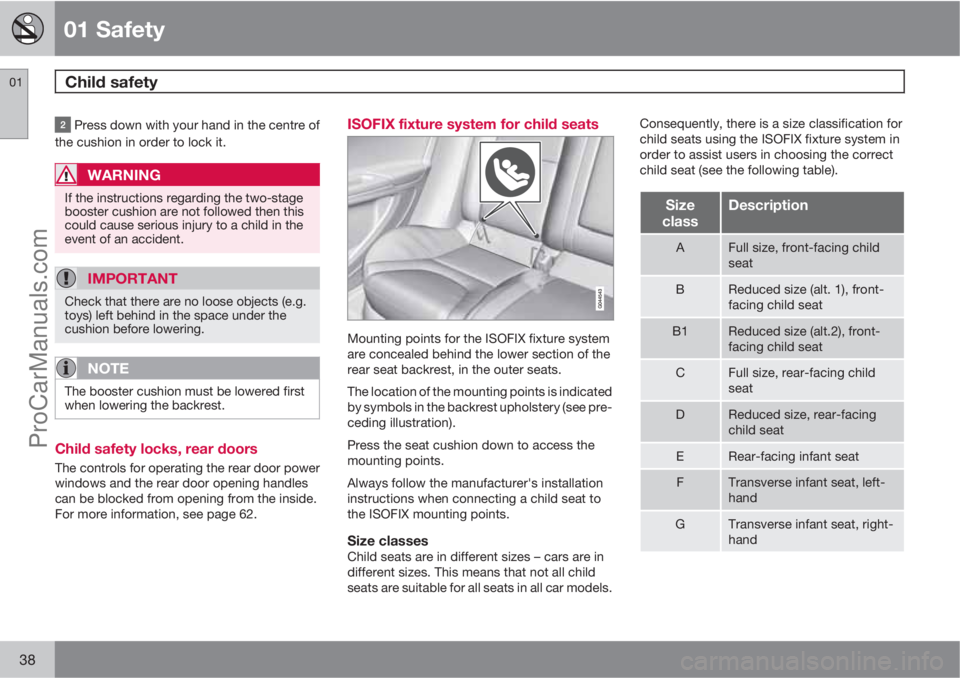
Pull the handle forwards to release the
cushion.
ProCarManuals.com
Page 40 of 422
01 Safety
Child safety 01
38
Press down with your hand in the centre of
the cushion in order to lock it.
WARNING
If the instructions regarding the two-stage
booster cushion are not followed then this
could cause serious injury to a child in the
event of an accident.
IMPORTANT
Check that there are no loose objects (e.g.
toys) left behind in the space under the
cushion before lowering.
NOTE
The booster cushion must be lowered first
when lowering the backrest.
Child safety locks, rear doors
The controls for operating the rear door power
windows and the rear door opening handles
can be blocked from opening from the inside.
For more information, see page 62.
ISOFIX fixture system for child seats
Mounting points for the ISOFIX fixture system
are concealed behind the lower section of the
rear seat backrest, in the outer seats.
The location of the mounting points is indicated
by symbols in the backrest upholstery (see pre-
ceding illustration).
Press the seat cushion down to access the
mounting points.
Always follow the manufacturer's installation
instructions when connecting a child seat to
the ISOFIX mounting points.
Size classesChild seats are in different sizes – cars are in
different sizes. This means that not all child
seats are suitable for all seats in all car models.Consequently, there is a size classification for
child seats using the ISOFIX fixture system in
order to assist users in choosing the correct
child seat (see the following table).
Size
classDescription
AFull size, front-facing child
seat
BReduced size (alt. 1), front-
facing child seat
B1Reduced size (alt.2), front-
facing child seat
CFull size, rear-facing child
seat
DReduced size, rear-facing
child seat
ERear-facing infant seat
FTransverse infant seat, left-
hand
GTransverse infant seat, right-
hand
ProCarManuals.com
Page 44 of 422
42* Option/accessory, for more information, see Introduction.
Remote control key/key blade................................................................ 44
Privacy locking*....................................................................................... 49
Battery replacement, remote control key/PCC*...................................... 51
Keyless drive*.......................................................................................... 53
Locking/unlocking................................................................................... 57
Child safety locks.................................................................................... 62
Alarm*...................................................................................................... 63
ProCarManuals.com
Page 45 of 422
LOCKS AND ALARM
ProCarManuals.com
Page 46 of 422
02 Locks and alarm
Remote control key/key blade
02
44
General
The car is supplied with 2 remote control keys
or PCCs (Personal Car Communicator). They
are used to start the car and for locking and
unlocking.
Additional remote control keys can be ordered
- up to 6 can be programmed and used for the
same car.
The remote control key contains a removable
key blade made of metal. The visible section is
available in two versions so that it is possible
to distinguish between the remote control
keys.
The PCC has increased functionality com-
pared with the remote control key. The contin-
uation of this chapter describes the functions
available in both the PCC and the remote con-
trol key.
WARNING
If there are children in the car:
Remember to switch off the supply to the
power windows and sunroof by removing
the remote control key if the driver leaves
the car.
Loss of a remote control keyIf you lose a remote control key then a new one
can be ordered at a workshop - an authorised
Volvo workshop is recommended. The remain-
ing remote control keys must then be taken to
the workshop. The code of the missing remote
control key must be erased from the system as
a theft prevention measure.
The current number of keys registered to the
car can be checked in the menu system MY
CAR under Information
Number of keys.
For a description of the menu system, see
page 202.
Key memory1 – door mirrors and driver's
seat
The settings are automatically connected to
each respective remote control key, see pages
81 and 103.
The function can be activated/deactivated in
the menu system MY CAR under Settings
Car settingsCar key memory.
For a description of the menu system, see
page 202.
For cars with the Keyless drive system, see
page 53.
Indicator for locking/unlockingWhen the car is locked or unlocked using the
remote control key, the direction indicators
confirm that locking/unlocking was correctly
performed.
•Locking - one flash and the door mirrors
are folded2 in.
•Unlocking - two flashes and the door mir-
rors are folded2 out.
After locking the indication is only given if all
locks have been activated once the doors have
been closed.
Selecting the functionDifferent options for indicating locking/unlock-
ing with light can be set in the car's menu sys-
tem, see page 202.
Search in the menu system MY CAR for
Settings
Car settingsLight settings
and select
Door lock confirmation light and/
or Unlock confirmation light.
1Only in combination with power driver's seat and power mirrors.2Only for cars with retractable power door mirrors.
ProCarManuals.com