engine VOLVO V60 2014 Owners Manual
[x] Cancel search | Manufacturer: VOLVO, Model Year: 2014, Model line: V60, Model: VOLVO V60 2014Pages: 442, PDF Size: 13.85 MB
Page 353 of 442
10 Maintenance and service
10
351
Filling
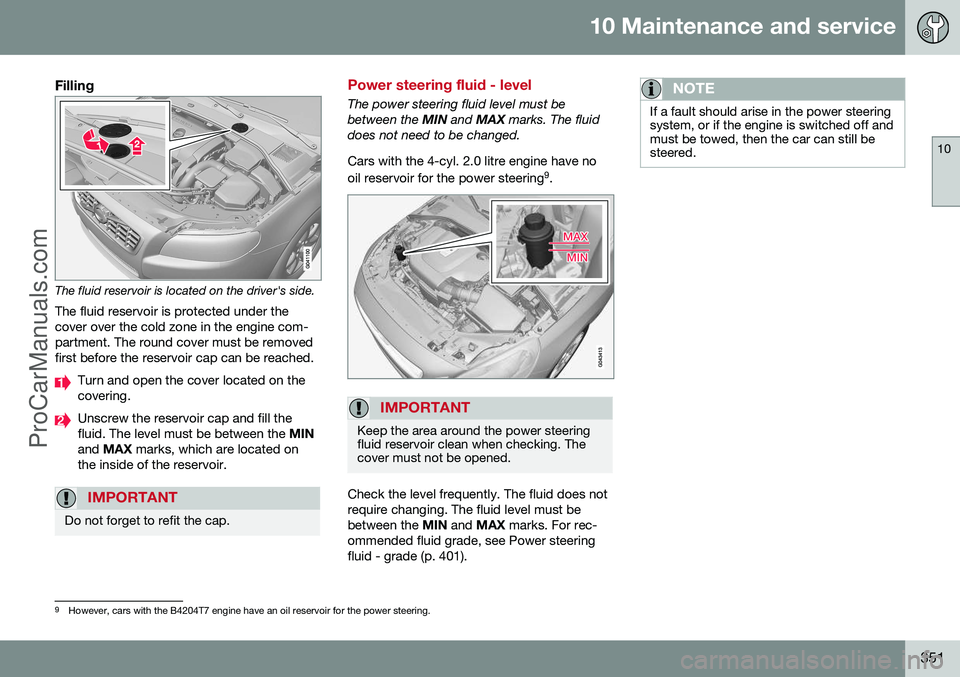
The fluid reservoir is located on the driver's side.The fluid reservoir is protected under the cover over the cold zone in the engine com-partment. The round cover must be removedfirst before the reservoir cap can be reached.
Turn and open the cover located on the covering.
Unscrew the reservoir cap and fill the fluid. The level must be between the MIN
and MAX marks, which are located on
the inside of the reservoir.
IMPORTANT
Do not forget to refit the cap.
Power steering fluid - level
The power steering fluid level must be between the MIN and MAX marks. The fluid
does not need to be changed. Cars with the 4-cyl. 2.0 litre engine have no oil reservoir for the power steering 9
.
IMPORTANT
Keep the area around the power steering fluid reservoir clean when checking. Thecover must not be opened.
Check the level frequently. The fluid does not require changing. The fluid level must bebetween the MIN and MAX marks. For rec-
ommended fluid grade, see Power steeringfluid - grade (p. 401).
NOTE
If a fault should arise in the power steering system, or if the engine is switched off andmust be towed, then the car can still besteered.
9 However, cars with the B4204T7 engine have an oil reservoir for the power steering.
ProCarManuals.co’
Page 355 of 442
10 Maintenance and service
10
353
NOTE
Outside lighting such as headlamps, fog lamps and rear lamps may temporarilyhave condensation on the inside of thelens. This is normal, all exterior lighting isdesigned to withstand this. Condensationis normally vented out of the lamp housingwhen the lamp has been switched on for atime.
Related information
•Lamp replacement - headlamps (p. 353)
• Lamp replacement - location of rear lamps (p. 357)
• Lamp replacement - vanity mirror lighting(p. 358)
• Lamp replacement - lighting in cargo area(p. 357)
• Lamp replacement - number plate lighting(p. 357)
Lamp replacement - headlamps
All of the headlamp bulbs are replaced via the engine compartment. First loosen and removethe whole headlamp.
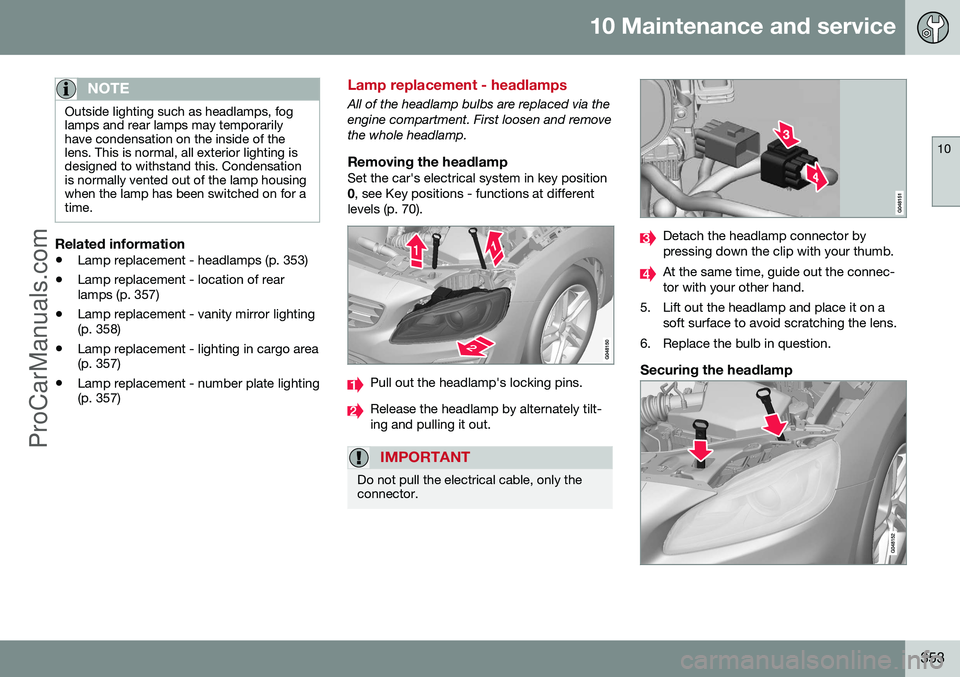
Removing the headlampSet the car's electrical system in key position0
, see Key positions - functions at different
levels (p. 70).
Pull out the headlamp's locking pins.
Release the headlamp by alternately tilt- ing and pulling it out.
IMPORTANT
Do not pull the electrical cable, only the connector.
Detach the headlamp connector by pressing down the clip with your thumb.
At the same time, guide out the connec- tor with your other hand.
5. Lift out the headlamp and place it on a soft surface to avoid scratching the lens.
6. Replace the bulb in question.
Securing the headlamp
ProCarManuals.com
Page 361 of 442
10 Maintenance and service
10
359
LightingWAType
–––
Reversing lamp21P21W LL
Rear fog lamp21H21W LL
A
Watt
Related information
• Lamp replacement (p. 352)
• Lamp replacement - location of rear lamps (p. 357)
• Lamp replacement - vanity mirror lighting(p. 358)
Wiper blades
The wiper blades sweep water away from the windscreen and rear window. Together withthe washer fluid they clean the windows andensure visibility for driving. The windscreen wiper blades must be in serv- ice position when they are to be replaced.
Service position
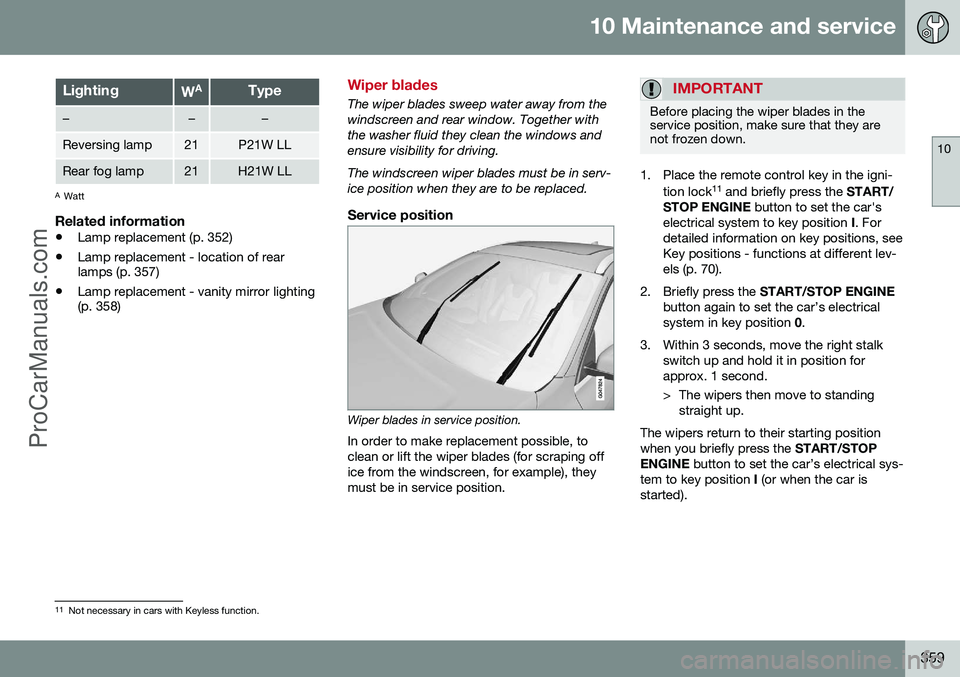
Wiper blades in service position.
In order to make replacement possible, to clean or lift the wiper blades (for scraping office from the windscreen, for example), theymust be in service position.
IMPORTANT
Before placing the wiper blades in the service position, make sure that they arenot frozen down.
1. Place the remote control key in the igni- tion lock 11
and briefly press the START/
STOP ENGINE button to set the car's
electrical system to key position I. For
detailed information on key positions, see Key positions - functions at different lev-els (p. 70).
2. Briefly press the START/STOP ENGINE
button again to set the car’s electricalsystem in key position 0.
3. Within 3 seconds, move the right stalk switch up and hold it in position forapprox. 1 second.
> The wipers then move to standingstraight up.
The wipers return to their starting position when you briefly press the START/STOP
ENGINE button to set the car’s electrical sys-
tem to key position I (or when the car is
started).
11 Not necessary in cars with Keyless function.
ProCarManuals.co’
Page 362 of 442
||
10 Maintenance and service
10
360
IMPORTANT
If the wiper arms in service position have been folded up from the windscreen, theymust be folded back down onto the wind-screen before the wipers are allowed toreturn to their starting position. This is toavoid scraping the paint on the bonnet.
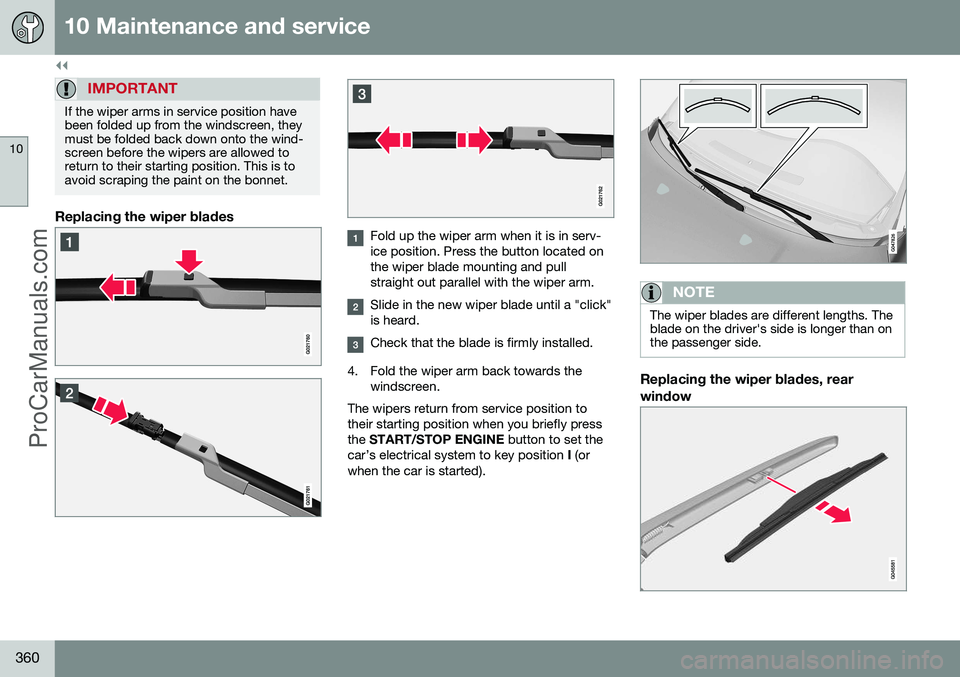
Replacing the wiper blades
Fold up the wiper arm when it is in serv- ice position. Press the button located onthe wiper blade mounting and pullstraight out parallel with the wiper arm.
Slide in the new wiper blade until a "click" is heard.
Check that the blade is firmly installed.
4. Fold the wiper arm back towards the windscreen.
The wipers return from service position to their starting position when you briefly pressthe START/STOP ENGINE button to set the
car’s electrical system to key position I (or
when the car is started).
NOTE
The wiper blades are different lengths. The blade on the driver's side is longer than onthe passenger side.
Replacing the wiper blades, rear window
ProCarManuals.com
Page 363 of 442
10 Maintenance and service
10
361
1. Fold out the wiper arm.
2. Grip the inner section of the blade (by the arrow).
3. Turn anticlockwise to use the blade's end position against the wiper arm as a lever to detach the blade more easily.
4. Press the new wiper blade into position. Check that it is firmly installed.
5. Lower the wiper arm.
CleaningFor cleaning wiper blades and windscreen,see Car washing (p. 379).
IMPORTANT
Check the blades regularly. Neglected maintenance shortens the service life ofthe wiper blades.
Related information
• Washer fluid - filling (p. 361)
Washer fluid - filling
Washer fluid is used for cleaning the head- lamps and windows. Washer fluid with anti-freeze must be used during winter.
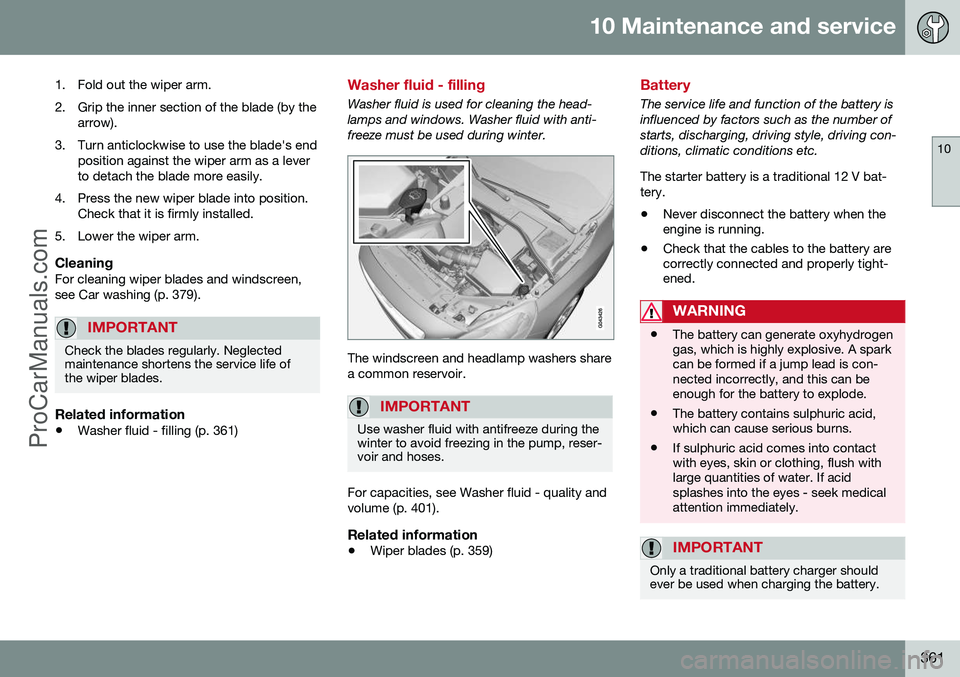
The windscreen and headlamp washers share a common reservoir.
IMPORTANT
Use washer fluid with antifreeze during the winter to avoid freezing in the pump, reser-voir and hoses.
For capacities, see Washer fluid - quality and volume (p. 401).
Related information
•Wiper blades (p. 359)
Battery
The service life and function of the battery is influenced by factors such as the number ofstarts, discharging, driving style, driving con-ditions, climatic conditions etc. The starter battery is a traditional 12 V bat- tery.
• Never disconnect the battery when the engine is running.
• Check that the cables to the battery arecorrectly connected and properly tight-ened.
WARNING
•The battery can generate oxyhydrogen gas, which is highly explosive. A sparkcan be formed if a jump lead is con-nected incorrectly, and this can beenough for the battery to explode.
• The battery contains sulphuric acid,which can cause serious burns.
• If sulphuric acid comes into contactwith eyes, skin or clothing, flush withlarge quantities of water. If acidsplashes into the eyes - seek medicalattention immediately.
IMPORTANT
Only a traditional battery charger should ever be used when charging the battery.
ProCarManuals.co’
Page 367 of 442
10 Maintenance and service
10
* Option/accessory, for more information, see Introduction.365
For more information on the car's battery - Electrical system (p. 410).
Battery - Start/Stop
Cars with the Start/Stop function are equip- ped with two 12 V batteries - one extra pow-erful battery for starting and one support bat-tery that helps during the Start/Stop func-tion's starting sequence. For more information on Start/Stop - see Start/Stop* (p. 279). For more information on the car's battery - see Jump starting with battery (p. 270) andStarter battery - specification (p. 411).
BatteryStartingAuxiliary
Cold start capacity
A
,
CCA (A)760180
Size B
,
L×W×H (mm)278×175×190150×90×130
Capacity (Ah)7010
A In accordance with the SAE standard.
B Largest possible size.
IMPORTANT
When replacing batteries in cars with the Start/Stop function, the AGM 12
type bat-
teries must be fitted.
NOTE
• The higher the current take-off in the car (extra cooling/heating, etc.) themore the batteries must be charged =increased fuel consumption.
• When the capacity of the battery hasfallen below the lowest permissiblelevel then the Start/Stop function isdisengaged.
Temporarily reduced Start/Stop function due to high current take-off means: •
The engine starts automatically 13
without
the driver depressing the clutch pedal (manual gearbox).
• The engine starts automatically withoutthe driver lifting his/her foot off the footbrake pedal (automatic gearbox).
12
Absorbed Glass Mat
13 Automatic starting can only take place if the gear lever is in neutral position.
ProCarManuals.co’
Page 368 of 442
||
10 Maintenance and service
10
366
Location of the batteries
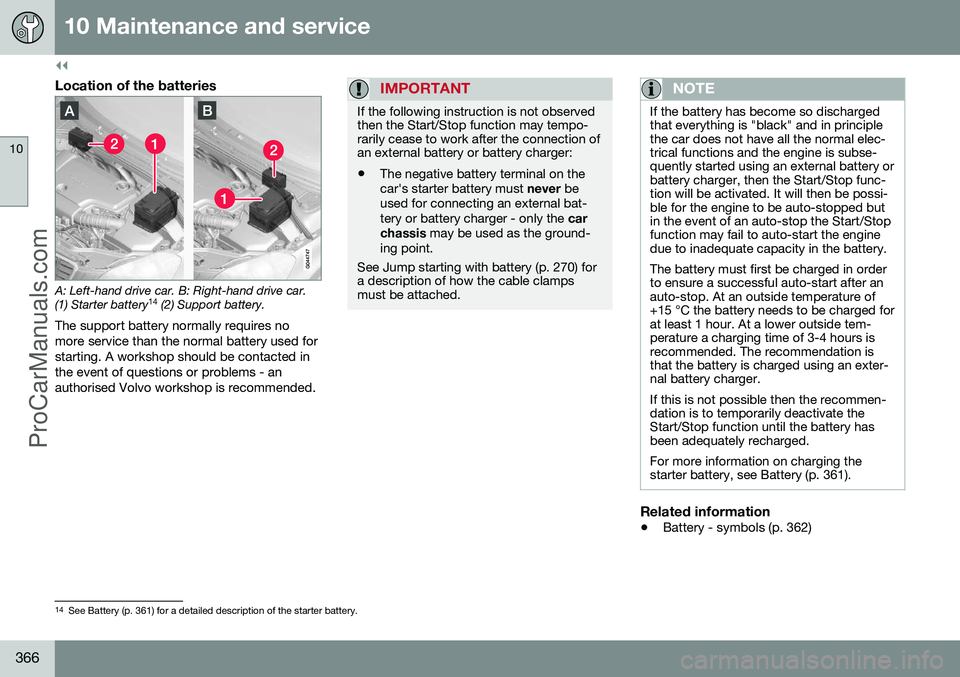
A: Left-hand drive car. B: Right-hand drive car. (1) Starter battery14
(2) Support battery.
The support battery normally requires no more service than the normal battery used forstarting. A workshop should be contacted inthe event of questions or problems - anauthorised Volvo workshop is recommended.
IMPORTANT
If the following instruction is not observed then the Start/Stop function may tempo-rarily cease to work after the connection ofan external battery or battery charger:
• The negative battery terminal on the car's starter battery must
never be
used for connecting an external bat-tery or battery charger - only the car
chassis may be used as the ground-
ing point.
See Jump starting with battery (p. 270) for a description of how the cable clampsmust be attached.
NOTE
If the battery has become so discharged that everything is "black" and in principlethe car does not have all the normal elec-trical functions and the engine is subse-quently started using an external battery orbattery charger, then the Start/Stop func-tion will be activated. It will then be possi-ble for the engine to be auto-stopped butin the event of an auto-stop the Start/Stopfunction may fail to auto-start the enginedue to inadequate capacity in the battery. The battery must first be charged in order to ensure a successful auto-start after anauto-stop. At an outside temperature of+15 °C the battery needs to be charged forat least 1 hour. At a lower outside tem-perature a charging time of 3-4 hours isrecommended. The recommendation isthat the battery is charged using an exter-nal battery charger. If this is not possible then the recommen- dation is to temporarily deactivate theStart/Stop function until the battery hasbeen adequately recharged. For more information on charging the starter battery, see Battery (p. 361).
Related information
• Battery - symbols (p. 362)
14
See Battery (p. 361) for a detailed description of the starter battery.
ProCarManuals.co’
Page 369 of 442
10 Maintenance and service
10
367
Fuses - general
All electrical functions and components are protected by a number of fuses in order toprotect the car's electrical system from dam-age by short circuiting or overloading. If an electrical component or function does not work, it may be because the component'sfuse was temporarily overloaded and failed. Ifthe same fuse fails repeatedly then there is afault in the circuit. Volvo recommends thatyou visit an authorised Volvo workshop forchecking.
Changing1. Look in the fuse diagram to locate thefuse.
2. Pull out the fuse and check from the side to see whether the curved wire hasblown.
3. If this is the case, replace it with a new fuse of the same colour and amperage.
WARNING
Never use a foreign object or a fuse with an amperage higher than that specifiedwhen replacing a fuse. This could causesignificant damage to the electrical systemand possibly lead to fire.
Location of central electrical units
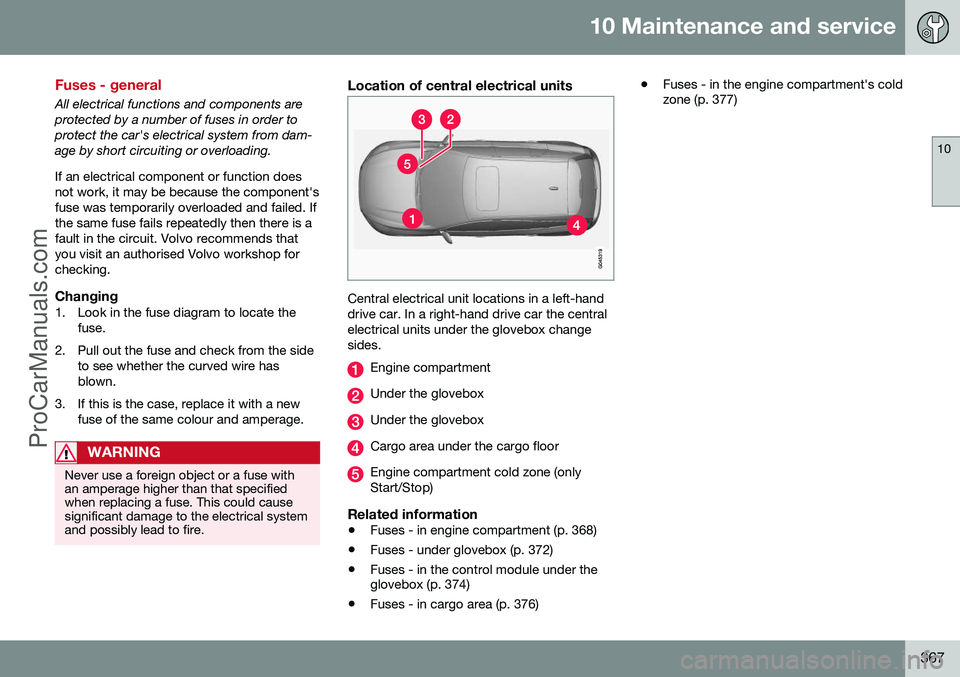
Central electrical unit locations in a left-hand drive car. In a right-hand drive car the centralelectrical units under the glovebox changesides.
Engine compartment
Under the glovebox
Under the glovebox
Cargo area under the cargo floor
Engine compartment cold zone (only Start/Stop)
Related information
• Fuses - in engine compartment (p. 368)
• Fuses - under glovebox (p. 372)
• Fuses - in the control module under the glovebox (p. 374)
• Fuses - in cargo area (p. 376) •
Fuses - in the engine compartment's coldzone (p. 377)
ProCarManuals.co’
Page 370 of 442
10 Maintenance and service
10
368
Fuses - in engine compartment
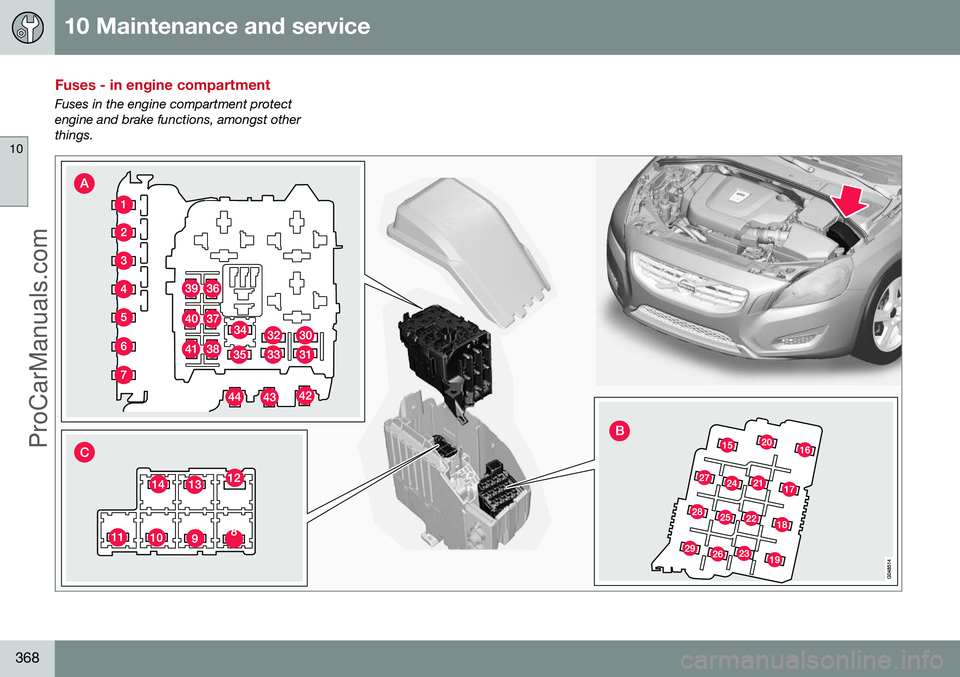
Fuses in the engine compartment protect engine and brake functions, amongst otherthings.
ProCarManuals.com
Page 371 of 442
10 Maintenance and service
10
}}
* Option/accessory, for more information, see Introduction.369
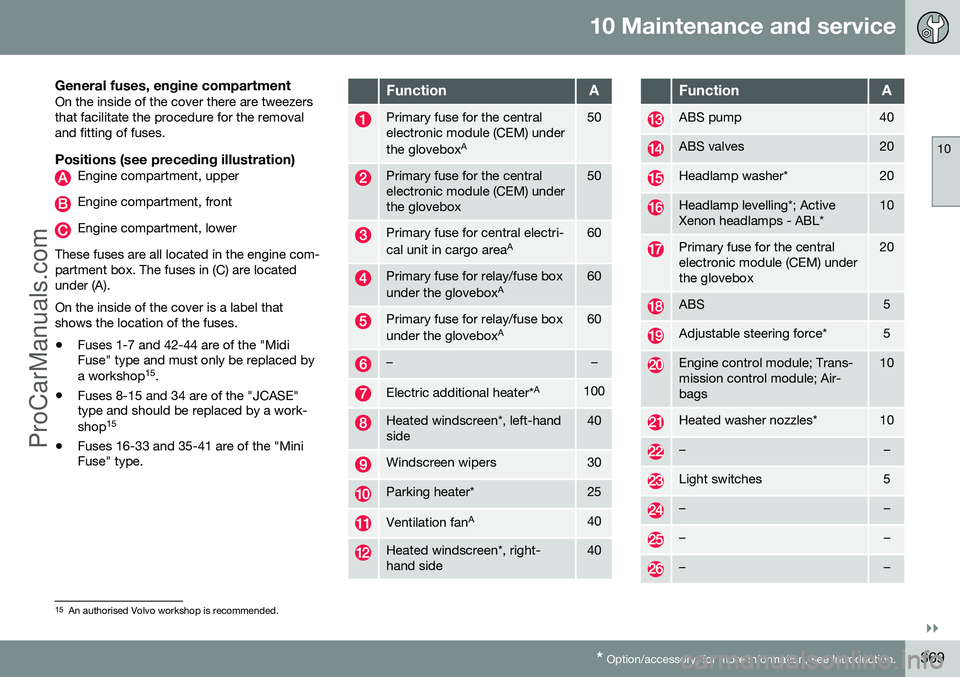
General fuses, engine compartmentOn the inside of the cover there are tweezers that facilitate the procedure for the removaland fitting of fuses.
Positions (see preceding illustration)Engine compartment, upper
Engine compartment, front
Engine compartment, lower
These fuses are all located in the engine com- partment box. The fuses in (C) are locatedunder (A). On the inside of the cover is a label that shows the location of the fuses. • Fuses 1-7 and 42-44 are of the "Midi Fuse" type and must only be replaced by a workshop 15
.
• Fuses 8-15 and 34 are of the "JCASE" type and should be replaced by a work- shop 15
• Fuses 16-33 and 35-41 are of the "Mini Fuse" type.
FunctionA
Primary fuse for the central electronic module (CEM) under the glovebox A50
Primary fuse for the central electronic module (CEM) underthe glovebox50
Primary fuse for central electri- cal unit in cargo area
A60
Primary fuse for relay/fuse box under the gloveboxA60
Primary fuse for relay/fuse box under the gloveboxA60
––
Electric additional heater* A100
Heated windscreen*, left-hand side40
Windscreen wipers30
Parking heater*25
Ventilation fanA40
Heated windscreen*, right- hand side40
FunctionA
ABS pump40
ABS valves20
Headlamp washer*20
Headlamp levelling*; Active Xenon headlamps - ABL*10
Primary fuse for the central electronic module (CEM) underthe glovebox20
ABS5
Adjustable steering force*5
Engine control module; Trans- mission control module; Air-bags10
Heated washer nozzles*10
––
Light switches5
––
––
––
15
An authorised Volvo workshop is recommended.
ProCarManuals.co’