ABS VOLVO V60 2014 User Guide
[x] Cancel search | Manufacturer: VOLVO, Model Year: 2014, Model line: V60, Model: VOLVO V60 2014Pages: 442, PDF Size: 13.85 MB
Page 253 of 442
07 Driver support
07
}}
* Option/accessory, for more information, see Introduction.251
Park Assist Pilot (PAP)* - limitations
The Park Assist Pilot (PAP – Park Assist Pilot) helps the driver to park by first checkingwhether a space is sufficiently large and thenturning the steering wheel and steering thecar into the space. The combined instrumentpanel uses symbols, graphics and text toshow when different operations should beperformed. The PAP sequence is stopped:
• if the car is driven too quickly - above 7 km/h
• if the driver touches the steering wheel
• if the ABS or DSTC function is enabled -e.g. if a wheel loses grip on a slipperyroad surface.
A text message indicates why the PAP sequence was stopped.
NOTE
Dirt, ice and snow covering the sensors will reduce their function and may preventmeasurement.
IMPORTANT
Under certain circumstances, PAP is unable to find parking spaces - one reasonfor this may be the fact that there is inter-ference with the sensors from externalsound sources which emit the same ultra-sound frequencies as those with which thesystem works. Examples of such sources include horns, wet tyres on asphalt, pneumatic brakesand exhaust noises from motorcycles etc.
To bear in mindThe driver should bear in mind that the Park Assist Pilot is an aid - not an infallible, fully-automatic function. The driver must thereforebe prepared to intervene. There are also sev-eral details to bear in mind while parking, e.g.:
• PAP starts out from the current location of the parked vehicles - if they are inap-propriately parked then the car's tyresand wheel rims may be damaged againstkerbs.
• PAP is designed for parking on straightstreets - not sharp bends or turns in theroad. For this reason, make sure the caris parallel to the parking space when PAPmeasures the space.
• It is not always possible to find parkingspaces on narrow streets since there isnot enough space for manoeuvring. Insuch parking situations, it helps the sys- tem to drive as close to the side of theroad as possible where you intend topark.
• Bear in mind that the front of the car mayswing out towards oncoming traffic whilebeing parked.
• Objects situated higher than the detectionarea of the sensors are not included whencalculations are made for the parkingmanoeuvre. This may cause PAP toswing into the parking space too early -for this reason, such parking spacesshould be avoided.
• The driver is responsible for determiningwhether the space selected by PAP issuitable for parking.
• Use approved tyres 24
with the correct tyre
pressure - this affects PAP's ability topark the car.
• Heavy rain or snow may cause the sys-tem to measure the parking space incor-rectly.
• Do not use PAP if snow chains or the
spare wheel are fitted.
• Do not use PAP if loaded objects are pro-truding from the car.
24
"Approved tyres" refers to tyres of the same type and make as those fitted new on delivery from the factory.
ProCarManuals.co’
Page 293 of 442
08 Starting and driving
08
291
WARNING
If and illuminate at the same
time, there may be a fault in the brake sys- tem. If the level in the brake fluid reservoir is normal at this stage, drive carefully to thenearest workshop and have the brake sys-tem checked - an authorised Volvo work-shop is recommended. If the brake fluid is below the MIN level in
the brake fluid reservoir, do not drive fur- ther before topping up the brake fluid. The reason for the loss of brake fluid must be investigated.
Related information
• Parking brake (p. 293)
• Foot brake - emergency brake lights and automatic hazard warning flashers (p.291)
• Foot brake - emergency brake assistance(p. 292)
• Foot brake - anti-lock braking system (p.291)
Foot brake - anti-lock braking system
The anti-lock braking system, ABS (Anti-lock Braking System), prevents the wheels fromlocking up during braking. The function allows steering ability to be maintained, and it is easier to swerve to avoida hazard for example. Vibration may be felt inthe brake pedal when this is engaged and thisis normal. A short test of the ABS system is made auto- matically after the engine has been startedwhen the driver releases the brake pedal. Afurther automatic test of the ABS system maybe made when the car reaches 10 km/h. Thetest may be experienced as pulses in thebrake pedal.
Related information
•Foot brake (p. 290)
• Parking brake (p. 293)
• Foot brake - emergency brake lights and automatic hazard warning flashers (p.291)
• Foot brake - emergency brake assistance(p. 292)
Foot brake - emergency brake lights and automatic hazard warningflashers
Emergency brake lights are activated to alert vehicles behind about sudden braking. Thefunction means that the brake light flashesinstead of - as in normal braking - shining witha constant glow. Emergency brake lights are activated at speeds above 50 km/h in the event of suddenbraking. After the car's speed has beenslowed below 10 km/h the brake light returnsfrom flashing to the normal constant glow -while at the same time the hazard warningflashers (p. 86) are activated, and they flashuntil the driver changes engine speed with theaccelerator pedal or they are deactivated withtheir button.
Related information
•Foot brake (p. 290)
• Parking brake (p. 293)
• Foot brake - emergency brake assistance (p. 292)
• Foot brake - anti-lock braking system (p.291)
ProCarManuals.co’
Page 294 of 442
08 Starting and driving
08
292
Foot brake - emergency brake assistance
Emergency brake assistance EBA (Emergency Brake Assist) helps to increase the brakingforce and so reduce the braking distance. EBA detects the driver's braking style and increases the braking force when necessary.The brake force can be reinforced up to thelevel when the ABS system is engaged. TheEBA function is interrupted when the pressureon the brake pedal is reduced.
NOTE
When EBA is activated the brake pedal lowers slightly more than usual, depress(hold) the brake pedal as long as neces-sary. If the brake pedal is released then allbraking ceases.
Related information
•Foot brake (p. 290)
• Parking brake (p. 293)
• Foot brake - emergency brake lights and automatic hazard warning flashers (p.291)
• Foot brake - anti-lock braking system (p.291)
ProCarManuals.co’
Page 309 of 442
08 Starting and driving
08
* Option/accessory, for more information, see Introduction.307
•
Do not tow a heavy trailer when the car is brand new. Wait until it has been drivenat least 1000 km.
• The brakes are loaded much more thanusual on long and steep downhill slopes.Downshift to a lower gear and adjust yourspeed.
• For safety reasons, the maximum permit-ted speed for the car when coupled witha trailer should not be exceeded. Followthe regulations in force for the permittedspeeds and weights.
• Maintain a low speed when driving with atrailer up long, steep ascents.
• Avoid driving with a trailer on inclines ofmore than 12%.
Trailer cableAn adapter is required if the car's towing bracket has 13 pin electrics and the trailerhas 7 pin electrics. Use an adapter cableapproved by Volvo. Make sure the cable doesnot drag on the ground.
Direction indicators and brake lights on
the trailer
If any of the trailer's lamps for direction indi-cators are broken, then the combined instru-ment panel's symbol for direction indicatorsflashes faster than normal and the information display shows the text
Bulb fail - Ind. signal
trailer. If any of the trailer's lamps for the brake light are broken then the
Bulb fail - Stop lamp
trailer text is shown.
Level control*The rear shock absorbers maintain a constant height irrespective of the car's load (up to themaximum permissible weight). When the caris stationary the rear of the car lowers slightly,which is normal.
Trailer weightsFor information on Volvo's permitted trailerweights, see Towing capacity and towballload (p. 391).
NOTE
The stated maximum permitted trailer weights are those permitted by Volvo.National vehicle regulations can furtherlimit trailer weights and speeds. Towbarscan be certified for higher towing weightsthan the car can actually tow.
WARNING
Follow the stated recommendations for trailer weights. Otherwise, the car andtrailer may be difficult to control in theevent of sudden movement and braking.
Related information
• Driving with a trailer - manual gearbox (p. 308)
• Driving with a trailer - automatic gearbox(p. 308)
• Towing bracket/Towbar (p. 309)
• Lamp replacement (p. 352)
ProCarManuals.co’
Page 367 of 442
10 Maintenance and service
10
* Option/accessory, for more information, see Introduction.365
For more information on the car's battery - Electrical system (p. 410).
Battery - Start/Stop
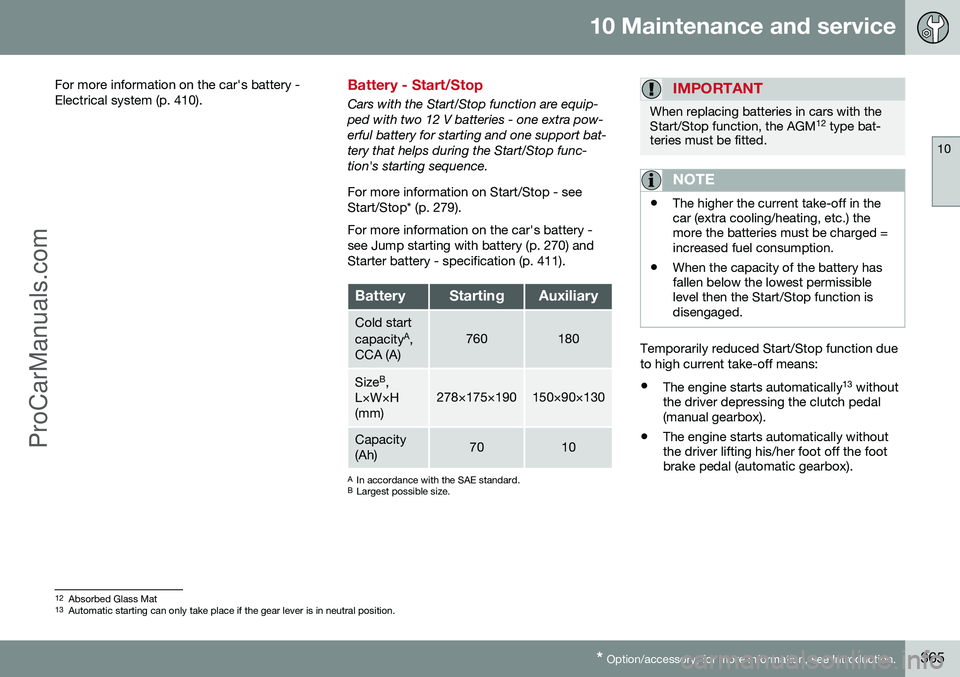
Cars with the Start/Stop function are equip- ped with two 12 V batteries - one extra pow-erful battery for starting and one support bat-tery that helps during the Start/Stop func-tion's starting sequence. For more information on Start/Stop - see Start/Stop* (p. 279). For more information on the car's battery - see Jump starting with battery (p. 270) andStarter battery - specification (p. 411).
BatteryStartingAuxiliary
Cold start capacity
A
,
CCA (A)760180
Size B
,
L×W×H (mm)278×175×190150×90×130
Capacity (Ah)7010
A In accordance with the SAE standard.
B Largest possible size.
IMPORTANT
When replacing batteries in cars with the Start/Stop function, the AGM 12
type bat-
teries must be fitted.
NOTE
• The higher the current take-off in the car (extra cooling/heating, etc.) themore the batteries must be charged =increased fuel consumption.
• When the capacity of the battery hasfallen below the lowest permissiblelevel then the Start/Stop function isdisengaged.
Temporarily reduced Start/Stop function due to high current take-off means: •
The engine starts automatically 13
without
the driver depressing the clutch pedal (manual gearbox).
• The engine starts automatically withoutthe driver lifting his/her foot off the footbrake pedal (automatic gearbox).
12
Absorbed Glass Mat
13 Automatic starting can only take place if the gear lever is in neutral position.
ProCarManuals.co’
Page 371 of 442
10 Maintenance and service
10
}}
* Option/accessory, for more information, see Introduction.369
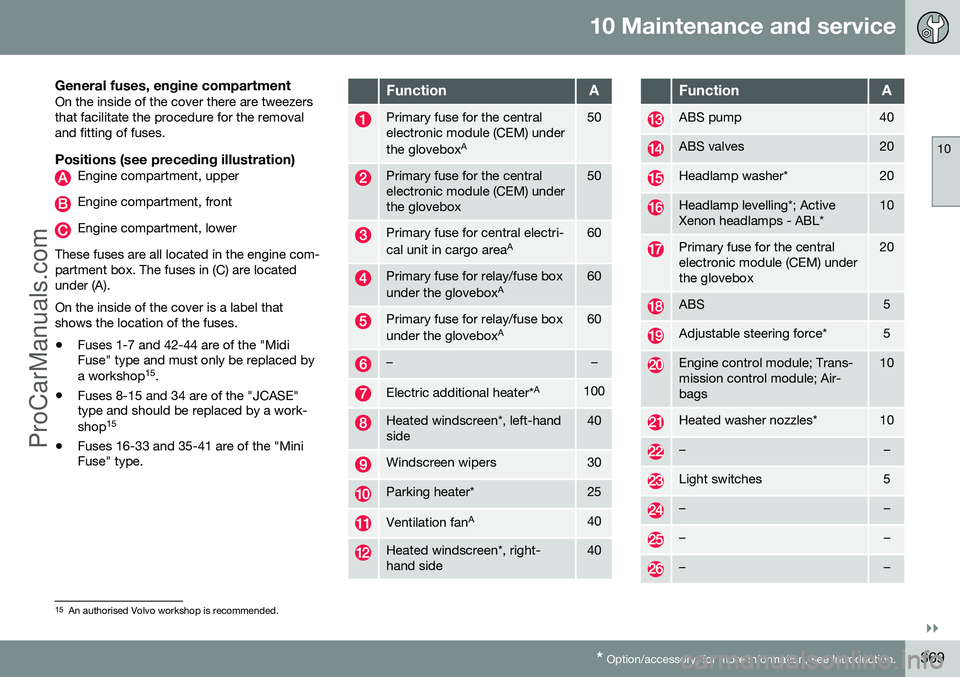
General fuses, engine compartmentOn the inside of the cover there are tweezers that facilitate the procedure for the removaland fitting of fuses.
Positions (see preceding illustration)Engine compartment, upper
Engine compartment, front
Engine compartment, lower
These fuses are all located in the engine com- partment box. The fuses in (C) are locatedunder (A). On the inside of the cover is a label that shows the location of the fuses. • Fuses 1-7 and 42-44 are of the "Midi Fuse" type and must only be replaced by a workshop 15
.
• Fuses 8-15 and 34 are of the "JCASE" type and should be replaced by a work- shop 15
• Fuses 16-33 and 35-41 are of the "Mini Fuse" type.
FunctionA
Primary fuse for the central electronic module (CEM) under the glovebox A50
Primary fuse for the central electronic module (CEM) underthe glovebox50
Primary fuse for central electri- cal unit in cargo area
A60
Primary fuse for relay/fuse box under the gloveboxA60
Primary fuse for relay/fuse box under the gloveboxA60
––
Electric additional heater* A100
Heated windscreen*, left-hand side40
Windscreen wipers30
Parking heater*25
Ventilation fanA40
Heated windscreen*, right- hand side40
FunctionA
ABS pump40
ABS valves20
Headlamp washer*20
Headlamp levelling*; Active Xenon headlamps - ABL*10
Primary fuse for the central electronic module (CEM) underthe glovebox20
ABS5
Adjustable steering force*5
Engine control module; Trans- mission control module; Air-bags10
Heated washer nozzles*10
––
Light switches5
––
––
––
15
An authorised Volvo workshop is recommended.
ProCarManuals.co’
Page 384 of 442
||
10 Maintenance and service
10
382
Stains on fabric upholstery and roof
upholstery
A special fabric cleaning agent, available from authorised Volvo dealers, is recommended toavoid impairing the fire retardant qualities ofthe upholstery.
IMPORTANT
Sharp objects and Velcro may damage the fabric upholstery.
Stains on leather upholsteryVolvo's leather upholstery is treated to pre- serve its original appearance. Leather upholstery ages and acquires a beau- tiful patina over time. The leather is refinedand processed so that it retains its naturalcharacteristics. It is given a protective coa-ting, but regular cleaning is required in orderto maintain both characteristics and appear-ance. Volvo offers a comprehensive productfor the cleaning and treatment of leatherupholstery which, when used in accordancewith the instructions, preserves the leather'sprotective coating. After a period of use thenatural appearance of the leather will never-theless emerge, depending more or less onthe surface texture of the leather. This is anatural maturing of the leather and showsthat it is a natural product. To achieve best results Volvo recommendscleaning and the application of protectivecream once to four times per year (or more ifnecessary). The Volvo Leather Care kit isavailable from your Volvo dealer.
IMPORTANT
•
Certain items of coloured clothing (for example, jeans and suede garments)may stain the upholstery.
• Never use strong solvents. Such prod-ucts may damage fabric, vinyl andleather upholstery.
Washing instructions for leather upholstery
1. Pour the leather cleaner on the damp-
ened sponge and squeeze out a strong foam.
2. Work the dirt away with gentle circular movements.
3. Dab accurately with the sponge on the stains. Allow the sponge to absorb thestain. Do not rub.
4. Wipe off with soft paper or a cloth and allow the leather to dry completely.
Protective treatment of leather upholstery
1. Pour a small amount of the protective cream on the felted cloth and massage in a thin layer of cream with gentle circularmovements on the leather.
2. Allow the leather to dry for 20 minutes before use.
The leather has now been given improvedprotection against stains and improved UVprotection.
Washing instructions for the leather steering wheel
• Remove dirt and dust with a soft pre- moistened sponge and neutral soap.
• Leather needs to breathe. Never coverthe leather steering wheel with protectiveplastic.
• Use natural oils. Volvo's leather careagents are recommended for best results.
If the steering wheel has stains: Group 1 (ink, wine, coffee, milk, sweat and
blood)
–Use a soft cloth or sponge. Mix a 5% ammonia solution. (For blood stains, usea solution of 2 dl water and 25g salt.)
Group 2 (fats, oils, sauces and chocolate)
1. Same procedure as for group 1.
2. Polish with an absorbent paper or cloth.
ProCarManuals.co’
Page 413 of 442
11 Specifications
11
411
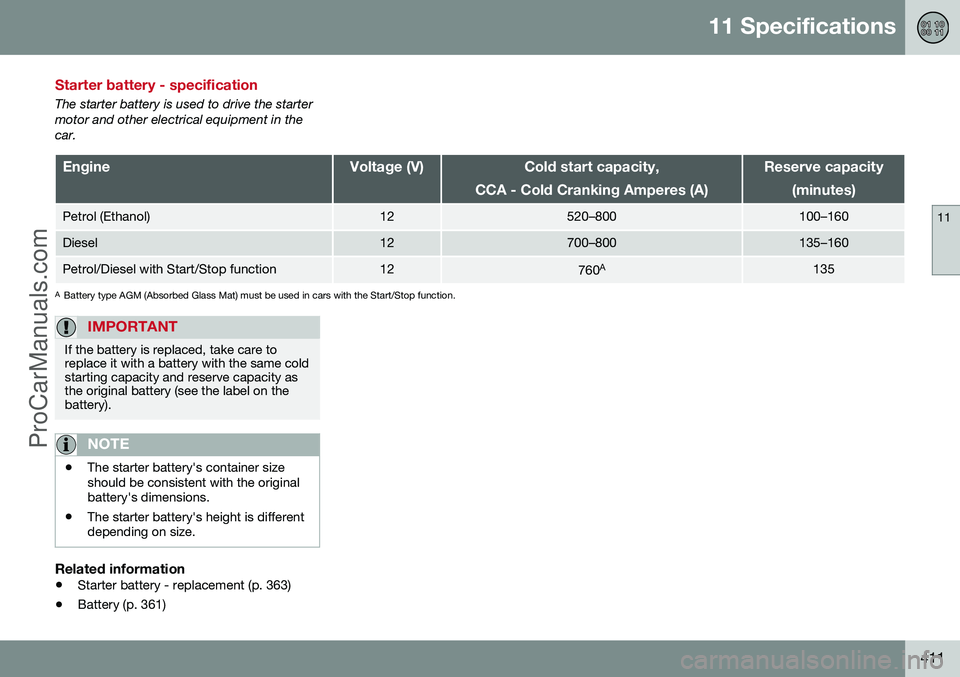
Starter battery - specification
The starter battery is used to drive the starter motor and other electrical equipment in thecar.
EngineVoltage (V)Cold start capacity,
CCA - Cold Cranking Amperes (A)Reserve capacity (minutes)
Petrol (Ethanol)12520–800100–160
Diesel12700–800135–160
Petrol/Diesel with Start/Stop function12760A135
A
Battery type AGM (Absorbed Glass Mat) must be used in cars with the Start/Stop function.
IMPORTANT
If the battery is replaced, take care to replace it with a battery with the same coldstarting capacity and reserve capacity asthe original battery (see the label on thebattery).
NOTE
• The starter battery's container size should be consistent with the originalbattery's dimensions.
• The starter battery's height is differentdepending on size.
Related information
•
Starter battery - replacement (p. 363)
• Battery (p. 361)
ProCarManuals.co’
Page 427 of 442
11 Specifications
11
* Option/accessory, for more information, see Introduction.425
QUENTIAL DAMAGE OR FOR ANY LOST PROFITS OR REVENUES.
©
Gracenote, Inc. 2009
Related information
• Volvo Sensus (p. 68)
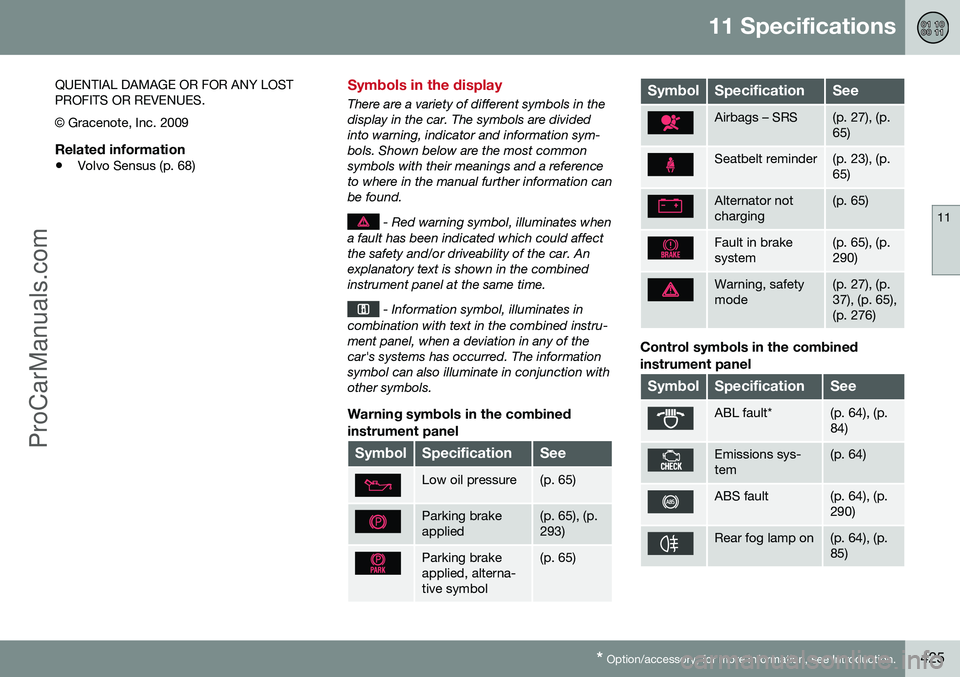
Symbols in the display
There are a variety of different symbols in the display in the car. The symbols are dividedinto warning, indicator and information sym-bols. Shown below are the most commonsymbols with their meanings and a referenceto where in the manual further information canbe found.
- Red warning symbol, illuminates when
a fault has been indicated which could affect the safety and/or driveability of the car. Anexplanatory text is shown in the combinedinstrument panel at the same time.
- Information symbol, illuminates in
combination with text in the combined instru- ment panel, when a deviation in any of thecar's systems has occurred. The informationsymbol can also illuminate in conjunction withother symbols.
Warning symbols in the combined
instrument panel
SymbolSpecificationSee
Low oil pressure(p. 65)
Parking brake applied(p. 65), (p. 293)
Parking brake applied, alterna-tive symbol(p. 65)
SymbolSpecificationSee
Airbags – SRS(p. 27), (p. 65)
Seatbelt reminder(p. 23), (p. 65)
Alternator not charging(p. 65)
Fault in brake system(p. 65), (p. 290)
Warning, safety mode(p. 27), (p. 37), (p. 65),(p. 276)
Control symbols in the combined instrument panel
SymbolSpecificationSee
ABL fault*(p. 64), (p. 84)
Emissions sys- tem(p. 64)
ABS fault(p. 64), (p. 290)
Rear fog lamp on(p. 64), (p. 85)
ProCarManuals.co’
Page 431 of 442
12 Alphabetical Index
12
429
symbols on the battery....................... 362
warning symbols................................. 362
Bioethanol E85........................................ 304
BLIS................................................. 253, 254
Bonnet, opening...................................... 343Booster seat lowering................................................ 46
raising................................................... 45
seating position.................................... 44
Brake and clutch fluid.............................. 350 Brake fluid grade and volume............................... 401
Brake light.................................................. 86
Brakes.............................................. 290, 291 Anti-lock braking system, ABS........... 291
brake light............................................. 86
brake system.............................. 290, 291
Emergency Brake Assistance, EBA ... 292
emergency brake lights........................ 86
filling brake fluid.................................. 351
handbrake........................................... 293symbols in the combined instrument
panel................................................... 290
Bulbs, see Lighting.................................. 353
C
Camera sensor................................ 207, 220
Car care................................................... 379
Car care, leather upholstery.................... 382Cargo area cargo cover......................................... 147
lighting.................................................. 88
mounting points.................................. 143
protective net...................................... 145
Cargo cover............................................. 147
Car upholstery......................................... 381
Car washing............................................. 379
Catalytic converter................................... 303 Recovery............................................. 314
Chassis settings...................................... 175
Checking the engine oil level................... 345Children child safety locks.................................. 39
child seat and airbag............................ 44
child seats and side airbags................. 32
location in car....................................... 44
safety.............................................. 32, 39
Child safety locks............................ 169, 170 Child seat integrated two-stage booster seat....... 44 Child seats................................................. 39
ISOFIX fixture system for child seats... 47
recommended...................................... 40size classes for child seats with ISO-
FIX fixture system................................. 48
types..................................................... 49
upper mounting points for child seats.. 51
City Safety™............................................ 205 Cleaning automatic car wash............................ 379
car washing........................................ 379
rims..................................................... 380
seatbelts............................................. 383
upholstery........................................... 381
Clean Zone Interior Package (CZIP)........ 117 Climate control actual temperature............................. 116
auto-regulation................................... 123
general................................................ 115
personal preferences.......................... 118
sensors............................................... 116
temperature control............................ 124
Clock, adjustment...................................... 68 CO 2 emissions......................................... 403
Collision..................................................... 37
Collision warning............................. 212, 213
ProCarManuals.co’