air condition VOLVO V60 2014 User Guide
[x] Cancel search | Manufacturer: VOLVO, Model Year: 2014, Model line: V60, Model: VOLVO V60 2014Pages: 442, PDF Size: 13.85 MB
Page 257 of 442
07 Driver support
07
* Option/accessory, for more information, see Introduction.255
IMPORTANT
Repair of the BLIS and CTA functions' components or repainting the bumpersmust only be performed by a workshop -an authorised Volvo workshop is recom-mended.
Related information
• BLIS* (Blind Spot Information System) (p. 253)
• BLIS - symbols and messages (p. 257)
CTA (Cross Traffic Alert)*
CTA (Cross Traffic Alert) is a driver aid intended to warn about crossing traffic whenthe car is reversing. CTA is a supplement toBLIS (p. 253).
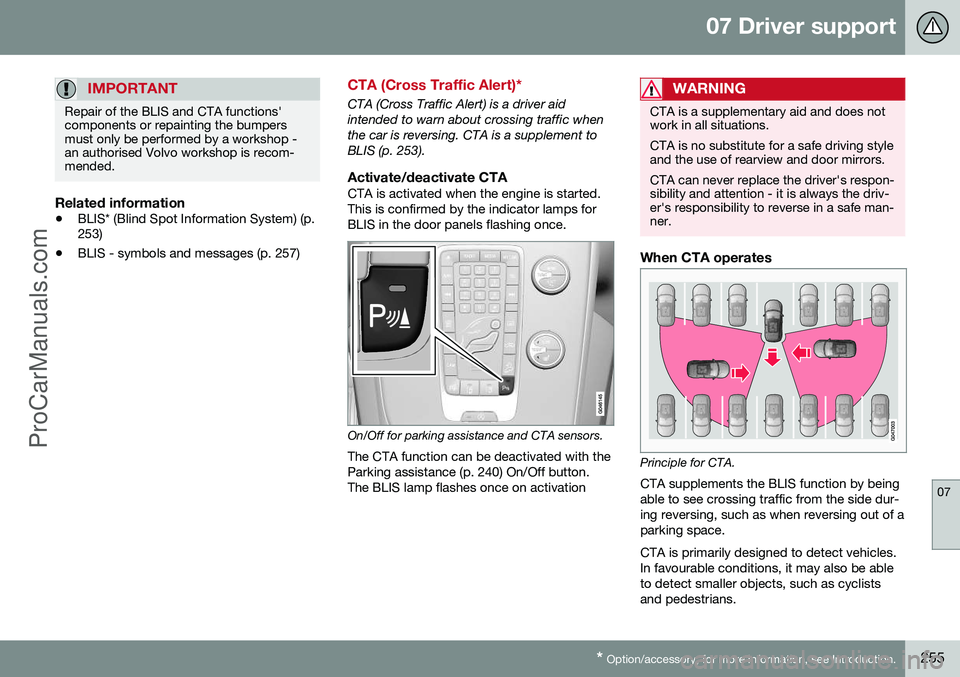
Activate/deactivate CTACTA is activated when the engine is started.This is confirmed by the indicator lamps forBLIS in the door panels flashing once.
On/Off for parking assistance and CTA sensors.
The CTA function can be deactivated with the Parking assistance (p. 240) On/Off button.The BLIS lamp flashes once on activation
WARNING
CTA is a supplementary aid and does not work in all situations. CTA is no substitute for a safe driving style and the use of rearview and door mirrors. CTA can never replace the driver's respon- sibility and attention - it is always the driv-er's responsibility to reverse in a safe man-ner.
When CTA operates
Principle for CTA.CTA supplements the BLIS function by being able to see crossing traffic from the side dur-ing reversing, such as when reversing out of aparking space. CTA is primarily designed to detect vehicles. In favourable conditions, it may also be ableto detect smaller objects, such as cyclistsand pedestrians.
ProCarManuals.co’
Page 284 of 442
08 Starting and driving
08
282* Option/accessory, for more information, see Introduction.
Start/Stop* - the engine does not stop
Some engine and gearbox combinations are equipped with a Start/Stop function whichengages in the event of e.g. stationary trafficor waiting at traffic lights. Although theStart/Stop function is activated, the enginedoes not always stop automatically. The engine does not auto-stop if:
ConditionsM/A A
the car has not first reached approx. 8 km/h after a key start orthe last auto-stop.M + A
the driver has unbuckled the seat- belt.M + A
battery capacity is below the mini- mum permitted level.M + A
the engine does not have normal operating temperature.M + A
outside temperature is below freezing point or aboveapprox. 30 °C.M + A
the windscreen's electric heating is activated.M + A
ConditionsM/AA
the environment in the passenger compartment deviates from thepreset values - indicated by theventilation fan running at a highspeed.M + A
the car is reversed.M + A
the starter battery temperature is below the freezing point or is toohigh.M + A
the driver makes greater steering wheel movements.M + A
the exhaust system's particulate filter is full - the temporarily disen-gaged Start/Stop function is reac-tivated as soon as an automaticcleaning cycle has been per-formed (see Diesel particle filter(DPF) (p. 305)).M + A
the road is very steep.M + A
a trailer is connected electrically to the car’s electrical system.M + A
the bonnet has been opened
B
.M + A
the gearbox does not have normal operating temperature.A
ConditionsM/A A
the atmospheric air pressure is less than equivalent to 1500-2500metres above sea level - the cur-rent air pressure varies with theprevailing weather conditions.A
adaptive cruise control Queue Assist is activated.A
the gear selector is in
S position C
or " +/-".A
A
M = Manual gearbox, A = Automatic gearbox.
B With certain engines only.
C Sport mode.
Related information
• Start/Stop* (p. 279)
• Start/Stop* - function and operation (p. 280)
• Starting the engine (p. 264)
• Start/Stop* - settings (p. 285)
• Start/Stop* - the engine does not auto-start (p. 284)
• Start/Stop* - the engine auto-starts (p.283)
• Start/Stop* - involuntary engine stoppagemanual gearbox (p. 284)
• Start/Stop* - symbols and messages (p.286)
• Battery - Start/Stop (p. 365)
ProCarManuals.co’
Page 299 of 442
08 Starting and driving
08
297
Fording
Fording means that the car is driven through a water-covered roadway. Fording must be car-ried out with great caution. The car can be driven through water at a maximum depth of 25 cm at a maximumspeed of 10 km/h. Extra caution should beexercised when passing through flowingwater. During driving in water, maintain a low speed and do not stop the car. When the water hasbeen passed, depress the brake pedal lightlyand check that full brake function is achieved.Water and mud for example can make thebrake linings wet resulting in delayed brakefunction. •Clean the electric contacts of the electric engine block heater and trailer couplingafter driving in water and mud.
• Do not let the car stand with water overthe sills for any long period of time - thiscould cause electrical malfunctions.IMPORTANT
Engine damage can occur if water enters the air filter. In depths greater than 25 cm, water could enter the transmission. This reduces thelubricating ability of the oils and shortensthe service life of these systems. In the event of the engine stalling in water, do not try restart - tow the car from thewater to a workshop - an authorised Volvoworkshop is recommended. Risk of enginebreakdown.
Related information
•Recovery (p. 316)
• Towing (p. 313)
Overheating
Under special conditions, for example hard driving in hilly terrain and hot climate, there isa risk that the engine and drive system mayoverheat - in particular with a heavy load. For information about overheating when driv- ing with a trailer, see Driving with a trailer (p.306). • Remove any auxiliary lamps from in front of the grille when driving in hot climates.
• If the temperature in the engine's coolingsystem is too high then a warning symbolis illuminated in the combined instrumentpanel's information display and a text message
High engine temp Stop safelyis shown there - stop the car in a safe way and allow the engine to run at idlingspeed for several minutes in order to cooldown.
• If the text message
High engine temp
Stop engine or Coolant level low, Stop
engine is shown then the engine must be
switched off after stopping the car.
• In the event of overheating in the gearbox a built-in protection function is activatedwhich, amongst other things, illuminatesa warning symbol in the combined instru-ment panel, and its display shows the text message
Transmission hot Reduce
speed or Transmission hot Stop safely- follow the recommendation given and lower the speed and stop the car in a safeway and allow the engine to run at idling
ProCarManuals.co’
Page 300 of 442
08 Starting and driving
08
298
speed for a few minutes in order to allow the gearbox to cool down.
• If the car overheats, the air conditioningmay be switched off temporarily.
• Do not turn the engine off immediatelyyou stop after a hard drive.
NOTE
It is normal for the engine's cooling fan to operate for a time after the engine hasbeen switched off.
Driving with open tailgate
When driving with the tailgate open, toxic exhaust fumes can be sucked into the carthrough the cargo area.
WARNING
Do not drive with an open tailgate! Toxic exhaust fumes could be drawn into the carthrough the cargo area.
Related information
•Loading (p. 142)
Overload - starter battery
The electrical functions in the car load the starter battery (p. 361) to varying degrees.Avoid using the key position (p. 70)
II when
the engine is switched off. Instead use the I
mode - which uses less power. Also, be aware of different accessories that load the electrical system. Do not use func-tions which use a lot of power when theengine is switched off. Examples of suchfunctions are: • ventilation fan
• headlamps
• windscreen wiper
• audio system (high volume).
If the starter battery voltage is low then the combined instrument panel's information dis- play shows the text
Low battery Power
save mode. The energy-saving function then
shuts down certain functions or reduces cer- tain functions such as the ventilation fanand/or audio system.
–In which case, charge the battery by star- ting the engine and then running it for atleast 15 minutes - starter battery chargingis more effective during driving than run-ning the engine at idling speed while sta-tionary.
ProCarManuals.co’
Page 305 of 442
08 Starting and driving
08
303
tion, see Key positions (p. 70) for more information.
2. Press the START button without
depressing the brake and/or clutch pedal.
3. Wait approx. 1 minute.
4. To start the engine: Depress the brake and/or clutch pedal and then press the START button again.
NOTE
Before filling with fuel in the event of fuel shortage:
• Stop the car on as flat/level ground as possible - if the car is tilting there is arisk of air pockets in the fuel supply.
Draining condensation from the fuel filter
The fuel filter separates condensation from the fuel. Condensation can disrupt engineoperation. The fuel filter must be drained at the intervals specified in the Service and Warranty Bookletor if you suspect that the car has been filledwith contaminated fuel. For more information,see Volvo service programme (p. 340).
IMPORTANT
Certain special additives remove the water separation in the fuel filter.
Related information
•
Fuel - handling (p. 301)
• Diesel particle filter (DPF) (p. 305)
• Fuel consumption and CO2 emissions (p. 403)
Catalytic converters
The purpose of the catalytic converters is to purify exhaust gases. They are located closeto the engine so that operating temperature isreached quickly. The catalytic converters consist of a monolith (ceramic or metal) with channels. The channelwalls are lined with a thin layer of platinum/rhodium/palladium. These metals act as cata-lysts, i.e. they participate in and accelerate achemical reaction without being used upthemselves.
Lambda-sond TM
oxygen sensorThe Lambda-sond is part of a control systemintended to reduce emissions and improvefuel economy (see Fuel consumption andCO2 emissions (p. 403)). An oxygen sensor monitors the oxygen con- tent of the exhaust gases leaving the engine.This value is fed into an electronic systemthat continuously controls the injectors. Theratio of fuel to air directed to the engine iscontinuously adjusted. These adjustmentscreate optimal conditions for efficient com-bustion, and together with the three-way cat-alytic converter reduce harmful emissions(hydrocarbons, carbon monoxide and nitrousoxides).
ProCarManuals.co’
Page 323 of 442
09 Wheels and tyres
09
* Option/accessory, for more information, see Introduction.321
Jack*
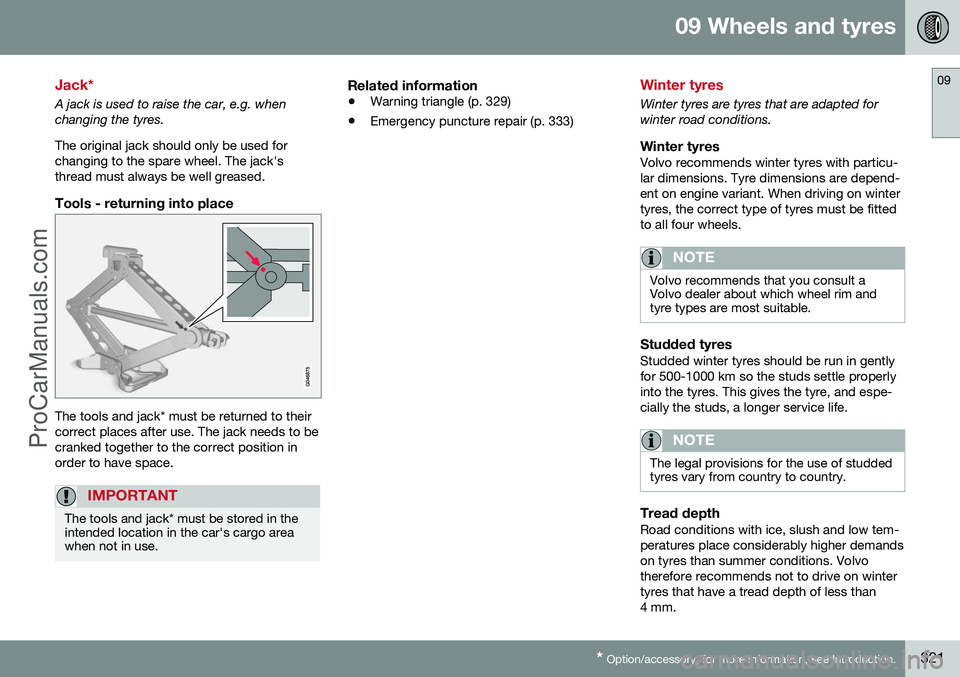
A jack is used to raise the car, e.g. when changing the tyres. The original jack should only be used for changing to the spare wheel. The jack'sthread must always be well greased.
Tools - returning into place
The tools and jack* must be returned to their correct places after use. The jack needs to becranked together to the correct position inorder to have space.
IMPORTANT
The tools and jack* must be stored in the intended location in the car's cargo areawhen not in use.
Related information
• Warning triangle (p. 329)
• Emergency puncture repair (p. 333)
Winter tyres
Winter tyres are tyres that are adapted for winter road conditions.
Winter tyresVolvo recommends winter tyres with particu-lar dimensions. Tyre dimensions are depend-ent on engine variant. When driving on wintertyres, the correct type of tyres must be fittedto all four wheels.
NOTE
Volvo recommends that you consult a Volvo dealer about which wheel rim andtyre types are most suitable.
Studded tyresStudded winter tyres should be run in gently for 500-1000 km so the studs settle properlyinto the tyres. This gives the tyre, and espe-cially the studs, a longer service life.
NOTE
The legal provisions for the use of studded tyres vary from country to country.
Tread depthRoad conditions with ice, slush and low tem- peratures place considerably higher demandson tyres than summer conditions. Volvotherefore recommends not to drive on wintertyres that have a tread depth of less than4 mm.
ProCarManuals.co’
Page 330 of 442
09 Wheels and tyres
09
328
Tyres - air pressure
Tyres can have different air pressures which are measured in bar.
Check the air pressure in the tyresThe tyre pressures must be checked everymonth.
• Tyre pressure for the car's recommended tyre dimension
• ECO pressure 2
NOTE
•
Check the tyre pressure when the tyres are cold. "Cold tyres" means thatthe tyres are at the same temperatureas the outdoor temperature. The tyreswill heat up and the tyre pressures willincrease after driving for a few kilome-tres.
• Tyre pressures which are too low willincrease fuel consumption, reduce tyreservice life and impair the car's han-dling. Driving with tyre pressureswhich are too low may lead to thetyres overheating and sustaining dam-age. Tyre pressures affect ride com-fort, road noise and steering.
• Tyre pressure decreases over time,this is a natural phenomenon. Tyrepressure also varies depending onambient temperature.
Tyre pressure label
G021830
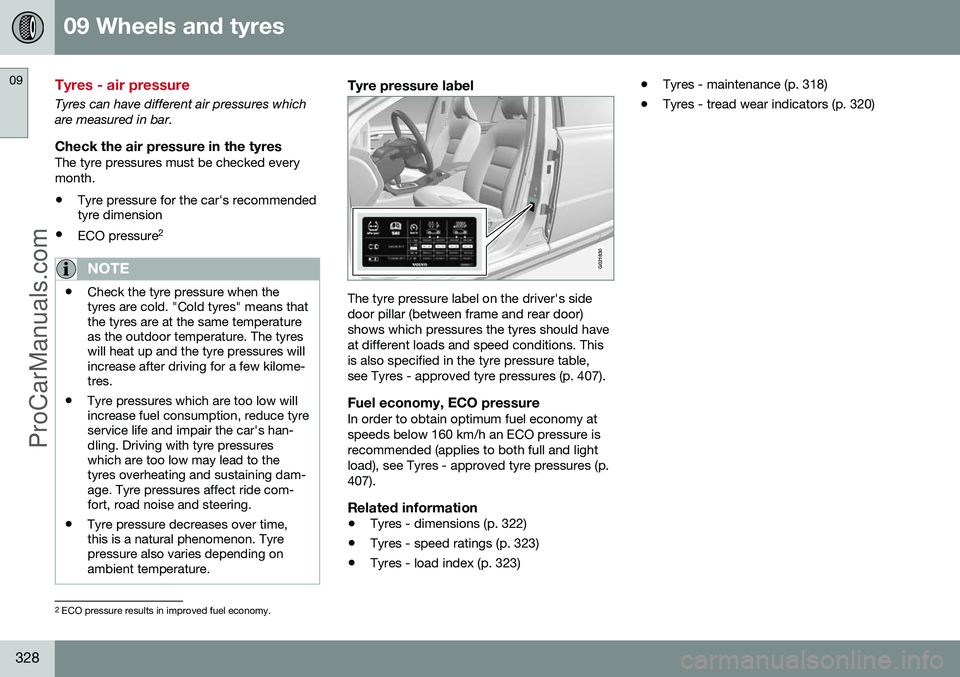
The tyre pressure label on the driver's side door pillar (between frame and rear door)shows which pressures the tyres should haveat different loads and speed conditions. Thisis also specified in the tyre pressure table,see Tyres - approved tyre pressures (p. 407).
Fuel economy, ECO pressureIn order to obtain optimum fuel economy atspeeds below 160 km/h an ECO pressure isrecommended (applies to both full and lightload), see Tyres - approved tyre pressures (p.407).
Related information
•
Tyres - dimensions (p. 322)
• Tyres - speed ratings (p. 323)
• Tyres - load index (p. 323) •
Tyres - maintenance (p. 318)
• Tyres - tread wear indicators (p. 320)
2
ECO pressure results in improved fuel economy.
ProCarManuals.co’
Page 354 of 442
10 Maintenance and service
10
352
Climate control system - fault tracing and repair
The air conditioning system must only be serviced and repaired by an authorised work-shop.
Troubleshooting and repairThe air conditioning system contains fluores-cent tracing agents. Use ultraviolet light whenlooking for leaks. Volvo recommends that you contact an authorised Volvo workshop.
WARNING
The air conditioning system contains pres- surised refrigerant R134a. This systemmust only be serviced and repaired by anauthorised workshop.
Related information
•Volvo service programme (p. 340)
Lamp replacement
Lamp replacement can be carried out for bulbs. When replacing LED and Xenon lamps,please refer to a workshop. The bulbs are specified (p. 358). The follow- ing list contains locations of bulbs and otherlight sources that are specialised, such as LED 10
lamps, or are unsuitable for changing
for some other reason, except at a workshop:
• Active Xenon headlamps - ABL (Xenon lamps)
• Daytime running lights/Position/parkinglamps front
• Side marker lamps front
• Cornering lights
• Side direction indicators, door mirrors
• Approach lighting, door mirrors
• Interior lighting apart from Courtesy light-ing front
• Glovebox lighting
• Position/parking lamps rear/Side markerlamps rear
• Brake light.WARNING
On cars with Xenon headlamps, the replacement of Xenon lamps must be car-ried out at a workshop - an authorisedVolvo workshop is recommended. Workingwith Xenon lamps demands extreme cau-tion because the headlamp is equippedwith a high voltage unit.
WARNING
The car's electrical system must be in key position
0 for bulb replacement; see Key
positions - functions at different levels (p.70).
IMPORTANT
Never touch the glass part of the bulbs with your fingers. Grease from your fingersis vaporised by the heat, coating thereflector and then causing damage.
NOTE
If an error message remains after the bro- ken bulb has been replaced then we rec-ommend that you visit an authorised Volvoworkshop.
10 LED (Light Emitting Diode)
ProCarManuals.co’
Page 430 of 442
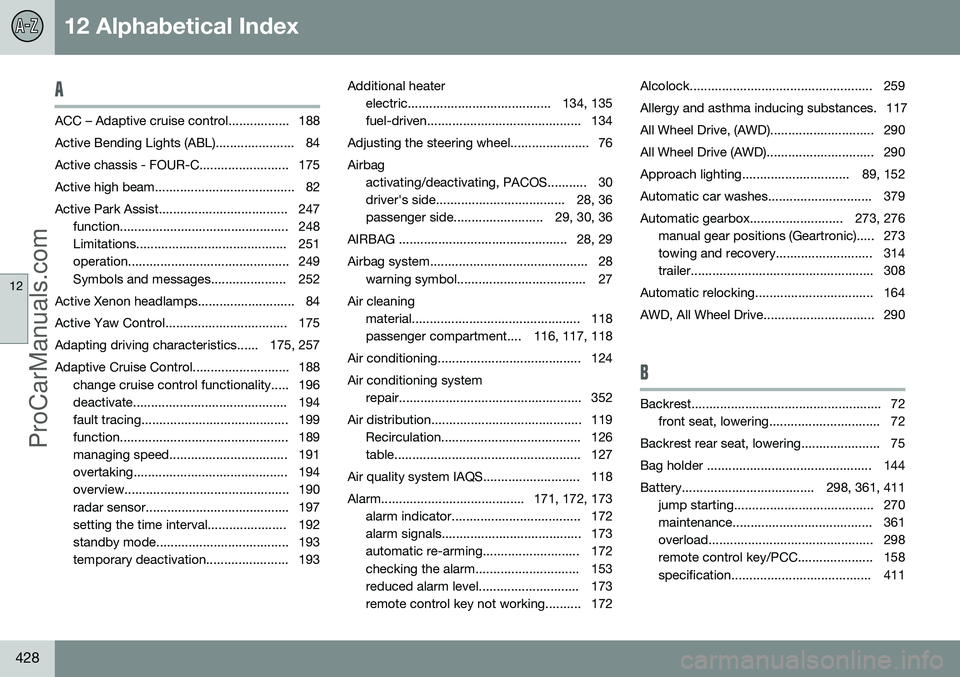
12 Alphabetical Index
12
428
A
ACC – Adaptive cruise control................. 188Active Bending Lights (ABL)...................... 84
Active chassis - FOUR-C......................... 175
Active high beam....................................... 82
Active Park Assist.................................... 247 function............................................... 248
Limitations.......................................... 251
operation............................................. 249
Symbols and messages..................... 252
Active Xenon headlamps........................... 84
Active Yaw Control.................................. 175
Adapting driving characteristics...... 175, 257
Adaptive Cruise Control........................... 188 change cruise control functionality..... 196
deactivate........................................... 194
fault tracing......................................... 199
function............................................... 189
managing speed................................. 191
overtaking........................................... 194
overview.............................................. 190
radar sensor........................................ 197
setting the time interval...................... 192
standby mode..................................... 193
temporary deactivation....................... 193 Additional heater
electric........................................ 134, 135
fuel-driven........................................... 134
Adjusting the steering wheel...................... 76 Airbag activating/deactivating, PACOS........... 30
driver's side.................................... 28, 36
passenger side......................... 29, 30, 36
AIRBAG ............................................... 28, 29
Airbag system............................................ 28 warning symbol.................................... 27
Air cleaning material............................................... 118
passenger compartment.... 116, 117, 118
Air conditioning........................................ 124 Air conditioning system repair................................................... 352
Air distribution.......................................... 119 Recirculation....................................... 126
table.................................................... 127
Air quality system IAQS........................... 118
Alarm........................................ 171, 172, 173 alarm indicator.................................... 172
alarm signals....................................... 173
automatic re-arming........................... 172
checking the alarm............................. 153
reduced alarm level............................ 173
remote control key not working.......... 172 Alcolock................................................... 259
Allergy and asthma inducing substances. 117
All Wheel Drive, (AWD)............................. 290
All Wheel Drive (AWD).............................. 290
Approach lighting.............................. 89, 152
Automatic car washes............................. 379
Automatic gearbox.......................... 273, 276
manual gear positions (Geartronic)..... 273
towing and recovery........................... 314
trailer................................................... 308
Automatic relocking................................. 164
AWD, All Wheel Drive............................... 290
B
Backrest..................................................... 72 front seat, lowering............................... 72
Backrest rear seat, lowering...................... 75
Bag holder .............................................. 144
Battery..................................... 298, 361, 411 jump starting....................................... 270
maintenance....................................... 361
overload.............................................. 298
remote control key/PCC..................... 158
specification....................................... 411
ProCarManuals.co’
Page 433 of 442
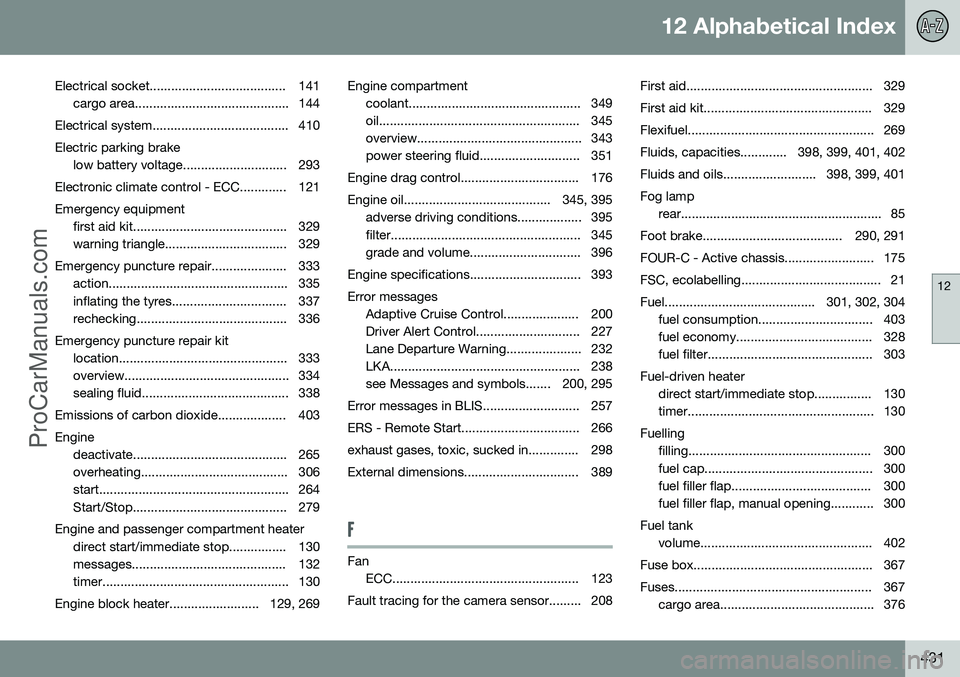
12 Alphabetical Index
12
431
Electrical socket...................................... 141
cargo area........................................... 144
Electrical system...................................... 410 Electric parking brake low battery voltage............................. 293
Electronic climate control - ECC............. 121Emergency equipment first aid kit........................................... 329
warning triangle.................................. 329
Emergency puncture repair..................... 333 action.................................................. 335
inflating the tyres................................ 337
rechecking.......................................... 336
Emergency puncture repair kit location............................................... 333
overview.............................................. 334
sealing fluid......................................... 338
Emissions of carbon dioxide................... 403 Engine deactivate........................................... 265
overheating......................................... 306
start..................................................... 264
Start/Stop........................................... 279
Engine and passenger compartment heater direct start/immediate stop................ 130
messages........................................... 132
timer.................................................... 130
Engine block heater......................... 129, 269 Engine compartment
coolant................................................ 349
oil........................................................ 345
overview.............................................. 343
power steering fluid............................ 351
Engine drag control................................. 176
Engine oil......................................... 345, 395 adverse driving conditions.................. 395
filter..................................................... 345
grade and volume............................... 396
Engine specifications............................... 393 Error messages Adaptive Cruise Control..................... 200
Driver Alert Control............................. 227
Lane Departure Warning..................... 232
LKA..................................................... 238
see Messages and symbols....... 200, 295
Error messages in BLIS........................... 257
ERS - Remote Start................................. 266
exhaust gases, toxic, sucked in.............. 298
External dimensions................................ 389
F
Fan ECC.................................................... 123
Fault tracing for the camera sensor......... 208 First aid.................................................... 329
First aid kit............................................... 329
Flexifuel.................................................... 269
Fluids, capacities............. 398, 399, 401, 402
Fluids and oils.......................... 398, 399, 401Fog lamp
rear........................................................ 85
Foot brake....................................... 290, 291
FOUR-C - Active chassis......................... 175
FSC, ecolabelling....................................... 21
Fuel.......................................... 301, 302, 304 fuel consumption................................ 403
fuel economy...................................... 328
fuel filter.............................................. 303
Fuel-driven heater direct start/immediate stop................ 130
timer.................................................... 130
Fuelling filling................................................... 300
fuel cap............................................... 300
fuel filler flap....................................... 300
fuel filler flap, manual opening............ 300
Fuel tank volume................................................ 402
Fuse box.................................................. 367
Fuses....................................................... 367 cargo area........................................... 376
ProCarManuals.co’