heater VOLVO V60 2014 User Guide
[x] Cancel search | Manufacturer: VOLVO, Model Year: 2014, Model line: V60, Model: VOLVO V60 2014Pages: 442, PDF Size: 13.85 MB
Page 134 of 442
04 Climate control
04
132* Option/accessory, for more information, see Introduction.
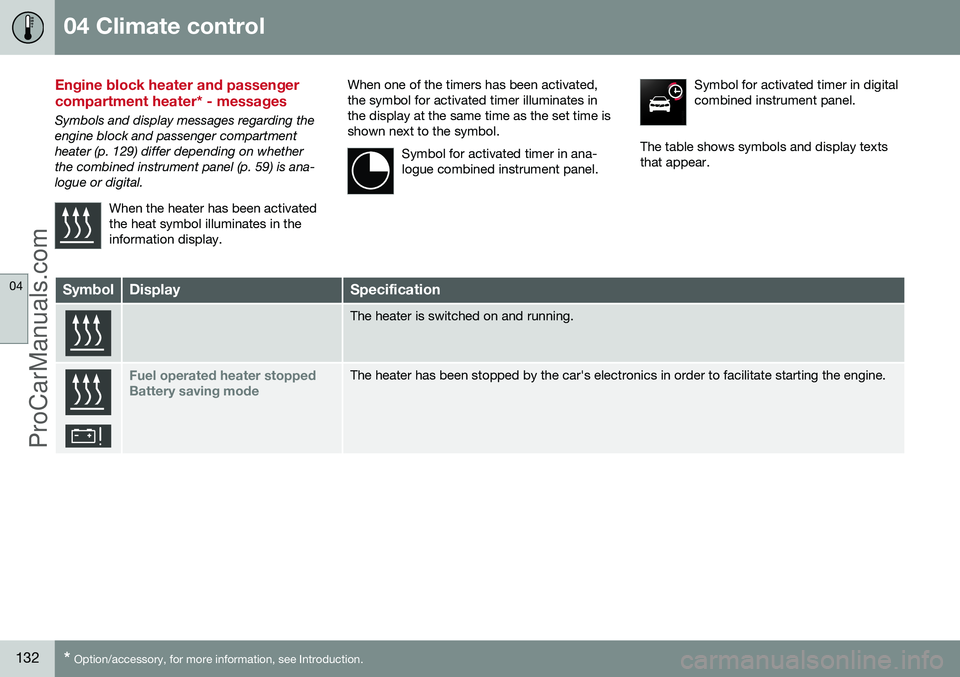
Engine block heater and passenger compartment heater* - messages
Symbols and display messages regarding the engine block and passenger compartment
heater (p. 129) differ depending on whetherthe combined instrument panel (p. 59) is ana-logue or digital.
When the heater has been activatedthe heat symbol illuminates in theinformation display.
When one of the timers has been activated, the symbol for activated timer illuminates inthe display at the same time as the set time isshown next to the symbol.Symbol for activated timer in ana-logue combined instrument panel.Symbol for activated timer in digital combined instrument panel.
The table shows symbols and display texts that appear.
SymbolDisplaySpecification
The heater is switched on and running.
Fuel operated heater stopped Battery saving modeThe heater has been stopped by the car's electronics in order to facilitate starting the engine.
ProCarManuals.co’
Page 135 of 442
04 Climate control
04
133
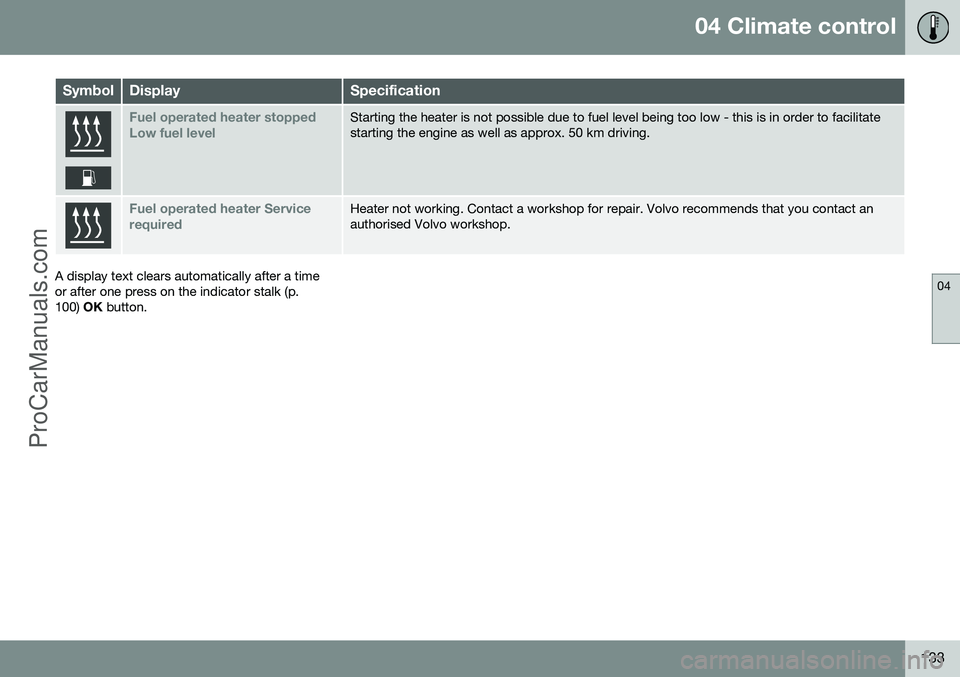
SymbolDisplaySpecification
Fuel operated heater stopped Low fuel levelStarting the heater is not possible due to fuel level being too low - this is in order to facilitate starting the engine as well as approx. 50 km driving.
Fuel operated heater Service requiredHeater not working. Contact a workshop for repair. Volvo recommends that you contact an authorised Volvo workshop.
A display text clears automatically after a time or after one press on the indicator stalk (p.100) OK button.
ProCarManuals.co’
Page 136 of 442
04 Climate control
04
134* Option/accessory, for more information, see Introduction.
Additional heater*
In cold climate zones 5
an additional heater
may be required to obtain the correct operat- ing temperature in the engine and to obtainsufficient heating in the passenger compart-ment. A fuel-driven additional heater (p. 134) is fit- ted in cars with diesel engines. In a semi-cold 5
climate zone diesel-driven
cars have an electric additional heater (p. 135) instead of a fuel-driven version. Cars with certain petrol engines 6
have an
electric additional heater integrated into the car's climate control system.
Related information
• Engine and passenger compartment heater* (p. 129)
Fuel-driven additional heater*
The car is equipped with either an electric (p. 135) or a fuel-driven additional heater (p. 134). The heater starts automatically when extra heat is required when the engine is running. The heater is switched off automatically when the correct temperature is reached or whenthe engine is switched off.
NOTE
When the additional heater is active there may be smoke from the right-hand wheelhousing, which is perfectly normal.
Auto mode or shutdownThe additional heater's automatic start sequence can be switched off if required.
NOTE
Volvo recommends that the fuel-driven additional heater should be switched offfor short distances.
1. Before starting the engine: Select key
position I (p. 70).
2. Press OK to access the menu. 3.
Scroll with the thumbwheel to
Additional
heater7 or Settings8 and select with OK.
4. Select one of the options
ON or OFFusing the thumbwheel and confirm with OK.
5. Exit the menu with RESET.
NOTE
The menu options are only visible in key position I - any adjustments must therefore
be made before starting the engine.
Passenger compartment heater*If the additional heater is supplemented with a timer function then it can be used as a pas-senger compartment heater (p. 129).
5 An authorised Volvo dealer has information regarding the geographical areas concerned.
6 An authorised Volvo dealer has information regarding the engines concerned.
7 Analogue combined instrument panel.
8 Digital combined instrument panel.
ProCarManuals.co’
Page 137 of 442

04 Climate control
04
* Option/accessory, for more information, see Introduction.135
Electric additional heater*
The car is equipped with either a fuel-driven (p. 134) or an electric additional heater (p.134). The heater cannot be controlled manually, but is instead activated automatically after theengine has been started in outside tempera-tures below 14 °C and is switched off afterthe set passenger compartment temperaturehas been reached.
Related information
• Engine and passenger compartment heater* (p. 129)
ProCarManuals.co’
Page 143 of 442
05 Loading and storage
05
* Option/accessory, for more information, see Introduction.141
Tunnel console - 12 V-sockets
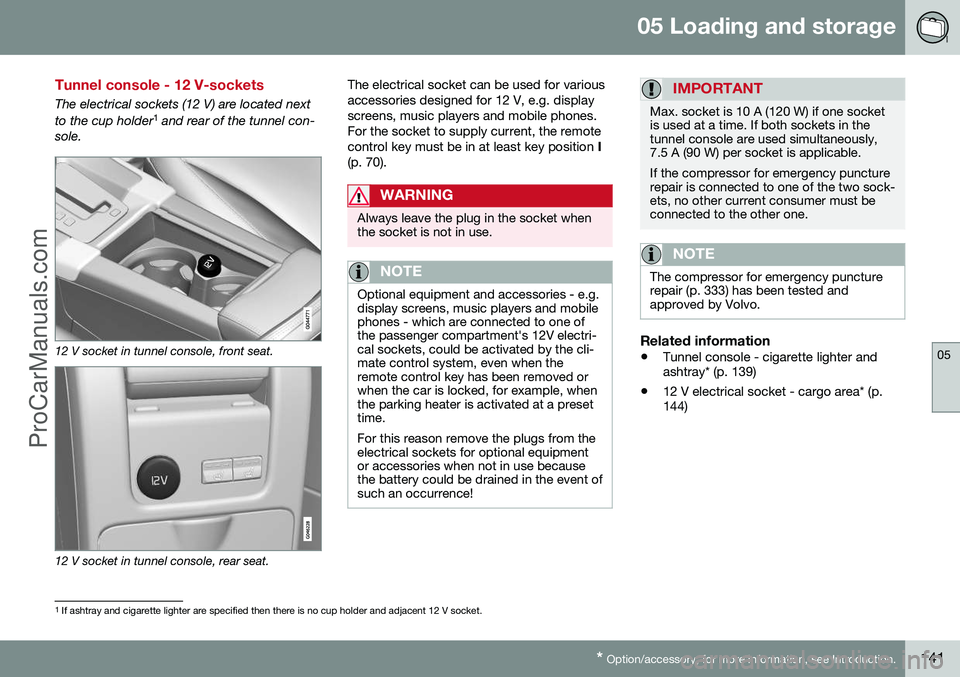
The electrical sockets (12 V) are located next to the cup holder 1
and rear of the tunnel con-
sole.
12 V socket in tunnel console, front seat.
12 V socket in tunnel console, rear seat. The electrical socket can be used for various accessories designed for 12 V, e.g. displayscreens, music players and mobile phones.For the socket to supply current, the remotecontrol key must be in at least key position
I
(p. 70).
WARNING
Always leave the plug in the socket when the socket is not in use.
NOTE
Optional equipment and accessories - e.g. display screens, music players and mobilephones - which are connected to one ofthe passenger compartment's 12V electri-cal sockets, could be activated by the cli-mate control system, even when theremote control key has been removed orwhen the car is locked, for example, whenthe parking heater is activated at a presettime. For this reason remove the plugs from the electrical sockets for optional equipmentor accessories when not in use becausethe battery could be drained in the event ofsuch an occurrence!
IMPORTANT
Max. socket is 10 A (120 W) if one socket is used at a time. If both sockets in thetunnel console are used simultaneously,7.5 A (90 W) per socket is applicable. If the compressor for emergency puncture repair is connected to one of the two sock-ets, no other current consumer must beconnected to the other one.
NOTE
The compressor for emergency puncture repair (p. 333) has been tested andapproved by Volvo.
Related information
• Tunnel console - cigarette lighter and ashtray* (p. 139)
• 12 V electrical socket - cargo area* (p.144)
1
If ashtray and cigarette lighter are specified then there is no cup holder and adjacent 12 V socket.
ProCarManuals.co’
Page 173 of 442
06 Locks and alarm
06
* Option/accessory, for more information, see Introduction.171
Alarm
The alarm is a device that warns in the event of e.g. a break-in in the car. Activated alarm is triggered if:
• a door, the bonnet or the tailgate is opened
• a movement is detected in the passengercompartment (if fitted with a movementdetector*)
• the car is raised or towed away (if fittedwith a tilt detector*)
• the battery's cable is disconnected
• the siren is disconnected.
If there is a fault in the alarm system then the information display in the combined instru-ment panel shows a message. In which case,contact a workshop - an authorised Volvoworkshop is recommended.NOTE
The movement sensors trigger an alarm in the event of movement in the passengercompartment - air currents are also regis-tered. For this reason the alarm is trig-gered if the car is left with a window or thesunroof open or if the passenger compart-ment heater is used. To avoid this: Close the window/sunroof when leaving the car. If the car's inte-grated passenger compartment heater (ora portable electric heater) shall be used -direct the airflow from the air vents so thatthey are not pointing upwards in the pas-senger compartment. Alternatively,reduced alarm level can be used, seeReduced alarm level (p. 173).
NOTE
Do not attempt to repair or alter compo- nents in the alarm system yourself. Anysuch attempts may affect the terms of theinsurance.
Arming the alarm–Press the remote control key lock button.
Deactivate the alarm–Press the remote control key unlock but- ton.
Deactivating a triggered alarm–Press the remote control key unlock but- ton or insert the remote control key in theignition switch.
Related information
• Alarm indicator (p. 172)
• Alarm - automatic re-arming (p. 172)
• Alarm - remote control key not working (p. 172)
ProCarManuals.co’
Page 271 of 442
08 Starting and driving
08
}}
* Option/accessory, for more information, see Introduction.269
Starting the engine – Flexifuel
Flexifuel engines can be driven on 95 octane unleaded petrol and bioethanol E85. Theengine is started in the same way as in a pet-rol-driven car.
Engine block heater*
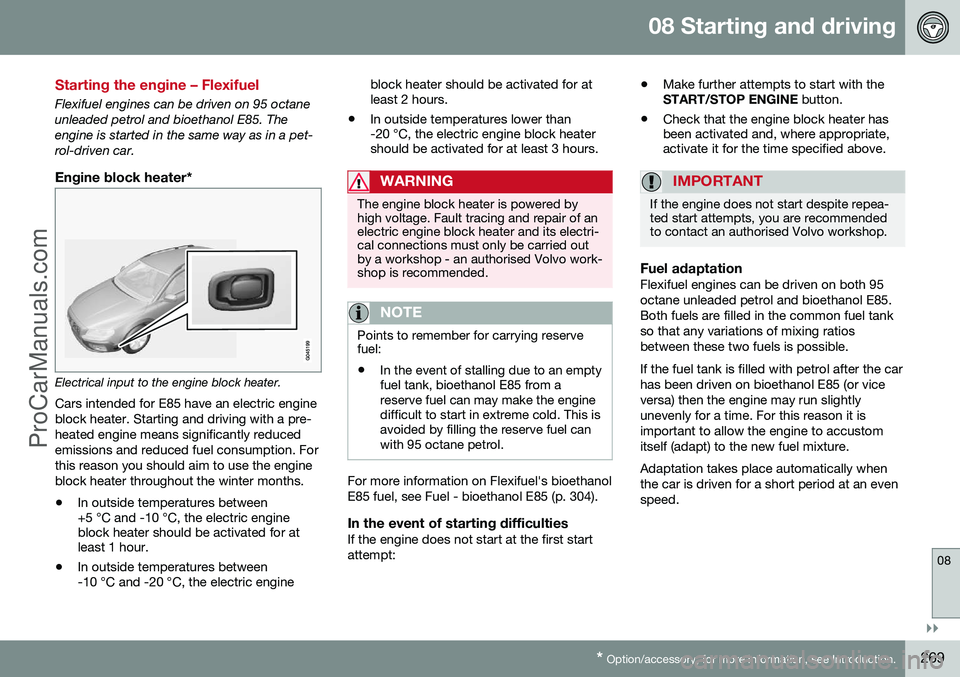
Electrical input to the engine block heater.
Cars intended for E85 have an electric engine block heater. Starting and driving with a pre-heated engine means significantly reducedemissions and reduced fuel consumption. Forthis reason you should aim to use the engineblock heater throughout the winter months. • In outside temperatures between +5 °C and -10 °C, the electric engineblock heater should be activated for atleast 1 hour.
• In outside temperatures between-10 °C and -20 °C, the electric engine block heater should be activated for atleast 2 hours.
• In outside temperatures lower than-20 °C, the electric engine block heatershould be activated for at least 3 hours.
WARNING
The engine block heater is powered by high voltage. Fault tracing and repair of anelectric engine block heater and its electri-cal connections must only be carried outby a workshop - an authorised Volvo work-shop is recommended.
NOTE
Points to remember for carrying reserve fuel:
• In the event of stalling due to an empty fuel tank, bioethanol E85 from areserve fuel can may make the enginedifficult to start in extreme cold. This isavoided by filling the reserve fuel canwith 95 octane petrol.
For more information on Flexifuel's bioethanol E85 fuel, see Fuel - bioethanol E85 (p. 304).
In the event of starting difficultiesIf the engine does not start at the first startattempt: •
Make further attempts to start with the START/STOP ENGINE
button.
• Check that the engine block heater hasbeen activated and, where appropriate,activate it for the time specified above.
IMPORTANT
If the engine does not start despite repea- ted start attempts, you are recommendedto contact an authorised Volvo workshop.
Fuel adaptationFlexifuel engines can be driven on both 95 octane unleaded petrol and bioethanol E85.Both fuels are filled in the common fuel tankso that any variations of mixing ratiosbetween these two fuels is possible. If the fuel tank is filled with petrol after the car has been driven on bioethanol E85 (or viceversa) then the engine may run slightlyunevenly for a time. For this reason it isimportant to allow the engine to accustomitself (adapt) to the new fuel mixture. Adaptation takes place automatically when the car is driven for a short period at an evenspeed.
ProCarManuals.co’
Page 299 of 442
08 Starting and driving
08
297
Fording
Fording means that the car is driven through a water-covered roadway. Fording must be car-ried out with great caution. The car can be driven through water at a maximum depth of 25 cm at a maximumspeed of 10 km/h. Extra caution should beexercised when passing through flowingwater. During driving in water, maintain a low speed and do not stop the car. When the water hasbeen passed, depress the brake pedal lightlyand check that full brake function is achieved.Water and mud for example can make thebrake linings wet resulting in delayed brakefunction. •Clean the electric contacts of the electric engine block heater and trailer couplingafter driving in water and mud.
• Do not let the car stand with water overthe sills for any long period of time - thiscould cause electrical malfunctions.IMPORTANT
Engine damage can occur if water enters the air filter. In depths greater than 25 cm, water could enter the transmission. This reduces thelubricating ability of the oils and shortensthe service life of these systems. In the event of the engine stalling in water, do not try restart - tow the car from thewater to a workshop - an authorised Volvoworkshop is recommended. Risk of enginebreakdown.
Related information
•Recovery (p. 316)
• Towing (p. 313)
Overheating
Under special conditions, for example hard driving in hilly terrain and hot climate, there isa risk that the engine and drive system mayoverheat - in particular with a heavy load. For information about overheating when driv- ing with a trailer, see Driving with a trailer (p.306). • Remove any auxiliary lamps from in front of the grille when driving in hot climates.
• If the temperature in the engine's coolingsystem is too high then a warning symbolis illuminated in the combined instrumentpanel's information display and a text message
High engine temp Stop safelyis shown there - stop the car in a safe way and allow the engine to run at idlingspeed for several minutes in order to cooldown.
• If the text message
High engine temp
Stop engine or Coolant level low, Stop
engine is shown then the engine must be
switched off after stopping the car.
• In the event of overheating in the gearbox a built-in protection function is activatedwhich, amongst other things, illuminatesa warning symbol in the combined instru-ment panel, and its display shows the text message
Transmission hot Reduce
speed or Transmission hot Stop safely- follow the recommendation given and lower the speed and stop the car in a safeway and allow the engine to run at idling
ProCarManuals.co’
Page 303 of 442
08 Starting and driving
08
301
Filling with a fuel can14When filling with a fuel can, use the funnel located under the floor hatch in the cargoarea. The funnel is located by the spare wheelor in the well under the floor hatch. Make sure you insert the funnel's pipe firmly into the filler pipe. The filler pipe has an open-able cap and the funnel's pipe must bemoved past the cap before filling can begin.
Related information
•
Fuel filler flap - manual opening (p. 300)
• Fuel - handling (p. 301)
Fuel - handling
Fuel of a lower quality than that recom- mended by Volvo must not be used as enginepower and fuel consumption is negativelyaffected.
WARNING
Always avoid inhaling fuel vapour and get- ting fuel splashes in the eyes. In the event of fuel in the eyes, remove any contact lenses and rinse the eyes in plentyof water for at least 15 minutes and seekmedical attention. Never swallow fuel. Fuels such as petrol, bioethanol and mixtures of them and die-sel are highly toxic and could cause per-manent injury or be fatal if swallowed.Seek medical attention immediately if fuelhas been swallowed.
WARNING
Fuel which spills onto the ground can be ignited. Switch off the fuel-driven heater before starting to refuel. Never carry an activated mobile phone when refuelling. The ring signal couldcause spark build-up and ignite petrolfumes, leading to fire and injury.
IMPORTANT
Mixing different types of fuel or the use of fuel not recommended invalidates Volvo'sguarantees, and any associated serviceagreement. This applies to all engines.NOTE: It does not apply to cars withengines that are adapted to run on ethanolfuel (E85).
NOTE
Extreme weather conditions, driving with a trailer or driving at high altitudes in combi-nation with fuel grade are factors thatcould affect the car's performance.
Related information
•Economical driving (p. 305)
• Fuel - diesel (p. 302)
• Diesel particle filter (DPF) (p. 305)
• Fuel consumption and CO2 emissions (p. 403)
• Fuel tank - volume (p. 402)
14
Only applies to cars with diesel engine.
ProCarManuals.co’
Page 307 of 442
08 Starting and driving
08
* Option/accessory, for more information, see Introduction.305
Diesel particle filter (DPF)
Diesel cars are equipped with a particle filter, which results in more efficient emission con-trol. The particles in the exhaust gases are collec- ted in the filter during normal driving. So-called "regeneration" is started in order toburn away the particles and empty the filter.This requires the engine to have reached nor-mal operating temperature. Regeneration of the particle filter is automatic and normally takes 10-20 minutes. It maytake a little longer at a low average speed.Fuel consumption may increase slightly dur-ing regeneration.
Regeneration in cold weatherIf the car is frequently driven short distancesin cold weather then the engine does notreach normal operating temperature. Thismeans that regeneration of the diesel particlefilter does not take place and the filter is notemptied. When the filter has become approx. 80% full of particles, a yellow warning triangle isshown in the combined instrument panel, and the message
Soot filter full See manual is
shown in its information display. Start regeneration of the filter by driving the car until the engine reaches normal operatingtemperature, preferably on a main road or motorway. The car should then be driven forapproximately 20 minutes more.
NOTE
The following may arise during regenera- tion:
• a smaller reduction of engine power may be noticed temporarily
• fuel consumption may increase tem-porarily
• a smell of burning may arise.
When regeneration is complete the warning text is cleared automatically. Use the parking heater* in cold weather - the engine then reaches normal operating tem-perature more quickly.
IMPORTANT
If the filter is completely filled with parti- cles, it may be difficult to start the engineand the filter is non-functional. Then thereis a risk that the filter will need to bereplaced.
Related information
•
Fuel - handling (p. 301)
• Fuel - diesel (p. 302)
• Fuel consumption and CO2 emissions (p. 403)
• Fuel tank - volume (p. 402)
Economical driving
Driving economically means driving smoothly while thinking ahead and adjusting your driv-ing style and speed to the prevailing condi-tions.
ProCarManuals.com