maintenance VOLVO V60 2014 User Guide
[x] Cancel search | Manufacturer: VOLVO, Model Year: 2014, Model line: V60, Model: VOLVO V60 2014Pages: 442, PDF Size: 13.85 MB
Page 214 of 442
07 Driver support
07
212* Option/accessory, for more information, see Introduction.
Collision warning system*
"Collision Warning with Auto Brake and Cyclist and Pedestrian Detection" is an aid toassist the driver when there is a risk of collid-ing with a pedestrian, bicycle or vehicle infront that are stationary or moving in the samedirection. Collision Warning with Auto Brake & Pedes- trian Detection is activated in situations wherethe driver should have started braking earlier,which is why it cannot help the driver in everysituation. Collision Warning with Auto Brake & Pedes- trian Detection is designed to be activated aslate as possible in order to avoid unnecessaryintervention. Collision Warning with Auto Brake & Pedes- trian Detection may prevent a collision orreduce the collision speed. Collision Warning with Auto Brake & Pedes- trian Detection must not be used as anexcuse for the driver to change his/her drivingstyle. If the driver solely relies on CollisionWarning with Auto Brake to do the braking,there might be a risk of a collision sooner orlater.
Two system levelsThe Collision Warning with Auto Brake &Pedestrian Detection function is available in two variants, depending on how the car isequipped: Level 1 The driver is merely warned
14
of occurring
obstacles by means of visual and acoustic signals - no automatic braking intervenes, thedriver must himself brake. Level 2 The driver is warned of occurring obstacles by means of visual and acoustic signals - thecar is braked automatically if the driver him-self does not act within a reasonable time.
IMPORTANT
Maintenance of components included in Collision Warning with Auto Brake &Pedestrian Detection must only be carriedout in a workshop - an authorised Volvoworkshop is recommended.
Related information
• Collision warning system* - function (p. 213)
• Collision warning system* - detection ofpedestrians (p. 216)
• Collision warning system* - cyclist detec-tion (p. 214)
• Collision warning system* - operation (p.217) •
Collision warning system* - general limita-tions (p. 218)
• Collision warning system* - camera sen-sor limitations (p. 220)
• Collision warning system* - symbols andmessages (p. 222)
14
No warning for cyclists with "Level 1".
ProCarManuals.co’
Page 220 of 442
||
07 Driver support
07
218* Option/accessory, for more information, see Introduction.
Maintenance
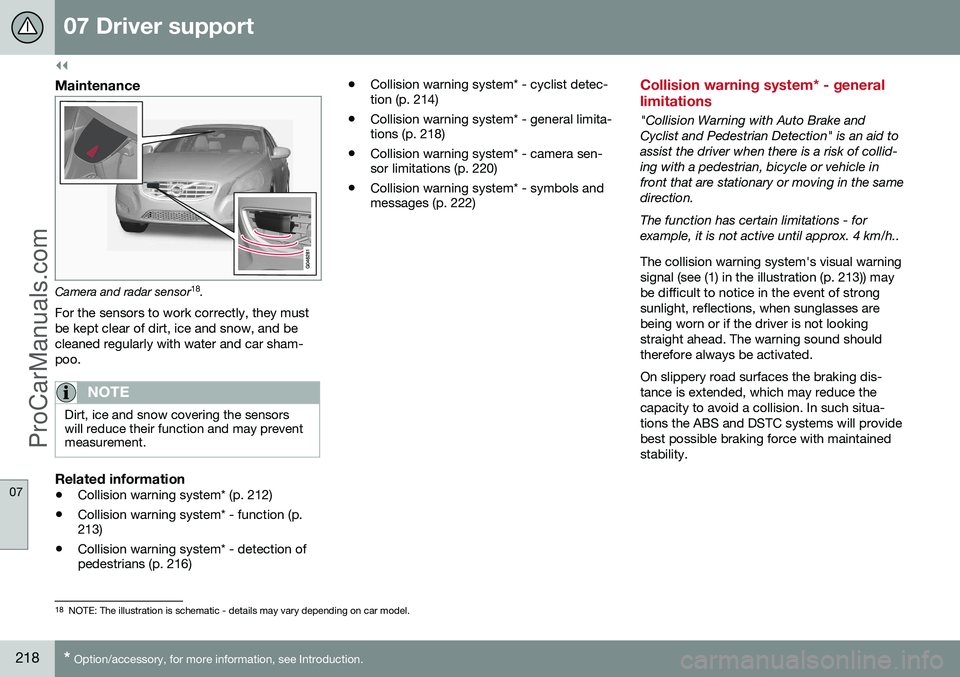
Camera and radar sensor 18
.
For the sensors to work correctly, they must be kept clear of dirt, ice and snow, and becleaned regularly with water and car sham-poo.
NOTE
Dirt, ice and snow covering the sensors will reduce their function and may preventmeasurement.
Related information
• Collision warning system* (p. 212)
• Collision warning system* - function (p. 213)
• Collision warning system* - detection ofpedestrians (p. 216) •
Collision warning system* - cyclist detec-tion (p. 214)
• Collision warning system* - general limita-tions (p. 218)
• Collision warning system* - camera sen-sor limitations (p. 220)
• Collision warning system* - symbols andmessages (p. 222)
Collision warning system* - general limitations
"Collision Warning with Auto Brake and Cyclist and Pedestrian Detection" is an aid toassist the driver when there is a risk of collid-ing with a pedestrian, bicycle or vehicle infront that are stationary or moving in the samedirection. The function has certain limitations - for example, it is not active until approx. 4 km/h.. The collision warning system's visual warning signal (see (1) in the illustration (p. 213)) maybe difficult to notice in the event of strongsunlight, reflections, when sunglasses arebeing worn or if the driver is not lookingstraight ahead. The warning sound shouldtherefore always be activated. On slippery road surfaces the braking dis- tance is extended, which may reduce thecapacity to avoid a collision. In such situa-tions the ABS and DSTC systems will providebest possible braking force with maintainedstability.
18
NOTE: The illustration is schematic - details may vary depending on car model.
ProCarManuals.co’
Page 254 of 442
||
07 Driver support
07
252* Option/accessory, for more information, see Introduction.
IMPORTANT
The PAP system's parameters may need to be updated when changing to anotherapproved wheel rim size involving changedtyre circumference. Consult a workshop -an authorised Volvo workshop is recom-mended.
Maintenance
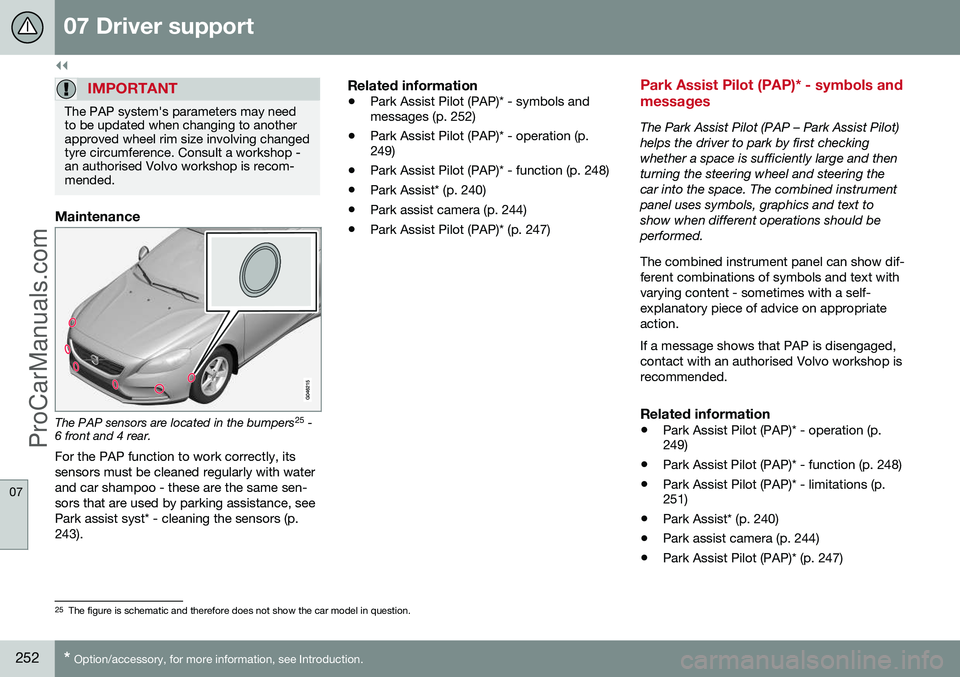
The PAP sensors are located in the bumpers 25
-
6 front and 4 rear.
For the PAP function to work correctly, its sensors must be cleaned regularly with waterand car shampoo - these are the same sen-sors that are used by parking assistance, seePark assist syst* - cleaning the sensors (p.243).
Related information
• Park Assist Pilot (PAP)* - symbols and messages (p. 252)
• Park Assist Pilot (PAP)* - operation (p.249)
• Park Assist Pilot (PAP)* - function (p. 248)
• Park Assist* (p. 240)
• Park assist camera (p. 244)
• Park Assist Pilot (PAP)* (p. 247)
Park Assist Pilot (PAP)* - symbols and messages
The Park Assist Pilot (PAP – Park Assist Pilot) helps the driver to park by first checkingwhether a space is sufficiently large and thenturning the steering wheel and steering thecar into the space. The combined instrumentpanel uses symbols, graphics and text toshow when different operations should beperformed. The combined instrument panel can show dif- ferent combinations of symbols and text withvarying content - sometimes with a self-explanatory piece of advice on appropriateaction. If a message shows that PAP is disengaged, contact with an authorised Volvo workshop isrecommended.
Related information
•
Park Assist Pilot (PAP)* - operation (p. 249)
• Park Assist Pilot (PAP)* - function (p. 248)
• Park Assist Pilot (PAP)* - limitations (p.251)
• Park Assist* (p. 240)
• Park assist camera (p. 244)
• Park Assist Pilot (PAP)* (p. 247)
25
The figure is schematic and therefore does not show the car model in question.
ProCarManuals.co’
Page 255 of 442
07 Driver support
07
* Option/accessory, for more information, see Introduction.253
BLIS* (Blind Spot Information System)
BLIS (Blind Spot Information System) is a function designed for providing support forthe driver when driving in dense traffic onroads with several lanes in the same direction. BLIS is a driver's aid intended to provide a warning about:
• vehicles in the car's blind spot
• rapidly approaching vehicles in the left and right-hand lanes closest to the car.
The BLIS function CTA (p. 255) (Cross Traffic Alert) is a driver's aid intended to provide awarning about:
• crossing traffic when the car is reversed.
WARNING
BLIS is a supplementary aid and does not work in all situations. BLIS is no substitute for a safe driving style and the use of rearview and door mir-rors. BLIS can never replace the driver's responsibility and attention - it is alwaysthe driver's responsibility to change lanesin a safe manner.
Overview
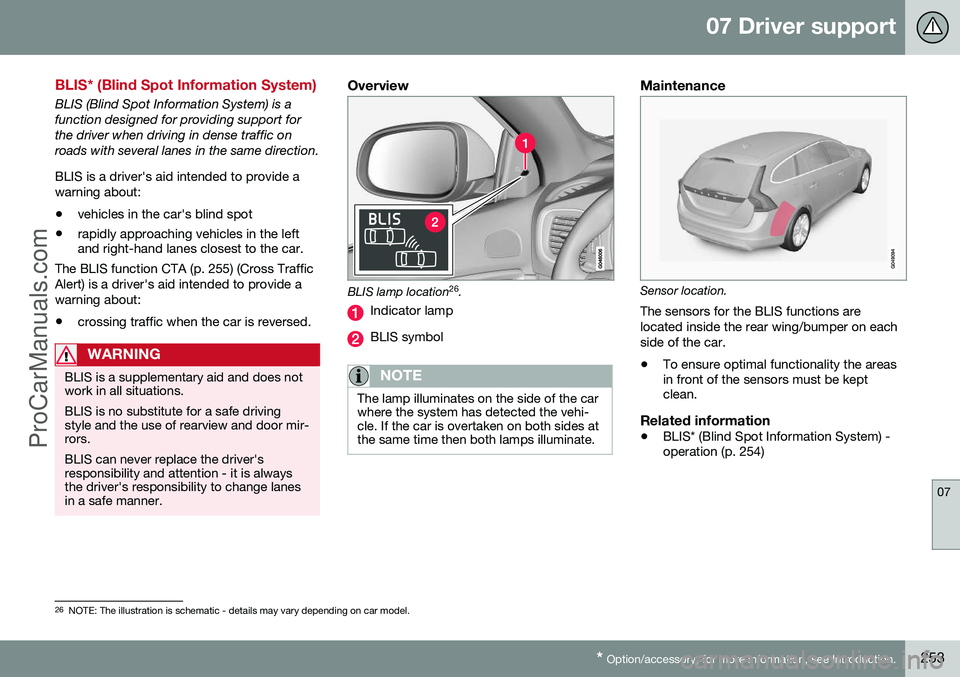
BLIS lamp location 26
.
Indicator lamp
BLIS symbol
NOTE
The lamp illuminates on the side of the car where the system has detected the vehi-cle. If the car is overtaken on both sides atthe same time then both lamps illuminate.
Maintenance
Sensor location.
The sensors for the BLIS functions are located inside the rear wing/bumper on eachside of the car.
• To ensure optimal functionality the areas in front of the sensors must be keptclean.
Related information
•BLIS* (Blind Spot Information System) -operation (p. 254)
26
NOTE: The illustration is schematic - details may vary depending on car model.
ProCarManuals.co’
Page 258 of 442
||
07 Driver support
07
256
CTA is only active during reversing and is activated automatically when the gearbox'sreverse position is selected. •If CTA detects something approaching from the side, an acoustic warning signalsounds. The signal comes from either theleft or the right-hand speaker, dependingon the direction from which the object isapproaching.
• CTA also warns by illuminating the BLISlamps.
• An additional warning is provided in theform of an illuminated icon in the displayscreen's PAS graphics (p. 240).
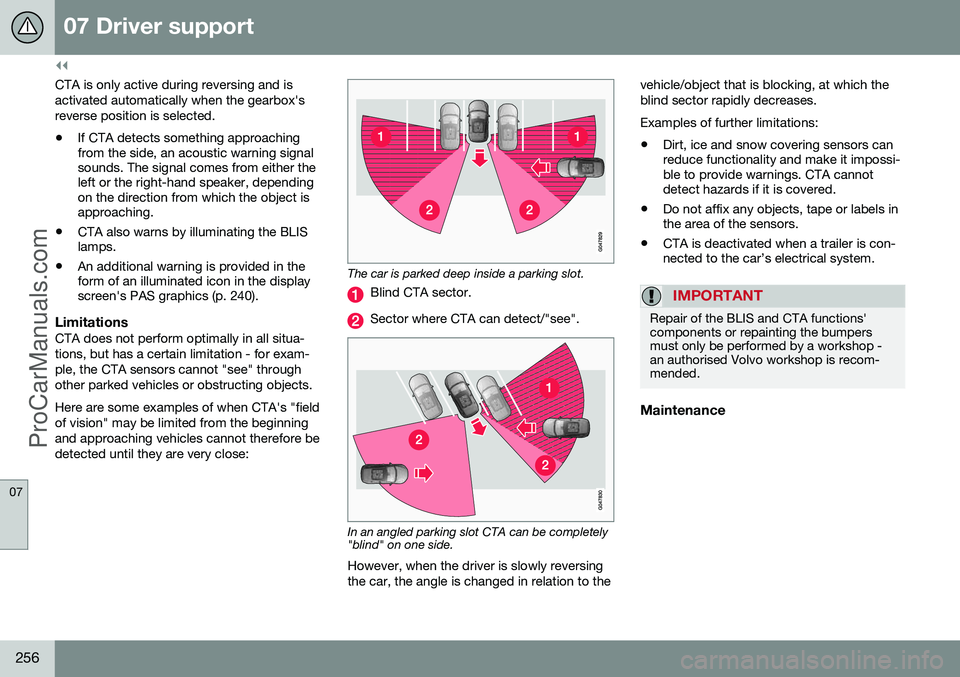
LimitationsCTA does not perform optimally in all situa- tions, but has a certain limitation - for exam-ple, the CTA sensors cannot "see" throughother parked vehicles or obstructing objects. Here are some examples of when CTA's "field of vision" may be limited from the beginningand approaching vehicles cannot therefore bedetected until they are very close:
The car is parked deep inside a parking slot.
Blind CTA sector.
Sector where CTA can detect/"see".
In an angled parking slot CTA can be completely "blind" on one side.
However, when the driver is slowly reversing the car, the angle is changed in relation to the vehicle/object that is blocking, at which theblind sector rapidly decreases. Examples of further limitations:
• Dirt, ice and snow covering sensors can reduce functionality and make it impossi-ble to provide warnings. CTA cannotdetect hazards if it is covered.
• Do not affix any objects, tape or labels inthe area of the sensors.
• CTA is deactivated when a trailer is con-nected to the car’s electrical system.
IMPORTANT
Repair of the BLIS and CTA functions' components or repainting the bumpersmust only be performed by a workshop -an authorised Volvo workshop is recom-mended.
Maintenance
ProCarManuals.com
Page 292 of 442
08 Starting and driving
08
290* Option/accessory, for more information, see Introduction.
All Wheel Drive - AWD*
The best traction possible is achieved with all- wheel drive.
All Wheel Drive is always available
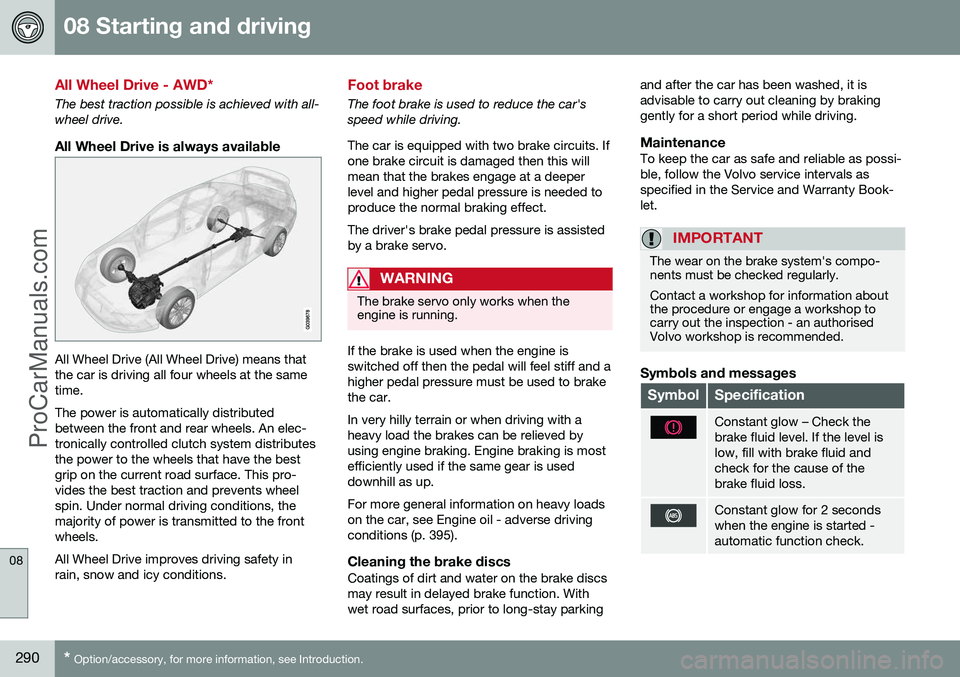
All Wheel Drive (All Wheel Drive) means that the car is driving all four wheels at the sametime. The power is automatically distributed between the front and rear wheels. An elec-tronically controlled clutch system distributesthe power to the wheels that have the bestgrip on the current road surface. This pro-vides the best traction and prevents wheelspin. Under normal driving conditions, themajority of power is transmitted to the frontwheels. All Wheel Drive improves driving safety in rain, snow and icy conditions.
Foot brake
The foot brake is used to reduce the car's speed while driving. The car is equipped with two brake circuits. If one brake circuit is damaged then this willmean that the brakes engage at a deeperlevel and higher pedal pressure is needed toproduce the normal braking effect. The driver's brake pedal pressure is assisted by a brake servo.
WARNING
The brake servo only works when the engine is running.
If the brake is used when the engine is switched off then the pedal will feel stiff and ahigher pedal pressure must be used to brakethe car. In very hilly terrain or when driving with a heavy load the brakes can be relieved byusing engine braking. Engine braking is mostefficiently used if the same gear is useddownhill as up. For more general information on heavy loads on the car, see Engine oil - adverse drivingconditions (p. 395).
Cleaning the brake discsCoatings of dirt and water on the brake discsmay result in delayed brake function. Withwet road surfaces, prior to long-stay parking and after the car has been washed, it isadvisable to carry out cleaning by brakinggently for a short period while driving.
MaintenanceTo keep the car as safe and reliable as possi-ble, follow the Volvo service intervals asspecified in the Service and Warranty Book-let.
IMPORTANT
The wear on the brake system's compo- nents must be checked regularly. Contact a workshop for information about the procedure or engage a workshop tocarry out the inspection - an authorisedVolvo workshop is recommended.
Symbols and messages
SymbolSpecification
Constant glow – Check the brake fluid level. If the level islow, fill with brake fluid andcheck for the cause of thebrake fluid loss.
Constant glow for 2 seconds when the engine is started -automatic function check.
ProCarManuals.co’
Page 320 of 442
09 Wheels and tyres
09
318
Tyres - direction of rotation
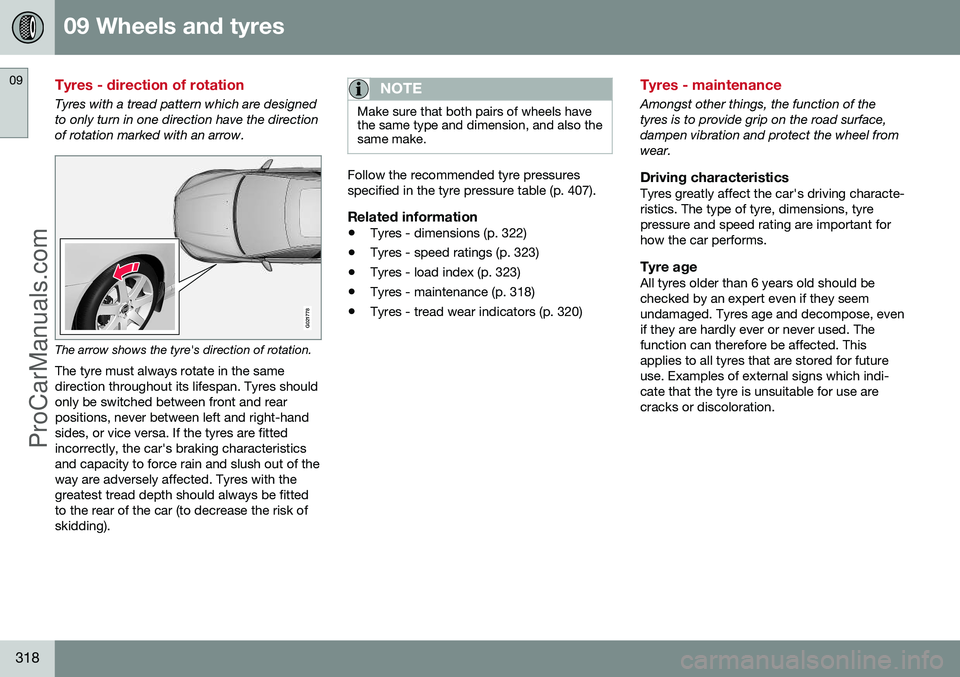
Tyres with a tread pattern which are designed to only turn in one direction have the directionof rotation marked with an arrow.
G021778
The arrow shows the tyre's direction of rotation.The tyre must always rotate in the same direction throughout its lifespan. Tyres shouldonly be switched between front and rearpositions, never between left and right-handsides, or vice versa. If the tyres are fittedincorrectly, the car's braking characteristicsand capacity to force rain and slush out of theway are adversely affected. Tyres with thegreatest tread depth should always be fittedto the rear of the car (to decrease the risk ofskidding).
NOTE
Make sure that both pairs of wheels have the same type and dimension, and also thesame make.
Follow the recommended tyre pressures specified in the tyre pressure table (p. 407).
Related information
• Tyres - dimensions (p. 322)
• Tyres - speed ratings (p. 323)
• Tyres - load index (p. 323)
• Tyres - maintenance (p. 318)
• Tyres - tread wear indicators (p. 320)
Tyres - maintenance
Amongst other things, the function of the tyres is to provide grip on the road surface,dampen vibration and protect the wheel fromwear.
Driving characteristicsTyres greatly affect the car's driving characte-ristics. The type of tyre, dimensions, tyrepressure and speed rating are important forhow the car performs.
Tyre ageAll tyres older than 6 years old should bechecked by an expert even if they seemundamaged. Tyres age and decompose, evenif they are hardly ever or never used. Thefunction can therefore be affected. Thisapplies to all tyres that are stored for futureuse. Examples of external signs which indi-cate that the tyre is unsuitable for use arecracks or discoloration.
ProCarManuals.co’
Page 321 of 442
09 Wheels and tyres
09
319
New tyres
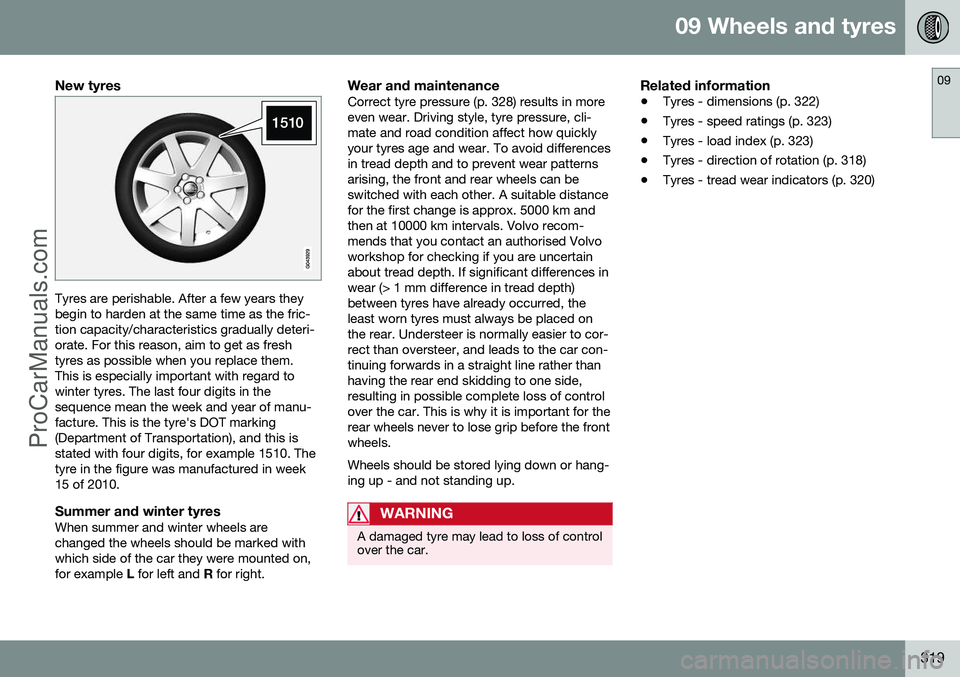
Tyres are perishable. After a few years they begin to harden at the same time as the fric-tion capacity/characteristics gradually deteri-orate. For this reason, aim to get as freshtyres as possible when you replace them.This is especially important with regard towinter tyres. The last four digits in thesequence mean the week and year of manu-facture. This is the tyre's DOT marking(Department of Transportation), and this isstated with four digits, for example 1510. Thetyre in the figure was manufactured in week15 of 2010.
Summer and winter tyresWhen summer and winter wheels arechanged the wheels should be marked withwhich side of the car they were mounted on,for example L for left and R for right.
Wear and maintenanceCorrect tyre pressure (p. 328) results in moreeven wear. Driving style, tyre pressure, cli-mate and road condition affect how quicklyyour tyres age and wear. To avoid differencesin tread depth and to prevent wear patternsarising, the front and rear wheels can beswitched with each other. A suitable distancefor the first change is approx. 5000 km andthen at 10000 km intervals. Volvo recom-mends that you contact an authorised Volvoworkshop for checking if you are uncertainabout tread depth. If significant differences inwear (> 1 mm difference in tread depth)between tyres have already occurred, theleast worn tyres must always be placed onthe rear. Understeer is normally easier to cor-rect than oversteer, and leads to the car con-tinuing forwards in a straight line rather thanhaving the rear end skidding to one side,resulting in possible complete loss of controlover the car. This is why it is important for therear wheels never to lose grip before the frontwheels. Wheels should be stored lying down or hang- ing up - and not standing up.
WARNING
A damaged tyre may lead to loss of control over the car.
Related information
• Tyres - dimensions (p. 322)
• Tyres - speed ratings (p. 323)
• Tyres - load index (p. 323)
• Tyres - direction of rotation (p. 318)
• Tyres - tread wear indicators (p. 320)
ProCarManuals.co’
Page 322 of 442
09 Wheels and tyres
09
320* Option/accessory, for more information, see Introduction.
Tyres - tread wear indicators
A tread wear indicator shows the status of the tyre's tread.
G021829
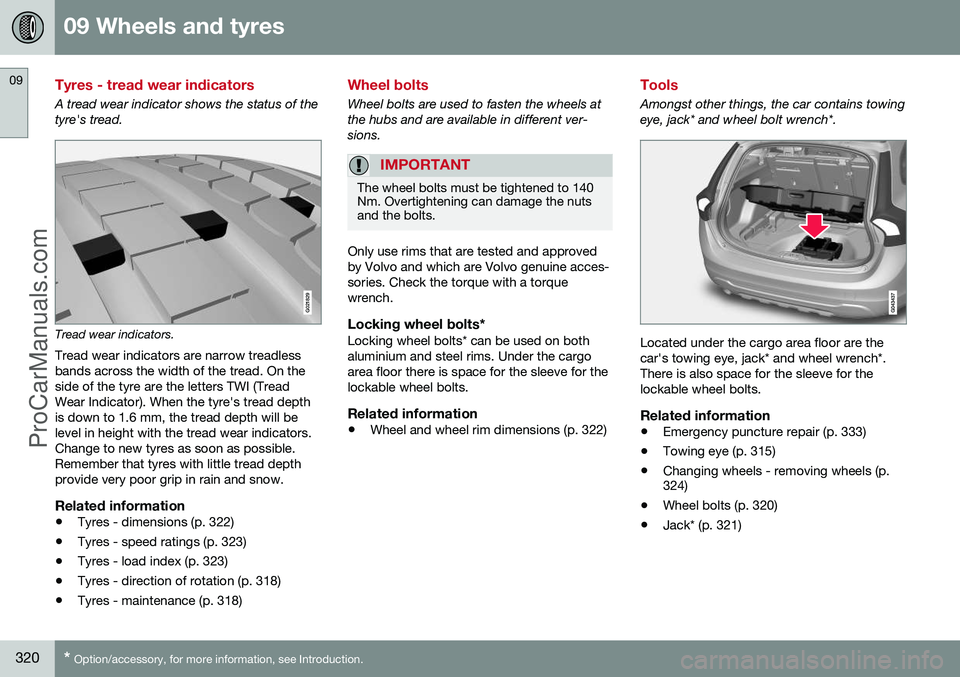
Tread wear indicators.
Tread wear indicators are narrow treadless bands across the width of the tread. On theside of the tyre are the letters TWI (TreadWear Indicator). When the tyre's tread depthis down to 1.6 mm, the tread depth will belevel in height with the tread wear indicators.Change to new tyres as soon as possible.Remember that tyres with little tread depthprovide very poor grip in rain and snow.
Related information
• Tyres - dimensions (p. 322)
• Tyres - speed ratings (p. 323)
• Tyres - load index (p. 323)
• Tyres - direction of rotation (p. 318)
• Tyres - maintenance (p. 318)
Wheel bolts
Wheel bolts are used to fasten the wheels at the hubs and are available in different ver-sions.
IMPORTANT
The wheel bolts must be tightened to 140 Nm. Overtightening can damage the nutsand the bolts.
Only use rims that are tested and approved by Volvo and which are Volvo genuine acces-sories. Check the torque with a torquewrench.
Locking wheel bolts*Locking wheel bolts* can be used on bothaluminium and steel rims. Under the cargoarea floor there is space for the sleeve for thelockable wheel bolts.
Related information
•
Wheel and wheel rim dimensions (p. 322)
Tools
Amongst other things, the car contains towing
eye, jack* and wheel bolt wrench*.
Located under the cargo area floor are the car's towing eye, jack* and wheel wrench*.There is also space for the sleeve for thelockable wheel bolts.
Related information
• Emergency puncture repair (p. 333)
• Towing eye (p. 315)
• Changing wheels - removing wheels (p. 324)
• Wheel bolts (p. 320)
• Jack* (p. 321)
ProCarManuals.co’
Page 325 of 442
09 Wheels and tyres
09
323
WARNING
19-inch wheels must never be used on
cars that are not equipped with the R-
Design or Sport chassis options. The use of 19-inch wheels on cars with standard
chassis constitutes a safety risk, with a
risk of vehicle damage, and it impairs thecar's driving characteristics.
Related information
• Tyres - speed ratings (p. 323)
• Tyres - load index (p. 323)
• Tyres - direction of rotation (p. 318)
• Tyres - maintenance (p. 318)
• Tyres - approved tyre pressures (p. 407)
• Wheel and wheel rim dimensions (p. 322)
Tyres - load index
Load index indicates a tyre's ability to carry a certain load. Each tyre has a certain capacity to carry a load, a load index (LI). The car's weight deter-mines the load capacity required of the tyres.Minimum permissible index is indicated in theload index table.
Related information
•Tyres - dimensions (p. 322)
• Tyres - approved tyre pressures (p. 407)
• Tyres - speed ratings (p. 323)
• Tyres - maintenance (p. 318)
Tyres - speed ratings
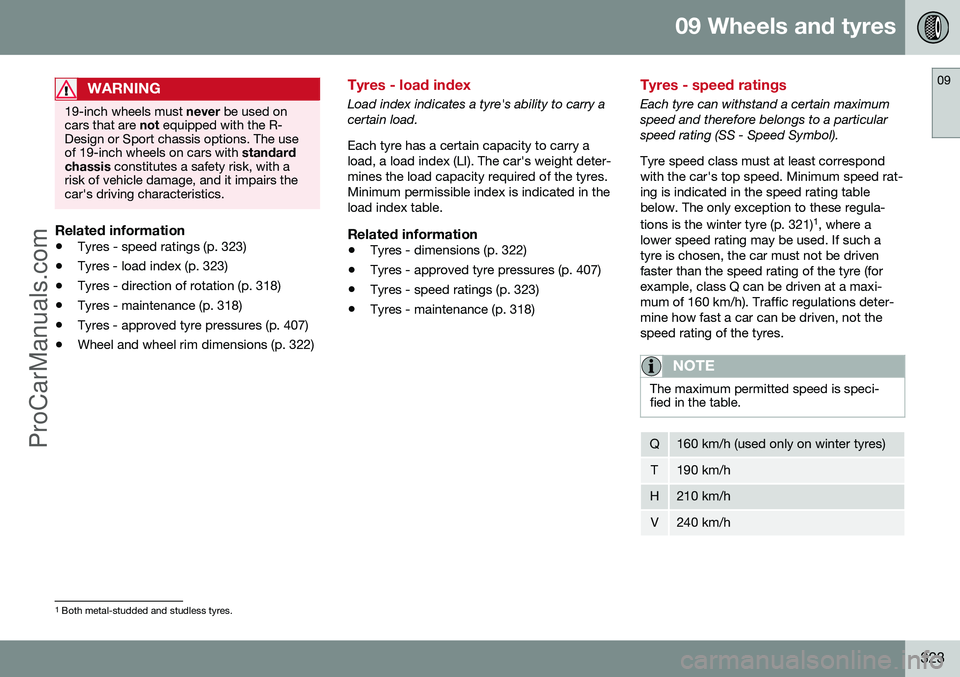
Each tyre can withstand a certain maximum speed and therefore belongs to a particularspeed rating (SS - Speed Symbol). Tyre speed class must at least correspond with the car's top speed. Minimum speed rat-ing is indicated in the speed rating tablebelow. The only exception to these regula- tions is the winter tyre (p. 321) 1
, where a
lower speed rating may be used. If such a tyre is chosen, the car must not be drivenfaster than the speed rating of the tyre (forexample, class Q can be driven at a maxi-mum of 160 km/h). Traffic regulations deter-mine how fast a car can be driven, not thespeed rating of the tyres.
NOTE
The maximum permitted speed is speci- fied in the table.
Q160 km/h (used only on winter tyres)
T190 km/h
H210 km/h
V240 km/h
1 Both metal-studded and studless tyres.
ProCarManuals.co’