power steering VOLVO V60 2014 User Guide
[x] Cancel search | Manufacturer: VOLVO, Model Year: 2014, Model line: V60, Model: VOLVO V60 2014Pages: 442, PDF Size: 13.85 MB
Page 314 of 442
||
08 Starting and driving
08
312
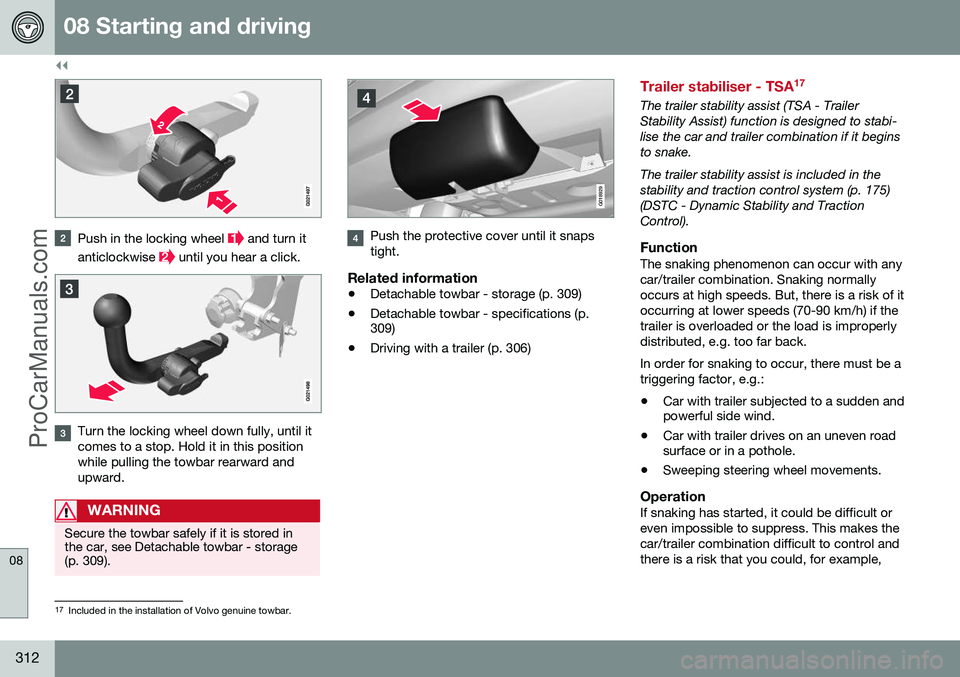
Push in the locking wheel and turn it
anticlockwise
until you hear a click.
Turn the locking wheel down fully, until it comes to a stop. Hold it in this positionwhile pulling the towbar rearward andupward.
WARNING
Secure the towbar safely if it is stored in the car, see Detachable towbar - storage(p. 309).
G018929
Push the protective cover until it snaps tight.
Related information
• Detachable towbar - storage (p. 309)
• Detachable towbar - specifications (p. 309)
• Driving with a trailer (p. 306)
Trailer stabiliser - TSA 17
The trailer stability assist (TSA - Trailer Stability Assist) function is designed to stabi-lise the car and trailer combination if it beginsto snake. The trailer stability assist is included in the stability and traction control system (p. 175)(DSTC - Dynamic Stability and TractionControl).
FunctionThe snaking phenomenon can occur with anycar/trailer combination. Snaking normallyoccurs at high speeds. But, there is a risk of itoccurring at lower speeds (70-90 km/h) if thetrailer is overloaded or the load is improperlydistributed, e.g. too far back. In order for snaking to occur, there must be a triggering factor, e.g.:
• Car with trailer subjected to a sudden and powerful side wind.
• Car with trailer drives on an uneven roadsurface or in a pothole.
• Sweeping steering wheel movements.
OperationIf snaking has started, it could be difficult or even impossible to suppress. This makes thecar/trailer combination difficult to control andthere is a risk that you could, for example,
17
Included in the installation of Volvo genuine towbar.
ProCarManuals.co’
Page 315 of 442
08 Starting and driving
08
313
end up in the wrong lane or leave the car- riageway. The trailer stability assist continually monitors the car's movements, particularly lateralmovements. If snaking is detected, the frontwheels are individually braked. This serves tostabilise the car/trailer combination. This isoften enough to help the driver regain controlof the car. If snaking is not eliminated the first time the trailer stability assist comes into action, thecar/trailer combination is braked with allwheels and engine power is reduced. Oncesnaking has been gradually suppressed andthe car/trailer combination is stable onceagain, the system stops regulating and thedriver once again has full control of the car.For more information, see Stability and trac-tion control system (DSTC) - operation (p.176)
MiscellaneousThe trailer stability assist can engage withinthe speed interval 60-160 km/h.
NOTE
TSA function is switched off if the driver selects Sport mode, see Stability and
traction control system (DSTC) (p. 175).
The trailer stability assist may fail to engage if the driver uses sudden steering wheel move-ments to try to rectify the snaking because in such a situation the system cannot determinewhether it is the trailer or the driver that iscausing the snaking.
When the trailer stability assist isworking, the combined instrument
panel's DSTC symbol flashes.
Related information
•Stability and traction control system (DSTC) - symbols and messages (p. 178)
Towing
During towing, one vehicle is towed by another vehicle using a tow rope.
IMPORTANT
Note that the car must always be towed with the wheels rolling forward. Do not tow the vehicle at speeds higher than 80 km/h or for distances in excess of80 km.
Find out the statutory maximum speed limit for towing before towing begins.
1. Unlock the steering lock by inserting the
remote control key in the ignition switch and giving a long press on the START/
STOP ENGINE button - key position II is
activated, see Key positions (p. 70) formore information about key positions.
2. The remote control key must remain in the ignition switch while the car is beingtowed.
3. Keep the towline taut when the towing vehicle reduces speed by holding yourfoot gently pressed on the brake pedal -thereby avoiding unnecessary jerking.
4. Be prepared to brake to stop.
ProCarManuals.co’
Page 316 of 442
||
08 Starting and driving
08
314
WARNING
•Check that the steering lock is unlocked before towing.
• The remote control key must be in keyposition
II - in position I all airbags are
deactivated.
• Never remove the remote control keyfrom the ignition switch when the caris being towed.
WARNING
The brake servo and power steering do not work when the engine is switched off - thebrake pedal needs to be depressedabout 5 times more heavily and the steer-ing is considerably heavier than normal.
Manual gearboxPrior to towing:
–Move gear lever into neutral and release the parking brake.
Automatic gearbox GeartronicPrior to towing:
–Move the gear selector to position
N and
release the parking brake.
Automatic gearbox PowershiftThe model with Powershift transmission should not be towed as it is dependent on theengine running in order to receive sufficient lubrication. If towing still has to take place,the route must be as short as possible andthen with very low speed. In the event of uncertainty as to whether or not the car is equipped with Powershift trans-mission, this can be verified by checking thedesignation on the gearbox label under thebonnet, see Type designations (p. 386). Thedesignation ”MPS6” means that it isPowershift transmission - otherwise it isGeartronic automatic transmission.
IMPORTANT
Avoid towing.
• However, the car can be towed for a short distance at low speed to move itfrom a dangerous position - not furtherthan 10 km and not faster than10 km/h. Note that the car mustalways be towed with the wheels roll-ing forward.
• In the event of moving a longer dis-tance than 10 km, the car must betransported with the drive wheelsraised from the road - professionalrecovery is recommended.
Prior to towing:
–Move the gear selector to position
N and
release the parking brake.
Jump startingDo not tow the car to bump start the engine. Use a donor battery if the battery is dis-charged and the engine does not start, seeJump starting with battery (p. 270).
IMPORTANT
The catalytic converter may be damaged during attempts to tow-start the engine.
Related information
• Towing eye (p. 315)
ProCarManuals.co’
Page 346 of 442
||
10 Maintenance and service
10
344
WARNING
The ignition system has very high voltage and output. The voltage in the ignition sys-tem is highly dangerous. The car's electri-cal system must always be in key position0 when work is being performed in the
engine compartment; see Key positions -functions at different levels (p. 70). Do not touch the spark plugs or ignition coil when the car's electrical system is inkey position II or when the engine is hot.
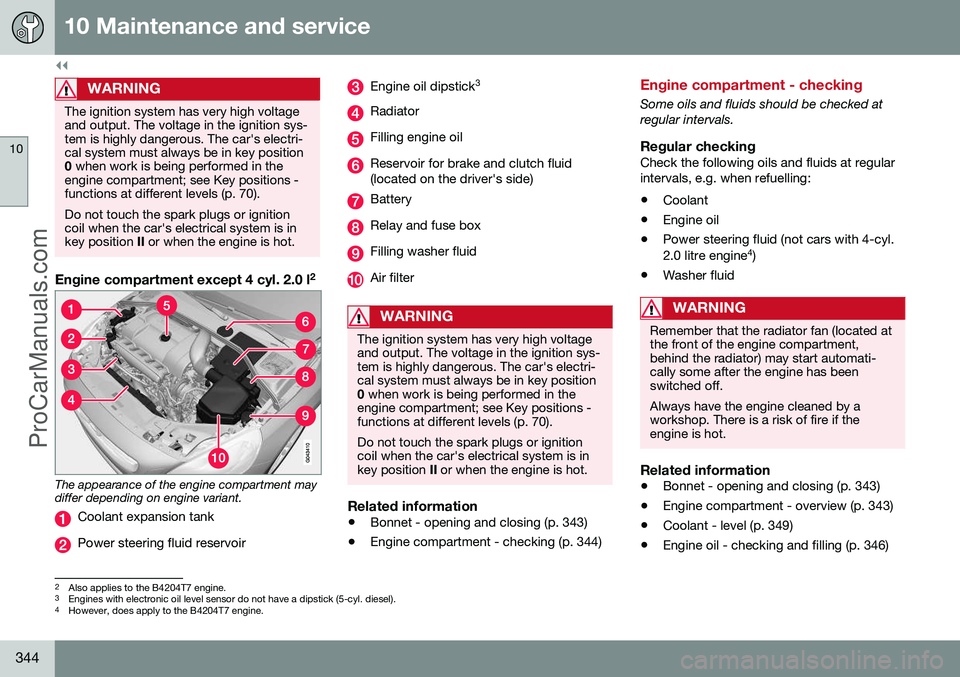
Engine compartment except 4 cyl. 2.0 l 2
The appearance of the engine compartment may differ depending on engine variant.
Coolant expansion tank
Power steering fluid reservoir
Engine oil dipstick
3
Radiator
Filling engine oil
Reservoir for brake and clutch fluid (located on the driver's side)
Battery
Relay and fuse box
Filling washer fluid
Air filter
WARNING
The ignition system has very high voltage and output. The voltage in the ignition sys-tem is highly dangerous. The car's electri-cal system must always be in key position0
when work is being performed in the
engine compartment; see Key positions -functions at different levels (p. 70). Do not touch the spark plugs or ignition coil when the car's electrical system is inkey position II or when the engine is hot.
Related information
• Bonnet - opening and closing (p. 343)
• Engine compartment - checking (p. 344)
Engine compartment - checking
Some oils and fluids should be checked at regular intervals.
Regular checkingCheck the following oils and fluids at regularintervals, e.g. when refuelling:
• Coolant
• Engine oil
• Power steering fluid (not cars with 4-cyl. 2.0 litre engine 4
)
• Washer fluid
WARNING
Remember that the radiator fan (located at the front of the engine compartment,behind the radiator) may start automati-cally some after the engine has beenswitched off. Always have the engine cleaned by a workshop. There is a risk of fire if theengine is hot.
Related information
• Bonnet - opening and closing (p. 343)
• Engine compartment - overview (p. 343)
• Coolant - level (p. 349)
• Engine oil - checking and filling (p. 346)
2
Also applies to the B4204T7 engine.3 Engines with electronic oil level sensor do not have a dipstick (5-cyl. diesel).
4 However, does apply to the B4204T7 engine.
ProCarManuals.co’
Page 347 of 442
10 Maintenance and service
10
345
•
Power steering fluid - level (p. 351)
• Washer fluid - filling (p. 361)
Engine oil - general
An approved engine oil must be used in order that the recommended service intervals canbe applied.
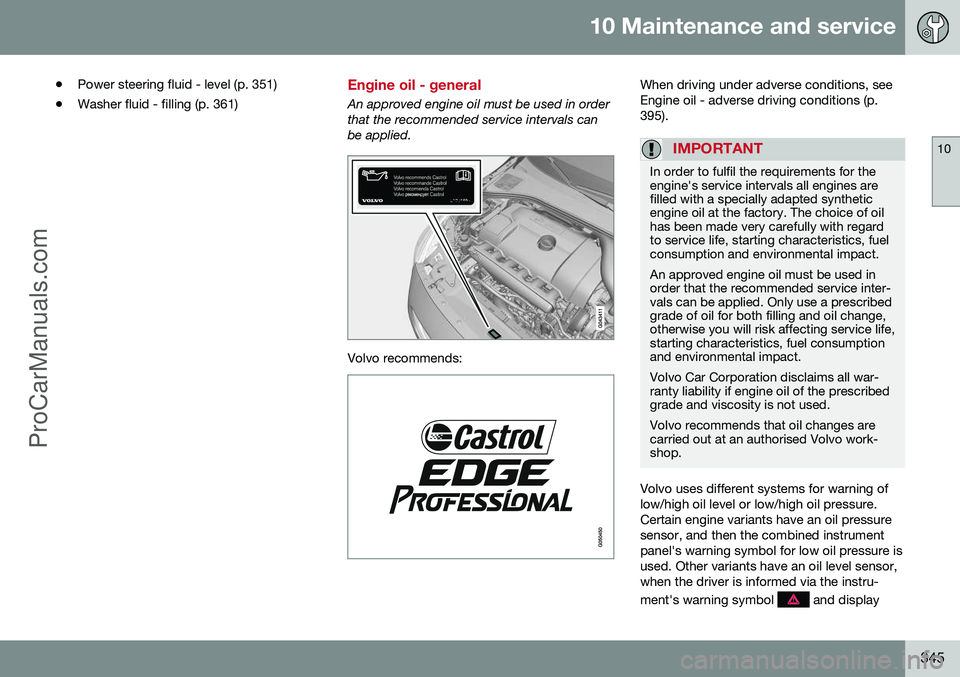
Volvo recommends:
When driving under adverse conditions, see Engine oil - adverse driving conditions (p.395).
IMPORTANT
In order to fulfil the requirements for the engine's service intervals all engines arefilled with a specially adapted syntheticengine oil at the factory. The choice of oilhas been made very carefully with regardto service life, starting characteristics, fuelconsumption and environmental impact. An approved engine oil must be used in order that the recommended service inter-vals can be applied. Only use a prescribedgrade of oil for both filling and oil change,otherwise you will risk affecting service life,starting characteristics, fuel consumptionand environmental impact. Volvo Car Corporation disclaims all war- ranty liability if engine oil of the prescribedgrade and viscosity is not used. Volvo recommends that oil changes are carried out at an authorised Volvo work-shop.
Volvo uses different systems for warning of low/high oil level or low/high oil pressure.Certain engine variants have an oil pressuresensor, and then the combined instrumentpanel's warning symbol for low oil pressure isused. Other variants have an oil level sensor,when the driver is informed via the instru- ment's warning symbol
and display
ProCarManuals.co’
Page 353 of 442
10 Maintenance and service
10
351
Filling
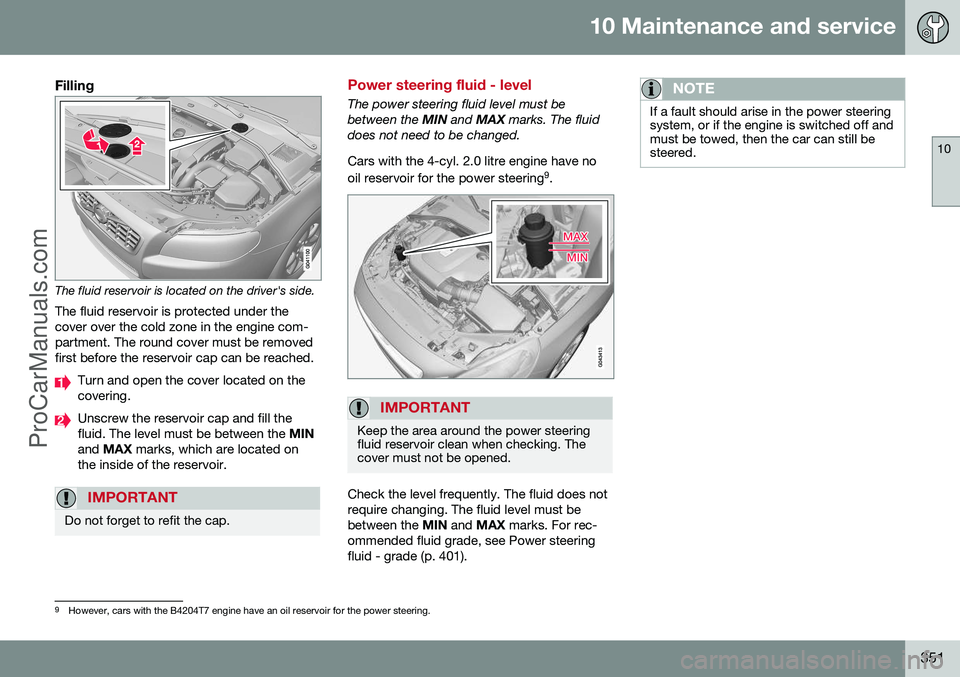
The fluid reservoir is located on the driver's side.The fluid reservoir is protected under the cover over the cold zone in the engine com-partment. The round cover must be removedfirst before the reservoir cap can be reached.
Turn and open the cover located on the covering.
Unscrew the reservoir cap and fill the fluid. The level must be between the MIN
and MAX marks, which are located on
the inside of the reservoir.
IMPORTANT
Do not forget to refit the cap.
Power steering fluid - level
The power steering fluid level must be between the MIN and MAX marks. The fluid
does not need to be changed. Cars with the 4-cyl. 2.0 litre engine have no oil reservoir for the power steering 9
.
IMPORTANT
Keep the area around the power steering fluid reservoir clean when checking. Thecover must not be opened.
Check the level frequently. The fluid does not require changing. The fluid level must bebetween the MIN and MAX marks. For rec-
ommended fluid grade, see Power steeringfluid - grade (p. 401).
NOTE
If a fault should arise in the power steering system, or if the engine is switched off andmust be towed, then the car can still besteered.
9 However, cars with the B4204T7 engine have an oil reservoir for the power steering.
ProCarManuals.co’
Page 373 of 442
10 Maintenance and service
10
371
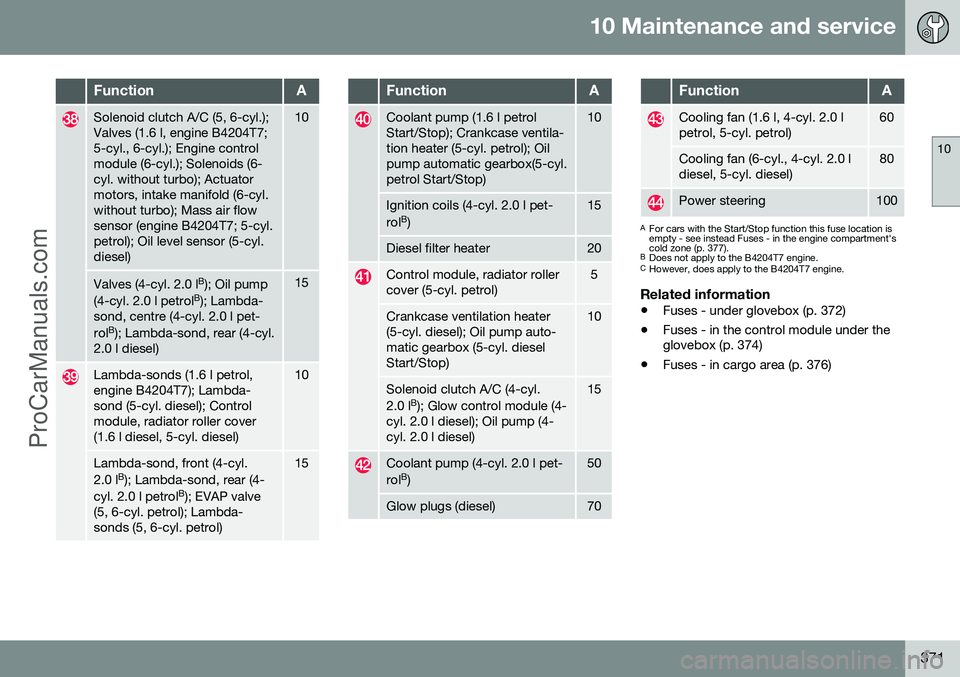
FunctionA
Solenoid clutch A/C (5, 6-cyl.); Valves (1.6 l, engine B4204T7;5-cyl., 6-cyl.); Engine controlmodule (6-cyl.); Solenoids (6-cyl. without turbo); Actuatormotors, intake manifold (6-cyl.without turbo); Mass air flowsensor (engine B4204T7; 5-cyl.petrol); Oil level sensor (5-cyl.diesel)10
Valves (4-cyl. 2.0 lB
); Oil pump
(4-cyl. 2.0 l petrol B
); Lambda-
sond, centre (4-cyl. 2.0 l pet- rol B
); Lambda-sond, rear (4-cyl.
2.0 l diesel)15
Lambda-sonds (1.6 l petrol, engine B4204T7); Lambda-sond (5-cyl. diesel); Controlmodule, radiator roller cover(1.6 l diesel, 5-cyl. diesel)10
Lambda-sond, front (4-cyl. 2.0 l B
); Lambda-sond, rear (4-
cyl. 2.0 l petrol B
); EVAP valve
(5, 6-cyl. petrol); Lambda- sonds (5, 6-cyl. petrol)15
FunctionA
Coolant pump (1.6 l petrol Start/Stop); Crankcase ventila-tion heater (5-cyl. petrol); Oilpump automatic gearbox(5-cyl.petrol Start/Stop)10
Ignition coils (4-cyl. 2.0 l pet- rol B
)15
Diesel filter heater20
Control module, radiator roller cover (5-cyl. petrol)5
Crankcase ventilation heater (5-cyl. diesel); Oil pump auto-matic gearbox (5-cyl. dieselStart/Stop)10
Solenoid clutch A/C (4-cyl. 2.0 l B
); Glow control module (4-
cyl. 2.0 l diesel); Oil pump (4- cyl. 2.0 l diesel)15
Coolant pump (4-cyl. 2.0 l pet- rol B
)50
Glow plugs (diesel)70
FunctionA
Cooling fan (1.6 l, 4-cyl. 2.0 l petrol, 5-cyl. petrol)60
Cooling fan (6-cyl., 4-cyl. 2.0 l diesel, 5-cyl. diesel)80
Power steering100
A For cars with the Start/Stop function this fuse location is empty - see instead Fuses - in the engine compartment'scold zone (p. 377).
B Does not apply to the B4204T7 engine.
C However, does apply to the B4204T7 engine.
Related information
• Fuses - under glovebox (p. 372)
• Fuses - in the control module under the glovebox (p. 374)
• Fuses - in cargo area (p. 376)
ProCarManuals.co’
Page 376 of 442
10 Maintenance and service
10
374* Option/accessory, for more information, see Introduction.
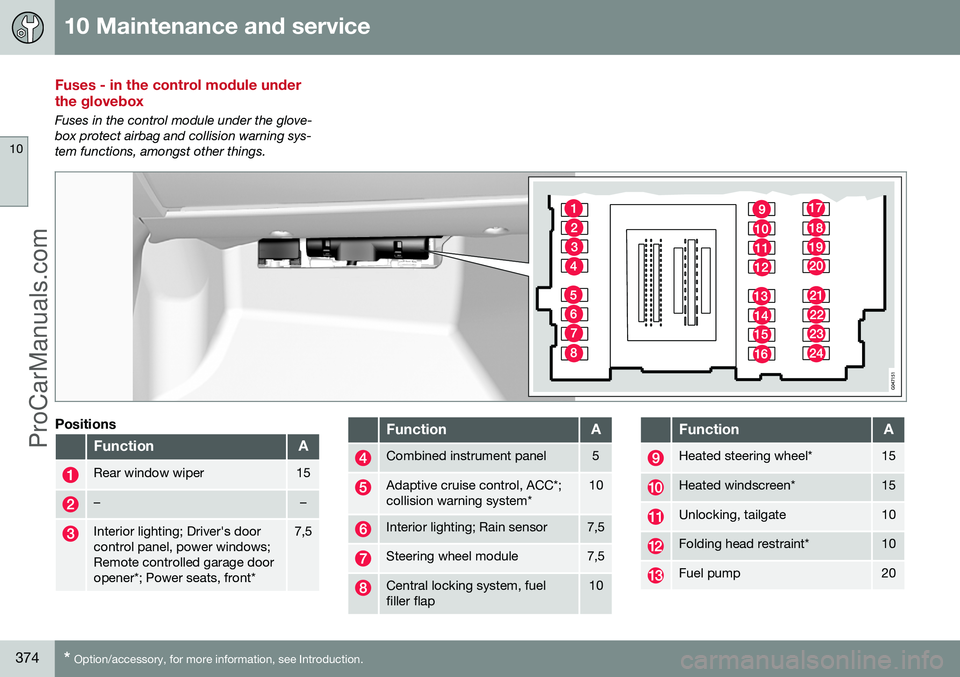
Fuses - in the control module under the glovebox
Fuses in the control module under the glove- box protect airbag and collision warning sys-tem functions, amongst other things.
Positions
FunctionA
Rear window wiper15
––
Interior lighting; Driver's door control panel, power windows;Remote controlled garage dooropener*; Power seats, front*7,5
FunctionA
Combined instrument panel5
Adaptive cruise control, ACC*; collision warning system*10
Interior lighting; Rain sensor7,5
Steering wheel module7,5
Central locking system, fuel filler flap10
FunctionA
Heated steering wheel*15
Heated windscreen*15
Unlocking, tailgate10
Folding head restraint*10
Fuel pump20
ProCarManuals.co’
Page 403 of 442
11 Specifications
11
401
Brake fluid - grade and volume
The medium in a hydraulic brake system is called brake fluid, and it is used to transferforce from e.g. a brake pedal via a masterbrake cylinder to one or more slave cylinders,which in turn act on a mechanical brake. Prescribed grade: DOT 4
Volume: 0.6 litres
Related information
•Brake and clutch fluid - level (p. 350)
Power steering fluid - grade
Power steering fluid is the denomination of the medium used in the car's power steeringsystem. Prescribed grade:
WSS M2C204-A2 or
equivalent product.
Related information
• Power steering fluid - level (p. 351)
Washer fluid - quality and volume
Washer fluid is used, together with wind- screen and rear window wipers (p. 90) to keepthe car's windows and headlamps clean andensure visibility when driving. Prescribed grade:
Washer fluid recom-
mended by Volvo - with frost protection dur- ing cold weather and below freezing point. Volume: • Cars
with headlamp washing: 5.4 litres.
• Cars
without headlamp washing: 4.0
litres.
Related information
• Washer fluid - filling (p. 361)
• Wiper blades (p. 359)
ProCarManuals.co’
Page 433 of 442
12 Alphabetical Index
12
431
Electrical socket...................................... 141
cargo area........................................... 144
Electrical system...................................... 410 Electric parking brake low battery voltage............................. 293
Electronic climate control - ECC............. 121Emergency equipment first aid kit........................................... 329
warning triangle.................................. 329
Emergency puncture repair..................... 333 action.................................................. 335
inflating the tyres................................ 337
rechecking.......................................... 336
Emergency puncture repair kit location............................................... 333
overview.............................................. 334
sealing fluid......................................... 338
Emissions of carbon dioxide................... 403 Engine deactivate........................................... 265
overheating......................................... 306
start..................................................... 264
Start/Stop........................................... 279
Engine and passenger compartment heater direct start/immediate stop................ 130
messages........................................... 132
timer.................................................... 130
Engine block heater......................... 129, 269 Engine compartment
coolant................................................ 349
oil........................................................ 345
overview.............................................. 343
power steering fluid............................ 351
Engine drag control................................. 176
Engine oil......................................... 345, 395 adverse driving conditions.................. 395
filter..................................................... 345
grade and volume............................... 396
Engine specifications............................... 393 Error messages Adaptive Cruise Control..................... 200
Driver Alert Control............................. 227
Lane Departure Warning..................... 232
LKA..................................................... 238
see Messages and symbols....... 200, 295
Error messages in BLIS........................... 257
ERS - Remote Start................................. 266
exhaust gases, toxic, sucked in.............. 298
External dimensions................................ 389
F
Fan ECC.................................................... 123
Fault tracing for the camera sensor......... 208 First aid.................................................... 329
First aid kit............................................... 329
Flexifuel.................................................... 269
Fluids, capacities............. 398, 399, 401, 402
Fluids and oils.......................... 398, 399, 401Fog lamp
rear........................................................ 85
Foot brake....................................... 290, 291
FOUR-C - Active chassis......................... 175
FSC, ecolabelling....................................... 21
Fuel.......................................... 301, 302, 304 fuel consumption................................ 403
fuel economy...................................... 328
fuel filter.............................................. 303
Fuel-driven heater direct start/immediate stop................ 130
timer.................................................... 130
Fuelling filling................................................... 300
fuel cap............................................... 300
fuel filler flap....................................... 300
fuel filler flap, manual opening............ 300
Fuel tank volume................................................ 402
Fuse box.................................................. 367
Fuses....................................................... 367 cargo area........................................... 376
ProCarManuals.co’