towing VOLVO V60 2014 User Guide
[x] Cancel search | Manufacturer: VOLVO, Model Year: 2014, Model line: V60, Model: VOLVO V60 2014Pages: 442, PDF Size: 13.85 MB
Page 313 of 442
08 Starting and driving
08
}}
311
G000000
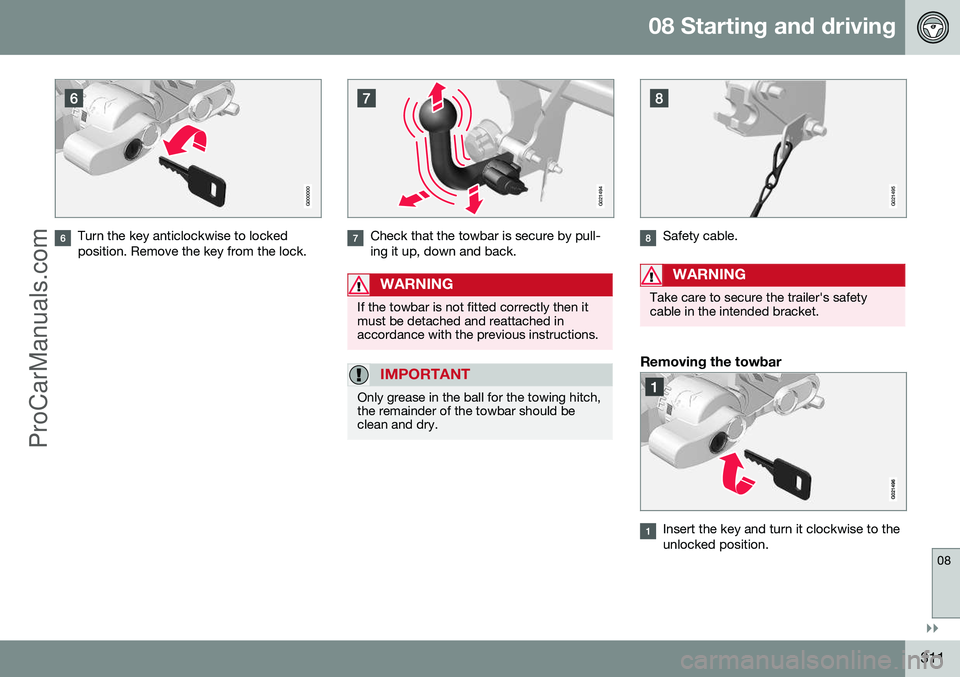
Turn the key anticlockwise to locked position. Remove the key from the lock.
G021494
Check that the towbar is secure by pull- ing it up, down and back.
WARNING
If the towbar is not fitted correctly then it must be detached and reattached inaccordance with the previous instructions.
IMPORTANT
Only grease in the ball for the towing hitch, the remainder of the towbar should beclean and dry.
G021495
Safety cable.
WARNING
Take care to secure the trailer's safety cable in the intended bracket.
Removing the towbar
Insert the key and turn it clockwise to the unlocked position.
ProCarManuals.co’
Page 315 of 442
08 Starting and driving
08
313
end up in the wrong lane or leave the car- riageway. The trailer stability assist continually monitors the car's movements, particularly lateralmovements. If snaking is detected, the frontwheels are individually braked. This serves tostabilise the car/trailer combination. This isoften enough to help the driver regain controlof the car. If snaking is not eliminated the first time the trailer stability assist comes into action, thecar/trailer combination is braked with allwheels and engine power is reduced. Oncesnaking has been gradually suppressed andthe car/trailer combination is stable onceagain, the system stops regulating and thedriver once again has full control of the car.For more information, see Stability and trac-tion control system (DSTC) - operation (p.176)
MiscellaneousThe trailer stability assist can engage withinthe speed interval 60-160 km/h.
NOTE
TSA function is switched off if the driver selects Sport mode, see Stability and
traction control system (DSTC) (p. 175).
The trailer stability assist may fail to engage if the driver uses sudden steering wheel move-ments to try to rectify the snaking because in such a situation the system cannot determinewhether it is the trailer or the driver that iscausing the snaking.
When the trailer stability assist isworking, the combined instrument
panel's DSTC symbol flashes.
Related information
•Stability and traction control system (DSTC) - symbols and messages (p. 178)
Towing
During towing, one vehicle is towed by another vehicle using a tow rope.
IMPORTANT
Note that the car must always be towed with the wheels rolling forward. Do not tow the vehicle at speeds higher than 80 km/h or for distances in excess of80 km.
Find out the statutory maximum speed limit for towing before towing begins.
1. Unlock the steering lock by inserting the
remote control key in the ignition switch and giving a long press on the START/
STOP ENGINE button - key position II is
activated, see Key positions (p. 70) formore information about key positions.
2. The remote control key must remain in the ignition switch while the car is beingtowed.
3. Keep the towline taut when the towing vehicle reduces speed by holding yourfoot gently pressed on the brake pedal -thereby avoiding unnecessary jerking.
4. Be prepared to brake to stop.
ProCarManuals.co’
Page 316 of 442
||
08 Starting and driving
08
314
WARNING
•Check that the steering lock is unlocked before towing.
• The remote control key must be in keyposition
II - in position I all airbags are
deactivated.
• Never remove the remote control keyfrom the ignition switch when the caris being towed.
WARNING
The brake servo and power steering do not work when the engine is switched off - thebrake pedal needs to be depressedabout 5 times more heavily and the steer-ing is considerably heavier than normal.
Manual gearboxPrior to towing:
–Move gear lever into neutral and release the parking brake.
Automatic gearbox GeartronicPrior to towing:
–Move the gear selector to position
N and
release the parking brake.
Automatic gearbox PowershiftThe model with Powershift transmission should not be towed as it is dependent on theengine running in order to receive sufficient lubrication. If towing still has to take place,the route must be as short as possible andthen with very low speed. In the event of uncertainty as to whether or not the car is equipped with Powershift trans-mission, this can be verified by checking thedesignation on the gearbox label under thebonnet, see Type designations (p. 386). Thedesignation ”MPS6” means that it isPowershift transmission - otherwise it isGeartronic automatic transmission.
IMPORTANT
Avoid towing.
• However, the car can be towed for a short distance at low speed to move itfrom a dangerous position - not furtherthan 10 km and not faster than10 km/h. Note that the car mustalways be towed with the wheels roll-ing forward.
• In the event of moving a longer dis-tance than 10 km, the car must betransported with the drive wheelsraised from the road - professionalrecovery is recommended.
Prior to towing:
–Move the gear selector to position
N and
release the parking brake.
Jump startingDo not tow the car to bump start the engine. Use a donor battery if the battery is dis-charged and the engine does not start, seeJump starting with battery (p. 270).
IMPORTANT
The catalytic converter may be damaged during attempts to tow-start the engine.
Related information
• Towing eye (p. 315)
ProCarManuals.co’
Page 317 of 442
08 Starting and driving
08
315
Towing eye
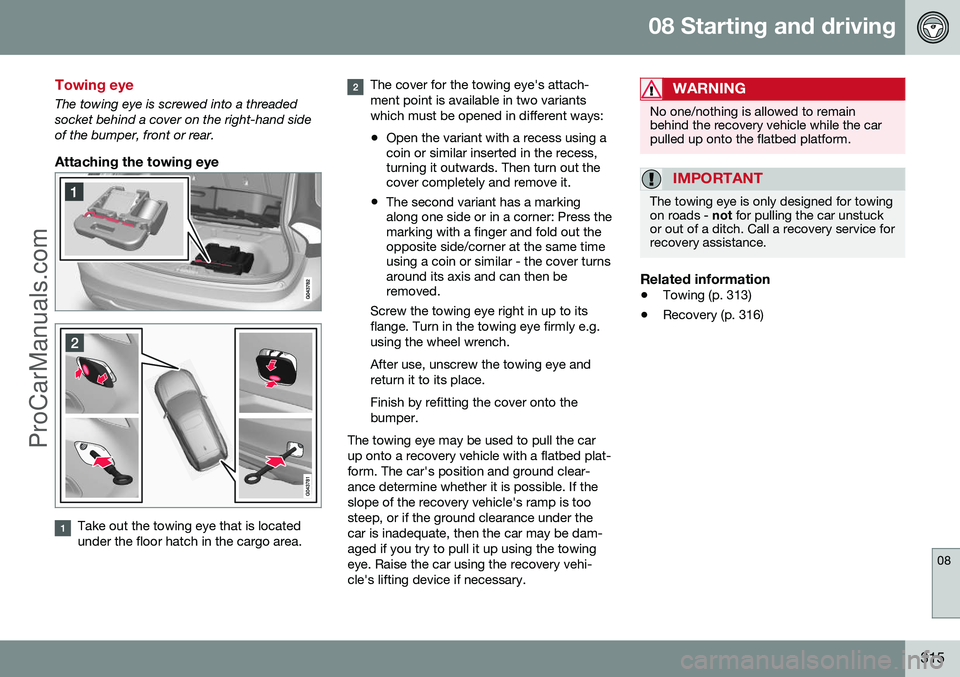
The towing eye is screwed into a threaded socket behind a cover on the right-hand sideof the bumper, front or rear.
Attaching the towing eye
Take out the towing eye that is located under the floor hatch in the cargo area.
The cover for the towing eye's attach- ment point is available in two variantswhich must be opened in different ways:
• Open the variant with a recess using a coin or similar inserted in the recess,turning it outwards. Then turn out thecover completely and remove it.
• The second variant has a markingalong one side or in a corner: Press themarking with a finger and fold out theopposite side/corner at the same timeusing a coin or similar - the cover turnsaround its axis and can then beremoved.
Screw the towing eye right in up to its flange. Turn in the towing eye firmly e.g.using the wheel wrench. After use, unscrew the towing eye and return it to its place. Finish by refitting the cover onto the bumper.
The towing eye may be used to pull the carup onto a recovery vehicle with a flatbed plat-form. The car's position and ground clear-ance determine whether it is possible. If theslope of the recovery vehicle's ramp is toosteep, or if the ground clearance under thecar is inadequate, then the car may be dam-aged if you try to pull it up using the towingeye. Raise the car using the recovery vehi-cle's lifting device if necessary.WARNING
No one/nothing is allowed to remain behind the recovery vehicle while the carpulled up onto the flatbed platform.
IMPORTANT
The towing eye is only designed for towing on roads - not for pulling the car unstuck
or out of a ditch. Call a recovery service forrecovery assistance.
Related information
• Towing (p. 313)
• Recovery (p. 316)
ProCarManuals.co’
Page 318 of 442
08 Starting and driving
08
316
Recovery
Recovery means that the vehicle is transpor- ted away by means of another vehicle. Call a recovery service for recovery assis- tance. The towing eye may be used to pull the car up onto a recovery vehicle with a flatbed plat-form. The car's position and ground clear-ance determine whether it is possible. If theslope of the recovery vehicle's ramp is toosteep, or if the ground clearance under thecar is inadequate, then the car may be dam-aged if you try to pull it up using the towingeye. Raise the car using the recovery vehi-cle's lifting device if necessary.
WARNING
No one/nothing is allowed to remain behind the recovery vehicle while the carpulled up onto the flatbed platform.
IMPORTANT
The towing eye is only designed for towing on roads - not for pulling the car unstuck
or out of a ditch. Call a recovery service forrecovery assistance.
IMPORTANT
Note that the car must always be transpor- ted with the wheels rolling forward.
• An All Wheel Drive car (AWD) with raised front suspension must not betowed at speeds above 70 km/h. Itshould not be towed further than 50km.
Related information
•
Towing (p. 313)
ProCarManuals.co’
Page 322 of 442
09 Wheels and tyres
09
320* Option/accessory, for more information, see Introduction.
Tyres - tread wear indicators
A tread wear indicator shows the status of the tyre's tread.
G021829
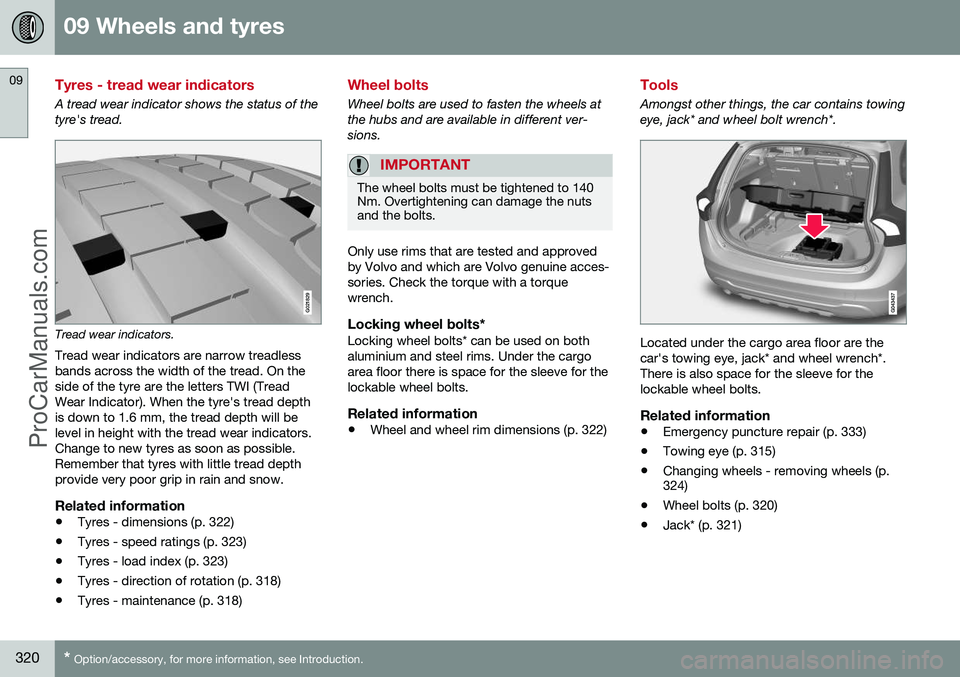
Tread wear indicators.
Tread wear indicators are narrow treadless bands across the width of the tread. On theside of the tyre are the letters TWI (TreadWear Indicator). When the tyre's tread depthis down to 1.6 mm, the tread depth will belevel in height with the tread wear indicators.Change to new tyres as soon as possible.Remember that tyres with little tread depthprovide very poor grip in rain and snow.
Related information
• Tyres - dimensions (p. 322)
• Tyres - speed ratings (p. 323)
• Tyres - load index (p. 323)
• Tyres - direction of rotation (p. 318)
• Tyres - maintenance (p. 318)
Wheel bolts
Wheel bolts are used to fasten the wheels at the hubs and are available in different ver-sions.
IMPORTANT
The wheel bolts must be tightened to 140 Nm. Overtightening can damage the nutsand the bolts.
Only use rims that are tested and approved by Volvo and which are Volvo genuine acces-sories. Check the torque with a torquewrench.
Locking wheel bolts*Locking wheel bolts* can be used on bothaluminium and steel rims. Under the cargoarea floor there is space for the sleeve for thelockable wheel bolts.
Related information
•
Wheel and wheel rim dimensions (p. 322)
Tools
Amongst other things, the car contains towing
eye, jack* and wheel bolt wrench*.
Located under the cargo area floor are the car's towing eye, jack* and wheel wrench*.There is also space for the sleeve for thelockable wheel bolts.
Related information
• Emergency puncture repair (p. 333)
• Towing eye (p. 315)
• Changing wheels - removing wheels (p. 324)
• Wheel bolts (p. 320)
• Jack* (p. 321)
ProCarManuals.co’
Page 328 of 442
||
09 Wheels and tyres
09
326* Option/accessory, for more information, see Introduction.
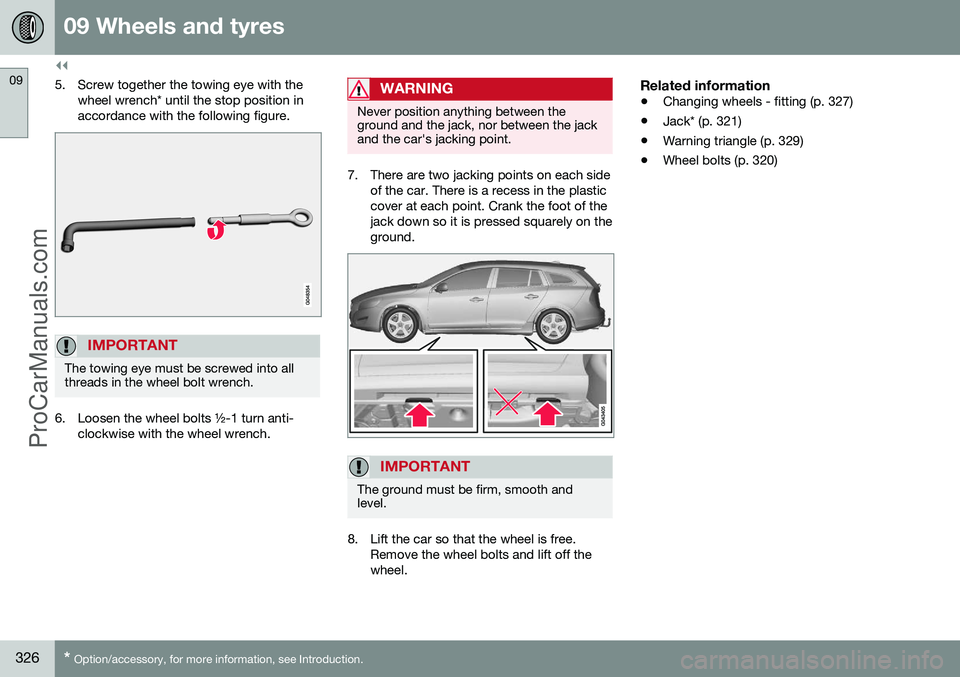
5. Screw together the towing eye with the
wheel wrench* until the stop position in accordance with the following figure.
IMPORTANT
The towing eye must be screwed into all threads in the wheel bolt wrench.
6. Loosen the wheel bolts ½-1 turn anti-clockwise with the wheel wrench.
WARNING
Never position anything between the ground and the jack, nor between the jackand the car's jacking point.
7. There are two jacking points on each sideof the car. There is a recess in the plastic cover at each point. Crank the foot of thejack down so it is pressed squarely on theground.
IMPORTANT
The ground must be firm, smooth and level.
8. Lift the car so that the wheel is free.Remove the wheel bolts and lift off the wheel.
Related information
• Changing wheels - fitting (p. 327)
• Jack* (p. 321)
• Warning triangle (p. 329)
• Wheel bolts (p. 320)
ProCarManuals.co’
Page 392 of 442
11 Specifications
11
390
Weights
Max. gross vehicle weight, etc. can be read on a label in the car. Kerb weight includes the driver, the fuel tank 90% full and all fluids. The weight of passengers and accessories, and towball load (p. 391) (when a trailer ishitched) influence the load capacity and arenot included in the kerb weight. Permitted max. load = Gross vehicle weight - Kerb weight.
NOTE
The documented kerb weight applies to cars in the standard version - i.e. a carwithout extra equipment or accessories.This means that for every accessory addedthe loading capacity of the car is reducedcorrespondingly by the weight of theaccessory. Examples of accessories that reduce load- ing capacity are the Kinetic/Momentum/Summum equipment levels, as well asother accessories such as Towbar, Loadcarriers, Space box, Audio system, Auxili-ary lamps, GPS, Fuel-driven heater, Safetygrille, Carpets, Cargo cover, Power seats,etc. Weighing the car is a certain way of ascer- taining the kerb weight of your own partic-ular car.
WARNING
The car's driving characteristics change depending on how heavily it is loaded andhow the load is distributed.
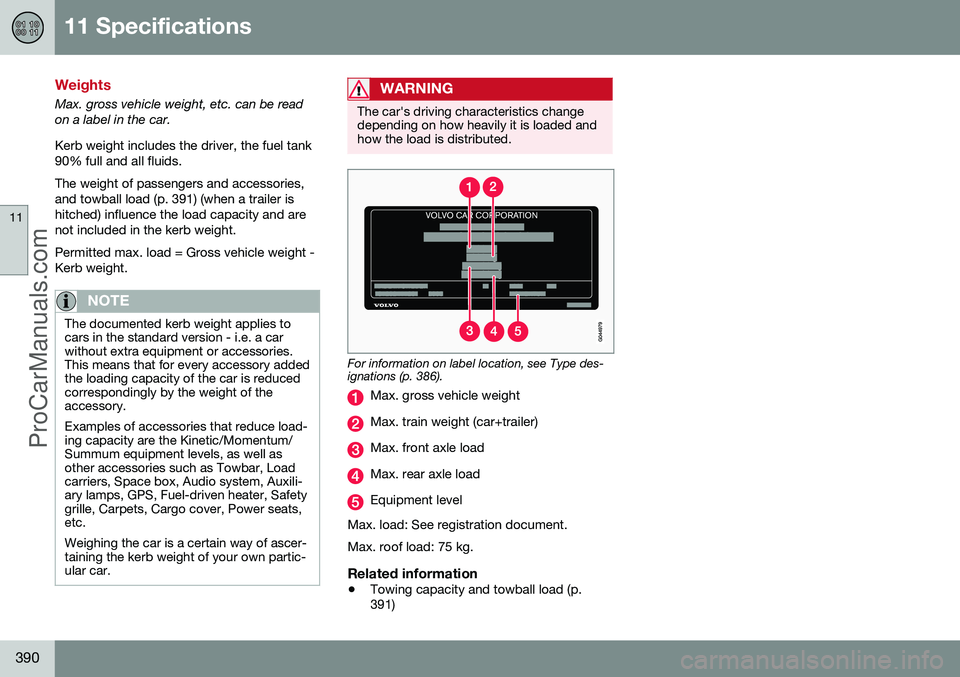
For information on label location, see Type des- ignations (p. 386).
Max. gross vehicle weight
Max. train weight (car+trailer)
Max. front axle load
Max. rear axle load
Equipment level
Max. load: See registration document. Max. roof load: 75 kg.
Related information
• Towing capacity and towball load (p. 391)
ProCarManuals.co’
Page 393 of 442
11 Specifications
11
}}
391
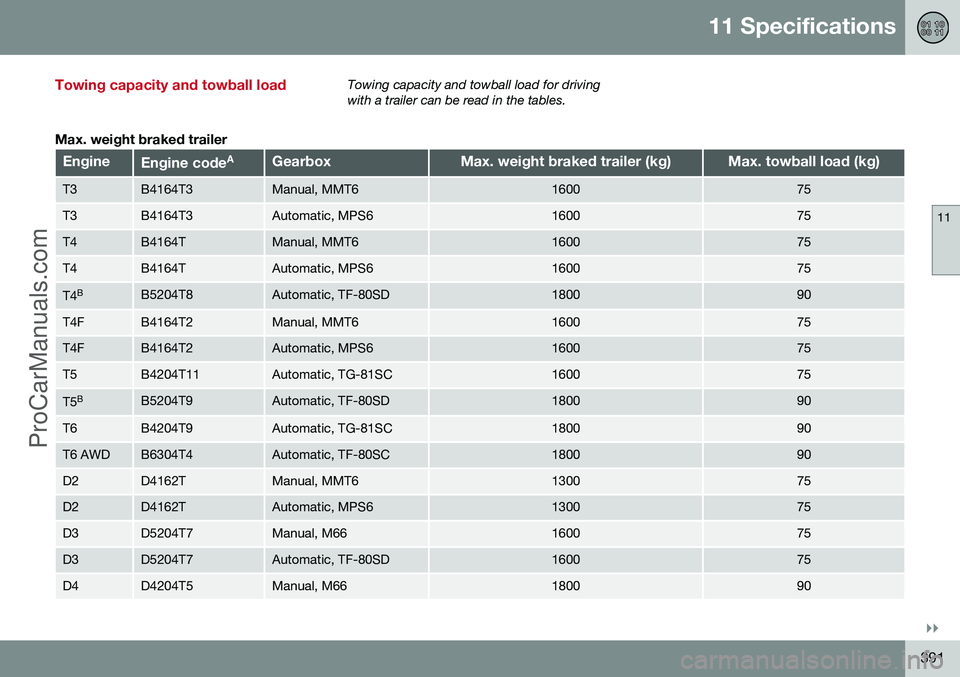
Towing capacity and towball loadTowing capacity and towball load for driving with a trailer can be read in the tables.
Max. weight braked trailer
EngineEngine codeAGearboxMax. weight braked trailer (kg)Max. towball load (kg)
T3B4164T3Manual, MMT6160075
T3B4164T3Automatic, MPS6160075
T4B4164TManual, MMT6160075
T4B4164TAutomatic, MPS6160075
T4
BB5204T8Automatic, TF-80SD180090
T4FB4164T2Manual, MMT6160075
T4FB4164T2Automatic, MPS6160075
T5B4204T11Automatic, TG-81SC160075
T5BB5204T9Automatic, TF-80SD180090
T6B4204T9Automatic, TG-81SC180090
T6 AWDB6304T4Automatic, TF-80SC180090
D2D4162TManual, MMT6130075
D2D4162TAutomatic, MPS6130075
D3D5204T7Manual, M66160075
D3D5204T7Automatic, TF-80SD160075
D4D4204T5Manual, M66180090
ProCarManuals.co’
Page 397 of 442
11 Specifications
11
395
Engine oil - adverse driving conditions
Adverse driving conditions can lead to abnor- mally high oil temperature or oil consumption.Below are some examples of adverse drivingconditions. Check the oil level (p. 346) more frequently for long journeys: •towing a caravan or trailer
• in mountainous regions
• at high speeds
• in temperatures colder than -30 °C or hotter than +40 °C.
The above also apply to shorter driving dis- tances at low temperatures. Choose a fully synthetic engine oil for adverse driving conditions. It provides extra protectionfor the engine. Volvo recommends:
IMPORTANT
In order to fulfil the requirements for the engine's service intervals all engines arefilled with a specially adapted syntheticengine oil at the factory. The choice of oilhas been made very carefully with regardto service life, starting characteristics, fuelconsumption and environmental impact. An approved engine oil must be used in order that the recommended service inter-vals can be applied. Only use a prescribedgrade of oil for both filling and oil change,otherwise you will risk affecting service life,starting characteristics, fuel consumptionand environmental impact. Volvo Car Corporation disclaims all war- ranty liability if engine oil of the prescribedgrade and viscosity is not used. Volvo recommends that oil changes are carried out at an authorised Volvo work-shop.
Related information
• Engine oil - grade and volume (p. 396)
• Engine oil - general (p. 345)
ProCarManuals.co’