brake VOLVO V60 2014 Repair Manual
[x] Cancel search | Manufacturer: VOLVO, Model Year: 2014, Model line: V60, Model: VOLVO V60 2014Pages: 442, PDF Size: 13.85 MB
Page 279 of 442
08 Starting and driving
08
277
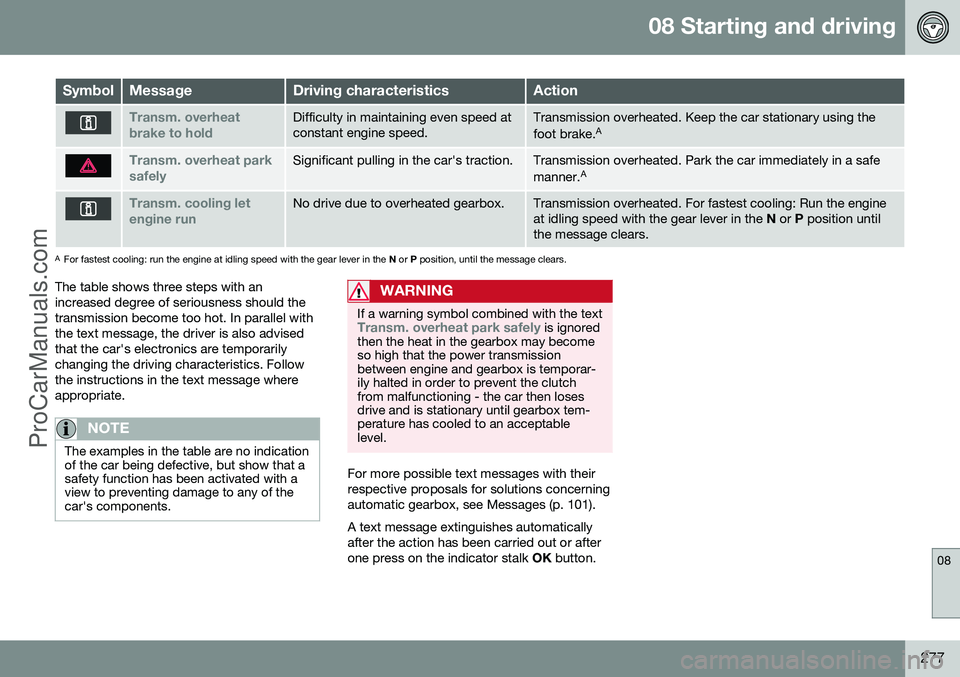
SymbolMessageDriving characteristicsAction
Transm. overheat brake to holdDifficulty in maintaining even speed at constant engine speed.Transmission overheated. Keep the car stationary using the foot brake.A
Transm. overheat park safelySignificant pulling in the car's traction.Transmission overheated. Park the car immediately in a safe manner.A
Transm. cooling let engine runNo drive due to overheated gearbox.Transmission overheated. For fastest cooling: Run the engine at idling speed with the gear lever in the
N or P position until
the message clears.
A For fastest cooling: run the engine at idling speed with the gear lever in the N or P position, until the message clears.
The table shows three steps with an increased degree of seriousness should thetransmission become too hot. In parallel withthe text message, the driver is also advisedthat the car's electronics are temporarilychanging the driving characteristics. Followthe instructions in the text message whereappropriate.
NOTE
The examples in the table are no indication of the car being defective, but show that asafety function has been activated with aview to preventing damage to any of thecar's components.
WARNING
If a warning symbol combined with the textTransm. overheat park safely is ignored
then the heat in the gearbox may become so high that the power transmissionbetween engine and gearbox is temporar-ily halted in order to prevent the clutchfrom malfunctioning - the car then losesdrive and is stationary until gearbox tem-perature has cooled to an acceptablelevel.
For more possible text messages with their respective proposals for solutions concerningautomatic gearbox, see Messages (p. 101). A text message extinguishes automatically after the action has been carried out or afterone press on the indicator stalk OK button.
ProCarManuals.co’
Page 280 of 442
08 Starting and driving
08
278
Gear selector inhibitor
There are two different types of gear selector inhibitor - mechanical and automatic.
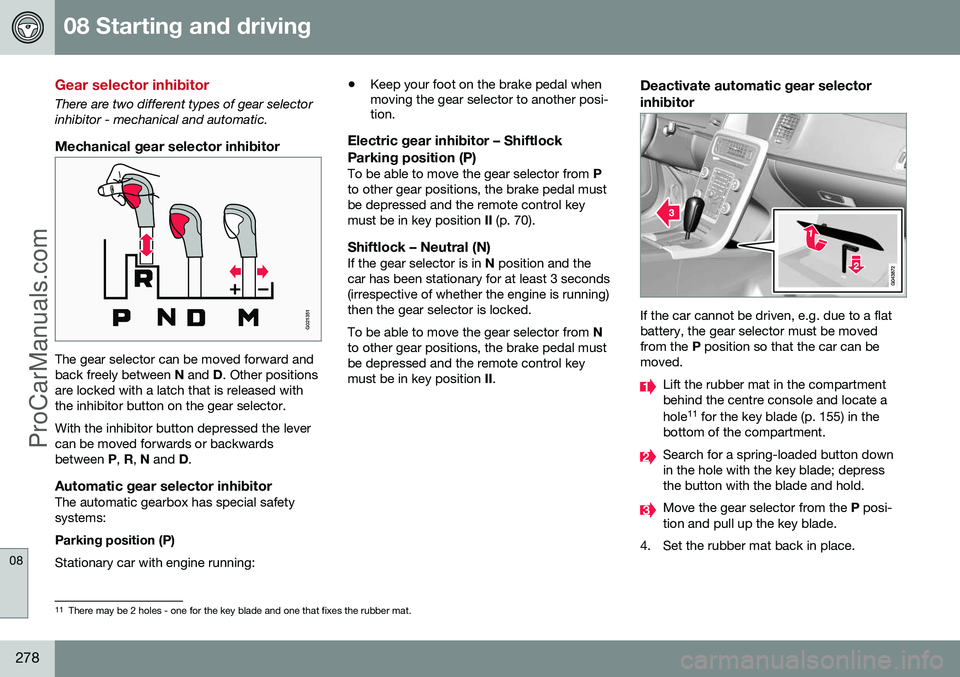
Mechanical gear selector inhibitor
G021351
The gear selector can be moved forward and back freely between N and D. Other positions
are locked with a latch that is released withthe inhibitor button on the gear selector. With the inhibitor button depressed the lever can be moved forwards or backwardsbetween P, R , N and D.
Automatic gear selector inhibitorThe automatic gearbox has special safetysystems: Parking position (P) Stationary car with engine running: •
Keep your foot on the brake pedal when moving the gear selector to another posi-tion.
Electric gear inhibitor – Shiftlock
Parking position (P)
To be able to move the gear selector from P
to other gear positions, the brake pedal must be depressed and the remote control keymust be in key position II (p. 70).
Shiftlock – Neutral (N)If the gear selector is in N position and the
car has been stationary for at least 3 seconds(irrespective of whether the engine is running)then the gear selector is locked. To be able to move the gear selector from N
to other gear positions, the brake pedal must be depressed and the remote control keymust be in key position II.
Deactivate automatic gear selector inhibitor
If the car cannot be driven, e.g. due to a flat battery, the gear selector must be movedfrom the P position so that the car can be
moved.
Lift the rubber mat in the compartment behind the centre console and locate a hole 11
for the key blade (p. 155) in the
bottom of the compartment.
Search for a spring-loaded button down in the hole with the key blade; depressthe button with the blade and hold.
Move the gear selector from the P posi-
tion and pull up the key blade.
4. Set the rubber mat back in place.
11 There may be 2 holes - one for the key blade and one that fixes the rubber mat.
ProCarManuals.co’
Page 281 of 442
08 Starting and driving
08
* Option/accessory, for more information, see Introduction.279
Related information
• Automatic gearbox -- Geartronic* (p. 273)
• Automatic gearbox -- Powershift* (p. 276)Hill start assist (HSA)* 12
The foot brake can be released before setting off or reversing uphill - the HSA (Hill StartAssist) function means that the car does notroll backwards. The function means that the pedal pressure in the brake system remains for several secondswhile the driver's foot is moved from brakepedal to accelerator pedal. The temporary braking effect releases after several seconds or when the driver acceler-ates.
Related information
•
Starting the engine (p. 264)
Start/Stop*
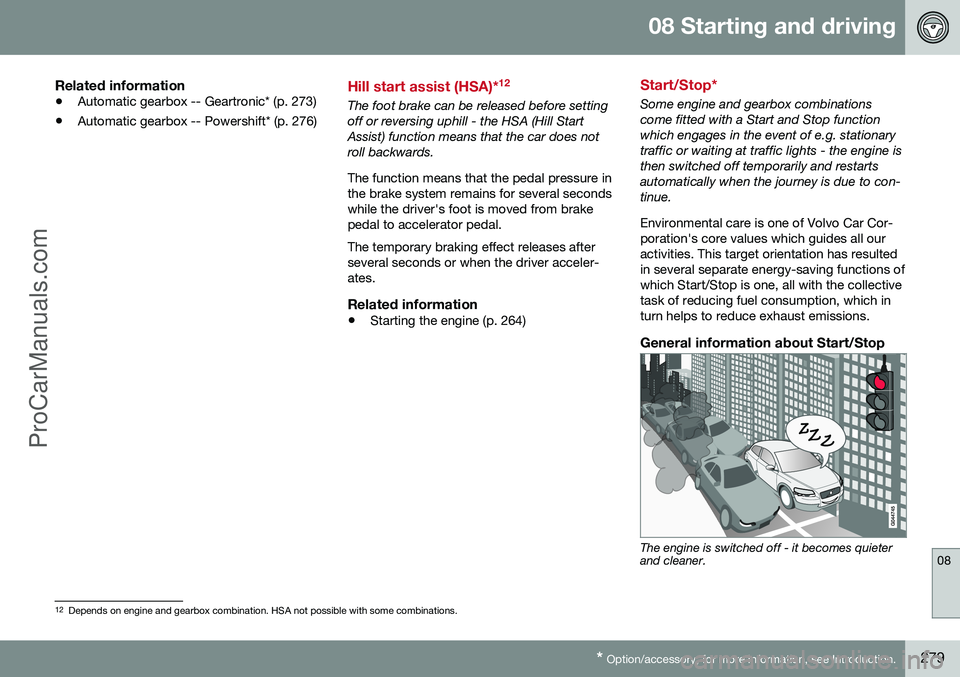
Some engine and gearbox combinations come fitted with a Start and Stop functionwhich engages in the event of e.g. stationarytraffic or waiting at traffic lights - the engine isthen switched off temporarily and restartsautomatically when the journey is due to con-tinue. Environmental care is one of Volvo Car Cor- poration's core values which guides all ouractivities. This target orientation has resultedin several separate energy-saving functions ofwhich Start/Stop is one, all with the collectivetask of reducing fuel consumption, which inturn helps to reduce exhaust emissions.
General information about Start/Stop
The engine is switched off - it becomes quieter and cleaner.
12
Depends on engine and gearbox combination. HSA not possible with some combinations.
ProCarManuals.co’
Page 282 of 442
||
08 Starting and driving
08
280* Option/accessory, for more information, see Introduction.
The Start/Stop function gives the driver the opportunity for a more active environmentallyconscious way of driving the car by means ofbeing able to allow the engine to stop auto-matically, whenever appropriate. Manual or Automatic Note that there are differences in the Start/Stop function depending on whether thegearbox is manual or automatic.
Related information
• Start/Stop* - function and operation (p. 280)
• Starting the engine (p. 264)
• Start/Stop* - settings (p. 285)
• Start/Stop* - the engine does not auto-start (p. 284)
• Start/Stop* - the engine auto-starts (p.283)
• Start/Stop* - the engine does not stop (p.282)
• Start/Stop* - involuntary engine stoppagemanual gearbox (p. 284)
• Start/Stop* - symbols and messages (p.286)
• Battery - Start/Stop (p. 365)
Start/Stop* - function and operation
Some engine and gearbox combinations are equipped with a Start/Stop function whichengages in the event of e.g. stationary trafficor waiting at traffic lights. The Start/Stopfunction is activated automatically when theengine is started with the key.
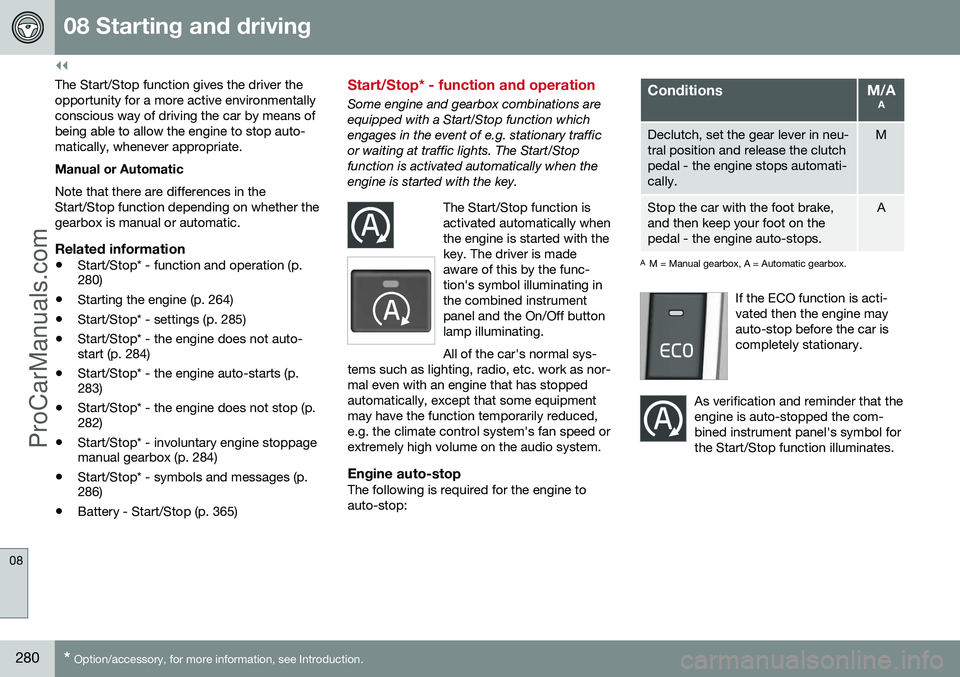
The Start/Stop function isactivated automatically whenthe engine is started with thekey. The driver is madeaware of this by the func-tion's symbol illuminating inthe combined instrumentpanel and the On/Off buttonlamp illuminating. All of the car's normal sys-
tems such as lighting, radio, etc. work as nor- mal even with an engine that has stoppedautomatically, except that some equipmentmay have the function temporarily reduced,e.g. the climate control system's fan speed orextremely high volume on the audio system.
Engine auto-stopThe following is required for the engine to auto-stop:
ConditionsM/A A
Declutch, set the gear lever in neu- tral position and release the clutchpedal - the engine stops automati-cally.M
Stop the car with the foot brake, and then keep your foot on thepedal - the engine auto-stops.A
AM = Manual gearbox, A = Automatic gearbox.
If the ECO function is acti- vated then the engine mayauto-stop before the car iscompletely stationary.
As verification and reminder that the engine is auto-stopped the com-bined instrument panel's symbol forthe Start/Stop function illuminates.
ProCarManuals.co’
Page 283 of 442
08 Starting and driving
08
* Option/accessory, for more information, see Introduction.281
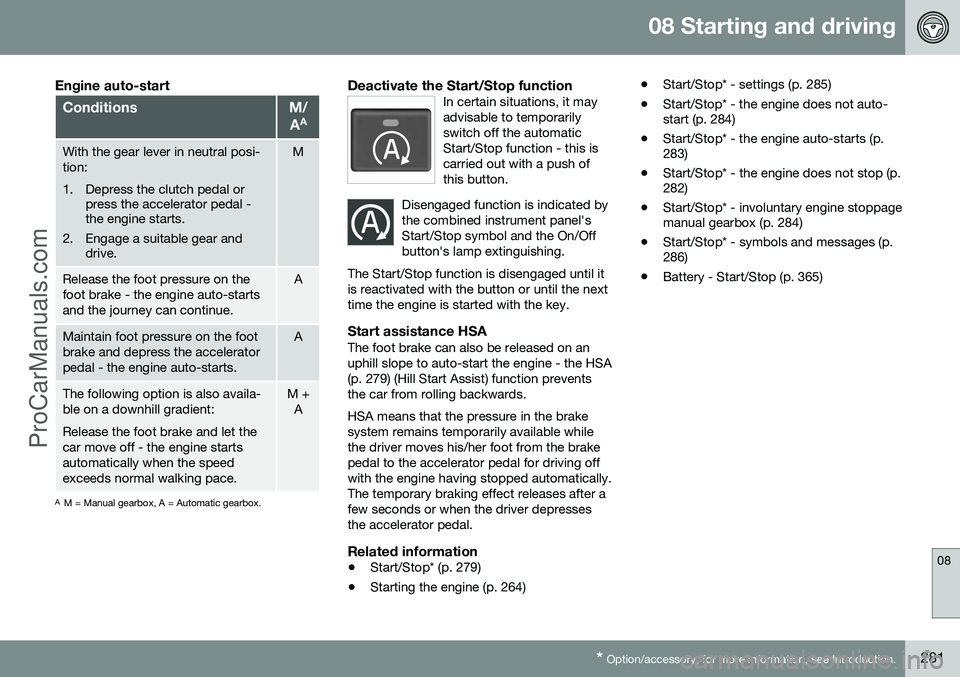
Engine auto-start
ConditionsM/
A A
With the gear lever in neutral posi- tion:
1. Depress the clutch pedal or
press the accelerator pedal - the engine starts.
2. Engage a suitable gear and drive.M
Release the foot pressure on the foot brake - the engine auto-startsand the journey can continue.A
Maintain foot pressure on the foot brake and depress the acceleratorpedal - the engine auto-starts.A
The following option is also availa- ble on a downhill gradient: Release the foot brake and let the car move off - the engine startsautomatically when the speedexceeds normal walking pace.M +
A
A M = Manual gearbox, A = Automatic gearbox.
Deactivate the Start/Stop functionIn certain situations, it may advisable to temporarilyswitch off the automaticStart/Stop function - this iscarried out with a push ofthis button.
Disengaged function is indicated by the combined instrument panel'sStart/Stop symbol and the On/Offbutton's lamp extinguishing.
The Start/Stop function is disengaged until it is reactivated with the button or until the nexttime the engine is started with the key.
Start assistance HSAThe foot brake can also be released on anuphill slope to auto-start the engine - the HSA(p. 279) (Hill Start Assist) function preventsthe car from rolling backwards. HSA means that the pressure in the brake system remains temporarily available whilethe driver moves his/her foot from the brakepedal to the accelerator pedal for driving offwith the engine having stopped automatically.The temporary braking effect releases after afew seconds or when the driver depressesthe accelerator pedal.
Related information
• Start/Stop* (p. 279)
• Starting the engine (p. 264) •
Start/Stop* - settings (p. 285)
• Start/Stop* - the engine does not auto- start (p. 284)
• Start/Stop* - the engine auto-starts (p.283)
• Start/Stop* - the engine does not stop (p.282)
• Start/Stop* - involuntary engine stoppagemanual gearbox (p. 284)
• Start/Stop* - symbols and messages (p.286)
• Battery - Start/Stop (p. 365)
ProCarManuals.co’
Page 285 of 442
08 Starting and driving
08
* Option/accessory, for more information, see Introduction.283
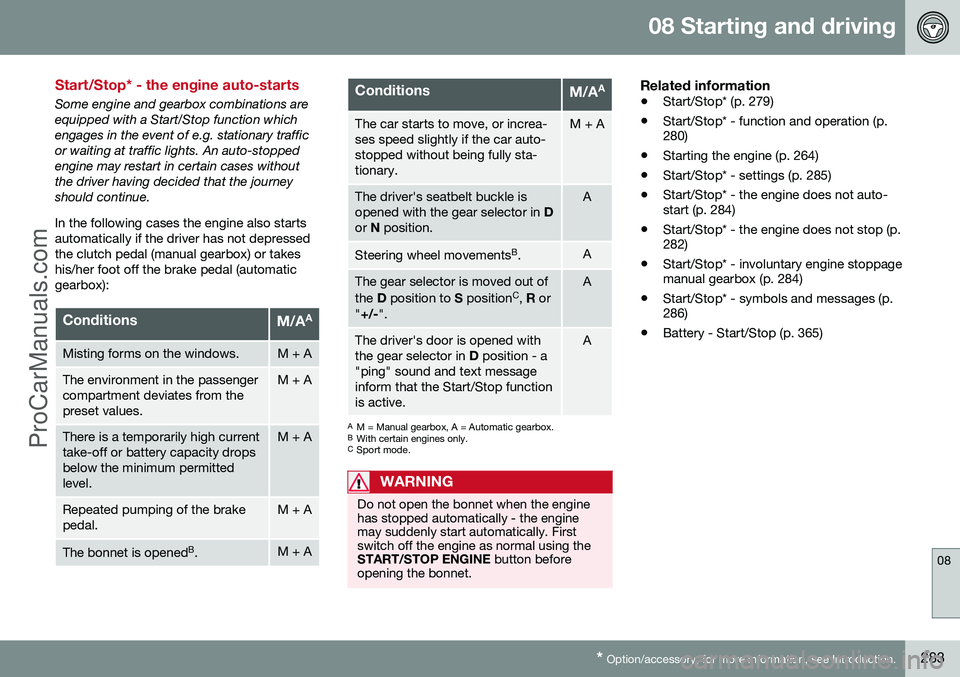
Start/Stop* - the engine auto-starts
Some engine and gearbox combinations are equipped with a Start/Stop function whichengages in the event of e.g. stationary trafficor waiting at traffic lights. An auto-stoppedengine may restart in certain cases withoutthe driver having decided that the journeyshould continue. In the following cases the engine also starts automatically if the driver has not depressedthe clutch pedal (manual gearbox) or takeshis/her foot off the brake pedal (automaticgearbox):
ConditionsM/A A
Misting forms on the windows.M + A
The environment in the passenger compartment deviates from thepreset values.M + A
There is a temporarily high current take-off or battery capacity dropsbelow the minimum permittedlevel.M + A
Repeated pumping of the brake pedal.M + A
The bonnet is opened
B
.M + A
ConditionsM/A A
The car starts to move, or increa- ses speed slightly if the car auto-stopped without being fully sta-tionary.M + A
The driver's seatbelt buckle is opened with the gear selector in
D
or N position.A
Steering wheel movements B
.A
The gear selector is moved out of the D position to S position C
, R or
" +/- ".A
The driver's door is opened with the gear selector in D position - a
"ping" sound and text messageinform that the Start/Stop functionis active.A
A M = Manual gearbox, A = Automatic gearbox.
B With certain engines only.
C Sport mode.
WARNING
Do not open the bonnet when the engine has stopped automatically - the enginemay suddenly start automatically. Firstswitch off the engine as normal using theSTART/STOP ENGINE button before
opening the bonnet.
Related information
• Start/Stop* (p. 279)
• Start/Stop* - function and operation (p. 280)
• Starting the engine (p. 264)
• Start/Stop* - settings (p. 285)
• Start/Stop* - the engine does not auto-start (p. 284)
• Start/Stop* - the engine does not stop (p.282)
• Start/Stop* - involuntary engine stoppagemanual gearbox (p. 284)
• Start/Stop* - symbols and messages (p.286)
• Battery - Start/Stop (p. 365)
ProCarManuals.co’
Page 288 of 442
08 Starting and driving
08
286* Option/accessory, for more information, see Introduction.
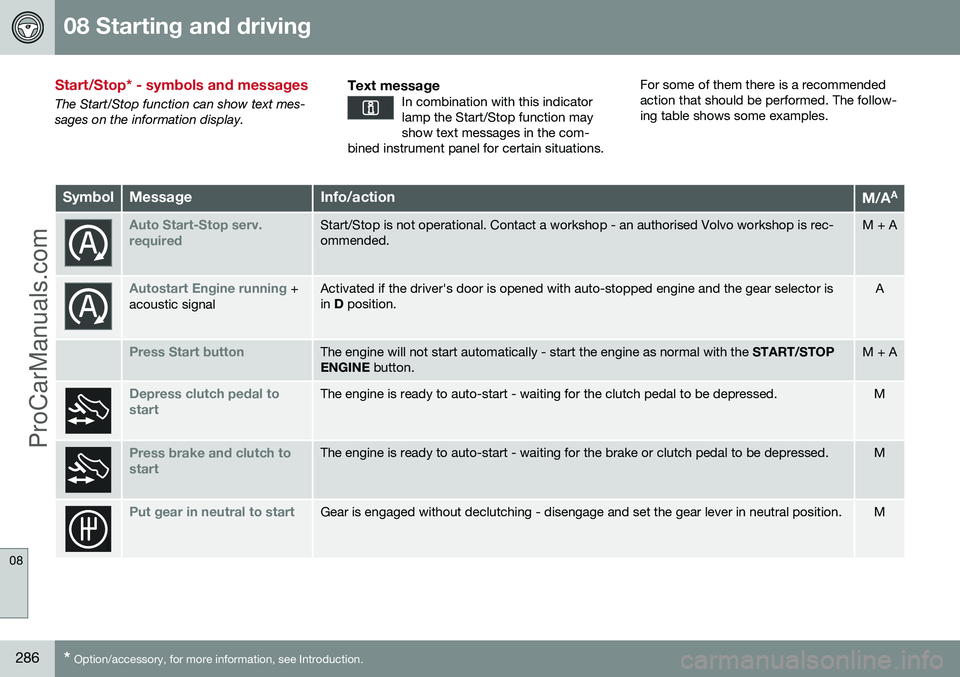
Start/Stop* - symbols and messages
The Start/Stop function can show text mes- sages on the information display.
Text messageIn combination with this indicatorlamp the Start/Stop function mayshow text messages in the com-
bined instrument panel for certain situations.
For some of them there is a recommended action that should be performed. The follow-ing table shows some examples.
SymbolMessageInfo/actionM/A A
Auto Start-Stop serv. requiredStart/Stop is not operational. Contact a workshop - an authorised Volvo workshop is rec- ommended.M + A
Autostart Engine running +
acoustic signalActivated if the driver's door is opened with auto-stopped engine and the gear selector is in D position.A
Press Start buttonThe engine will not start automatically - start the engine as normal with the START/STOP
ENGINE button.M + A
Depress clutch pedal to startThe engine is ready to auto-start - waiting for the clutch pedal to be depressed.M
Press brake and clutch to startThe engine is ready to auto-start - waiting for the brake or clutch pedal to be depressed.M
Put gear in neutral to startGear is engaged without declutching - disengage and set the gear lever in neutral position.M
ProCarManuals.co’
Page 291 of 442
08 Starting and driving
08
289
and
• Deactivated ECO function: Short coasting with
engine braking = Minimum con-
sumption.
NOTE
However, to achieve optimal low fuel con- sumption, Eco Coast in combination withshort coasting distances should generallybe avoided.
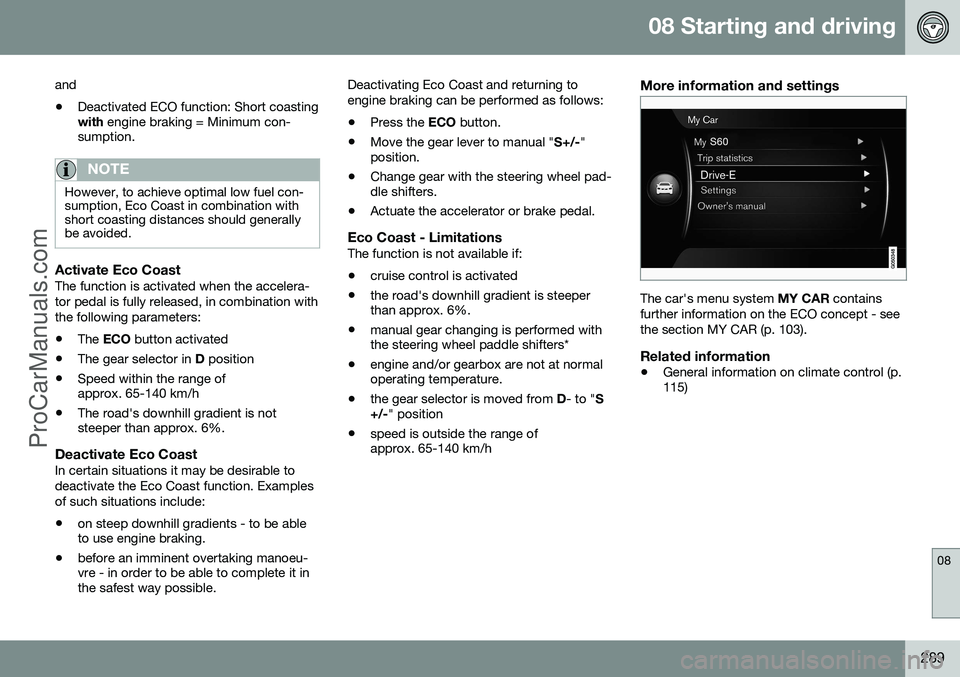
Activate Eco CoastThe function is activated when the accelera- tor pedal is fully released, in combination withthe following parameters: • The
ECO button activated
• The gear selector in
D position
• Speed within the range of approx. 65-140 km/h
• The road's downhill gradient is notsteeper than approx. 6%.
Deactivate Eco CoastIn certain situations it may be desirable to deactivate the Eco Coast function. Examplesof such situations include:
• on steep downhill gradients - to be able to use engine braking.
• before an imminent overtaking manoeu-vre - in order to be able to complete it inthe safest way possible. Deactivating Eco Coast and returning to engine braking can be performed as follows:
• Press the
ECO button.
• Move the gear lever to manual "
S+/-"
position.
• Change gear with the steering wheel pad- dle shifters.
• Actuate the accelerator or brake pedal.
Eco Coast - LimitationsThe function is not available if:
• cruise control is activated
• the road's downhill gradient is steeperthan approx. 6%.
• manual gear changing is performed withthe steering wheel paddle shifters*
• engine and/or gearbox are not at normaloperating temperature.
• the gear selector is moved from
D- to " S
+/- " position
• speed is outside the range ofapprox. 65-140 km/h
More information and settings
The car's menu system
MY CAR contains
further information on the ECO concept - see the section MY CAR (p. 103).
Related information
• General information on climate control (p. 115)
ProCarManuals.co’
Page 292 of 442
08 Starting and driving
08
290* Option/accessory, for more information, see Introduction.
All Wheel Drive - AWD*
The best traction possible is achieved with all- wheel drive.
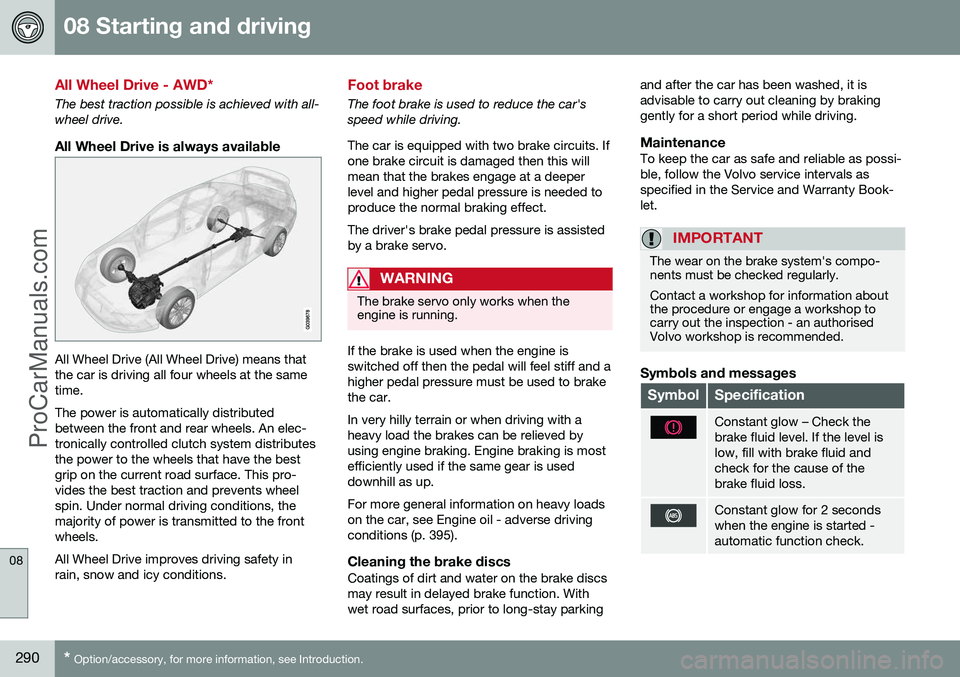
All Wheel Drive is always available
All Wheel Drive (All Wheel Drive) means that the car is driving all four wheels at the sametime. The power is automatically distributed between the front and rear wheels. An elec-tronically controlled clutch system distributesthe power to the wheels that have the bestgrip on the current road surface. This pro-vides the best traction and prevents wheelspin. Under normal driving conditions, themajority of power is transmitted to the frontwheels. All Wheel Drive improves driving safety in rain, snow and icy conditions.
Foot brake
The foot brake is used to reduce the car's speed while driving. The car is equipped with two brake circuits. If one brake circuit is damaged then this willmean that the brakes engage at a deeperlevel and higher pedal pressure is needed toproduce the normal braking effect. The driver's brake pedal pressure is assisted by a brake servo.
WARNING
The brake servo only works when the engine is running.
If the brake is used when the engine is switched off then the pedal will feel stiff and ahigher pedal pressure must be used to brakethe car. In very hilly terrain or when driving with a heavy load the brakes can be relieved byusing engine braking. Engine braking is mostefficiently used if the same gear is useddownhill as up. For more general information on heavy loads on the car, see Engine oil - adverse drivingconditions (p. 395).
Cleaning the brake discsCoatings of dirt and water on the brake discsmay result in delayed brake function. Withwet road surfaces, prior to long-stay parking and after the car has been washed, it isadvisable to carry out cleaning by brakinggently for a short period while driving.
MaintenanceTo keep the car as safe and reliable as possi-ble, follow the Volvo service intervals asspecified in the Service and Warranty Book-let.
IMPORTANT
The wear on the brake system's compo- nents must be checked regularly. Contact a workshop for information about the procedure or engage a workshop tocarry out the inspection - an authorisedVolvo workshop is recommended.
Symbols and messages
SymbolSpecification
Constant glow – Check the brake fluid level. If the level islow, fill with brake fluid andcheck for the cause of thebrake fluid loss.
Constant glow for 2 seconds when the engine is started -automatic function check.
ProCarManuals.co’
Page 293 of 442
08 Starting and driving
08
291
WARNING
If and illuminate at the same
time, there may be a fault in the brake sys- tem. If the level in the brake fluid reservoir is normal at this stage, drive carefully to thenearest workshop and have the brake sys-tem checked - an authorised Volvo work-shop is recommended. If the brake fluid is below the MIN level in
the brake fluid reservoir, do not drive fur- ther before topping up the brake fluid. The reason for the loss of brake fluid must be investigated.
Related information
• Parking brake (p. 293)
• Foot brake - emergency brake lights and automatic hazard warning flashers (p.291)
• Foot brake - emergency brake assistance(p. 292)
• Foot brake - anti-lock braking system (p.291)
Foot brake - anti-lock braking system
The anti-lock braking system, ABS (Anti-lock Braking System), prevents the wheels fromlocking up during braking. The function allows steering ability to be maintained, and it is easier to swerve to avoida hazard for example. Vibration may be felt inthe brake pedal when this is engaged and thisis normal. A short test of the ABS system is made auto- matically after the engine has been startedwhen the driver releases the brake pedal. Afurther automatic test of the ABS system maybe made when the car reaches 10 km/h. Thetest may be experienced as pulses in thebrake pedal.
Related information
•Foot brake (p. 290)
• Parking brake (p. 293)
• Foot brake - emergency brake lights and automatic hazard warning flashers (p.291)
• Foot brake - emergency brake assistance(p. 292)
Foot brake - emergency brake lights and automatic hazard warningflashers
Emergency brake lights are activated to alert vehicles behind about sudden braking. Thefunction means that the brake light flashesinstead of - as in normal braking - shining witha constant glow. Emergency brake lights are activated at speeds above 50 km/h in the event of suddenbraking. After the car's speed has beenslowed below 10 km/h the brake light returnsfrom flashing to the normal constant glow -while at the same time the hazard warningflashers (p. 86) are activated, and they flashuntil the driver changes engine speed with theaccelerator pedal or they are deactivated withtheir button.
Related information
•Foot brake (p. 290)
• Parking brake (p. 293)
• Foot brake - emergency brake assistance (p. 292)
• Foot brake - anti-lock braking system (p.291)
ProCarManuals.co’