engine VOLVO V60 2016 Owner´s Manual
[x] Cancel search | Manufacturer: VOLVO, Model Year: 2016, Model line: V60, Model: VOLVO V60 2016Pages: 402, PDF Size: 10.3 MB
Page 358 of 402
||
10 Maintenance and servicing
10
356* Option/accessory, for more information, see Introduction.
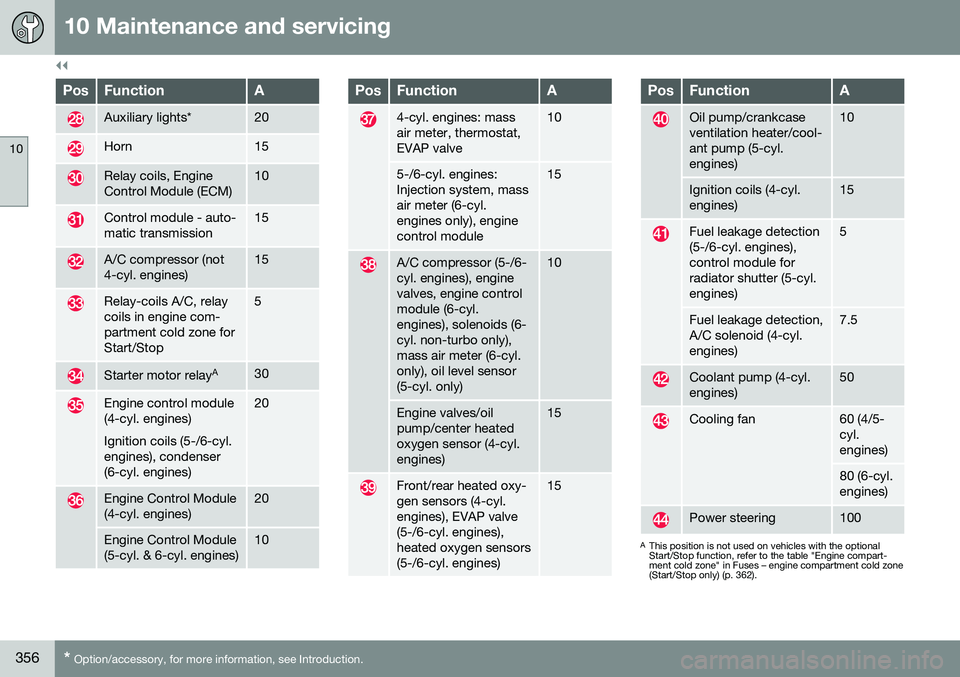
PosFunctionA
Auxiliary lights*20
Horn15
Relay coils, Engine Control Module (ECM)10
Control module - auto- matic transmission15
A/C compressor (not 4-cyl. engines)15
Relay-coils A/C, relay coils in engine com-partment cold zone forStart/Stop5
Starter motor relay A30
Engine control module (4-cyl. engines) Ignition coils (5-/6-cyl. engines), condenser(6-cyl. engines)20
Engine Control Module (4-cyl. engines)20
Engine Control Module (5-cyl. & 6-cyl. engines)10
PosFunctionA
4-cyl. engines: mass air meter, thermostat,EVAP valve10
5-/6-cyl. engines: Injection system, massair meter (6-cyl.engines only), enginecontrol module15
A/C compressor (5-/6- cyl. engines), enginevalves, engine controlmodule (6-cyl.engines), solenoids (6-cyl. non-turbo only),mass air meter (6-cyl.only), oil level sensor(5-cyl. only)10
Engine valves/oil pump/center heatedoxygen sensor (4-cyl.engines)15
Front/rear heated oxy- gen sensors (4-cyl.engines), EVAP valve(5-/6-cyl. engines),heated oxygen sensors(5-/6-cyl. engines)15
PosFunctionA
Oil pump/crankcase ventilation heater/cool-ant pump (5-cyl.engines)10
Ignition coils (4-cyl. engines)15
Fuel leakage detection (5-/6-cyl. engines),control module forradiator shutter (5-cyl.engines)5
Fuel leakage detection, A/C solenoid (4-cyl.engines)7.5
Coolant pump (4-cyl. engines)50
Cooling fan60 (4/5- cyl.engines)
80 (6-cyl. engines)
Power steering100
A
This position is not used on vehicles with the optional Start/Stop function, refer to the table "Engine compart-ment cold zone" in Fuses – engine compartment cold zone(Start/Stop only) (p. 362).
Page 362 of 402
||
10 Maintenance and servicing
10
360* Option/accessory, for more information, see Introduction.
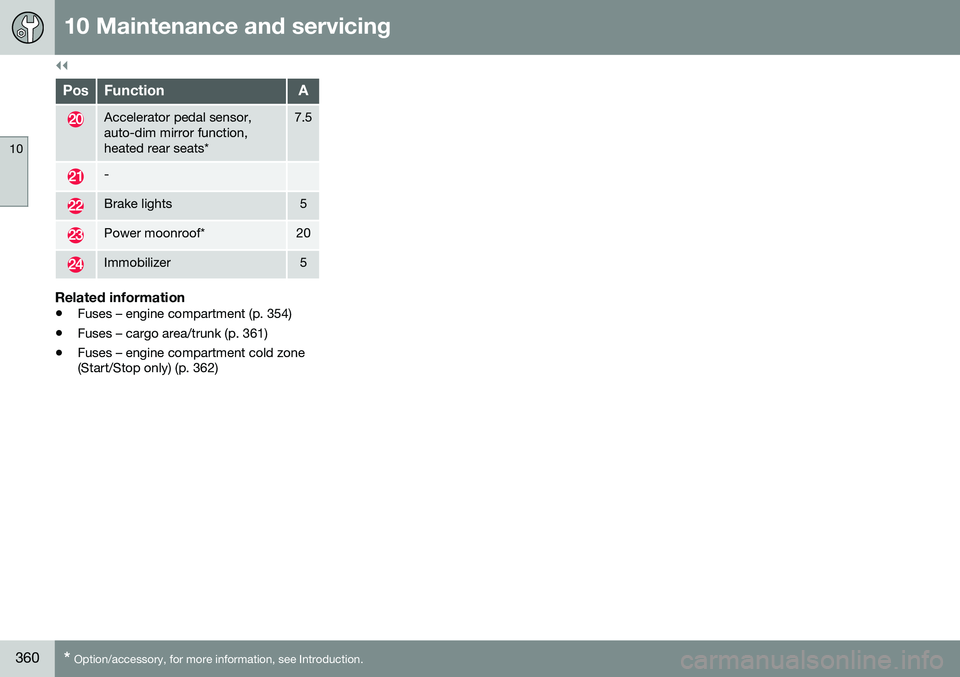
PosFunctionA
Accelerator pedal sensor, auto-dim mirror function,heated rear seats*7.5
-
Brake lights5
Power moonroof*20
Immobilizer5
Related information
• Fuses – engine compartment (p. 354)
• Fuses – cargo area/trunk (p. 361)
• Fuses – engine compartment cold zone (Start/Stop only) (p. 362)
Page 363 of 402
10 Maintenance and servicing
10
* Option/accessory, for more information, see Introduction.361
Fuses – cargo area/trunk
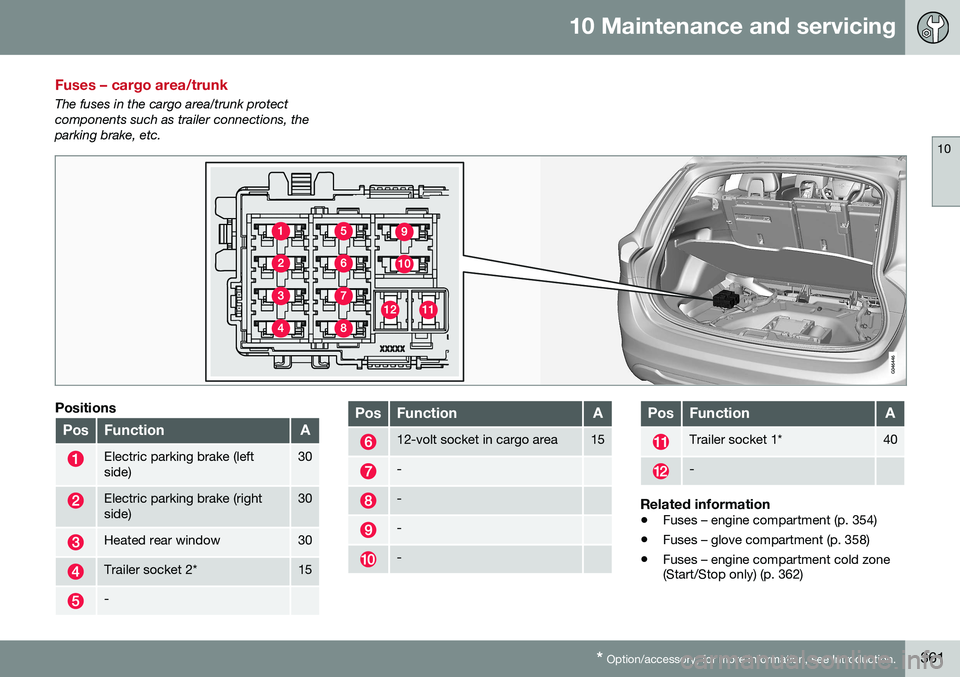
The fuses in the cargo area/trunk protect components such as trailer connections, theparking brake, etc.
Positions
PosFunctionA
Electric parking brake (left side)30
Electric parking brake (right side)30
Heated rear window30
Trailer socket 2*15
-
PosFunctionA
12-volt socket in cargo area15
-
-
-
-
PosFunctionA
Trailer socket 1*40
-
Related information
• Fuses – engine compartment (p. 354)
• Fuses – glove compartment (p. 358)
• Fuses – engine compartment cold zone (Start/Stop only) (p. 362)
Page 364 of 402
10 Maintenance and servicing
10
362
Fuses – engine compartment cold zone (Start/Stop only)7
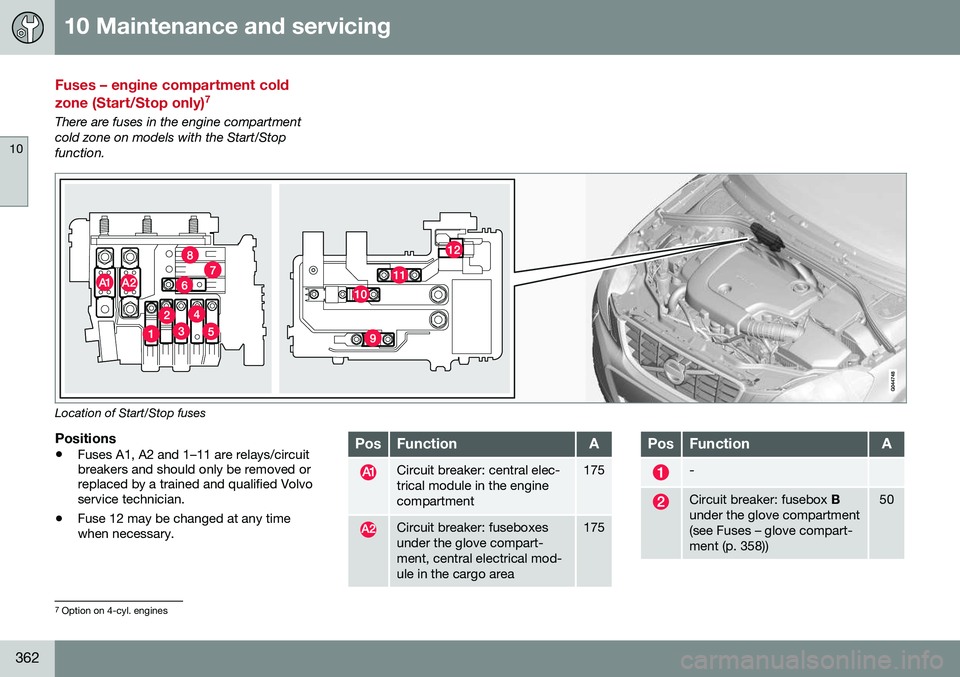
There are fuses in the engine compartment cold zone on models with the Start/Stopfunction.
Location of Start/Stop fuses
Positions
•
Fuses A1, A2 and 1–11 are relays/circuit breakers and should only be removed orreplaced by a trained and qualified Volvoservice technician.
• Fuse 12 may be changed at any timewhen necessary.PosFunctionA
Circuit breaker: central elec- trical module in the enginecompartment175
Circuit breaker: fuseboxes under the glove compart-ment, central electrical mod-ule in the cargo area175
PosFunctionA
-
Circuit breaker: fusebox
B
under the glove compartment (see Fuses – glove compart-ment (p. 358))50
7 Option on 4-cyl. engines
Page 365 of 402
10 Maintenance and servicing
10
363
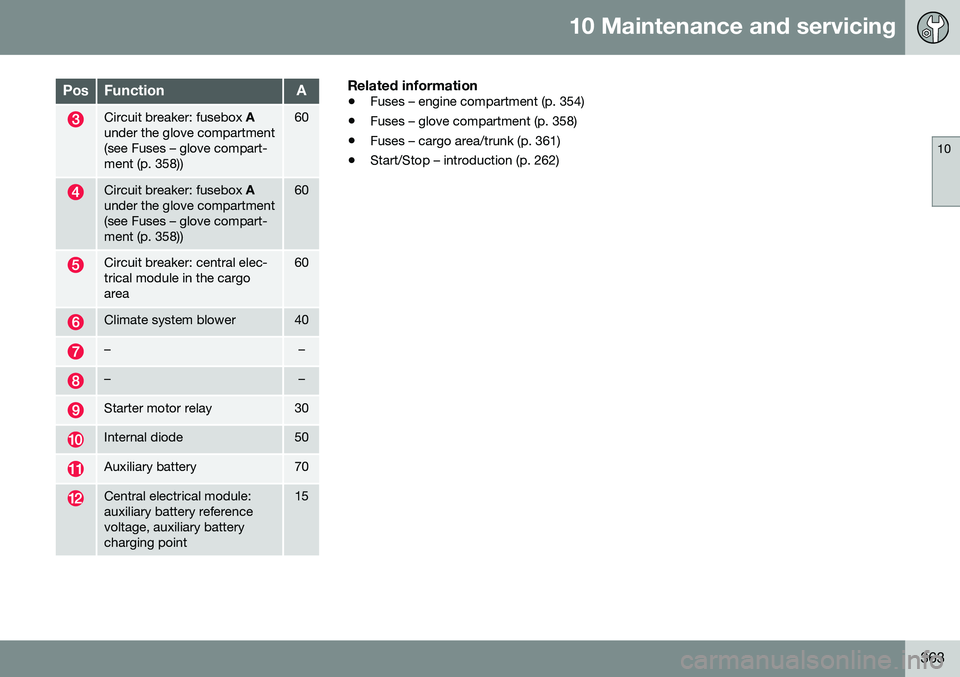
PosFunctionA
Circuit breaker: fusebox A
under the glove compartment (see Fuses – glove compart-ment (p. 358))60
Circuit breaker: fusebox A
under the glove compartment (see Fuses – glove compart-ment (p. 358))60
Circuit breaker: central elec- trical module in the cargoarea60
Climate system blower40
––
––
Starter motor relay30
Internal diode50
Auxiliary battery70
Central electrical module: auxiliary battery referencevoltage, auxiliary batterycharging point15
Related information
• Fuses – engine compartment (p. 354)
• Fuses – glove compartment (p. 358)
• Fuses – cargo area/trunk (p. 361)
• Start/Stop – introduction (p. 262)
Page 367 of 402
10 Maintenance and servicing
10
}}
365
Automatic car wash
The vehicle should be washed at regular inter- vals since dirt, dust, insects and tar spotsadhere to the paint and may cause damage.To help prevent corrosion, it is particularlyimportant to wash the car frequently in thewintertime.• We do NOT recommend washing your car in an automatic wash during the firstfew months (because the paint will nothave hardened sufficiently).
• An automatic wash is a simple and quickway to clean your car, but it is worthremembering that it may not be as thor-ough as when you yourself go over thecar with sponge and water. Keeping theunderbody clean is most important, espe-cially in the winter. Some automaticwashers do not have facilities for washingthe underbody.
NOTE
Condensation may form temporarily on the inside of the lenses of exterior lights suchas headlights, fog lights, or taillights. Thisis normal and the lights are designed towithstand moisture. Normally, condensa-tion will dissipate after the lights have beenon for a short time.
CAUTION
• Before driving into an automatic car wash, turn off the optional rain sensorto avoid damaging the windshield wip-ers.
• Make sure that side view mirrors, aux-iliary lamps, etc, are secure, and thatany antenna(s) are retracted orremoved. Otherwise there is risk of themachine dislodging them.
• Chromed wheels:
Clean chrome-
plated wheels using the same deter-gents used for the body of the vehicle.Aggressive wheel-cleaning agents canpermanently stain chrome-platedwheels.
WARNING
• When the vehicle is driven immediately after being washed, apply the brakes,including the parking brake, severaltimes in order to remove any moisturefrom the brake linings.
• Engine cleaning agents should not beused when the engine is warm. Thisconstitutes a fire risk.
Related information
•
Polishing and waxing (p. 365)
• Cleaning the interior (p. 366)
• Washing the car (p. 364)
Polishing and waxing
Normally, polishing is not required during the first year after delivery, however, waxing maybe beneficial.
• Before applying polish or wax the vehicle must be washed and dried. Tar spots canbe removed with kerosene or tar remover.Difficult spots may require a fine rubbingcompound.
• After polishing use liquid or paste wax.
• Several commercially available productscontain both polish and wax.
• Waxing alone does not substitute for pol-ishing a dull surface.
• A wide range of polymer-based waxescan be purchased today. These waxesare easy to use and produce a long-last-ing, high-gloss finish that protects thebodywork against oxidation, road dirt andfading.
• Do not polish or wax your vehicle in directsunlight (the surface of the vehicle shouldnot be warmer than 113 °F (45 °C).
Page 375 of 402
11 Specifications
11
373
List of labelsVehicle Emission Control Information. Your Volvo is designed to meet all appli- cable emission standards, as evidencedby the certification label on the undersideof the hood. For further information regar-ding these regulations, please consultyour Volvo retailer.
Engine oil. This label contains the recom-
mended engine oil specifications.
Vehicle Identification Number (VIN). The VIN plate is located on the top left surface of the dashboard. The VehicleIdentification Number (VIN) should alwaysbe quoted in all correspondence concern-ing your vehicle with the retailer and whenordering parts.
Tire inflation pressures. This label indi-
cates the correct inflation pressures for the tires that were on the vehicle when itleft the factory.
Federal Motor Vehicle Safety Stand- ards (FMVSS) specifications (USA) andMinistry of Transport (CMVSS) stand- ards (Canada). Your Volvo is designed to
meet all applicable safety standards, as evidenced by the certification label on thedriver's side B-pillar (the structural mem-ber at the side of the vehicle, at the rearof the driver's door opening). This labelalso includes codes for paint color, etc.For further information regarding theseregulations, please consult your Volvoretailer. U.S. models have the upperdecal; Canadian models have the lowerone.
Related information
• Weights (p. 378)
• Engine specifications (p. 380)
Page 382 of 402
11 Specifications
11
380
Engine specifications
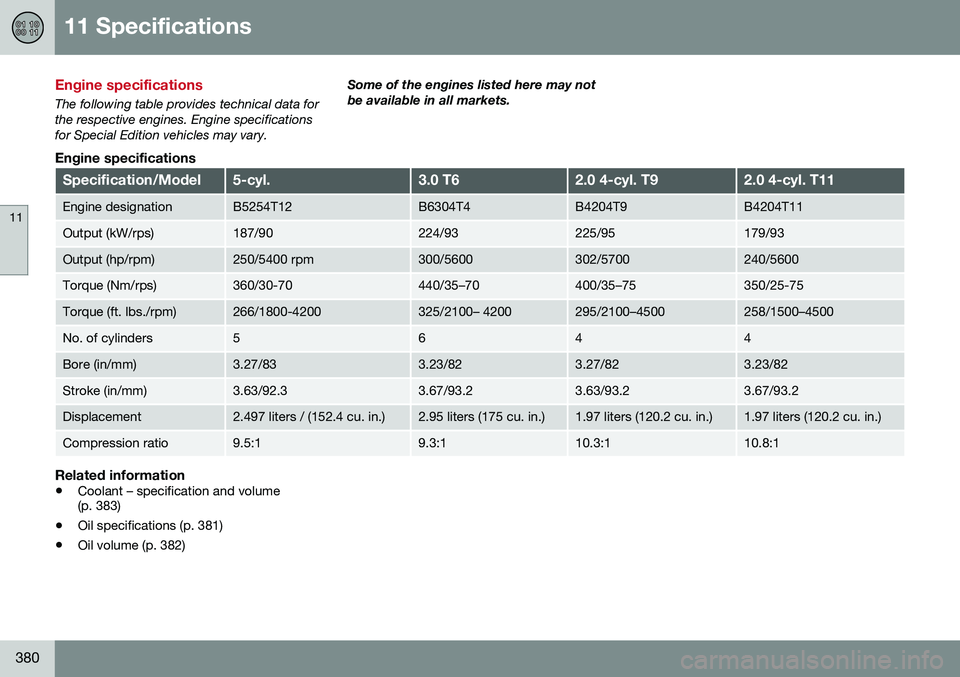
The following table provides technical data for the respective engines. Engine specificationsfor Special Edition vehicles may vary.Some of the engines listed here may notbe available in all markets.
Engine specifications
Specification/Model5-cyl.3.0 T62.0 4-cyl. T92.0 4-cyl. T11
Engine designationB5254T12B6304T4B4204T9B4204T11
Output (kW/rps)187/90224/93225/95179/93
Output (hp/rpm)250/5400 rpm300/5600302/5700240/5600
Torque (Nm/rps)360/30-70440/35–70400/35–75350/25-75
Torque (ft. lbs./rpm)266/1800-4200325/2100– 4200295/2100–4500258/1500–4500
No. of cylinders5644
Bore (in/mm)3.27/833.23/823.27/823.23/82
Stroke (in/mm)3.63/92.33.67/93.23.63/93.23.67/93.2
Displacement2.497 liters / (152.4 cu. in.)2.95 liters (175 cu. in.)1.97 liters (120.2 cu. in.)1.97 liters (120.2 cu. in.)
Compression ratio9.5:19.3:110.3:110.8:1
Related information
•
Coolant – specification and volume (p. 383)
• Oil specifications (p. 381)
• Oil volume (p. 382)
Page 383 of 402
11 Specifications
11
381
Oil specifications
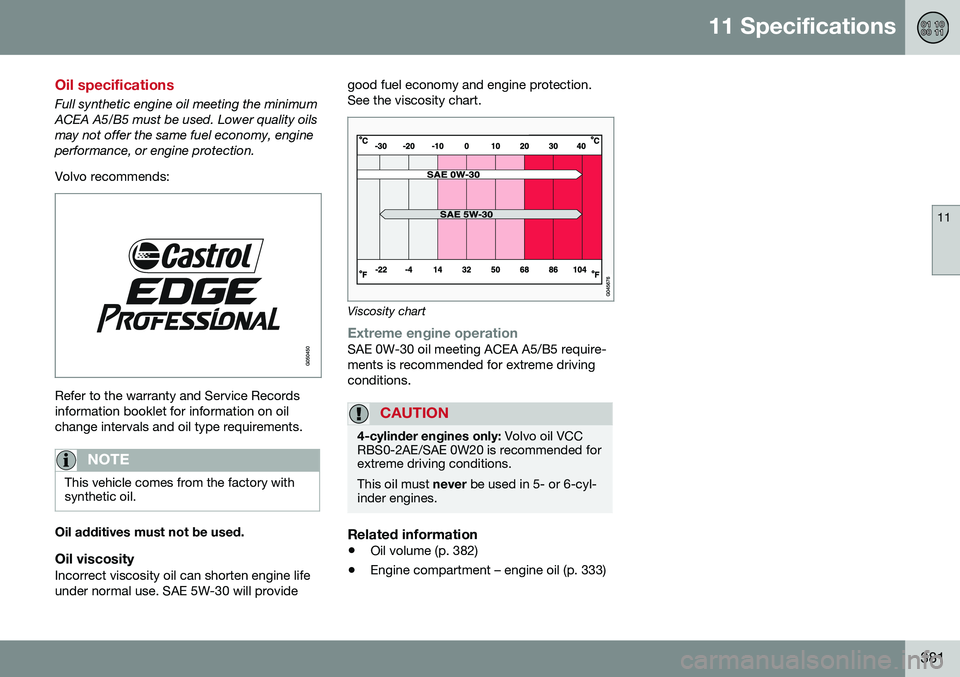
Full synthetic engine oil meeting the minimum ACEA A5/B5 must be used. Lower quality oilsmay not offer the same fuel economy, engineperformance, or engine protection. Volvo recommends:
Refer to the warranty and Service Records information booklet for information on oilchange intervals and oil type requirements.
NOTE
This vehicle comes from the factory with synthetic oil.
Oil additives must not be used.
Oil viscosityIncorrect viscosity oil can shorten engine life under normal use. SAE 5W-30 will providegood fuel economy and engine protection.See the viscosity chart.
Viscosity chart
Extreme engine operationSAE 0W-30 oil meeting ACEA A5/B5 require- ments is recommended for extreme drivingconditions.
CAUTION
4-cylinder engines only:
Volvo oil VCC
RBS0-2AE/SAE 0W20 is recommended for extreme driving conditions. This oil must never be used in 5- or 6-cyl-
inder engines.
Related information
• Oil volume (p. 382)
• Engine compartment – engine oil (p. 333)
Page 384 of 402
11 Specifications
11
382
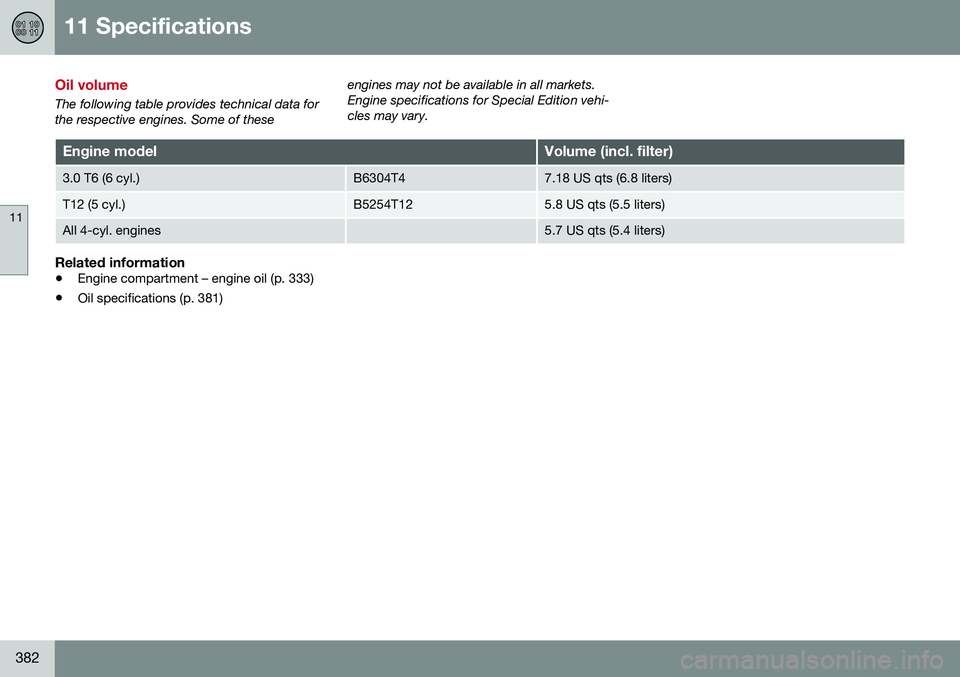
Oil volume
The following table provides technical data for the respective engines. Some of theseengines may not be available in all markets.Engine specifications for Special Edition vehi-cles may vary.
Engine modelVolume (incl. filter)
3.0 T6 (6 cyl.)B6304T47.18 US qts (6.8 liters)
T12 (5 cyl.)B5254T125.8 US qts (5.5 liters)
All 4-cyl. engines5.7 US qts (5.4 liters)
Related information
•
Engine compartment – engine oil (p. 333)
• Oil specifications (p. 381)