clock VOLVO V60 2016 Owner´s Manual
[x] Cancel search | Manufacturer: VOLVO, Model Year: 2016, Model line: V60, Model: VOLVO V60 2016Pages: 402, PDF Size: 10.3 MB
Page 286 of 402
||
08 Starting and driving
08
284
2. Open a perforated section of the insula-tion and grasp the handle on the green cord.
3. Gently pull the cord straight rearward until the fuel filler door clicks open.
Related information
• Refueling – opening/closing fuel cap (p. 284)
• Refueling – fuel requirements (p. 281)
• Refueling – octane rating (p. 282)
Refueling – opening/closing fuel cap
If necessary, the fuel filler door can be opened manually.
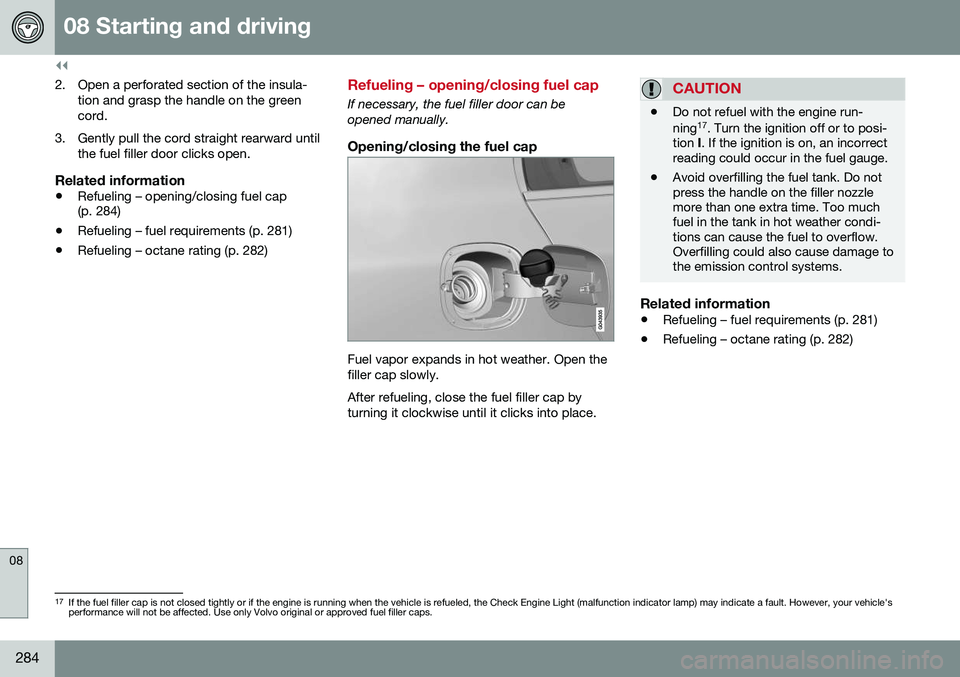
Opening/closing the fuel cap
Fuel vapor expands in hot weather. Open the filler cap slowly. After refueling, close the fuel filler cap by turning it clockwise until it clicks into place.
CAUTION
• Do not refuel with the engine run- ning 17
. Turn the ignition off or to posi-
tion I. If the ignition is on, an incorrect
reading could occur in the fuel gauge.
• Avoid overfilling the fuel tank. Do not press the handle on the filler nozzlemore than one extra time. Too muchfuel in the tank in hot weather condi-tions can cause the fuel to overflow.Overfilling could also cause damage tothe emission control systems.
Related information
•
Refueling – fuel requirements (p. 281)
• Refueling – octane rating (p. 282)
17
If the fuel filler cap is not closed tightly or if the engine is running when the vehicle is refueled, the Check Engine Light (malfunction indicator lamp) may indicate a fault. However, your vehicle's performance will not be affected. Use only Volvo original or approved fuel filler caps.
Page 299 of 402
09 Wheels and tires
09
}}
297
3.
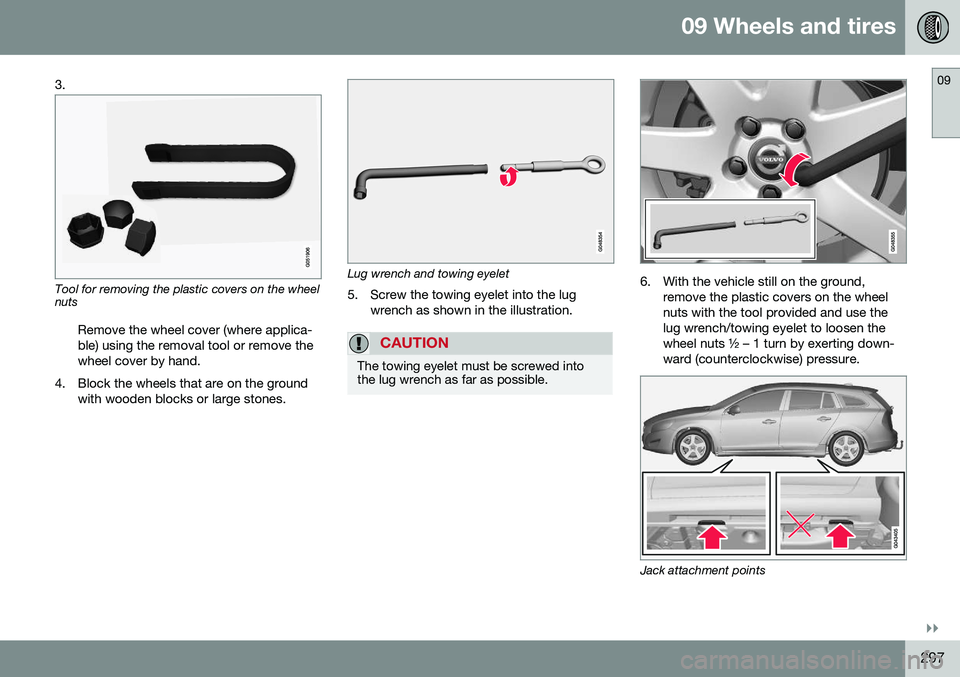
Tool for removing the plastic covers on the wheel nuts
Remove the wheel cover (where applica- ble) using the removal tool or remove thewheel cover by hand.
4. Block the wheels that are on the ground with wooden blocks or large stones.Lug wrench and towing eyelet
5. Screw the towing eyelet into the lug wrench as shown in the illustration.
CAUTION
The towing eyelet must be screwed into the lug wrench as far as possible.
6. With the vehicle still on the ground,remove the plastic covers on the wheel nuts with the tool provided and use thelug wrench/towing eyelet to loosen thewheel nuts ½ – 1 turn by exerting down-ward (counterclockwise) pressure.
Jack attachment points
Page 325 of 402
09 Wheels and tires
09
}}
* Option/accessory, for more information, see Introduction.323
Tire sealing system – checking inflation pressure
The tire sealing system can also be used to check the tires' inflation pressure.
Stage 2: Checking inflation pressure1. Connect the tire sealing system as
described in stage 1, see Tire sealing
system* – sealing hole (p. 321).
2. Refer to the inflation pressure table in this chapter for the correct inflation pressure.If the tire needs to be inflated, start thetire sealing system’s compressor. If nec-essary, release air from the tire by turningthe air release knob counterclockwise.
CAUTION
The compressor should not be used for more than 10 minutes at a time to avoidoverheating.
WARNING
If you interrupt your trip for more than 1 hour, check the inflation pressure in thedamaged tire again before continuing.
Tire sealing system* – inflating tires
The tire sealing system can be used to inflate the tires. To do so:
1. Park the car in a safe place.
2. The compressor should be switched off.Ensure that the on/off switch is in position0 (the 0 side of the switch should be
pressed down).
3. Take out the electrical wire and hose.
4. Remove the valve cap from the tire’s inflation valve and screw the hose con- nector onto the valve as tightly as possi-ble by hand.
5. Connect the electrical wire to the nearest 12-volt socket in the vehicle.
6. Start the vehicle’s engine.WARNING
• The vehicle’s engine should be running when the tire sealing system is used toavoid battery drain. Therefore, be surethe vehicle is parked in a well ventilatedplace, or outdoors, before using thesystem. The parking brake should besecurely applied and the gear selectorshould be in the
P (park) position.
• Children should never be left unatten-ded in the vehicle when the engine isrunning.
7. Check the tire’s inflation pressure on the
gauge. Switch off the compressor briefly to get a clear reading from the pressuregauge.
8. Refer to the tire inflation table in this chapter for the correct inflation pressure.If the tire needs to be inflated, start thetire sealing system’s compressor (pressthe on/off switch to position I). If neces-sary, release air from the tire by turningthe air release knob counterclockwise.
Page 333 of 402
10 Maintenance and servicing
10
331
where any retailer can access or search for this information using your vehicle's VIN num-ber. This number can be found in your war-ranty booklet or on the dashboard at thelower left corner of the windshield.
–Select Maintenance & repairSend
vehicle data.
Booking information and vehicle dataWhen you opt to book service from your vehi- cle, booking information and vehicle data willbe transmitted. Vehicle data consists of anumber of parameters in the following areas:
• Service requirements
• Function status
• Fluid levels
• Odometer reading (mileage)
• Vehicle Identification Number (VIN)
• The vehicle's software version
Related information
•Volvo ID (p. 21)
Maintenance – opening/closing hood
The hood is opened by first releasing the lock from the passenger compartment and thenpressing the release control.
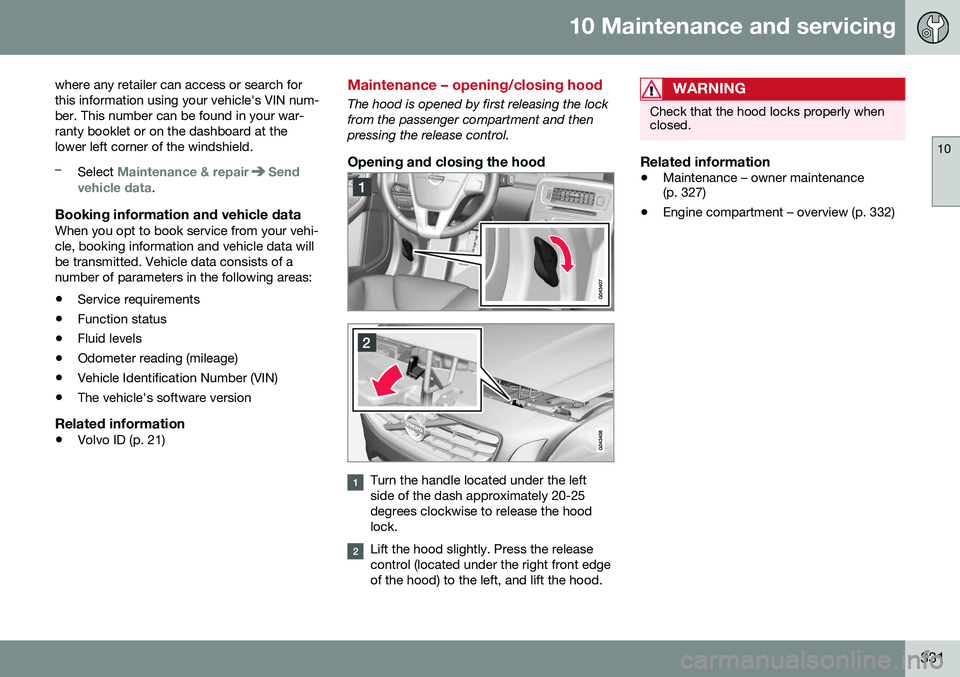
Opening and closing the hood
Turn the handle located under the left side of the dash approximately 20-25degrees clockwise to release the hoodlock.
Lift the hood slightly. Press the release control (located under the right front edgeof the hood) to the left, and lift the hood.
WARNING
Check that the hood locks properly when closed.
Related information
•Maintenance – owner maintenance (p. 327)
• Engine compartment – overview (p. 332)
Page 343 of 402
10 Maintenance and servicing
10
}}
341
Related information
•Bulbs – headlight housing (p. 339)
• Bulbs – low beam, Halogen (p. 341)
• Bulbs – high beam, Halogen (p. 341)
• Bulbs – extra high beam (p. 342)
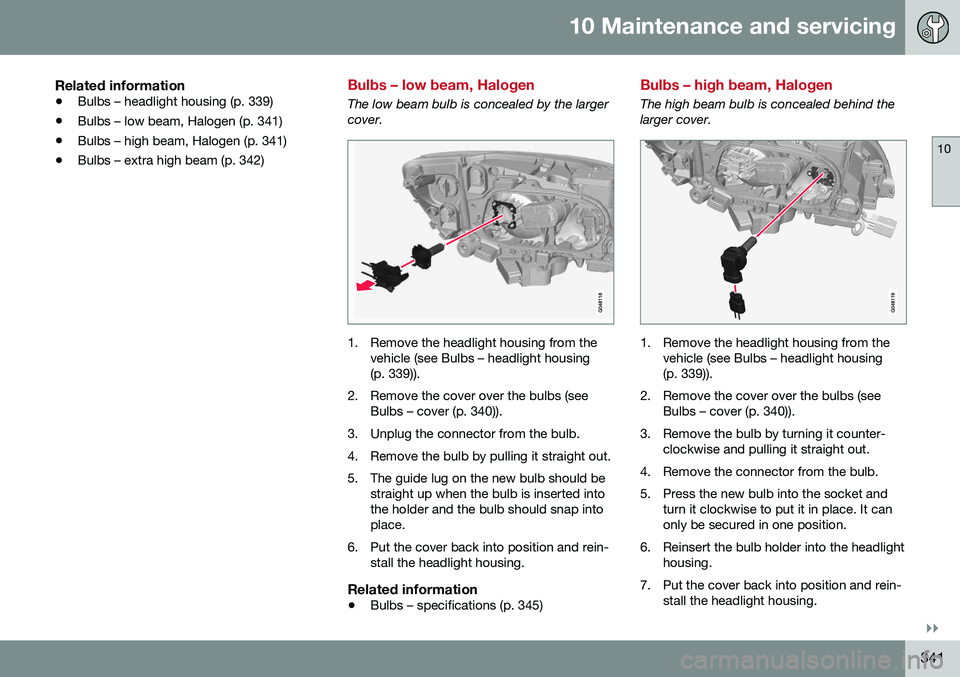
Bulbs – low beam, Halogen
The low beam bulb is concealed by the larger cover.
1. Remove the headlight housing from the
vehicle (see Bulbs – headlight housing (p. 339)).
2. Remove the cover over the bulbs (see Bulbs – cover (p. 340)).
3. Unplug the connector from the bulb.
4. Remove the bulb by pulling it straight out.
5. The guide lug on the new bulb should be straight up when the bulb is inserted into the holder and the bulb should snap intoplace.
6. Put the cover back into position and rein- stall the headlight housing.
Related information
• Bulbs – specifications (p. 345)
Bulbs – high beam, Halogen
The high beam bulb is concealed behind the larger cover.
1. Remove the headlight housing from the
vehicle (see Bulbs – headlight housing (p. 339)).
2. Remove the cover over the bulbs (see Bulbs – cover (p. 340)).
3. Remove the bulb by turning it counter- clockwise and pulling it straight out.
4. Remove the connector from the bulb.
5. Press the new bulb into the socket and turn it clockwise to put it in place. It can only be secured in one position.
6. Reinsert the bulb holder into the headlight housing.
7. Put the cover back into position and rein- stall the headlight housing.
Page 344 of 402
||
10 Maintenance and servicing
10
342
Related information
•Bulbs – specifications (p. 345)
Bulbs – extra high beam
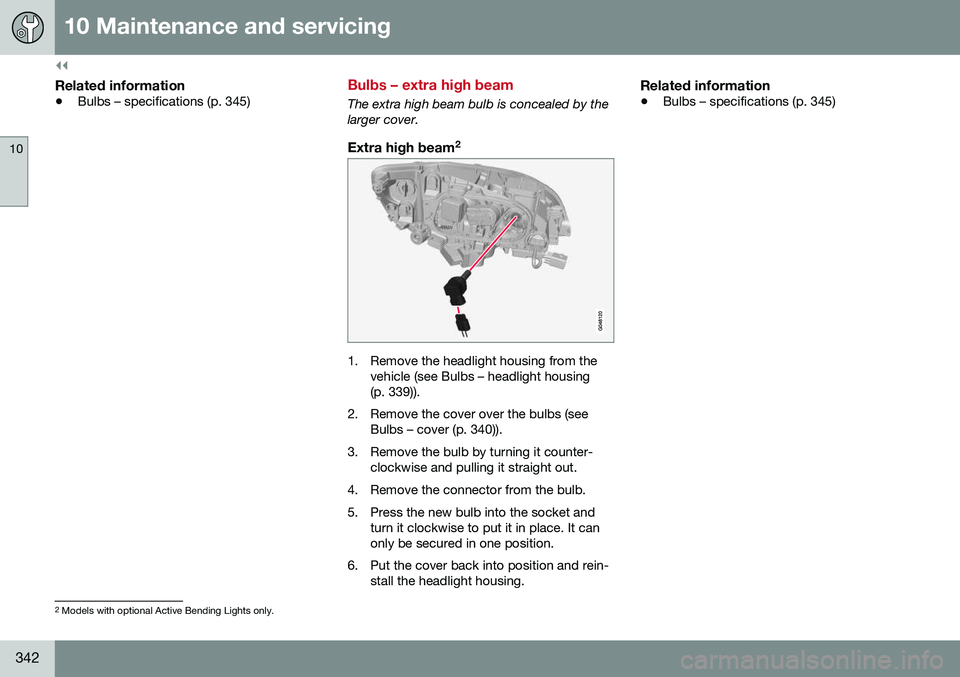
The extra high beam bulb is concealed by the larger cover.
Extra high beam 2
1. Remove the headlight housing from the
vehicle (see Bulbs – headlight housing (p. 339)).
2. Remove the cover over the bulbs (see Bulbs – cover (p. 340)).
3. Remove the bulb by turning it counter- clockwise and pulling it straight out.
4. Remove the connector from the bulb.
5. Press the new bulb into the socket and turn it clockwise to put it in place. It can only be secured in one position.
6. Put the cover back into position and rein- stall the headlight housing.
Related information
• Bulbs – specifications (p. 345)
2
Models with optional Active Bending Lights only.
Page 346 of 402
||
10 Maintenance and servicing
10
344
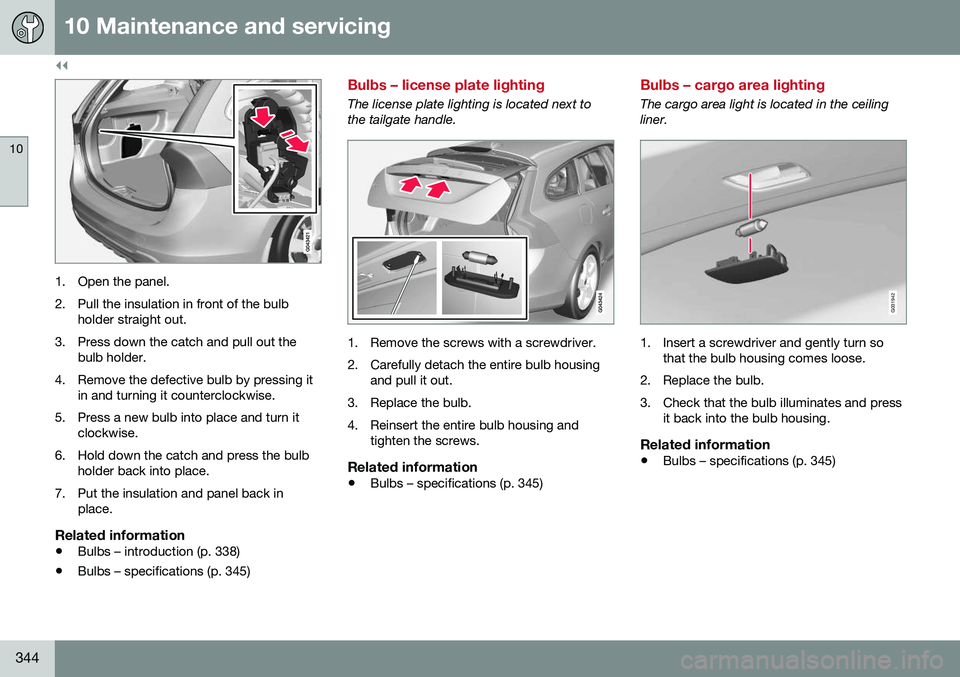
1. Open the panel.2. Pull the insulation in front of the bulb holder straight out.
3. Press down the catch and pull out the bulb holder.
4. Remove the defective bulb by pressing it in and turning it counterclockwise.
5. Press a new bulb into place and turn it clockwise.
6. Hold down the catch and press the bulb holder back into place.
7. Put the insulation and panel back in place.
Related information
• Bulbs – introduction (p. 338)
• Bulbs – specifications (p. 345)
Bulbs – license plate lighting
The license plate lighting is located next to the tailgate handle.
1. Remove the screws with a screwdriver.
2. Carefully detach the entire bulb housing
and pull it out.
3. Replace the bulb.
4. Reinsert the entire bulb housing and tighten the screws.
Related information
• Bulbs – specifications (p. 345)
Bulbs – cargo area lighting
The cargo area light is located in the ceiling liner.
G031942
1. Insert a screwdriver and gently turn so
that the bulb housing comes loose.
2. Replace the bulb.
3. Check that the bulb illuminates and press it back into the bulb housing.
Related information
• Bulbs – specifications (p. 345)
Page 393 of 402
12 Index
12
391
Central locking system, introduction 146,
147, 150, 153
Chains...................................................... 309
Check Engine warning light....................... 71Child restraints recalls and registration......................... 47
Child restraint systems.............................. 47 booster cushions.................................. 54
convertible seats.................................. 51
infant seats........................................... 49
ISOFIX/LATCH anchors........................ 55
top tether anchors................................ 56
Child safety................................................ 46 booster cushions.................................. 54
child restraint systems.......................... 47
convertible seats.................................. 51
infant seats........................................... 49
Child safety locks...................................... 61
City safety........................................ 197, 198
Climate system........................................ 129 air distribution..................... 124, 130, 132
air vents.............................................. 124
Interior Air Quality System.................. 123
introduction......................................... 122
passenger compartment filter............ 123
refrigerant........................................... 122
Clock, setting............................................. 76
Cold weather driving................................ 280 Collision warning system.. 204, 206, 209,
210, 212, 213
Compass in rearview mirror..................... 103
Connected service booking..................... 329
Conserving electrical current................... 279
Convertible seats....................................... 51
Coolant............................................ 335, 383
Cooling system, general information....... 279
Corner traction control............................. 170
Courtesy lighting........................................ 94
Crash event data....................................... 18
Crash mode......................................... 44, 45
Cruise control.................................. 176, 178 adaptive.............................................. 179
Curb weight............................................. 306
Current, conserving................................. 279
Cyclist detection.............................. 208, 212
D
Daytime running lights............................... 87
Defroster.................................................. 129
Detachable key blade...................... 151, 152Disconnecting the front passenger’s air-
bag............................................................. 36 Distance Alert.......................................... 193
Dome lighting............................................. 94
Door mirrors..................................... 100, 101
Driver alert....................... 217, 218, 219, 220
Lane Departure Warning..... 222, 223,
224, 225Lane Keeping Aid....... 227, 228, 230, 231
Driver distraction warning.......................... 23
Driving economically................................ 285
Driving in cold weather............................ 280
Driving through water.............................. 278
E
ECC................................................. 127, 128
Eco (driving function)............................... 267
Eco coast................................................. 267
Eco guide................................................... 69
Economical driving.................................. 285
Electrically heated steering wheel............. 86
Electrical sockets..................................... 137
Electric parking brake...... 274, 275, 276, 277
Electronic Climate Control............... 126, 128 air distribution table............................ 132
Interior Air Quality System.................. 123