height VOLVO V60 2016 Owner´s Manual
[x] Cancel search | Manufacturer: VOLVO, Model Year: 2016, Model line: V60, Model: VOLVO V60 2016Pages: 402, PDF Size: 10.3 MB
Page 86 of 402
||
03 Instruments and controls
03
84
NOTE
•The head restraint must be returned to the upright position manually.
• The outboard head restraints cannotbe folded down on models that are notequipped with this button.
CAUTION
The rear head restraints should not be kept folded down for prolonged periods.This could result in pressure marks inleather upholstery.
WARNING
For safety reasons, no one should be allowed to sit in the outboard rear seatpositions if the head restraints are foldeddown. If these positions are occupied, thehead restraints should be in the upright(fixed) position.
Related information
•
Front seats (p. 78)
• Front seats – power seat (p. 79)
• Rear seats – head restraints (p. 82)
Rear seats – folding backrest
The rear seat head restraints and backrests can be folded down. The center headrestraint can be raised/lowered according tothe passenger's height.
Folding down the rear seat backrestsThe three sections of the rear seat backrestcan be folded down in different combinationsto make it easier to transport long objects.
• The left (driver's side) section can be folded down separately.
• The center section can be folded downseparately.
• The right (passenger's side) section canonly be folded down together with thecenter section.
• All three sections can be folded downtogether.
CAUTION
To help avoid damage to the upholstery, there should be no objects on the rear seatand the seat belt should not be buckledwhen the backrest is folded down.
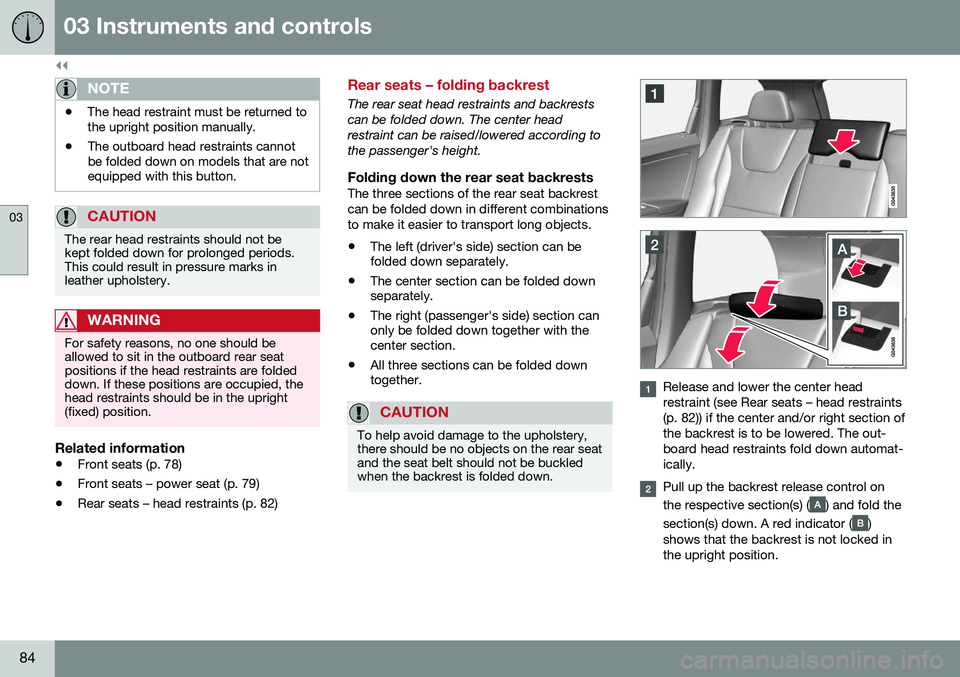
Release and lower the center head restraint (see Rear seats – head restraints(p. 82)) if the center and/or right section ofthe backrest is to be lowered. The out-board head restraints fold down automat-ically.
Pull up the backrest release control on the respective section(s) (
) and fold the
section(s) down. A red indicator (
)
shows that the backrest is not locked in the upright position.
Page 87 of 402
03 Instruments and controls
03
}}
* Option/accessory, for more information, see Introduction.85
NOTE
It may be necessary to move the front seats forward or put their backrests in amore upright position before folding downthe rear seat backrests.
WARNING
• When one or more sections of the backrest is returned to the uprightposition, check that it is properlylocked in place by pushing and pullingit. The red indicators should also notbe visible.
• Return the outboard head restraints tothe upright position.
• Long loads should always be securelyanchored to help avoid injury in theevent of a sudden stop.
• Always turn the engine off and applythe parking brake when loading/unloading the vehicle.
• Place the transmission in the Park (
P)
position to help prevent inadvertentmovement of the gear selector.
• On hot days, the temperature in thevehicle interior can rise very quickly.Exposure of people to these high tem-peratures for even a short period oftime can cause heat-related injury ordeath. Small children are particularly atrisk.
Related information
•
Front seats (p. 78)
• Front seats – power seat (p. 79)
• Rear seats – head restraints (p. 82)
Steering wheel
The steering wheel can be adjusted to various positions and has controls for the horn, cruisecontrol*, menus, the infotainment system and Bluetooth
®-connected cell phone.
Adjusting
G021138
Adjusting the steering wheel
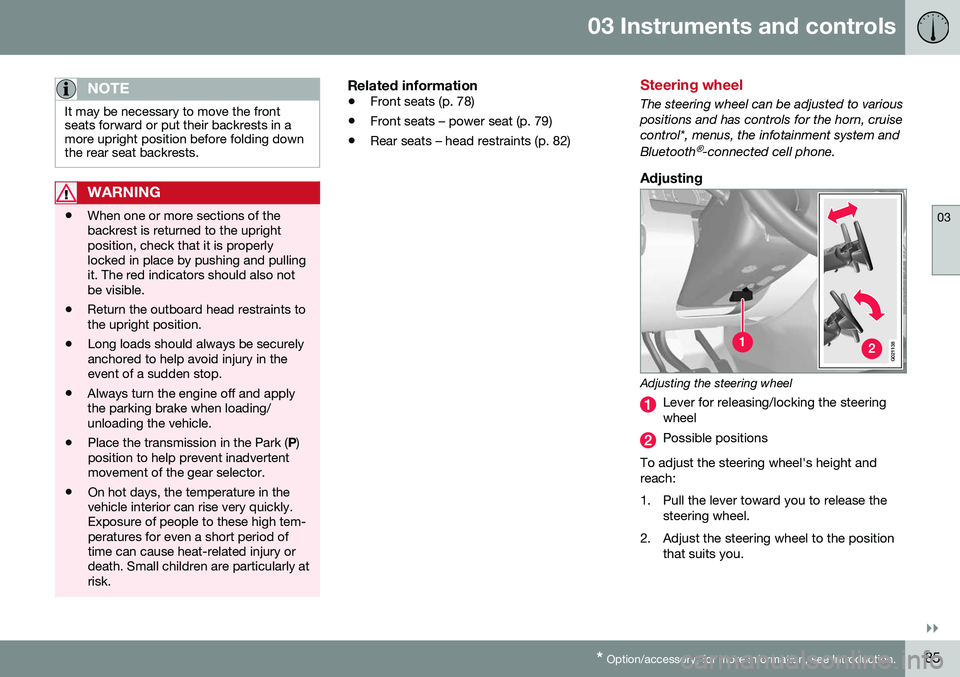
Lever for releasing/locking the steering wheel
Possible positions
To adjust the steering wheel's height and reach:
1. Pull the lever toward you to release the steering wheel.
2. Adjust the steering wheel to the position that suits you.
Page 295 of 402
09 Wheels and tires
09
293
Tires – general information
Your vehicle is equipped with tires according to the vehicle's tire information placard on theB-pillar (the structural member at the side ofthe vehicle, at the rear of the driver's dooropening).
Introduction
CAUTION
Some Volvo models are equipped with an Ultra High Performance tire and wheelcombination designed to provide maxi-mum dry pavement performance with con-sideration for hydroplaning resistance.They may be more susceptible to roadhazard damage and, depending on drivingconditions, may achieve a tread life of lessthan 20,000 miles (30,000 km). Even if thisvehicle is equipped with Volvo’s advancedAWD or stability system, these tires are notdesigned for winter driving, and should bereplaced with winter tires when weatherconditions dictate.
The tires have good road holding characteris- tics and offer good handling on dry and wetsurfaces. It should be noted however that thetires have been developed to give these fea-tures on snow/ice-free surfaces. Most models are equipped with "all-season" tires, which provide a somewhat higherdegree of road holding on slippery surfacesthan tires without the "all-season" rating.However, for optimum road holding on icy orsnow-covered roads, we recommend suitablewinter tires on all four wheels. When replacing tires, be sure that the new tires are the same size designation, type(radial) and preferably from the same manu-facturer, on all four wheels. Otherwise there isa risk of altering the car's roadholding andhandling characteristics.
Tire rotationYour vehicle has no required tire rotation. Tirewear is affected by a number of factors suchas tire inflation, ambient temperature, drivingstyle, etc.
NOTE
•
If the tires are rotated, they should only be moved from front to rear orvice versa. They should never be rota-ted left to right/right to left.
• Ideally, tire rotation should be done thefirst time after approximately 3,000miles (5,000 km) and thereafter at6,000-mile (10,000-km) intervals.Some customers find that tire rotationmay help to get extra mileage from tirelife.
• Tire rotation should only be performedif front/rear tire wear is fairly even andtread height is above 1/16" (1.6 mm).
Related information
•
Tire inflation – pressure table (p. 305)
• Tire specifications (p. 303)
• Changing a wheel – direction of rotation (p. 296)
• Tires – tread wear indicator (p. 295)
Page 306 of 402
||
09 Wheels and tires
09
304
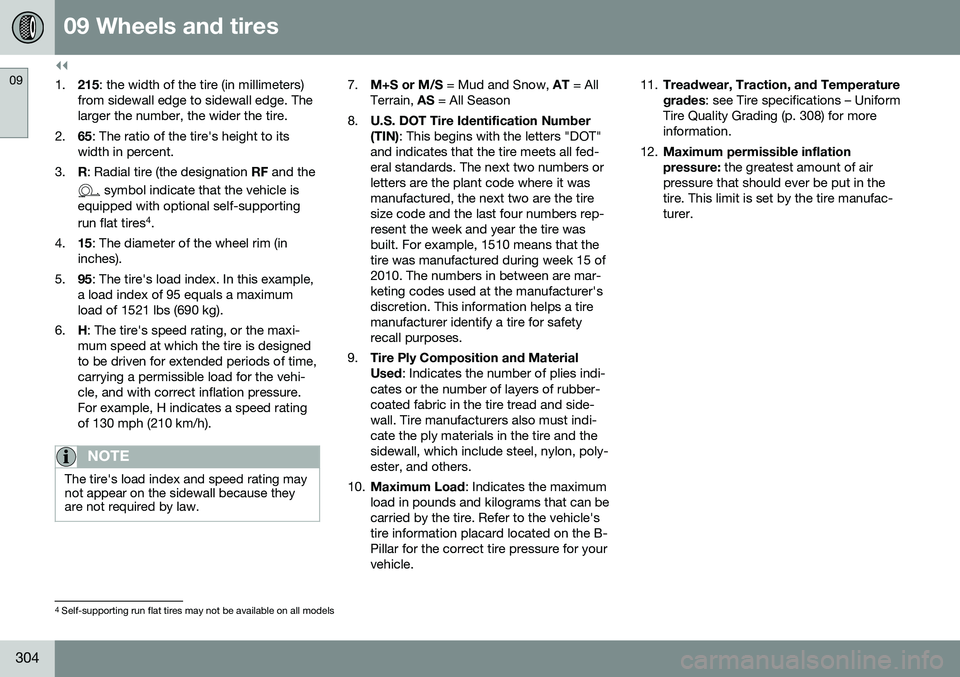
1.215: the width of the tire (in millimeters)
from sidewall edge to sidewall edge. The larger the number, the wider the tire.
2. 65: The ratio of the tire's height to its
width in percent.
3. R: Radial tire (the designation RF and the
symbol indicate that the vehicle is
equipped with optional self-supporting run flat tires 4
.
4. 15: The diameter of the wheel rim (in
inches).
5. 95: The tire's load index. In this example,
a load index of 95 equals a maximum load of 1521 lbs (690 kg).
6. H: The tire's speed rating, or the maxi-
mum speed at which the tire is designedto be driven for extended periods of time,carrying a permissible load for the vehi-cle, and with correct inflation pressure.For example, H indicates a speed ratingof 130 mph (210 km/h).
NOTE
The tire's load index and speed rating may not appear on the sidewall because theyare not required by law.
7. M+S or M/S = Mud and Snow, AT = All
Terrain, AS = All Season
8. U.S. DOT Tire Identification Number (TIN)
: This begins with the letters "DOT"
and indicates that the tire meets all fed- eral standards. The next two numbers orletters are the plant code where it wasmanufactured, the next two are the tiresize code and the last four numbers rep-resent the week and year the tire wasbuilt. For example, 1510 means that thetire was manufactured during week 15 of2010. The numbers in between are mar-keting codes used at the manufacturer'sdiscretion. This information helps a tiremanufacturer identify a tire for safetyrecall purposes.
9. Tire Ply Composition and Material Used
: Indicates the number of plies indi-
cates or the number of layers of rubber- coated fabric in the tire tread and side-wall. Tire manufacturers also must indi-cate the ply materials in the tire and thesidewall, which include steel, nylon, poly-ester, and others.
10. Maximum Load : Indicates the maximum
load in pounds and kilograms that can becarried by the tire. Refer to the vehicle'stire information placard located on the B-Pillar for the correct tire pressure for yourvehicle. 11.
Treadwear, Traction, and Temperature grades
: see Tire specifications – Uniform
Tire Quality Grading (p. 308) for more information.
12. Maximum permissible inflation pressure:
the greatest amount of air
pressure that should ever be put in the tire. This limit is set by the tire manufac-turer.
4 Self-supporting run flat tires may not be available on all models
Page 378 of 402
||
11 Specifications
11
376
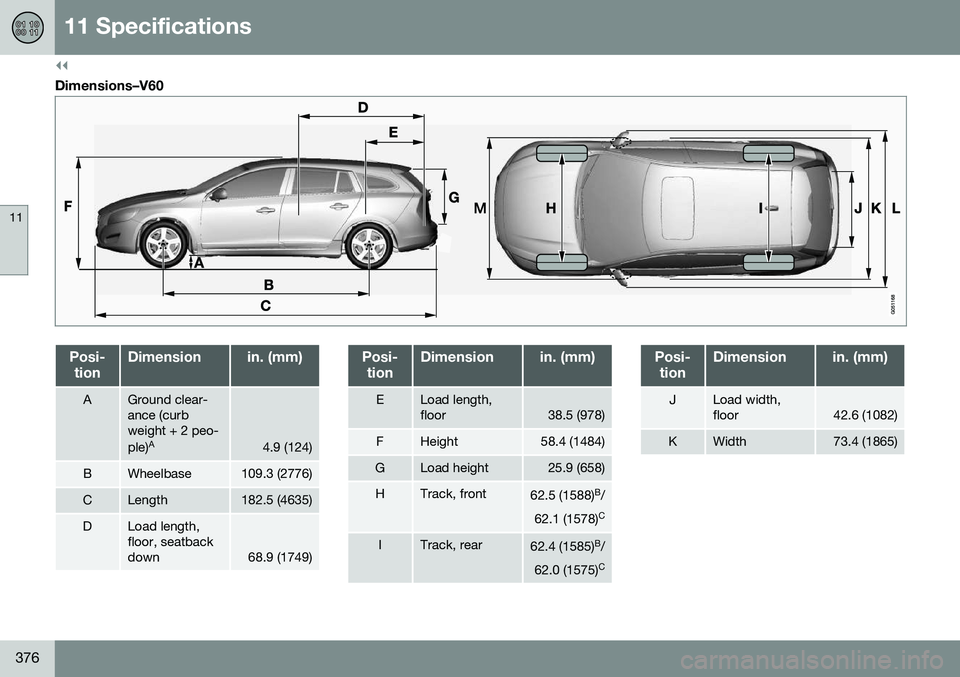
Dimensions–V60
Posi-tionDimensionin. (mm)
AGround clear- ance (curbweight + 2 peo- ple) A
4.9 (124)
BWheelbase109.3 (2776)
CLength182.5 (4635)
DLoad length, floor, seatbackdown
68.9 (1749)
Posi-
tionDimensionin. (mm)
ELoad length, floor38.5 (978)
FHeight58.4 (1484)
GLoad height25.9 (658)
HTrack, front62.5 (1588) B
/
62.1 (1578) C
ITrack, rear62.4 (1585)
B
/
62.0 (1575) C
Posi-
tionDimensionin. (mm)
JLoad width, floor42.6 (1082)
KWidth73.4 (1865)