remote control VOLVO V60 2016 Owner´s Manual
[x] Cancel search | Manufacturer: VOLVO, Model Year: 2016, Model line: V60, Model: VOLVO V60 2016Pages: 402, PDF Size: 10.3 MB
Page 156 of 402
||
06 Locks and alarm
06
154
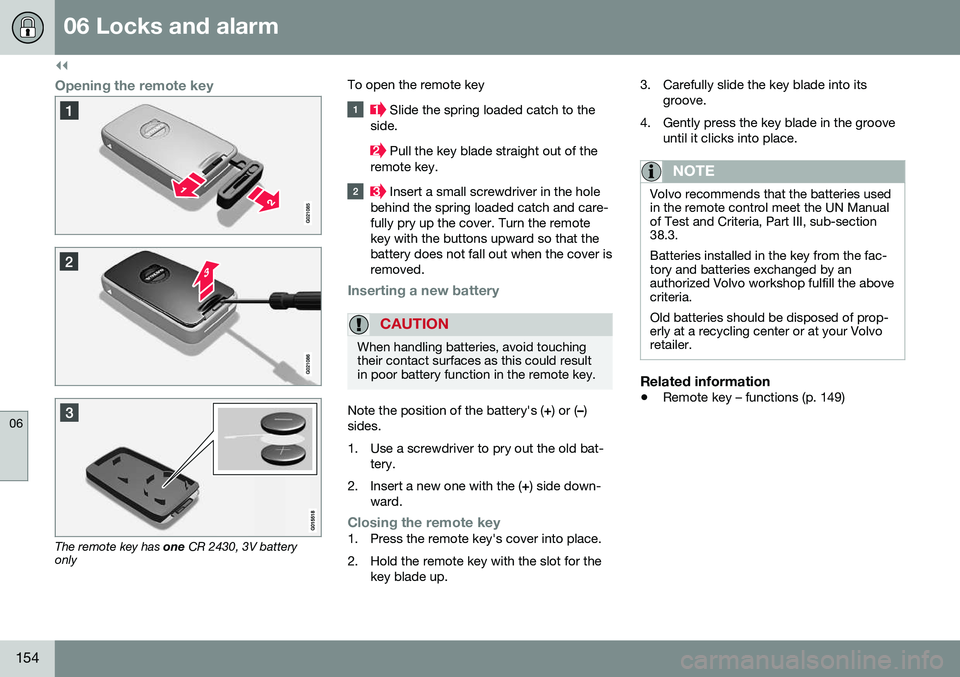
Opening the remote key
The remote key has one CR 2430, 3V battery
only To open the remote key
Slide the spring loaded catch to the
side.
Pull the key blade straight out of the
remote key.
Insert a small screwdriver in the hole
behind the spring loaded catch and care- fully pry up the cover. Turn the remotekey with the buttons upward so that thebattery does not fall out when the cover isremoved.
Inserting a new battery
CAUTION
When handling batteries, avoid touching their contact surfaces as this could resultin poor battery function in the remote key.
Note the position of the battery's ( +) or ( –)
sides.
1. Use a screwdriver to pry out the old bat- tery.
2. Insert a new one with the ( +) side down-
ward.
Closing the remote key1. Press the remote key's cover into place.
2. Hold the remote key with the slot for the key blade up. 3. Carefully slide the key blade into its
groove.
4. Gently press the key blade in the groove until it clicks into place.
NOTE
Volvo recommends that the batteries used in the remote control meet the UN Manualof Test and Criteria, Part III, sub-section38.3. Batteries installed in the key from the fac- tory and batteries exchanged by anauthorized Volvo workshop fulfill the abovecriteria. Old batteries should be disposed of prop- erly at a recycling center or at your Volvoretailer.
Related information
• Remote key – functions (p. 149)
Page 157 of 402
06 Locks and alarm
06
* Option/accessory, for more information, see Introduction.155
Keyless drive*– locking/unlocking
This system makes it possible to unlock and lock the vehicle without having to press anybuttons on the remote key. It is only neces-sary to have a keyless drive remote key inyour possession to operate the central lockingsystem.
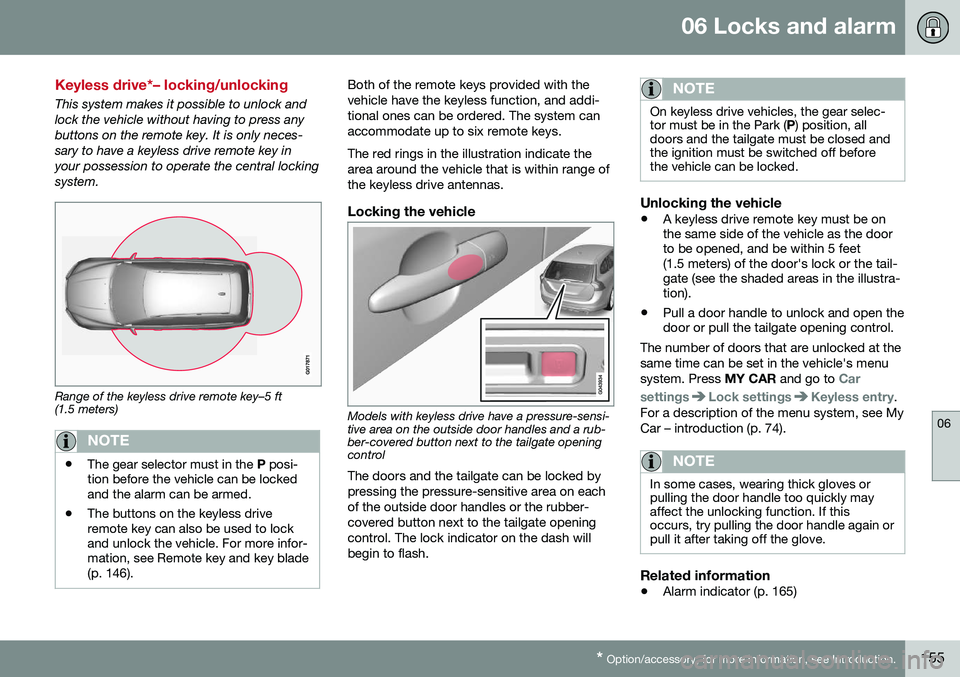
Range of the keyless drive remote key–5 ft (1.5 meters)
NOTE
• The gear selector must in the
P posi-
tion before the vehicle can be locked and the alarm can be armed.
• The buttons on the keyless driveremote key can also be used to lockand unlock the vehicle. For more infor-mation, see Remote key and key blade(p. 146).
Both of the remote keys provided with the vehicle have the keyless function, and addi-tional ones can be ordered. The system canaccommodate up to six remote keys. The red rings in the illustration indicate the area around the vehicle that is within range ofthe keyless drive antennas.
Locking the vehicle
Models with keyless drive have a pressure-sensi- tive area on the outside door handles and a rub-ber-covered button next to the tailgate openingcontrol
The doors and the tailgate can be locked by pressing the pressure-sensitive area on eachof the outside door handles or the rubber-covered button next to the tailgate openingcontrol. The lock indicator on the dash willbegin to flash.
NOTE
On keyless drive vehicles, the gear selec- tor must be in the Park ( P) position, all
doors and the tailgate must be closed andthe ignition must be switched off beforethe vehicle can be locked.
Unlocking the vehicle
• A keyless drive remote key must be on the same side of the vehicle as the doorto be opened, and be within 5 feet(1.5 meters) of the door's lock or the tail-gate (see the shaded areas in the illustra-tion).
• Pull a door handle to unlock and open thedoor or pull the tailgate opening control.
The number of doors that are unlocked at the same time can be set in the vehicle's menusystem. Press MY CAR and go to
Car
settings
Lock settingsKeyless entry.
For a description of the menu system, see My Car – introduction (p. 74).
NOTE
In some cases, wearing thick gloves or pulling the door handle too quickly mayaffect the unlocking function. If thisoccurs, try pulling the door handle again orpull it after taking off the glove.
Related information
• Alarm indicator (p. 165)
Page 159 of 402
06 Locks and alarm
06
}}
* Option/accessory, for more information, see Introduction.157
position of the driver's seat
2
and door mirrors
will be stored in the remote key's memory. The next time a door is opened by a person with the same remote key in his/her posses-
sion, the driver's seat and door mirrors willautomatically move to the position that theywere in when the door was most recentlylocked.
NOTE
If several people carrying remote keys approach the vehicle at the same time, thedriver's seat and door mirrors will assumethe positions they were in for the personwho opens the driver's door.
See also power seats (p. 79) for information on adjusting and storing the seat's position inthe seat memory.
NOTE
If the vehicle is locked by pressing the but- ton on one of the door handles or bypressing the lock button on the remotekey, or if it is left unlocked for more than30 minutes, the key memory function willbe deactivated. To reactivate the key's memory: • Unlock the vehicle by pulling a door handle with the remote key in yourpossession or by pressing the unlockbutton on the remote key.
Related information
•
Keyless drive*– locking/unlocking (p. 155)
• Remote key – functions (p. 149)
Keyless drive* – messages
If all of the remote keys are removed from the vehicle while the engine is running or if theignition modes (p. 77) is in mode
II and all of
the doors are closed, a message will appearin the instrument panel display and an audiblesignal will sound. When at least one remote key has been returned to the car, the message will beerased in the display and the audible signalwill stop when:
• A door has been opened and closed
• The remote key has been inserted in the ignition slot
• The
OK button has been pressed. For the
location of this button, see Informationdisplay – menu controls (p. 111)
2 Power seats only
Page 255 of 402
08 Starting and driving
08
253
WARNING
•Always remove the remote key from the ignition slot when leaving the vehi-cle and ensure that the ignition inmode
0 (see Ignition modes (p. 77) for
information about the ignition modes).
• On vehicles with the optional keylessdrive, never remove the remote keyfrom the vehicle while it is being drivenor towed.
• Always place the gear selector in Parkand apply the parking brake beforeleaving the vehicle. Never leave thevehicle unattended with the enginerunning.
• Always open garage doors fully beforestarting the engine inside a garage toensure adequate ventilation. Theexhaust gases contain carbon monox-ide, which is invisible and odorless butvery poisonous.
NOTE
•
After a cold start, idle speed may be noticeably higher than normal for ashort period. This is done to help bringcomponents in the emission controlsystem to their normal operating tem-perature as quickly as possible, whichenables them to control emissions andhelp reduce the vehicle's impact on the environment 3
.
CAUTION
• When starting in cold weather, the automatic transmission may shift up atslightly higher engine speeds than nor-mal until the automatic transmissionfluid reaches normal operating tem-perature.
• Do not race a cold engine immediatelyafter starting. Oil flow may not reachsome lubrication points fast enough toprevent engine damage.
• The engine should be idling when youmove the gear selector. Never acceler-ate until after you feel the transmissionengage. Accelerating immediately afterselecting a gear will cause harshengagement and premature transmis-sion wear.
• Selecting
P or N when idling at a
standstill for prolonged periods of timewill help prevent overheating of theautomatic transmission fluid.
Related information
• Switching off the engine (p. 254)
3
If the gear selector is in the D or R positions and the car is not moving, engine speed (rpm) will be lower and it will take longer for the engine to reach normal operating temperature.
Page 257 of 402
08 Starting and driving
08
* Option/accessory, for more information, see Introduction.255
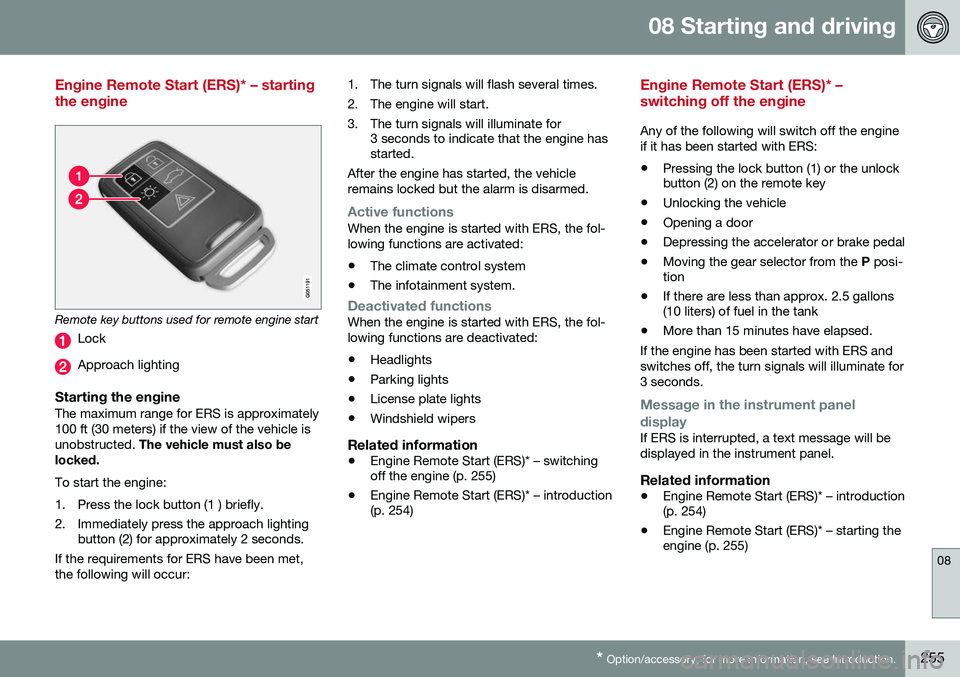
Engine Remote Start (ERS)* – starting the engine
Remote key buttons used for remote engine start
Lock
Approach lighting
Starting the engineThe maximum range for ERS is approximately 100 ft (30 meters) if the view of the vehicle isunobstructed. The vehicle must also be
locked. To start the engine:
1. Press the lock button (1 ) briefly.
2. Immediately press the approach lighting button (2) for approximately 2 seconds.
If the requirements for ERS have been met, the following will occur: 1. The turn signals will flash several times.
2. The engine will start.
3. The turn signals will illuminate for
3 seconds to indicate that the engine has started.
After the engine has started, the vehicle remains locked but the alarm is disarmed.
Active functionsWhen the engine is started with ERS, the fol- lowing functions are activated: • The climate control system
• The infotainment system.
Deactivated functionsWhen the engine is started with ERS, the fol- lowing functions are deactivated: •Headlights
• Parking lights
• License plate lights
• Windshield wipers
Related information
•
Engine Remote Start (ERS)* – switching off the engine (p. 255)
• Engine Remote Start (ERS)* – introduction(p. 254)
Engine Remote Start (ERS)* – switching off the engine
Any of the following will switch off the engine if it has been started with ERS:
• Pressing the lock button (1) or the unlock button (2) on the remote key
• Unlocking the vehicle
• Opening a door
• Depressing the accelerator or brake pedal
• Moving the gear selector from the
P posi-
tion
• If there are less than approx. 2.5 gallons(10 liters) of fuel in the tank
• More than 15 minutes have elapsed.
If the engine has been started with ERS and switches off, the turn signals will illuminate for3 seconds.
Message in the instrument panel
display
If ERS is interrupted, a text message will be displayed in the instrument panel.
Related information
• Engine Remote Start (ERS)* – introduction (p. 254)
• Engine Remote Start (ERS)* – starting theengine (p. 255)
Page 278 of 402
08 Starting and driving
08
276
Parking brake – releasing
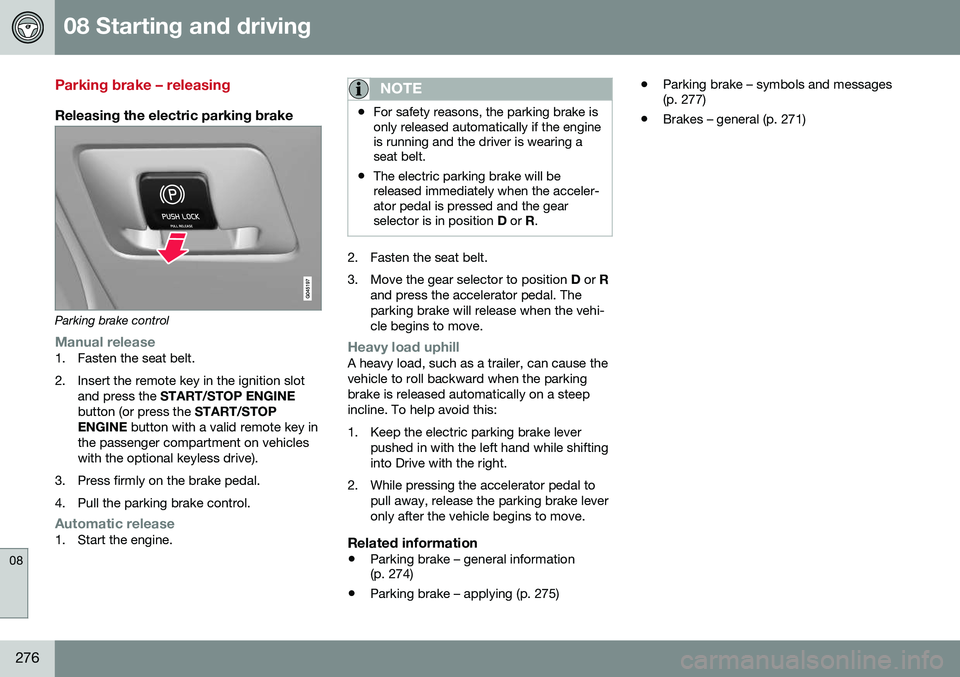
Releasing the electric parking brake
Parking brake control
Manual release1. Fasten the seat belt.
2. Insert the remote key in the ignition slotand press the START/STOP ENGINE
button (or press the START/STOP
ENGINE button with a valid remote key in
the passenger compartment on vehicles with the optional keyless drive).
3. Press firmly on the brake pedal.
4. Pull the parking brake control.
Automatic release1. Start the engine.
NOTE
• For safety reasons, the parking brake is only released automatically if the engineis running and the driver is wearing aseat belt.
• The electric parking brake will bereleased immediately when the acceler-ator pedal is pressed and the gearselector is in position
D or R.
2. Fasten the seat belt.
3. Move the gear selector to position D or R
and press the accelerator pedal. The parking brake will release when the vehi-cle begins to move.
Heavy load uphillA heavy load, such as a trailer, can cause the vehicle to roll backward when the parkingbrake is released automatically on a steepincline. To help avoid this:
1. Keep the electric parking brake lever pushed in with the left hand while shifting into Drive with the right.
2. While pressing the accelerator pedal to pull away, release the parking brake leveronly after the vehicle begins to move.
Related information
• Parking brake – general information (p. 274)
• Parking brake – applying (p. 275) •
Parking brake – symbols and messages(p. 277)
• Brakes – general (p. 271)
Page 291 of 402
08 Starting and driving
08
}}
289
be switched off (but will be on again the next time the engine is started)
• TSA may not intervene when the vehicleand trailer begin to sway if the driver triesto compensate for the swaying motion bymoving the steering wheel rapidly
How TSA worksOnce swaying has begun, it can be very diffi- cult to stop, which makes it difficult to controlthe vehicle and trailer. The TSA system continuously monitors the vehicle's movements, particularly lateralmovement. If the system detects a tendencyto sway, the brakes are applied individuallyon the front wheels, which has a stabilizingeffect on the vehicle and trailer. This is oftenenough to enable the driver to regain controlof the vehicle. If this is not adequate to stop the swaying motion, the brakes are applied to all of thewheels on the vehicle and on the trailer if it isequipped with brakes, and engine power istemporarily reduced. As the swaying motionbegins to decrease and the vehicle-trailerhave once again become stable, TSA will nowstop regulating the brakes/engine power andthe driver regains control of the vehicle.
Related information
• Towing a trailer (p. 287)
• Loading – general (p. 139)
Towing the vehicle
Always check with state and local authorities before attempting to tow another vehiclebecause this type of towing is subject to reg-ulations regarding maximum towing speed,length and type of towing device, lighting, etc.
1. With the remote key fully pressed into the
ignition slot 20
, press START/STOP
ENGINE for approximately 2 seconds to
activate ignition mode II. 2. The remote key must remain in the igni-
tion slot 21
for the entire time that the vehi-
cle is being towed.
3. Keep the tow rope taut when the towing vehicle slows down by applying light pressure on the brake pedal. This willhelp prevent jarring movements of thevehicle being towed.
4. Be prepared to apply the brakes to stop the vehicle being towed.
20Not necessary in vehicles with the optional keyless drive.
Page 354 of 402
||
10 Maintenance and servicing
10
352* Option/accessory, for more information, see Introduction.
RemovalSwitch off the ignition, remove the remote key from the ignition slot and wait at least5 minutes before disconnecting the battery sothat all information in the vehicle's electricalsystem can be stored in the control modules.
Open the clips on the front cover and remove the cover.
Release the rubber molding so that the rear cover is free.
Remove the rear cover by pulling it away.
Detach the black negative cable.
Detach the red positive cable
Detach the ventilation hose from the
battery
Loosen the screw holding the battery
clamp.
Move the battery to the side and lift it up.
WARNING
PROPOSITION 65 WARNING! Battery posts, terminals, and related accessories contain lead and lead com-pounds, chemicals known to the state ofCalifornia to cause cancer and reproduc-tive harm. Wash hands after handling.
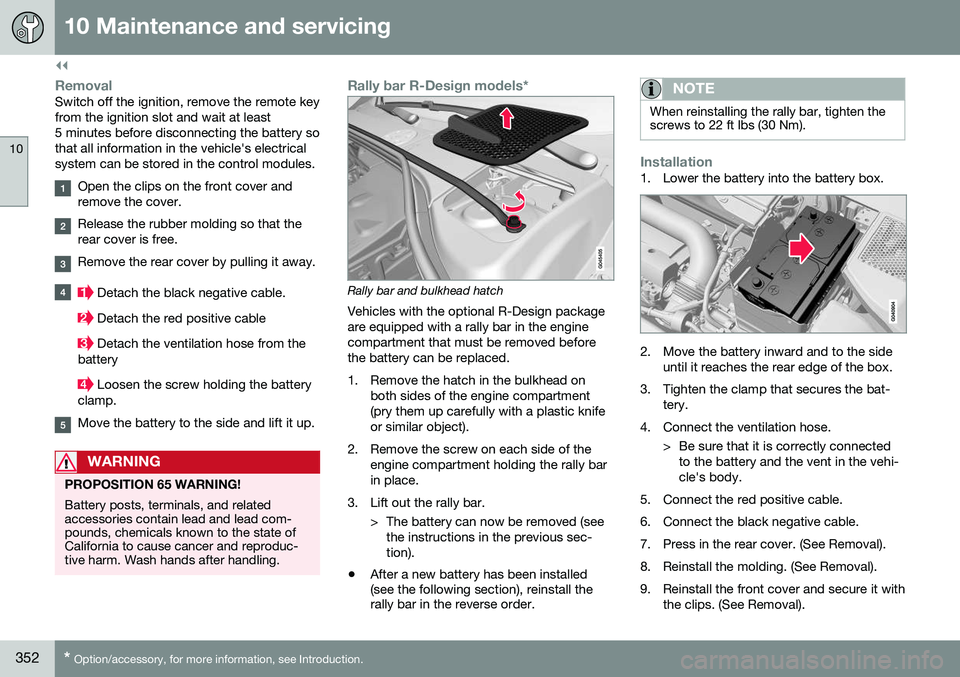
Rally bar R-Design models*
Rally bar and bulkhead hatch
Vehicles with the optional R-Design package are equipped with a rally bar in the enginecompartment that must be removed beforethe battery can be replaced.
1. Remove the hatch in the bulkhead on both sides of the engine compartment (pry them up carefully with a plastic knifeor similar object).
2. Remove the screw on each side of the engine compartment holding the rally barin place.
3. Lift out the rally bar. > The battery can now be removed (seethe instructions in the previous sec-tion).
• After a new battery has been installed (see the following section), reinstall therally bar in the reverse order.
NOTE
When reinstalling the rally bar, tighten the screws to 22 ft lbs (30 Nm).
Installation1. Lower the battery into the battery box.
2. Move the battery inward and to the side
until it reaches the rear edge of the box.
3. Tighten the clamp that secures the bat- tery.
4. Connect the ventilation hose. > Be sure that it is correctly connectedto the battery and the vent in the vehi- cle's body.
5. Connect the red positive cable.
6. Connect the black negative cable.
7. Press in the rear cover. (See Removal).
8. Reinstall the molding. (See Removal).
9. Reinstall the front cover and secure it with the clips. (See Removal).
Page 392 of 402
12 Index
12
390
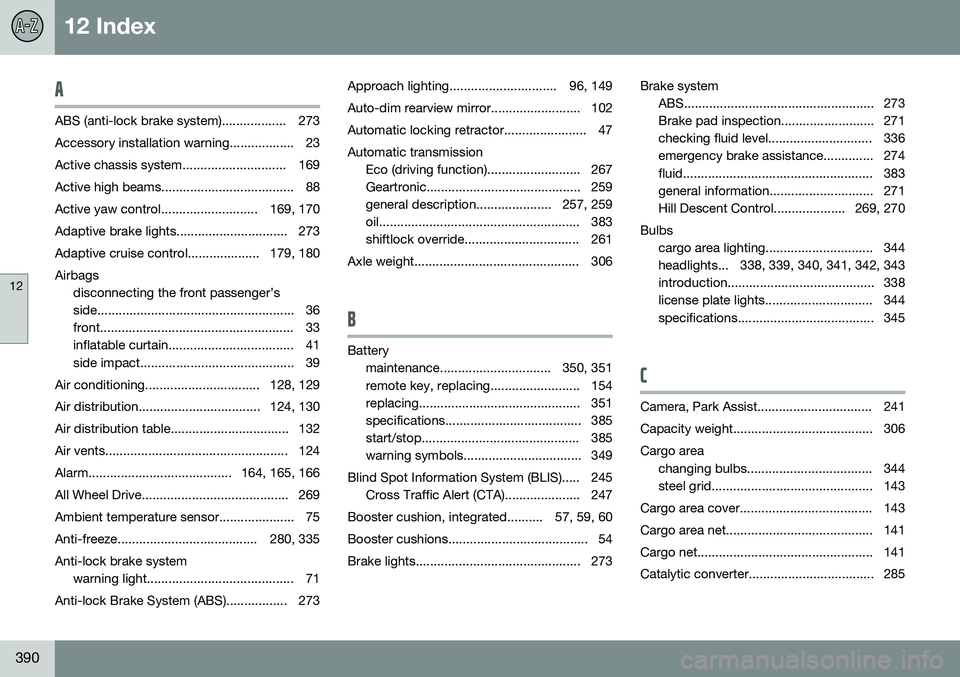
A
ABS (anti-lock brake system).................. 273
Accessory installation warning.................. 23
Active chassis system............................. 169
Active high beams..................................... 88Active yaw control........................... 169, 170
Adaptive brake lights............................... 273
Adaptive cruise control.................... 179, 180Airbags disconnecting the front passenger’s
side....................................................... 36
front...................................................... 33
inflatable curtain................................... 41
side impact........................................... 39
Air conditioning................................ 128, 129
Air distribution.................................. 124, 130
Air distribution table................................. 132
Air vents................................................... 124
Alarm........................................ 164, 165, 166
All Wheel Drive......................................... 269
Ambient temperature sensor..................... 75
Anti-freeze....................................... 280, 335Anti-lock brake system warning light......................................... 71
Anti-lock Brake System (ABS)................. 273 Approach lighting.............................. 96, 149
Auto-dim rearview mirror......................... 102
Automatic locking retractor....................... 47Automatic transmission
Eco (driving function).......................... 267
Geartronic........................................... 259
general description..................... 257, 259
oil........................................................ 383
shiftlock override................................ 261
Axle weight.............................................. 306
B
Battery maintenance............................... 350, 351
remote key, replacing......................... 154
replacing............................................. 351
specifications...................................... 385
start/stop............................................ 385
warning symbols................................. 349
Blind Spot Information System (BLIS)..... 245 Cross Traffic Alert (CTA)..................... 247
Booster cushion, integrated.......... 57, 59, 60
Booster cushions....................................... 54
Brake lights.............................................. 273 Brake system
ABS..................................................... 273
Brake pad inspection.......................... 271
checking fluid level............................. 336
emergency brake assistance.............. 274
fluid..................................................... 383
general information............................. 271
Hill Descent Control.................... 269, 270
Bulbs cargo area lighting.............................. 344
headlights... 338, 339, 340, 341, 342, 343
introduction......................................... 338
license plate lights.............................. 344
specifications...................................... 345
C
Camera, Park Assist................................ 241
Capacity weight....................................... 306Cargo area changing bulbs................................... 344
steel grid............................................. 143
Cargo area cover..................................... 143
Cargo area net......................................... 141
Cargo net................................................. 141
Catalytic converter................................... 285
Page 394 of 402
12 Index
12
392
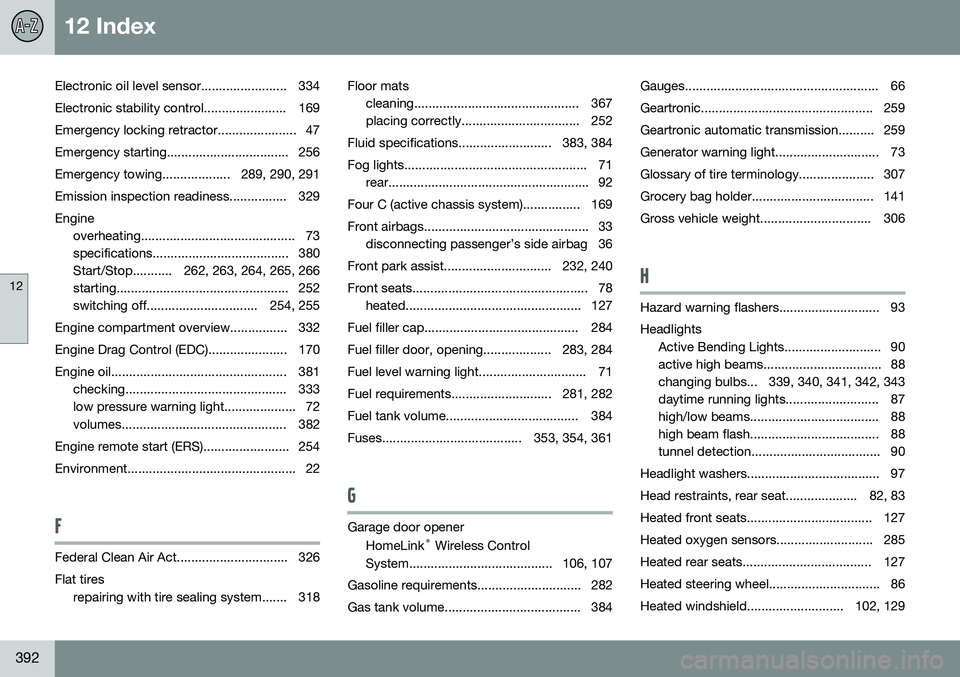
Electronic oil level sensor........................ 334
Electronic stability control....................... 169Emergency locking retractor...................... 47
Emergency starting.................................. 256
Emergency towing................... 289, 290, 291
Emission inspection readiness................ 329Engine overheating........................................... 73
specifications...................................... 380
Start/Stop........... 262, 263, 264, 265, 266
starting................................................ 252
switching off............................... 254, 255
Engine compartment overview................ 332
Engine Drag Control (EDC)...................... 170
Engine oil................................................. 381 checking............................................. 333
low pressure warning light.................... 72
volumes.............................................. 382
Engine remote start (ERS)........................ 254
Environment............................................... 22
F
Federal Clean Air Act............................... 326 Flat tires repairing with tire sealing system....... 318 Floor mats
cleaning.............................................. 367
placing correctly................................. 252
Fluid specifications.......................... 383, 384
Fog lights................................................... 71 rear........................................................ 92
Four C (active chassis system)................ 169
Front airbags.............................................. 33 disconnecting passenger’s side airbag 36
Front park assist.............................. 232, 240
Front seats................................................. 78 heated................................................. 127
Fuel filler cap........................................... 284
Fuel filler door, opening................... 283, 284
Fuel level warning light.............................. 71
Fuel requirements............................ 281, 282
Fuel tank volume..................................... 384
Fuses....................................... 353, 354, 361
G
Garage door opener HomeLink ®
Wireless Control
System........................................ 106, 107
Gasoline requirements............................. 282
Gas tank volume...................................... 384 Gauges...................................................... 66
Geartronic................................................ 259
Geartronic automatic transmission.......... 259
Generator warning light............................. 73
Glossary of tire terminology..................... 307
Grocery bag holder.................................. 141
Gross vehicle weight............................... 306
H
Hazard warning flashers............................ 93 Headlights
Active Bending Lights........................... 90
active high beams................................. 88
changing bulbs... 339, 340, 341, 342, 343
daytime running lights.......................... 87
high/low beams.................................... 88
high beam flash.................................... 88
tunnel detection.................................... 90
Headlight washers..................................... 97
Head restraints, rear seat.................... 82, 83
Heated front seats................................... 127
Heated oxygen sensors........................... 285
Heated rear seats.................................... 127
Heated steering wheel............................... 86
Heated windshield........................... 102, 129