kPa VOLVO V60 2016 Owner´s Manual
[x] Cancel search | Manufacturer: VOLVO, Model Year: 2016, Model line: V60, Model: VOLVO V60 2016Pages: 402, PDF Size: 10.3 MB
Page 304 of 402

||
09 Wheels and tires
09
302
WARNING
•Under-inflation is the most common cause of tire failure and may result insevere tire cracking, tread separation,or "blow-out," with unexpected loss ofvehicle control and increased risk ofinjury.
• Under-inflated tires reduce the loadcarrying capacity of your vehicle.
When weather temperature changes occur, tire inflation pressures also change. A 10-degree temperature drop causes a corres-ponding drop of 1 psi (7 kPa) in inflation pres-sure. Check your tire pressures frequentlyand adjust them to the proper pressure,which can be found on the vehicle's tire infor-mation placard or certification label.
Related information
•
Tire specifications (p. 303)
• Tires – storage and age (p. 294)
• Tires – tread wear indicator (p. 295)
• Tire inflation – pressure table (p. 305)
Tire inflation – checking pressure
Inflation pressure should be checked when the tires are cold.
Cold tiresThe tires are considered to be cold when they have the same temperature as thesurrounding (ambient) air. This temperature is normally reached after the vehicle has been parked for at least 3 hours. After driving a distance of approximately 1 mile (1.6 km), the tires are considered to behot. If you have to drive farther than this dis-tance to pump your tire(s), check and recordthe tire pressure first and add the appropriateair pressure when you get to the pump. If checking tire pressure when the tire is hot, never "bleed" or reduce air pressure. Thetires are hot from driving and it is normal forpressures to increase above recommendedcold pressures. A hot tire at or below recom-mended cold inflation pressure could be sig-nificantly under-inflated.
To check inflation pressure:1. Remove the cap from the valve on one
tire, then firmly press the tire gauge onto the valve.
2. Add air to reach the recommended air pressure. 3. Replace the valve cap.
CAUTION
•
After inflating the tires, always reinstall the valve cap to help avoid damage tothe valve from dirt, gravel, etc.
• Use plastic valve caps only. Metal capscould corrode and become difficult toremove.
4. Visually inspect the tires to make sure
there are no nails or other objects embedded that could puncture the tireand cause an air leak.
5. Check the sidewalls to make sure there are no gouges, cuts, bulges or otherirregularities.
6. Repeat this procedure for each tire, including the spare 3
.
NOTE
• If you overfill the tire, release air by pushing on the metal stem in the cen-ter of the valve. Then recheck thepressure with your tire gauge.
• Some spare tires (available as anaccessory) require higher inflationpressure than the other tires. Consultthe tire inflation pressure table, see
3
Available as an accessory
Page 307 of 402
09 Wheels and tires
09
305
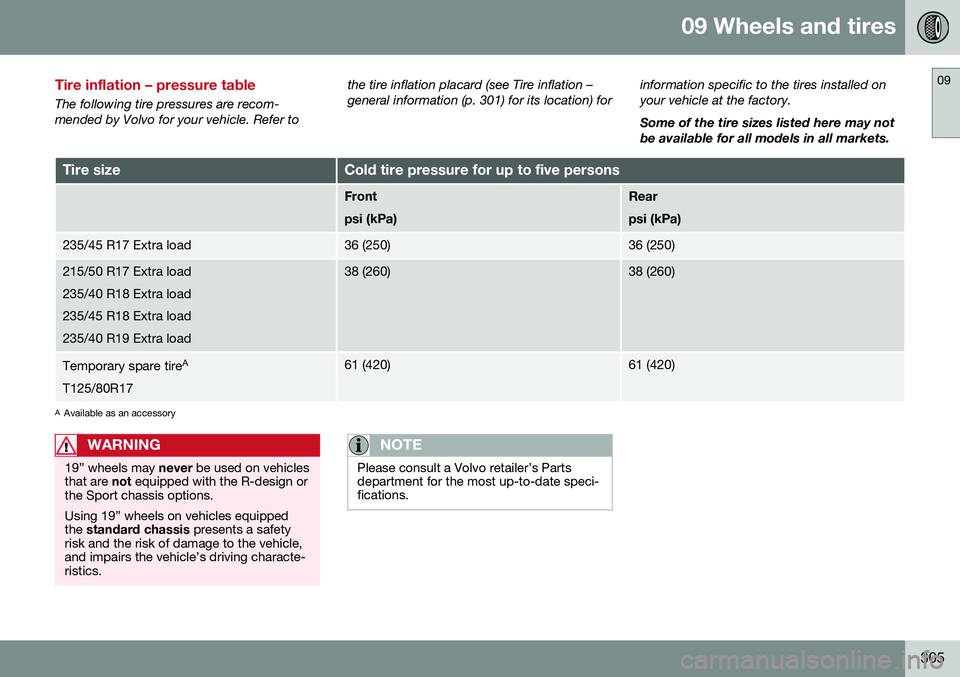
Tire inflation – pressure table
The following tire pressures are recom- mended by Volvo for your vehicle. Refer tothe tire inflation placard (see Tire inflation –general information (p. 301) for its location) for
information specific to the tires installed onyour vehicle at the factory. Some of the tire sizes listed here may not be available for all models in all markets.
Tire sizeCold tire pressure for up to five persons
Front psi (kPa)Rear psi (kPa)
235/45 R17 Extra load36 (250)36 (250)
215/50 R17 Extra load 235/40 R18 Extra load235/45 R18 Extra load235/40 R19 Extra load38 (260)38 (260)
Temporary spare tire
A
T125/80R1761 (420)61 (420)
A Available as an accessory
WARNING
19” wheels may never be used on vehicles
that are not equipped with the R-design or
the Sport chassis options. Using 19” wheels on vehicles equipped the standard chassis presents a safety
risk and the risk of damage to the vehicle,and impairs the vehicle’s driving characte-ristics.
NOTE
Please consult a Volvo retailer’s Parts department for the most up-to-date speci-fications.
Page 309 of 402
09 Wheels and tires
09
}}
307
6. If your vehicle will be towing a trailer, load
from your trailer will be transferred to your vehicle.
WARNING
•Exceeding the permissible axle weight, gross vehicle weight, or any otherweight rating limits can cause tireoverheating resulting in permanentdeformation or catastrophic failure.
• Do not use replacement tires withlower load carrying capacities than thetires that were original equipment onthe vehicle because this will lower thevehicle's GVW rating. Use only tireswith the correct load carrying capacity.Consult your Volvo retailer for informa-tion.
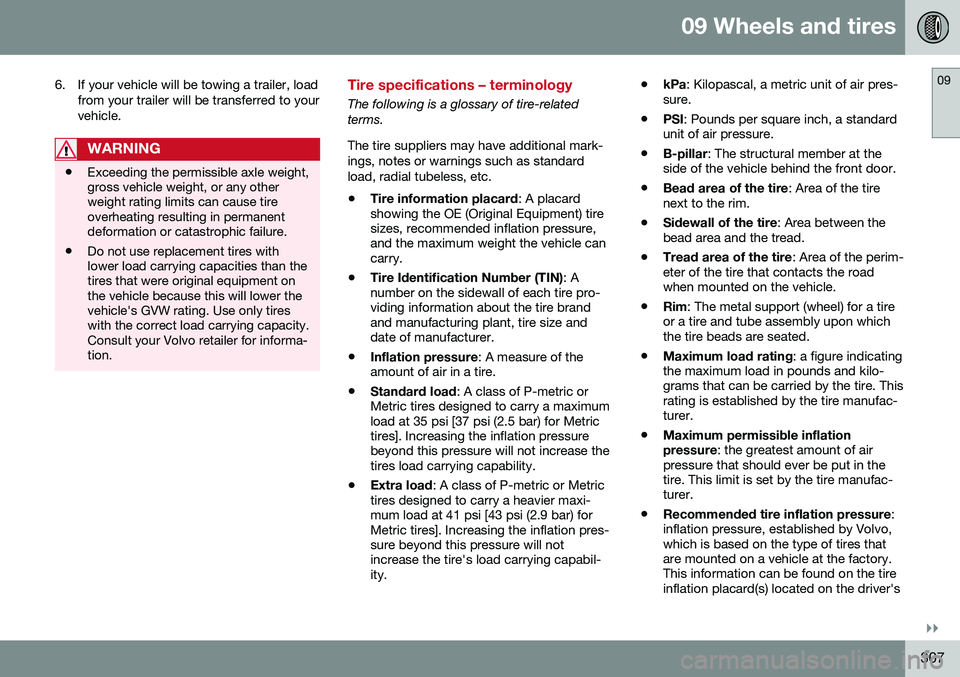
Tire specifications – terminology
The following is a glossary of tire-related terms. The tire suppliers may have additional mark- ings, notes or warnings such as standardload, radial tubeless, etc.
• Tire information placard
: A placard
showing the OE (Original Equipment) tire sizes, recommended inflation pressure,and the maximum weight the vehicle cancarry.
• Tire Identification Number (TIN)
: A
number on the sidewall of each tire pro-viding information about the tire brandand manufacturing plant, tire size anddate of manufacturer.
• Inflation pressure
: A measure of the
amount of air in a tire.
• Standard load
: A class of P-metric or
Metric tires designed to carry a maximumload at 35 psi [37 psi (2.5 bar) for Metrictires]. Increasing the inflation pressurebeyond this pressure will not increase thetires load carrying capability.
• Extra load
: A class of P-metric or Metric
tires designed to carry a heavier maxi-mum load at 41 psi [43 psi (2.9 bar) forMetric tires]. Increasing the inflation pres-sure beyond this pressure will notincrease the tire's load carrying capabil-ity. •
kPa
: Kilopascal, a metric unit of air pres-
sure.
• PSI
: Pounds per square inch, a standard
unit of air pressure.
• B-pillar
: The structural member at the
side of the vehicle behind the front door.
• Bead area of the tire
: Area of the tire
next to the rim.
• Sidewall of the tire
: Area between the
bead area and the tread.
• Tread area of the tire
: Area of the perim-
eter of the tire that contacts the roadwhen mounted on the vehicle.
• Rim
: The metal support (wheel) for a tire
or a tire and tube assembly upon whichthe tire beads are seated.
• Maximum load rating
: a figure indicating
the maximum load in pounds and kilo-grams that can be carried by the tire. Thisrating is established by the tire manufac-turer.
• Maximum permissible inflation pressure
: the greatest amount of air
pressure that should ever be put in the tire. This limit is set by the tire manufac-turer.
• Recommended tire inflation pressure
:
inflation pressure, established by Volvo,which is based on the type of tires thatare mounted on a vehicle at the factory.This information can be found on the tireinflation placard(s) located on the driver's