warning VOLVO V60 2017 Owner´s Manual
[x] Cancel search | Manufacturer: VOLVO, Model Year: 2017, Model line: V60, Model: VOLVO V60 2017Pages: 406, PDF Size: 9.65 MB
Page 347 of 406
MAINTENANCE AND SERVICING
}}
* Option/accessory, for more information, see Introduction.345
WARNING
•The engine should not be running when changing bulbs.
• If the engine has been running just priorto replacing bulbs in the headlight hous-ing, please keep in mind that componentsin the engine compartment will be hot.
WARNING
•
Active Bending Lights
* – due to the high
voltage used by these headlights, these bulbs should only be replaced by atrained and qualified Volvo service techni-cian.
• Turn off the lights and remove the remotekey from the ignition before changing anybulbs.
Related information
•Bulbs – headlight housing (p. 345)
• Bulbs – taillight housing (p. 349)
• Bulbs – vanity mirror lighting (p. 350)
• Bulbs – cargo area lighting (p. 350)
• Bulbs – license plate lighting (p. 350)
Bulbs – headlight housing
The entire headlight housing must be lifted out when replacing all front bulbs.
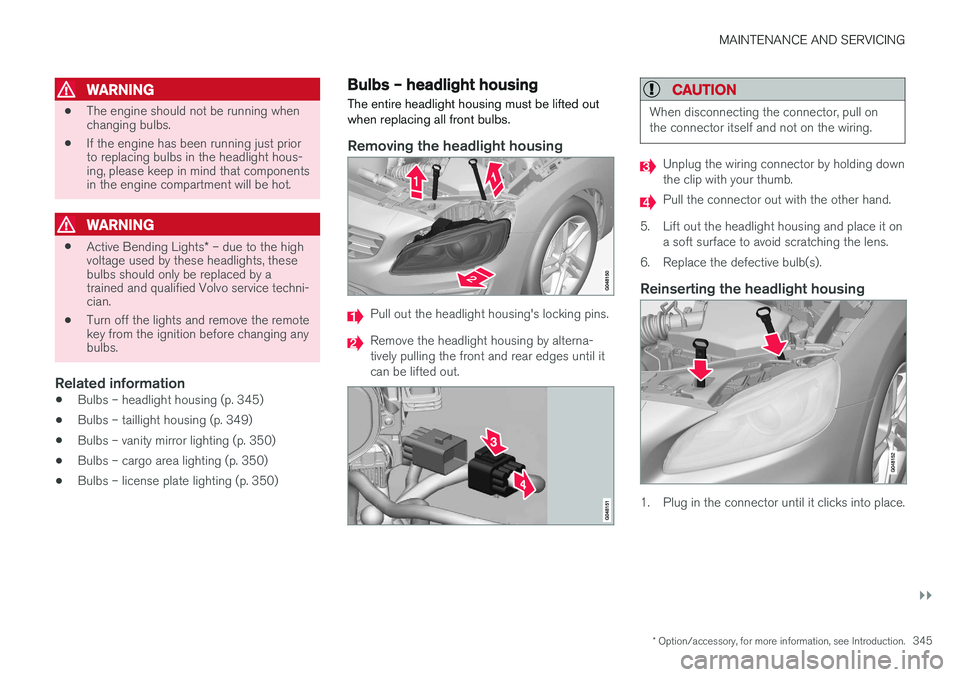
Removing the headlight housing
Pull out the headlight housing's locking pins.
Remove the headlight housing by alterna- tively pulling the front and rear edges until itcan be lifted out.
CAUTION
When disconnecting the connector, pull on the connector itself and not on the wiring.
Unplug the wiring connector by holding down the clip with your thumb.
Pull the connector out with the other hand.
5. Lift out the headlight housing and place it on a soft surface to avoid scratching the lens.
6. Replace the defective bulb(s).
Reinserting the headlight housing
1. Plug in the connector until it clicks into place.
Page 356 of 406
MAINTENANCE AND SERVICING
354
Engine compartment – washer fluid
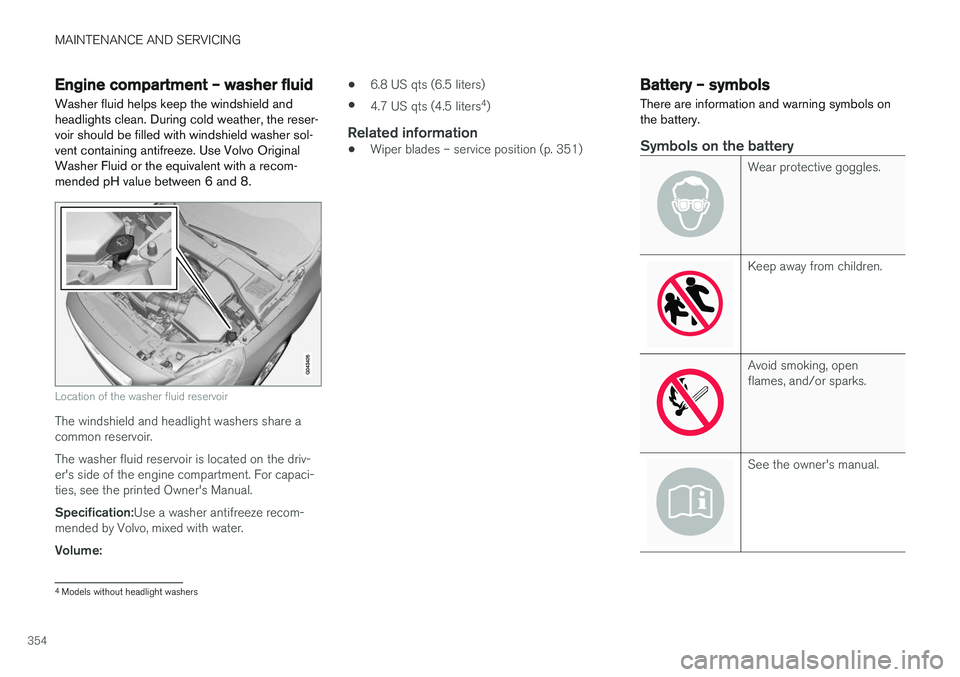
Washer fluid helps keep the windshield and headlights clean. During cold weather, the reser-voir should be filled with windshield washer sol-vent containing antifreeze. Use Volvo OriginalWasher Fluid or the equivalent with a recom-mended pH value between 6 and 8.
Location of the washer fluid reservoir
The windshield and headlight washers share a common reservoir. The washer fluid reservoir is located on the driv- er's side of the engine compartment. For capaci-ties, see the printed Owner's Manual. Specification: Use a washer antifreeze recom-
mended by Volvo, mixed with water.Volume: •
6.8 US qts (6.5 liters)
• 4.7 US qts (4.5 liters 4
)
Related information
• Wiper blades – service position (p. 351)
Battery – symbols
There are information and warning symbols on the battery.
Symbols on the battery
Wear protective goggles.
Keep away from children.
Avoid smoking, open flames, and/or sparks.
See the owner's manual.
4 Models without headlight washers
Page 359 of 406
MAINTENANCE AND SERVICING
}}
357
Battery – changing
When changing batteries, be sure to use the correct battery for your vehicle. Consult a Volvoretailer or a trained and qualified Volvo servicetechnician.
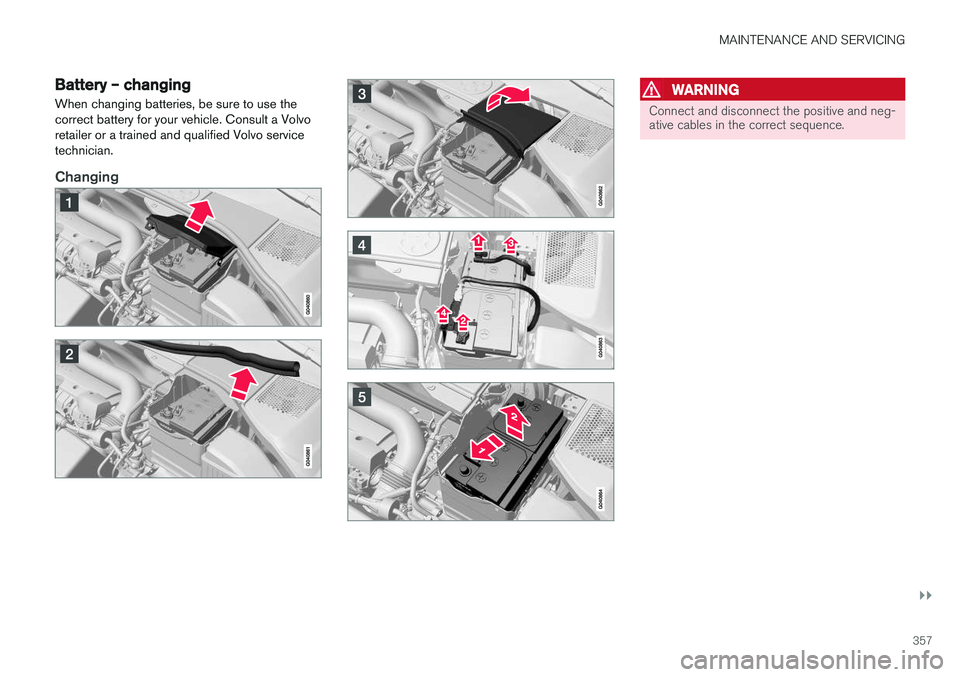
Changing
WARNING
Connect and disconnect the positive and neg- ative cables in the correct sequence.
Page 360 of 406
||
MAINTENANCE AND SERVICING
* Option/accessory, for more information, see Introduction.
358
Removal
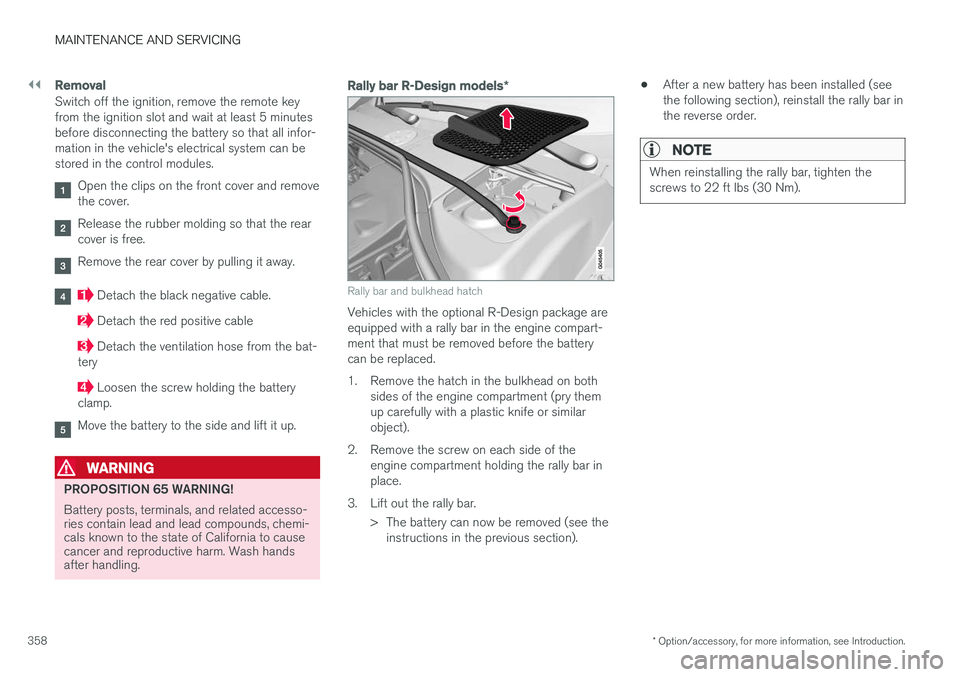
Switch off the ignition, remove the remote key from the ignition slot and wait at least 5 minutesbefore disconnecting the battery so that all infor-mation in the vehicle's electrical system can bestored in the control modules.
Open the clips on the front cover and remove the cover.
Release the rubber molding so that the rear cover is free.
Remove the rear cover by pulling it away.
Detach the black negative cable.
Detach the red positive cable
Detach the ventilation hose from the bat-
tery
Loosen the screw holding the battery
clamp.
Move the battery to the side and lift it up.
WARNING
PROPOSITION 65 WARNING! Battery posts, terminals, and related accesso- ries contain lead and lead compounds, chemi-cals known to the state of California to causecancer and reproductive harm. Wash handsafter handling.
Rally bar R-Design models *
Rally bar and bulkhead hatch
Vehicles with the optional R-Design package are equipped with a rally bar in the engine compart-ment that must be removed before the batterycan be replaced.
1. Remove the hatch in the bulkhead on both
sides of the engine compartment (pry them up carefully with a plastic knife or similarobject).
2. Remove the screw on each side of the engine compartment holding the rally bar inplace.
3. Lift out the rally bar. > The battery can now be removed (see theinstructions in the previous section). •
After a new battery has been installed (seethe following section), reinstall the rally bar inthe reverse order.
NOTE
When reinstalling the rally bar, tighten the screws to 22 ft lbs (30 Nm).
Page 361 of 406
MAINTENANCE AND SERVICING
359
Installation
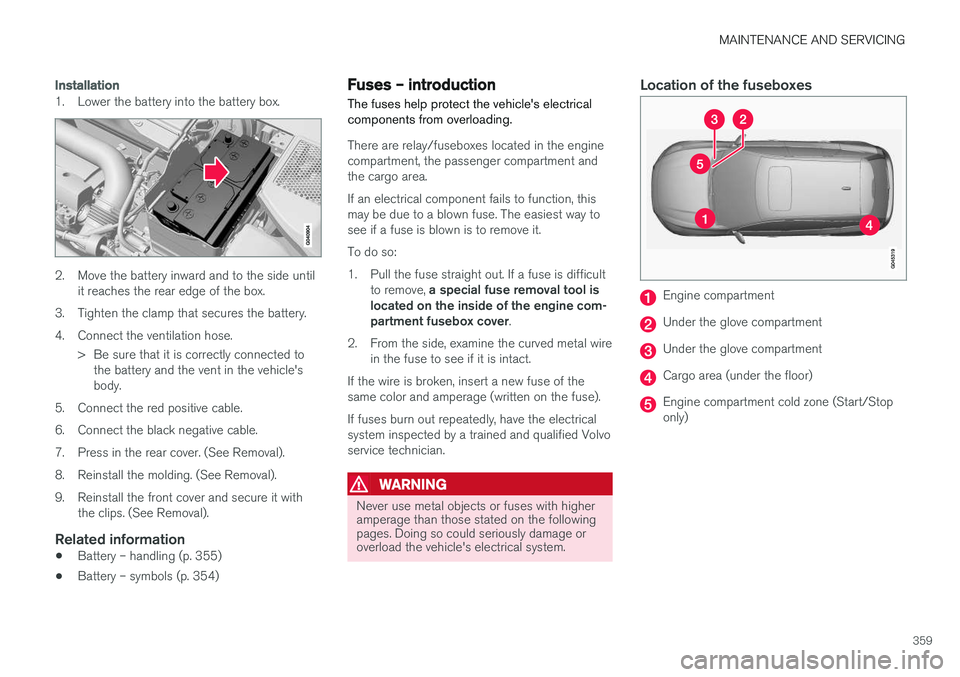
1. Lower the battery into the battery box.
2. Move the battery inward and to the side untilit reaches the rear edge of the box.
3. Tighten the clamp that secures the battery.
4. Connect the ventilation hose. > Be sure that it is correctly connected tothe battery and the vent in the vehicle's body.
5. Connect the red positive cable.
6. Connect the black negative cable.
7. Press in the rear cover. (See Removal).
8. Reinstall the molding. (See Removal).
9. Reinstall the front cover and secure it with the clips. (See Removal).
Related information
• Battery – handling (p. 355)
• Battery – symbols (p. 354)
Fuses – introduction
The fuses help protect the vehicle's electrical components from overloading.
There are relay/fuseboxes located in the engine compartment, the passenger compartment andthe cargo area. If an electrical component fails to function, this may be due to a blown fuse. The easiest way tosee if a fuse is blown is to remove it. To do so:
1. Pull the fuse straight out. If a fuse is difficult to remove, a special fuse removal tool is
located on the inside of the engine com- partment fusebox cover .
2. From the side, examine the curved metal wire in the fuse to see if it is intact.
If the wire is broken, insert a new fuse of thesame color and amperage (written on the fuse). If fuses burn out repeatedly, have the electrical system inspected by a trained and qualified Volvoservice technician.
WARNING
Never use metal objects or fuses with higher amperage than those stated on the followingpages. Doing so could seriously damage oroverload the vehicle's electrical system.
Location of the fuseboxes
Engine compartment
Under the glove compartment
Under the glove compartment
Cargo area (under the floor)
Engine compartment cold zone (Start/Stop only)
Page 366 of 406
||
MAINTENANCE AND SERVICING
* Option/accessory, for more information, see Introduction.
364
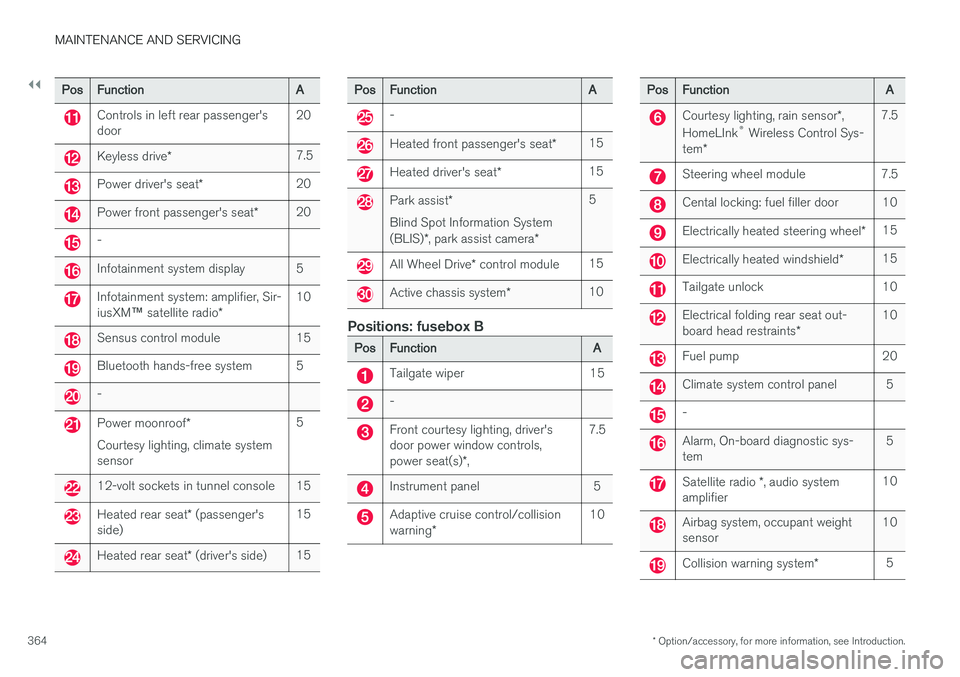
PosFunctionA
Controls in left rear passenger's door20
Keyless drive *7.5
Power driver's seat *20
Power front passenger's seat *20
-
Infotainment system display5
Infotainment system: amplifier, Sir- iusXM™ satellite radio *10
Sensus control module15
Bluetooth hands-free system5
-
Power moonroof *
Courtesy lighting, climate system sensor5
12-volt sockets in tunnel console15
Heated rear seat * (passenger's
side)15
Heated rear seat * (driver's side)15
PosFunctionA
-
Heated front passenger's seat *15
Heated driver's seat*15
Park assist*
Blind Spot Information System (BLIS) *, park assist camera *5
All Wheel Drive* control module15
Active chassis system *10
Positions: fusebox B
PosFunctionA
Tailgate wiper15
-
Front courtesy lighting, driver's door power window controls, power seat(s)*,7.5
Instrument panel5
Adaptive cruise control/collision warning *10
PosFunctionA
Courtesy lighting, rain sensor *,
HomeLInk ®
Wireless Control Sys-
tem *7.5
Steering wheel module7.5
Cental locking: fuel filler door10
Electrically heated steering wheel *15
Electrically heated windshield*15
Tailgate unlock10
Electrical folding rear seat out- board head restraints*10
Fuel pump20
Climate system control panel5
-
Alarm, On-board diagnostic sys- tem5
Satellite radio *, audio system
amplifier10
Airbag system, occupant weight sensor10
Collision warning system *5
Page 372 of 406
||
MAINTENANCE AND SERVICING
370
CAUTION
•Avoid waxing or polishing plastic or rub- ber components
• Polishing chromed strips can wear awayor damage the surface
• Polishes containing abrasive substancesshould not be used
Related information
• Polishing and waxing (p. 371)
• Cleaning the interior (p. 371)
Automatic car wash
The vehicle should be washed at regular inter- vals since dirt, dust, insects and tar spotsadhere to the paint and may cause damage. Tohelp prevent corrosion, it is particularly importantto wash the car frequently in the wintertime.
• We do NOT recommend washing your car in an automatic wash during the first fewmonths (because the paint will not havehardened sufficiently).
• An automatic wash is a simple and quick wayto clean your car, but it is worth rememberingthat it may not be as thorough as when youyourself go over the car with sponge andwater. Keeping the underbody clean is mostimportant, especially in the winter. Someautomatic washers do not have facilities forwashing the underbody.
NOTE
Condensation may form temporarily on the inside of the lenses of exterior lights such asheadlights, fog lights, or taillights. This is nor-mal and the lights are designed to withstandmoisture. Normally, condensation will dissi-pate after the lights have been on for a shorttime.
CAUTION
•
Before driving into an automatic car wash, turn off the optional rain sensor toavoid damaging the windshield wipers.
• Make sure that side view mirrors, auxiliarylamps, etc, are secure, and that anyantenna(s) are retracted or removed. Oth-erwise there is risk of the machine dis-lodging them.
• Chromed wheels:
Clean chrome-plated
wheels using the same detergents usedfor the body of the vehicle. Aggressivewheel-cleaning agents can permanentlystain chrome-plated wheels.
WARNING
• When the vehicle is driven immediately after being washed, apply the brakes,including the parking brake, several timesin order to remove any moisture from thebrake linings.
• Engine cleaning agents should not beused when the engine is warm. This con-stitutes a fire risk.
Related information
•
Polishing and waxing (p. 371)
• Cleaning the interior (p. 371)
• Washing the car (p. 369)
Page 390 of 406
SPECIFICATIONS
388
Tire inflation – pressure table
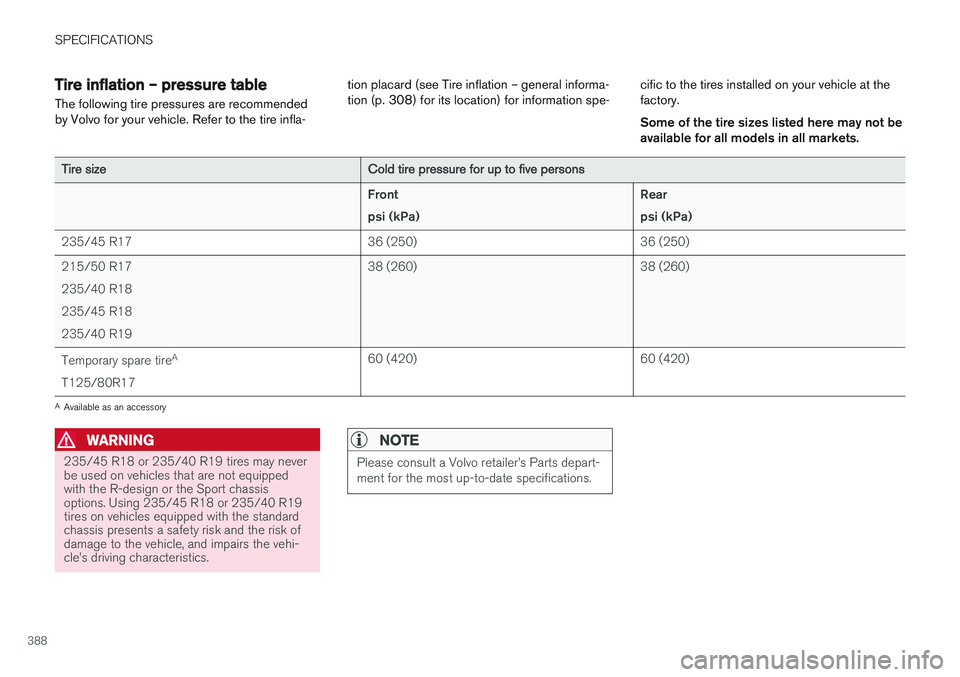
The following tire pressures are recommended by Volvo for your vehicle. Refer to the tire infla- tion placard (see Tire inflation – general informa-tion (p. 308) for its location) for information spe-
cific to the tires installed on your vehicle at thefactory. Some of the tire sizes listed here may not be available for all models in all markets.
Tire sizeCold tire pressure for up to five persons
Front psi (kPa)Rear psi (kPa)
235/45 R1736 (250)36 (250)
215/50 R17 235/40 R18235/45 R18235/40 R1938 (260)38 (260)
Temporary spare tire
A
T125/80R1760 (420)60 (420)
A Available as an accessory
WARNING
235/45 R18 or 235/40 R19 tires may never be used on vehicles that are not equippedwith the R-design or the Sport chassisoptions. Using 235/45 R18 or 235/40 R19tires on vehicles equipped with the standardchassis presents a safety risk and the risk ofdamage to the vehicle, and impairs the vehi-cle
Page 392 of 406
SPECIFICATIONS
* Option/accessory, for more information, see Introduction.
390
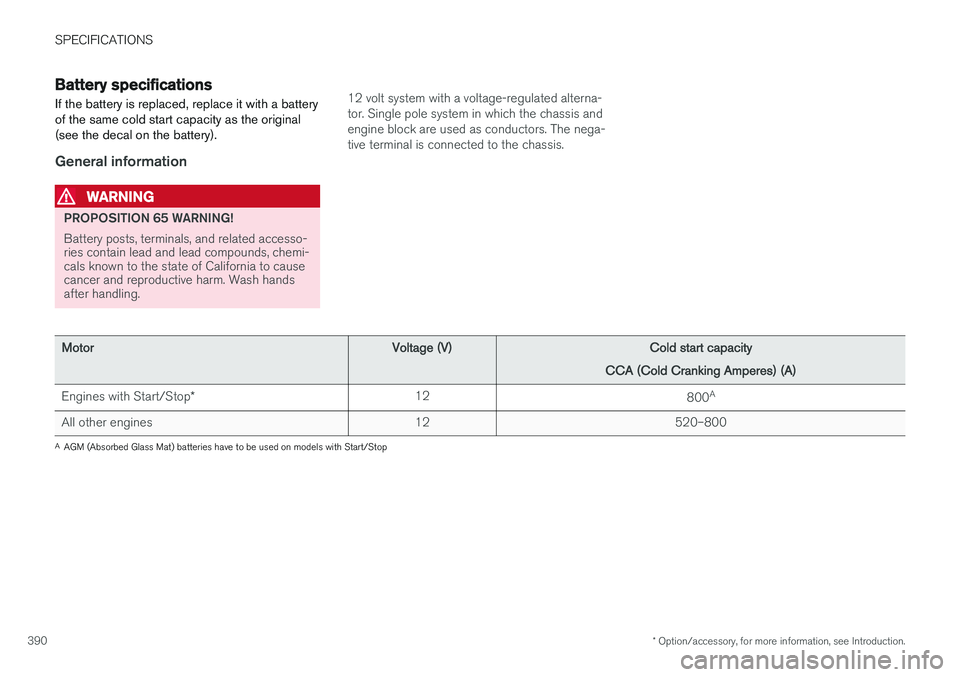
Battery specifications If the battery is replaced, replace it with a battery of the same cold start capacity as the original(see the decal on the battery).
General information
WARNING
PROPOSITION 65 WARNING! Battery posts, terminals, and related accesso- ries contain lead and lead compounds, chemi-cals known to the state of California to causecancer and reproductive harm. Wash handsafter handling. 12 volt system with a voltage-regulated alterna- tor. Single pole system in which the chassis andengine block are used as conductors. The nega-tive terminal is connected to the chassis.
MotorVoltage (V)Cold start capacity
CCA (Cold Cranking Amperes) (A)
Engines with Start/Stop *12800A
All other engines12520–800
A
AGM (Absorbed Glass Mat) batteries have to be used on models with Start/Stop
Page 393 of 406
SPECIFICATIONS
}}
391
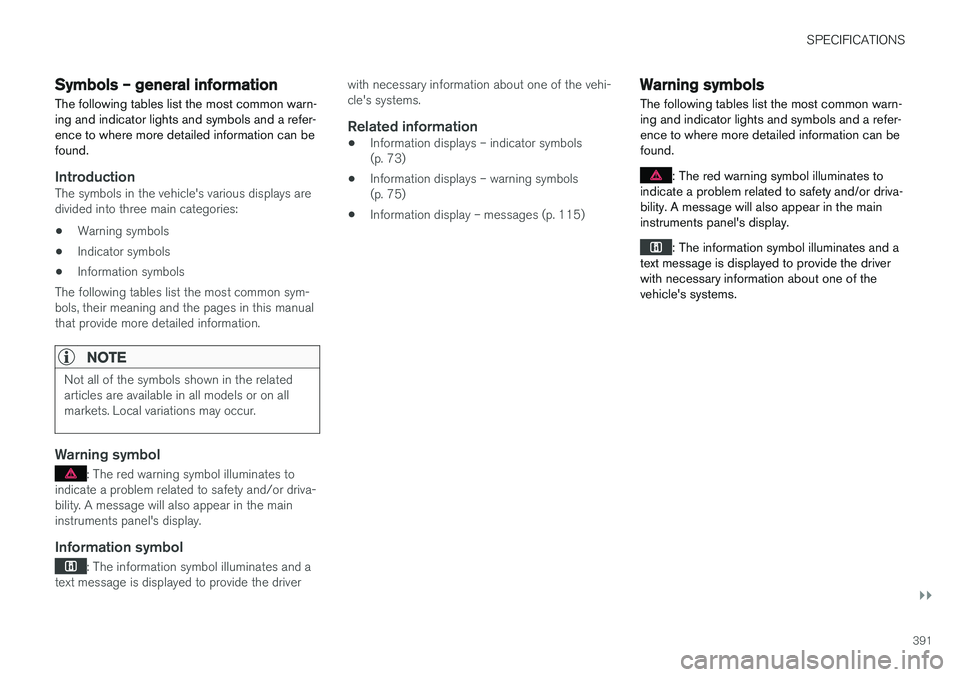
Symbols – general information The following tables list the most common warn- ing and indicator lights and symbols and a refer-ence to where more detailed information can befound.
IntroductionThe symbols in the vehicle's various displays are divided into three main categories: •Warning symbols
• Indicator symbols
• Information symbols
The following tables list the most common sym- bols, their meaning and the pages in this manualthat provide more detailed information.
NOTE
Not all of the symbols shown in the related articles are available in all models or on allmarkets. Local variations may occur.
Warning symbol
: The red warning symbol illuminates to
indicate a problem related to safety and/or driva- bility. A message will also appear in the maininstruments panel's display.
Information symbol
: The information symbol illuminates and a
text message is displayed to provide the driver with necessary information about one of the vehi- cle's systems.
Related information
•
Information displays – indicator symbols(p. 73)
• Information displays – warning symbols(p. 75)
• Information display – messages (p. 115)
Warning symbols
The following tables list the most common warn- ing and indicator lights and symbols and a refer-ence to where more detailed information can befound.
: The red warning symbol illuminates to
indicate a problem related to safety and/or driva- bility. A message will also appear in the maininstruments panel's display.
: The information symbol illuminates and a
text message is displayed to provide the driver with necessary information about one of thevehicle's systems.