service VOLVO V60 2017 Owner´s Manual
[x] Cancel search | Manufacturer: VOLVO, Model Year: 2017, Model line: V60, Model: VOLVO V60 2017Pages: 406, PDF Size: 9.65 MB
Page 359 of 406
MAINTENANCE AND SERVICING
}}
357
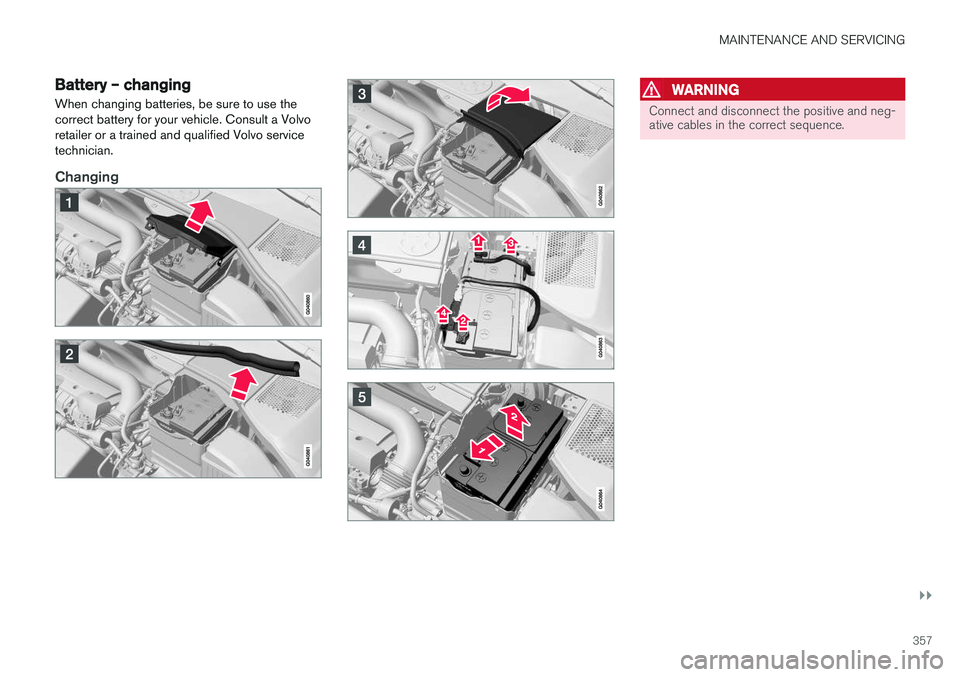
Battery – changing
When changing batteries, be sure to use the correct battery for your vehicle. Consult a Volvoretailer or a trained and qualified Volvo servicetechnician.
Changing
WARNING
Connect and disconnect the positive and neg- ative cables in the correct sequence.
Page 361 of 406
MAINTENANCE AND SERVICING
359
Installation
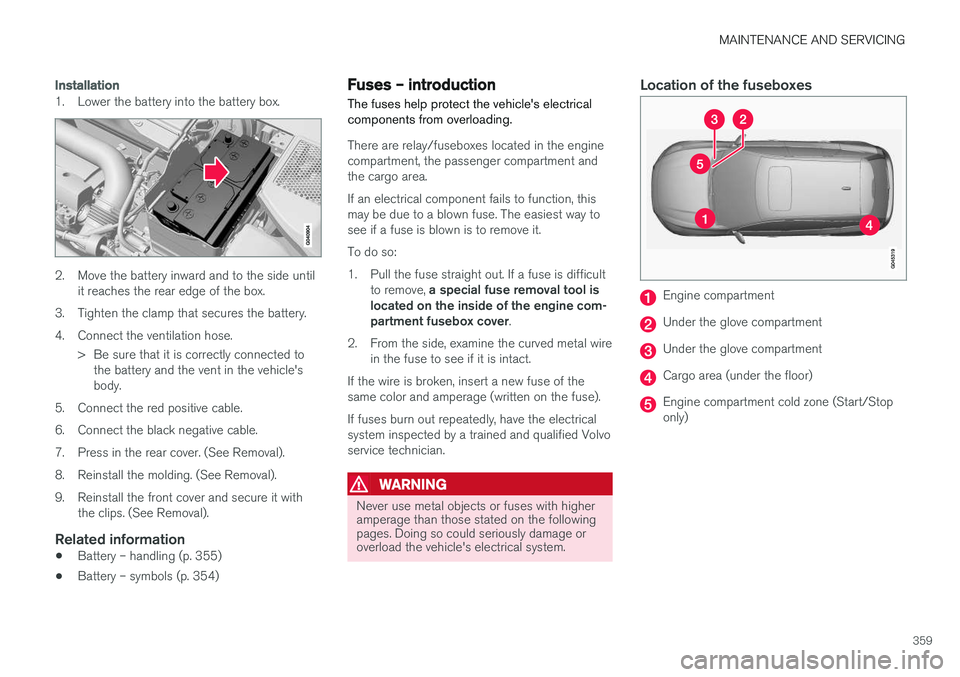
1. Lower the battery into the battery box.
2. Move the battery inward and to the side untilit reaches the rear edge of the box.
3. Tighten the clamp that secures the battery.
4. Connect the ventilation hose. > Be sure that it is correctly connected tothe battery and the vent in the vehicle's body.
5. Connect the red positive cable.
6. Connect the black negative cable.
7. Press in the rear cover. (See Removal).
8. Reinstall the molding. (See Removal).
9. Reinstall the front cover and secure it with the clips. (See Removal).
Related information
• Battery – handling (p. 355)
• Battery – symbols (p. 354)
Fuses – introduction
The fuses help protect the vehicle's electrical components from overloading.
There are relay/fuseboxes located in the engine compartment, the passenger compartment andthe cargo area. If an electrical component fails to function, this may be due to a blown fuse. The easiest way tosee if a fuse is blown is to remove it. To do so:
1. Pull the fuse straight out. If a fuse is difficult to remove, a special fuse removal tool is
located on the inside of the engine com- partment fusebox cover .
2. From the side, examine the curved metal wire in the fuse to see if it is intact.
If the wire is broken, insert a new fuse of thesame color and amperage (written on the fuse). If fuses burn out repeatedly, have the electrical system inspected by a trained and qualified Volvoservice technician.
WARNING
Never use metal objects or fuses with higher amperage than those stated on the followingpages. Doing so could seriously damage oroverload the vehicle's electrical system.
Location of the fuseboxes
Engine compartment
Under the glove compartment
Under the glove compartment
Cargo area (under the floor)
Engine compartment cold zone (Start/Stop only)
Page 363 of 406
MAINTENANCE AND SERVICING
}}
* Option/accessory, for more information, see Introduction.361
Engine compartment, upper
Engine compartment, front
Engine compartment, lower
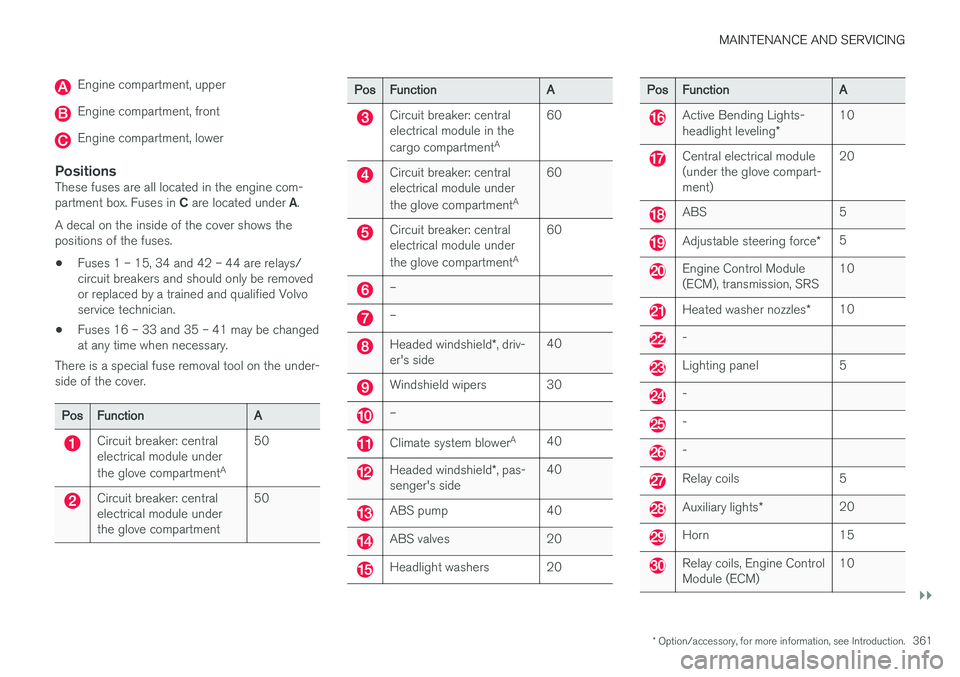
PositionsThese fuses are all located in the engine com- partment box. Fuses in C are located under A.
A decal on the inside of the cover shows the positions of the fuses. • Fuses 1 – 15, 34 and 42 – 44 are relays/ circuit breakers and should only be removedor replaced by a trained and qualified Volvoservice technician.
• Fuses 16 – 33 and 35 – 41 may be changedat any time when necessary.
There is a special fuse removal tool on the under-side of the cover.
PosFunctionA
Circuit breaker: central electrical module under the glove compartment A50
Circuit breaker: central electrical module underthe glove compartment50
PosFunctionA
Circuit breaker: central electrical module in the cargo compartmentA60
Circuit breaker: central electrical module under the glove compartment A60
Circuit breaker: central electrical module under the glove compartmentA60
–
–
Headed windshield
*, driv-
er's side40
Windshield wipers30
–
Climate system blower A40
Headed windshield
*, pas-
senger's side40
ABS pump40
ABS valves20
Headlight washers20
PosFunctionA
Active Bending Lights- headlight leveling *10
Central electrical module (under the glove compart-ment)20
ABS5
Adjustable steering force *5
Engine Control Module (ECM), transmission, SRS10
Heated washer nozzles*10
-
Lighting panel5
-
-
-
Relay coils5
Auxiliary lights*20
Horn15
Relay coils, Engine Control Module (ECM)10
Page 369 of 406
MAINTENANCE AND SERVICING
}}
367
Fuses – engine compartment cold zone (Start/Stop only)7
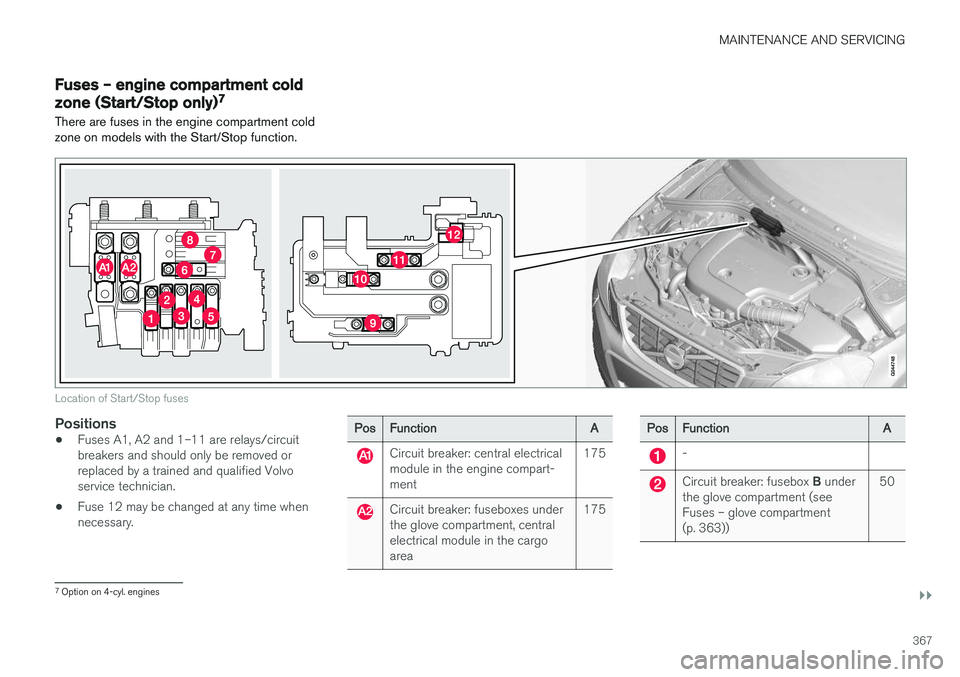
There are fuses in the engine compartment cold zone on models with the Start/Stop function.
Location of Start/Stop fuses
Positions
• Fuses A1, A2 and 1–11 are relays/circuit breakers and should only be removed orreplaced by a trained and qualified Volvoservice technician.
• Fuse 12 may be changed at any time whennecessary.PosFunctionA
Circuit breaker: central electrical module in the engine compart-ment175
Circuit breaker: fuseboxes under the glove compartment, centralelectrical module in the cargoarea175
PosFunctionA
-
Circuit breaker: fusebox
B under
the glove compartment (see Fuses – glove compartment(p. 363))50
7 Option on 4-cyl. engines
Page 371 of 406
MAINTENANCE AND SERVICING
}}
369
Washing the car
The vehicle should be washed at regular inter- vals since dirt, dust, insects and tar spotsadhere to the paint and may cause damage. Tohelp prevent corrosion, it is particularly importantto wash the car frequently in the wintertime.
The following points should be kept in mind when washing and cleaning the car:
CAUTION
Avoid using car washing detergents with a pH value lower than 3.5 or higher than 11.5.Doing so could result in discoloring of ano-dized aluminum surfaces on e.g., roof rails orthe frames around the side windows.
• Avoid washing your car in direct sunlight. Doing so may cause detergents and wax todry out and become abrasive. To avoidscratching, use lukewarm water to soften thedirt before you wash with a soft sponge, andplenty of sudsy water.
• Bird droppings
: Remove from paintwork as
soon as possible. Otherwise the finish maybe permanently damaged.
• A detergent can be used to facilitate thesoftening of dirt and oil.
• Dry the car with a clean chamois andremember to clean the drain holes in thedoors and rocker panels. •
Tar spots can be removed with tar removerafter the car has been washed.
• A stiff-bristle brush and lukewarm soapywater can be used to clean the wiper blades.Frequent cleaning of the windshield andwiper blades improves visibility considerablyand also helps prolong the service life of thewiper blades.
• Wash off the dirt from the underside (wheelhousings, fenders, etc).
• In areas of high industrial fallout, more fre-quent washing is recommended.
NOTE
When washing the car, remember to remove dirt from the drain holes in the doors and sills.
CAUTION
•
During high pressure washing, the spray mouthpiece must never be closer to thevehicle than 13" (30 cm). Do not sprayinto the locks.
• Dirt, snow, etc., on the headlights canreduce lighting capacity considerably.Clean the headlights regularly, for exam-ple when refueling.
Special moonroof cautions:
• Always close the moonroof and sunshade before washing your vehicle.
• Never use abrasive cleaning agents onthe moonroof.
• Never use wax on the rubber sealsaround the moonroof.
Exterior componentsVolvo recommends the use of special cleaning products, available at your Volvo retailer, forcleaning colored plastic, rubber, or ornamentalcomponents such as chromed strips on the exte-rior of your vehicle. The instructions for usingthese products should be followed carefully. Sol-vents or stain removers should not be used.
Page 386 of 406
SPECIFICATIONS
384
Oil specifications
Full synthetic engine oil meeting the minimum
ACEA A5/B5 must be used. Lower quality oils may not offer the same fuel economy, engineperformance, or engine protection.
Volvo recommends:
Refer to the warranty and Service Records infor- mation booklet for information on oil changeintervals and oil type requirements.
NOTE
This vehicle comes from the factory with syn- thetic oil.
Oil additives must not be used.
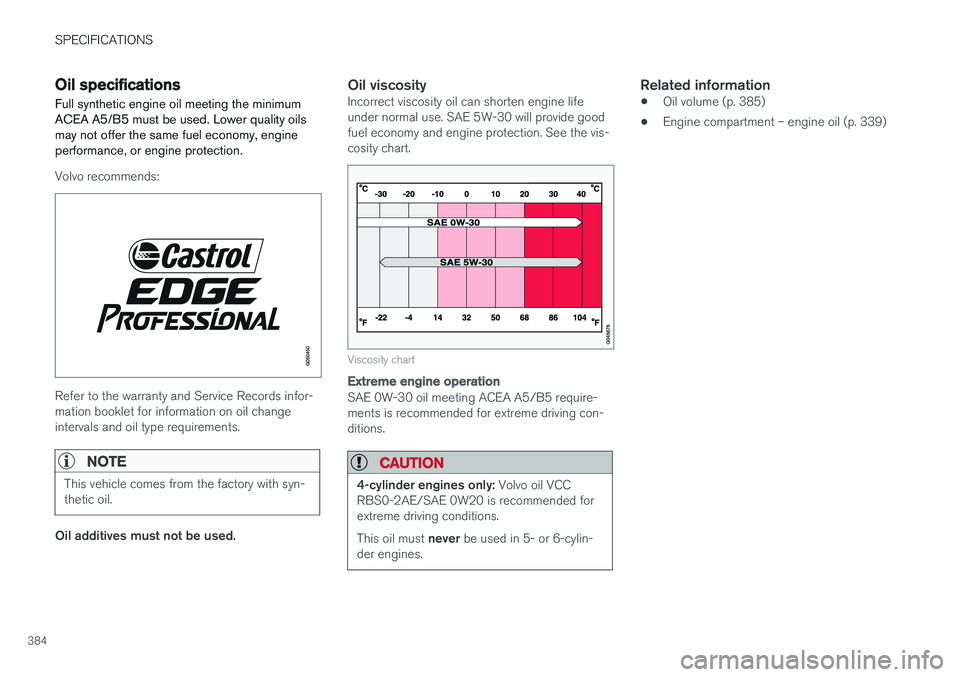
Oil viscosityIncorrect viscosity oil can shorten engine life under normal use. SAE 5W-30 will provide goodfuel economy and engine protection. See the vis-cosity chart.
Viscosity chart
Extreme engine operation
SAE 0W-30 oil meeting ACEA A5/B5 require- ments is recommended for extreme driving con-ditions.
CAUTION
4-cylinder engines only: Volvo oil VCC
RBS0-2AE/SAE 0W20 is recommended for extreme driving conditions. This oil must never be used in 5- or 6-cylin-
der engines.
Related information
• Oil volume (p. 385)
• Engine compartment – engine oil (p. 339)
Page 388 of 406
SPECIFICATIONS
386
Coolant – specification and volume The table lists coolant volumes and specifica- tions.
SystemVolumeSpecification
B4204T9 B4204T11B4204T438.7 US qts. (8.3 liters)Coolant with corrosion inhibi-tor mixed withwater (50/50mix), see pack-aging.
Related information
•Engine compartment – coolant (p. 341)
Transmission oil – specification and volumes The table lists transmission oil 1
volumes and
specifications.
Automatic transmis-sionVolumeSpecifica- tion
TF-80SD7.4 US qts (7 liters)Transmis- sion fluidAW1
TG-81SC7 US qts ( 6.6 liters)
TF-71SC7.1 US qts (6.8 liters)
Related information
• Label information (p. 376)
Brake fluid – specification and volume
Brake fluid transfers braking force when the brake pedal is depressed to the master cylinderand to the slave cylinders on each wheel.
Specification: Volvo Original Standard DOT 4 or
equivalent Volume: 0.63 US qts (0.6 liters)
Related information
•Engine compartment – brake fluid (p. 342)
1
Under normal driving conditions the transmission oil does not need changing during its service life. However, it may be necessary under adverse driving conditions.
Page 398 of 406
INDEX
396Check Engine warning light 74 Child restraints
recalls and registration 49
Child restraint systems 49 booster cushions 55
convertible seats 53
infant seats 51
ISOFIX/LATCH anchors 56
top tether anchors 58
Child safety 47 booster cushions 55
child restraint systems 49
convertible seats 53
infant seats 51
Child safety locks 63
City safety 201, 202
Climate system 133 air distribution 129, 134, 136
air vents 129
Interior Air Quality System 127
introduction 126
passenger compartment filter 127
refrigerant 126
Clock, setting 79
Cold weather driving 286
Collision warning system 208, 210, 213, 214, 216, 217
Compass in rearview mirror 107
Connected service booking 335
Conserving electrical current 285
Convertible seats 53
Coolant 341, 386
Cooling system, general information 284
Corner traction control 173
Courtesy lighting 98
Crash event data 19
Crash mode 45, 46, 47
Cruise control 179, 181 adaptive 182
Curb weight 312
Current, conserving 285
Cyclist detection 212, 216
D
Daytime running lights 90
Defroster 133
Detachable key blade 155, 156
Disconnecting the front passenger
Page 400 of 406
INDEX
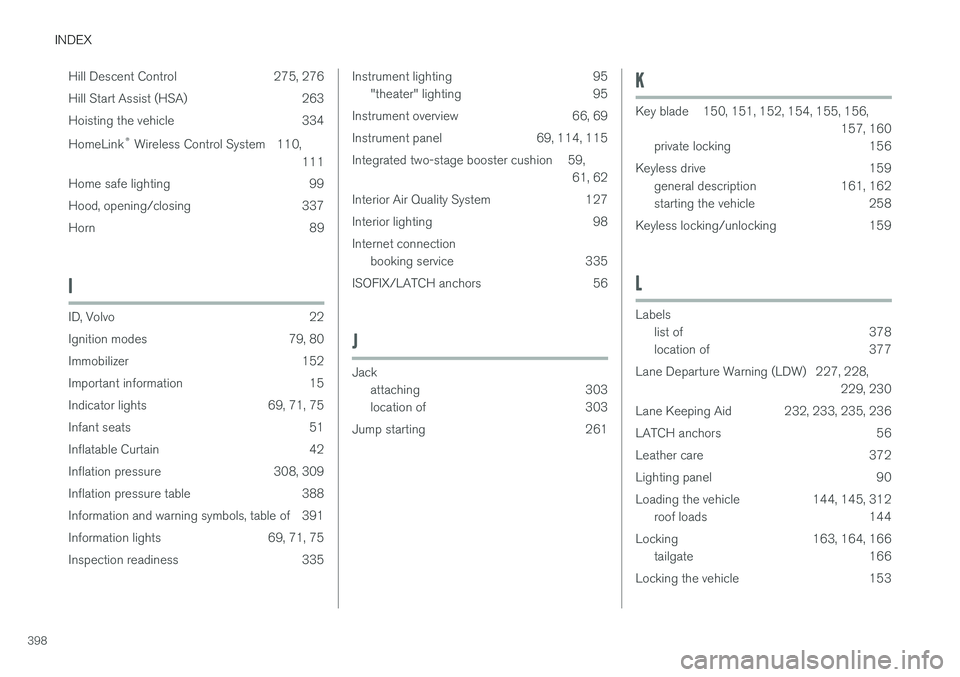
398Hill Descent Control 275, 276
Hill Start Assist (HSA) 263
Hoisting the vehicle 334 HomeLink
®
Wireless Control System 110,
111
Home safe lighting 99
Hood, opening/closing 337Horn 89
I
ID, Volvo 22
Ignition modes 79, 80
Immobilizer 152
Important information 15
Indicator lights 69, 71, 75
Infant seats 51
Inflatable Curtain 42
Inflation pressure 308, 309
Inflation pressure table 388
Information and warning symbols, table of 391
Information lights 69, 71, 75
Inspection readiness 335
Instrument lighting 95
"theater" lighting 95
Instrument overview 66, 69
Instrument panel 69, 114, 115
Integrated two-stage booster cushion 59, 61, 62
Interior Air Quality System 127
Interior lighting 98Internet connection booking service 335
ISOFIX/LATCH anchors 56
J
Jack attaching 303
location of 303
Jump starting 261
K
Key blade 150, 151, 152, 154, 155, 156, 157, 160
private locking 156
Keyless drive 159 general description 161, 162
starting the vehicle 258
Keyless locking/unlocking 159
L
Labels list of 378
location of 377
Lane Departure Warning (LDW) 227, 228, 229, 230
Lane Keeping Aid 232, 233, 235, 236
LATCH anchors 56
Leather care 372
Lighting panel 90
Loading the vehicle 144, 145, 312 roof loads 144
Locking 163, 164, 166 tailgate 166
Locking the vehicle 153
Page 402 of 406
INDEX
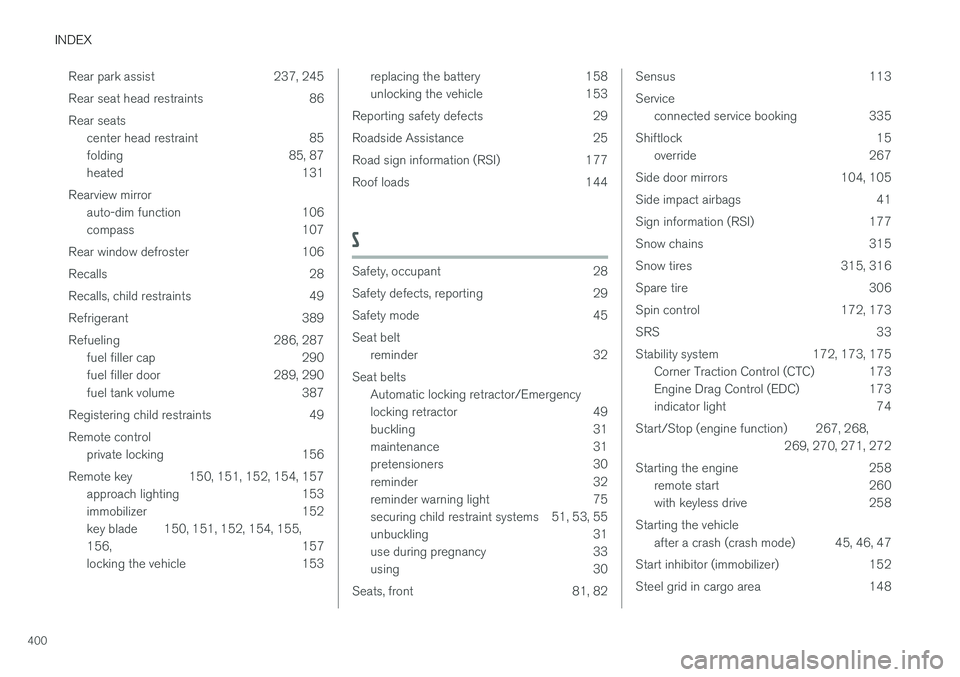
400Rear park assist 237, 245
Rear seat head restraints 86Rear seats
center head restraint 85
folding 85, 87
heated 131
Rearview mirror auto-dim function 106
compass 107
Rear window defroster 106
Recalls 28
Recalls, child restraints 49
Refrigerant 389
Refueling 286, 287 fuel filler cap 290
fuel filler door 289, 290
fuel tank volume 387
Registering child restraints 49 Remote control private locking 156
Remote key 150, 151, 152, 154, 157 approach lighting 153
immobilizer 152
key blade 150, 151, 152, 154, 155,156 , 157
locking the vehicle 153
replacing the battery 158
unlocking the vehicle 153
Reporting safety defects 29
Roadside Assistance 25
Road sign information (RSI) 177
Roof loads 144
S
Safety, occupant 28
Safety defects, reporting 29
Safety mode 45Seat belt reminder 32
Seat belts Automatic locking retractor/Emergency
locking retractor 49
buckling 31
maintenance 31
pretensioners 30
reminder 32
reminder warning light 75
securing child restraint systems 51, 53, 55
unbuckling 31
use during pregnancy 33
using 30
Seats, front 81, 82
Sensus 113 Service connected service booking 335
Shiftlock 15 override 267
Side door mirrors 104, 105
Side impact airbags 41
Sign information (RSI) 177
Snow chains 315
Snow tires 315, 316
Spare tire 306
Spin control 172, 173SRS 33
Stability system 172, 173, 175 Corner Traction Control (CTC) 173
Engine Drag Control (EDC) 173
indicator light 74
Start/Stop (engine function) 267, 268, 269, 270, 271, 272
Starting the engine 258 remote start 260
with keyless drive 258
Starting the vehicle after a crash (crash mode) 45, 46, 47
Start inhibitor (immobilizer) 152
Steel grid in cargo area 148