weight VOLVO V60 2018 Owner´s Manual
[x] Cancel search | Manufacturer: VOLVO, Model Year: 2018, Model line: V60, Model: VOLVO V60 2018Pages: 406, PDF Size: 9.59 MB
Page 314 of 406
WHEELS AND TIRES
312
Loading specifications Properly loading your vehicle will provide maxi- mum return of vehicle design performance.
Before loading your vehicle, familiarize yourself with the following terms for determining yourvehicle's weight ratings, with or without a trailer,from the vehicle's Federal/Canadian Motor Vehi-cle Safety Standards (FMVSS/CMVSS) label, andthe vehicle's tire information placard:
Curb weightThe weight of the vehicle including a full tank offuel and all standard equipment. It does notinclude passengers, cargo, or optional equipment.
Capacity weightAll weight added to the curb weight, includingcargo and optional equipment. When towing,trailer hitch tongue load is also part of cargoweight.
Permissible axle weightThe maximum allowable weight that can be car-ried by a single axle (front or rear). These num-bers are shown on the Federal/Canadian MotorVehicle Safety Standards (FMVSS/CMVSS) label.The total load on each axle must never exceed itsmaximum permissible weight.
Gross vehicle weight (GVW)The vehicle's curb weight + cargo + passengers.
NOTE
•The location of the various labels in your vehicle, see Label information (p. 376).
• A table listing important weight limits foryour vehicle, see Weights (p. 381).
Loading specifications – load limit The load limit of your vehicle is the combined weight of the occupants and cargo.
Steps for Determining Correct Load
Limit
1. Locate the statement "the combined weight of occupants and cargo should never exceed XXX kg or XXX lbs." on your vehicle's plac-ard.
2. Determine the combined weight of the driver and passengers that will be riding in yourvehicle.
3. Subtract the combined weight of the driver and passengers from XXX kg or XXX lbs.
4. The resulting figure equals the available amount of cargo and luggage load capacity.For example, if the "XXX" amount equals1400 lbs. and there will be five 150 lb. pas-sengers in your vehicle, the amount of availa-ble cargo and luggage load capacity is650 lbs. (1400 – 750 (5 × 150) = 650 lbs.)
5. Determine the combined weight of luggage and cargo being loaded on the vehicle. Thatweight may not safely exceed the availablecargo and luggage load capacity calculatedin Step 4.
Page 315 of 406
WHEELS AND TIRES
}}
313
6. If your vehicle will be towing a trailer, load
from your trailer will be transferred to your vehicle. Consult this manual to determinehow this reduces the available cargo and lug-gage load capacity of your vehicle.
WARNING
• Exceeding the permissible axle weight, gross vehicle weight, or any other weightrating limits can cause tire overheatingresulting in permanent deformation orcatastrophic failure.
• Do not use replacement tires with lowerload carrying capacities than the tires thatwere original equipment on the vehiclebecause this will lower the vehicle's GVWrating. Use only tires with the correct loadcarrying capacity. Consult your Volvoretailer for information.
Tire specifications – terminology
The following is a glossary of tire-related terms.
The tire suppliers may have additional markings, notes or warnings such as standard load, radialtubeless, etc.
• Tire information placard
: A placard show-
ing the OE (Original Equipment) tire sizes,recommended inflation pressure, and themaximum weight the vehicle can carry.
• Tire Identification Number (TIN)
: A number
on the sidewall of each tire providing infor-mation about the tire brand and manufactur-ing plant, tire size and date of manufacturer.
• Inflation pressure
: A measure of the
amount of air in a tire.
• Standard load
: A class of P-metric or Metric
tires designed to carry a maximum load at35 psi [37 psi (2.5 bar) for Metric tires].Increasing the inflation pressure beyond thispressure will not increase the tires load car-rying capability.
• Extra load
: A class of P-metric or Metric
tires designed to carry a heavier maximumload at 41 psi [43 psi (2.9 bar) for Metrictires]. Increasing the inflation pressurebeyond this pressure will not increase thetire's load carrying capability.
• kPa
: Kilopascal, a metric unit of air pressure.
• PSI
: Pounds per square inch, a standard unit
of air pressure. •
B-pillar
: The structural member at the side
of the vehicle behind the front door.
• Bead area of the tire
: Area of the tire next
to the rim.
• Sidewall of the tire
: Area between the bead
area and the tread.
• Tread area of the tire
: Area of the perime-
ter of the tire that contacts the road whenmounted on the vehicle.
• Rim
: The metal support (wheel) for a tire or a
tire and tube assembly upon which the tirebeads are seated.
• Maximum load rating
: a figure indicating
the maximum load in pounds and kilogramsthat can be carried by the tire. This rating isestablished by the tire manufacturer.
• Maximum permissible inflation pressure
:
the greatest amount of air pressure thatshould ever be put in the tire. This limit is setby the tire manufacturer.
• Recommended tire inflation pressure
:
inflation pressure, established by Volvo,which is based on the type of tires that aremounted on a vehicle at the factory. Thisinformation can be found on the tire inflationplacard(s) located on the driver's side B-pillarand in the tire inflation table in this chapter.
• Cold tires
: The tires are considered to be
cold when they have the same temperatureas the surrounding (ambient) air. This tem-
Page 366 of 406
||
MAINTENANCE AND SERVICING
* Option/accessory.
364
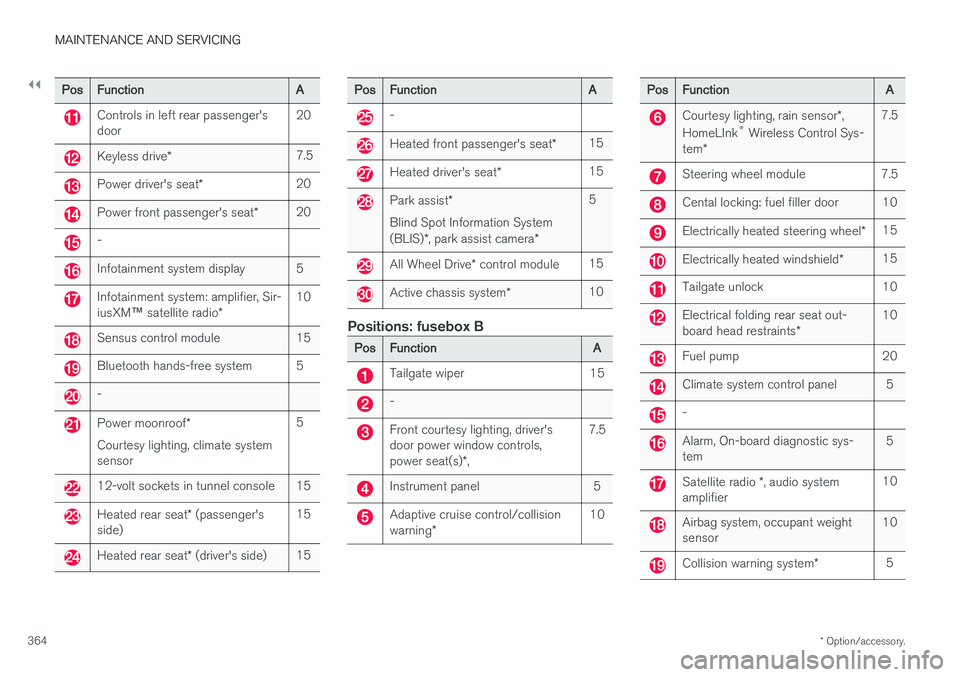
Pos Function A
Controls in left rear passenger's door20
Keyless drive
* 7.5
Power driver's seat
*20
Power front passenger's seat
*20
-
Infotainment system display 5
Infotainment system: amplifier, Sir- iusXM
™ satellite radio * 10
Sensus control module 15
Bluetooth hands-free system 5
-
Power moonroof
*
Courtesy lighting, climate system sensor 5
12-volt sockets in tunnel console 15
Heated rear seat
* (passenger's
side) 15
Heated rear seat
* (driver's side) 15
Pos
Function A
-
Heated front passenger's seat*15
Heated driver's seat
*15
Park assist
*
Blind Spot Information System (BLIS) *, park assist camera *5
All Wheel Drive
* control module 15
Active chassis system
*10
Positions: fusebox B
Pos
Function A
Tailgate wiper 15
-
Front courtesy lighting, driver's door power window controls, power seat(s)*, 7.5
Instrument panel 5
Adaptive cruise control/collision warning
* 10
Pos
Function A
Courtesy lighting, rain sensor*,
HomeLInk ®
Wireless Control Sys-
tem * 7.5
Steering wheel module 7.5
Cental locking: fuel filler door 10
Electrically heated steering wheel
*15
Electrically heated windshield
*15
Tailgate unlock 10
Electrical folding rear seat out- board head restraints
*10
Fuel pump 20
Climate system control panel 5
-
Alarm, On-board diagnostic sys- tem
5
Satellite radio
*, audio system
amplifier 10
Airbag system, occupant weight sensor
10
Collision warning system
*5
Page 380 of 406
||
SPECIFICATIONS
378
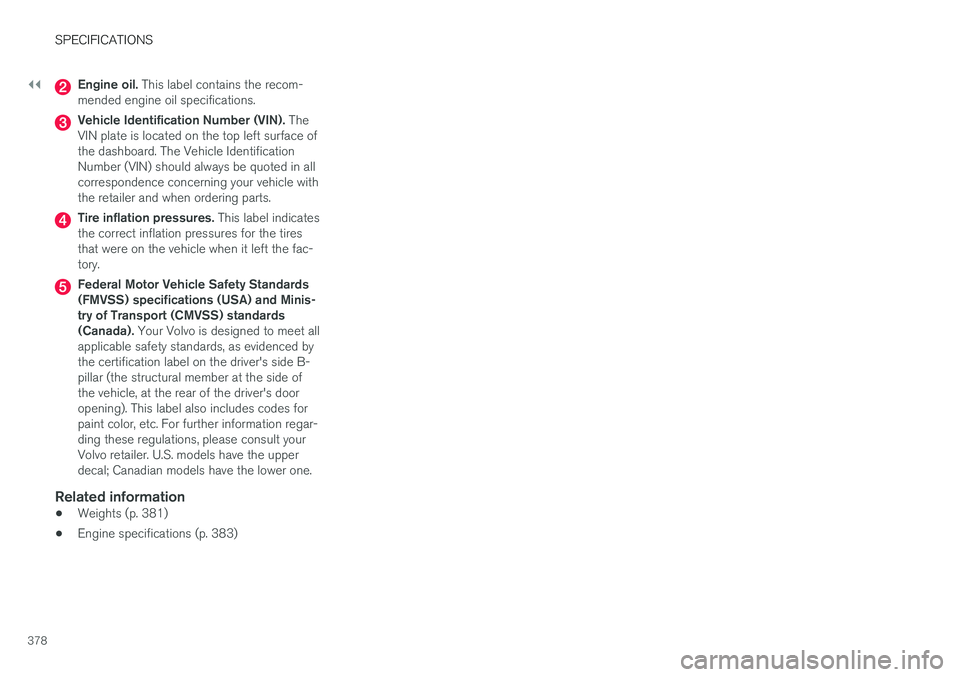
Engine oil. This label contains the recom-
mended engine oil specifications.
Vehicle Identification Number (VIN). The
VIN plate is located on the top left surface of the dashboard. The Vehicle IdentificationNumber (VIN) should always be quoted in allcorrespondence concerning your vehicle withthe retailer and when ordering parts.
Tire inflation pressures. This label indicates
the correct inflation pressures for the tires that were on the vehicle when it left the fac-tory.
Federal Motor Vehicle Safety Standards (FMVSS) specifications (USA) and Minis-try of Transport (CMVSS) standards(Canada). Your Volvo is designed to meet all
applicable safety standards, as evidenced bythe certification label on the driver's side B-pillar (the structural member at the side ofthe vehicle, at the rear of the driver's dooropening). This label also includes codes forpaint color, etc. For further information regar-ding these regulations, please consult yourVolvo retailer. U.S. models have the upperdecal; Canadian models have the lower one.
Related information
• Weights (p. 381)
• Engine specifications (p. 383)
Page 382 of 406
||
SPECIFICATIONS
380
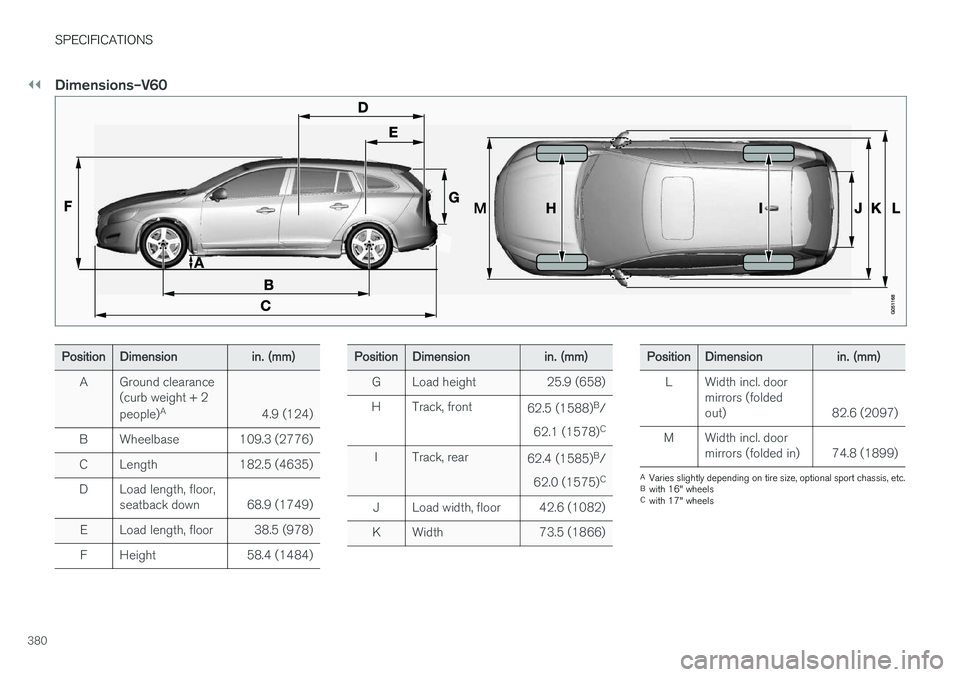
Dimensions–V60
PositionDimension in. (mm)
A Ground clearance (curb weight + 2 people) A
4.9 (124)
B Wheelbase 109.3 (2776)
C Length 182.5 (4635)
D Load length, floor, seatback down 68.9 (1749)
E Load length, floor 38.5 (978)
F Height 58.4 (1484)Position Dimension in. (mm)
G Load height 25.9 (658)
H Track, front 62.5 (1588)B
/
62.1 (1578) C
I Track, rear 62.4 (1585)B
/
62.0 (1575) C
J Load width, floor 42.6 (1082)
K Width 73.5 (1866)Position Dimension in. (mm)
L Width incl. door mirrors (folded
out) 82.6 (2097)
M Width incl. door mirrors (folded in) 74.8 (1899)
AVaries slightly depending on tire size, optional sport chassis, etc.
B with 16" wheels
C with 17" wheels
Page 383 of 406
SPECIFICATIONS
}}
381
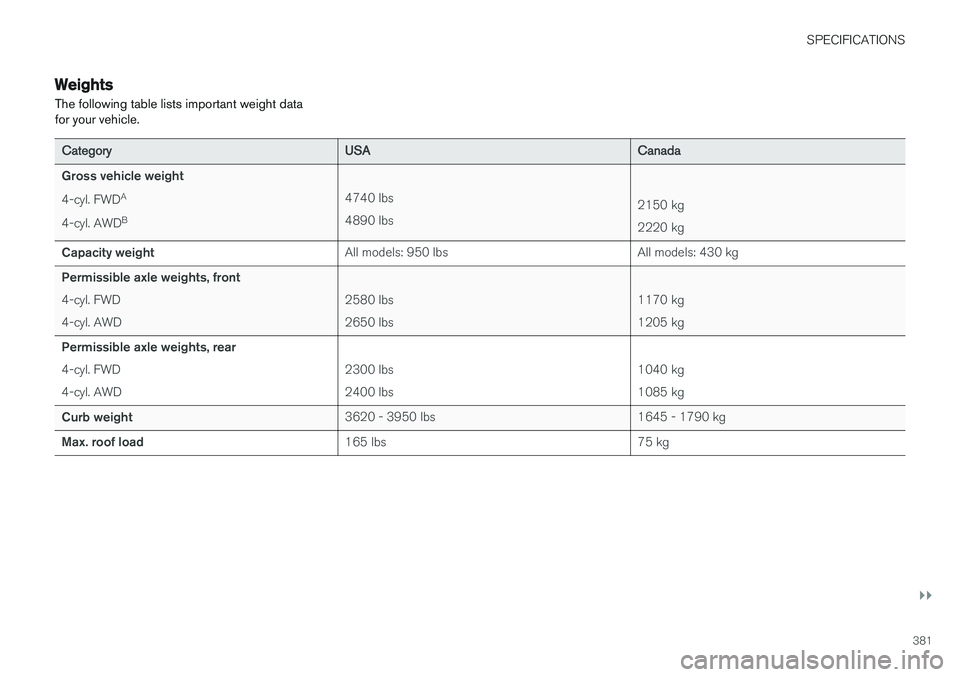
Weights The following table lists important weight data for your vehicle.
CategoryUSA Canada
Gross vehicle weight 4-cyl. FWD A
4-cyl. AWD B 4740 lbs 4890 lbs
2150 kg2220 kg
Capacity weight All models: 950 lbs All models: 430 kg
Permissible axle weights, front
4-cyl. FWD4-cyl. AWD 2580 lbs2650 lbs 1170 kg1205 kg
Permissible axle weights, rear 4-cyl. FWD 4-cyl. AWD 2300 lbs2400 lbs 1040 kg1085 kg
Curb weight 3620 - 3950 lbs 1645 - 1790 kg
Max. roof load 165 lbs
75 kg
Page 384 of 406
||
SPECIFICATIONS
382
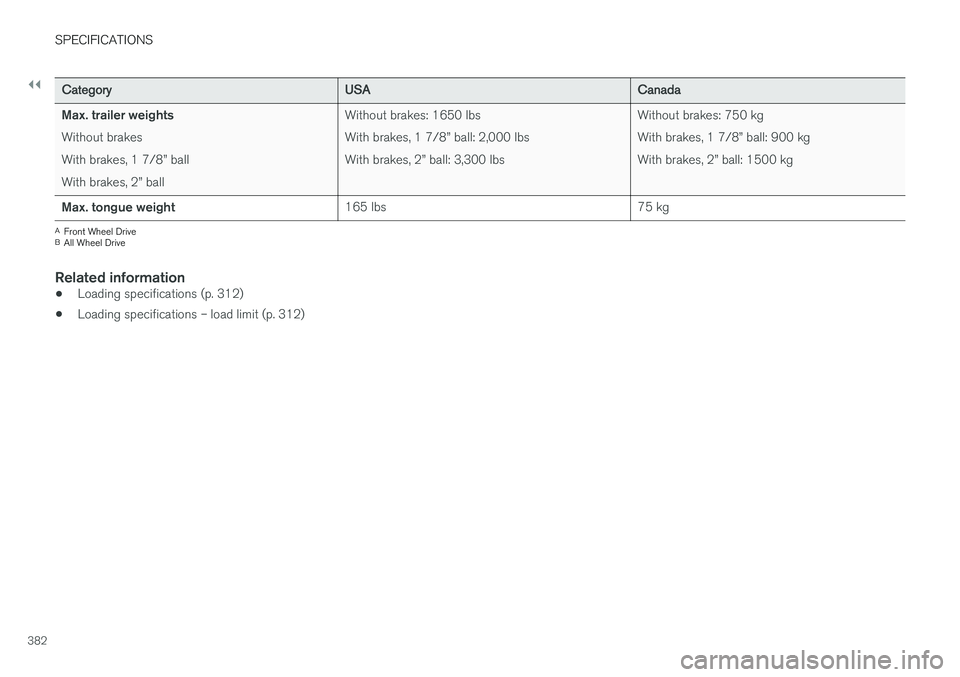
CategoryUSA Canada
Max. trailer weights Without brakes With brakes, 1 7/8” ballWith brakes, 2” ball Without brakes: 1650 lbsWith brakes, 1 7/8” ball: 2,000 lbsWith brakes, 2” ball: 3,300 lbs
Without brakes: 750 kgWith brakes, 1 7/8” ball: 900 kgWith brakes, 2” ball: 1500 kg
Max. tongue weight 165 lbs
75 kg
A
Front Wheel Drive
B All Wheel Drive
Related information
• Loading specifications (p. 312)
• Loading specifications – load limit (p. 312)
Page 394 of 406

||
SPECIFICATIONS
* Option/accessory.
392
Symbol Description See
Camera sensor, laser sensor(p. 215)(p. 208)
Collision Warning with Full Auto-brake and Pedestrian Detection
*(p. 220)
Active Bending Lights (ABL)
* (p. 95)
Driver Alert System
*(p. 222)
Driver Alert System
*(p. 222)
Parking brake (p. 280)
Rain sensor
* (p. 103)
Active High Beams (AHB)
* (p. 94)
Windshield sensor
*(p. 94)
Symbol
Description See
Driver Alert System*
(Lane Departure Warning/LaneKeeping Aid) (p. 228)
Driver Alert System
*
(Lane Departure Warning/LaneKeeping Aid) (p. 228)
Driver Alert System
*
(Lane Departure Warning/LaneKeeping Aid) (p. 228)
Fuel tank on passeng- er's side of the vehicle
(p. 289)
Related information
•
Information displays – indicator symbols (p. 75)
• Information displays – warning symbols(p. 77)
• Information display – messages (p. 117)
Information symbols – ceiling console
The following tables list the most common warn- ing and indicator lights and symbols and a refer-ence to where more detailed information can befound.
: The red warning symbol illuminates to
indicate a problem related to safety and/or driva- bility. A message will also appear in the maininstruments panel's display.
: The information symbol illuminates and a
text message is displayed to provide the driver with necessary information about one of thevehicle's systems.
Symbol Description See
Seat belt reminder (p. 32)
Occupant Weight Sensor (p. 38)
Related information
•Information displays – indicator symbols (p. 75)
• Information displays – warning symbols(p. 77)
• Information display – messages (p. 117)
Page 398 of 406
INDEX
396Child restraint systems 50
booster cushions 56
convertible seats 54
infant seats 52
ISOFIX/LATCH anchors 57
top tether anchors 59
Child safety 48 booster cushions 56
child restraint systems 50
convertible seats 54
infant seats 52
Child safety locks 65
City safety 202, 203
Climate system 135 air distribution 131, 136, 138
air vents 131
Interior Air Quality System 129
introduction 128
passenger compartment filter 129
refrigerant 128
Clock, setting 81
Cold weather driving 286
Collision warning system 209, 211, 214, 215, 217, 218
Compass in rearview mirror 109
Connected service booking 335
Conserving electrical current 285
Convertible seats 54
Coolant 342, 386
Cooling system, general information 284
Corner traction control 174
Courtesy lighting 100
Crash event data 19
Crash mode 46, 47
Cruise control 180, 181, 183 adaptive 183
Curb weight 312
Current, conserving 285
Cyclist detection 213, 217
D
Daytime running lights 92
Defroster 135
Detachable key blade 157, 158
Disconnecting the front passenger
Page 401 of 406
INDEX
399
M
Main instrument panel 116, 117
Maintenance 332hoisting the vehicle 334
performed by the owner 333
Malfunction indicator light 76
Messages in the instrument panel 116, 117Mirrors defroster 108
power door 106, 107
rearview, auto-dim function 108
retractable 106, 107
vanity 145
Moonroof 110, 111 Motor oil checking 339
volumes 385
O
Occupant safety 28
Occupant weight sensor 38
Octane recommendations 287
Odometer, trip 81
Oil checking 339
volumes 385
Oil level sensor 340
Oil quality 384
OK button 116, 117
Option/accessory 15
Outside temperature sensor 80
Overhead courtesy lighting 100
Overheating, engine 78
Ownership, changing 19
Oxygen sensors, heated 290
P
Paint, touching up 373
Park assist 238, 246
Park Assist Camera 247
Park Assist Pilot 242Parking brake electric, applying/releasing 280, 281, 283
warning light 77
Parking lights 97
Pedestrian detection 214, 217
Polishing 371
Power front seat memory function 84
Power meter 74
Power mirrors 106, 107 defroster 108
Power moonroof 110, 111Power steering adjustable 178
fluid 343
Power steering fluid 387
Power windows 105
Pregnancy, using seat belts during 33
Private locking 158
PROPOSITION 65 WARNING 262, 358, 389
R
Rain sensor 103
Rear fog lights 98
Rear park assist 238, 246
Rear seat head restraints 88Rear seats center head restraint 87
folding 87, 89
heated 133