oil type VOLVO V60 2021 Owners Manual
[x] Cancel search | Manufacturer: VOLVO, Model Year: 2021, Model line: V60, Model: VOLVO V60 2021Pages: 661, PDF Size: 12.68 MB
Page 15 of 661
13
Paintwork620
Touching up minor paint damage 621
Color codes 622
Changing rear window wipers 622
Replacing windshield wiper blades 624
Putting the wiper blades in service position 625
Filling washer fluid 626
SPECIFICATIONS
Type designations628
Dimensions 631
Weights 633
Towing capacity and tongue weight 634
Engine specifications 635
Engine oil specifications 636
Transmission fluid specifications 636
Brake fluid specifications 637
Fuel tank volume 637
Air conditioning specifications 637
Approved tire pressure 639
INDEX
Index 641
Page 426 of 661
STARTING AND DRIVING
* Option/accessory.
424
Preparing for a long trip
It is important to have the vehicle's systems and equipment checked carefully before driv-ing long distances.
Check that
the engine is running properly and that fuel consumption is normal
there are no leaks (fuel, oil or other fluid)
the brake pedal is functioning properly
all lights work
tire tread depth and air pressure are atcorrect levels. Change to snow tires whendriving in areas where there is a risk ofsnowy or icy roads
the start battery is sufficiently charged
the wiper blades are in good condition
Related information
Checking tire pressure (p. 527)
Filling washer fluid (p. 626)
Winter driving (p. 424)
Economical driving (p. 423)
Vehicle modem settings (p. 503)
Loading recommendations (p. 556)
Driving with a trailer (p. 434)
Pilot Assist
* (p. 296)
Tire sealing system (p. 542)
Winter driving
It is important to check the vehicle before driving in cold/snowy conditions to makesure it can be driven safely.
Before the cold season arrives: Make sure the engine coolant contains 50% antifreeze. This mixture helps pro-tect the engine from frost erosion down toapprox. –35 °C (–31 °F). Do not mix dif-ferent types of antifreeze as this couldpose a health risk.
Keep the fuel tank well filled to preventcondensation from forming.
Check the viscosity of the engine oil. Oilwith low viscosity (thinner oil) improvescold-weather starting and reduces fuelconsumption when driving with a coldengine.
Check the condition and charge level ofthe start battery. Cold weather placesgreater demands on the start battery andreduces its capacity.
Use washer fluid containing antifreeze tohelp prevent ice from forming in thewasher fluid reservoir.
See separate section for engine oil recommen-dations.
Slippery driving conditionsTo help optimize traction and roadholding,Volvo recommends using snow tires on allwheels whenever there is a risk of snow or iceon the road.
NOTE
Certain countries require use of winter tires by law. Not all countries permit the use ofstudded tires.
Practice driving on slippery surfaces under controlled conditions to learn how the vehiclereacts.
Related information
Engine oil specifications (p. 636)
Snow tires (p. 540)
Snow chains (p. 541)
Braking on salted roads (p. 399)
Braking on wet roads (p. 399)
Filling washer fluid (p. 626)
Starter battery (p. 584)
Replacing windshield wiper blades(p. 624)
Changing rear window wipers (p. 622)
Refilling coolant (p. 582)
Page 569 of 661
MAINTENANCE AND SERVICE
}}
567
Periodic maintenance helps minimize emissions
NOTE
Refer to your Service and Warranty Booklet for a comprehensive serviceand maintenance schedule up to240,000 km (150,000 miles). Thisprogram contains inspections and ser-vices necessary for the proper functionof your vehicle and includes compo-nents that affect vehicle emissions.
The Warranty and Service RecordsInformation booklet also containsdetailed information concerning thewarranties that apply to your vehicle.
On-board Diagnostic SystemOBD II is part of your vehicle's computerized engine management system. It stores diag-nostic information about your vehicle's emis-sion controls. It can light the Check Enginelight (MIL) if it detects an emission control"fault." A "fault" is a component or systemthat is not performing within an expectedrange. A fault may be permanent or temporary.OBD II will store a message about any fault.
Emission inspection readiness
How do states use
OBD II for emission
inspections?
Many states connect a computer directly to a vehicle's OBD II system. The inspector canthen read "faults." In some states, this type ofinspection has replaced the tailpipe emissiontest.
How can my vehicle fail OBD II emission
inspection?
Your vehicle can fail OBD II emission inspec- tion for any of the following reasons: If your Check Engine (MIL) light is lit, your vehicle may fail inspection.
If your vehicle's Check Engine light was lit,but went out without any action on yourpart, OBD II will still have a recorded fault.Your vehicle may pass or fail, dependingon the inspection practices in your area.
If you had recent service that required dis-connecting the battery, OBD II diagnosticinformation may be incomplete and "notready" for inspection. A vehicle that is notready may fail inspection.
How can I prepare for my next
OBD II
emission inspection?
If your Check Engine (MIL) light is lit or was lit but went out without service, have your vehicle diagnosed and, if necessary,serviced by a qualified Volvo technician.
If you recently had service for a lit CheckEngine light, or if you had service thatrequired disconnecting the battery, aperiod of driving is necessary to bring theOBD II system to "ready" for inspection.Two half-hour trips of mixed stop-and-go/highway driving are typically needed toallow OBD II to reach readiness. YourVolvo retailer can provide you with moreinformation on planning a trip.
Maintain your vehicle in accordance withyour vehicle's maintenance schedule.
Owner maintenancePeriodic maintenance requirements and inter-vals are described in your vehicle's Warrantyand Service Records Information booklet. The following points can be carried out between the normally scheduled maintenanceservices.
Each time the vehicle is refueled:
Check the engine oil level.
Clean the windshield, windshield wipers, headlights, and taillights.
Page 581 of 661
MAINTENANCE AND SERVICE
}}
579
Engine oil For the recommended service intervals and warranties to be applied, an approved engineoil must be used.
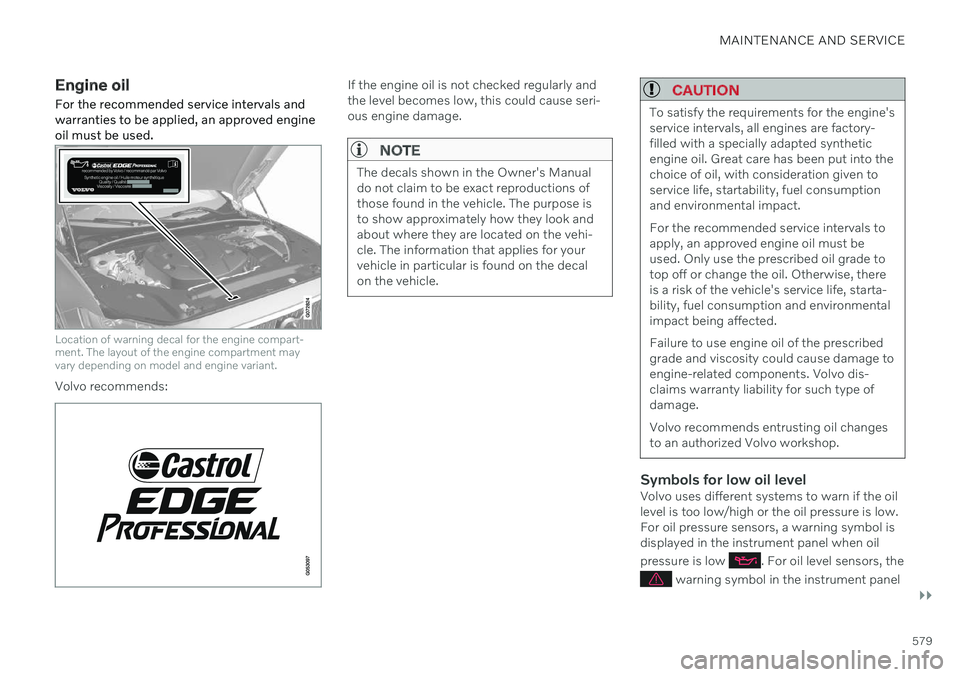
Location of warning decal for the engine compart- ment. The layout of the engine compartment mayvary depending on model and engine variant.
Volvo recommends:
If the engine oil is not checked regularly and the level becomes low, this could cause seri-ous engine damage.
NOTE
The decals shown in the Owner's Manual do not claim to be exact reproductions ofthose found in the vehicle. The purpose isto show approximately how they look andabout where they are located on the vehi-cle. The information that applies for yourvehicle in particular is found on the decalon the vehicle.
CAUTION
To satisfy the requirements for the engine's service intervals, all engines are factory-filled with a specially adapted syntheticengine oil. Great care has been put into thechoice of oil, with consideration given toservice life, startability, fuel consumptionand environmental impact. For the recommended service intervals to apply, an approved engine oil must beused. Only use the prescribed oil grade totop off or change the oil. Otherwise, thereis a risk of the vehicle's service life, starta-bility, fuel consumption and environmentalimpact being affected. Failure to use engine oil of the prescribed grade and viscosity could cause damage toengine-related components. Volvo dis-claims warranty liability for such type ofdamage. Volvo recommends entrusting oil changes to an authorized Volvo workshop.
Symbols for low oil levelVolvo uses different systems to warn if the oil level is too low/high or the oil pressure is low.For oil pressure sensors, a warning symbol isdisplayed in the instrument panel when oil pressure is low
. For oil level sensors, the
warning symbol in the instrument panel
Page 594 of 661

||
MAINTENANCE AND SERVICE
592Fuse pliers are provided on the inside of the fuse box cover to assist in removing andinserting fuses.
There are also spaces for several extra fuses inthe fusebox.
PositionsThere is a decal with a diagram of the loca-tions of the fuses on the inside of the cover.
Function
Ampere Type
– – Micro
–– Micro
Lambda sensors; Electric charge pressure module15 Micro
Ignition coils (gasoline); spark plugs (gasoline) Exhaust sensor; Diesel particulate sensor15 Micro
Oil pump solenoid; A/C magnetic coupling; heated oxygen sensor, center (gasoline); heated oxygen sensor, rear (diesel); heated oxygen sensor, front (gasoline/diesel)
15 Micro
Vacuum regulator; Valve; Output pulse valve (diesel); Oil level/temperature sensor (gasoline/diesel); Glow plug (GCU) (diesel)7.5 Micro
Engine control module; actuator; throttle unit; EGR valve (diesel); turbo position sensor (diesel); turbocharger valve (gasoline) 20 Micro
Engine control module
5 Micro
–– Micro
Solenoids (gasoline); Fuel leakage control valve; Engine cooling system thermostat (gasoline); EGR vacuum valve (die- sel); Glow control module (diesel); Supercharger clutch (gasoline); Crankshaft ventilation heater (diesel); Transmissionoil cooler valve (diesel)10 Micro
Spoiler damper control module; Cooler damper control module; Relay coils for output pulse (diesel); Coolant valve Fuel leakage detection (gasoline)
5 Micro
Page 602 of 661

||
MAINTENANCE AND SERVICE
* Option/accessory.
600
Function Ampere Type
Fuses in the trunk/cargo compartment 10 Micro
Control module for Internet-connected vehicle; Control module for Volvo On Call 5 Micro
Door module in left-side rear door20 Micro
Infotainment control module (amplifier)40
MCaseB
–
–
MCaseB
Multi-band antenna module
5 Micro
Front seat massage function* 5 Micro
–
– Micro
Rear window wiper15 Micro
Fuel pump control module15 Micro
Relay coil for transmission oil pump Converter medium voltage; Integrated starter motor 5 Micro
Opening trunk/tailgate with foot movement
* 5 Micro
Driver's seat heating
15 Micro
Front passenger's seat heating15 Micro
Coolant pump7.5 Micro
– – Micro
Page 614 of 661
||
MAINTENANCE AND SERVICE
* Option/accessory.
612 2. Move the sponge in circular motions to
apply the foam to the stain.
3. Dampen the stain thoroughly with the sponge. Let the sponge absorb the stain and do not rub.
4. Dry the stain using a soft towel and let the leather dry completely.
Protecting the leather upholstery1. Apply a small amount of leather protector to a cloth and then apply the protector tothe leather using light circular movements.
2. Let it dry for approximately 20 minutes. > Protecting the leather upholsterymakes it better able to withstand sun-light's harmful UV rays.
Related information
Cleaning the interior (p. 607)
Cleaning the center display (p. 608)
Cleaning fabric upholstery and ceiling liner(p. 609)
Cleaning the seat belt (p. 610)
Cleaning textile floor and inlay mats(p. 611)
Cleaning the leather steering wheel(p. 612)
Cleaning interior plastic, metal and wood surfaces (p. 613)
Cleaning the leather steering wheel
Use cleaning agents and car care products recommended by Volvo. Clean regularly andtreat stains immediately. It is important tovacuum before using a cleaning agent.
Leather needs to breathe. Never cover the leather steering wheel with a plastic protector.Volvo Leather Care Kit 951 0251 and LeatherSoftener 943 7429 are recommended forcleaning the leather steering wheel. First,remove dirt, dust, etc. with a damp sponge orcloth.
CAUTION
Sharp objects such as rings could damage the leather on the steering wheel.
Treating stains on the steering wheel:Type 1 (ink, wine, coffee, milk, sweat or blood)
–Use a soft cloth or sponge. Wipe the steering wheel using a solution of 5%ammonia. For blood stains, mix approxi-mately 2 dl (1 cup) of water with 25 g(one ounce) of salt and wipe the stain.
Type 2 (grease, oil, sauces or chocolate)
1. Same procedure as for Type 1 stains.
2. Finish by wiping the wheel with an absorbent paper or towel. Type 3
(dry dirt or dust)
1. Remove the dirt/dust using a soft brush.
2. Same procedure as for Type 1 stains.
Related information
Cleaning the interior (p. 607)
Cleaning the center display (p. 608)
Cleaning fabric upholstery and ceiling liner (p. 609)
Cleaning the seat belt (p. 610)
Cleaning textile floor and inlay mats(p. 611)
Cleaning leather upholstery
* (p. 611)
Cleaning interior plastic, metal and woodsurfaces (p. 613)
Page 637 of 661
SPECIFICATIONS
635
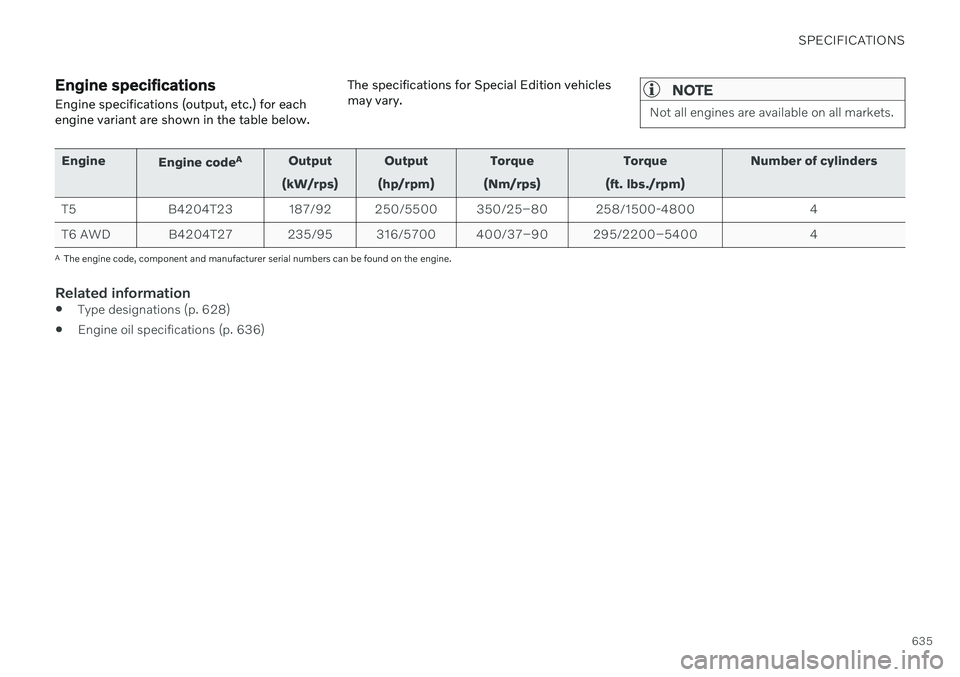
Engine specifications Engine specifications (output, etc.) for each engine variant are shown in the table below.The specifications for Special Edition vehiclesmay vary.NOTE
Not all engines are available on all markets.
Engine
Engine codeA
Output
(kW/rps) Output
(hp/rpm) Torque
(Nm/rps) Torque
(ft. lbs./rpm) Number of cylinders
T5 B4204T23 187/92 250/5500 350/25–80 258/1500-4800 4
T6 AWD B4204T27 235/95 316/5700 400/37–90 295/2200–5400 4
A The engine code, component and manufacturer serial numbers can be found on the engine.
Related information
Type designations (p. 628)
Engine oil specifications (p. 636)
Page 638 of 661
SPECIFICATIONS
636
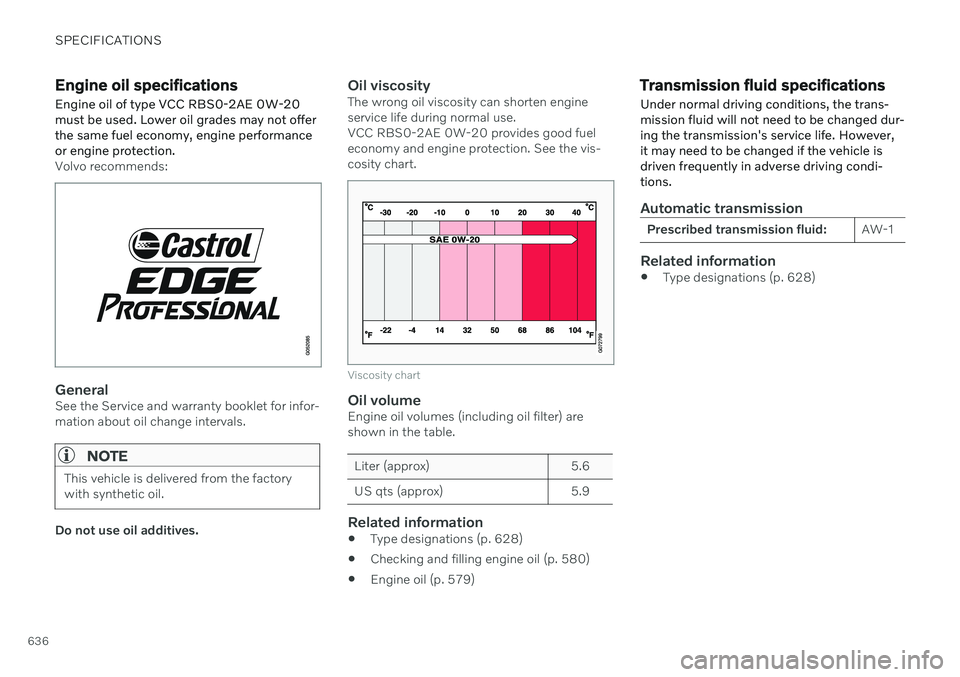
Engine oil specifications Engine oil of type VCC RBS0-2AE 0W-20 must be used. Lower oil grades may not offerthe same fuel economy, engine performanceor engine protection.
Volvo recommends:
GeneralSee the Service and warranty booklet for infor- mation about oil change intervals.
NOTE
This vehicle is delivered from the factory with synthetic oil.
Do not use oil additives.
Oil viscosityThe wrong oil viscosity can shorten engine service life during normal use.VCC RBS0-2AE 0W-20 provides good fueleconomy and engine protection. See the vis-cosity chart.
Viscosity chart
Oil volumeEngine oil volumes (including oil filter) are shown in the table.
Liter (approx) 5.6
US qts (approx) 5.9
Related information
Type designations (p. 628)
Checking and filling engine oil (p. 580)
Engine oil (p. 579)
Transmission fluid specifications
Under normal driving conditions, the trans- mission fluid will not need to be changed dur-ing the transmission's service life. However,it may need to be changed if the vehicle isdriven frequently in adverse driving condi-tions.
Automatic transmission
Prescribed transmission fluid: AW-1
Related information
Type designations (p. 628)
Page 648 of 661
INDEX
646Fluids and oils 581, 636, 637 Fog lights
front 157
rear 158
Four-C 422 Front seat blower 220
climate 210
heating 212, 213
temperature 222
ventilation 215
Front seat manual 182
Front seats, power 183 adjusting passenger seat from driv-
er's seat 191
adjusting seat 183
lumbar support 189
massage 186, 187, 188
multifunction control 186, 187, 188, 189
side bolsters 189
store position 184, 185
FSC, environmental labeling 23
Fuel 427 Travel Link service 467
Fuel filling 426
Fuel gauge 87
Fuel requirements 427, 428
Fuel tank volume 637
Fuse box 589
Fuses 589 below the glove compartment 596
in engine compartment 591
in the cargo compartment 602
replacing 589
G
Gasoline grade 427 Gaugefuel gauge 87
Gear selector positions automatic transmission 407
Glass, laminated/reinforced 164
Glove compartment 554 Gracenote ® 473
Grocery bag holders 557
Gross vehicle weight 633
H
Handbrake 400
Hand wash 615
Hard disk space 508
Hazard warning flashers 159
HD radio 457
Head restraint 193
Head-up display 140 activating/deactivating 141
cleaning 609
Distance Alert 350
replacing windshield 576
settings 142
store position 142, 184, 185
Heated wiper blades 174 Heating Seats 212, 213
steering wheel 215, 216
windows 219
high beams 154, 155
High engine temperature 430
Hill Start Assist 405 Hill Start Assist (HSA) 405
Hoisting the vehicle 573 HomeLink ®
441
programming 442
type approval 444
use 443