light VOLVO V70 2003 Service Manual
[x] Cancel search | Manufacturer: VOLVO, Model Year: 2003, Model line: V70, Model: VOLVO V70 2003Pages: 117, PDF Size: 2.56 MB
Page 86 of 117
18 -
pg. 120 Replacing bulbs
Replacing high/low beam headlight bulbs
The headlight bulbs must be replaced from the engine compartment.
CAUTION:
Do not touch the glass on halogen bulbs with your fingers. Grease, oil or any other impurities can be carbonized onto
the bulb and cause damage to the reflector.
Be sure to use bulbs of the correct type and voltage.
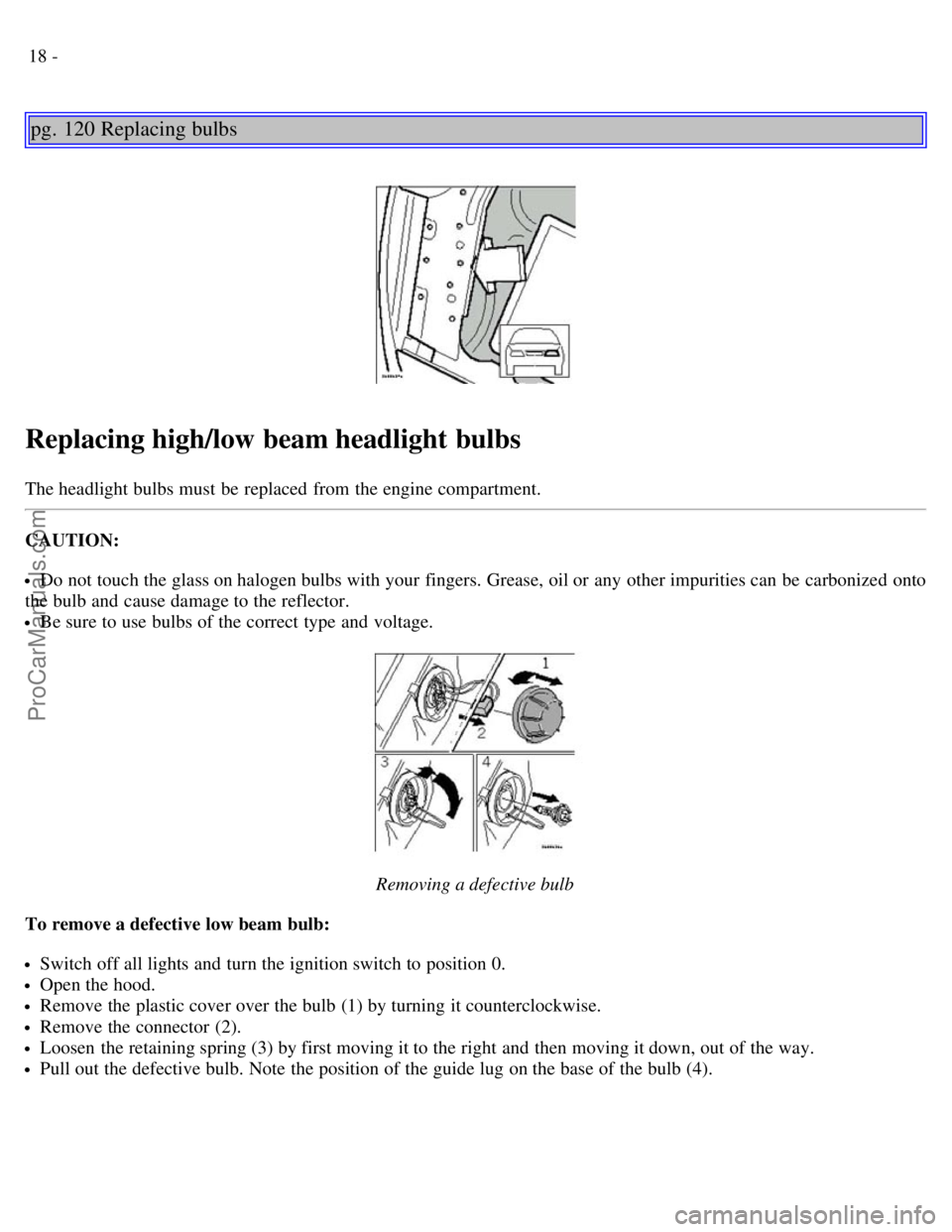
Removing a defective bulb
To remove a defective low beam bulb:
Switch off all lights and turn the ignition switch to position 0.
Open the hood.
Remove the plastic cover over the bulb (1) by turning it counterclockwise.
Remove the connector (2).
Loosen the retaining spring (3) by first moving it to the right and then moving it down, out of the way.
Pull out the defective bulb. Note the position of the guide lug on the base of the bulb (4).
ProCarManuals.com
Page 87 of 117
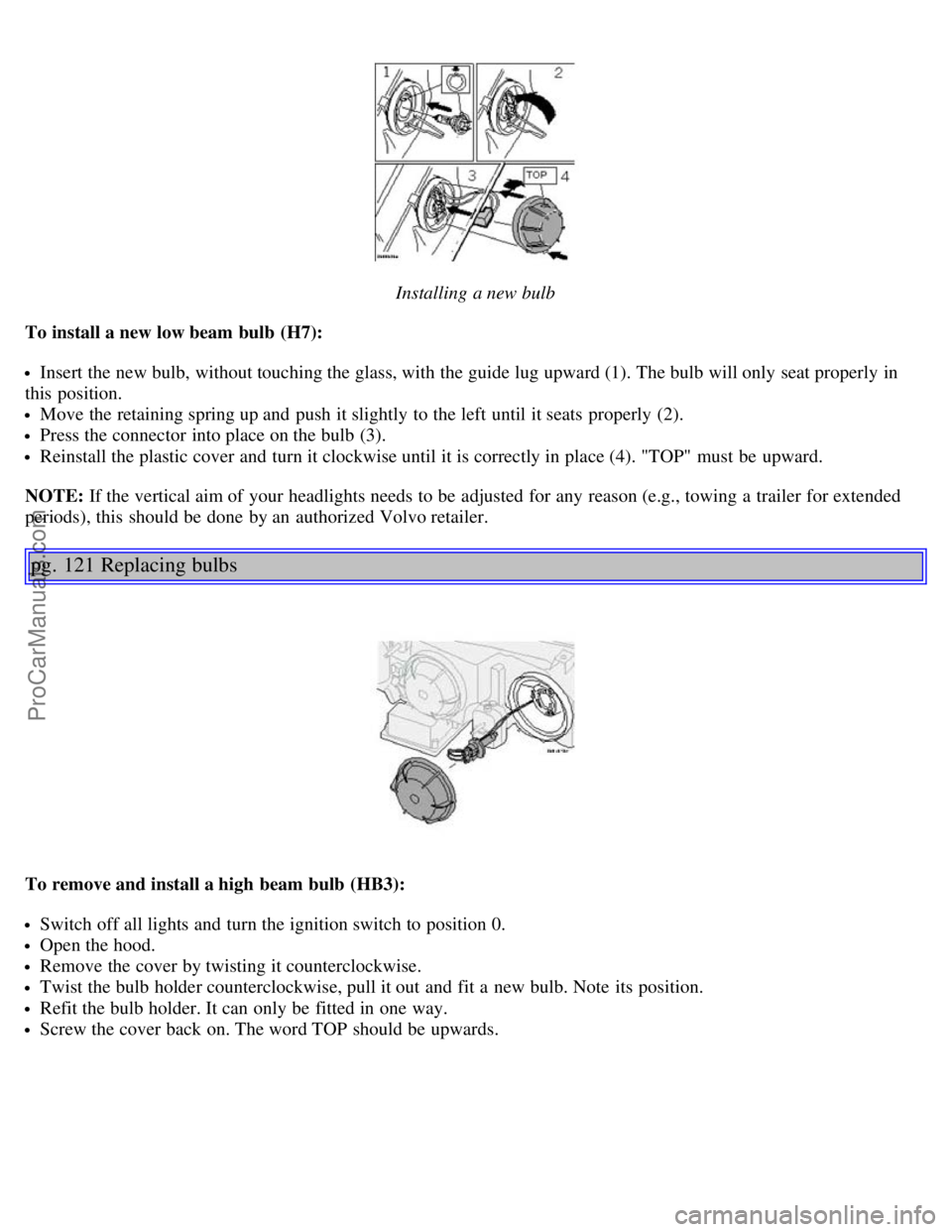
Installing a new bulb
To install a new low beam bulb (H7):
Insert the new bulb, without touching the glass, with the guide lug upward (1). The bulb will only seat properly in
this position.
Move the retaining spring up and push it slightly to the left until it seats properly (2).
Press the connector into place on the bulb (3).
Reinstall the plastic cover and turn it clockwise until it is correctly in place (4). "TOP" must be upward.
NOTE: If the vertical aim of your headlights needs to be adjusted for any reason (e.g., towing a trailer for extended
periods), this should be done by an authorized Volvo retailer.
pg. 121 Replacing bulbs
To remove and install a high beam bulb (HB3):
Switch off all lights and turn the ignition switch to position 0.
Open the hood.
Remove the cover by twisting it counterclockwise.
Twist the bulb holder counterclockwise, pull it out and fit a new bulb. Note its position.
Refit the bulb holder. It can only be fitted in one way.
Screw the cover back on. The word TOP should be upwards.
ProCarManuals.com
Page 88 of 117
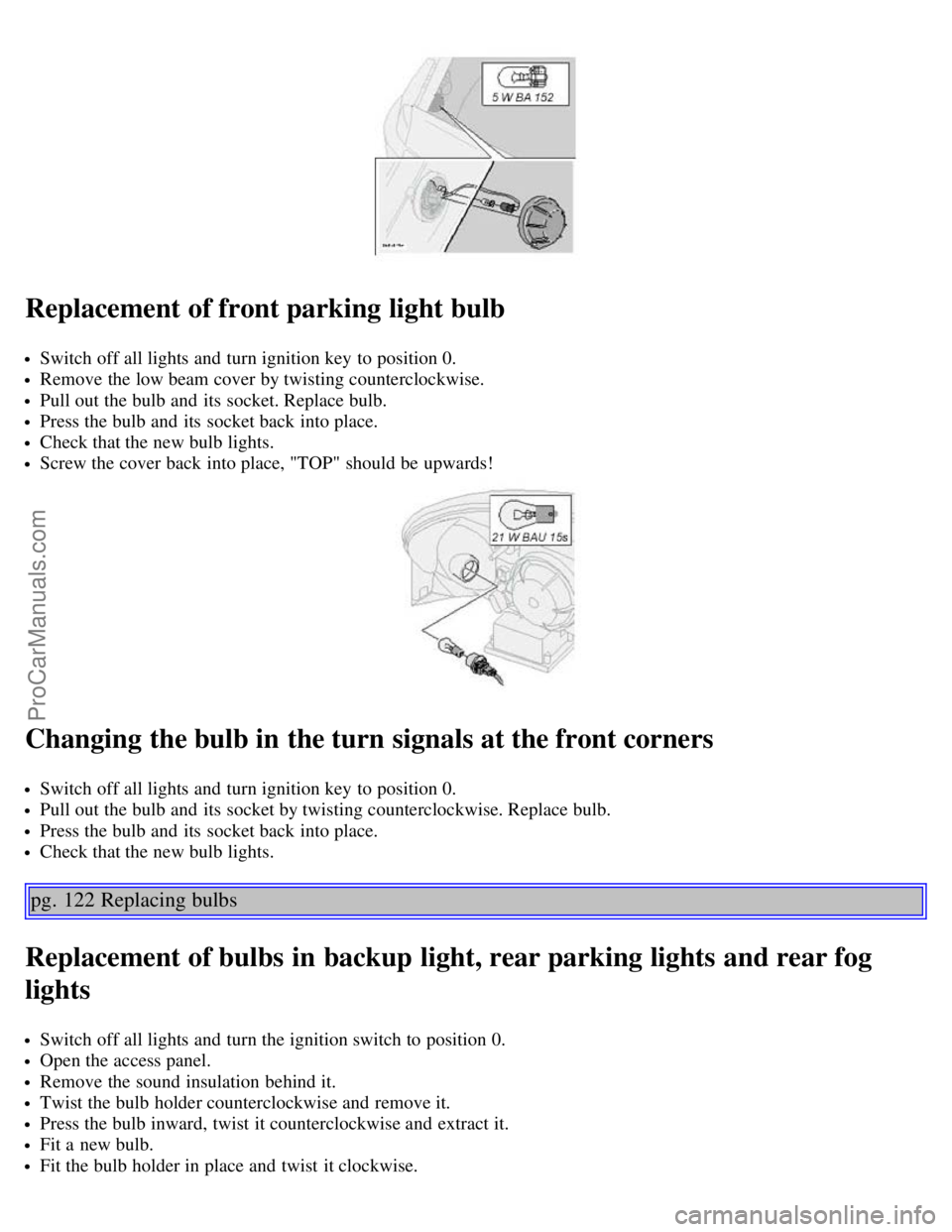
Replacement of front parking light bulb
Switch off all lights and turn ignition key to position 0.
Remove the low beam cover by twisting counterclockwise.
Pull out the bulb and its socket. Replace bulb.
Press the bulb and its socket back into place.
Check that the new bulb lights.
Screw the cover back into place, "TOP" should be upwards!
Changing the bulb in the turn signals at the front corners
Switch off all lights and turn ignition key to position 0.
Pull out the bulb and its socket by twisting counterclockwise. Replace bulb.
Press the bulb and its socket back into place.
Check that the new bulb lights.
pg. 122 Replacing bulbs
Replacement of bulbs in backup light, rear parking lights and rear fog
lights
Switch off all lights and turn the ignition switch to position 0.
Open the access panel.
Remove the sound insulation behind it.
Twist the bulb holder counterclockwise and remove it.
Press the bulb inward, twist it counterclockwise and extract it.
Fit a new bulb.
Fit the bulb holder in place and twist it clockwise.
ProCarManuals.com
Page 89 of 117
Refit the sound insulation and put the access panel back in place.
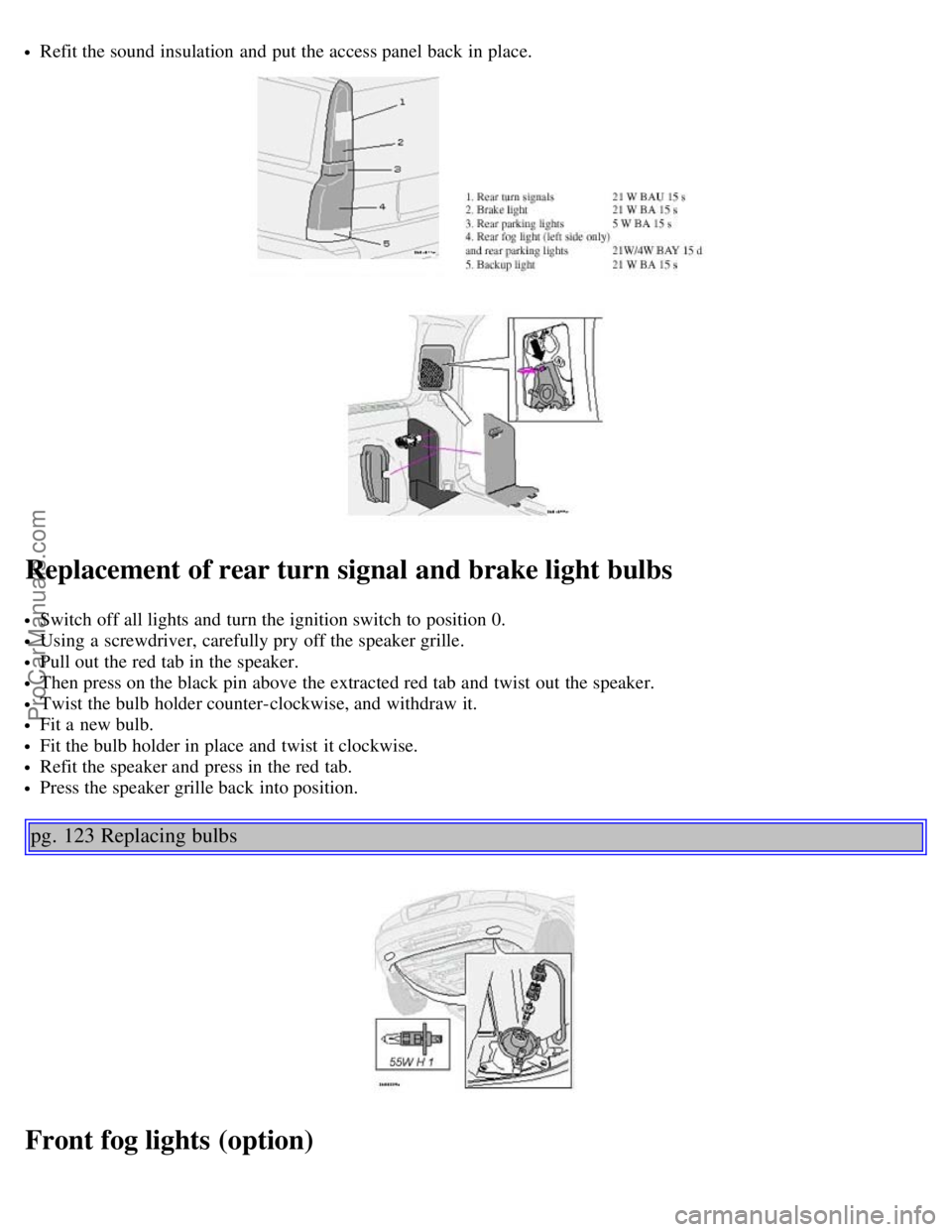
Replacement of rear turn signal and brake light bulbs
Switch off all lights and turn the ignition switch to position 0.
Using a screwdriver, carefully pry off the speaker grille.
Pull out the red tab in the speaker.
Then press on the black pin above the extracted red tab and twist out the speaker.
Twist the bulb holder counter-clockwise, and withdraw it.
Fit a new bulb.
Fit the bulb holder in place and twist it clockwise.
Refit the speaker and press in the red tab.
Press the speaker grille back into position.
pg. 123 Replacing bulbs
Front fog lights (option)
ProCarManuals.com
Page 90 of 117
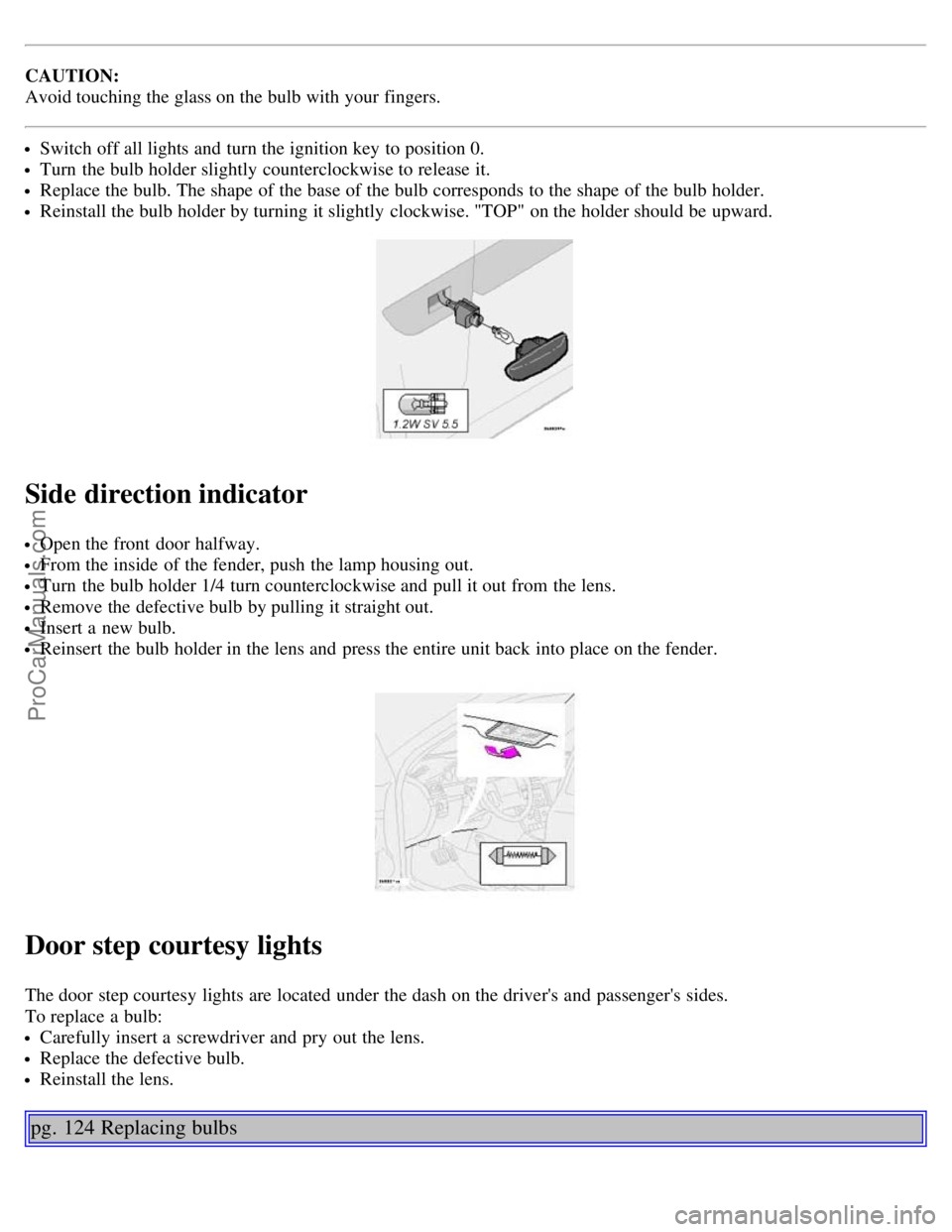
CAUTION:
Avoid touching the glass on the bulb with your fingers.
Switch off all lights and turn the ignition key to position 0.
Turn the bulb holder slightly counterclockwise to release it.
Replace the bulb. The shape of the base of the bulb corresponds to the shape of the bulb holder.
Reinstall the bulb holder by turning it slightly clockwise. "TOP" on the holder should be upward.
Side direction indicator
Open the front door halfway.
From the inside of the fender, push the lamp housing out.
Turn the bulb holder 1/4 turn counterclockwise and pull it out from the lens.
Remove the defective bulb by pulling it straight out.
Insert a new bulb.
Reinsert the bulb holder in the lens and press the entire unit back into place on the fender.
Door step courtesy lights
The door step courtesy lights are located under the dash on the driver's and passenger's sides.
To replace a bulb:
Carefully insert a screwdriver and pry out the lens.
Replace the defective bulb.
Reinstall the lens.
pg. 124 Replacing bulbs
ProCarManuals.com
Page 91 of 117
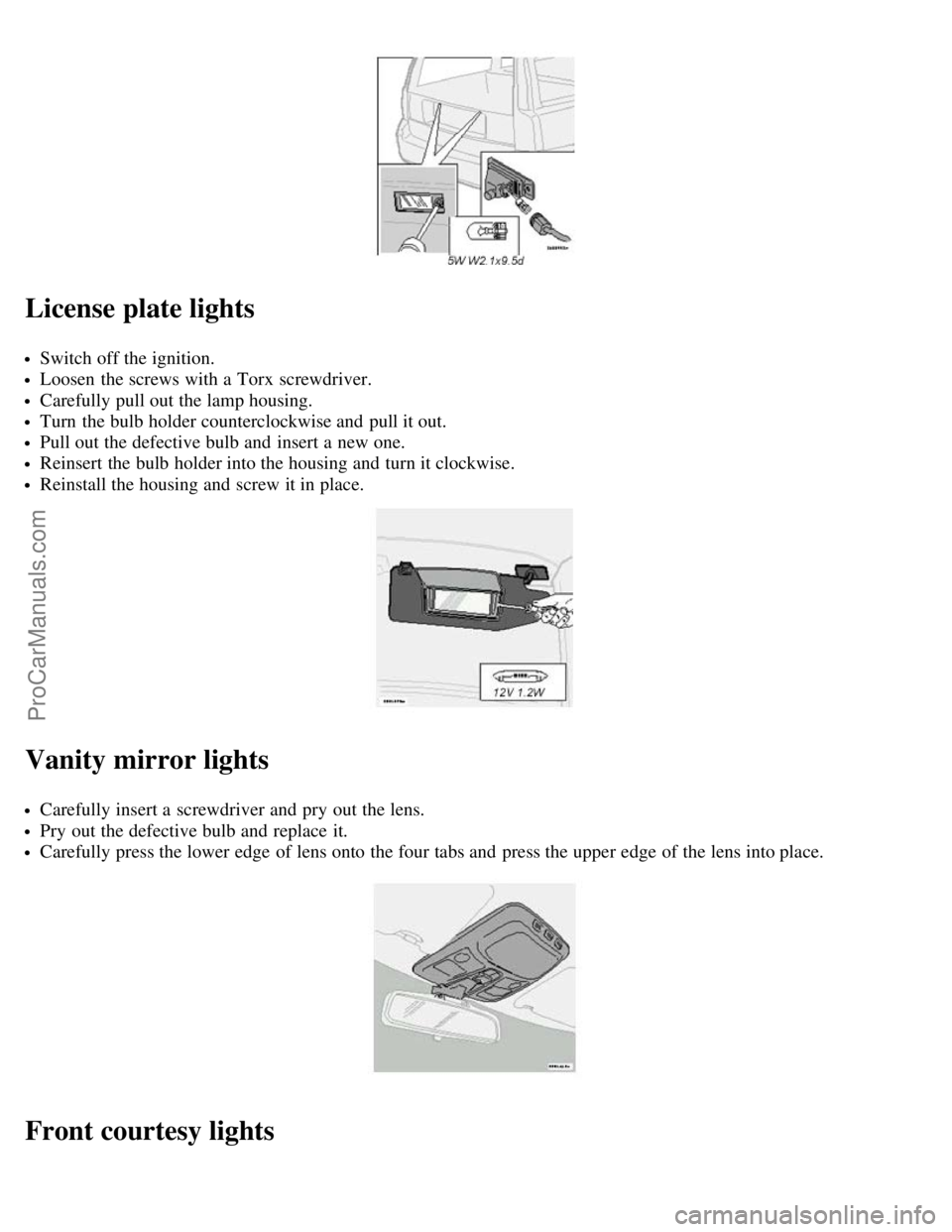
License plate lights
Switch off the ignition.
Loosen the screws with a Torx screwdriver.
Carefully pull out the lamp housing.
Turn the bulb holder counterclockwise and pull it out.
Pull out the defective bulb and insert a new one.
Reinsert the bulb holder into the housing and turn it clockwise.
Reinstall the housing and screw it in place.
Vanity mirror lights
Carefully insert a screwdriver and pry out the lens.
Pry out the defective bulb and replace it.
Carefully press the lower edge of lens onto the four tabs and press the upper edge of the lens into place.
Front courtesy lights
ProCarManuals.com
Page 92 of 117
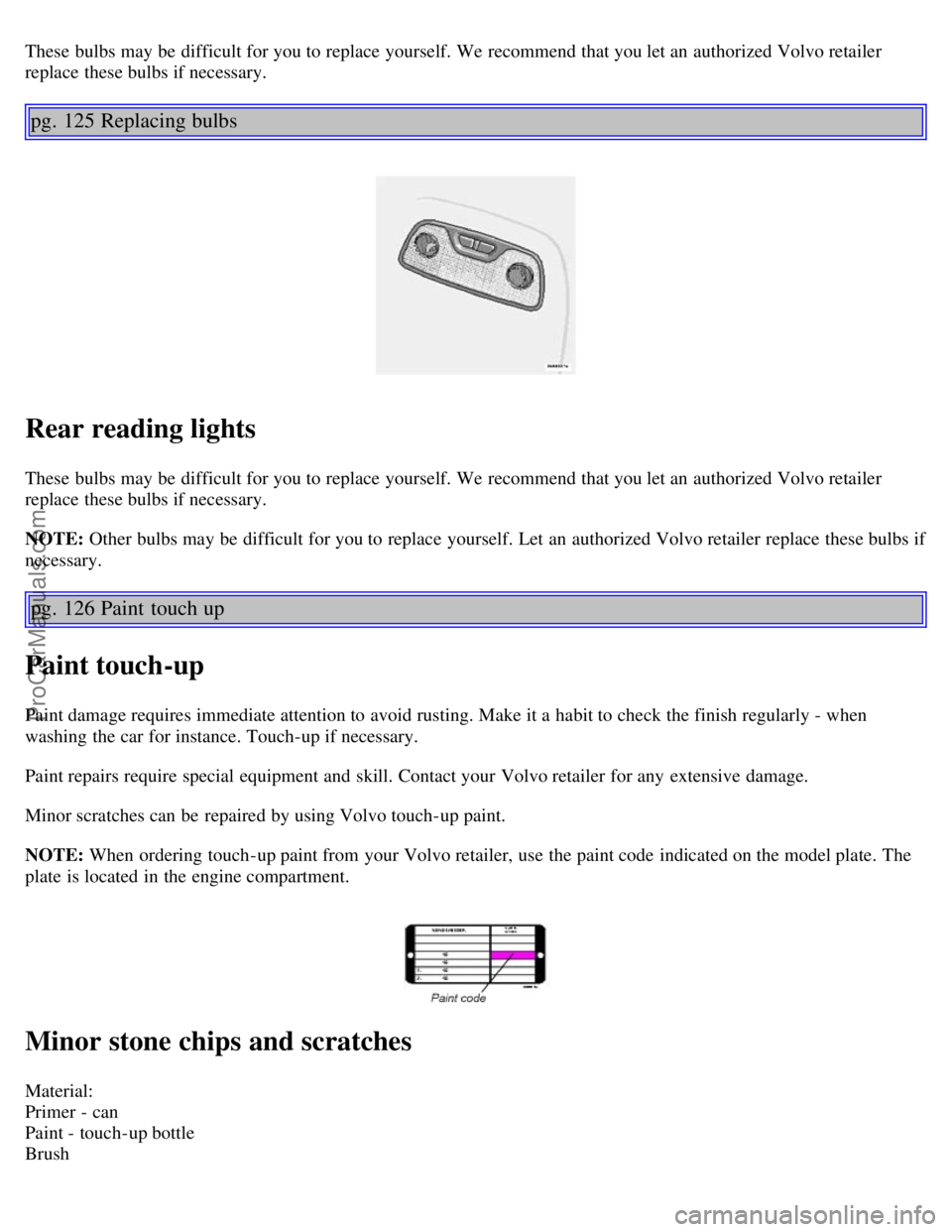
These bulbs may be difficult for you to replace yourself. We recommend that you let an authorized Volvo retailer
replace these bulbs if necessary.
pg. 125 Replacing bulbs
Rear reading lights
These bulbs may be difficult for you to replace yourself. We recommend that you let an authorized Volvo retailer
replace these bulbs if necessary.
NOTE: Other bulbs may be difficult for you to replace yourself. Let an authorized Volvo retailer replace these bulbs if
necessary.
pg. 126 Paint touch up
Paint touch-up
Paint damage requires immediate attention to avoid rusting. Make it a habit to check the finish regularly - when
washing the car for instance. Touch-up if necessary.
Paint repairs require special equipment and skill. Contact your Volvo retailer for any extensive damage.
Minor scratches can be repaired by using Volvo touch-up paint.
NOTE: When ordering touch-up paint from your Volvo retailer, use the paint code indicated on the model plate. The
plate is located in the engine compartment.
Minor stone chips and scratches
Material:
Primer - can
Paint - touch-up bottle
Brush
ProCarManuals.com
Page 93 of 117
Masking tape
NOTE: When touching up the car, it should be clean and dry. The surface temperature should be above 60° F (15° C).
Minor scratches on the surface
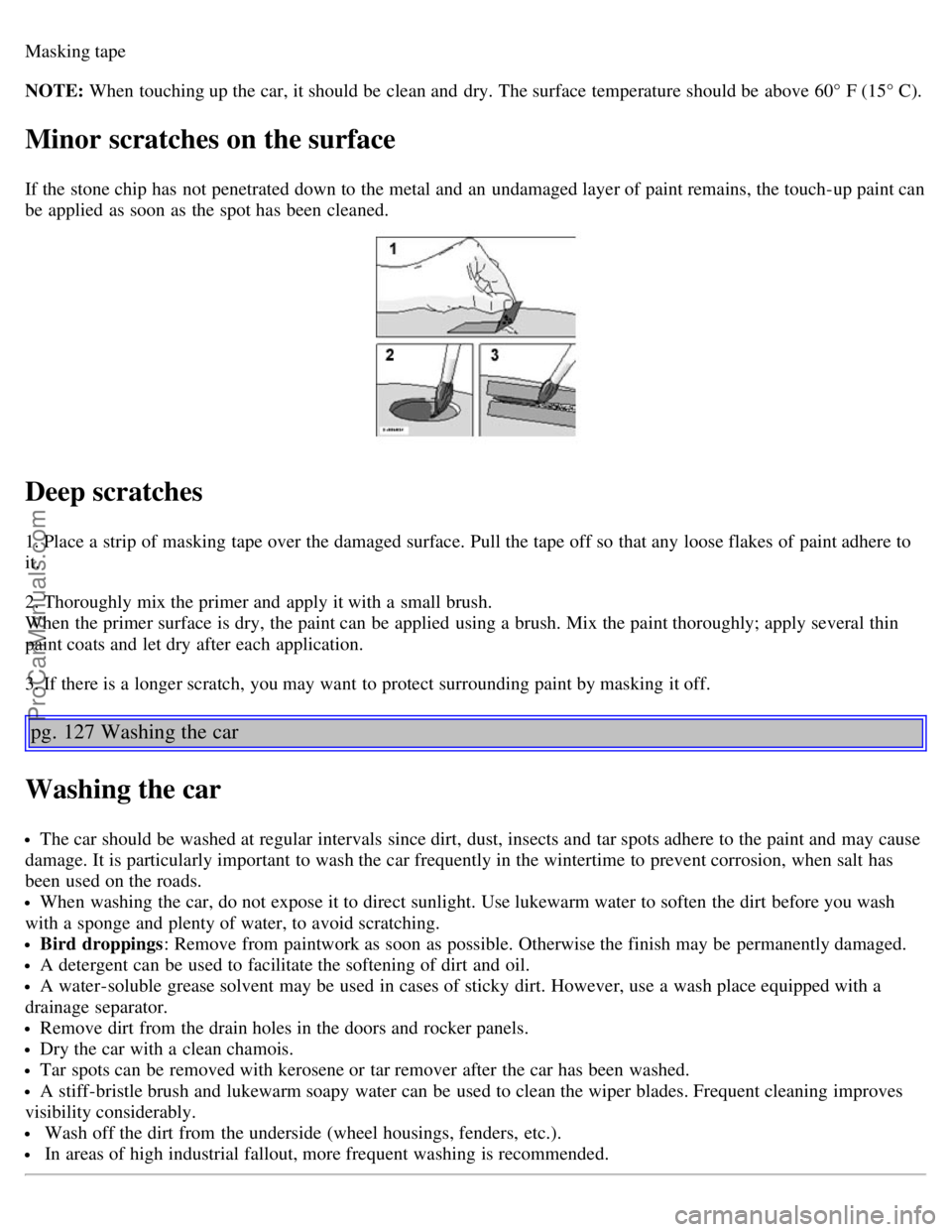
If the stone chip has not penetrated down to the metal and an undamaged layer of paint remains, the touch-up paint can
be applied as soon as the spot has been cleaned.
Deep scratches
1. Place a strip of masking tape over the damaged surface. Pull the tape off so that any loose flakes of paint adhere to
it.
2. Thoroughly mix the primer and apply it with a small brush.
When the primer surface is dry, the paint can be applied using a brush. Mix the paint thoroughly; apply several thin
paint coats and let dry after each application.
3. If there is a longer scratch, you may want to protect surrounding paint by masking it off.
pg. 127 Washing the car
Washing the car
The car should be washed at regular intervals since dirt, dust, insects and tar spots adhere to the paint and may cause
damage. It is particularly important to wash the car frequently in the wintertime to prevent corrosion, when salt has
been used on the roads.
When washing the car, do not expose it to direct sunlight. Use lukewarm water to soften the dirt before you wash
with a sponge and plenty of water, to avoid scratching.
Bird droppings : Remove from paintwork as soon as possible. Otherwise the finish may be permanently damaged.
A detergent can be used to facilitate the softening of dirt and oil.
A water-soluble grease solvent may be used in cases of sticky dirt. However, use a wash place equipped with a
drainage separator.
Remove dirt from the drain holes in the doors and rocker panels.
Dry the car with a clean chamois.
Tar spots can be removed with kerosene or tar remover after the car has been washed.
A stiff-bristle brush and lukewarm soapy water can be used to clean the wiper blades. Frequent cleaning improves
visibility considerably.
Wash off the dirt from the underside (wheel housings, fenders, etc.).
In areas of high industrial fallout, more frequent washing is recommended.
ProCarManuals.com
Page 94 of 117
CAUTION:
During high pressure washing, the spray mouthpiece must never be closer to the vehicle than 13" (30 cm). Do not
spray into the locks.
Special sun roof cautions:
- Always close the sun roof and sun shade before washing your vehicle.
- Never use abrasive cleaning agents on the sun roof.
- Never use wax on the rubber seals around the sun roof.
When washing or steam cleaning the engine, avoid spraying water or steam directly on the electrical components or
toward the rear side of the engine.
After cleaning the engine, the spark plug wells should be inspected for water and blown dry if necessary.
Suitable detergents: Special car washing detergents should be used. Mix according to manufacturer's instructions.
Bumpers: The bumpers are painted. Wash the bumpers with the same cleaning agent used on the rest of the car.
Never clean the bumpers with gasoline or paint thinner. Difficult spots can be removed with denatured alcohol. To
avoid scratches, do not dry the bumpers with paper.
WARNING!
When the car is driven immediately after being washed, apply the brakes several times in order to remove any
moisture from the brake linings.
Engine cleaning agents should not be used when the engine is warm. This constitutes a fire risk.
pg. 128 Washing the car, Cleaning the upholstery
Automatic washing - simple and quick
We do NOT recommend washing your car in an automatic wash during the first six months (because the
paint will not have hardened sufficiently).
An automatic wash is a simple and quick way to clean your car, but it is worth remembering that it may not be as
thorough as when you yourself go over the car with sponge and water. Keeping the underbody clean is most important,
especially in the winter. Some automatic washers do not have facilities for washing the underbody.
Before driving into an automatic wash, make sure that side view mirrors, auxiliary lamps, etc, are secure, otherwise
there is risk of the machine dislodging them.
Polishing and waxing
Normally, polishing is not required during the first year after delivery. However, waxing may be beneficial.
Before applying polish or wax the car must be washed and dried. Tar spots can be removed with kerosene or tar
remover. Difficult spots may require a fine rubbing compound.
After polishing, use liquid or paste wax.
Several commercially available products contain both polish and wax.
Waxing alone does not substitute for polishing of a dull surface.
A wide range of polymer-based car waxes can be purchased today. These waxes are easy to use and produce a long-
lasting, high-gloss finish that protects the bodywork against oxidation, road dirt and fading.
Do not polish or wax your car in direct sunlight (the surface of the car should not be warmer than 113° F (45° C).
ProCarManuals.com
Page 103 of 117
Always turn the ignition off when:
Replacing ignition components e.g. plugs, coil, etc.
Do not touch any part of the ignition system while the engine is running. This may result in a shock and bodily
injury.
Front suspension
Spring strut suspension with integrated shock absorbers and control arms linked to the support frame. Power-assisted
rack and pinion steering. Safety type steering column. The alignment specifications apply to an unladen car but include
fuel, coolant and spare wheel.
Rear suspension
Individual rear wheel suspension with longitudinal support arms, double link arms and track rods.
All specifications are subject to change without prior notice.
pg. 148 Electrical system
Electrical system
12 Volt, negative ground.
Voltage-controlled generator. Single-wire system with chassis and engine used as conductors. Grounded on chassis.
Battery
Voltage: 12 Volt, capacity: 600 A/115 min reserve capacity.
The battery contains corrosive and poisonous acids. It is of the utmost importance that old batteries are disposed of
correctly. Your Volvo retailer can assist you in this matter.
Generator
Rated output: max. current: 140 A
Starter motor:
Output: 1.7 kW
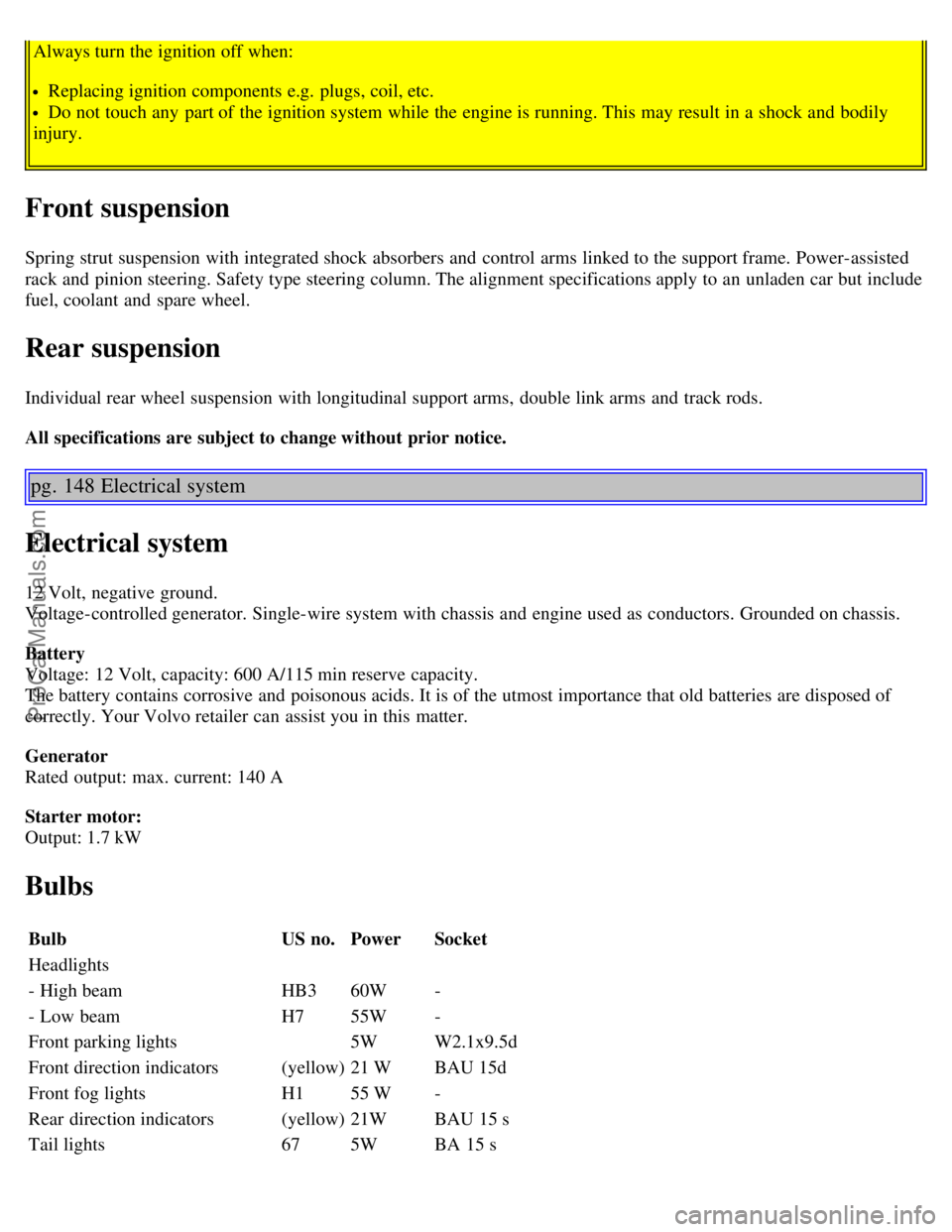
Bulbs
Bulb US no. Power Socket
Headlights
- High beam HB3 60W -
- Low beam H7 55W -
Front parking lights 5W W2.1x9.5d
Front direction indicators (yellow) 21 W BAU 15d Front fog lights H1 55 W -
Rear direction indicators (yellow) 21W BAU 15 s Tail lights 67 5W BA 15 s
ProCarManuals.com