automatic transmission VOLVO V70 2005 User Guide
[x] Cancel search | Manufacturer: VOLVO, Model Year: 2005, Model line: V70, Model: VOLVO V70 2005Pages: 139, PDF Size: 3.84 MB
Page 68 of 139

Front park assist: it may not be possible to combine auxiliary headlights and front park assist since these lights
could trigger the system's sensors.
Faults in the system
If a fault should occur in the system, the LED in the button will be switched off and a message will be displayed in the
text window.
Cleaning the sensors
For the system to function properly, the sensors in the front and/or rear bumpers should be kept clean. They can be
cleaned with car washing detergent and a sponge.
WARNING!
These systems are designed to be a supplementary aid when parking the vehicle. They are not, however, intended to
replace the driver's attention and judgement.
pg. 101 Driving economy, Handling
Economical driving conserves natural resources
Better driving economy may be obtained by thinking ahead, avoiding rapid starts and stops and adjusting the speed of
your vehicle to immediate traffic conditions. Observe the following rules:
Bring the engine to normal operating temperature as soon as possible by driving with a light foot on the accelerator
pedal for the first few minutes of operation. A cold engine uses more fuel and is subject to increased wear.
Whenever possible, avoid using the car for driving short distances. This does not allow the engine to reach normal
operating temperature.
Drive carefully and avoid rapid acceleration and hard braking.
Do not exceed posted speed limits.
Avoid carrying unnecessary items (extra load) in the car.
Maintain correct tire pressure. Check tire pressure regularly (when tires are cold).
Remove snow tires when threat of snow or ice has ended.
Note that roof racks, ski racks, etc., increase air resistance and fuel consumption.
Avoid using automatic transmission kickdown feature unless necessary.
Avoid using the air conditioning when it is not required. When engaged, the A/C compressor places an additional
load on the engine. However, at higher driving speeds, fuel consumption will be lower with the air conditioning on and
the windows closed than with the air conditioning off and the windows open.
Using the onboard trip computer's fuel consumption modes can help you learn how to drive more economically.
Other factors that decrease gas mileage are:
Dirty air cleaner
Dirty engine oil and clogged oil filter
Dragging brakes
Incorrect front end alignment Some of the above mentioned items and others are checked at the standard
Maintenance Service intervals.
NOTE: Vehicles equipped with automatic transmissions should use (D)rive as often as possible and avoid using
"kick -down" to help improve fuel economy. Vehicles equipped with manual transmissions should use fifth gear at
highway speeds. At other times, choose the highest gear that still allows smooth acceleration.
Handling, roadholding
Vehicle load, tire design and inflation pressure all affect vehicle handling. Therefore, check that the tires are inflated to
the recommended pressure according to the vehicle load. See "Tire pressure" section. Loads should be distributed so
that capacity weight or maximum permissible axle loads are not exceeded.
ProCarManuals.com
Page 84 of 139
Recommended tire pressure (see the placard on the B-pillar or on the fuel filler door) should be maintained irrespective
of which position on the car the temporary spare tire is used on.
In the event of damage to this tire, a new one can be purchased from your Volvo retailer.WARNING!
Current legislation prohibits the use of the "Temporary Spare" tire other than as a temporary replacement for a
punctured tire. It must be replaced as soon as possible by a standard tire. Road holding and handling may be affected
with the "Temporary Spare" in use. Do not exceed 50 mph (80 km/h). Do not drive farther than 50 miles (80 km) on
a temporary spare tire.
CAUTION:
The car must not be driven with wheels of different dimensions or with a spare tire other than the one that came with
the car. The use of different size wheels can seriously damage your car's transmission.
pg. 126 Changing a wheel
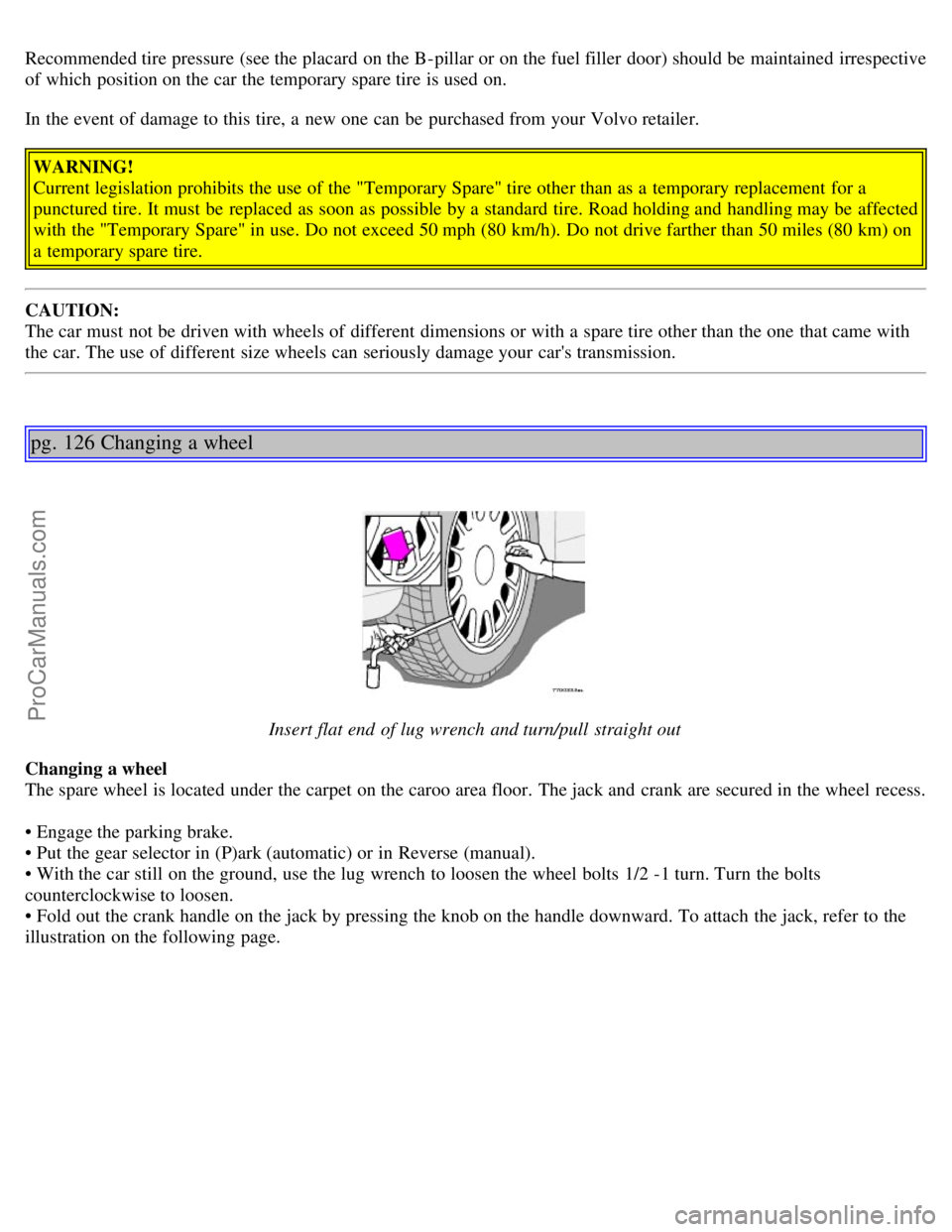
Insert flat end of lug wrench and turn/pull straight out
Changing a wheel
The spare wheel is located under the carpet on the caroo area floor. The jack and crank are secured in the wheel recess.
• Engage the parking brake.
• Put the gear selector in (P)ark (automatic) or in Reverse (manual).
• With the car still on the ground, use the lug wrench to loosen the wheel bolts 1/2 -1 turn. Turn the bolts
counterclockwise to loosen.
• Fold out the crank handle on the jack by pressing the knob on the handle downward. To attach the jack, refer to the
illustration on the following page.
ProCarManuals.com
Page 86 of 139
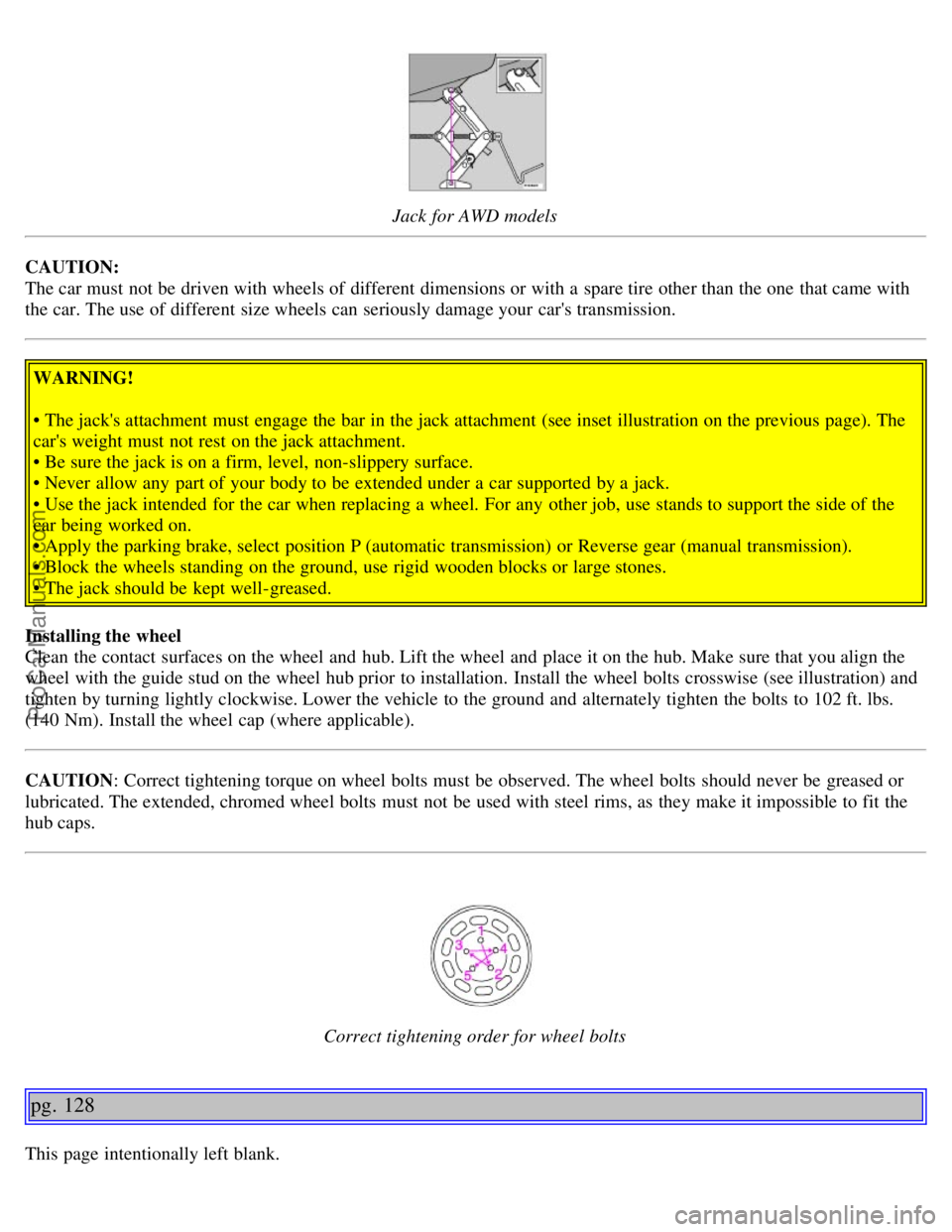
Jack for AWD models
CAUTION:
The car must not be driven with wheels of different dimensions or with a spare tire other than the one that came with
the car. The use of different size wheels can seriously damage your car's transmission.
WARNING!
• The jack's attachment must engage the bar in the jack attachment (see inset illustration on the previous page). The
car's weight must not rest on the jack attachment.
• Be sure the jack is on a firm, level, non-slippery surface.
• Never allow any part of your body to be extended under a car supported by a jack.
• Use the jack intended for the car when replacing a wheel. For any other job, use stands to support the side of the
car being worked on.
• Apply the parking brake, select position P (automatic transmission) or Reverse gear (manual transmission).
• Block the wheels standing on the ground, use rigid wooden blocks or large stones.
• The jack should be kept well-greased.
Installing the wheel
Clean the contact surfaces on the wheel and hub. Lift the wheel and place it on the hub. Make sure that you align the
wheel with the guide stud on the wheel hub prior to installation. Install the wheel bolts crosswise (see illustration) and
tighten by turning lightly clockwise. Lower the vehicle to the ground and alternately tighten the bolts to 102 ft. lbs.
(140 Nm). Install the wheel cap (where applicable).
CAUTION : Correct tightening torque on wheel bolts must be observed. The wheel bolts should never be greased or
lubricated. The extended, chromed wheel bolts must not be used with steel rims, as they make it impossible to fit the
hub caps.
Correct tightening order for wheel bolts
pg. 128
This page intentionally left blank.
ProCarManuals.com
Page 112 of 139
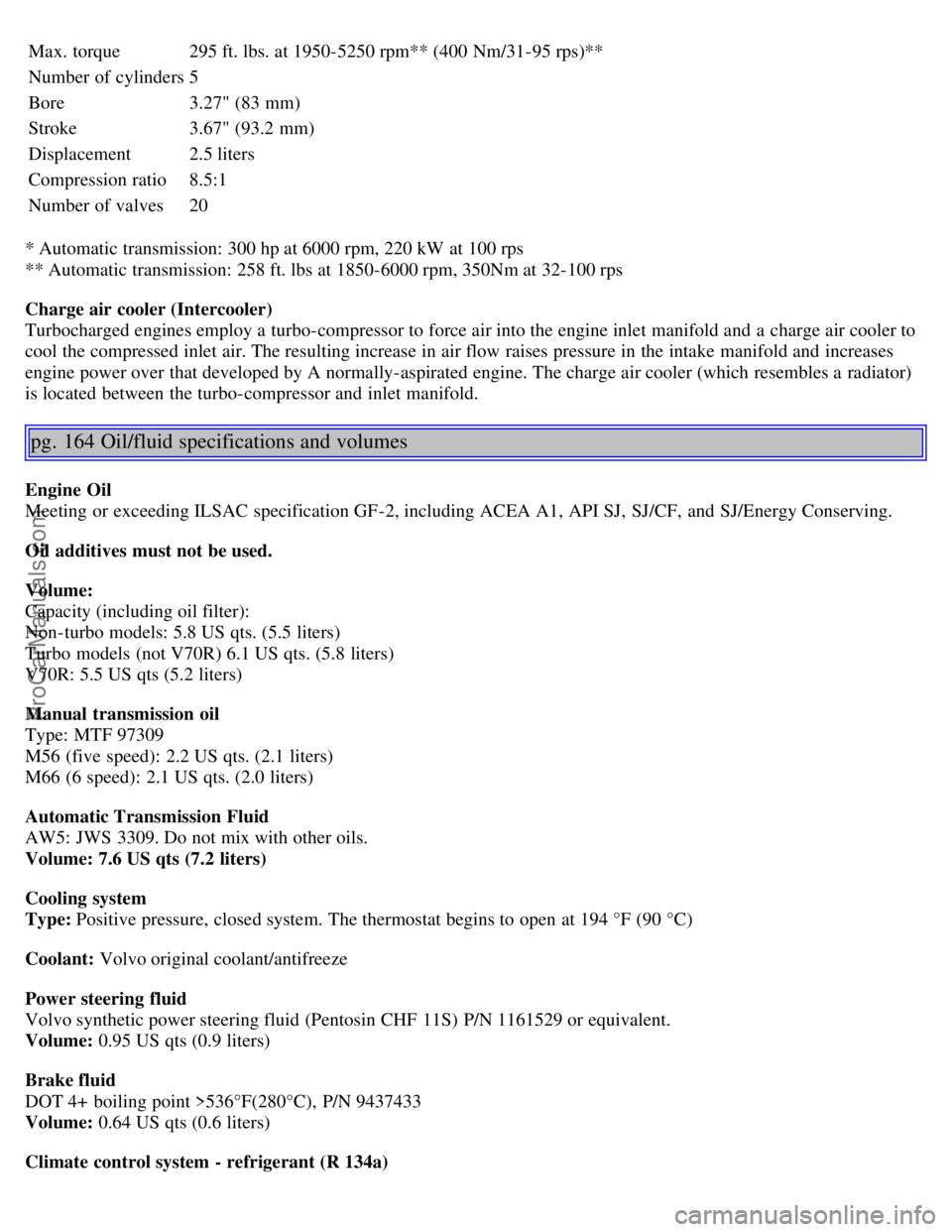
Max. torque 295 ft. lbs. at 1950-5250 rpm** (400 Nm/31-95 rps)**
Number of cylinders 5
Bore3.27" (83 mm)
Stroke 3.67" (93.2 mm)
Displacement 2.5 liters
Compression ratio 8.5:1
Number of valves 20
* Automatic transmission: 300 hp at 6000 rpm, 220 kW at 100 rps
** Automatic transmission: 258 ft. lbs at 1850-6000 rpm, 350Nm at 32-100 rps
Charge air cooler (Intercooler)
Turbocharged engines employ a turbo-compressor to force air into the engine inlet manifold and a charge air cooler to
cool the compressed inlet air. The resulting increase in air flow raises pressure in the intake manifold and increases
engine power over that developed by A normally-aspirated engine. The charge air cooler (which resembles a radiator)
is located between the turbo-compressor and inlet manifold.
pg. 164 Oil/fluid specifications and volumes
Engine Oil
Meeting or exceeding ILSAC specification GF-2, including ACEA A1, API SJ, SJ/CF, and SJ/Energy Conserving.
Oil additives must not be used.
Volume:
Capacity (including oil filter):
Non-turbo models: 5.8 US qts. (5.5 liters)
Turbo models (not V70R) 6.1 US qts. (5.8 liters)
V70R: 5.5 US qts (5.2 liters)
Manual transmission oil
Type: MTF 97309
M56 (five speed): 2.2 US qts. (2.1 liters)
M66 (6 speed): 2.1 US qts. (2.0 liters)
Automatic Transmission Fluid
AW5: JWS 3309. Do not mix with other oils.
Volume: 7.6 US qts (7.2 liters)
Cooling system
Type: Positive pressure, closed system. The thermostat begins to open at 194 °F (90 °C)
Coolant: Volvo original coolant/antifreeze
Power steering fluid
Volvo synthetic power steering fluid (Pentosin CHF 11S) P/N 1161529 or equivalent.
Volume: 0.95 US qts (0.9 liters)
Brake fluid
DOT 4+ boiling point >536°F(280°C), P/N 9437433
Volume: 0.64 US qts (0.6 liters)
Climate control system - refrigerant (R 134a)
ProCarManuals.com
Page 128 of 139
2 0 0 5
VOLVO V70
INDEX
pg. 189 - 192 Index
A
ABS 21
ABS - warning light31
Active chassis system99
Adjusting the steering wheel38
Air conditioning52 - 55
Air filter - engine149
Air vents50
Airbag (SIPS)10
Airbag (SRS)4
Alarm84, 85
Alarm - "panic" function84
All Wheel Drive
- general information98
ALR/ELR16
Anti-lock Brake System (ABS)21
Anti-lock Brake System - warning light31
Antifreeze110, 148
Approach lighting80
Armrest (center) - 3-section rear seat69
Ashtray43
Audio systems169
- CD player180, 181
- specifications185
Automatic car washing144
Automatic Locking Retractor (ALR)16
Automatic transmission94, 95
- Cold starts95
- Geartronic96, 97
- Kickdown95, 96
- Sport mode97
Auxiliary socket43
ProCarManuals.com
Page 131 of 139

Four-C active chassis system99
Front airbags - SRS4 - 9
Front airbags - SRS - warning light30
Front courtesy lights - replacing140
Front fog lights38
Front park assist (accessory)100
Front reading lights78
Front seats - adjusting60, 61
Front seats - heated42
Front suspension165
Fuel88
Fuel filler cap90
Fuel filler door, unlocking37
Fuel filter149
Fuel formulations89
Fuel gauge29
Fuel requirements88
Fuel system147, 149, 165
Fuel/emissions systems147
Fuses130-134
G
Gas cap90
Gasoline88
Gear indicator29
Geartronic (automatic transmission)96, 97
Generator166
Generator warning light30
Glossary of tire terminology121
H
Hand brake43
Handgrip - XC7059, 77
Handling101
Hazard warning flashers42
Head restraint (center) - 3-section rear seat68
Head restraint - center rear3
Headlight wiper blades - replacing157
Headlights37
Heated front seats42
Heated rear window42
Heated sideview mirrors42
Heating52-55
Hoisting the car150
Holder for grocery bags71
Home Safe System80
ProCarManuals.com
Page 134 of 139

Remote control - Homelink® Universal Transceiver187
Remote keyless entry system81
Remote keyless entry system - replacing batteries82
Removing the seat cushion70
Replacing bulbs135-141
Replacing fuses130
Replacing the battery155
Replacing wiper blades157
Road assistance167
Roadholding101
Roof load - maximum162
Roof racks103
Run flat tires119
S
Safety locks - child86
Seat belt maintenance19
Seat belts2, 3, 16
Seat belts - cleaning145
Seats - front60, 61
Securing cargo72
Self supporting run flat tires119
Servicing150
Shiftlock91, 94, 96
Side impact airbag system (SIPS)10
Side windows - laminated41
Sideview mirrors45
Sideview mirrors - heated42
Sideview mirrors - memory function45
Spare tire76
Spark plugs149, 165
Specifications163
Speed -sensitive power steering101
Sport mode (automatic transmission)97
SRS6
SRS diagnostic system30
Stability Traction Control (STC)21
Start inhibitor (immobilizer)80, 91
Starting the engine91, 92
Steel grid73
Steering wheel adjustment38
Steering wheel lock38
Stop and Store bag68
Storage compartments63
Storage in the glove compartment65
ProCarManuals.com
Page 135 of 139
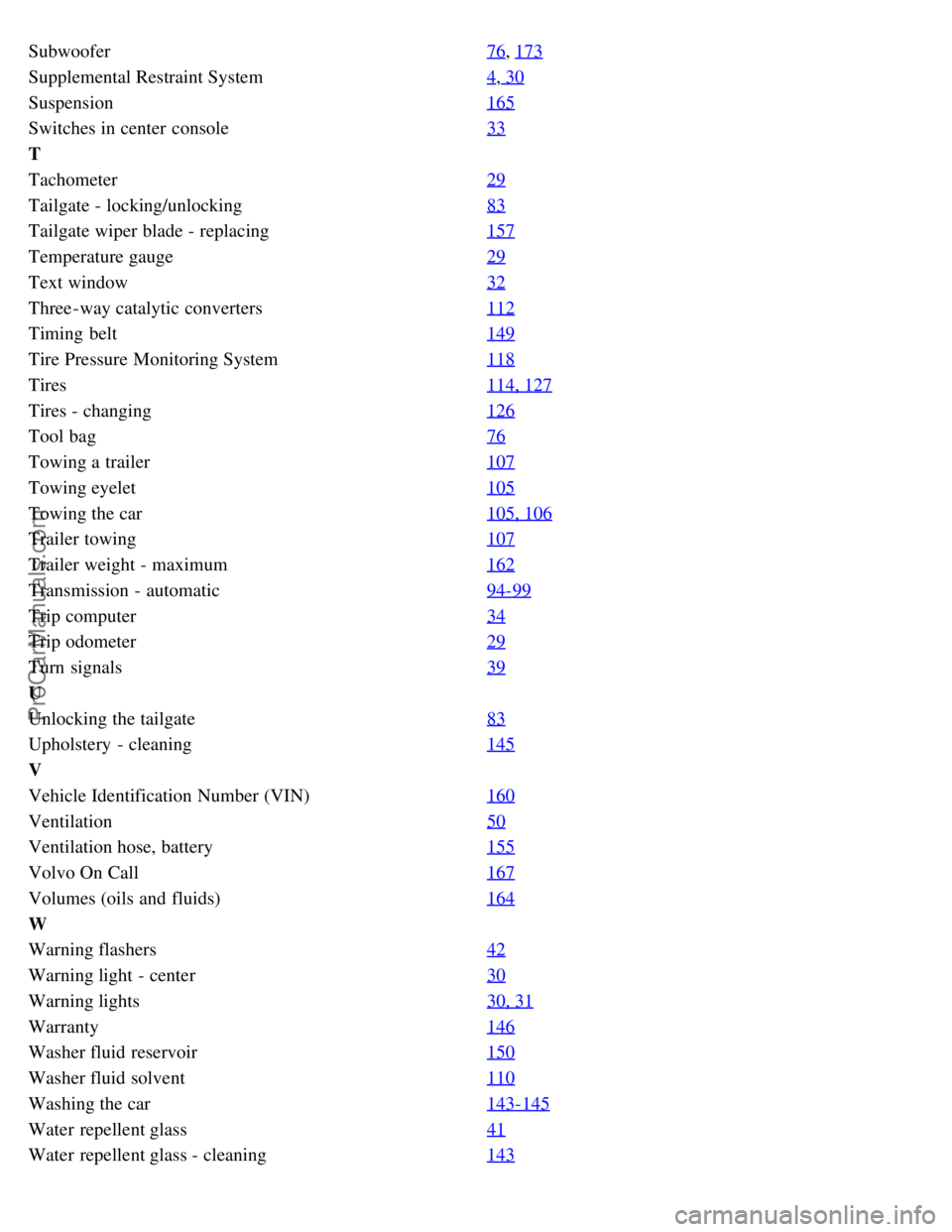
Subwoofer76, 173
Supplemental Restraint System4, 30
Suspension165
Switches in center console33
T
Tachometer29
Tailgate - locking/unlocking83
Tailgate wiper blade - replacing157
Temperature gauge29
Text window32
Three-way catalytic converters112
Timing belt149
Tire Pressure Monitoring System118
Tires114, 127
Tires - changing126
Tool bag76
Towing a trailer107
Towing eyelet105
Towing the car105, 106
Trailer towing107
Trailer weight - maximum162
Transmission - automatic94-99
Trip computer34
Trip odometer29
Turn signals39
U
Unlocking the tailgate83
Upholstery - cleaning145
V
Vehicle Identification Number (VIN)160
Ventilation50
Ventilation hose, battery155
Volvo On Call167
Volumes (oils and fluids)164
W
Warning flashers42
Warning light - center30
Warning lights30, 31
Warranty146
Washer fluid reservoir150
Washer fluid solvent110
Washing the car143-145
Water repellent glass41
Water repellent glass - cleaning143
ProCarManuals.com