belt VOLVO V70 2005 User Guide
[x] Cancel search | Manufacturer: VOLVO, Model Year: 2005, Model line: V70, Model: VOLVO V70 2005Pages: 139, PDF Size: 3.84 MB
Page 15 of 139

pg. 9 Occupant Weight Sensor (OWS)*
WARNING!
Never try to open, remove, or repair any components in the OWS system. This could result in system malfunction.
Maintenance or repairs should only be carried out by an authorized Volvo service technician.
*NOTE: Not available on the V70R. WARNING!
Keep the following points in mind with respect to the OWS system. Failure to follow these instructions could
adversely affect the system's function and result in serious injury to the occupant of the front passenger's seat:
The full weight of the front seat passenger should always be on the seat cushion. The passenger should never lift
him/herself off the seat cushion using the armrest in the door or the center console, by pressing the feet on the floor,
by sitting on the edge of the seat cushion, or by pressing against the backrest in a way that reduces pressure on the
seat cushion. This could cause OWS to disable the front, passenger's side airbag.
The front passenger's seat should not be modified in any way. This could reduce pressure on the seat cushion, which
might interfere with the OWS system's function.
Do not place any type of object on the front passenger's seat in such a way that jamming, pressing, or squeezing
occurs between the object and hte front seat, other than as a direct result of the correct use of the ALR/ELR seat belt
(see page 16)
.
No objects should be placed under the front passenger's seat. This could interfere with the OWS system's function.
WARNING!
No objects that add to the total weight on the seat should be placed on the front passenger's seat. If a child is seated
in the front passenger's seat with any additional weight, this extra weight could cause the OWS system to enable the
airbag, which might cause it to deploy in the event of a collision, thereby injuring the child.
The seat belt should never be wrapped around an object on the front passenger's seat. This could interfere with the
OWS system's function.
The front passenger's seat belt should never be used in a way that exerts more pressure on the passenger than
normal. This could increase the pressure exerted on the weight sensor by a child, and could result in the airbag being
enabled, which might cause it to deploy in the event of a collision, thereby injuring the child.
pg. 10 Side impact airbags (SIPS)
ProCarManuals.com
Page 16 of 139
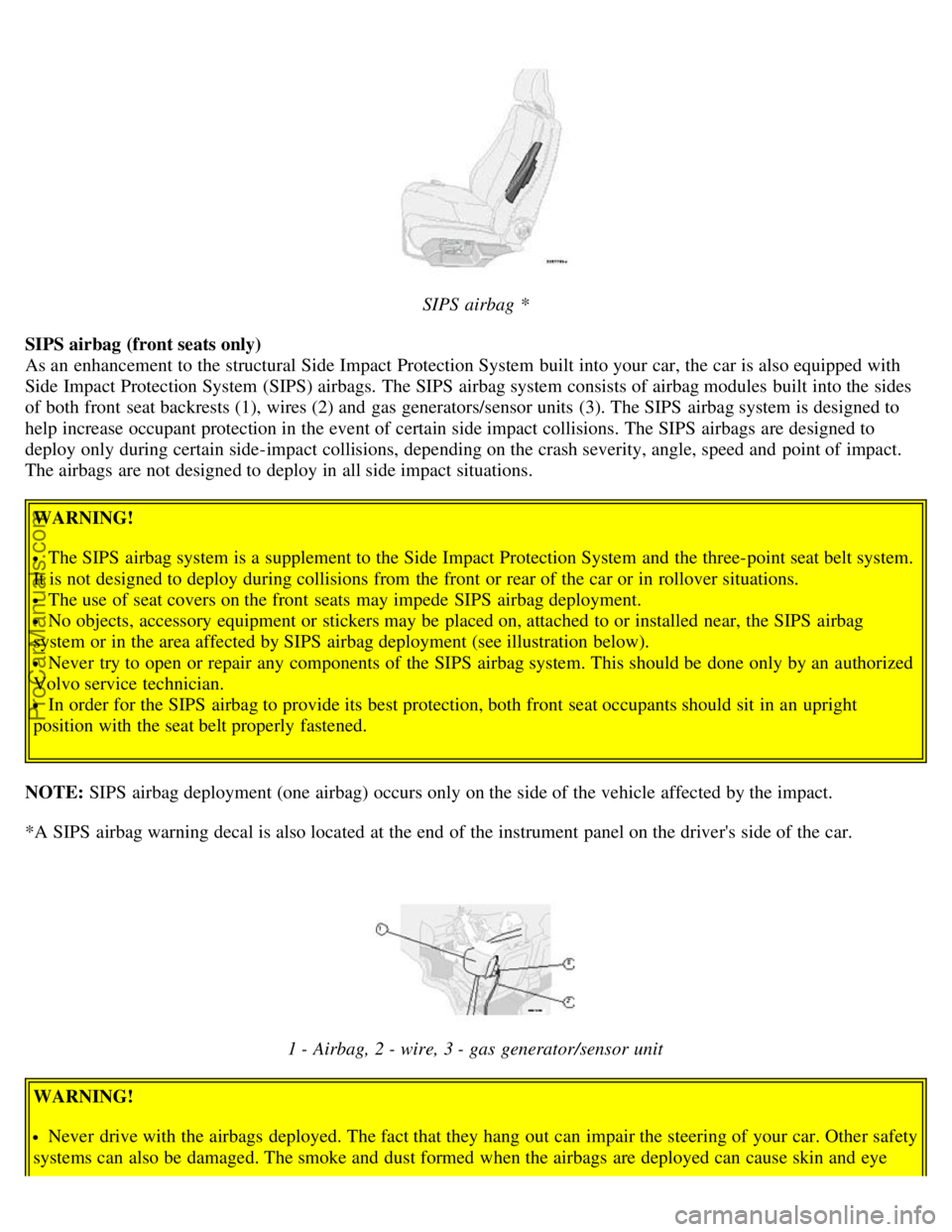
SIPS airbag *
SIPS airbag (front seats only)
As an enhancement to the structural Side Impact Protection System built into your car, the car is also equipped with
Side Impact Protection System (SIPS) airbags. The SIPS airbag system consists of airbag modules built into the sides
of both front seat backrests (1), wires (2) and gas generators/sensor units (3). The SIPS airbag system is designed to
help increase occupant protection in the event of certain side impact collisions. The SIPS airbags are designed to
deploy only during certain side-impact collisions, depending on the crash severity, angle, speed and point of impact.
The airbags are not designed to deploy in all side impact situations.
WARNING!
The SIPS airbag system is a supplement to the Side Impact Protection System and the three-point seat belt system.
It is not designed to deploy during collisions from the front or rear of the car or in rollover situations.
The use of seat covers on the front seats may impede SIPS airbag deployment.
No objects, accessory equipment or stickers may be placed on, attached to or installed near, the SIPS airbag
system or in the area affected by SIPS airbag deployment (see illustration below).
Never try to open or repair any components of the SIPS airbag system. This should be done only by an authorized
Volvo service technician.
In order for the SIPS airbag to provide its best protection, both front seat occupants should sit in an upright
position with the seat belt properly fastened.
NOTE: SIPS airbag deployment (one airbag) occurs only on the side of the vehicle affected by the impact.
*A SIPS airbag warning decal is also located at the end of the instrument panel on the driver's side of the car.
1 - Airbag, 2 - wire, 3 - gas generator/sensor unit
WARNING!
Never drive with the airbags deployed. The fact that they hang out can impair the steering of your car. Other safety
systems can also be damaged. The smoke and dust formed when the airbags are deployed can cause skin and eye
ProCarManuals.com
Page 18 of 139
The inflatable curtains are designed to deploy only during certain side-impact collisions, depending on the crash
severity, angle, speed and impact. The inflatable curtains are not designed to deploy in all side impact situations.
In order for the IC to provide its best protection, both front seat occupants and both outboard rear seat occupants
should sit in an upright position with the seat belt properly fastened; adults using the seat belt and children using the
proper child restraint system. Only adults should sit in the front seats. Children must never be allowed in the front
passenger seat. See page 16
for guidelines. Failure to follow these instructions can result in injury to the vehicle
occupants.
When the rear seat backrest(s) are folded down, the car should not be loaded to a level higher than 2 in. (5 cm)
below the upper edge of the rear passenger door windows. Objects placed higher than this level could impede the
function of the inflatable curtain.
pg. 12 Whiplash Protection System (WHIPS)
Whiplash Protection System (WHIPS) - front seats only
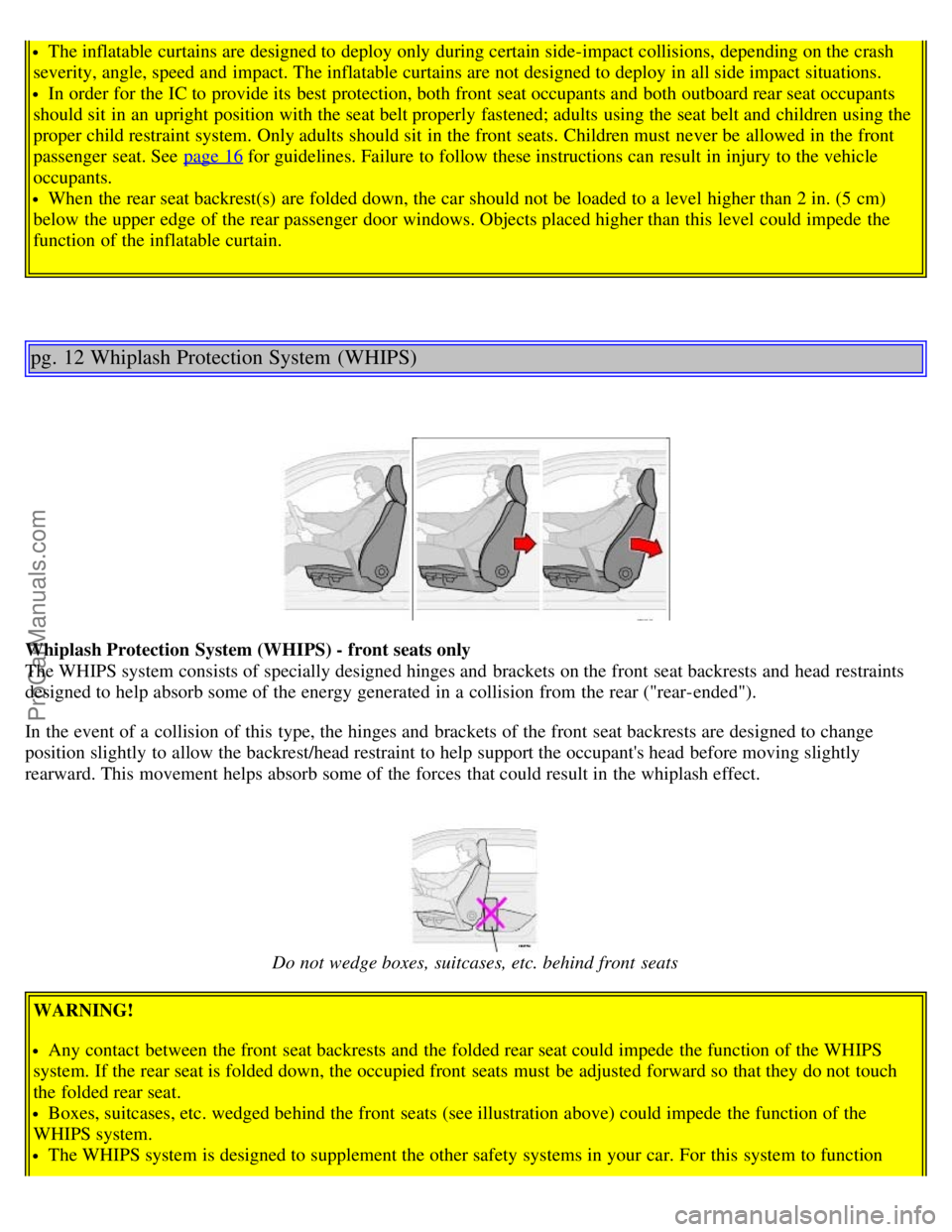
The WHIPS system consists of specially designed hinges and brackets on the front seat backrests and head restraints
designed to help absorb some of the energy generated in a collision from the rear ("rear-ended").
In the event of a collision of this type, the hinges and brackets of the front seat backrests are designed to change
position slightly to allow the backrest/head restraint to help support the occupant's head before moving slightly
rearward. This movement helps absorb some of the forces that could result in the whiplash effect.
Do not wedge boxes, suitcases, etc. behind front seats
WARNING!
Any contact between the front seat backrests and the folded rear seat could impede the function of the WHIPS
system. If the rear seat is folded down, the occupied front seats must be adjusted forward so that they do not touch
the folded rear seat.
Boxes, suitcases, etc. wedged behind the front seats (see illustration above) could impede the function of the
WHIPS system.
The WHIPS system is designed to supplement the other safety systems in your car. For this system to function
ProCarManuals.com
Page 19 of 139
properly, the three-point seat belt must be worn. Please be aware that no system can prevent all possible injuries that
may occur in an accident.
If your car has been involved in a collision, the front seat backrests must be inspected by an authorized Volvo
retailer even if the seats appear to be undamaged. Certain components in the WHIPS system may need to be
replaced. Do not attempt to service any component in the WHIPS system yourself.
If the rear seat backrests are folded down, cargo must be secured to prevent it from sliding forward against the
front seat backrests in the event of a collision from the rear. This could interfere with the action of the WHIPS
system.
The WHIPS system is designed to function in certain collisions from the rear, depending on the crash severity,
angle and speed.
Occupants in the front seats must never sit out of position. The occupant's back must be as upright as comfort
allows and be against the seat back with the seat belt properly fastened.
Contents | Top of Page
ProCarManuals.com
Page 25 of 139

Rear fog light
This light indicates that the rear fog light is on.
Malfunction indicator lamp
On-Board Diagnostic II (OBDII): As you drive, a computer called "OBDII" monitors your car's engine, transmission,
electrical and emission systems. The CHECK ENGINE light will light up if the computer senses a condition that
potentially may need correcting. When this happens, please have your car checked by a Volvo retailer as soon as
possible.
A CHECK ENGINE light may have many causes. Sometimes, you may not notice a change in your car's behavior.
Even so, an uncorrected condition could hurt fuel economy, emission cleanliness, and driveability. Extended driving
without correcting the cause could even damage other components in your car.
Canadian models are equipped with this warning light:
NOTE : If the fuel filler cap is not closed tightly or if the engine is running when the car is refueled, the Malfunction
Indicator Lamp may indicate a fault. However, your vehicle's performance will not be affected. Use only Volvo
original or approved fuel filler caps.
Anti-lock Brake System ABS
If the warning light comes on, there is a malfunction of the ABS system (the standard braking system will still
function). The vehicle should be driven to a Volvo retailer for inspection. See page 21
for additional information.
Stability Traction Control (STC) system (option), or Dynamic Stability and Traction Control (DSTC) system
(option)
An indicator light will flash when STC or DSTC is actively working to stabilize the car. See pages 22-23
for more
detailed information.
Turn signal indicator - trailer (certain models)
If you are towing a trailer, this light will flash simultaneously with the turn signals on the trailer. If the light does not
flash when signaling, neither the trailer's turn signals nor the car's turn signals are functioning.
Seat belt reminder
This symbol lights up to indicate that the driver has not fastened his/her seat belt.
Tire pressure warning light
ProCarManuals.com
Page 58 of 139

additional information.
WARNING!
Never carry a cell phone that is switched on while refueling your vehicle. If the phone rings, this may cause a spark
that could ignite gasoline fumes, resulting in fire and injury.
CAUTION:
Do not refuel with the engine running *. Turn the ignition off or to position I. If the ignition is on, an incorrect
reading could occur in the fuel gauge.
After refueling, close the fuel filler cap by turning it clockwise until it clicks into place *.
Allow for fuel expansion by not overfilling the tank. Overfilling could also cause damage to the emission control
systems.
Avoid spilling gasoline when refueling. In addition to causing damage to the environment, gasolines containing
alcohol can cause damage to painted surfaces, which may not be covered under the New Vehicle Limited Warranty.
Do not use gasolines containing methanol (methyl alcohol, wood alcohol). This practice can result in vehicle
performance deterioration and can damage critical parts in the fuel system. Such damage may not be covered under the
New Vehicle Limited Warranty.
* If the fuel filler cap is not closed tightly or if the engine is running when the car is refueled, the Check Engine light
(malfunction indicator lamp) may indicate a fault. However, your vehicle's performance will not be affected. Use only
Volvo original or approved fuel filler caps.
pg. 91 Starting the engine
Starting the engine
1. Fasten the seat belt.
WARNING!
Before starting, check that the seat, steering wheel and mirrors adjusted properly.
Make sure the brake pedal can be depressed completely. Adjust the seat if necessary. See page 60.
2. Apply the parking brake, if not already set. The gear selector ( automatic transmission) is locked in the (P)ark
position ( SHIFT -LOCK ).
Manual transmission: the clutch must be fully depressed.
3. Without touching the accelerator pedal, turn the ignition key* to the starting position. Allow the starter to operate
for up to 10 seconds. Release the key as soon as the engine starts. If the engine fails to start, repeat this step.
For cold starts at altitudes above 6000 ft (1800 meters), depress the accelerator pedal halfway and turn the key to the
starting position. Release the pedal slowly when the engine starts.
NOTE:
On certain models, when the car is started, idle speed may be noticeably higher than normal for a short period,
depending on the temperature of the engine.
This has been done to help bring components in the emission control system to their normal operating temperature as
quickly as possible, which enables them to function normally.
For cold starts at altitudes above 6000 ft (1800 meters), depress the accelerator pedal halfway and turn the key to the
starting position. Release the pedal slowly when the engine starts.
4. To release the gear selector from the (P)ark position, the engine must be running (or the ignition key must be in
position II) and the brake pedal must be depressed. While keeping firm pressure on the brake pedal, release the parking
brake.
ProCarManuals.com
Page 88 of 139
2 0 0 5
VOLVO V70
Chapter 8 - Maintenance/Servicing
pg. 129 Maintenance/Servicing
Fuses130
Replacing bulbs135
Paint touch up142
Washing the car143
Cleaning the upholstery145
Maintenance service, Warranty146
Fuel/emissions systems147
Drive belt, Coolant148
Emissions maintenance149
Washer fluid reservoir, Hoisting the car150
Opening the hood, Engine compartment151
Engine oil152
Power steering/Brake fluid reservoirs154
Replacing the battery155
Battery maintenance156
Replacing wiper blades157
pg. 130 Fuses
ProCarManuals.com
Page 106 of 139
Start from the outside of the stain and work toward the center.
Sharp objects (e.g. pencils or pens in a pocket) or velcro fasteners on clothing may damage the textile upholstery.
Cleaning the seat belts
Clean only with lukewarm water and mild soap solution.
Cleaning floor mats
The floor mats should be vacuumed or brushed clean regularly, especially during winter when they should be taken out
for drying. Spots on textile mats can be removed with a mild detergent.
Bear in mind
Take extra care when removing stains such as ink or lipstick since the coloring can spread.
Use solvents sparingly. Too much solvent can damage the seat padding.
Start from the outside of the stain and work toward the center.
pg. 146 Maintenance service, Warranty
Maintenance service
Volvo advises you to follow the service program outlined in the Warranty and Service Records Information booklet.
This maintenance program contains inspections and services necessary for the proper function of your car. The
maintenance services contain several checks which require special instruments and tools and therefore must be
performed by a qualified technician. To keep your Volvo in top condition, specify time-tested and proven Genuine
Volvo Parts and Accessories.
The Federal Clean Air Act - U.S.
The Federal Clean Air Act requires vehicle manufacturers to furnish written instructions to the ultimate purchaser to
assure the proper servicing and function of the components that control emissions. These services, which are listed in
the "Warranty and Service Records Information booklet," are not covered by the warranty. You will be required to pay
for labor and material used.
Maintenance services
Your Volvo passed several major inspections before it was delivered to you, in accordance with Volvo specifications.
The maintenance services outlined in the Warranty and Service Records Information booklet, many of which will
positively affect your vehicle's emissions, should be performed as indicated. It is recommended that receipts for
vehicle emission services be retained in case questions arise concerning maintenance.
Inspection and service should also be performed anytime a malfunction is observed or suspected.
Page 149
provides information about maintenance of emission-related components.
Applicable warranties - U.S.
In accordance with applicable U.S. and Canadian regulations, the following list of warranties is provided.
New Car Limited Warranty
Parts and Accessories Limited Warranty
Corrosion Protection Limited Warranty
Seat Belt and Supplemental Restraint Systems Limited Warranty
Emission Design and Defect Warranty
Emission Performance Warranty
These are the Federal warranties; other warranties are provided as required by state/provincial law. Refer to your
separate Warranty and Service Records Information booklet for detailed information concerning each of the warranties.
ProCarManuals.com
Page 130 of 139

Courtesy light78
Courtesy lights (front) - replacing140
Courtesy lights - exterior80
Cruise control35
D
Detachable trailer hitch - installing108
Dimensions161
Direction indicators39
Distributor ignition system165
Door step courtesy lights - replacing141
Doors and locks80
Drive belt148
Driving economy101
Driving mode indicator29
Driving mode W95, 97, 110
Driving with trunk open102
E
Economical driving101
Electric socket in cargo compartment71
Electrical system166
Electrical system - general information102
Electrically operated moonroof46
Electrically operated sideview mirrors45
Electrically operated windows44
Electronic Brake Force Distribution21
Electronic Climate Control (ECC)52 - 55
Emergency Locking Retractor (ELR)16
Emergency towing105, 106
Emergency warning flashers42
Emissions systems147
Engine - specifications163
Engine - starting91, 92
Engine air filter149
Engine compartment151
Engine oil110, 152, 153
Extension of cargo compartment67
Exterior courtesy lights80
Exterior features - overview27
Extra seat77
F
Fog light - rear31
, 38
Fog lights - front38
Folding passenger's seat backrest62
Folding table66
ProCarManuals.com
Page 134 of 139

Remote control - Homelink® Universal Transceiver187
Remote keyless entry system81
Remote keyless entry system - replacing batteries82
Removing the seat cushion70
Replacing bulbs135-141
Replacing fuses130
Replacing the battery155
Replacing wiper blades157
Road assistance167
Roadholding101
Roof load - maximum162
Roof racks103
Run flat tires119
S
Safety locks - child86
Seat belt maintenance19
Seat belts2, 3, 16
Seat belts - cleaning145
Seats - front60, 61
Securing cargo72
Self supporting run flat tires119
Servicing150
Shiftlock91, 94, 96
Side impact airbag system (SIPS)10
Side windows - laminated41
Sideview mirrors45
Sideview mirrors - heated42
Sideview mirrors - memory function45
Spare tire76
Spark plugs149, 165
Specifications163
Speed -sensitive power steering101
Sport mode (automatic transmission)97
SRS6
SRS diagnostic system30
Stability Traction Control (STC)21
Start inhibitor (immobilizer)80, 91
Starting the engine91, 92
Steel grid73
Steering wheel adjustment38
Steering wheel lock38
Stop and Store bag68
Storage compartments63
Storage in the glove compartment65
ProCarManuals.com