air filter VOLVO V70 2005 Owners Manual
[x] Cancel search | Manufacturer: VOLVO, Model Year: 2005, Model line: V70, Model: VOLVO V70 2005Pages: 139, PDF Size: 3.84 MB
Page 31 of 139

Air flow
The air that is drawn into the passenger compartment is distributed from 14 ventilation points.
Air vents in door pillars
Air vents in door pillars
A Open
B Closed
C Horizontal air flow
D Vertical air flow
Direct the air vents toward the rear side windows to demist.
Direct the air vents toward the rear seat for the best heating/cooling effect.
pg. 51 Climate control system - general information
Condensation on the inside of the windows
Keeping the insides of the windows clean will help reduce the amount of condensation that forms on the windows. Use
a commercial window cleaning agent to clean the windows.
Ice and snow
Always keep the air intake grille at the base of the windshield free of snow.
Cabin air filter
Replace the cabin air filter with a new one at the recommended intervals. Please refer to your Warranty and Service
Records Information booklet, or consult your Volvo retailer for these intervals. The filter should be replaced more
often when driving under dirty and dusty conditions. The filter cannot be cleaned and therefore should always be
replaced with a new one.
ProCarManuals.com
Page 34 of 139

on the outside air and then revert back to fresh air.
Timer mode deactivation: Press and hold the recirculation button for at least 3 seconds. The amber LED in the
recirculation button will illuminate steadily for 5 seconds to show a return to "normal" mode.
In normal mode, when the recirculation button is pressed, the climate control system will recirculate the air in the
passenger compartment until the recirculation button is pressed again.
Timer mode memory: If the car is turned off while timer mode is active, timer mode will still be active when the
car is restarted.
Heated front seats (option)
Please see page 42
for more information on this function.
Press AUTO to automatically regulate air flow or press any combination of the controls shown in the illustration to
manually adjust air flow. An LED in the switch will light up if an air flow control has been pressed.
Air conditioning ON/OFF
Press the switch to turn the air conditioning on or off. The "ON" or "OFF" LED will light up to indicate if the system
is switched on or off. Other functions will still be regulated automatically (if the AUTO switch is on).
The air conditioning functions only at temperatures above 32° F (0° C).
While the Defroster function is selected, the air conditioning is temporarily activated to dehumidify the air, even if
you have manually switched the air conditioning off. This will only function if the blower is not switched off.
Blower control
Turn the control clockwise to increase or counterclockwise to decrease the blower speed. Pressing the AUTO switch
will automatically regulate blower speed and override manual adjustment.
NOTE: Turning the blower control counterclockwise as far as possible (an orange LED next to the control will light
up) will turn both the blower and the air conditioning off.
pg. 55 Electronic Climate Control (ECC) with Interior Air Quality system (option)
Interior Air Quality system (option)
Some cars are equipped with a multifilter and air quality sensor. The filter separates gases and particles, thereby
reducing the amounts of odors and contaminants entering the car. The air quality sensor detects increased levels of
contaminants in the outside air. When the Air quality sensor detects contaminated outside air, the air intake closes and
the air inside the passenger compartment is recirculated, i.e. no outside air enters the car. The filter also cleans
recirculated passenger compartment air. When the Air quality sensor is activated, the LED AUT comes on in
ProCarManuals.com
Page 35 of 139
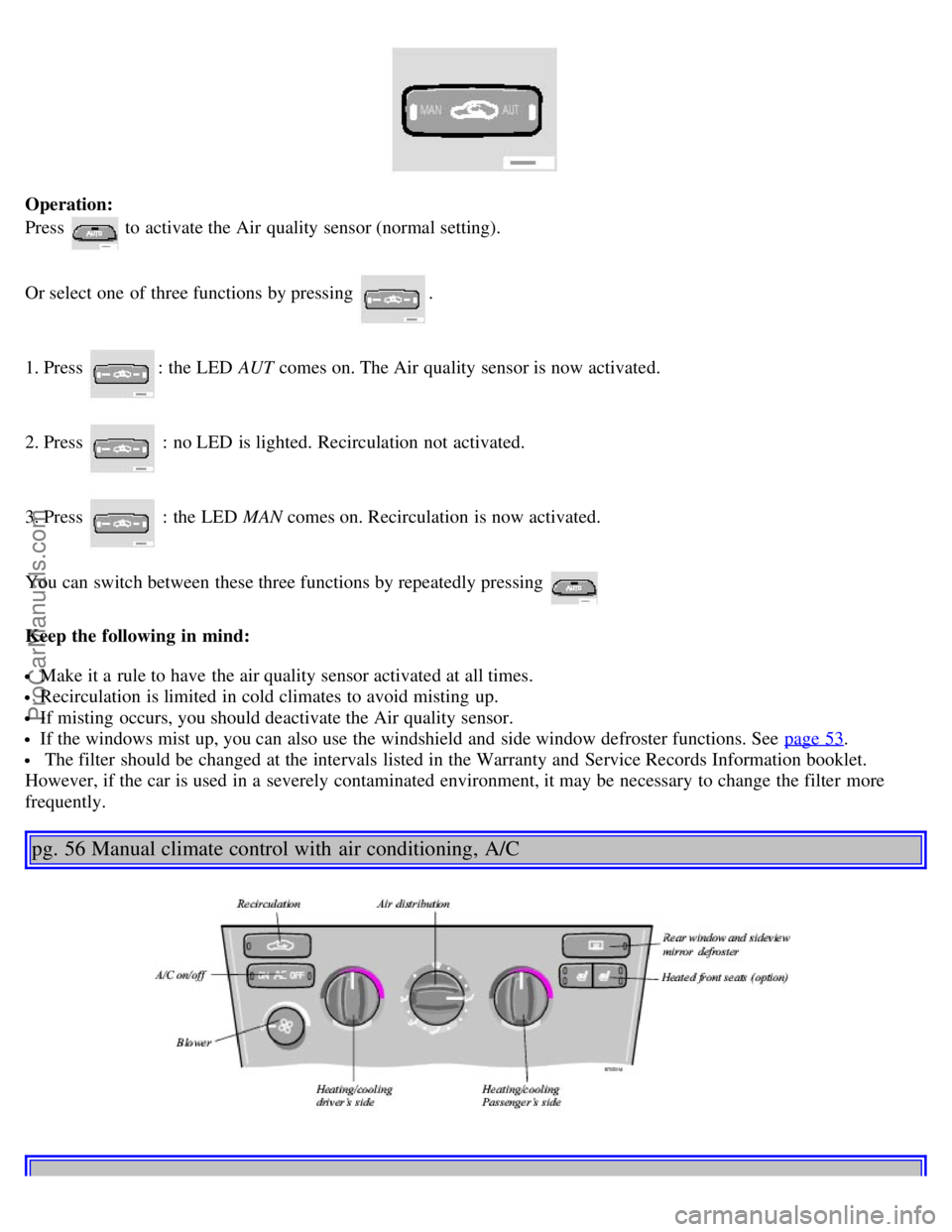
Operation:
Press
to activate the Air quality sensor (normal setting).
Or select one of three functions by pressing
.
1. Press
: the LED AUT comes on. The Air quality sensor is now activated.
2. Press
: no LED is lighted. Recirculation not activated.
3. Press
: the LED MAN comes on. Recirculation is now activated.
You can switch between these three functions by repeatedly pressing
Keep the following in mind:
Make it a rule to have the air quality sensor activated at all times.
Recirculation is limited in cold climates to avoid misting up.
If misting occurs, you should deactivate the Air quality sensor.
If the windows mist up, you can also use the windshield and side window defroster functions. See page 53.
The filter should be changed at the intervals listed in the Warranty and Service Records Information booklet.
However, if the car is used in a severely contaminated environment, it may be necessary to change the filter more
frequently.
pg. 56 Manual climate control with air conditioning, A/C
ProCarManuals.com
Page 68 of 139

Front park assist: it may not be possible to combine auxiliary headlights and front park assist since these lights
could trigger the system's sensors.
Faults in the system
If a fault should occur in the system, the LED in the button will be switched off and a message will be displayed in the
text window.
Cleaning the sensors
For the system to function properly, the sensors in the front and/or rear bumpers should be kept clean. They can be
cleaned with car washing detergent and a sponge.
WARNING!
These systems are designed to be a supplementary aid when parking the vehicle. They are not, however, intended to
replace the driver's attention and judgement.
pg. 101 Driving economy, Handling
Economical driving conserves natural resources
Better driving economy may be obtained by thinking ahead, avoiding rapid starts and stops and adjusting the speed of
your vehicle to immediate traffic conditions. Observe the following rules:
Bring the engine to normal operating temperature as soon as possible by driving with a light foot on the accelerator
pedal for the first few minutes of operation. A cold engine uses more fuel and is subject to increased wear.
Whenever possible, avoid using the car for driving short distances. This does not allow the engine to reach normal
operating temperature.
Drive carefully and avoid rapid acceleration and hard braking.
Do not exceed posted speed limits.
Avoid carrying unnecessary items (extra load) in the car.
Maintain correct tire pressure. Check tire pressure regularly (when tires are cold).
Remove snow tires when threat of snow or ice has ended.
Note that roof racks, ski racks, etc., increase air resistance and fuel consumption.
Avoid using automatic transmission kickdown feature unless necessary.
Avoid using the air conditioning when it is not required. When engaged, the A/C compressor places an additional
load on the engine. However, at higher driving speeds, fuel consumption will be lower with the air conditioning on and
the windows closed than with the air conditioning off and the windows open.
Using the onboard trip computer's fuel consumption modes can help you learn how to drive more economically.
Other factors that decrease gas mileage are:
Dirty air cleaner
Dirty engine oil and clogged oil filter
Dragging brakes
Incorrect front end alignment Some of the above mentioned items and others are checked at the standard
Maintenance Service intervals.
NOTE: Vehicles equipped with automatic transmissions should use (D)rive as often as possible and avoid using
"kick -down" to help improve fuel economy. Vehicles equipped with manual transmissions should use fifth gear at
highway speeds. At other times, choose the highest gear that still allows smooth acceleration.
Handling, roadholding
Vehicle load, tire design and inflation pressure all affect vehicle handling. Therefore, check that the tires are inflated to
the recommended pressure according to the vehicle load. See "Tire pressure" section. Loads should be distributed so
that capacity weight or maximum permissible axle loads are not exceeded.
ProCarManuals.com
Page 112 of 139
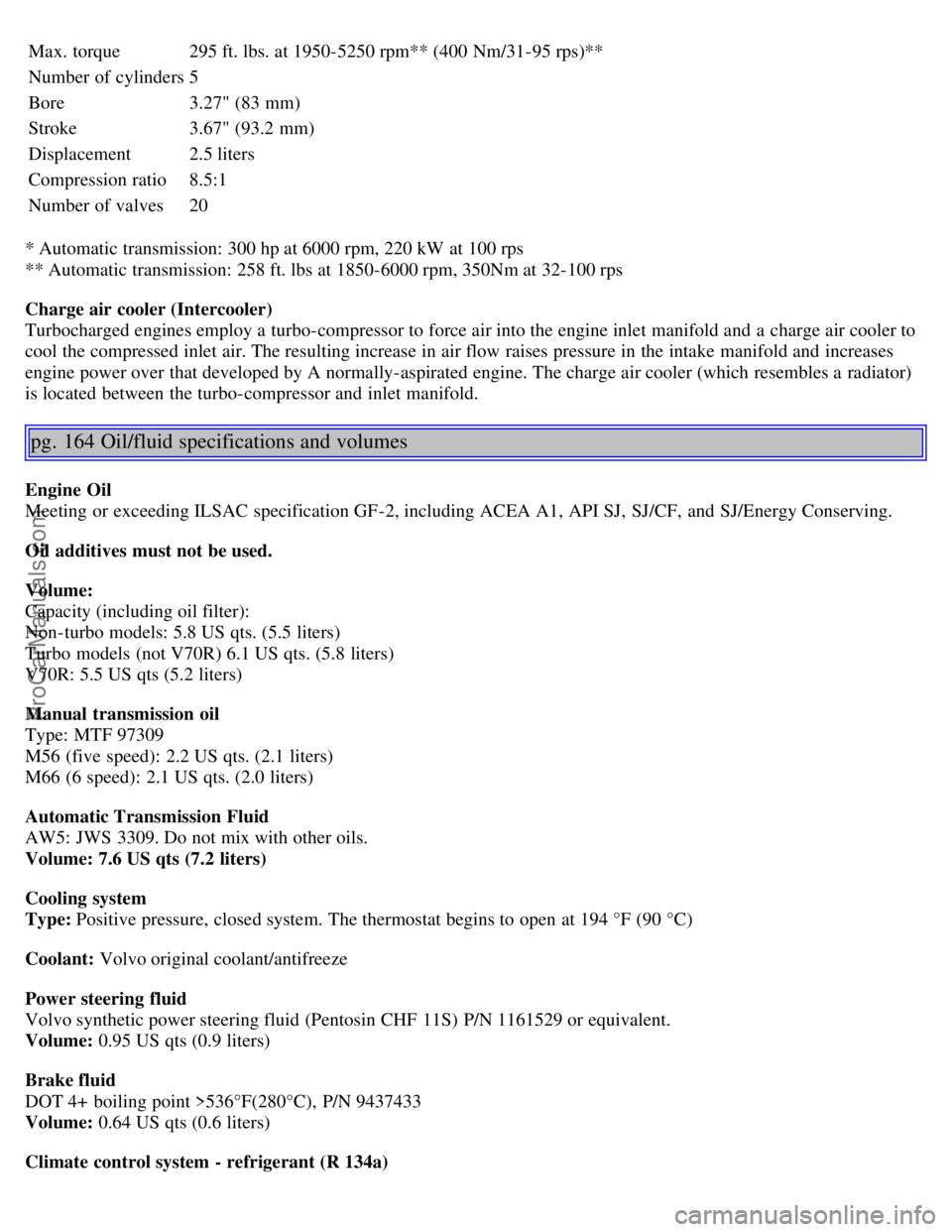
Max. torque 295 ft. lbs. at 1950-5250 rpm** (400 Nm/31-95 rps)**
Number of cylinders 5
Bore3.27" (83 mm)
Stroke 3.67" (93.2 mm)
Displacement 2.5 liters
Compression ratio 8.5:1
Number of valves 20
* Automatic transmission: 300 hp at 6000 rpm, 220 kW at 100 rps
** Automatic transmission: 258 ft. lbs at 1850-6000 rpm, 350Nm at 32-100 rps
Charge air cooler (Intercooler)
Turbocharged engines employ a turbo-compressor to force air into the engine inlet manifold and a charge air cooler to
cool the compressed inlet air. The resulting increase in air flow raises pressure in the intake manifold and increases
engine power over that developed by A normally-aspirated engine. The charge air cooler (which resembles a radiator)
is located between the turbo-compressor and inlet manifold.
pg. 164 Oil/fluid specifications and volumes
Engine Oil
Meeting or exceeding ILSAC specification GF-2, including ACEA A1, API SJ, SJ/CF, and SJ/Energy Conserving.
Oil additives must not be used.
Volume:
Capacity (including oil filter):
Non-turbo models: 5.8 US qts. (5.5 liters)
Turbo models (not V70R) 6.1 US qts. (5.8 liters)
V70R: 5.5 US qts (5.2 liters)
Manual transmission oil
Type: MTF 97309
M56 (five speed): 2.2 US qts. (2.1 liters)
M66 (6 speed): 2.1 US qts. (2.0 liters)
Automatic Transmission Fluid
AW5: JWS 3309. Do not mix with other oils.
Volume: 7.6 US qts (7.2 liters)
Cooling system
Type: Positive pressure, closed system. The thermostat begins to open at 194 °F (90 °C)
Coolant: Volvo original coolant/antifreeze
Power steering fluid
Volvo synthetic power steering fluid (Pentosin CHF 11S) P/N 1161529 or equivalent.
Volume: 0.95 US qts (0.9 liters)
Brake fluid
DOT 4+ boiling point >536°F(280°C), P/N 9437433
Volume: 0.64 US qts (0.6 liters)
Climate control system - refrigerant (R 134a)
ProCarManuals.com
Page 128 of 139
2 0 0 5
VOLVO V70
INDEX
pg. 189 - 192 Index
A
ABS 21
ABS - warning light31
Active chassis system99
Adjusting the steering wheel38
Air conditioning52 - 55
Air filter - engine149
Air vents50
Airbag (SIPS)10
Airbag (SRS)4
Alarm84, 85
Alarm - "panic" function84
All Wheel Drive
- general information98
ALR/ELR16
Anti-lock Brake System (ABS)21
Anti-lock Brake System - warning light31
Antifreeze110, 148
Approach lighting80
Armrest (center) - 3-section rear seat69
Ashtray43
Audio systems169
- CD player180, 181
- specifications185
Automatic car washing144
Automatic Locking Retractor (ALR)16
Automatic transmission94, 95
- Cold starts95
- Geartronic96, 97
- Kickdown95, 96
- Sport mode97
Auxiliary socket43
ProCarManuals.com
Page 130 of 139

Courtesy light78
Courtesy lights (front) - replacing140
Courtesy lights - exterior80
Cruise control35
D
Detachable trailer hitch - installing108
Dimensions161
Direction indicators39
Distributor ignition system165
Door step courtesy lights - replacing141
Doors and locks80
Drive belt148
Driving economy101
Driving mode indicator29
Driving mode W95, 97, 110
Driving with trunk open102
E
Economical driving101
Electric socket in cargo compartment71
Electrical system166
Electrical system - general information102
Electrically operated moonroof46
Electrically operated sideview mirrors45
Electrically operated windows44
Electronic Brake Force Distribution21
Electronic Climate Control (ECC)52 - 55
Emergency Locking Retractor (ELR)16
Emergency towing105, 106
Emergency warning flashers42
Emissions systems147
Engine - specifications163
Engine - starting91, 92
Engine air filter149
Engine compartment151
Engine oil110, 152, 153
Extension of cargo compartment67
Exterior courtesy lights80
Exterior features - overview27
Extra seat77
F
Fog light - rear31
, 38
Fog lights - front38
Folding passenger's seat backrest62
Folding table66
ProCarManuals.com
Page 131 of 139

Four-C active chassis system99
Front airbags - SRS4 - 9
Front airbags - SRS - warning light30
Front courtesy lights - replacing140
Front fog lights38
Front park assist (accessory)100
Front reading lights78
Front seats - adjusting60, 61
Front seats - heated42
Front suspension165
Fuel88
Fuel filler cap90
Fuel filler door, unlocking37
Fuel filter149
Fuel formulations89
Fuel gauge29
Fuel requirements88
Fuel system147, 149, 165
Fuel/emissions systems147
Fuses130-134
G
Gas cap90
Gasoline88
Gear indicator29
Geartronic (automatic transmission)96, 97
Generator166
Generator warning light30
Glossary of tire terminology121
H
Hand brake43
Handgrip - XC7059, 77
Handling101
Hazard warning flashers42
Head restraint (center) - 3-section rear seat68
Head restraint - center rear3
Headlight wiper blades - replacing157
Headlights37
Heated front seats42
Heated rear window42
Heated sideview mirrors42
Heating52-55
Hoisting the car150
Holder for grocery bags71
Home Safe System80
ProCarManuals.com