ECO mode VOLVO V70 2006 User Guide
[x] Cancel search | Manufacturer: VOLVO, Model Year: 2006, Model line: V70, Model: VOLVO V70 2006Pages: 138, PDF Size: 3.53 MB
Page 63 of 138

The Four-C system is based on a number of sensors that continuously monitor factors such as the car's lateral and
vertical movements, speed, and movements of the wheels. The sensors receive data up to 500 times per second, which
is used to provide extremely fast and precise adjustment of each shock absorber. The system adjusts the stiffness of the
shock absorbers approximately 100 times per second.
Use the button in the center console to switch between the driving modes Comfort and Sport. This can be
done at any time.
Comfort
The Comfort mode chassis setting offers the greatest amount of shock absorption and the softest ride. This mode is
recommended for long-distance driving, or when driving in slippery conditions. The indicator light in the button will
be off when this mode is selected. If Comfort mode was selected when the engine was switched off, this mode will still
be active when the engine is restarted.
Sport
In this mode, shock absorption is stiffer to reduce the car's body sway during cornering and to provide more immediate
steering response. The indicator light in the button will come on to indicate that Sport mode has been selected.
If this setting was selected when the engine was switched off, Sport mode will still be active when the engine is
restarted.
Advanced sport (V70 R only)
In this mode, movement of the shock absorbers is minimal, response from pressure on the throttle pedal is more direct,
and body sway in curves or when cornering is sharply reduced. If Advanced sport mode was selected when the engine
was switched off, Sport mode will be active when the engine is restarted.
V70 R buttons on the dashboard
pg. 100 Front/rear park assist (option/accessory)
ProCarManuals.com
Page 65 of 138
If a fault should occur in the system, the LED in the button will be switched off and a message will be displayed in the
text window.
Cleaning the sensors
For the system to function properly, the sensors in the front and/or rear bumpers should be kept clean. They can be
cleaned with car washing detergent and a sponge.
WARNING!
These systems are designed to be a supplementary aid when parking the vehicle. They are not, however, intended to
replace the driver's attention and judgement.
pg. 101 Driving economy, Handling
Economical driving conserves natural resources
Better driving economy may be obtained by thinking ahead, avoiding rapid starts and stops and adjusting the speed of
your vehicle to immediate traffic conditions. Observe the following rules:
Bring the engine to normal operating temperature as soon as possible by driving with a light foot on the accelerator
pedal for the first few minutes of operation. A cold engine uses more fuel and is subject to increased wear.
Whenever possible, avoid using the car for driving short distances. This does not allow the engine to reach normal
operating temperature.
Drive carefully and avoid rapid acceleration and hard braking.
Do not exceed posted speed limits.
Avoid carrying unnecessary items (extra load) in the car.
Maintain correct tire pressure. Check tire pressure regularly (when tires are cold).
Remove snow tires when threat of snow or ice has ended.
Note that roof racks, ski racks, etc., increase air resistance and fuel consumption.
Avoid using automatic transmission kickdown feature unless necessary.
Avoid using the air conditioning when it is not required. When engaged, the A/C compressor places an additional
load on the engine. However, at higher driving speeds, fuel consumption will be lower with the air conditioning on and
the windows closed than with the air conditioning off and the windows open.
Using the onboard trip computer's fuel consumption modes can help you learn how to drive more economically.
Other factors that decrease gas mileage are:
Dirty air cleaner
Dirty engine oil and clogged oil filter
Dragging brakes
Incorrect front end alignment
Some of the above mentioned items and others are checked at the standard Maintenance Service intervals.
NOTE: Vehicles equipped with automatic transmissions should use (D)rive as often as possible and avoid using
"kick -down" to help improve fuel economy. Vehicles equipped with manual transmissions should use fifth gear at
highway speeds. At other times, choose the highest gear that still allows smooth acceleration.
Handling, roadholding
Vehicle load, tire design and inflation pressure all affect vehicle handling. Therefore, check that the tires are inflated to
the recommended pressure according to the vehicle load. See "Tire pressure" section. Loads should be distributed so
that capacity weight or maximum permissible axle loads are not exceeded.
Speed-sensitive power steering
(Option on certain models)
ProCarManuals.com
Page 67 of 138

of the accelerator pedal is not impeded. Not more than one protective floor covering may be used at one time.
Electrical system
When replacing the battery or when carrying out work involving the electrical system, the following should be
observed:
A battery connection to the wrong terminal will damage the electrical system. Be sure to connect the positive battery
cable to the positive battery terminal and the negative battery cable to the negative battery terminal.
If booster batteries are used for starting, they must be properly connected to minimize the risk of the electrical
system being damaged. For correct connection, see "Jump starting" section.
Never disconnect the battery circuit (for example, to replace the battery) while the engine is running, as this may
damage the generator. Always make sure that all the battery connections are properly cleaned and tightened.
If any electrical welding work is performed on the vehicle, the battery's ground lead (negative cable) and all the
connecting cables of the generator must be disconnected and the welder cables placed as near the welding points as
possible.
The radio must be turned off before the battery is disconnected.
Switch off the ignition for at least 10 minutes before disconnecting the battery.
pg. 103 Roof racks/Load carriers
Load carriers (accessory)
Load carriers are available as Volvo accessories. Observe the following points when in use:
To avoid damaging your car and to achieve maximum safety when driving, we recommend using the load carriers
that Volvo has developed especially for your car.
Volvo-approved removable roof racks are designed to carry the maximum allowable roof load for this vehicle: 220
lbs (100 kg). For Non-Volvo roof racks, check the manufacturer's weight limits for the rack.
Never exceed the rack manufacturer's weigh limits and never exceed the maximum rated roof load of 220 lbs (100
kg).
Avoid single-point loads. Distribute loads evenly.
Place heavier cargo at the bottom of the load.
Anchor the cargo correctly with appropriate tie-down equipment.
Check periodically that the load carriers and load are properly secured.
Remember that the car's center of gravity and handling change when you carry a load on the roof.
The car's wind resistance (and correspondingly, fuel consumption) will increase with the size of the load.
Drive smoothly. Avoid rapid starts, fast cornering and hard braking.
Load carrier attachment points
Attaching load carriers (models without rails)
The attachment brackets for the load carriers are located under the roof molding.
ProCarManuals.com
Page 68 of 138
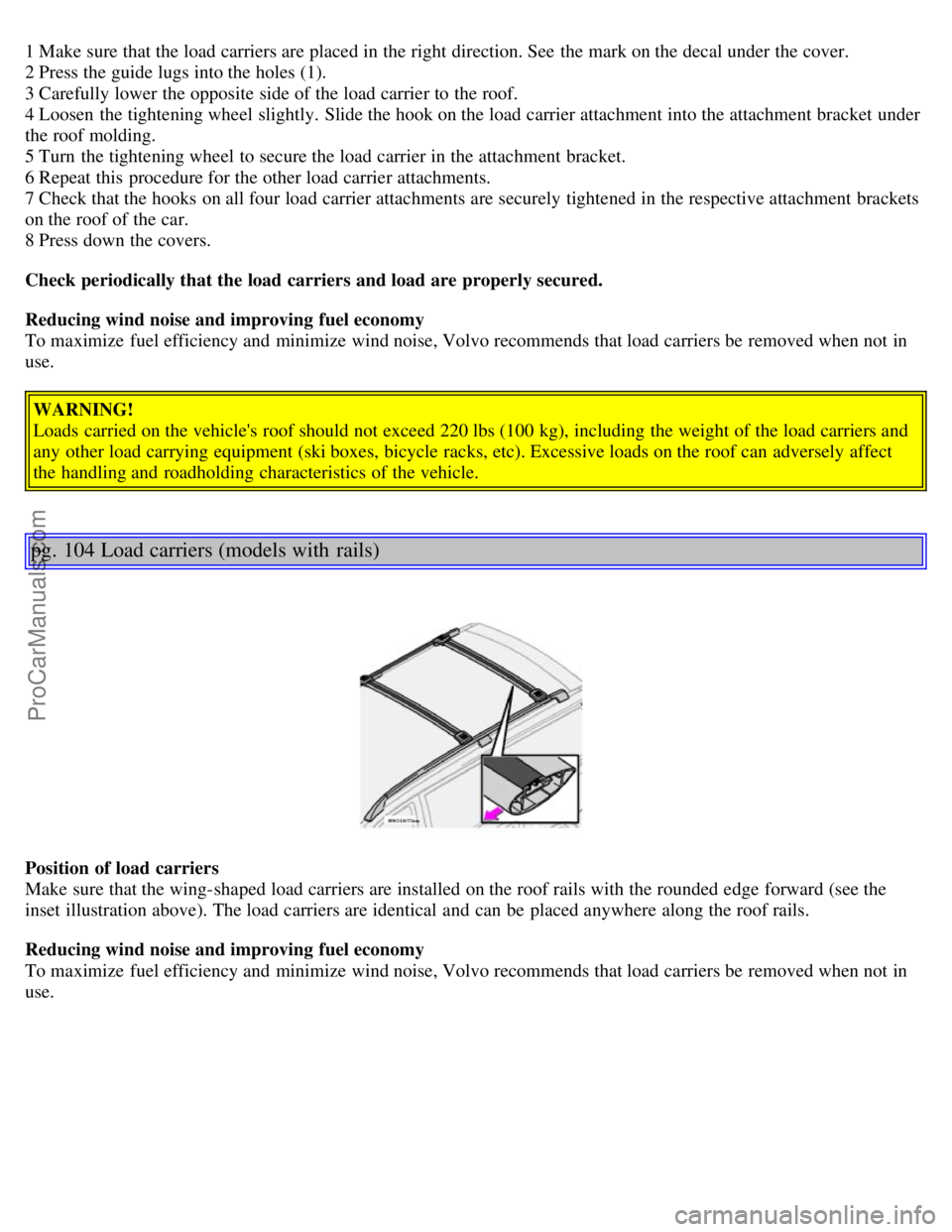
1 Make sure that the load carriers are placed in the right direction. See the mark on the decal under the cover.
2 Press the guide lugs into the holes (1).
3 Carefully lower the opposite side of the load carrier to the roof.
4 Loosen the tightening wheel slightly. Slide the hook on the load carrier attachment into the attachment bracket under
the roof molding.
5 Turn the tightening wheel to secure the load carrier in the attachment bracket.
6 Repeat this procedure for the other load carrier attachments.
7 Check that the hooks on all four load carrier attachments are securely tightened in the respective attachment brackets
on the roof of the car.
8 Press down the covers.
Check periodically that the load carriers and load are properly secured.
Reducing wind noise and improving fuel economy
To maximize fuel efficiency and minimize wind noise, Volvo recommends that load carriers be removed when not in
use.WARNING!
Loads carried on the vehicle's roof should not exceed 220 lbs (100 kg), including the weight of the load carriers and
any other load carrying equipment (ski boxes, bicycle racks, etc). Excessive loads on the roof can adversely affect
the handling and roadholding characteristics of the vehicle.
pg. 104 Load carriers (models with rails)
Position of load carriers
Make sure that the wing-shaped load carriers are installed on the roof rails with the rounded edge forward (see the
inset illustration above). The load carriers are identical and can be placed anywhere along the roof rails.
Reducing wind noise and improving fuel economy
To maximize fuel efficiency and minimize wind noise, Volvo recommends that load carriers be removed when not in
use.
ProCarManuals.com
Page 70 of 138

2 0 0 6
VOLVO V70
Chapter 7 - Wheels and tires
pg.117 Wheels and tires
General information118
Tire inflation120
Tire inflation pressure tables122
Tire Pressure Monitoring System (TPMS)123
Self supporting run flat tires125
Tire designations126
Glossary of tire terminology127
Vehicle loading128
Uniform Tire Quality Grading129
Snow chains, snow tires, studded tires130
Temporary spare131
Changing a wheel132
pg. 118 Wheels and tires
General information
Your vehicle is equipped with tires according to the vehicle's tire information placard on the B-pillar (the structural
member at the side of the vehicle, at the rear of the driver's door opening), or on the inside of the fuel filler door on
Canadian models.
The tires have good road holding characteristics and offer good handling on dry and wet surfaces. It should be noted
however that the tires have been developed to give these features on snow/ice-free surfaces.
Certain models are equipped with "all-season" tires, which provide a somewhat higher degree of road holding on
slippery surfaces than tires without the "all-season" rating. However, for optimum road holding on icy or snow-
covered roads, we recommend suitable winter tires on all four wheels.
When replacing tires, be sure that the new tires are the same size designation, type (radial) and preferably from the
same manufacturer, on all four wheels. Otherwise there is a risk of altering the car's roadholding and handling
characteristics.
ProCarManuals.com
Page 72 of 138
Tires degrade over time, even when they are not being used, which can affect their reliability and roadholding
characteristics. Therefore, all tires older than 6 years (including the spare tire and winter tires) should be inspected by a
qualified technician, regardless of appearance or mileage. Heat caused by hot climates or frequent high loading
conditions can accelerate the aging process.
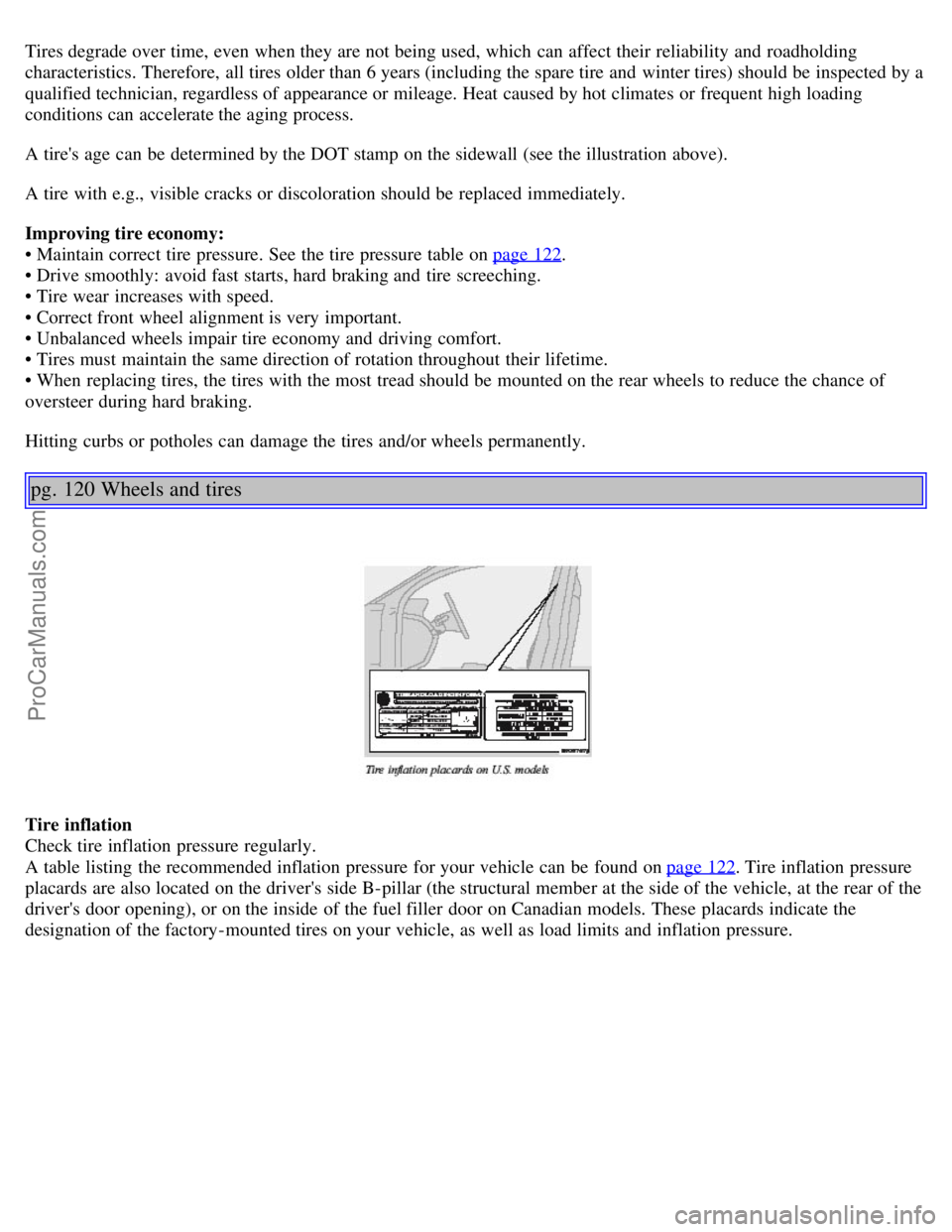
A tire's age can be determined by the DOT stamp on the sidewall (see the illustration above).
A tire with e.g., visible cracks or discoloration should be replaced immediately.
Improving tire economy:
• Maintain correct tire pressure. See the tire pressure table on page 122
.
• Drive smoothly: avoid fast starts, hard braking and tire screeching.
• Tire wear increases with speed.
• Correct front wheel alignment is very important.
• Unbalanced wheels impair tire economy and driving comfort.
• Tires must maintain the same direction of rotation throughout their lifetime.
• When replacing tires, the tires with the most tread should be mounted on the rear wheels to reduce the chance of
oversteer during hard braking.
Hitting curbs or potholes can damage the tires and/or wheels permanently.
pg. 120 Wheels and tires
Tire inflation
Check tire inflation pressure regularly.
A table listing the recommended inflation pressure for your vehicle can be found on page 122
. Tire inflation pressure
placards are also located on the driver's side B-pillar (the structural member at the side of the vehicle, at the rear of the
driver's door opening), or on the inside of the fuel filler door on Canadian models. These placards indicate the
designation of the factory-mounted tires on your vehicle, as well as load limits and inflation pressure.
ProCarManuals.com
Page 73 of 138
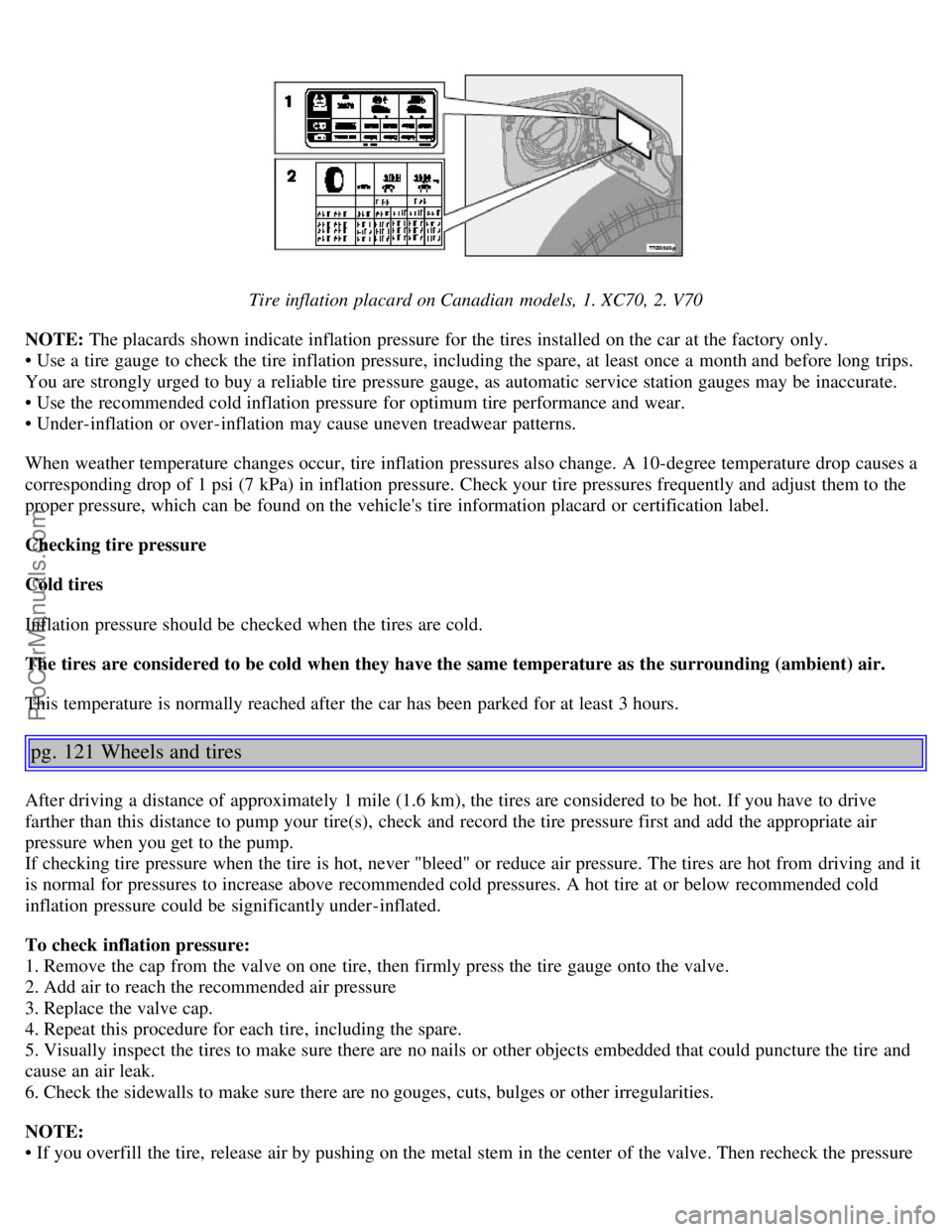
Tire inflation placard on Canadian models, 1. XC70, 2. V70
NOTE: The placards shown indicate inflation pressure for the tires installed on the car at the factory only.
• Use a tire gauge to check the tire inflation pressure, including the spare, at least once a month and before long trips.
You are strongly urged to buy a reliable tire pressure gauge, as automatic service station gauges may be inaccurate.
• Use the recommended cold inflation pressure for optimum tire performance and wear.
• Under-inflation or over-inflation may cause uneven treadwear patterns.
When weather temperature changes occur, tire inflation pressures also change. A 10-degree temperature drop causes a
corresponding drop of 1 psi (7 kPa) in inflation pressure. Check your tire pressures frequently and adjust them to the
proper pressure, which can be found on the vehicle's tire information placard or certification label.
Checking tire pressure
Cold tires
Inflation pressure should be checked when the tires are cold.
The tires are considered to be cold when they have the same temperature as the surrounding (ambient) air.
This temperature is normally reached after the car has been parked for at least 3 hours.
pg. 121 Wheels and tires
After driving a distance of approximately 1 mile (1.6 km), the tires are considered to be hot. If you have to drive
farther than this distance to pump your tire(s), check and record the tire pressure first and add the appropriate air
pressure when you get to the pump.
If checking tire pressure when the tire is hot, never "bleed" or reduce air pressure. The tires are hot from driving and it
is normal for pressures to increase above recommended cold pressures. A hot tire at or below recommended cold
inflation pressure could be significantly under-inflated.
To check inflation pressure:
1. Remove the cap from the valve on one tire, then firmly press the tire gauge onto the valve.
2. Add air to reach the recommended air pressure
3. Replace the valve cap.
4. Repeat this procedure for each tire, including the spare.
5. Visually inspect the tires to make sure there are no nails or other objects embedded that could puncture the tire and
cause an air leak.
6. Check the sidewalls to make sure there are no gouges, cuts, bulges or other irregularities.
NOTE:
• If you overfill the tire, release air by pushing on the metal stem in the center of the valve. Then recheck the pressure
ProCarManuals.com
Page 74 of 138
with your tire gauge.
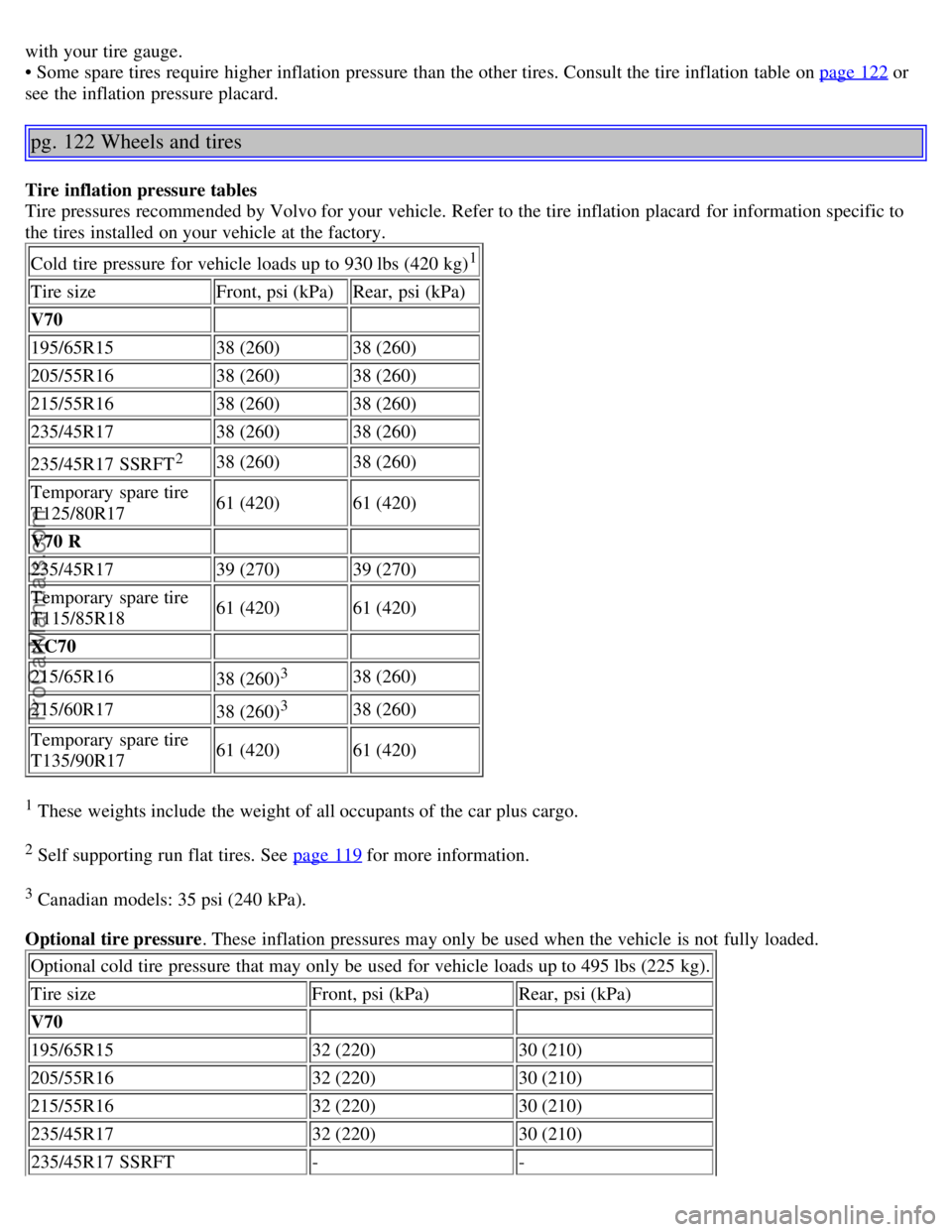
• Some spare tires require higher inflation pressure than the other tires. Consult the tire inflation table on page 122 or
see the inflation pressure placard.
pg. 122 Wheels and tires
Tire inflation pressure tables
Tire pressures recommended by Volvo for your vehicle. Refer to the tire inflation placard for information specific to
the tires installed on your vehicle at the factory.
Cold tire pressure for vehicle loads up to 930 lbs (420 kg)
1
Tire size Front, psi (kPa)Rear, psi (kPa)
V70
195/65R15 38 (260)38 (260)
205/55R16 38 (260)38 (260)
215/55R16 38 (260)38 (260)
235/45R17 38 (260)38 (260)
235/45R17 SSRFT
238 (260) 38 (260)
Temporary spare tire
T125/80R17 61 (420)
61 (420)
V70 R
235/45R17 39 (270)39 (270)
Temporary spare tire
T115/85R18 61 (420)
61 (420)
XC70
215/65R16 38 (260)
338 (260)
215/60R17 38 (260)
338 (260)
Temporary spare tire
T135/90R17 61 (420)
61 (420)
1 These weights include the weight of all occupants of the car plus cargo.
2 Self supporting run flat tires. See page 119 for more information.
3 Canadian models: 35 psi (240 kPa).
Optional tire pressure . These inflation pressures may only be used when the vehicle is not fully loaded.
Optional cold tire pressure that may only be used for vehicle loads up to 495 lbs (225 kg).
Tire size Front, psi (kPa)Rear, psi (kPa)
V70
195/65R15 32 (220)30 (210)
205/55R16 32 (220)30 (210)
215/55R16 32 (220)30 (210)
235/45R17 32 (220)30 (210)
235/45R17 SSRFT --
ProCarManuals.com
Page 75 of 138

Temporary spare tire
T125/80R1761 (420)
61 (420)
V70 R
235/45R17 35 (240)35 (240)
Temporary spare tire
T115/85R18 61 (420)
61 (420)
XC70
215/65R16 30 (210)
430 (210)4
215/60R1730 (210)430 (210)4
Temporary spare tire
T135/90R1761 (420)
61 (420)
4 The optional tire pressure shown in this table may not be used on XC70s equipped with the Tire Pressure Monitoring
System (option as available). Vehicles with this system must use the standard tire pressure listed in the table in the left
column (38 psi/260 kPa).
pg. 123 Wheels and tires
Tire Pressure Monitoring System (TPMS) - option on certain U.S. models only
The tire pressure monitoring system uses sensors mounted in the tire valves to check inflation pressure levels. When
the vehicle is moving at a speed of 20 mph (30 km/h) or faster, these sensors transmit inflation pressure data to a
receiver located in the vehicle.
USA - FCC ID: MRXTG315AM04
This device complies with part 15 of the FCC rules. Operation is subject to the following conditions: (1) This device
may not cause harmful interference, and (2) this device must accept any interference received, including interference
that may cause undesired operation.
WARNING!
The TPMS system uses a radio frequency of 315 MHz. Accessory electrical equipment using the same frequency
could interfere with TPMS and should not be installed in the vehicle. Please consult your Volvo retailer, a qualified
Volvo service technician, or the accessory equipment's supplier for further information.
When low inflation pressure is detected, TPMS will light up the tire pressure warning light (
) i (also referred to as a
telltale) in the instrument panel, and will display a message in the text window. The wording of this message is
determined by the degree of inflation pressure loss.
When the tire pressure monitoring system warning light is on, one or more of your tires is significantly under-inflated.
You should stop and check your tires as soon as possible, and inflate them to the proper pressure as indicated on the
vehicle's tire information placard.
Driving on a significantly under-inflated tire causes the tire to overheat and can lead to tire failure. Under-inflation
also reduces fuel efficiency and tire tread life, and may affect the vehicle's handling and stopping ability. Each tire,
including the spare, should be checked monthly when cold and set to the recommended inflation pressure as specified
in the vehicle placard and owner's manual.
NOTE: If a fault occurs in TPMS, the tire pressure warning light will flash for approximately 1 minute and TIRE
PRESS SYST SERVICE REQUIRED will be displayed.
ProCarManuals.com
Page 76 of 138

Each tire, including the spare (if provided), should be checked monthly when cold and inflated to the inflation pressure
recommended by the vehicle manufacturer on the vehicle placard or tire inflation pressure label. (If your vehicle has
tires of a different size than the size indicated on the vehicle placard or tire inflation pressure label, you should consult
the appropriate section of this owner's manual to determine the proper tire inflation pressure.) When the low tire
pressure telltale is illuminated, one or more of your tires is significantly underinflated. You should stop and check your
tires as soon as possible, and inflate them to the proper pressure. Driving on a significantly underinflated tire causes
the tire to overheat and can lead to tire failure. Under-inflation also reduces fuel efficiency and tire tread life, and may
affect the vehicle's handling and stopping ability. Your vehicle has also been equipped with a TPMS malfunction
telltale to indicate when the system is not operating properly. When the malfunction telltale is illuminated, the system
may not be able to detect or signal low tire pressure as intended. TPMS malfunctions may occur for a variety of
reasons, including the installation of incompatible replacement tires on the vehicle. Always check the TPMS
malfunction telltale after replacing one or more tires on your vehicle to ensure that the replacement tires are
compatible with the TPMS.
NOTE: TPMS indicates low tire pressure but does not replace normal tire maintenance. For information on correct tire
pressure, please refer to the table on page 122
, or consult your Volvo retailer.
Erasing warning messages
When a low tire pressure warning message has been displayed, and the tire pressure warning light has come on:
1. Use a tire pressure gauge to check the inflation pressure of all four tires.
2. Re-inflate the tire(s) to the correct pressure (consult the tire pressure placard or the table on page 122
).
3. Drive the car for several minutes at a speed of 20 mph (30 km/h) or faster.
This will erase the warning text and the warning light will go out.
WARNING!
Incorrect inflation pressure could lead to tire failure, resulting in a loss of control of the vehicle.
(Contd. on following page)
pg. 124 Wheels and tires
Changing tires
Please note the following when changing or replacing the factory installed TPMS wheels/ tires on the vehicle:
Only the factory-mounted wheels are equipped with TPMS sensors in the valves.
If the vehicle is equipped with a temporary spare tire, this tire does not have a TPMS sensor.
If winter wheels without TPMS sensors are mounted on the vehicle, TIRE PRESS SYST SERVICE REQUIRED will
be displayed each time the vehicle is driven above 25 mph (40 km/h) for 10 minutes or more.
Once TPMS sensors are properly installed, the warning message should not reappear.
Volvo recommends that TPMS sensors be fitted on all wheels used on the vehicle. Volvo does not recommend
moving sensors back and forth between sets of wheels.
CAUTION!
When inflating tires with TPMS valves, press the pump's mouthpiece straight onto the valve to help avoid bending or
otherwise damaging the valve.
pg. 125 Wheels and tires
Self supporting run flat tires (option)
Certain models equipped with the Tire Pressure Monitoring System (TPMS) can also be equipped with self supporting
ProCarManuals.com