oil VOLVO V70 2006 User Guide
[x] Cancel search | Manufacturer: VOLVO, Model Year: 2006, Model line: V70, Model: VOLVO V70 2006Pages: 138, PDF Size: 3.53 MB
Page 88 of 138

1 ABS30A
2 ABS30A
3 -
4 -
5 Auxiliary lights (option) 20A
6 Starter motor relay 35A
7 Windshield wipers 25A
8 -
9 Fuel pump 15A
10 Ignition coils, engine control module 20A
11 Throttle pedal sensor, A/C compressor, e -box fan 10A
12 Engine control module, fuel injectors, mass airflow sensor 15A
13 Throttle housing control module 10A
14 Heated oxygen sensor 20A
15 Crankcase ventilation heater, solenoid valves 10A
16 Driver's side low beam headlight. 20A
17 Passenger's side low beam headlight 20A
18 -
19 Engine control module feed, engine relay 5A
20 Parking lights 15A
21 -
pg. 138 Fuses in the passenger compartment
Fuse box on the edge of the dashboard
Fuses are located inside the access panel on the edge of the dashboard. When replacing a blown fuse, be sure to
replace it with a new one of the same color and amperage (written on the fuse).
Location Amperage
1 Power driver's seat (option) 25A
2 Power passenger's seat (option) 25A
3 Climate system blower 30A
4 Control module - front passenger's door 25A
5 Control module - driver's door 25A
6 Ceiling lighting, upper electrical control module 10A
ProCarManuals.com
Page 92 of 138
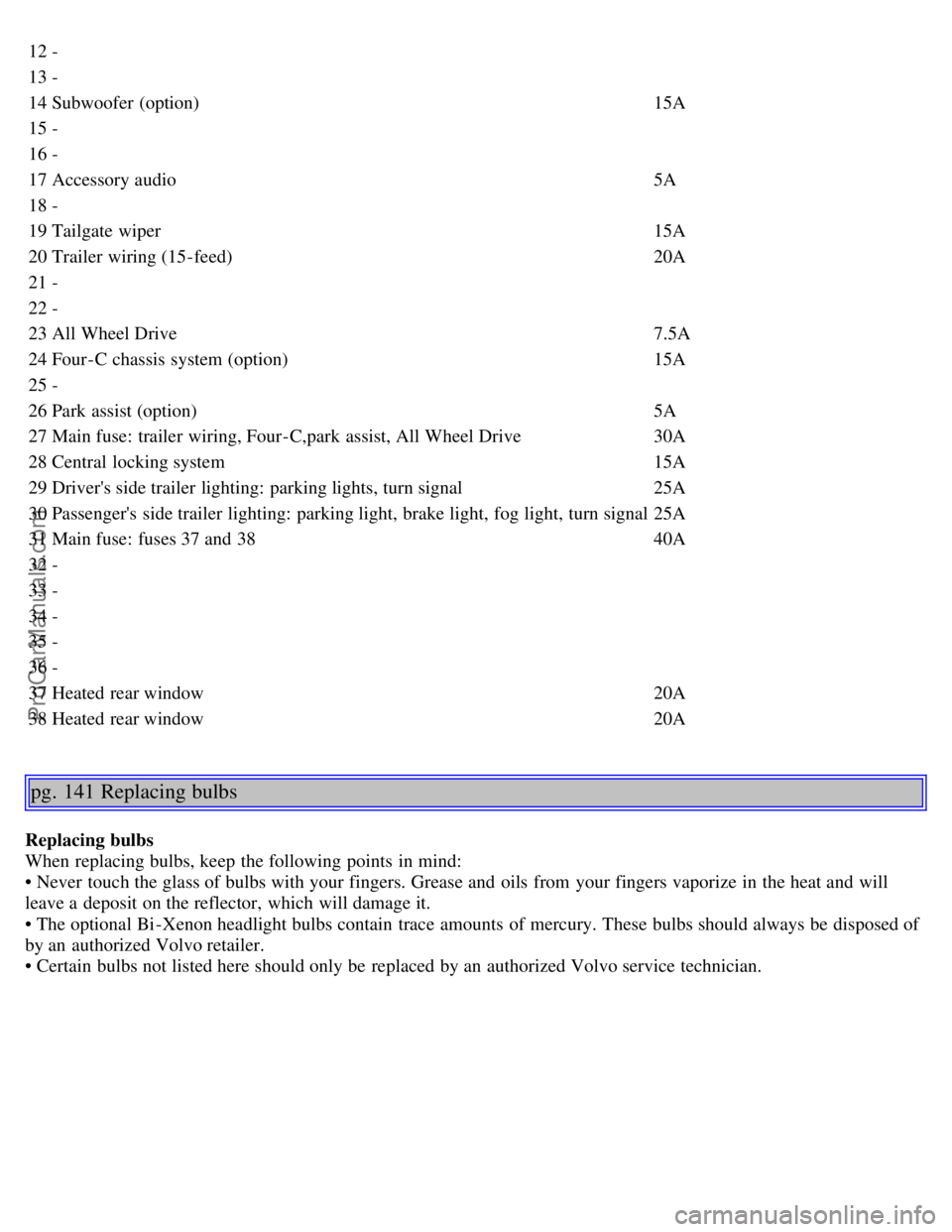
12 -
13 -
14 Subwoofer (option)15A
15 -
16 -
17 Accessory audio 5A
18 -
19 Tailgate wiper 15A
20 Trailer wiring (15-feed) 20A
21 -
22 -
23 All Wheel Drive 7.5A
24 Four-C chassis system (option) 15A
25 -
26 Park assist (option) 5A
27 Main fuse: trailer wiring, Four-C,park assist, All Wheel Drive 30A
28 Central locking system 15A
29 Driver's side trailer lighting: parking lights, turn signal 25A
30 Passenger's side trailer lighting: parking light, brake light, fog light, turn signal 25A
31 Main fuse: fuses 37 and 38 40A
32 -
33 -
34 -
35 -
36 -
37 Heated rear window 20A
38 Heated rear window 20A
pg. 141 Replacing bulbs
Replacing bulbs
When replacing bulbs, keep the following points in mind:
• Never touch the glass of bulbs with your fingers. Grease and oils from your fingers vaporize in the heat and will
leave a deposit on the reflector, which will damage it.
• The optional Bi -Xenon headlight bulbs contain trace amounts of mercury. These bulbs should always be disposed of
by an authorized Volvo retailer.
• Certain bulbs not listed here should only be replaced by an authorized Volvo service technician.
ProCarManuals.com
Page 102 of 138
A detergent can be used to facilitate the softening of dirt and oil.
A water-soluble grease solvent may be used in cases of sticky dirt. However, use a wash place equipped with a
drainage separator.
Remove dirt from the drain holes in the doors and rocker panels.
Dry the car with a clean chamois.
Tar spots can be removed with kerosene or tar remover after the car has been washed.
A stiff-bristle brush and lukewarm soapy water can be used to clean the wiper blades. Frequent cleaning improves
visibility considerably.
Wash off the dirt from the underside (wheel housings, fenders, etc.).
In areas of high industrial fallout, more frequent washing is recommended.
CAUTION:
During high pressure washing, the spray mouthpiece must never be closer to the vehicle than 13" (30 cm). Do not
spray into the locks.
Special moonroof cautions:
- Always close the moonroof and sun shade before washing your vehicle.
- Never use abrasive cleaning agents on the moonroof.
- Never use wax on the rubber seals around the moonroof.
When washing or steam cleaning the engine, avoid spraying water or steam directly on the electrical components or
toward the rear side of the engine.
After cleaning the engine, the spark plug wells should be inspected for water and blown dry if necessary.
Suitable detergents: Special car washing detergents should be used. Mix according to manufacturer's instructions.
Exterior plastic components
Cleaning exterior plastic components should be done with a cleaning agent specially designed for this purpose.
Solvents or stain removers should not be used. Consult your Volvo retailer.
WARNING!
When the car is driven immediately after being washed, apply the brakes several times in order to remove any
moisture from the brake linings.
Engine cleaning agents should not be used when the engine is warm. This constitutes a fire risk.
Water repellent glass (sideview mirrors/side windows) - option
Do not apply wax, degreasing agents, etc. to this glass. This could damage the coating.
Clean the glass surface with care to avoid scratching.
pg. 150 Washing the car
Automatic washing - simple and quick
We do NOT recommend washing your car in an automatic wash during the first six months (because the
paint will not have hardened sufficiently).
An automatic wash is a simple and quick way to clean your car, but it is worth remembering that it may not be as
thorough as when you yourself go over the car with sponge and water. Keeping the underbody clean is most important,
especially in the winter. Some automatic washers do not have facilities for washing the underbody.
Before driving into an automatic wash, make sure that side view mirrors, auxiliary lamps, etc, are secure, otherwise
there is risk of the machine dislodging them.
ProCarManuals.com
Page 103 of 138

Polishing and waxing
Normally, polishing is not required during the first year after delivery. However, waxing may be beneficial.
Before applying polish or wax the car must be washed and dried. Tar spots can be removed with kerosene or tar
remover. Difficult spots may require a fine rubbing compound.
After polishing, use liquid or paste wax.
Several commercially available products contain both polish and wax.
Waxing alone does not substitute for polishing of a dull surface.
A wide range of polymer-based car waxes can be purchased today. These waxes are easy to use and produce a long-
lasting, high-gloss finish that protects the bodywork against oxidation, road dirt and fading.
Do not polish or wax your car in direct sunlight (the surface of the car should not be warmer than 113° F (45° C).
CAUTION:
Volvo does not recommend the use of long-life or durable paint protection coatings, some of which may claim to
prevent pitting, fading, oxidation, etc. These coatings have not been tested by Volvo for compatibility with your
vehicle's clear coat. Some of them may cause the clear coat to soften, crack, or cloud. Damage caused by application
of paint protection coatings may not be covered under your vehicle's paint warranty.
pg. 151 Cleaning the upholstery
Fabric
Clean with soapy water or a detergent. For more difficult spots caused by oil, ice cream, shoe polish, grease, etc., use a
clothing/fabric stain remover. Consult your Volvo retailer.
Interior plastic components
Cleaning interior plastic components should be done with a cleaning agent specially designed for this purpose. Consult
your Volvo retailer.
Alcantera™ suede-like material
Suede -like upholstery can be cleaned with a soft cloth and mild soap solution.
Leather care
Volvo's leather upholstery is manufactured with a protectant to repel soiling. Over time, sunlight, grease and dirt can
break down the protection. Staining, cracking, scuffing, and fading can result.
Volvo offers an easy-to-use, non-greasy leather care kit formulated to clean and beautify your vehicle's leather, and to
renew the protective qualities of its finish. The cleaner removes dirt and oil buildup. The light cream protectant
restores a barrier against soil and sunlight.
Volvo also offers a special leather softener that should be applied after the cleaner and protectant. It leaves leather soft
and smooth, and reduces friction between leather and other finishes in the vehicle.
Volvo recommends cleaning, protecting and conditioning your vehicle's leather two to four times a year. Ask your
Volvo retailer about Leather Care Kit 951 0251 and Leather Softener 943 7429.
CAUTION!
Under no circumstances should gasoline, naphtha or similar cleaning agents be used on the plastic or the leather
since these can cause damage.
Take extra care when removing stains such as ink or lipstick since the coloring can spread.
Use solvents sparingly. Too much solvent can damage the seat padding.
Start from the outside of the stain and work toward the center.
ProCarManuals.com
Page 106 of 138

2 0 0 6
VOLVO V70
Chapter 9 - Specifications
pg. 165 Specifications
Label information166
Dimensions and weights167
Engine specifications169
Oil/fluid specifications and volumes170
Fuel system, Distributor ignition system, Suspension171
Electrical system172
Volvo On Call Roadside Assistance173
pg. 166 Label information
1 Loads and Tire Pressures
(on inside of fuel filler door): Canadian models only.
2 Child safety latch label
3 Federal Motor Vehicle Safety Standards (FMVSS) specifications (USA) and Ministry of Transport (CMVSS)
standards (Canada)
Your Volvo is designed to meet all applicable safety standards, as evidenced by the certification label on the facing
side of the driver's door. For further information regarding these regulations, please consult your Volvo retailer.
4 Loads and Tire Pressures - U.S. models only
Certain models will only have one decal, depending on the specifications of the vehicle.
5 Vehicle Identification Number (VIN) *
The VIN plate is located on the top left surface of the dashboard. The VIN is also stamped on the right hand door
pillar.
6 Model plate
Vehicle Identification Number (VIN). Codes for color and upholstery, etc. The plate is located in the engine
compartment, on the inside of the left front fender.
7 Vehicle Emission Control Information
Your Volvo is designed to meet all applicable emission standards, as evidenced by the certification label on the
underside of the hood. For further information regarding these regulations, please consult your Volvo retailer.
8 Vacuum hose routing
ProCarManuals.com
Page 110 of 138
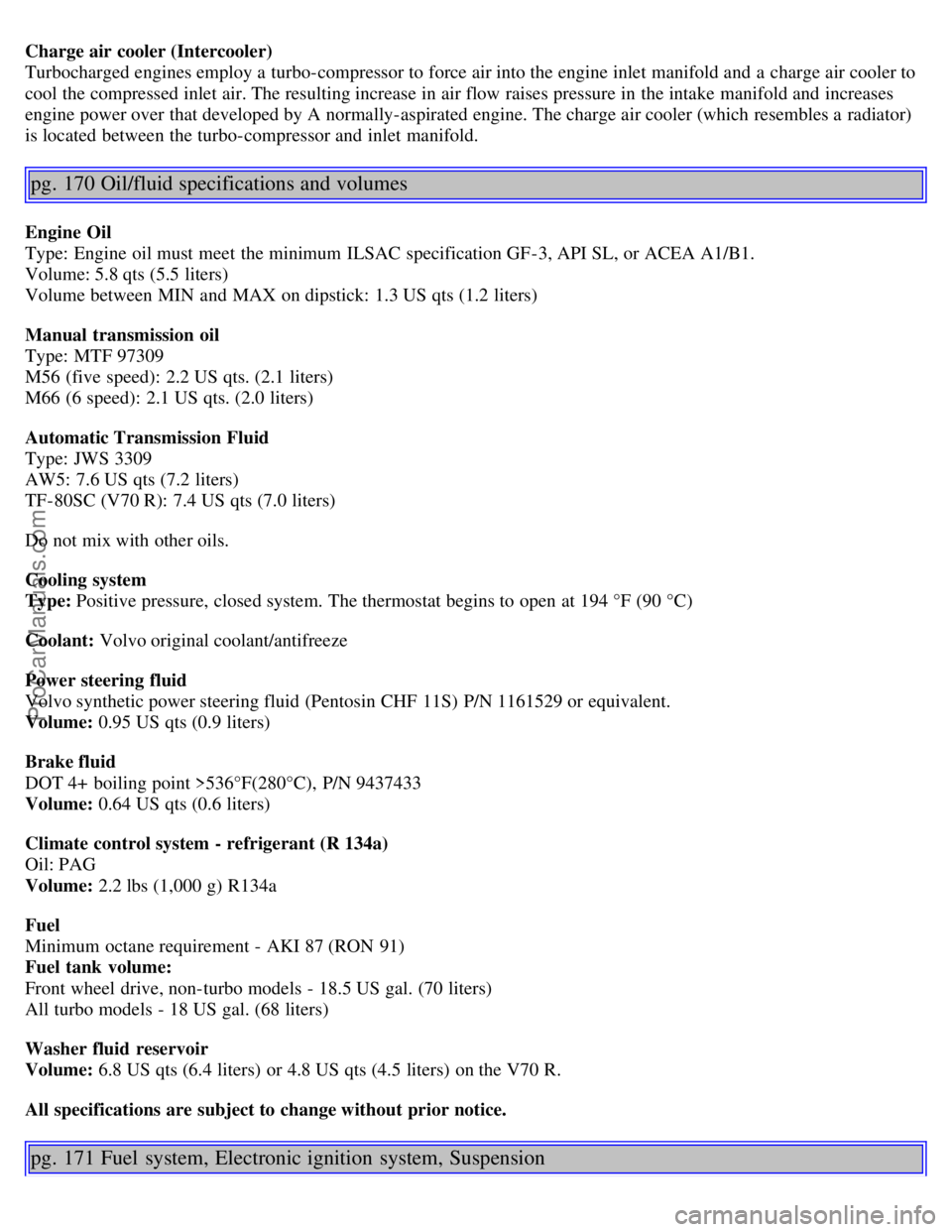
Charge air cooler (Intercooler)
Turbocharged engines employ a turbo-compressor to force air into the engine inlet manifold and a charge air cooler to
cool the compressed inlet air. The resulting increase in air flow raises pressure in the intake manifold and increases
engine power over that developed by A normally-aspirated engine. The charge air cooler (which resembles a radiator)
is located between the turbo-compressor and inlet manifold.
pg. 170 Oil/fluid specifications and volumes
Engine Oil
Type: Engine oil must meet the minimum ILSAC specification GF-3, API SL, or ACEA A1/B1.
Volume: 5.8 qts (5.5 liters)
Volume between MIN and MAX on dipstick: 1.3 US qts (1.2 liters)
Manual transmission oil
Type: MTF 97309
M56 (five speed): 2.2 US qts. (2.1 liters)
M66 (6 speed): 2.1 US qts. (2.0 liters)
Automatic Transmission Fluid
Type: JWS 3309
AW5: 7.6 US qts (7.2 liters)
TF-80SC (V70 R): 7.4 US qts (7.0 liters)
Do not mix with other oils.
Cooling system
Type: Positive pressure, closed system. The thermostat begins to open at 194 °F (90 °C)
Coolant: Volvo original coolant/antifreeze
Power steering fluid
Volvo synthetic power steering fluid (Pentosin CHF 11S) P/N 1161529 or equivalent.
Volume: 0.95 US qts (0.9 liters)
Brake fluid
DOT 4+ boiling point >536°F(280°C), P/N 9437433
Volume: 0.64 US qts (0.6 liters)
Climate control system - refrigerant (R 134a)
Oil: PAG
Volume: 2.2 lbs (1,000 g) R134a
Fuel
Minimum octane requirement - AKI 87 (RON 91)
Fuel tank volume:
Front wheel drive, non-turbo models - 18.5 US gal. (70 liters)
All turbo models - 18 US gal. (68 liters)
Washer fluid reservoir
Volume: 6.8 US qts (6.4 liters) or 4.8 US qts (4.5 liters) on the V70 R.
All specifications are subject to change without prior notice.
pg. 171 Fuel system, Electronic ignition system, Suspension
ProCarManuals.com
Page 111 of 138
Fuel system
The engine is equipped with a multiport fuel injection system.
Distributor ignition system
Firing order: 1-2-4-5-3
Electronic ignition setting: Not adjustable
Spark plugs: Champion RC8PYP 8 (or equivalent)
Spark plug gap: 0.028-0.032" (0.7-0.8 mm)
Tightening torque: 18.4 ft. lbs. (25 Nm) WARNING!
The ignition system operates at very high voltages. Special safety precautions must be followed to prevent injury.
Always turn the ignition off when:
Replacing ignition components e.g. plugs, coil, etc.
Do not touch any part of the ignition system while the engine is running. This may result in a shock and bodily
injury.
Front suspension
Spring strut suspension with integrated shock absorbers and control arms linked to the support frame. Power-assisted
rack and pinion steering. Safety type steering column. The alignment specifications apply to an unladen car but include
fuel, coolant and spare wheel.
Rear suspension
Individual rear wheel suspension with longitudinal support arms, double link arms and track rods.
All specifications are subject to change without prior notice.
pg. 172 Electrical system
Electrical system
12 Volt, negative ground.
Voltage-controlled generator. Single-wire system with chassis and engine used as conductors. Grounded on chassis.
Battery
Voltage: 12 Volt, capacity: 600 A/115 min reserve capacity.
The battery contains corrosive and poisonous acids. It is of the utmost importance that old batteries are disposed of
correctly. Your Volvo retailer can assist you in this matter.
Generator
Rated output: max. current: 140 A
Starter motor:
Output: 1.7 kW
ProCarManuals.com
Page 127 of 138

B
Backrest (center) - 3-section rear seat66
Backrests, rear - folding down65
Battery110, 172
- maintenance163
- replacing162
- ventilation hose162
"Black box" (Vehicle Event Data)152
Booster cushion19, 20
Brake failure warning light28
Brake fluid
- reservoir161
- specifications170
Brake system113
Bulbs (list)172
Bulbs - replacing141-147
C
Capacities (oils and fluids)165
, 170
Car washing149
Cargo compartment cover74
Cargo compartment lighting70
Cargo eyelets71
Cargo net72
Catalytic converters - three-way112
Center armrest - 3-section rear seat67
Center backrest (3-section rear seat)66
Center console - switches31
Center seat head restraint65
Central locking buttons83
Chains (winter driving)130
Changing a wheel132
Chassis settings (R-models)99
Child auxiliary seat18
Child booster cushion19, 20
Child Restraint Anchorages22
Child safety17-22
Child safety locks - rear doors86
Child seat anchors, ISOFIX22
Climate controls50-56
Climate system - general information49
Clock27
Clutch interlock93
Coat hanger63
Cold weather driving110
ProCarManuals.com
Page 128 of 138

Combination filter50, 53
Comfort chassis mode99
Coolant154
Cooling system - general information102
Courtesy light77
Courtesy lights (front) - replacing146
Courtesy lights - exterior80
Cruise control33
Cup holders63
D
Detachable trailer hitch108
Dimensions167
Direction indicators37
Direction indicators30
Distributor ignition system171
Dolby Surround Pro Logic II189
Dome lighting77
Door step courtesy lights - replacing147
Doors and locks80
Drive belt154
Driving economy101
Driving mode indicator27
Driving mode W95, 97, 110
Driving with tailgate open102
Dynamic Stability Traction Control (DSTC)115, 116
E
Economical driving101
Electric socket in cargo compartment70
Electrical system172
Electrical system - general information102
Electrically operated moonroof44
Electrically operated seats58
Electrically operated sideview mirrors43
Electrically operated windows42
Electronic Brake Force Distribution114
Electronic Climate Control (ECC)50 - 53
Emergency towing105, 106
Emergency warning flashers40
Emission inspection readiness156
Emissions systems153
Engine - specifications169
Engine - starting91, 92
Engine compartment158
Engine oil110, 159-160 , 170
ProCarManuals.com
Page 131 of 138

LATCH/ISOFIX anchors22
License plate lights - replacing146
Lifting the car157
Lighting panel35
Load carriers103
Loading the vehicle71
Locking and unlocking the car80
Locking steering wheel36
Long distance trip111
Long loads60
Low/high beam headlights37
`
M
Maintaining your car156
Maintenance, performed by owner155
Maintenance service152
Malfunction indicator lamp29
Manual climate control with air conditioning54-56
Manual front seat adjustment59
Manual transmission93
Mirrors43
Mirrors, sideview - memory function43
Moonroof44
N
Net - cargo72
Nylon cargo net72
O
Occupant safety2
Occupant Weight Sensor (OWS)9-11
Octane rating88
Odometer29
Oil - engine110, 159-160, 170
Oil -level (R-models)160
Oil pressure warning light28
On Call Roadside Assistance173
Opening the hood158
Owner maintenance155
P
Paint touch-up148
Panel lighting35
Panic function (alarm)84
Park Assist100
Parking brake41
Parking brake reminder light28
ProCarManuals.com