ignition VOLVO V70 2006 Owner's Guide
[x] Cancel search | Manufacturer: VOLVO, Model Year: 2006, Model line: V70, Model: VOLVO V70 2006Pages: 138, PDF Size: 3.53 MB
Page 106 of 138

2 0 0 6
VOLVO V70
Chapter 9 - Specifications
pg. 165 Specifications
Label information166
Dimensions and weights167
Engine specifications169
Oil/fluid specifications and volumes170
Fuel system, Distributor ignition system, Suspension171
Electrical system172
Volvo On Call Roadside Assistance173
pg. 166 Label information
1 Loads and Tire Pressures
(on inside of fuel filler door): Canadian models only.
2 Child safety latch label
3 Federal Motor Vehicle Safety Standards (FMVSS) specifications (USA) and Ministry of Transport (CMVSS)
standards (Canada)
Your Volvo is designed to meet all applicable safety standards, as evidenced by the certification label on the facing
side of the driver's door. For further information regarding these regulations, please consult your Volvo retailer.
4 Loads and Tire Pressures - U.S. models only
Certain models will only have one decal, depending on the specifications of the vehicle.
5 Vehicle Identification Number (VIN) *
The VIN plate is located on the top left surface of the dashboard. The VIN is also stamped on the right hand door
pillar.
6 Model plate
Vehicle Identification Number (VIN). Codes for color and upholstery, etc. The plate is located in the engine
compartment, on the inside of the left front fender.
7 Vehicle Emission Control Information
Your Volvo is designed to meet all applicable emission standards, as evidenced by the certification label on the
underside of the hood. For further information regarding these regulations, please consult your Volvo retailer.
8 Vacuum hose routing
ProCarManuals.com
Page 110 of 138
Charge air cooler (Intercooler)
Turbocharged engines employ a turbo-compressor to force air into the engine inlet manifold and a charge air cooler to
cool the compressed inlet air. The resulting increase in air flow raises pressure in the intake manifold and increases
engine power over that developed by A normally-aspirated engine. The charge air cooler (which resembles a radiator)
is located between the turbo-compressor and inlet manifold.
pg. 170 Oil/fluid specifications and volumes
Engine Oil
Type: Engine oil must meet the minimum ILSAC specification GF-3, API SL, or ACEA A1/B1.
Volume: 5.8 qts (5.5 liters)
Volume between MIN and MAX on dipstick: 1.3 US qts (1.2 liters)
Manual transmission oil
Type: MTF 97309
M56 (five speed): 2.2 US qts. (2.1 liters)
M66 (6 speed): 2.1 US qts. (2.0 liters)
Automatic Transmission Fluid
Type: JWS 3309
AW5: 7.6 US qts (7.2 liters)
TF-80SC (V70 R): 7.4 US qts (7.0 liters)
Do not mix with other oils.
Cooling system
Type: Positive pressure, closed system. The thermostat begins to open at 194 °F (90 °C)
Coolant: Volvo original coolant/antifreeze
Power steering fluid
Volvo synthetic power steering fluid (Pentosin CHF 11S) P/N 1161529 or equivalent.
Volume: 0.95 US qts (0.9 liters)
Brake fluid
DOT 4+ boiling point >536°F(280°C), P/N 9437433
Volume: 0.64 US qts (0.6 liters)
Climate control system - refrigerant (R 134a)
Oil: PAG
Volume: 2.2 lbs (1,000 g) R134a
Fuel
Minimum octane requirement - AKI 87 (RON 91)
Fuel tank volume:
Front wheel drive, non-turbo models - 18.5 US gal. (70 liters)
All turbo models - 18 US gal. (68 liters)
Washer fluid reservoir
Volume: 6.8 US qts (6.4 liters) or 4.8 US qts (4.5 liters) on the V70 R.
All specifications are subject to change without prior notice.
pg. 171 Fuel system, Electronic ignition system, Suspension
ProCarManuals.com
Page 111 of 138
Fuel system
The engine is equipped with a multiport fuel injection system.
Distributor ignition system
Firing order: 1-2-4-5-3
Electronic ignition setting: Not adjustable
Spark plugs: Champion RC8PYP 8 (or equivalent)
Spark plug gap: 0.028-0.032" (0.7-0.8 mm)
Tightening torque: 18.4 ft. lbs. (25 Nm) WARNING!
The ignition system operates at very high voltages. Special safety precautions must be followed to prevent injury.
Always turn the ignition off when:
Replacing ignition components e.g. plugs, coil, etc.
Do not touch any part of the ignition system while the engine is running. This may result in a shock and bodily
injury.
Front suspension
Spring strut suspension with integrated shock absorbers and control arms linked to the support frame. Power-assisted
rack and pinion steering. Safety type steering column. The alignment specifications apply to an unladen car but include
fuel, coolant and spare wheel.
Rear suspension
Individual rear wheel suspension with longitudinal support arms, double link arms and track rods.
All specifications are subject to change without prior notice.
pg. 172 Electrical system
Electrical system
12 Volt, negative ground.
Voltage-controlled generator. Single-wire system with chassis and engine used as conductors. Grounded on chassis.
Battery
Voltage: 12 Volt, capacity: 600 A/115 min reserve capacity.
The battery contains corrosive and poisonous acids. It is of the utmost importance that old batteries are disposed of
correctly. Your Volvo retailer can assist you in this matter.
Generator
Rated output: max. current: 140 A
Starter motor:
Output: 1.7 kW
ProCarManuals.com
Page 122 of 138
2 0 0 6
VOLVO V70
HomeLink® Universal Transceiver (option)
pg. 192 HomeLink® Universal Transceiver (option)
HomeLink® Universal Transceiver
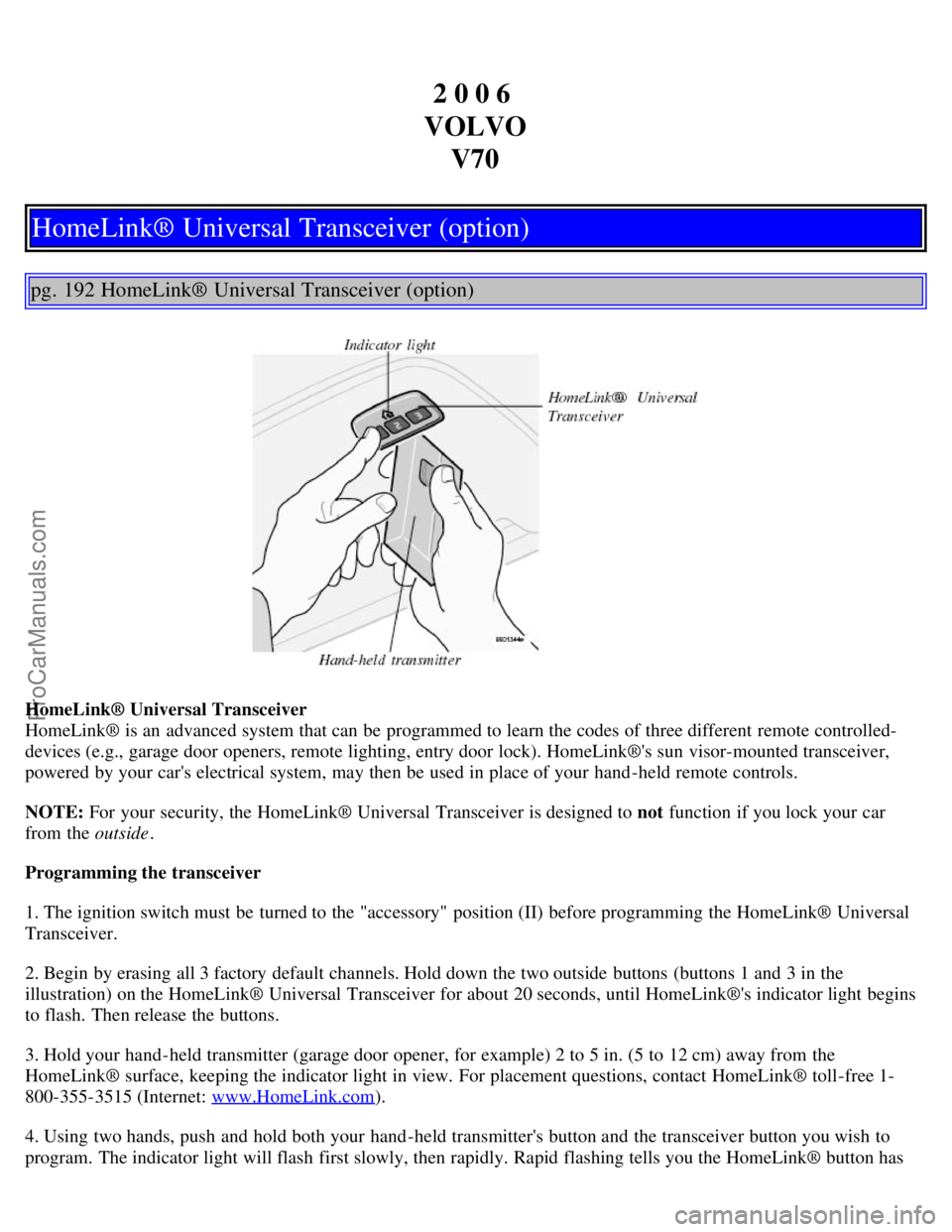
HomeLink® is an advanced system that can be programmed to learn the codes of three different remote controlled-
devices (e.g., garage door openers, remote lighting, entry door lock). HomeLink®'s sun visor-mounted transceiver,
powered by your car's electrical system, may then be used in place of your hand -held remote controls.
NOTE: For your security, the HomeLink® Universal Transceiver is designed to not function if you lock your car
from the outside .
Programming the transceiver
1. The ignition switch must be turned to the "accessory" position (II) before programming the HomeLink® Universal
Transceiver.
2. Begin by erasing all 3 factory default channels. Hold down the two outside buttons (buttons 1 and 3 in the
illustration) on the HomeLink® Universal Transceiver for about 20 seconds, until HomeLink®'s indicator light begins
to flash. Then release the buttons.
3. Hold your hand -held transmitter (garage door opener, for example) 2 to 5 in. (5 to 12 cm) away from the
HomeLink® surface, keeping the indicator light in view. For placement questions, contact HomeLink® toll-free 1-
800-355-3515 (Internet: www.HomeLink.com
).
4. Using two hands, push and hold both your hand -held transmitter's button and the transceiver button you wish to
program. The indicator light will flash first slowly, then rapidly. Rapid flashing tells you the HomeLink® button has
ProCarManuals.com
Page 124 of 138
original hand -held transmitter can also be used, as desired, to operate the garage door.
The remaining two HomeLink® buttons can be programmed in the same way. In the event of any problems in
programming the HomeLink® Universal Transceiver, call toll-free 1-800-355-3515 (Internet: www.HomeLink.com
).
Operating the HomeLink® Universal Transceiver
Once programmed, the HomeLink® Universal Transceiver can be used in place of your hand -held transmitters.
To operate, the key must be turned to the "accessory" position (II) or the engine must be running. Press the
programmed HomeLink® button to activate the garage door, driveway gate, security lighting, home security system,
etc.
Your original hand -held transmitters may, of course, be used at any time.
Erasing programmed buttons
Individual buttons cannot be erased. To erase all three programmed buttons:
1. Turn the ignition key to the "accessory" position (II).
2. Hold down the two outside buttons on the HomeLink® Universal Transceiver for about 20 seconds, until
HomeLink®'s indicator light begins to flash.
3. Release both buttons.
The HomeLink® buttons can be reprogrammed using the procedures described on the previous page.
(HomeLink® information continues on the next page)
pg. 194 HomeLink® Universal Transceiver (option)
Reprogramming a single HomeLink® button
1. Press and hold the desired HomeLink® button. Do not release the button until step 3 has been completed.
2. When the indicator light begins to flash slowly (after approximately 20 seconds), position your hand -held
transmitter 2 to 5 in. (5 to 12 cm) away from the HomeLink® surface.
3. Press and hold the hand -held transmitter button. The HomeLink® indicator light will flash first slowly, then rapidly.
When the indicator light flashes rapidly, release both buttons.
The previously programmed device has now been erased and the new device can be activated by pressing the
HomeLink® button that has just been programmed. This procedure will not affect any other programmed HomeLink®
buttons.
NOTE:
Retain the original transmitter(s) for future programming procedures (e.g., if you purchase a new car).
For your own security, erase all programmed buttons on the HomeLink® Universal Transceiver when you sell your
car.
Metallic sun protection films should not be used on any windows in a car equipped with HomeLink® Universal
Transceiver. This could interfere with the transceiver's function.
ProCarManuals.com
Page 128 of 138

Combination filter50, 53
Comfort chassis mode99
Coolant154
Cooling system - general information102
Courtesy light77
Courtesy lights (front) - replacing146
Courtesy lights - exterior80
Cruise control33
Cup holders63
D
Detachable trailer hitch108
Dimensions167
Direction indicators37
Direction indicators30
Distributor ignition system171
Dolby Surround Pro Logic II189
Dome lighting77
Door step courtesy lights - replacing147
Doors and locks80
Drive belt154
Driving economy101
Driving mode indicator27
Driving mode W95, 97, 110
Driving with tailgate open102
Dynamic Stability Traction Control (DSTC)115, 116
E
Economical driving101
Electric socket in cargo compartment70
Electrical system172
Electrical system - general information102
Electrically operated moonroof44
Electrically operated seats58
Electrically operated sideview mirrors43
Electrically operated windows42
Electronic Brake Force Distribution114
Electronic Climate Control (ECC)50 - 53
Emergency towing105, 106
Emergency warning flashers40
Emission inspection readiness156
Emissions systems153
Engine - specifications169
Engine - starting91, 92
Engine compartment158
Engine oil110, 159-160 , 170
ProCarManuals.com
Page 130 of 138

Head restraint - center rear66
Head restraint rear65
Headlight flash37
Headlight wiper blades - replacing164
Headlights35, 37
Heated front seats40
Heated rear window40
Heated sideview mirrors40
Heating50-53
High beam flash37
High/low beam headlights37
Hoisting the car157
Holder for grocery bags70
Home safe lighting37
HomeLink®192 -194
Hood - opening158
HU -650 - overview177
HU -850 - overview178
I
Ignition switch36
Immobilizer (start inhibitor)80, 91
Indicator lights28, 29
Inflatable curtain (VIC)13
Inspecting SRS system components14
Instrument panel27
Instrument panel lighting35
Instruments26
Integrated booster cushion19
Interior Air Quality system53
Interior features - overview24
Interior lighting77
ISOFIX child seat anchors22
J
Jack75
, 132
Jump starting109
K
Key - removing from ignition switch91
Keyless entry system81, 82
Keyless entry system - replacing batteries82
Keylock91
Keys80
Kickdown95, 96
L
Label information166
ProCarManuals.com