oil level VOLVO V70 2006 Owners Manual
[x] Cancel search | Manufacturer: VOLVO, Model Year: 2006, Model line: V70, Model: VOLVO V70 2006Pages: 138, PDF Size: 3.53 MB
Page 4 of 138

purification systems and cleaner fuels are bringing us closer to our goal.
After Volvo cars and parts have fulfilled their use, recycling is the next critical step in completing the life cycle. The
metal content is about 75% of the total weight of a car, which makes the car among the most recycled industrial
products. In order to have efficient and well controlled recycling, many Volvo variants have printed dismantling
manuals, indicating the weight and material of individual components. For Volvo, all homogeneous plastic parts
weighing more than 1.7 oz. (50 grams) are marked with international symbols that indicate how the component is to be
sorted for recycling.
In addition to continuous environmental refinement of conventional gasoline-powered internal combustion engines,
Volvo is actively looking at advanced technology alternative-fuel vehicles. When you drive a Volvo, you become our
partner in the work to lessen the car's impact on the environment.
To reduce your vehicle's environmental impact, you can:
Maintain proper air pressure in your tires. Tests have shown decreased fuel economy with improperly inflated tires
Follow the recommended maintenance schedule in your Warranty and Service Records Information booklet.
Drive at a constant speed
See an authorized Volvo retailer as soon as possible for inspection if the check engine (malfunction indicator) lamp
illuminates, or stays on after the vehicle has started
Properly dispose of any vehicle related waste such as used motor oil, used batteries, brake pads, etc.
When cleaning your car, use Volvo's own car care products, all of which have systematically been adapted to the
environment
PremAir®
On the surface of the radiator in the engine compartment, there is a special coating called PremAir®. PremAir® works
as a catalytic converter, converting most of the ozone passing through the radiator into oxygen, thereby reducing
harmful ground-level ozone. PremAir is a registered trademark of Engelhard Corporation.
Top of Page
ProCarManuals.com
Page 21 of 138
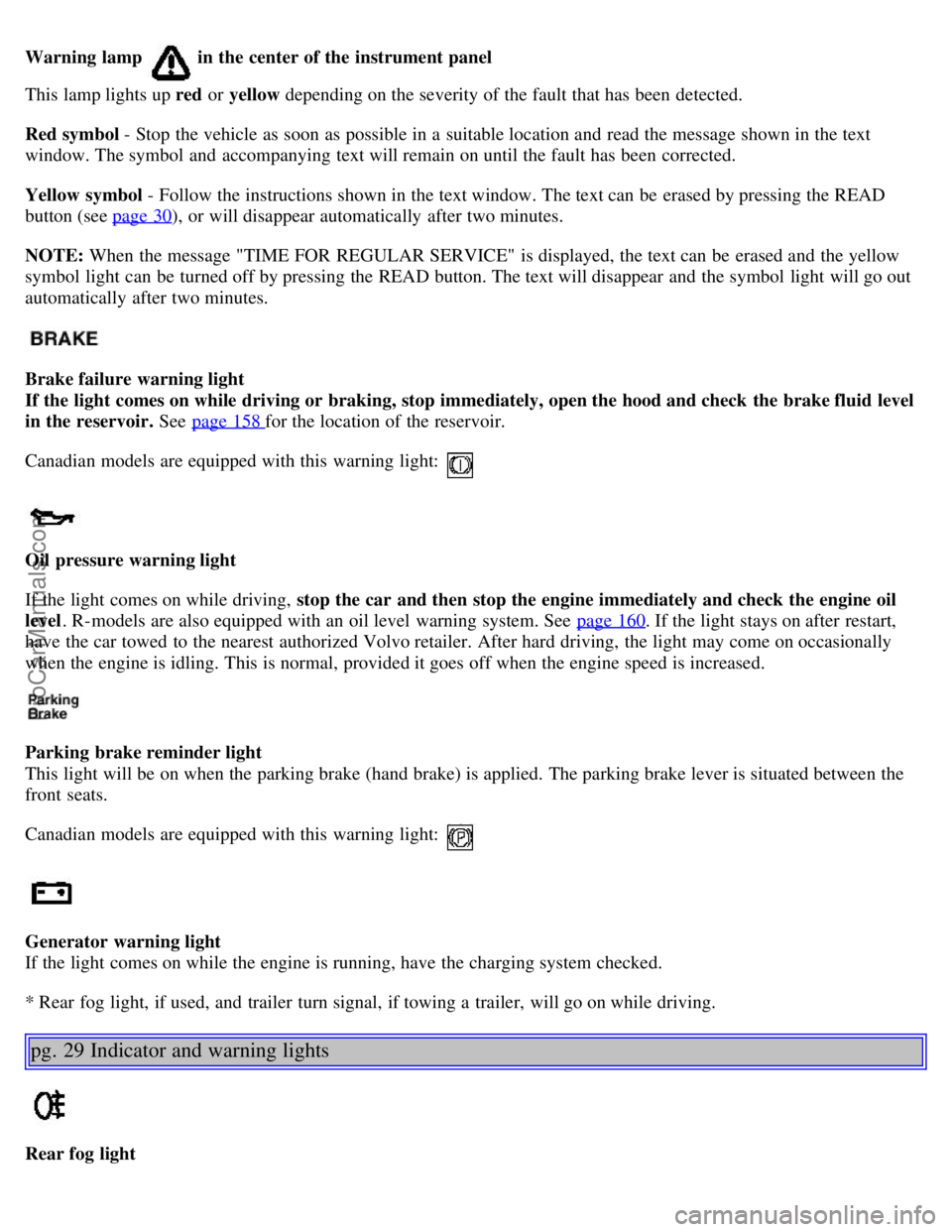
Warning lamp in the center of the instrument panel
This lamp lights up red or yellow depending on the severity of the fault that has been detected.
Red symbol - Stop the vehicle as soon as possible in a suitable location and read the message shown in the text
window. The symbol and accompanying text will remain on until the fault has been corrected.
Yellow symbol - Follow the instructions shown in the text window. The text can be erased by pressing the READ
button (see page 30
), or will disappear automatically after two minutes.
NOTE: When the message "TIME FOR REGULAR SERVICE" is displayed, the text can be erased and the yellow
symbol light can be turned off by pressing the READ button. The text will disappear and the symbol light will go out
automatically after two minutes.
Brake failure warning light
If the light comes on while driving or braking, stop immediately, open the hood and check the brake fluid level
in the reservoir. See page 158
for the location of the reservoir.
Canadian models are equipped with this warning light:
Oil pressure warning light
If the light comes on while driving, stop the car and then stop the engine immediately and check the engine oil
level . R-models are also equipped with an oil level warning system. See page 160
. If the light stays on after restart,
have the car towed to the nearest authorized Volvo retailer. After hard driving, the light may come on occasionally
when the engine is idling. This is normal, provided it goes off when the engine speed is increased.
Parking brake reminder light
This light will be on when the parking brake (hand brake) is applied. The parking brake lever is situated between the
front seats.
Canadian models are equipped with this warning light:
Generator warning light
If the light comes on while the engine is running, have the charging system checked.
* Rear fog light, if used, and trailer turn signal, if towing a trailer, will go on while driving.
pg. 29 Indicator and warning lights
Rear fog light
ProCarManuals.com
Page 24 of 138
light will stay on for 2 minutes after start until reset by the servicing retailer.
1) OIL LEVEL LOW/FILL OIL* Check the oil level and top up if necessary. See page 160.
2) OIL LEVEL LOW/STOP SAFELY* Stop as soon as possible and switch off the engine, check the oil level and
top up if necessary. See page 160
.
2) OIL LEVEL LOW/STOP ENGINE* Stop as soon as possible and switch off the engine, check the oil level and
top up if necessary. See page 160
.
2) OIL LEVEL LOW/SEE MANUAL* Stop as soon as possible and switch off the engine, check the oil level and
top up if necessary. See page 160
.
* These messages apply to R-models only.
1) Orange warning triangle, see page 28
.
2) Red warning triangle, see page 28
.
pg. 31 Switches in the center console
The positions of these buttons may vary, depending on the specifications of your car
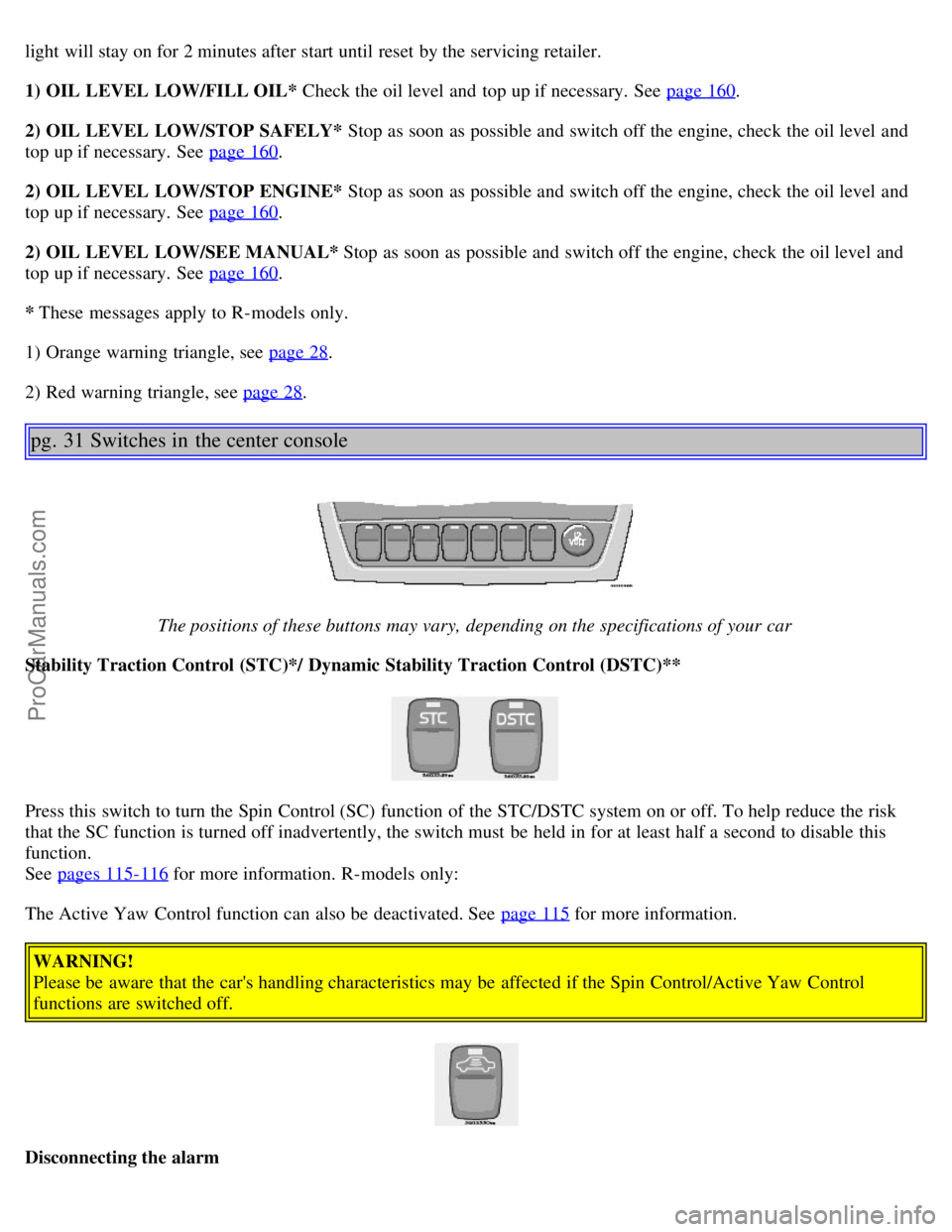
Stability Traction Control (STC)*/ Dynamic Stability Traction Control (DSTC)**
Press this switch to turn the Spin Control (SC) function of the STC/DSTC system on or off. To help reduce the risk
that the SC function is turned off inadvertently, the switch must be held in for at least half a second to disable this
function.
See pages 115-116
for more information. R-models only:
The Active Yaw Control function can also be deactivated. See page 115
for more information.
WARNING!
Please be aware that the car's handling characteristics may be affected if the Spin Control/Active Yaw Control
functions are switched off.
Disconnecting the alarm
ProCarManuals.com
Page 66 of 138

With this feature, the steering is most responsive at lower speeds to make parking, driving in city traffic, etc., easier.
The effect of the power steering diminishes as you accelerate for greater stability at highway speeds.
Weight distribution affects handling
At the specified curb weight your car has a tendency to understeer, which means that the steering wheel has to be
turned more than might seem appropriate for the curvature of a bend. This ensures good stability and reduces the risk
of rear wheel skid. Remember that these properties can alter with the vehicle load. The heavier the load on the rear of
the vehicle (e.g., heavily loaded (max. 220 lbs, 100 kg) cargo area or when towing a trailer, the less the tendency to
understeer.
pg. 102 Points to remember
Cooling system
The risk for engine overheating is greatest, especially in hot weather, when:
Towing a trailer up steep inclines for prolonged periods at wide open throttle and low engine rpm.
Stopping the engine suddenly after high speed driving (so-called "after-boiling" can occur).
To avoid overheating, the following rules should be followed:
Do not drive for prolonged periods at engine speeds above 4500 rpm if you are towing a trailer in hilly terrain.
Reduce speed when towing a trailer up long, steep inclines. The risk of overheating can be reduced by switching off
the air conditioning system for a short time.
Do not let the engine idle unnecessarily for prolonged periods.
Do not mount auxiliary lamps in front of the grill.
When the risk of overheating is imminent, or in the event of overheating (the temperature gauge goes repeatedly into,
or stays continually in, the red section), the following precautions should be taken:
Switch off the air conditioning system.
Pull off the road, away from traffic, stop the car and put the gear selector into neutral.
Switch the heater to full (maximum) position. Increase the engine speed to approx. 2000 rpm (twice idling speed)
until the temperature begins to drop.
WARNING!
Do not remove coolant expansion tank cap. The coolant will be extremely hot.
If necessary, see page 154
for information on checking and topping-up the coolant level.
CAUTION: Drive slowly and carefully if going through standing water (i.e. flooded roadways, etc.). Damage to the
engine could result if excess water is drawn in through the air intake system. Never drive the vehicle in water deeper
than 1 foot (300 mm). See the flood warning on page 5
.
WARNING!
Driving with the tailgate open : Driving with the tailgate open could mean that poisonous exhaust gases enter the
passenger compartment.
If the tailgate must be kept open for any reason, proceed as follows:
- Close the windows.
- Set the ventilation system to air flow to floor, windshield and side windows and blower control to its highest
setting.
Floor mats : An extra mat on the driver's floor can cause the accelerator pedal to catch. Check that the movement
ProCarManuals.com
Page 131 of 138

LATCH/ISOFIX anchors22
License plate lights - replacing146
Lifting the car157
Lighting panel35
Load carriers103
Loading the vehicle71
Locking and unlocking the car80
Locking steering wheel36
Long distance trip111
Long loads60
Low/high beam headlights37
`
M
Maintaining your car156
Maintenance, performed by owner155
Maintenance service152
Malfunction indicator lamp29
Manual climate control with air conditioning54-56
Manual front seat adjustment59
Manual transmission93
Mirrors43
Mirrors, sideview - memory function43
Moonroof44
N
Net - cargo72
Nylon cargo net72
O
Occupant safety2
Occupant Weight Sensor (OWS)9-11
Octane rating88
Odometer29
Oil - engine110, 159-160, 170
Oil -level (R-models)160
Oil pressure warning light28
On Call Roadside Assistance173
Opening the hood158
Owner maintenance155
P
Paint touch-up148
Panel lighting35
Panic function (alarm)84
Park Assist100
Parking brake41
Parking brake reminder light28
ProCarManuals.com
Page 132 of 138

Parking lights35
Passenger's seat backrest - folding60
Polishing150
Power moonroof44
Power seats58, 59
Power steering - speed sensitive101
Power steering fluid161
Power windows42
On Call Roadside Assistance183
R
R-models, checking oil level160
Radio175
Rain sensor - windshield wipers38
Reading lights - front/rear77
Rear fog light29, 35
Rear park assist87, 100
Rear reading lights77
Rear seat backrest69
Rear window - heated40
Rear-facing auxiliary seat18, 76
Rearview mirror43
Refrigerant49
Refueling90
Remote central locking system and sideview mirrors43
Remote control - keyless entry system81
Remote control - Homelink® Universal Transceiver193
Remote keyless entry system81
Remote keyless entry system - replacing batteries82
Removing the seat cushion69
Replacing bulbs141-147
Replacing fuses136
Replacing the battery162
Replacing wiper blades164
Reporting Safety Defects2
Road assistance173
Roadholding101
Roadside Assistance173
Roof load - maximum168
Roof racks103
Run flat tires125
S
Safety Defects - reporting2
Safety locks - child86
Seat belt reminder3
ProCarManuals.com
Page 137 of 138
the vehicle and others sharing the roadway. Avoiding distractions is part of that responsibility.
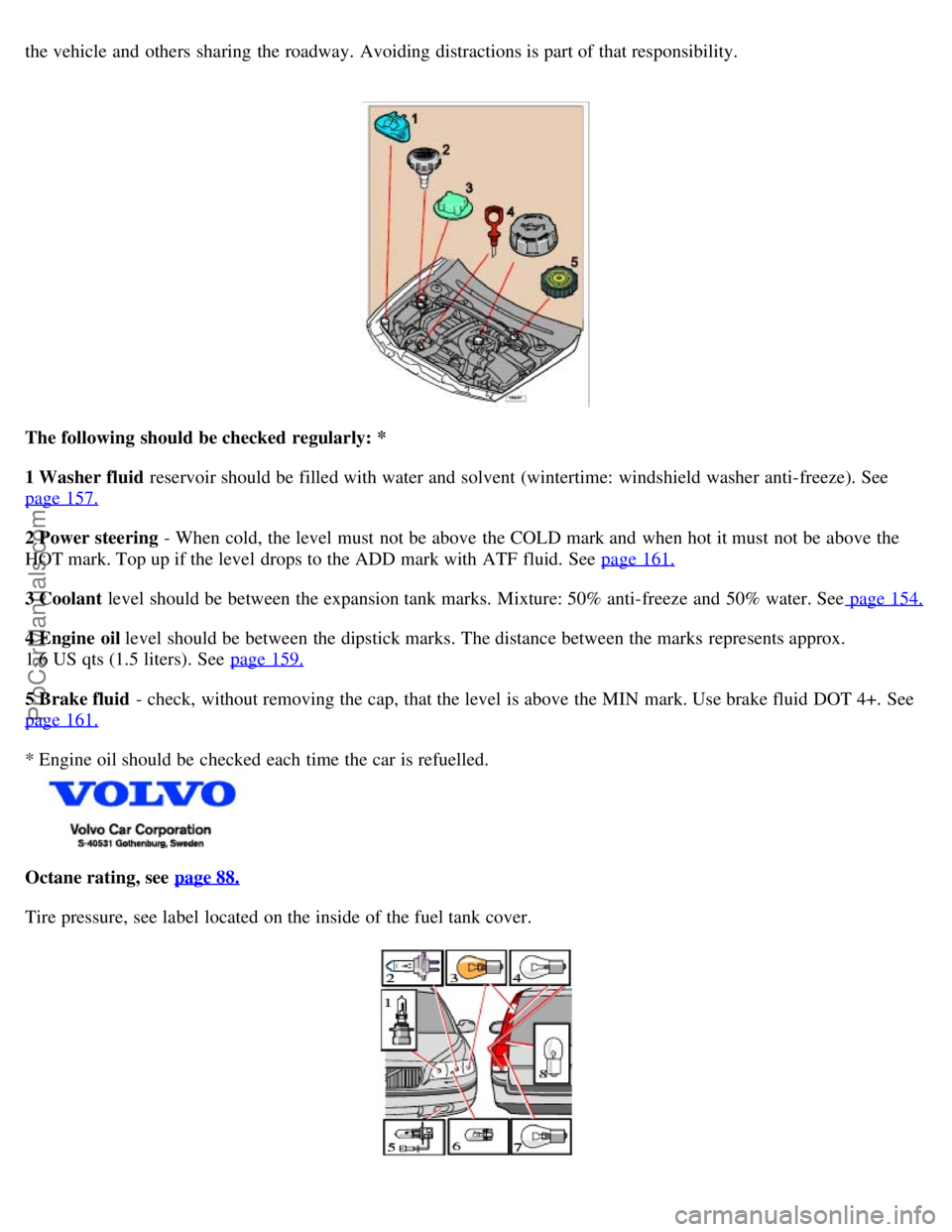
The following should be checked regularly: *
1 Washer fluid reservoir should be filled with water and solvent (wintertime: windshield washer anti-freeze). See
page 157.
2 Power steering - When cold, the level must not be above the COLD mark and when hot it must not be above the
HOT mark. Top up if the level drops to the ADD mark with ATF fluid. See page 161.
3 Coolant level should be between the expansion tank marks. Mixture: 50% anti-freeze and 50% water. See page 154.
4 Engine oil level should be between the dipstick marks. The distance between the marks represents approx.
1.6 US qts (1.5 liters). See page 159.
5 Brake fluid - check, without removing the cap, that the level is above the MIN mark. Use brake fluid DOT 4+. See
page 161.
* Engine oil should be checked each time the car is refuelled.
Octane rating, see page 88.
Tire pressure, see label located on the inside of the fuel tank cover.
ProCarManuals.com