door lock VOLVO V70 2007 User Guide
[x] Cancel search | Manufacturer: VOLVO, Model Year: 2007, Model line: V70, Model: VOLVO V70 2007Pages: 123, PDF Size: 2.64 MB
Page 52 of 123

The status of the alarm system is indicated by the red LED at the top of the dash:
LED off - the alarm is not armed
LED flashes once per second - the alarm is armed
LED flashes rapidly before the ignition is switched on - the alarm has been triggered
Fault in the alarm system: If a fault has been detected in the alarm system, a message will be displayed in the text
window. Contact a Volvo retailer.
Automatic re-lock/re-arm system
If the car is unlocked with the remote, the car will re-lock and the alarm will re-arm after 2 minutes unless a door or
the tailgate has been opened.
pg. 82 Child safety locks - rear doors
Child safety lock control in left rear doorChild safety lock control in right rear door
Child safety locks - rear doors
The controls are located on the rear door jambs. Use the ignition key or a screwdriver to adjust these controls.
A The door cannot be opened from the inside. Normal operation from the outside.
B The door lock functions normally.
WARNING!
Remember, in the event of an accident, the rear seat passengers cannot open the doors from the inside with the
buttons in position A.
Contents | Top of Page
Page 55 of 123

Fuel Formulations
Do not use gasoline that contains lead as a knock inhibitor, and do not use lead additives. Besides damaging the
exhaust emission control systems on your car, lead has been strongly linked to certain forms of cancer.
Many fuels contain benzene as a solvent. Unburned benzene has been strongly linked to certain forms of cancer. If you
live in an area where you must fill your own gas tank, take precautions. These may include:
standing upwind away from the filler nozzle while refueling
refueling only at gas stations with vapor recovery systems that fully seal the mouth of the filler neck during refueling
wear neoprene gloves while handling a fuel filler nozzle.
Use of Additives
With the exception of gas line antifreeze during winter months, do not add solvents, thickeners, or other store -bought
additives to your car's fuel, cooling, or lubricating systems. Overuse may damage your engine, and some of these
additives contain organically volatile chemicals. Do not needlessly expose yourself to these chemicals.
pg. 86 Refueling
Refueling
The fuel tank holds approximately:
Front wheel drive models:18.5 US gal. (70 liters)
All Wheel Drive models: 19 US gal. (72 liters)
V70R: 18 US gal. (68 liters),
with sufficient volume left over to accommodate possible expansion of the fuel in hot weather. Be aware that the
"usable" tank capacity will be somewhat less than the specified maximum. When the fuel level is low, such factors as
ambient temperature, the fuel's "Reid vapor pressure" characteristics, and terrain can affect the fuel pump's ability to
supply the engine with an adequate supply of fuel. Therefore, it is advisable to refuel as soon as possible when the
needle nears the red zone, or when the fuel warning light comes on.
Fuel filler door
Press the button on the light switch panel (see illustration on page 34) when the car is at a standstill to unlock the fuel
filler door. Please note that the fuel filler door will remain unlocked until the car begins to move forward. An audible
click will be heard when the fuel filler door relocks.
If you intend to leave your car while it is being refueled, this features enables you to lock the door/tailgate while
leaving the fuel filler door unlocked.
You can also keep the car locked if you remain inside it during refueling. The central locking button does not lock the
fuel filler door.
Be sure the fuel filler door is not obstructed and is completely closed after refueling.
Page 57 of 123

starting position. Release the pedal slowly when the engine starts.
4. To release the gear selector from the (P)ark position, the engine must be running (or the ignition key must be in
position II) and the brake pedal must be depressed. While keeping firm pressure on the brake pedal, release the parking
brake.
5. Select the desired gear. The gear engages after a very slight delay which is especially noticeable when selecting R.
NOTE:
Your car is equipped with a KEYLOCK system. When the engine is switched off, the gear selector must be in the
( P )ark position before the key can be removed from the ignition switch.
When starting in cold weather, the transmission may shift up at slightly higher engine speeds than normal until the
automatic transmission fluid reaches normal operating temperature.
* Your car is equipped with an electronic start inhibitor (immobilizer). The keys you received with your car are
specially coded. The code in the key is transmitted to an antenna in the ignition switch where it is compared to the
code stored in the start inhibitor module. The car can only be started if a properly coded key is used.
If two of the keys to your car are close together, e.g., on the same key ring, when you try to start the car, this could
cause interference in the immobilizer system and result in the car not starting. If this should occur, remove one of the
keys from the key ring before trying to start the car again.
pg. 88 Starting the engine
CAUTION:
The engine should be idling when you move the gear selector. Never accelerate until after you feel the transmission
engage! Accelerating immediately after selecting a gear will cause harsh engagement and premature transmission wear.
Selecting P or N when idling at a standstill for prolonged periods time will help prevent overheating of the automatic
transmission fluid.
Do not race a cold engine immediately after starting. Oil flow may not reach some lubrication points fast enough to
prevent engine damage.
WARNING!
Always place the gear selector in Park and apply the parking brake before leaving the vehicle. Never leave the car
unattended with the engine running.
Always open garage doors fully before starting the engine inside a garage to ensure adequate ventilation. The
exhaust gases contain carbon monoxide, which is invisible and odorless but very poisonous.
An extra mat on the driver's floor can cause the accelerator pedal and the clutch to catch. Check that the
movement of the accelerator pedal and clutch is not impeded. Not more than one protective floor covering may be
used at one time.
pg. 89 Manual transmission
Page 83 of 123
33 Fuel pump15A
34 Power moonroof15A
35 Central locking system, power windows - left door mirror 25A
36 Central locking system, power windows - right door mirror 25A
37 Rear power windows 30A
38 Alarm siren 5A
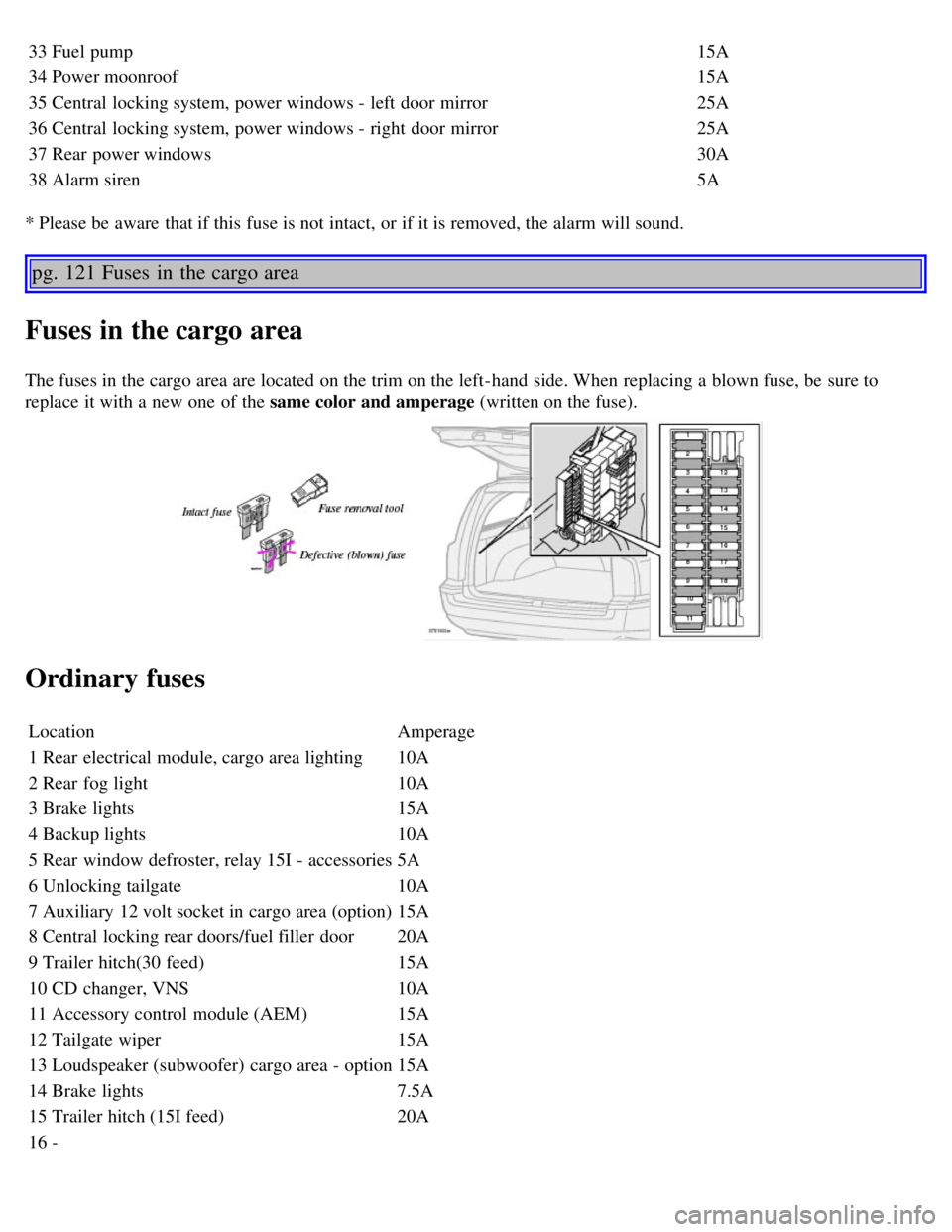
* Please be aware that if this fuse is not intact, or if it is removed, the alarm will sound.
pg. 121 Fuses in the cargo area
Fuses in the cargo area
The fuses in the cargo area are located on the trim on the left-hand side. When replacing a blown fuse, be sure to
replace it with a new one of the same color and amperage (written on the fuse).
Ordinary fuses
LocationAmperage
1 Rear electrical module, cargo area lighting 10A
2 Rear fog light 10A
3 Brake lights 15A
4 Backup lights 10A
5 Rear window defroster, relay 15I - accessories 5A
6 Unlocking tailgate 10A
7 Auxiliary 12 volt socket in cargo area (option) 15A
8 Central locking rear doors/fuel filler door 20A
9 Trailer hitch(30 feed) 15A
10 CD changer, VNS 10A
11 Accessory control module (AEM) 15A
12 Tailgate wiper 15A
13 Loudspeaker (subwoofer) cargo area - option 15A
14 Brake lights 7.5A
15 Trailer hitch (15I feed) 20A
16 -
Page 88 of 123

Front fog lights (option)
CAUTION:
Avoid touching the glass on the bulb with your fingers.
Switch off all lights and turn the ignition key to position 0.
Turn the bulb holder slightly counterclockwise to release it.
Replace the bulb. The shape of the base of the bulb corresponds to the shape of the bulb holder.
Reinstall the bulb holder by turning it slightly clockwise. "TOP" on the holder should be upward.
* R-models: H3
Side direction indicator
Open the front door halfway.
From the inside of the fender, push the lamp housing out.
Turn the bulb holder 1/4 turn counterclockwise and pull it out from the lens.
Remove the defective bulb by pulling it straight out.
Insert a new bulb.
Reinsert the bulb holder in the lens and press the entire unit back into place on the fender.
Door step courtesy lights
The door step courtesy lights are located under the dash on the driver's and passenger's sides.
To replace a bulb:
Carefully insert a screwdriver and pry out the lens.
Replace the defective bulb.
Page 92 of 123

damage. It is particularly important to wash the car frequently in the wintertime to prevent corrosion, when salt has
been used on the roads.
When washing the car, do not expose it to direct sunlight. Use lukewarm water to soften the dirt before you wash
with a sponge and plenty of water, to avoid scratching.
Bird droppings : Remove from paintwork as soon as possible. Otherwise the finish may be permanently damaged.
A detergent can be used to facilitate the softening of dirt and oil.
A water-soluble grease solvent may be used in cases of sticky dirt. However, use a wash place equipped with a
drainage separator.
Remove dirt from the drain holes in the doors and rocker panels.
Dry the car with a clean chamois.
Tar spots can be removed with kerosene or tar remover after the car has been washed.
A stiff-bristle brush and lukewarm soapy water can be used to clean the wiper blades. Frequent cleaning improves
visibility considerably.
Wash off the dirt from the underside (wheel housings, fenders, etc.).
In areas of high industrial fallout, more frequent washing is recommended.
CAUTION:
During high pressure washing, the spray mouthpiece must never be closer to the vehicle than 13" (30 cm). Do not
spray into the locks.
Special moonroof cautions:
- Always close the moonroof and sun shade before washing your vehicle.
- Never use abrasive cleaning agents on the moonroof.
- Never use wax on the rubber seals around the moonroof.
When washing or steam cleaning the engine, avoid spraying water or steam directly on the electrical components or
toward the rear side of the engine.
After cleaning the engine, the spark plug wells should be inspected for water and blown dry if necessary.
Suitable detergents: Special car washing detergents should be used. Mix according to manufacturer's instructions.
Bumpers: The bumpers are painted. Wash the bumpers with the same cleaning agent used on the rest of the car.
Never clean the bumpers with gasoline or paint thinner. Difficult spots can be removed with denatured alcohol. To
avoid scratches, do not dry the bumpers with paper.
WARNING!
When the car is driven immediately after being washed, apply the brakes several times in order to remove any
moisture from the brake linings.
Engine cleaning agents should not be used when the engine is warm. This constitutes a fire risk.
pg. 130 Washing the car, Cleaning the upholstery
Automatic washing - simple and quick
We do NOT recommend washing your car in an automatic wash during the first six months (because the
paint will not have hardened sufficiently).
An automatic wash is a simple and quick way to clean your car, but it is worth remembering that it may not be as
thorough as when you yourself go over the car with sponge and water. Keeping the underbody clean is most important,
especially in the winter. Some automatic washers do not have facilities for washing the underbody.
Page 113 of 123
Automatic Locking Retractor (ALR)14
Automatic transmission90, 91
- Cold starts91
- Geartronic92, 93
- Kickdown91, 92
- Sport mode93
Auxiliary socket31, 39
AWD
- general information94
- using snow chains111
B
Backrest (center) - 3-section rear seat64
Battery105, 150
Battery maintenance140, 141
- Replacing the battery141
- Ventilation hose141
Booster cushion12, 16
Brake failure warning light28
Brake fluid139
Brake system18
Bulbs (list)150
Bulbs - replacing122-127
C
Capacities (oils and fluids)143
, 148
Cargo compartment cover71
Cargo compartment lighting67
Cargo eyelets68
Cargo net69
Catalytic converters - three-way107
Center armrest - 3-section rear seat65
Center backrest (3-section rear seat)64
Center console - switches31
Center head restraint - 3-section rear seat64
Center head restraint - rear seat3
Center seat head restraint63
Central locking buttons79
Chains - winter driving111
Changing wheels114, 115
Chassis settings (R-models)95
Child booster cushion12, 16
Child Restraint Anchorages15
Child safety11, 12, 14, 16
Child safety locks - rear doors82
Climate controls48-51
Page 114 of 123

Climate system - general information47
Clock27
Clutch interlock89
Coat hanger61
Coin compartment59
Cold weather driving105
Combination filter48, 51
Coolant133
Cooling system - general information97
Courtesy light76
Courtesy lights (front) - replacing126
Courtesy lights - exterior76
Cruise control33
Cup holder59
Cup holder in the center console60
D
Detachable trailer hitch - installing103
Dimensions145
Direction indicators36
Distributor ignition system149
Door step courtesy lights - replacing125
Doors and locks76
Drive belt133
Driver's seat and remote keyless entry system57
Driving economy96
Driving mode indicator27
Driving mode W91, 93, 105
Driving with trunk open97
E
Economical driving96
Electric socket in cargo compartment67
Electrical system150
Electrical system - general information97
Electrically operated front seats56
Electrically operated moonroof42
Electrically operated sideview mirrors41
Electrically operated windows40
Electronic Brake Force Distribution19
Electronic Climate Control (ECC)48 - 51
Emergency Locking Retractor (ELR)14
Emergency towing100, 101
Emergency warning flashers38
Emissions systems132
Engine - specifications147