wheel VOLVO V70 2007 Owner's Manual
[x] Cancel search | Manufacturer: VOLVO, Model Year: 2007, Model line: V70, Model: VOLVO V70 2007Pages: 123, PDF Size: 2.64 MB
Page 76 of 123

Insert flat end of lug wrench and turn/pull straight out
Changing wheels
The spare wheel is located under the carpet on the cargo area floor. The optional subwoofer, located under the cargo
area floor, must be removed to allow access to the spare wheel. See page 72
for instructions. The jack and crank are
secured in the wheel recess.
There are two jack attachment points on each side of the car.
To change a wheel:
Engage the parking brake.
Put the gear selector in (P)ark.
Remove the wheel cap (where applicable) using the lug wrench in the tool bag.
With the car still on the ground, use the lug wrench to loosen the wheel bolts 1/2 - 1 turn by exerting downward
pressure. Turn the bolts counterclockwise to loosen.
Loosen wheel bolts
Position the jack on the bar in the attachment ( A in the illustration above) and crank while simultaneously guiding
the base of the jack to the ground. The base of the jack must be flat on a level, firm, non-slippery surface. Before
raising the car, check that the jack is still correctly positioned in the attachment.
Raise the vehicle until the wheel to be changed is lifted off the ground.
Unscrew the wheel bolts completely and carefully remove the wheel so as not to damage the thread on the studs.
NOTE: See also page 135
for hoisting the vehicle on a garage lift!
WARNING!
The jack must correctly engage the bar in the jack attachment (A). The car's weight must not rest on the jack
Page 77 of 123

attachment (B). See illustration on page 115.
Be sure the jack is on a firm, level, non-slippery surface.
Never allow any part of your body to be extended under a car supported by a jack.
Use the jack intended for the car when replacing a wheel. For any other job, use stands to support the side of the
car being worked on.
Apply the parking brake and put the gear selector in the (P)ark position.
Block the wheels standing on the ground, use rigid wooden blocks or large stones.
The jack should be kept well-greased.
pg. 115 Changing wheels
Attaching the jack
NOTE: To avoid excessive wear and the necessity of rebalancing, mark and reinstall wheels in the same location and
position as before removal. To lessen the chance of imbalance, each wheel hub is equipped with a guide stud to ensure
that a removed wheel can be reinstalled in its original position (as when changing over to winter tires/wheels).
NOTE: Refer to page 135
for hoisting the vehicle on a garage lift.
Jack for AWD models
CAUTION:
The car must not be driven with wheels of different dimensions or with a spare tire other than the one that came with
the car. The use of different size wheels can seriously damage your car's transmission.
Correct tightening torque on wheel bolts must be observed. The wheel bolts should never be greased or lubricated.
The extended, chromed wheel bolts must not be used with steel rims, as they make it impossible to fit the hub caps.
Page 78 of 123
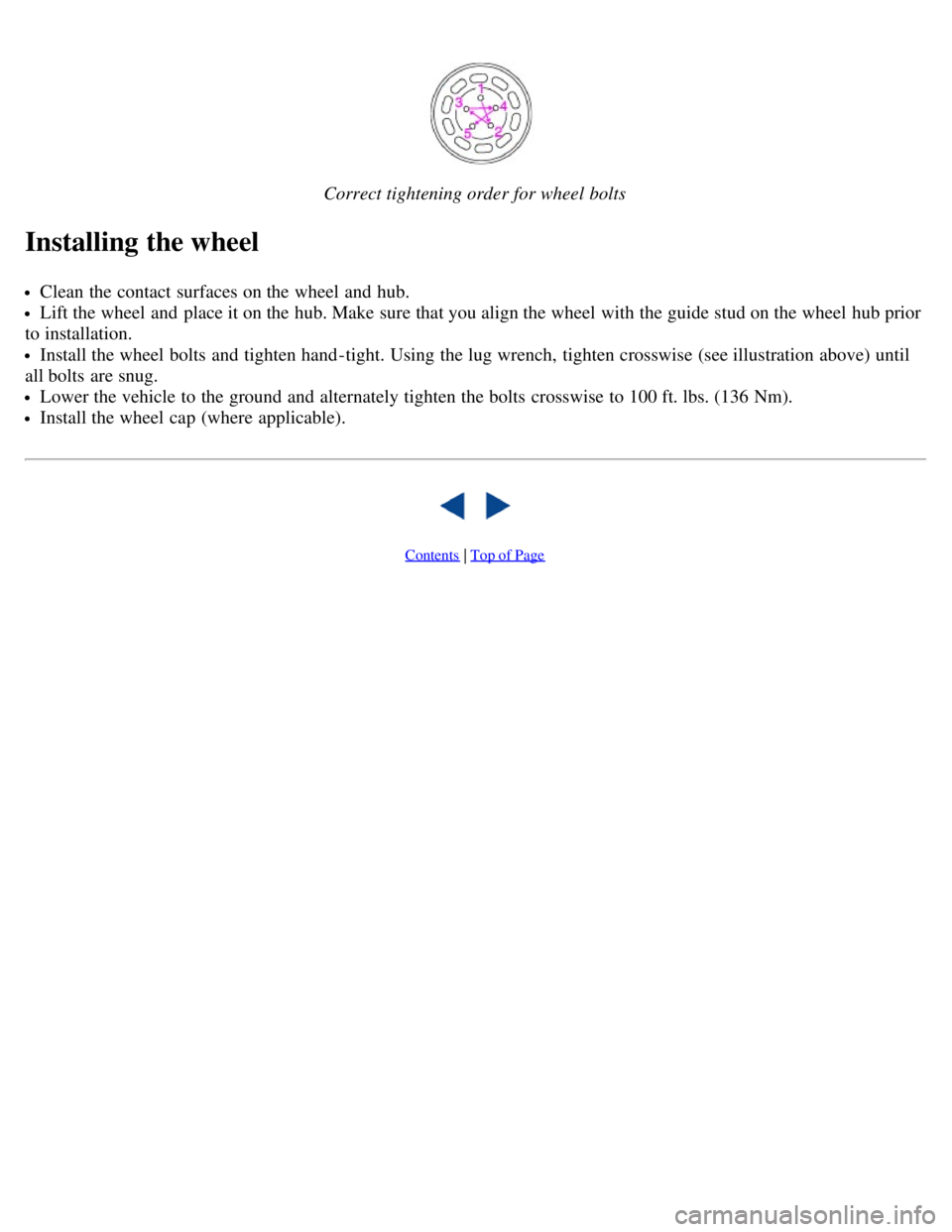
Correct tightening order for wheel bolts
Installing the wheel
Clean the contact surfaces on the wheel and hub.
Lift the wheel and place it on the hub. Make sure that you align the wheel with the guide stud on the wheel hub prior
to installation.
Install the wheel bolts and tighten hand -tight. Using the lug wrench, tighten crosswise (see illustration above) until
all bolts are snug.
Lower the vehicle to the ground and alternately tighten the bolts crosswise to 100 ft. lbs. (136 Nm).
Install the wheel cap (where applicable).
Contents | Top of Page
Page 82 of 123

LocationAmperage
1 Low beam headlights 15A
2 High beam headlights 20A
3 Power driver's seat 30A
4 Power passenger's seat 30A
5 Speed -dependent power steering, vacuum pump 15A
6 -
7 Heated seat - front left (option) 15A
8 Heated seat - front right (option) 15A
9 ABS/STC/DSTC 5A
10 Daytime running lights 10A
11 Daytime running lights 10A
12 Headlight wipers (certain models) 15A
13 Electric socket 12 V 15A
14 Power passenger's seat 5A
15 Audio system, VNS 5A
16 Audio system 20A
17 Audio amplifier 30A
18 Front fog lights 15A
19 VNS display 10A
20 -
21 Automatic transmission, shiftlock, extended D2 feed 10A
22 Direction indicators 20A
23 Headlight switch module, climate control system, onboard diagnostic connector,
steering wheel lever modules 5A
24 Relay for extended D1 feed: climate control system, power driver's seat, driver's info 10A
25 Ignition switch, relay starter motor, SRS, engine control module 10A
26 Climate control system blower 30A
27 -
28 Electronic module - courtesy lighting 10A
29 -
30 Left front/rear parking lights 7.5A
31 Right front/rear parking lights, license plate lights 7.5A
32 Central electrical module, vanity mirror lightings,
glove compartment light, interior courtesy lighting 10A
Page 84 of 123

17 All Wheel Drive control module7.5A
18 -
pg. 122 Replacing bulbs
Replacing high/low beam headlight bulbs
The headlight bulbs must be replaced from the engine compartment.
CAUTION:
Do not touch the glass on halogen bulbs with your fingers. Grease, oil or any other impurities can be carbonized onto
the bulb and cause damage to the reflector.
Be sure to use bulbs of the correct type and voltage.
Removing a defective bulb
To remove a defective low beam bulb:
Switch off all lights and turn the ignition switch to position 0.
Open the hood.
Remove the plastic cover over the bulb (1) by turning it counterclockwise.
Remove the connector (2).
Loosen the retaining spring (3) by first moving it to the right and then moving it down, out of the way.
Pull out the defective bulb. Note the position of the guide lug on the base of the bulb (4).
Page 92 of 123

damage. It is particularly important to wash the car frequently in the wintertime to prevent corrosion, when salt has
been used on the roads.
When washing the car, do not expose it to direct sunlight. Use lukewarm water to soften the dirt before you wash
with a sponge and plenty of water, to avoid scratching.
Bird droppings : Remove from paintwork as soon as possible. Otherwise the finish may be permanently damaged.
A detergent can be used to facilitate the softening of dirt and oil.
A water-soluble grease solvent may be used in cases of sticky dirt. However, use a wash place equipped with a
drainage separator.
Remove dirt from the drain holes in the doors and rocker panels.
Dry the car with a clean chamois.
Tar spots can be removed with kerosene or tar remover after the car has been washed.
A stiff-bristle brush and lukewarm soapy water can be used to clean the wiper blades. Frequent cleaning improves
visibility considerably.
Wash off the dirt from the underside (wheel housings, fenders, etc.).
In areas of high industrial fallout, more frequent washing is recommended.
CAUTION:
During high pressure washing, the spray mouthpiece must never be closer to the vehicle than 13" (30 cm). Do not
spray into the locks.
Special moonroof cautions:
- Always close the moonroof and sun shade before washing your vehicle.
- Never use abrasive cleaning agents on the moonroof.
- Never use wax on the rubber seals around the moonroof.
When washing or steam cleaning the engine, avoid spraying water or steam directly on the electrical components or
toward the rear side of the engine.
After cleaning the engine, the spark plug wells should be inspected for water and blown dry if necessary.
Suitable detergents: Special car washing detergents should be used. Mix according to manufacturer's instructions.
Bumpers: The bumpers are painted. Wash the bumpers with the same cleaning agent used on the rest of the car.
Never clean the bumpers with gasoline or paint thinner. Difficult spots can be removed with denatured alcohol. To
avoid scratches, do not dry the bumpers with paper.
WARNING!
When the car is driven immediately after being washed, apply the brakes several times in order to remove any
moisture from the brake linings.
Engine cleaning agents should not be used when the engine is warm. This constitutes a fire risk.
pg. 130 Washing the car, Cleaning the upholstery
Automatic washing - simple and quick
We do NOT recommend washing your car in an automatic wash during the first six months (because the
paint will not have hardened sufficiently).
An automatic wash is a simple and quick way to clean your car, but it is worth remembering that it may not be as
thorough as when you yourself go over the car with sponge and water. Keeping the underbody clean is most important,
especially in the winter. Some automatic washers do not have facilities for washing the underbody.
Page 96 of 123

* The Vehicle Identification Number (VIN) should always be quoted in all correspondence concerning your vehicle
with the retailer and when ordering parts.
All specifications are subject to change without prior notice.
pg. 145 Dimensions and weights
Dimensions
Length - 185.4 in. (471 cm), V70 -186.2 (473 cm)
Width - 71 in. (180 cm), V70 - 73.2 in. (186 cm)
Height - 57.7 in. (147 cm), V70 AWD - 58.7 in. (149 cm), V70 - 61.5 in. (156 cm)
Wheelbase - 108.5 in. (276 cm), V70 - 108.8 in. (276 cm)
Track, front - 61.5 in. (156 cm), V70 - 63.4 in. (161 cm)
Track, rear - 61.4 in. (156 cm), V70 - 60.9 in. (155 cm)
Turning circle (between curbs) - 35.8-39 ft. (10.9-11.9 m)
Cargo capacity - 17.1 cu. ft. (0.48 m
3 )1
- 26.3 cu. ft. (0.74 m
3 )2
- 58.0 cu. ft. (1.64 m
3 )3 USA Canada
Max roof load 220 lbs100 kg
Max trailer weight (w/o brakes) 1650 lbs750 kg
Max trailer weight*
- (with brakes, 2" ball) 3300 lbs1500 kg
- (with brakes, 1 7/8" ball) 2000 lbs900 kg
Max tongue weight * 165 lbs75 kg
Page 100 of 123

Volume: 7.9 US qts (7.5 liters)
Cooling system
Type: Positive pressure, closed system. The thermostat begins to open at 194 °F (90 °C)
Coolant: Volvo original coolant/antifreeze
Power steering fluid
ATF fluid
Volume: 0.95 US qts (0.9 liters)
Brake fluid
DOT 4+ boiling point >536°F(280°C), P/N 9437433
Volume: 0.64 US qts (0.6 liters)
Climate control system - refrigerant (R 134a)
Oil: PAG
Volume: 2.2 lbs (1,000 g) R134a
Fuel
Minimum octane requirement - AKI 87 (RON 91)
Fuel tank volume:
Front wheel drive models:18.5 US gal. (70 liters)
All Wheel Drive models: 19 US gal. (72 liters)
V70R: 18 US gal. (68 liters)
Washer fluid reservoir
Volume: 4.7 US qts (4.5 liters)
All specifications are subject to change without prior notice.
pg. 149 Fuel system, Distributor ignition system, Suspension
Fuel system
The engine is equipped with a multiport fuel injection system.
Distributor ignition system
Firing order: 1-2-4-5-3
Electronic ignition setting: Not adjustable
Spark plugs: Champion RC8PYP 8 (or equivalent)
Page 101 of 123

Spark plug gap: 0.028-0.032" (0.7-0.8 mm)
Tightening torque: 18.4 ft. lbs. (25 Nm) WARNING!
The ignition system operates at very high voltages. Special safety precautions must be followed to prevent injury.
Always turn the ignition off when:
Replacing ignition components e.g. plugs, coil, etc.
Do not touch any part of the ignition system while the engine is running. This may result in a shock and bodily
injury.
Front suspension
Spring strut suspension with integrated shock absorbers and control arms linked to the support frame. Power-assisted
rack and pinion steering. Safety type steering column. The alignment specifications apply to an unladen car but include
fuel, coolant and spare wheel.
Rear suspension
Individual rear wheel suspension with longitudinal support arms, double link arms and track rods.
All specifications are subject to change without prior notice.
pg. 150 Electrical system
Electrical system
12 Volt, negative ground.
Voltage-controlled generator. Single-wire system with chassis and engine used as conductors. Grounded on chassis.
Battery
Voltage: 12 Volt, capacity: 600 A/115 min reserve capacity.
The battery contains corrosive and poisonous acids. It is of the utmost importance that old batteries are disposed of
correctly. Your Volvo retailer can assist you in this matter.
Generator
Rated output: max. current: 140 A
Starter motor:
Output: 1.7 kW
Bulbs
Bulb US no.Power Socket
Headlights
- High beam HB360W -
- Low beam H755W -
Bi -Xenon headlights*
Page 106 of 123

Internal CD changer
Station scan - press
TV (option on certain models)
External CD changer (option)
7. Radio - Station seek up/down
CD - Selecting next/previous track
8. Radio - Manual station selection
CD - Fast forward/backward
9. CD eject
10. Dolby Pro Logic - switching on
11. 2 channel stereo
12. 3 channel stereo
13. CD slot
14. CD random play
15. Program type
16. News
17. Traffic information
18. Automatic presetting of radio stations
19. Display
pg. 156 Audio systems HU-613/HU-803
Switch on/off
Press the knob to switch on or turn off the radio.
Volume control
Turn the knob clockwise to increase volume. Volume control is electronic and does not have an end stop. If you have
a key pad in the steering wheel, increase or decrease the volume with the + or - buttons.
Bass