door VOLVO V70 2007 Owners Manual
[x] Cancel search | Manufacturer: VOLVO, Model Year: 2007, Model line: V70, Model: VOLVO V70 2007Pages: 123, PDF Size: 2.64 MB
Page 1 of 123

2 0 0 4
VOLVO V70
This manual deals with the operation and care of your Volvo.
Welcome to the worldwide family of Volvo owners. We trust that you will enjoy many years of safe driving in your
Volvo, an automobile designed with your safety and comfort in mind. To help ensure your satisfaction with this
vehicle, we encourage you to familiarize yourself with the equipment descriptions, operating instructions and
maintenance requirements/recommendations in this manual. We also urge you and your passengers to wear seat belts
at all times in this or any other automobile. And, of course, please do not operate a vehicle if you may be affected by
alcohol, medication or any impairment that could hinder your ability to drive.
Your Volvo is designed to meet all applicable safety and emission standards, as evidenced by the certification labels
attached to the driver's door opening and on the left wheel housing in the engine compartment.
For further information please contact your retailer, or:
In the USA: In Canada:
Page 3 of 123
Anti-lock Brake System (ABS)
The ABS system in your car performs a self -diagnostic test when the vehicle first reaches the speed of approximately
12 mph (20 km/h). The brake pedal will pulsate several times and a sound may be audible from the ABS control
module. This is normal.
Fuel filler door
Press the button on the light switch panel (see page 34
) when the car is at a standstill to unlock the fuel filler door.
Please note that the fuel filler door will remain unlocked until the car begins to move forward. An audible click will be
heard when the fuel filler door relocks.
Fuel filler cap
After refueling, close the fuel filler cap by turning it clockwise until it clicks into place. If this cap is not closed tightly
or if the engine is running when the car is refueled, the Malfunction Indicator Lamp ("Check Engine" light) may
indicate a fault.
WARNING! If your vehicle is involved in an accident, unseen damage may affect your vehicle's driveability and
safety.
Important
Before you operate your car for the first time, please familiarize yourself with the new-engine oil consumption
information on page 137
. You should also be familiar with the information in the chapters one, two and four of
this manual.
Information contained in the balance of the manual is extremely useful and should be read after operating the
vehicle for the first time.
The manual is structured so that it can be used for reference. For this reason, it should be kept in the car for
ready access.
Do not export your Volvo to another country before investigating that country's applicable safety and exhaust
emission requirements. In some cases it may be difficult or impossible to comply with these requirements.
Modifications to the emission control system(s) may render your Volvo not certifiable for legal operation in the
U.S., Canada and other countries.
All information, illustrations and specifications contained in this manual are based on the latest product
information available at the time of publication. Please note that some vehicles may be equipped differently,
depending on special legal requirements and that optional equipment described in this manual may not be
available in all markets.
Volvo reserves the right to make model changes at any time, or to change specifications or design, without
notice and without incurring obligation.
CALIFORNIA Proposition 65 Warning
WARNING! Engine exhaust, some of its constituents, and certain vehicle components contain or emit chemicals
known to the state of California to cause cancer, and birth defects or other reproductive harm. In addition, certain
fluids contained in vehicles and certain products of component wear contain or emit chemicals known to the State
of California to cause cancer, and birth defects or other reproductive harm.
Page 9 of 123

The center head restraint can be adjusted according to the passenger's height. The restraint should be carefully adjusted
to support the occupant's head.
To raise, lift up to desired position. To lower the center head restraint, press the release button behind the right-hand
support while pressing down the head restraint to the desired position.WARNING!
Please note that the lowest head restraint position is only intended for use when the backrest is to be folded down,
or when the seat is not occupied.
The head restraint is intended to help protect the head/neck in a collision. Ensure that it is properly adjusted for
the occupant of the seat.
pg. 4 Front airbags - SRS
Driver's side airbag - in steering wheel hubPassenger's side airbag - above glove compartment
As an enhancement to the three-point seat belt system, your Volvo is equipped with a Supplemental Restraint System
(SRS). The Volvo SRS consists of an airbag (2) on both the driver's and passenger's sides and seat belt tensioners in
both front door pillars (4). The system is designed to supplement the protection provided by the three-point seat belt
system. All three rear seat belts are also equipped with tensioners.
The SRS system is indicated by the "SRS" embossed on the steering wheel pad and above the glove compartment, and
by decals on both sun visors and on the front and far right side of the dash.
The airbags are folded and located in the steering wheel hub and above the glove compartment. They are designed to
deploy during certain frontal or front -angular collisions, impacts, or decelerations, depending on the crash severity,
angle, speed and object impacted. The airbags may also deploy in certain non-frontal collisions where rapid
deceleration occurs.
The airbag system includes gas generators (1) surrounded by the airbags (2) and front seat belt tensioners for both of
the front seats (4). To deploy the system, the sensor (3) activates the gas generators causing the airbags to be inflated
with nitrogen gas. As the movement of the seats' occupants compresses the airbags, some of the gas is expelled at a
controlled rate to provide better cushioning. Both seat belt tensioners also deploy, minimizing any seat belt slack.
The entire process, including inflation and deflation of the airbags, takes approximately two-tenths of a second.
Page 11 of 123
to the nearest authorized Volvo retailer for inspection as soon as possible.
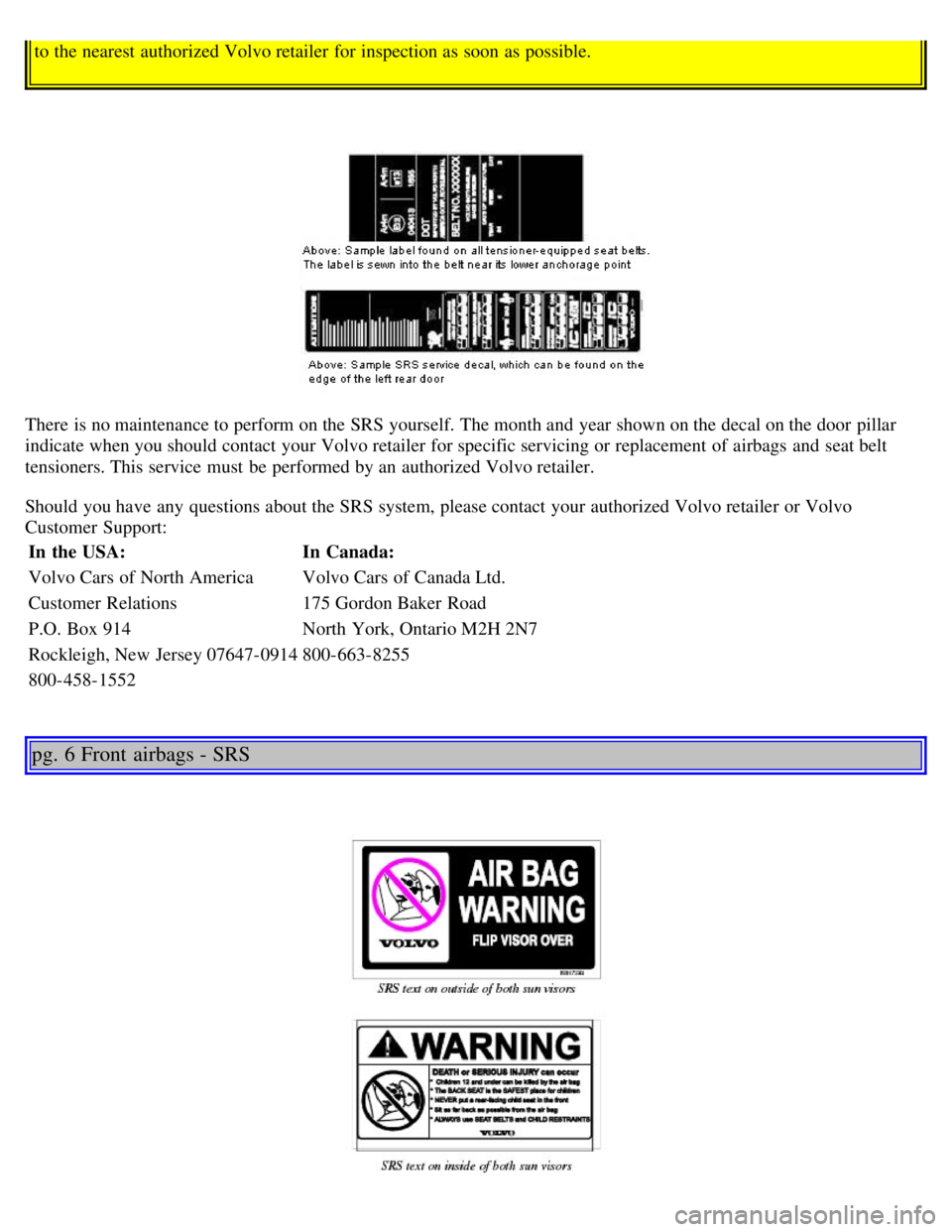
There is no maintenance to perform on the SRS yourself. The month and year shown on the decal on the door pillar
indicate when you should contact your Volvo retailer for specific servicing or replacement of airbags and seat belt
tensioners. This service must be performed by an authorized Volvo retailer.
Should you have any questions about the SRS system, please contact your authorized Volvo retailer or Volvo
Customer Support:In the USA: In Canada:
Volvo Cars of North America Volvo Cars of Canada Ltd.
Customer Relations 175 Gordon Baker Road
P.O. Box 914 North York, Ontario M2H 2N7
Rockleigh, New Jersey 07647-0914 800-663-8255
800-458-1552
pg. 6 Front airbags - SRS
Page 15 of 123
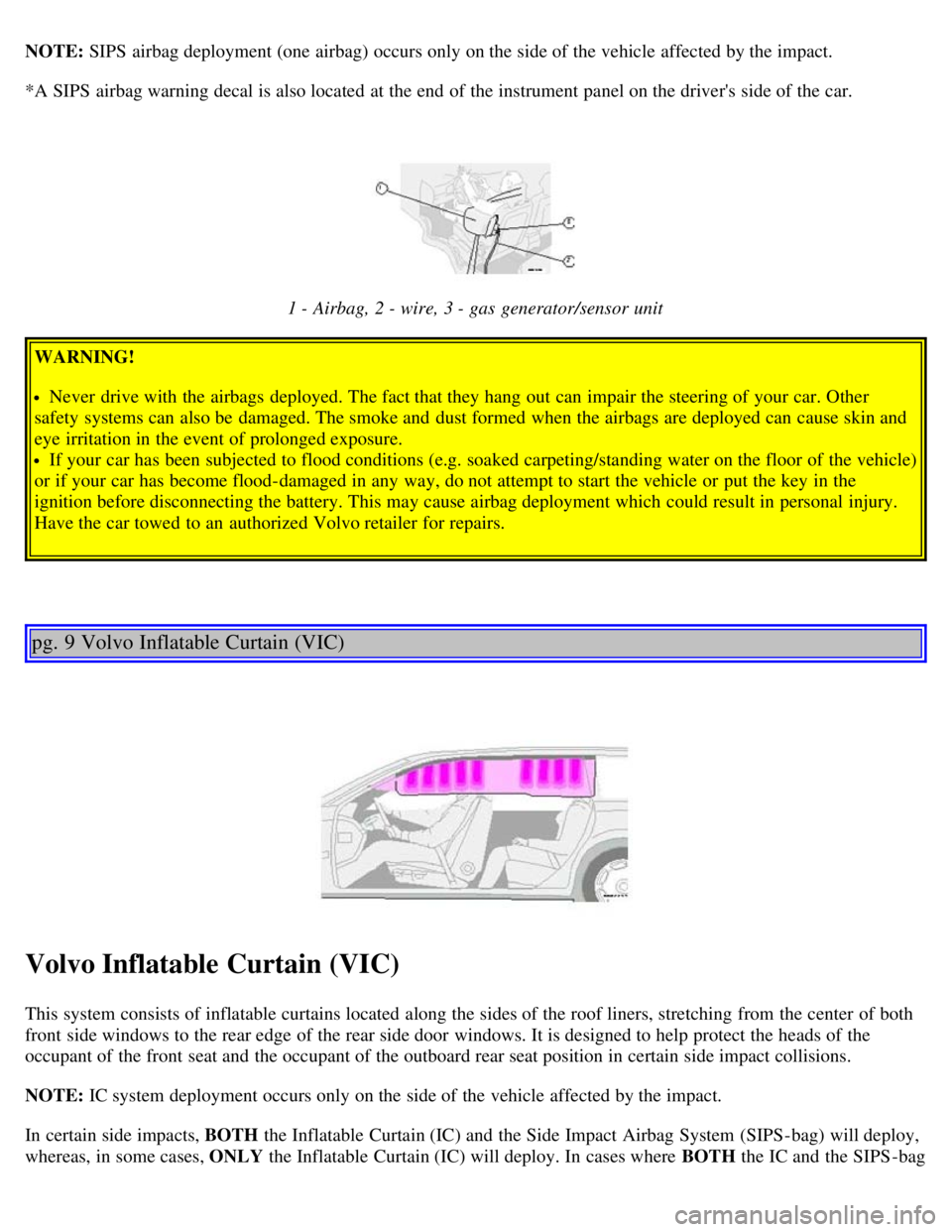
NOTE: SIPS airbag deployment (one airbag) occurs only on the side of the vehicle affected by the impact.
*A SIPS airbag warning decal is also located at the end of the instrument panel on the driver's side of the car.
1 - Airbag, 2 - wire, 3 - gas generator/sensor unit
WARNING!
Never drive with the airbags deployed. The fact that they hang out can impair the steering of your car. Other
safety systems can also be damaged. The smoke and dust formed when the airbags are deployed can cause skin and
eye irritation in the event of prolonged exposure.
If your car has been subjected to flood conditions (e.g. soaked carpeting/standing water on the floor of the vehicle)
or if your car has become flood-damaged in any way, do not attempt to start the vehicle or put the key in the
ignition before disconnecting the battery. This may cause airbag deployment which could result in personal injury.
Have the car towed to an authorized Volvo retailer for repairs.
pg. 9 Volvo Inflatable Curtain (VIC)
Volvo Inflatable Curtain (VIC)
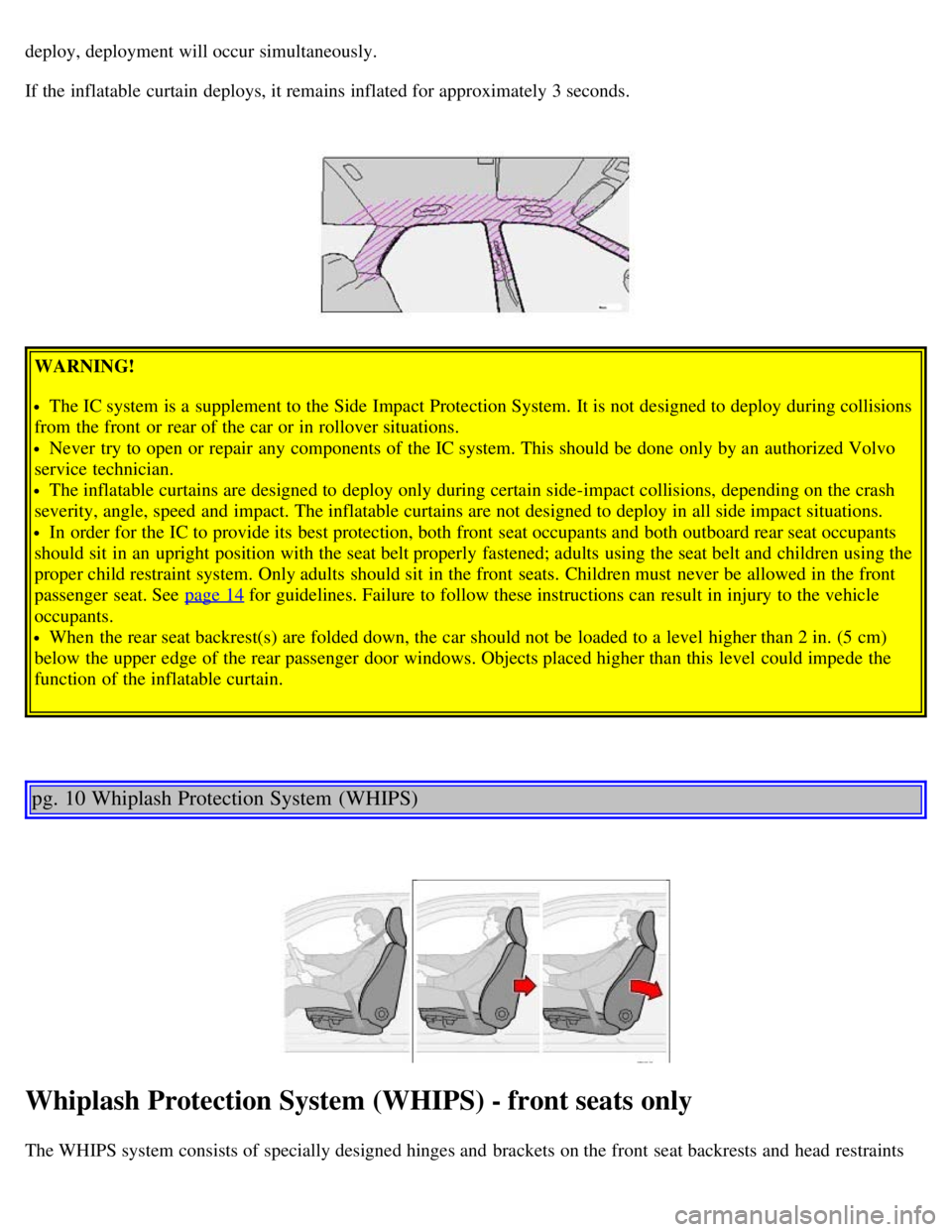
This system consists of inflatable curtains located along the sides of the roof liners, stretching from the center of both
front side windows to the rear edge of the rear side door windows. It is designed to help protect the heads of the
occupant of the front seat and the occupant of the outboard rear seat position in certain side impact collisions.
NOTE: IC system deployment occurs only on the side of the vehicle affected by the impact.
In certain side impacts, BOTH the Inflatable Curtain (IC) and the Side Impact Airbag System (SIPS-bag) will deploy,
whereas, in some cases, ONLY the Inflatable Curtain (IC) will deploy. In cases where BOTH the IC and the SIPS -bag
Page 16 of 123
deploy, deployment will occur simultaneously.
If the inflatable curtain deploys, it remains inflated for approximately 3 seconds.
WARNING!
The IC system is a supplement to the Side Impact Protection System. It is not designed to deploy during collisions
from the front or rear of the car or in rollover situations.
Never try to open or repair any components of the IC system. This should be done only by an authorized Volvo
service technician.
The inflatable curtains are designed to deploy only during certain side-impact collisions, depending on the crash
severity, angle, speed and impact. The inflatable curtains are not designed to deploy in all side impact situations.
In order for the IC to provide its best protection, both front seat occupants and both outboard rear seat occupants
should sit in an upright position with the seat belt properly fastened; adults using the seat belt and children using the
proper child restraint system. Only adults should sit in the front seats. Children must never be allowed in the front
passenger seat. See page 14
for guidelines. Failure to follow these instructions can result in injury to the vehicle
occupants.
When the rear seat backrest(s) are folded down, the car should not be loaded to a level higher than 2 in. (5 cm)
below the upper edge of the rear passenger door windows. Objects placed higher than this level could impede the
function of the inflatable curtain.
pg. 10 Whiplash Protection System (WHIPS)
Whiplash Protection System (WHIPS) - front seats only
The WHIPS system consists of specially designed hinges and brackets on the front seat backrests and head restraints
Page 29 of 123
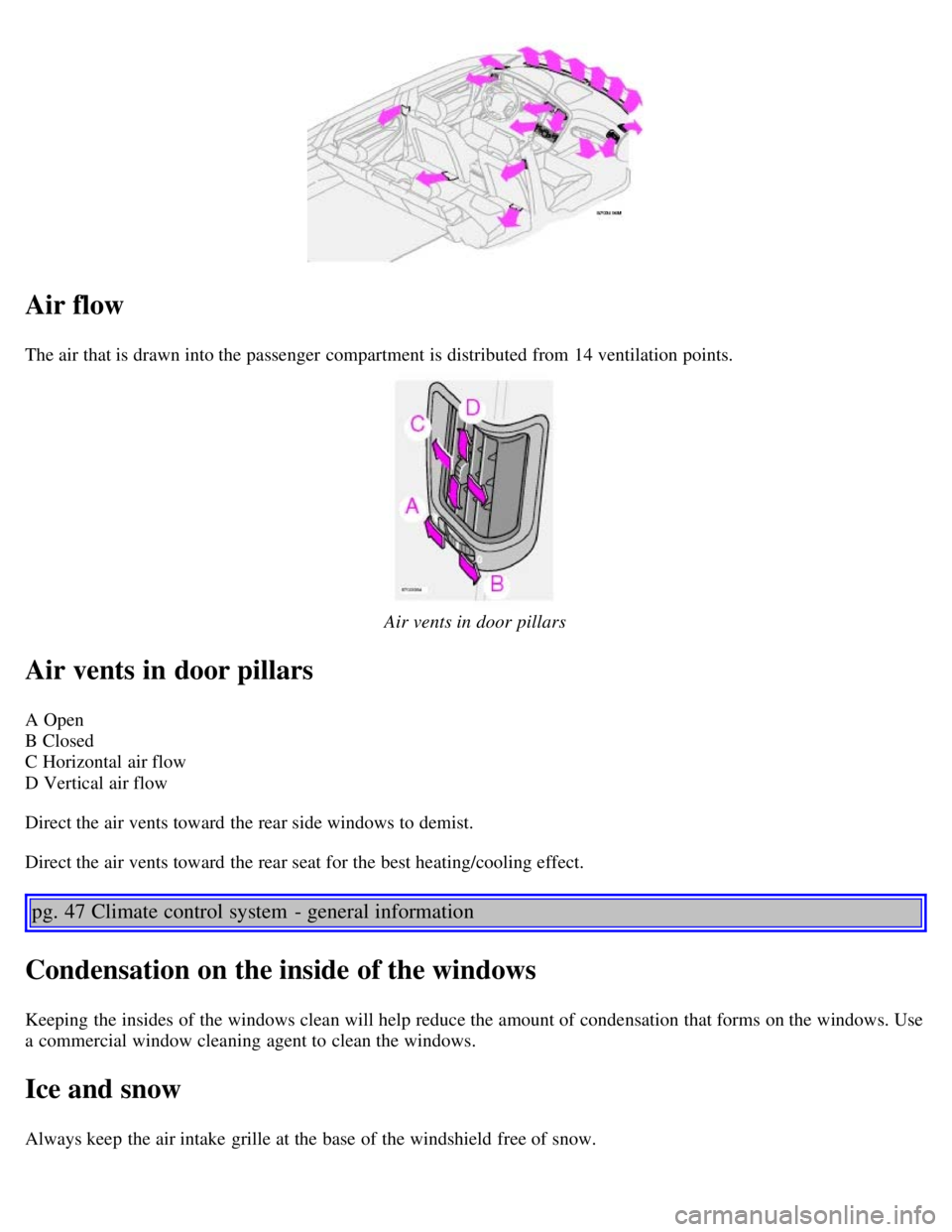
Air flow
The air that is drawn into the passenger compartment is distributed from 14 ventilation points.
Air vents in door pillars
Air vents in door pillars
A Open
B Closed
C Horizontal air flow
D Vertical air flow
Direct the air vents toward the rear side windows to demist.
Direct the air vents toward the rear seat for the best heating/cooling effect.
pg. 47 Climate control system - general information
Condensation on the inside of the windows
Keeping the insides of the windows clean will help reduce the amount of condensation that forms on the windows. Use
a commercial window cleaning agent to clean the windows.
Ice and snow
Always keep the air intake grille at the base of the windshield free of snow.
Page 37 of 123
2 0 0 4
VOLVO V70
Chapter 4 - Interior
pg. 55 Interior
Front seats (electrically operated)56
Front seats (manually operated)58
Storage compartments59
Storage compartment, front60
Folding table in rear seat62
Rear seat and cargo area63
Spare tire72
Auxiliary seat in cargo area, Extra handgrip - V7073
Interior lighting74
pg. 56 Front seats
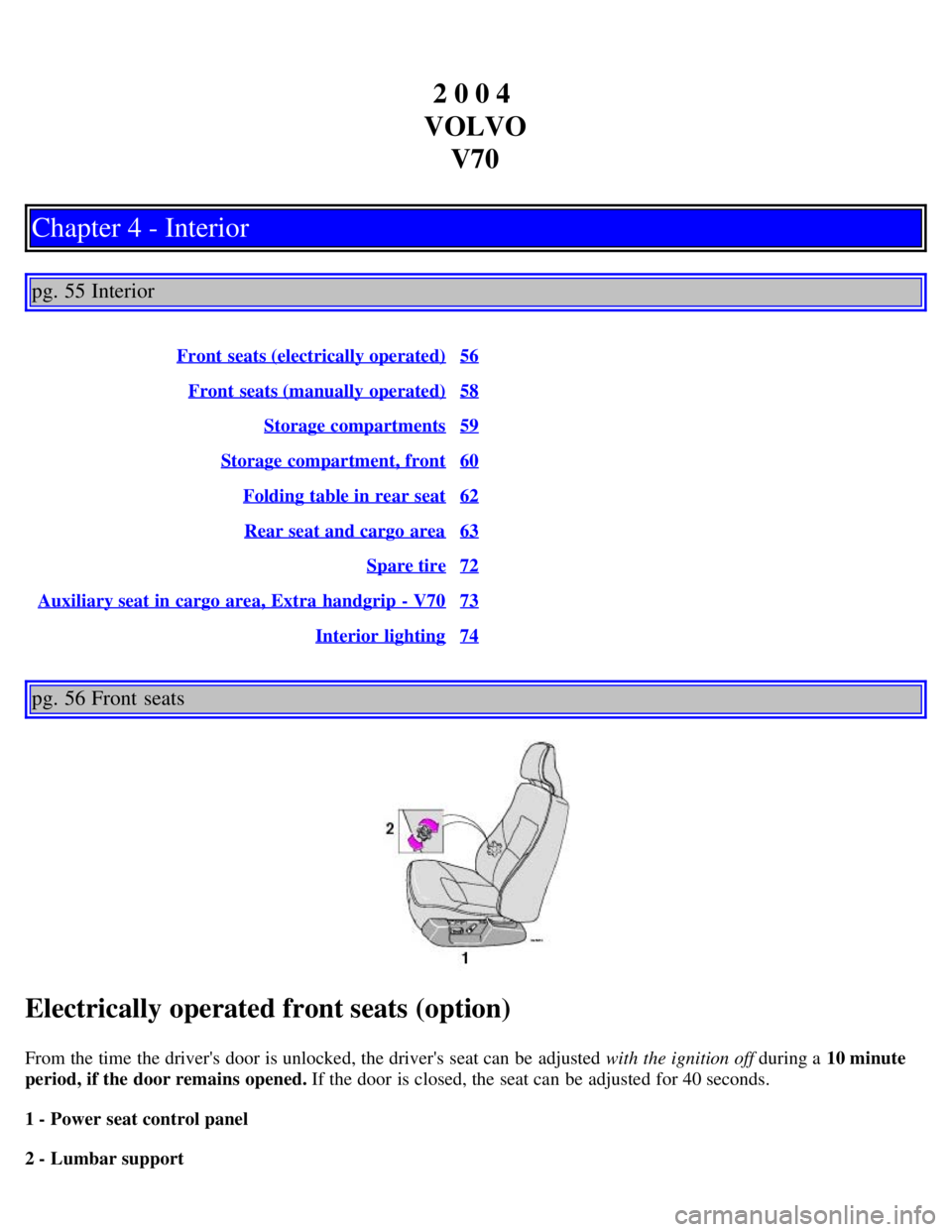
Electrically operated front seats (option)
From the time the driver's door is unlocked, the driver's seat can be adjusted with the ignition off during a 10 minute
period, if the door remains opened. If the door is closed, the seat can be adjusted for 40 seconds.
1 - Power seat control panel
2 - Lumbar support
Page 39 of 123
happens, remove the object and wait 20 seconds before operating the seat again.
* This option is only available on the driver's seat.
pg. 57 Front seats
Electrically operated seats - general information
Adjusting the front seats:
Passengers's seat: The passenger's seat can only be adjusted if the ignition key is in position I or II.
Driver's seat: The driver's seat can be adjusted if the ignition key is in position I or II (see page 36
). However, it can
also be adjusted:
Within 40 seconds after the ignition has been switched off (even if the key has been removed from the ignition
switch).
Within 40 seconds after the driver's door has been unlocked with the key or remote control and opened. The key
does not have to be in the ignition switch during this period.
Remote keyless entry system and driver's seat
The remote control transmitter also controls the electrically operated driver's seat in the following way:
Adjust the seat to your preferences.
When you leave your car, lock it using the remote control.
The next time you unlock the driver's door with the same remote control(the one you used to lock the doors with)
and open the driver's door , the driver's seat will automatically move to the position in which you left it.
The seat will move to this position even if someone else has adjusted it since you last unlocked the car with the same
remote control.
NOTE:
This feature will work in the same way with all of the remote control transmitters (up to 3) that you use with your
car.
This feature will not function if you lock your car with the key.
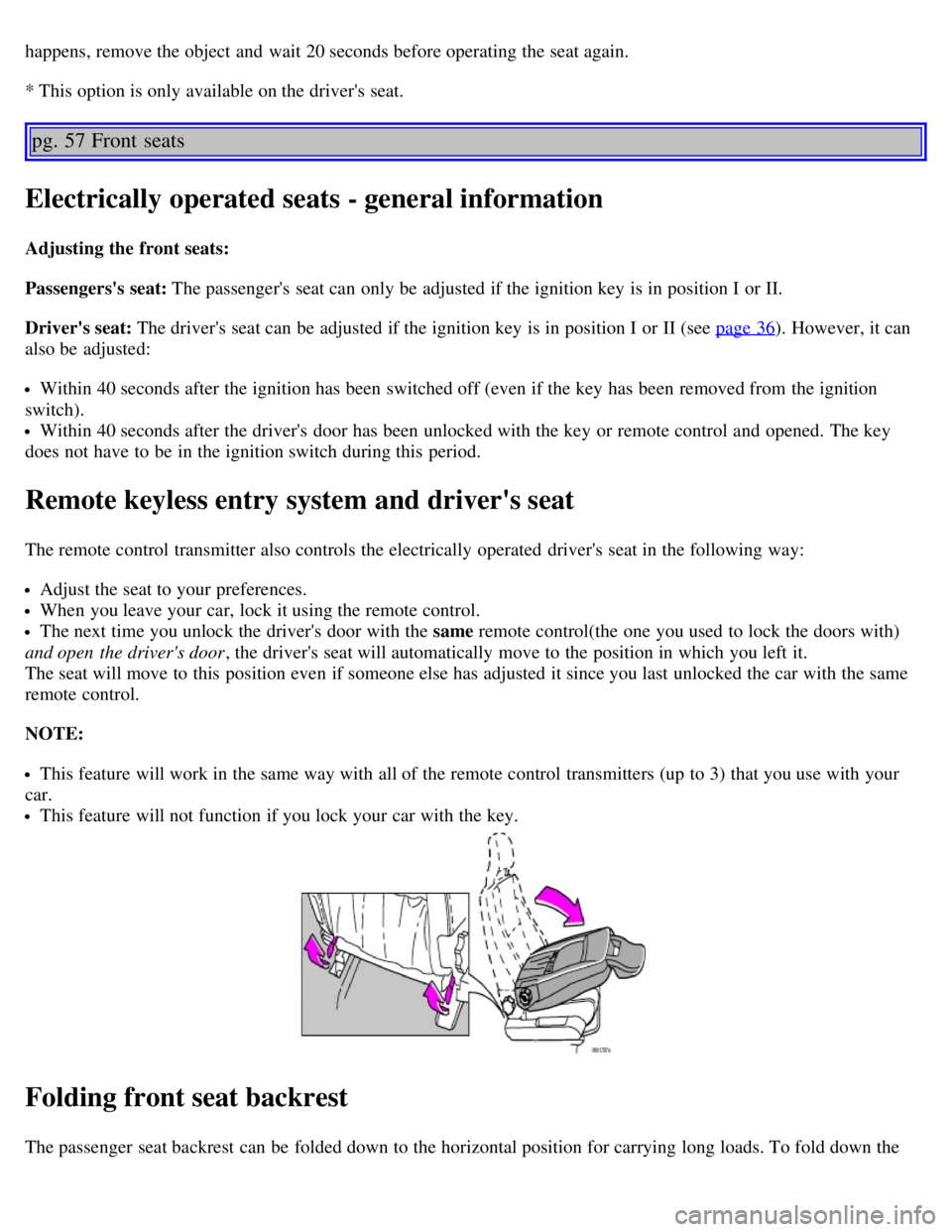
Folding front seat backrest
The passenger seat backrest can be folded down to the horizontal position for carrying long loads. To fold down the
Page 45 of 123

2 0 0 4
VOLVO V70
Chapter 5 - Keys, Locks, Alarm
pg.75 Keys, Locks, Alarm
Keys, Exterior courtesy lights, Locking and unlocking the car76
Remote keyless entry system77
Unlocking the tailgate, Central locking buttons79
Alarm80
Child safety locks - rear doors82
pg. 76 Keys, Exterior courtesy lights, Locking and unlocking the car
Keys
Two types of keys are provided with your car; master keys and a service key. The master key, the remote control, and
the central locking button may all be used to lock and unlock all of your car's locks.
The service key operates the driver's door and the ignition switch. It will also fit the tailgate lock cylinder on models
outfitted with a factory installed third seat. The service key is intended to help deter unwanted entry into the glove
compartment.
Turn the key once to unlock the driver's door and the fuel filler door.
Turn the key again (within 10 seconds) to unlock all doors and the tailgate.