tailgate VOLVO V70 2008 User Guide
[x] Cancel search | Manufacturer: VOLVO, Model Year: 2008, Model line: V70, Model: VOLVO V70 2008Pages: 274, PDF Size: 7.82 MB
Page 57 of 274
Lock the glove compartment by turning the key a quarter of a turn (90°) clockwise. The key slot is horizontal when
the glove compartment is locked.
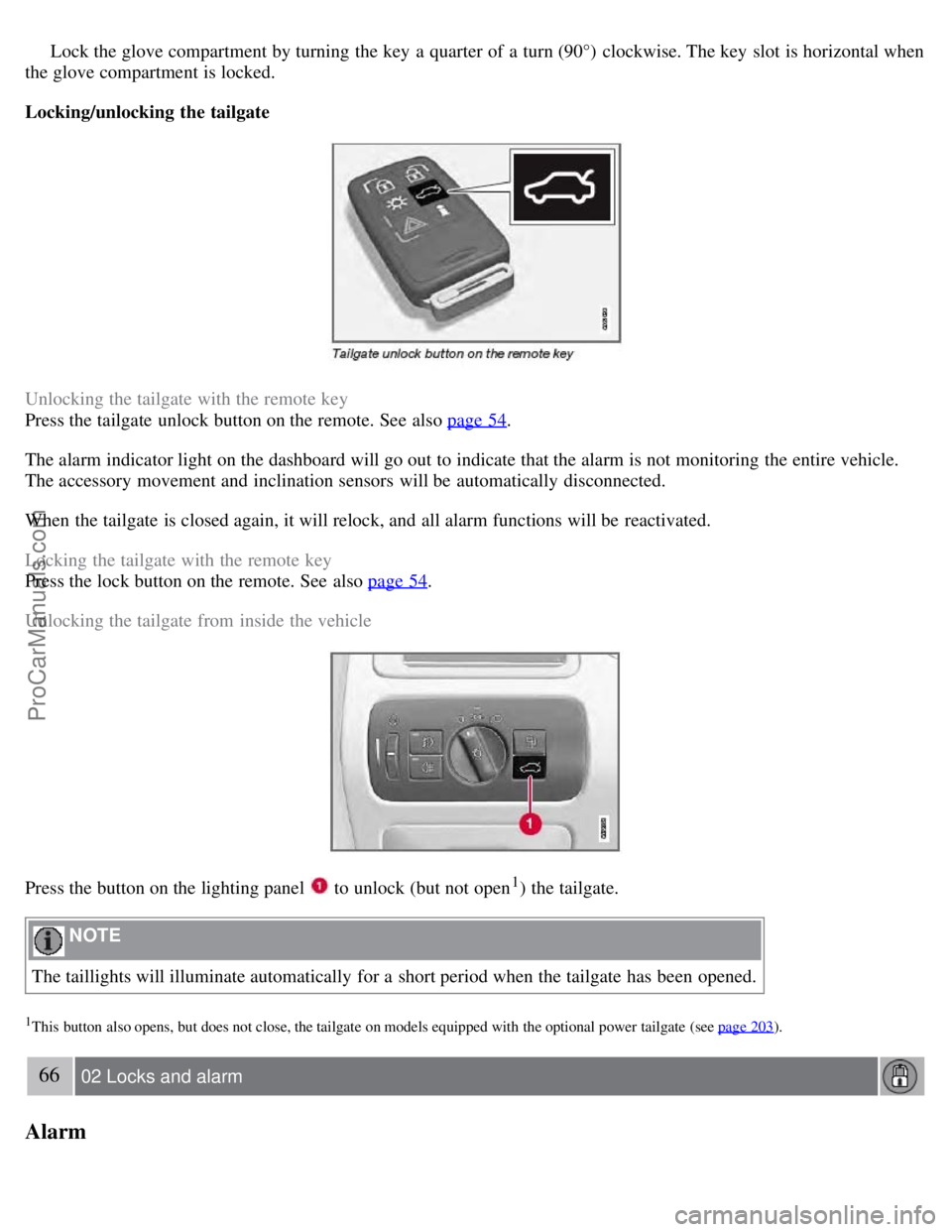
Locking/unlocking the tailgate
Unlocking the tailgate with the remote key
Press the tailgate unlock button on the remote. See also page 54
.
The alarm indicator light on the dashboard will go out to indicate that the alarm is not monitoring the entire vehicle.
The accessory movement and inclination sensors will be automatically disconnected.
When the tailgate is closed again, it will relock, and all alarm functions will be reactivated.
Locking the tailgate with the remote key
Press the lock button on the remote. See also page 54
.
Unlocking the tailgate from inside the vehicle
Press the button on the lighting panel to unlock (but not open1) the tailgate.
NOTE
The taillights will illuminate automatically for a short period when the tailgate has been opened.
1This button also opens, but does not close, the tailgate on models equipped with the optional power tailgate (see page 203).
66 02 Locks and alarm
Alarm
ProCarManuals.com
Page 58 of 274

The alarm system
The alarm is automatically armed whenever the vehicle is locked with the remote key or optional Personal Car
Communicator.
When armed, the alarm continuously monitors a number of points on the vehicle. The following conditions will trigger
the alarm:
The hood is forced open.
The tailgate is forced open.
A door is forced open.
The ignition slot is tampered with
An attempt is made to start the vehicle with a non-approved key (a key not coded to the car's ignition).
If there is movement in the passenger compartment (if the vehicle is equipped with the accessory movement sensor).
The vehicle is lifted or towed (if the vehicle is equipped with the accessory inclination sensor)
The battery is disconnected (while the alarm is armed).
The siren is disconnected when the alarm is disarmed.
A message will appear in the information display if a fault should occur in the alarm system. Contact an authorized
Volvo service technician.
NOTE
Do not attempt to repair any of the components in the alarm system yourself. This could affect the insurance policy
on the vehicle.
The alarm indicator light
The status of the alarm system is indicated by the indicator light on the dashboard (see illustration):
Indicator light off - the alarm is not armed
The indicator light flashes at one -second intervals - the alarm is armed
The indicator light flashes rapidly before the remote key is inserted in the ignition slot - the alarm has been
triggered.
Arming the alarm
Press the Lock button on the remote key. One long flash of the turn signals will confirm that the alarm is armed.
Alarm confirmation settings can be changed under Car settings
Lock settings Keyless entry . See page 125 for a
description of the menu system.
USA FCC ID: MAYDA 5823(3)
ProCarManuals.com
Page 59 of 274

This device complies with part 15 of the FCC rules. Operation is subject to the following conditions: (1) This device
may not cause harmful interference, and (2) this device must accept any interference received, including interference
that may cause undesired operation.
Canada IC: 4405A-DA 5823(3)
Movement sensor DA5823 by Dynex Operation is subject to the following conditions: (1) this device may not cause
interference, and (2) this device must accept any interference, including interference that may cause undesired
operation of the device.
67 02 Locks and alarm
Alarm
Disarming the alarm
Press the Unlock button on the remote key. Two short flashes from the car's direction indicators confirm that the alarm
has been deactivated and that all doors are unlocked.
Turning off (stopping) the alarm
If the alarm is sounding, it can be stopped by pressing the Unlock button on the remote control or by inserting the
remote key in the ignition slot. Two short flashes from the car's direction indicators confirm that the alarm has been
turned off.
Other alarm-related functions
Automatic re-arming
If the doors are unlocked, the locks will automatically reengage (re-lock) and the alarm will re-arm after 2 minutes
unless a door or the tailgate has been opened.
Audible/visual alarm signal
An audible alarm signal is given by a battery powered siren. The alarm cycle lasts for 30 seconds.
The visual alarm signal is given by flashing all turn signals for approximately 5 minutes or until the alarm is turned
off.
Remote key not functioning
If the remote key is not functioning properly, the alarm can be turned off and the vehicle can be started as follows:
1. Open the driver's door with the key blade. This will trigger the alarm.
2. Insert the remote key into the ignition slot. This will turn off the alarm.
68 02 Locks and alarm
Alarm
Reduced alarm function
Turning off the accessory alarm sensor(s)
ProCarManuals.com
Page 68 of 274

until the fault has been rectified but the text message can be cleared with the READ button, see page 126. The
warning symbol can also come on in conjunction with other symbols.
Action:
1. Stop in a safe place. Do not drive the vehicle further.
2. Read the information on the information display. Implement the action in accordance with the message in the
display. Clear the message using READ.
Reminder - doors not closed
If one of the doors, the hood or trunk lid is not closed properly, the information or warning symbol comes on together
with an explanatory text message in the instrument panel. Stop the vehicle in a safe place as soon as possible and close
the door, hood or tailgate.
If the vehicle is driven at a speed lower than approximately 5 mph (7 km/h), the information symbol comes on.
If the vehicle is driven at a speed higher than approximately 5 mph (7 km/h), the warning symbol comes on.
Trip odometers
Odometer display
Button for toggling between T1 and T2, and for resetting the odometer.
The trip odometers are used to measure short distances. A short press on the button toggles between the two trip
odometers T1 and T2. A long press (more than 2 seconds) resets an active trip odometer to zero. The distance is shown
in the display.
79 03 Your driving environment
Instruments and controls
Clock
ProCarManuals.com
Page 88 of 274

Move the lever toward the steering wheel to start the windshield and headlight washers. After the lever is released the
wipers make several extra sweeps.
Heated washer nozzles (option)
The washer nozzles are heated automatically in cold weather to help prevent the washer fluid from freezing.
High-pressure headlight washing (option)
High-pressure headlight washing consumes a large quantity of washer fluid. To save fluid, the headlights are washed
using two alternatives:
Low/high beam headlights on
The headlights will be washed the first time the windshield is washed. Thereafter, the headlights will only be washed
once for every five times the windshield is washed within a 10-minute period.
Parking lights on
Optional Active Bi -Xenon® headlights will be washed once for every five times the windshield is washed.
Normal halogen headlights will not be washed.
CAUTION
Use ample washer fluid when washing the windshield. The windshield should be thoroughly wet when the wipers
are in operation.
NOTE
One headlight is washed at a time.
98 03 Your driving environment
Wipers and washers
Tailgate wiper/washer
ProCarManuals.com
Page 89 of 274

1. Intermittent wiping
2. Normal (continuous) wiping
Move the lever forward (see the arrow in the illustration) to start the tailgate washer.
Tailgate wiper and reverse gear
If the windshield wipers are on and the transmission is put into reverse gear, the tailgate wiper will go into intermittent
wiping function
1. This function is deactivated when a different gear is selected.
1Consult your Volvo retailer if you would like to have this function deactivated.
NOTE
On vehicles with the optional rain sensor, the tailgate wiper will be activated when reverse is selected, if the rain
sensor is activated and it is raining.
If the tailgate wiper is in the normal (continuous) wiping mode, selecting different gears will not affect its function.
99 03 Your driving environment
Power windows
Power windows
Switch for power child safety locks1 and disengaging rear power window buttons, see page 48
Rear window controls
Front window controls.
ProCarManuals.com
Page 180 of 274

Remove snow tires when threat of snow or ice has ended.
Note that roof racks, ski racks, etc, increase air resistance and also fuel consumption.
At highway driving speeds, fuel consumption will be lower with the air conditioning on and the windows closed
than with the air conditioning off and the windows open.
Using the onboard trip computer's fuel consumption modes can help you learn how to drive more economically.
Other factors that decrease gas mileage are:
Dirty air cleaner
Dirty engine oil and clogged oil filter
Dragging brakes
Incorrect front end alignment
Some of the above mentioned items and others are checked at the standard maintenance intervals.
WARNING
Driving with the tailgate open: Driving with the tailgate open could lead to poisonous exhaust gases entering the
passenger compartment. If the tailgate must be kept open for any reason, proceed as follows:
Close the windows
Set the ventilation system control to air flow to floor, windshield and side windows and the blower control to its
highest setting.
Weight distribution affects handling
At the specified curb weight your vehicle has a tendency to understeer, which means that the steering wheel has to be
turned more than might seem appropriate for the curvature of a bend. This ensures good stability and reduces the risk
of rear wheel skid. Remember that these properties can alter with the vehicle load. The heavier the load in the cargo
area, the less the tendency to understeer.
Handling, roadholding
Vehicle load, tire design and inflation pressure all affect vehicle handling. Therefore, check that the tires are inflated to
the recommended pressure according to the vehicle load. See the "Tire pressure" section. Loads should be distributed
so that capacity weight
193 05 During your trip
Driving recommendations
or maximum permissible axle loads are not exceeded.
Driving through water
The vehicle can be driven through water up to a depth of approximately 9 in. (25 cm), at a maximum speed of 6 mph
(10 km/h).
Take particular care when driving through flowing water.
Clean the electrical connections for trailer wiring after driving in mud or water.
When driving through water, maintain low speed and do not stop in the water.
WARNING
After driving through water, press lightly on the brake pedal to ensure that the brakes are functioning normally.
ProCarManuals.com
Page 188 of 274
cargo, the weight of any accessories that may be installed, etc.
When loading the cargo area, keep the following in mind:
Load objects in the cargo area against the backrest whenever possible.
Unstable loads can be secured to the load anchoring eyelets with straps or web lashings to help keep them from
shifting.
Stop the engine and apply the parking brake when loading or unloading long objects. The gear selector can be
knocked out of position by long loads, which could set the vehicle in motion.
NOTE
To increase loading space, the rear seat backrests can be folded down, see page 85
.
WARNING
Stop the engine, put the gear selector in P , and apply the parking brake when loading or unloading long objects.
The vehicle's driving characteristics may change depending on the weight and distribution of the load.
A 44-pound (20 kg) object produces a force of 2,200 pounds (1,000 kg) in a head-on collision at 30 mph (50
km/h).
The cargo area and rear seat should not be loaded to a level higher than 2 in. (5 cm) below the upper edge of the
rear side windows. Objects placed higher than this level could impede the function of the Volvo Inflatable Curtain.
203 05 During your trip
Loading
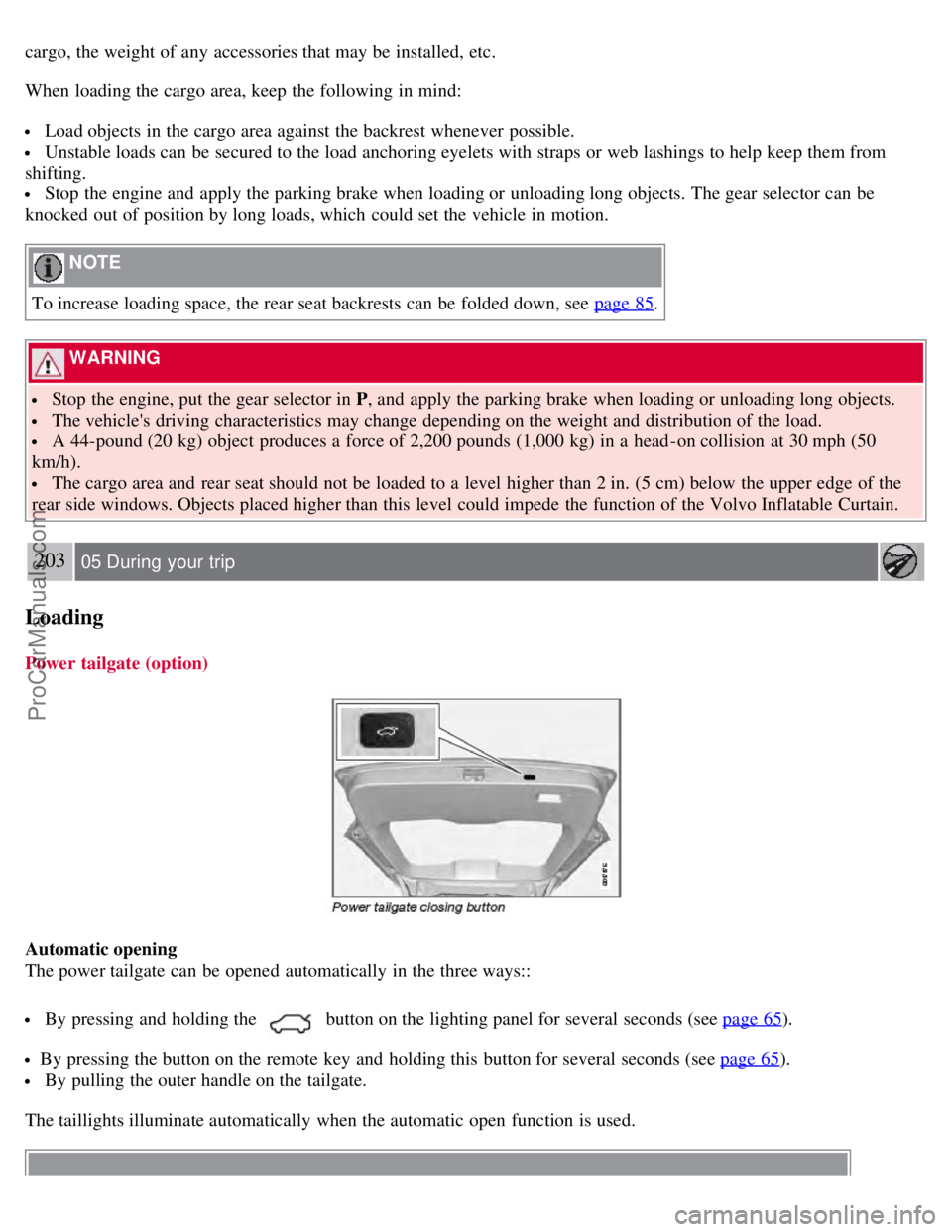
Power tailgate (option)
Automatic opening
The power tailgate can be opened automatically in the three ways::
By pressing and holding thebutton on the lighting panel for several seconds (see page 65).
By pressing the button on the remote key and holding this button for several seconds (see page 65).
By pulling the outer handle on the tailgate.
The taillights illuminate automatically when the automatic open function is used.
ProCarManuals.com
Page 189 of 274
CAUTION
Be sure that there is adequate space above and behind the vehicle before opening the tailgate automatically.
NOTE
If the tailgate has been opened and closed continuously for more than 90 seconds, the automatic function will be
deactivated to avoid overloading the electrical system. The automatic function can be used again after approximately
10 minutes.
Automatic closing
The power tailgate can be closed by pressing the
button on the tailgate (see the illustration), or by pressing it
down.
NOTE
If the tailgate is pressed down e.g., by the weight of snow or strong wind, it will close automatically.
WARNING
Be sure that no one is near the tailgate when it is opened or closed automatically. The tailgate should never be
obstructed in any way when it is operated.
Interrupting automatic opening/closing
Automatic opening or closing the tailgate can be interrupted in four ways:
By pressing the button on the lighting panel (see page 65).
By pressing the remote key (see page 65) for several seconds.
By pressing the button on the lower edge of the tailgate.
By pulling the outer handle on the tailgate. If one of these actions is taken:
While the tailgate is being opened, the electrical function will be switched off and the tailgate will be released from
the electrical system.
While the tailgate is being closed, it will return to the fully open position.
Pinch protection
If the tailgate is obstructed while it is being operated, the pinch protection function is activated.
204 05 During your trip
Loading
If the tailgate is being opened , the electrical function will be switched off and the tailgate will be released from the
electrical system.
If the tailgate is being closed , it will move in the opposite direction.
Operating the tailgate manually
The power tailgate can be disconnected from the vehicle's electrical system by quickly pulling the outer handle twice.
The tailgate can then be opened/closed manually.
ProCarManuals.com
Page 192 of 274
NOTE
In order to return a removed hook into a rail, it must be press down lightly.
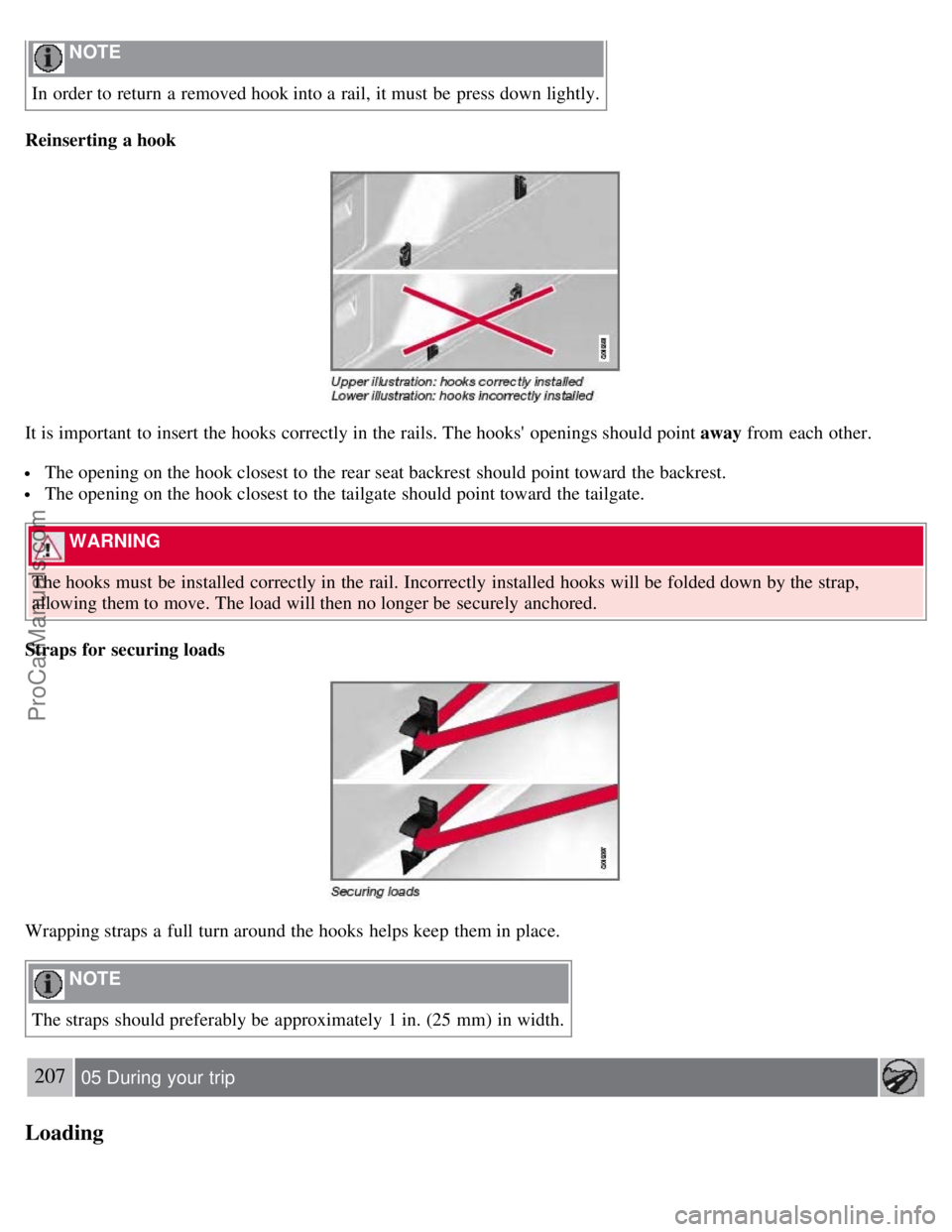
Reinserting a hook
It is important to insert the hooks correctly in the rails. The hooks' openings should point away from each other.
The opening on the hook closest to the rear seat backrest should point toward the backrest.
The opening on the hook closest to the tailgate should point toward the tailgate.
WARNING
The hooks must be installed correctly in the rail. Incorrectly installed hooks will be folded down by the strap,
allowing them to move. The load will then no longer be securely anchored.
Straps for securing loads
Wrapping straps a full turn around the hooks helps keep them in place.
NOTE
The straps should preferably be approximately 1 in. (25 mm) in width.
207 05 During your trip
Loading
ProCarManuals.com