ECU VOLVO V70 2008 Owner's Manual
[x] Cancel search | Manufacturer: VOLVO, Model Year: 2008, Model line: V70, Model: VOLVO V70 2008Pages: 274, PDF Size: 7.82 MB
Page 190 of 274
205 05 During your trip
Loading
Load anchoring eyelets
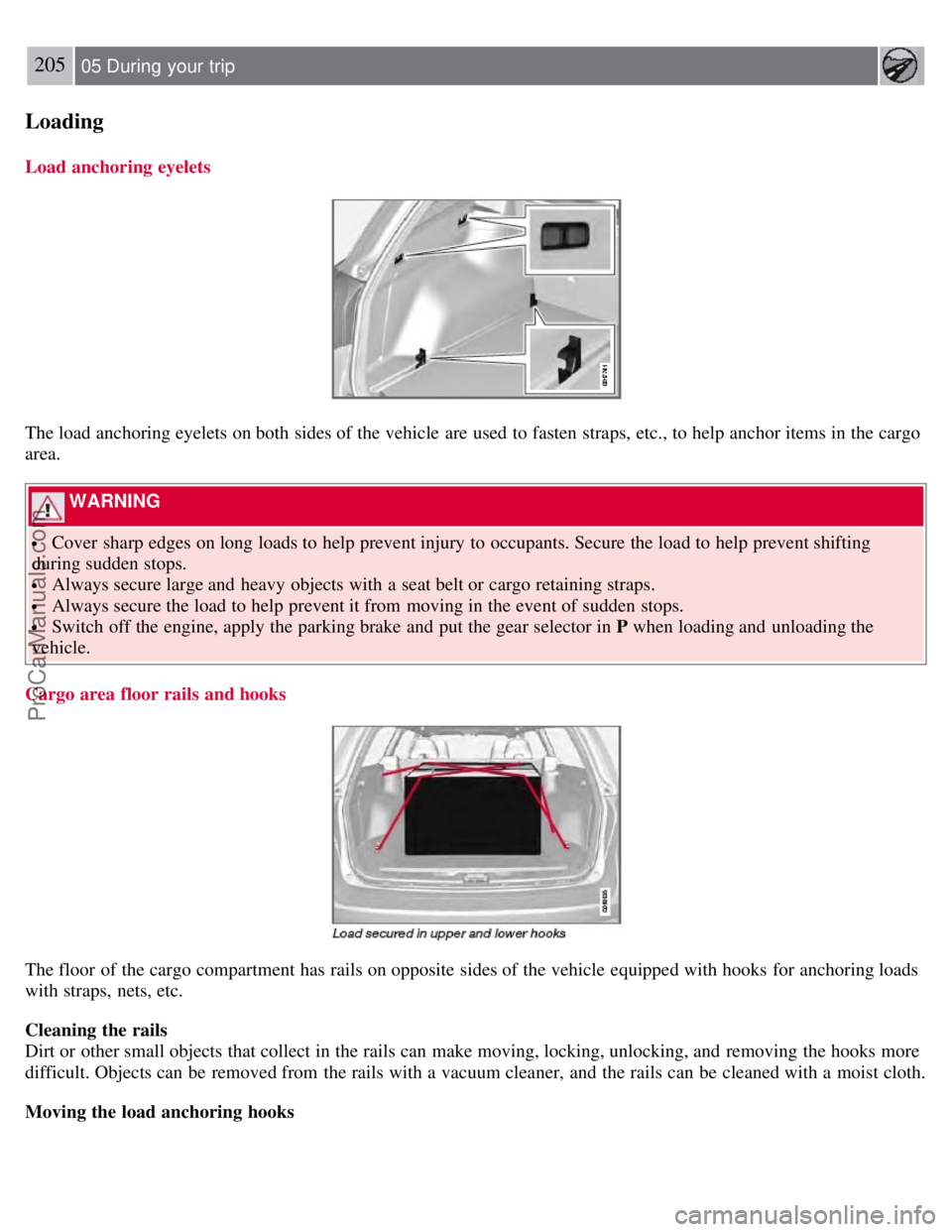
The load anchoring eyelets on both sides of the vehicle are used to fasten straps, etc., to help anchor items in the cargo
area.
WARNING
Cover sharp edges on long loads to help prevent injury to occupants. Secure the load to help prevent shifting
during sudden stops.
Always secure large and heavy objects with a seat belt or cargo retaining straps.
Always secure the load to help prevent it from moving in the event of sudden stops.
Switch off the engine, apply the parking brake and put the gear selector in P when loading and unloading the
vehicle.
Cargo area floor rails and hooks
The floor of the cargo compartment has rails on opposite sides of the vehicle equipped with hooks for anchoring loads
with straps, nets, etc.
Cleaning the rails
Dirt or other small objects that collect in the rails can make moving, locking, unlocking, and removing the hooks more
difficult. Objects can be removed from the rails with a vacuum cleaner, and the rails can be cleaned with a moist cloth.
Moving the load anchoring hooks
ProCarManuals.com
Page 191 of 274
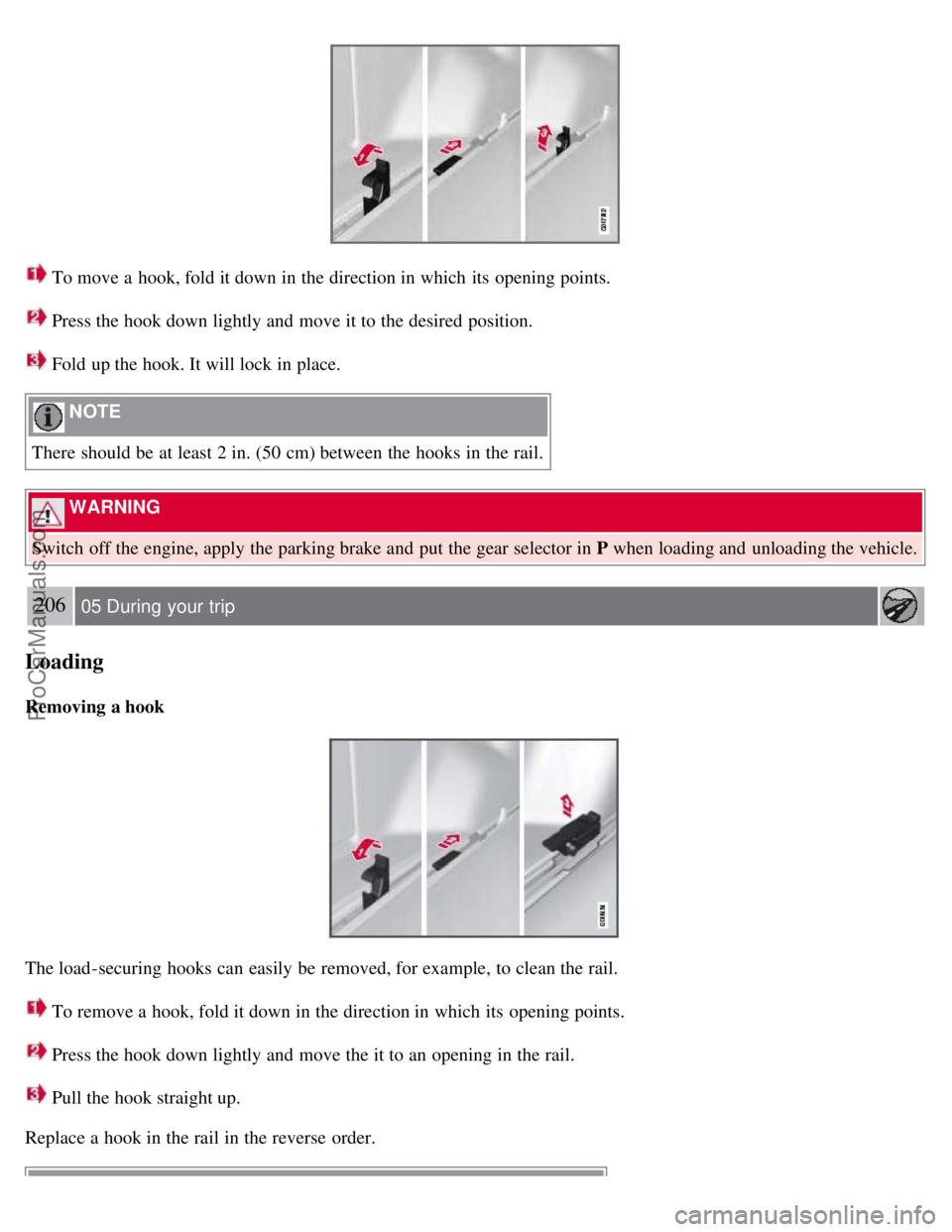
To move a hook, fold it down in the direction in which its opening points.
Press the hook down lightly and move it to the desired position.
Fold up the hook. It will lock in place.
NOTE
There should be at least 2 in. (50 cm) between the hooks in the rail.
WARNING
Switch off the engine, apply the parking brake and put the gear selector in P when loading and unloading the vehicle.
206 05 During your trip
Loading
Removing a hook
The load-securing hooks can easily be removed, for example, to clean the rail.
To remove a hook, fold it down in the direction in which its opening points.
Press the hook down lightly and move the it to an opening in the rail.
Pull the hook straight up.
Replace a hook in the rail in the reverse order.
ProCarManuals.com
Page 192 of 274
NOTE
In order to return a removed hook into a rail, it must be press down lightly.
Reinserting a hook
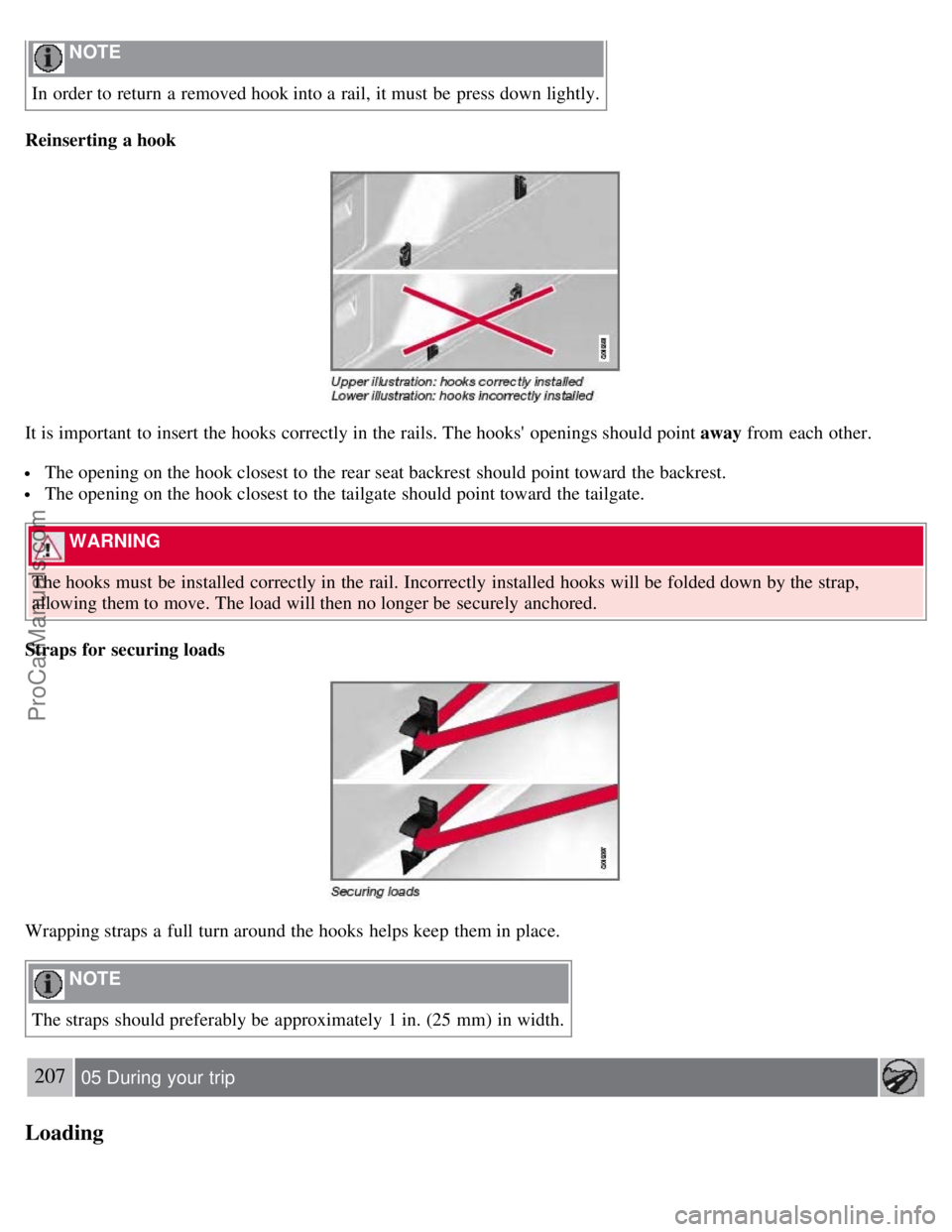
It is important to insert the hooks correctly in the rails. The hooks' openings should point away from each other.
The opening on the hook closest to the rear seat backrest should point toward the backrest.
The opening on the hook closest to the tailgate should point toward the tailgate.
WARNING
The hooks must be installed correctly in the rail. Incorrectly installed hooks will be folded down by the strap,
allowing them to move. The load will then no longer be securely anchored.
Straps for securing loads
Wrapping straps a full turn around the hooks helps keep them in place.
NOTE
The straps should preferably be approximately 1 in. (25 mm) in width.
207 05 During your trip
Loading
ProCarManuals.com
Page 193 of 274
Grocery bag holder1 (option)
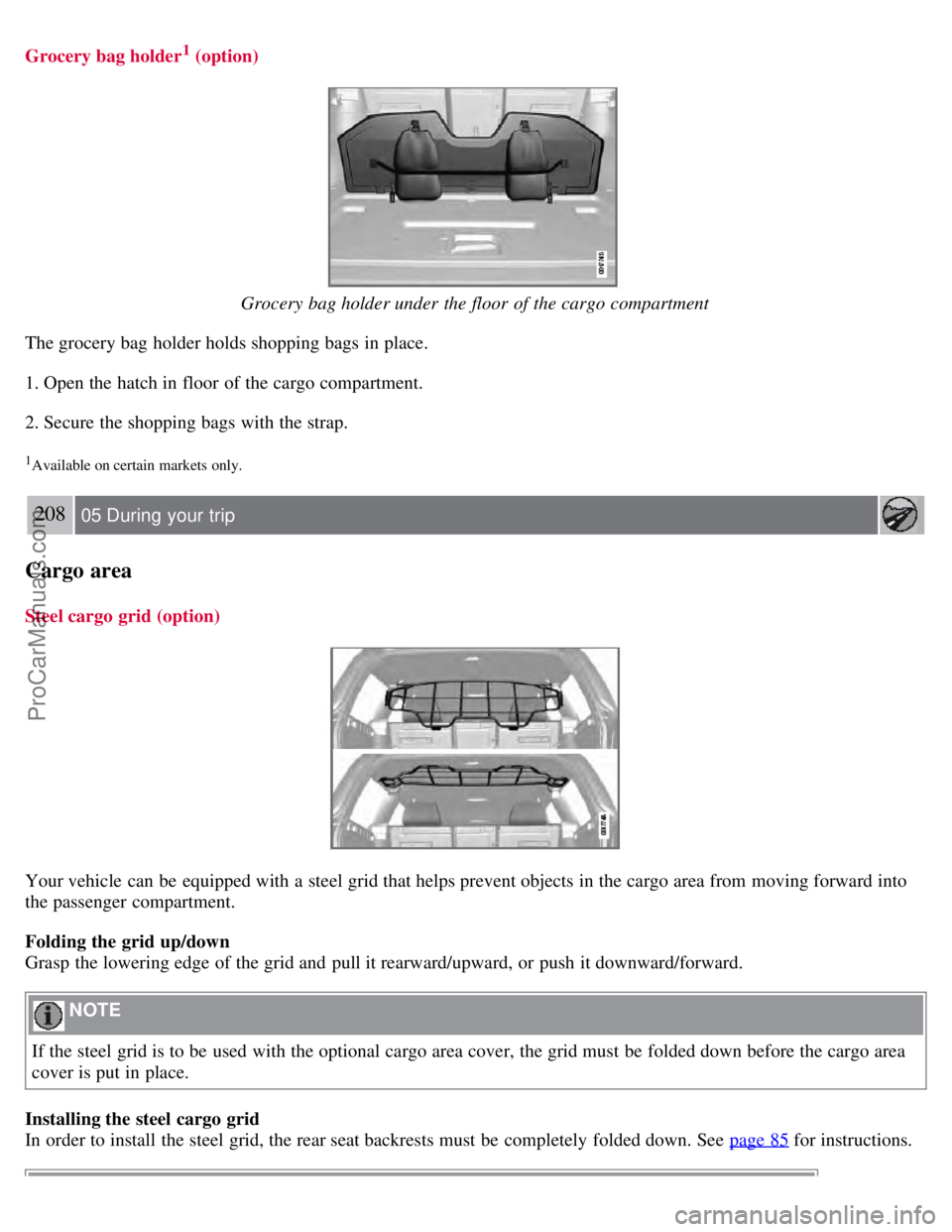
Grocery bag holder under the floor of the cargo compartment
The grocery bag holder holds shopping bags in place.
1. Open the hatch in floor of the cargo compartment.
2. Secure the shopping bags with the strap.
1Available on certain markets only.
208 05 During your trip
Cargo area
Steel cargo grid (option)
Your vehicle can be equipped with a steel grid that helps prevent objects in the cargo area from moving forward into
the passenger compartment.
Folding the grid up/down
Grasp the lowering edge of the grid and pull it rearward/upward, or push it downward/forward.
NOTE
If the steel grid is to be used with the optional cargo area cover, the grid must be folded down before the cargo area
cover is put in place.
Installing the steel cargo grid
In order to install the steel grid, the rear seat backrests must be completely folded down. See page 85
for instructions.
ProCarManuals.com
Page 195 of 274
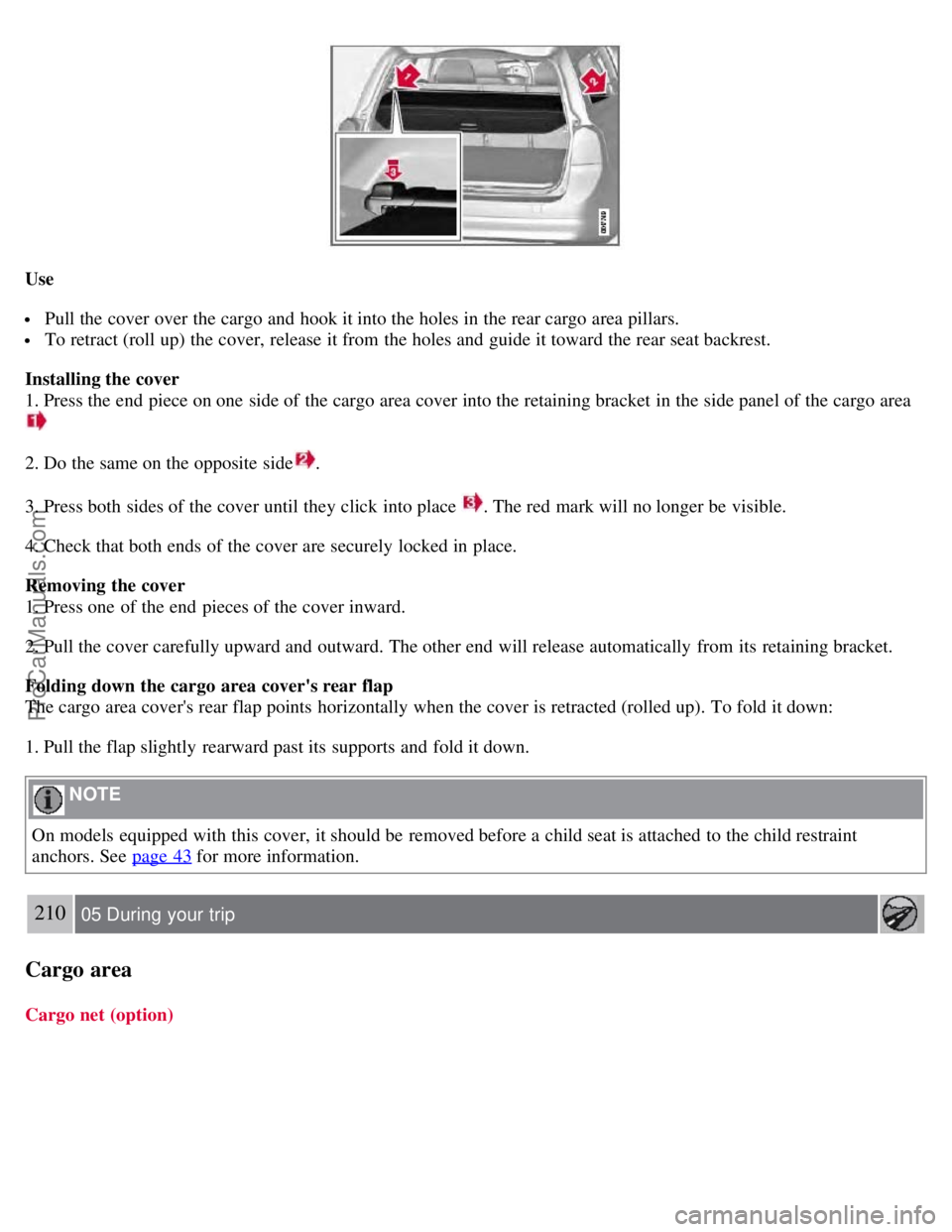
Use
Pull the cover over the cargo and hook it into the holes in the rear cargo area pillars.
To retract (roll up) the cover, release it from the holes and guide it toward the rear seat backrest.
Installing the cover
1. Press the end piece on one side of the cargo area cover into the retaining bracket in the side panel of the cargo area
2. Do the same on the opposite side.
3. Press both sides of the cover until they click into place
. The red mark will no longer be visible.
4. Check that both ends of the cover are securely locked in place.
Removing the cover
1. Press one of the end pieces of the cover inward.
2. Pull the cover carefully upward and outward. The other end will release automatically from its retaining bracket.
Folding down the cargo area cover's rear flap
The cargo area cover's rear flap points horizontally when the cover is retracted (rolled up). To fold it down:
1. Pull the flap slightly rearward past its supports and fold it down.
NOTE
On models equipped with this cover, it should be removed before a child seat is attached to the child restraint
anchors. See page 43
for more information.
210 05 During your trip
Cargo area
Cargo net (option)
ProCarManuals.com
Page 197 of 274
Insert the net's rod in the retaining bracket on the right side near the ceiling and press it forward. It will click into
place.
Extend the left section of the rod and insert it in the bracket on the left side of the cargo compartment. Press it
forward until it clicks into place.
Pull up the left side of the cargo net and secure it on the rod.
211 05 During your trip
Cargo area
NOTE
The net can be fastened in the same way if the rear seat backrests are folded down. In this case, use the retaining
brackets near the ceiling, above the front seats.
The front passenger's seat backrest can also be folded down for carrying long objects, see page 82.
Removing the cargo net cassettes
1. Retract the net(s) in the reverse order (see the section "With the backrests up" on page 210
).
2. Fold the entire rear seat backrest down.
3. Slide the cassettes outward until they release from the mounting brackets.
WARNING
When not in use, return the cassettes to their storage compartment under the cargo area floor.
Objects in the cargo area should be securely anchored, even if the cargo net is correctly installed and in use.
Using the cargo net with the cargo area cover
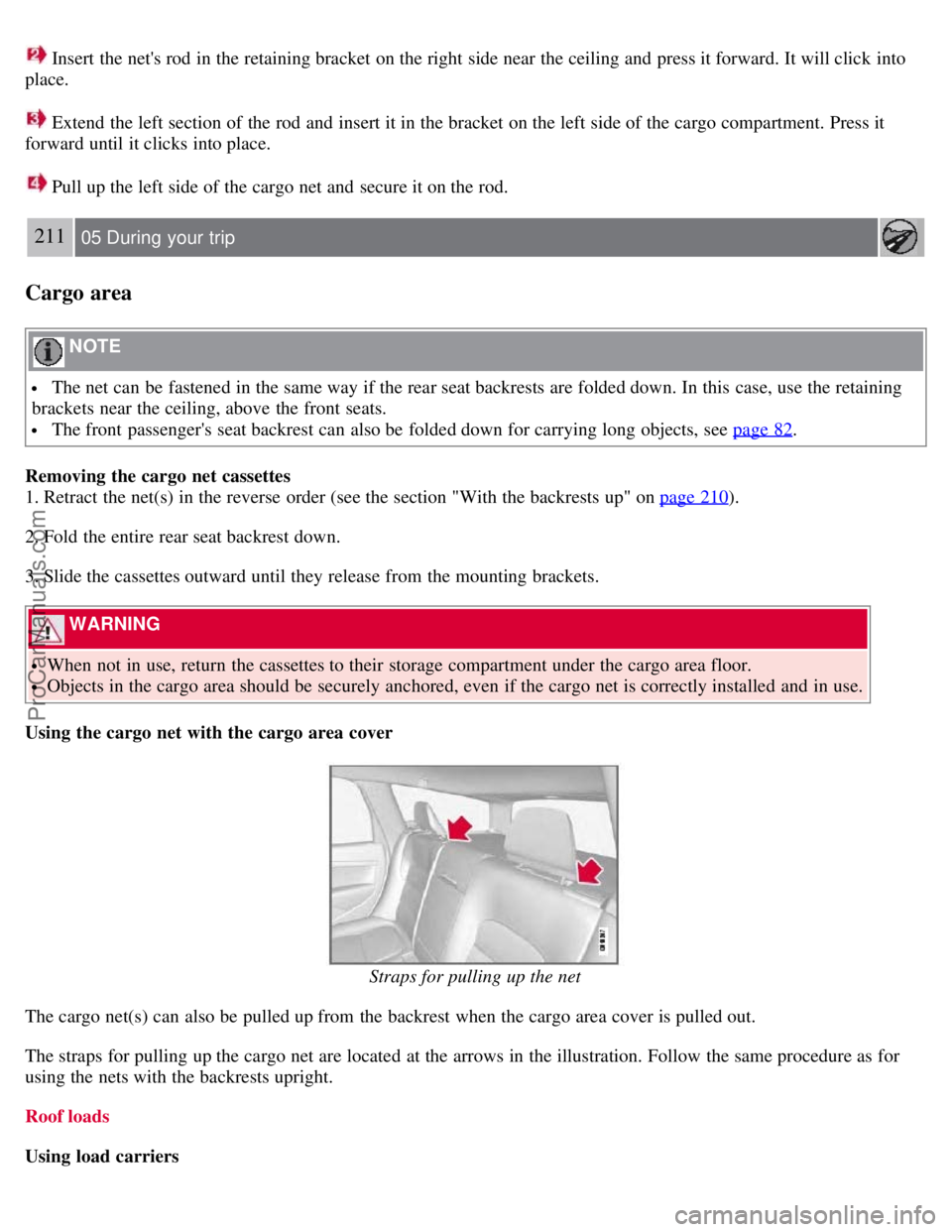
Straps for pulling up the net
The cargo net(s) can also be pulled up from the backrest when the cargo area cover is pulled out.
The straps for pulling up the cargo net are located at the arrows in the illustration. Follow the same procedure as for
using the nets with the backrests upright.
Roof loads
Using load carriers
ProCarManuals.com
Page 198 of 274

Load carriers are available as Volvo accessories. Observe the following points when in use:
To avoid damaging your vehicle and to achieve maximum safety when driving, we recommend using the load
carriers that Volvo has developed especially for your vehicle.
Volvo-approved removable roof racks are designed to carry the maximum allowable roof load for this vehicle: 220
lbs (100 kg). For non-Volvo roof racks, check the manufacturer's weight limits for the rack.
Never exceed the rack manufacturer's weigh limits and never exceed the maximum rated roof load of 220 lbs (100
kg).
Avoid single-point loads. Distribute loads evenly.
Place heavier cargo at the bottom of the load.
Secure the cargo correctly with appropriate tie-down equipment.
Check periodically that the load carriers and load are properly secured.
Remember that the vehicle's center of gravity and handling change when you carry a load on the roof.
212 05 During your trip
Cargo area
The vehicle's wind resistance and fuel consumption will increase with the size of the load.
Drive smoothly. Avoid rapid starts, fast cornering and hard braking.
213 05 During your trip
Towing a trailer
Introduction
Volvo recommends the use of Volvo trailer hitches that are specially designed for the vehicle.
NOTE
See page 274
for the maximum trailer and tongue weights recommended by Volvo.
Observe the legal requirements of the state/province in which the vehicles are
All Volvo models are equipped with energy- absorbing shock-mounted bumpers. Trailer hitch installation should
not interfere with the proper operation of this bumper system.
Trailer towing does not normally present any particular problems, but take into consideration:
Increase tire pressure to recommended full. See the tire inflation tables on pages 250 and 251.
When your vehicle is new, avoid towing heavy trailers during the first 620 miles (1,000 km).
Maximum speed when towing a trailer: 50 mph (80 km/h).
Engine and transmission are subject to increased loads. Therefore, engine coolant temperature should be closely
watched when driving in hot climates or hilly terrain. Use a lower gear and turn off the air conditioner if the
temperature gauge needle enters the red range.
If the automatic transmission begins to overheat, a message will be displayed in the text window.
Avoid overload and other abusive operation.
Hauling a trailer affects handling, durability, and economy.
It is necessary to balance trailer brakes with the towing vehicle brakes to provide a safe stop (check and observe
state/local regulations).
Do not connect the trailer's brake system directly to the vehicle's brake system.
ProCarManuals.com
Page 201 of 274
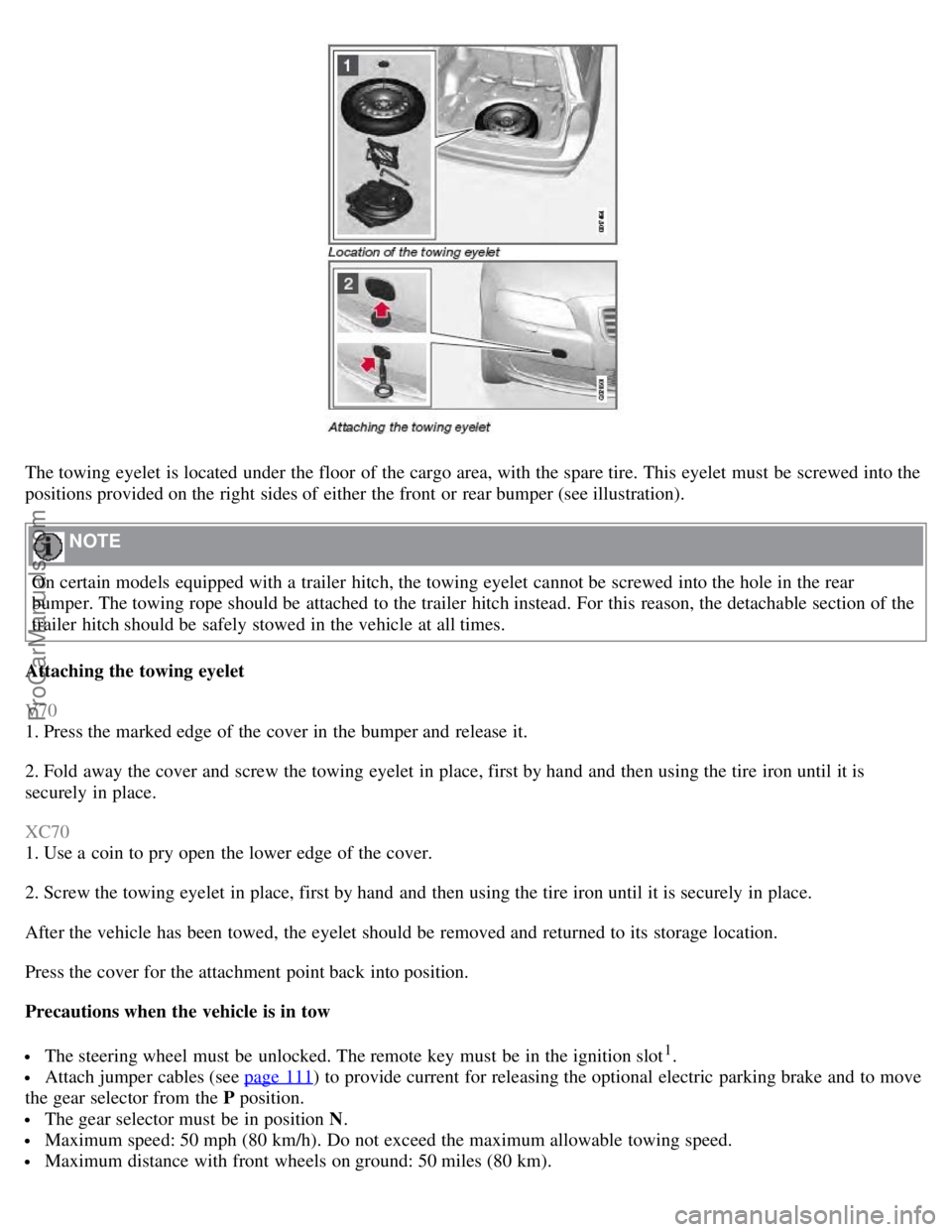
The towing eyelet is located under the floor of the cargo area, with the spare tire. This eyelet must be screwed into the
positions provided on the right sides of either the front or rear bumper (see illustration).
NOTE
On certain models equipped with a trailer hitch, the towing eyelet cannot be screwed into the hole in the rear
bumper. The towing rope should be attached to the trailer hitch instead. For this reason, the detachable section of the
trailer hitch should be safely stowed in the vehicle at all times.
Attaching the towing eyelet
V70
1. Press the marked edge of the cover in the bumper and release it.
2. Fold away the cover and screw the towing eyelet in place, first by hand and then using the tire iron until it is
securely in place.
XC70
1. Use a coin to pry open the lower edge of the cover.
2. Screw the towing eyelet in place, first by hand and then using the tire iron until it is securely in place.
After the vehicle has been towed, the eyelet should be removed and returned to its storage location.
Press the cover for the attachment point back into position.
Precautions when the vehicle is in tow
The steering wheel must be unlocked. The remote key must be in the ignition slot1.
Attach jumper cables (see page 111) to provide current for releasing the optional electric parking brake and to move
the gear selector from the P position.
The gear selector must be in position N .
Maximum speed: 50 mph (80 km/h). Do not exceed the maximum allowable towing speed.
Maximum distance with front wheels on ground: 50 miles (80 km).
ProCarManuals.com
Page 202 of 274
While the vehicle is being towed, try to keep the tow rope taut at all times.
1On vehicles with the optional keyless drive, the remote key must be in the passenger compartment.
217 05 During your trip
Emergency towing
The vehicle should only be towed in the forward direction.
CAUTION
Please check with state and local authorities before attempting this type of towing, as vehicles being towed are
subject to regulations regarding maximum towing speed, length and type of towing device, lighting, etc.
If the vehicle's battery is dead, do not attempt to start the vehicle by pushing or pulling it as this will damage the
three-way catalytic converter(s). The engine must be jump started using an auxiliary battery (see page 111
).
If the vehicle is being towed on a flat bed truck, the towing eyelets must not be used to secure the vehicle on the
flat bed. Consult the tow truck operator.
Towing vehicles with front wheel drive/All Wheel Drive
Volvo recommends the use of flat bed equipment.
If wheel lift equipment must be used, please use extreme caution to help avoid damage to the vehicle. In this case,
the vehicle should be towed with the rear wheels on the ground if at all possible.
If it is absolutely necessary to tow the vehicle with the front wheels on the ground, please refer to the towing
information on the page 216
.
CAUTION
Sling-type equipment applied at the front will damage radiator and air conditioning lines.
It is equally important not to use sling -type equipment at the rear or apply lifting equipment inside the rear
wheels; serious damage to the rear axle may result.
If the vehicle is being towed on a flat bed truck, the towing eyelets must not be used to secure the vehicle on the
flat bed. Consult the tow truck operator.
Contents | Top of Page
ProCarManuals.com
Page 213 of 274

4. Lift out the housing and place it on a soft surface to avoid scratching the lens.
5. Replace the defective bulb(s), see page 234
.
Reinserting the headlight housing
1. Plug in the connector until it clicks into place.
2. Reinstall the headlight housing and locking pins. Check that they are correctly inserted. The headlight housing must
be properly inserted and secured in place before the lighting is switched on or the remote key is inserted into the
ignition slot.
3. Check that the lights function properly.
Removing the cover to access the headlights and parking lights
NOTE
Before starting to replace a bulb, see page 228
.
1. Open the retaining clamp by pressing it to the side.
2. Press down the clips on the upper edge of the cover and remove it.
Reinstall the cover in the reverse order.
Low beam, halogen
1. Remove the headlight housing from the vehicle (see the instructions on page 228.
2. Remove the cover over the bulbs.
3. Detach the bulb by pressing the upper section of the retaining spring downward and to the side.
ProCarManuals.com