weight VOLVO V70 2008 Owner's Manual
[x] Cancel search | Manufacturer: VOLVO, Model Year: 2008, Model line: V70, Model: VOLVO V70 2008Pages: 274, PDF Size: 7.82 MB
Page 241 of 274

1. 215: the width of the tire (in millimeters) from sidewall edge to sidewall edge. The larger the number, the wider the
tire.
2. 65: The ratio of the tire's height to its width.
3. R: Radial tire.
4. 15: The diameter of the wheel rim (in inches).
5. 95: The tire's load index. In this example, a load index of 95 equals a maximum load of 1521 lbs (690 kg).
6. H : The tire's speed rating, or the maximum speed at which the tire is designed to be driven for extended periods of
time, carrying a permissible load for the vehicle, and with correct inflation pressure. For example, H indicates a speed
rating of 130 mph (210 km/h).
NOTE
This information may not appear on the tire because it is not required by law.
7. M+S or M/S = Mud and Snow, AT = All Terrain, AS = All Season
8. U.S. DOT Tire Identification Number (TIN) : This begins with the letters "DOT" and indicates that the tire meets
all federal standards. The next two numbers or letters are the plant code where it was manufactured, the next two are
the tire size code and the last four numbers represent the week and year the tire was built. For example, the numbers
317 mean the 31st week of 1997. After 2000 the numbers go to four digits. For example, 2501 means the 25th week of
2001. The numbers in between are marketing codes used at the manufacturer's discretion. This information helps a tire
manufacturer identify a tire for safety recall purposes.
9. Tire Ply Composition and Material Used : Indicates the number of plies indicates or the number of layers of
rubber-coated fabric in the tire tread and sidewall. Tire manufacturers also must indicate the ply materials in the tire
and the sidewall, which include steel, nylon, polyester, and others.
10. Maximum Load : Indicates the maximum load in pounds and kilograms that can be carried by the tire. Refer to the
vehicle's tire information placard or the safety certification label, located on the B-Pillar or the driver's door or on the
inside of the fuel filler door on Canadian models, for the correct tire pressure for your vehicle.
11. Treadwear, Traction, and Temperature grades : See page 258
for more information.
12. Maximum permissible inflation pressure: the greatest amount of air pressure that should ever be put in the tire. This
limit is set by the tire manufacturer.
255 06 Maintenance and specifications
Wheels and tires
Glossary of tire terminology
The tire suppliers may have additional markings, notes or warnings such as standard load, radial tubeless, etc.
Tire information placard : A placard showing the OE (Original Equipment) tire sizes, recommended inflation
pressure, and the maximum weight the vehicle can carry.
Tire Identification Number (TIN) : A number on the sidewall of each tire providing information about the tire
brand and manufacturing plant, tire size and date of manufacturer.
ProCarManuals.com
Page 242 of 274
![VOLVO V70 2008 Owners Manual Inflation pressure: A measure of the amount of air in a tire.
Standard load: A class of P-metric or Metric tires designed to carry a maximum load at 35 psi [37 psi (2.5 bar) for
Metric tires]. Inc](/img/45/58548/w960_58548-241.png "VOLVO V70 2008 Owners Manual Inflation pressure: A measure of the amount of air in a tire.
Standard load: A class of P-metric or Metric tires designed to carry a maximum load at 35 psi [37 psi (2.5 bar) for
Metric tires]. Inc")
Inflation pressure: A measure of the amount of air in a tire.
Standard load: A class of P-metric or Metric tires designed to carry a maximum load at 35 psi [37 psi (2.5 bar) for
Metric tires]. Increasing the inflation pressure beyond this pressure will not increase the tires load carrying capability.
Extra load : A class of P-metric or Metric tires designed to carry a heavier maximum load at 41 psi [43 psi (2.9 bar)
for Metric tires]. Increasing the inflation pressure beyond this pressure will not increase the tire's load carrying
capability.
kPa : Kilopascal, a metric unit of air pressure.
PSI: Pounds per square inch, a standard unit of air pressure.
B-pillar: The structural member at the side of the vehicle behind the front door.
Bead area of the tire : Area of the tire next to the rim.
Sidewall of the tire: Area between the bead area and the tread.
Tread area of the tire : Area of the perimeter of the tire that contacts the road when mounted on the vehicle.
Rim: The metal support (wheel) for a tire or a tire and tube assembly upon which the tire beads are seated.
Maximum load rating : a figure indicating the maximum load in pounds and kilograms that can be carried by the
tire. This rating is established by the tire manufacturer.
Maximum permissible inflation pressure : the greatest amount of air pressure that should ever be put in the tire.
This limit is set by the tire manufacturer.
Recommended tire inflation pressure : inflation pressure, established by Volvo, which is based on the type of tires
that are mounted on a vehicle at the factory. This inflation pressure is affected by the number of occupants in the
vehicle, the amount of cargo, and the speed at which the vehicle will be driven for a prolonged period. This
information can be found on the tire inflation placard(s) located on the driver's side B-pillar or on the inside of the fuel
filler door on Canadian models, and in the tire inflation table in this chapter.
Cold tires : The tires are considered to be cold when they have the same temperature as the surrounding (ambient)
air. This temperature is normally reached after the vehicle has been parked for at least 3 hours.
256 06 Maintenance and specifications
Wheels and tires
Vehicle loading
Properly loading your vehicle will provide maximum return of vehicle design performance.
Before loading your vehicle, familiarize yourself with the following terms for determining your vehicle's weight
ratings, with or without a trailer, from the vehicle's Federal/Canadian Motor Vehicle Safety Standards
(FMVSS/CMVSS) label, and the vehicle's tire information placard:
Curb weight
The weight of the vehicle including a full tank of fuel and all standard equipment. It does not include passengers,
cargo, or optional equipment.
Capacity weight
All weight added to the curb weight, including cargo and optional equipment. When towing, trailer hitch tongue load
is also part of cargo weight.
NOTE
For trailer towing information, please refer to the section "Towing a trailer" on page 213
.
Permissible axle weight
The maximum allowable weight that can be carried by a single axle (front or rear). These numbers are shown on the
Federal/Canadian Motor Vehicle Safety Standards (FMVSS/CMVSS) label. The total load on each axle must never
ProCarManuals.com
Page 243 of 274

exceed its maximum permissible weight.
Gross vehicle weight (GVW)
The vehicle's curb weight + cargo + passengers.
NOTE
The location of the various labels in your vehicle can be found on page 270.
A table listing important weight limits for your vehicle can be found on page 274.
Steps for Determining Correct Load Limit
1. Locate the statement ''the combined weight of occupants and cargo should never exceed XXX pounds'' on your
vehicle's placard.
2. Determine the combined weight of the driver and passengers that will be riding in your vehicle.
3. Subtract the combined weight of the driver and passengers from XXX kilograms or XXX pounds.
4. The resulting figure equals the available amount of cargo and luggage load capacity. For example, if the ''XXX''
amount equals 1400 lbs. and there will be five 150 lb. passengers in your vehicle, the amount of available cargo and
luggage load capacity is 650 lbs. (1400-750 (5 x 150) = 650 lbs.)
5. Determine the combined weight of luggage and cargo being loaded on the vehicle. That weight may not safely
exceed the available cargo and luggage load capacity calculated in Step 4.
6. If your vehicle will be towing a trailer, load from your trailer will be transferred to your vehicle. Consult this
manual
1 to determine how this reduces the available cargo and luggage load capacity of your vehicle.
1See "Towing a trailer" on page 213.
257 06 Maintenance and specifications
Wheels and tires
WARNING
Exceeding the permissible axle weight, gross vehicle weight, or any other weight rating limits can cause tire
overheating resulting in permanent deformation or catastrophic failure.
Do not use replacement tires with lower load carrying capacities than the tires that were original equipment on the
vehicle because this will lower the vehicle's GVW rating. Replacement tires with a higher limit than the originals do
not increase the vehicle's GVW rating limitations.
258 06 Maintenance and specifications
Wheels and tires
Uniform Tire Quality Grading
ALL PASSENGER VEHICLE TIRES MUST CONFORM TO FEDERAL SAFETY REQUIREMENTS IN
ADDITION TO THESE GRADES
ProCarManuals.com
Page 257 of 274

274 06 Maintenance and specifications
Specifications
Weights
275 06 Maintenance and specifications
Specifications
Engine specifications
276 06 Maintenance and specifications
Specifications
Engine oil
ProCarManuals.com
Page 258 of 274

Engine oil must meet the minimum ILSAC specification GF-3, API SL, or ACEA A1/B1. Lower quality oils may not
offer the same fuel economy, engine performance, or engine protection.
Volvo recommends Castrol.
Depending on your driving habits, premium or synthetic oils may provide superior fuel economy and engine
protection. Consult your Volvo retailer for recommendations on premium or synthetic oils.
Oil additives must not be used.
Synthetic oil is not used when the oil is changed at the normal maintenance services. This oil is only used at customer
request, at additional charge. Please consult your Volvo retailer.
Oil viscosity (stable ambient temperatures)
Operation in hot climates
When temperatures exceed 104° F (40° C) in your area, Volvo recommends, for the protection of your engine, that you
use a heavier weight oil, such as such as SAE 5W -40 or 0W -40. See the viscosity chart.
Operation in temperate climates
Incorrect viscosity oil can shorten engine life. Under normal use when temperatures do not exceed 104° F (40° C),
SAE 5W -30 will provide good fuel economy and engine protection. See the viscosity chart.
Extreme engine operation
Synthetic oils meeting SAE 0W -30 or 0W -40 and complying with oil quality requirements are recommended for
driving in areas of sustained temperature extremes (hot or cold), when towing a trailer over long distances, and for
prolonged driving in mountainous areas.
277 06 Maintenance and specifications
Specifications
ProCarManuals.com
Page 263 of 274

Automatic transmission
Geartronic113
general description112- 113
oil279
shiftlock override113
Axle weight 256
B
Battery
changing 238-239
maintenance238
remote control, replacing60
specifications280
warning symbols237
Black box 6, 220
Blind Spot Information System(BLIS)182-184
Blinkers (turn signals)93
Booster cushion, integrated45-47
Booster cushions41
Brake lights91
emergency brake lights91
Brake system
checking fluid level 227
emergency brake assistance116
fluid279
general information115
Hill Descent Control117, 118
warning light77
Bulbs
cargo area lighting 233
fog lights232
footwell lighting233
headlights228- 230
introduction228
license plate lights233
side marker lights231
specifications234
taillight232
vanity mirror234
C
Capacity weight 256
Cargo area
changing bulbs 23
cover209
floor rails205
ProCarManuals.com
Page 264 of 274

hooks for securing loads205, 206
net210
steel grid208
Catalytic converter 200
CD player/changer140-141
Central locking system, introduction52
Chains259
Chassis system155
Check engine light75
Child restraint systems34-35
booster cushions41
convertible seats38- 40
infant seats36- 37
ISOFIX/LATCH anchors42
top tether anchors43
Child restraints, recalls and registration 44
Child safety31-33
booster cushions41
child restraint systems34- 35
convertible seats38- 40
infant seats36- 37
Child safety locks48
Climate system
air distribution 130
air distribution table135
air vents130
defroster133
Interior Air Quality System129
introduction128
passenger compartment filter129
refrigerant128
Clock, setting 79
Cold weather driving194
Collision warning system168, 170
Compass in rearview mirror151
Conserving electrical current193
Convertible seats38-40
Coolant226, 279
Cooling system, general information193
Courtesy lighting93-94
Crash mode30
Cruise control156-157
adaptive158- 161
Curb weight256
ProCarManuals.com
Page 266 of 274

F
Federal Clean Air Act220
Floor rails205
Fluid specifications279
Fog lights
front 76
front, changing bulbs232
front/rear91, 92
Four C (active chassis system) 155
Front airbags19-21
disconnecting passenger's side airbag22- 24
Front fog lights76, 91
changing bulbs232
Front park assist 178-180
Front seats84
heated131
Fuel filler cap 200
Fuel filler door
opening automatically 198
opening manually199
Fuel level warning light 76
Fuel requirements196-197
Fuel tank volume279
Fuses240-244
G
Gas tank volume279
Gasoline requirements197
Gauges74
Geartronic automatic transmission113
General warnings7
Generator warning light77
Glossary of tire terminology255
Glove compartment, locking65
Grocery bag holder207
Gross vehicle weight256
H
Hazard warning flashers92
Headlight washers97
Headlights
active bi-xenon® lights 90
changing bulbs229- 230
high beam flash90
high/low beams90
switch90
ProCarManuals.com
Page 269 of 274

Net in cargo area210
O
Occupant safety14
Occupant weight sensor22-24
Octane recommendations197
Odometer, trip78
Oil
checking 224
low pressure warning light76
specifications276
volumes278
On Call Roadside Assistance 281
Overhead courtesy lighting93-94
Overheating, engine77
Oxygen sensors, heated201
P
Pacemaker (keyless drive warning)63
Paint, touching up269
Panic alarm55
Park assist178-180
Parking brake
electric, applying/releasing 119
warning light76
Parking lights 90
changing bulbs230
Personal Car Communicator, unique functions 55-56
Polishing the vehicle267
Power front seat
memory function 83
with keyless drive84
Power mirrors 101
defroster102
Power moonroof 103-104
Power steering
fluid 227
, 279
speed-dependent155
Power tailgate (option) 203
Power windows99-100
laminated glass100
Pregnancy, using seat belts during 17
Private locking58
Proposition 65 warning9, 111, 239, 280
R
Radio
ProCarManuals.com
Page 273 of 274
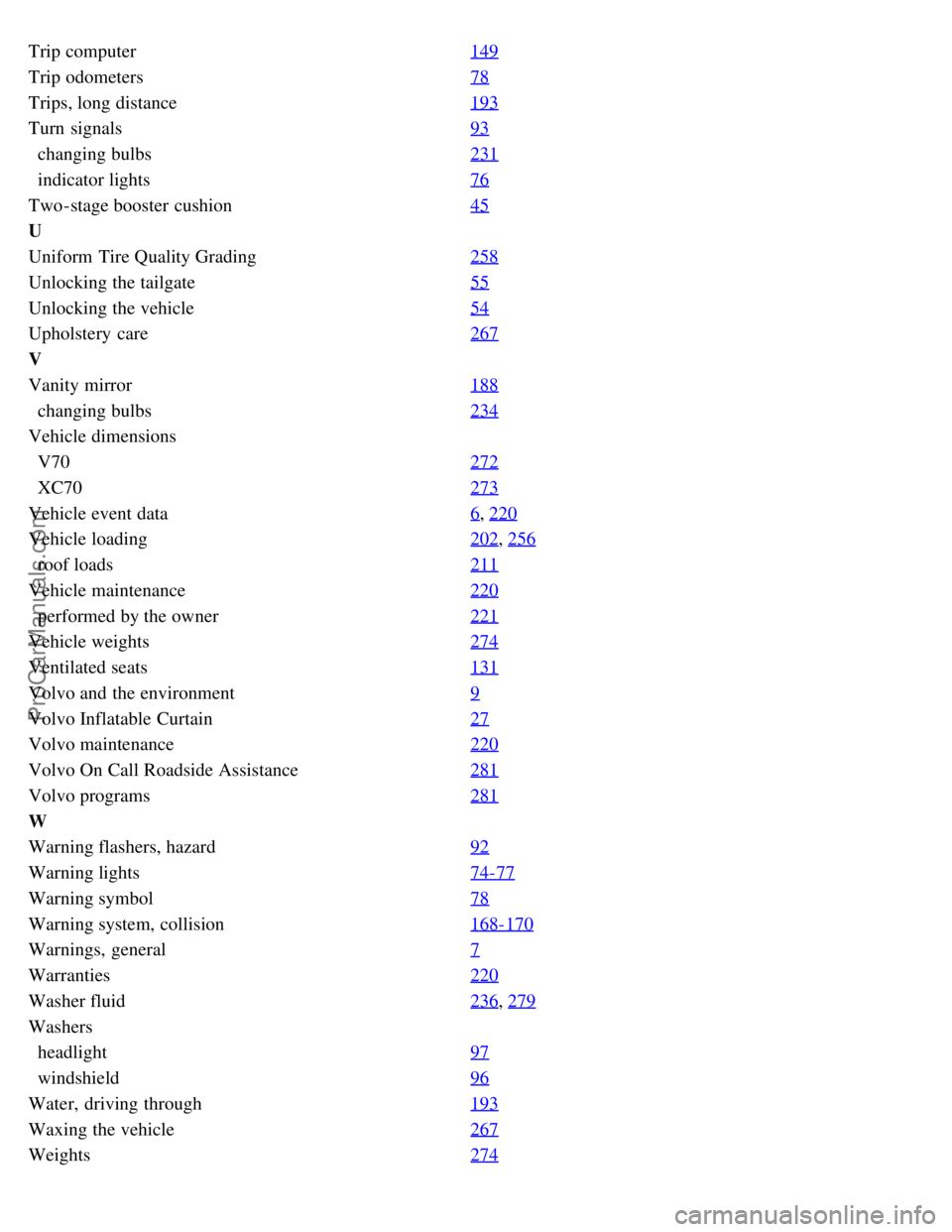
Trip computer149
Trip odometers78
Trips, long distance193
Turn signals93
changing bulbs231
indicator lights76
Two-stage booster cushion 45
U
Uniform Tire Quality Grading258
Unlocking the tailgate55
Unlocking the vehicle54
Upholstery care267
V
Vanity mirror188
changing bulbs234
Vehicle dimensions
V70 272
XC70273
Vehicle event data 6, 220
Vehicle loading202, 256
roof loads211
Vehicle maintenance 220
performed by the owner221
Vehicle weights 274
Ventilated seats131
Volvo and the environment9
Volvo Inflatable Curtain27
Volvo maintenance220
Volvo On Call Roadside Assistance281
Volvo programs281
W
Warning flashers, hazard92
Warning lights74-77
Warning symbol78
Warning system, collision168-170
Warnings, general7
Warranties220
Washer fluid236, 279
Washers
headlight 97
windshield96
Water, driving through 193
Waxing the vehicle267
Weights274
ProCarManuals.com