lock VOLVO V70 2008 Manual PDF
[x] Cancel search | Manufacturer: VOLVO, Model Year: 2008, Model line: V70, Model: VOLVO V70 2008Pages: 274, PDF Size: 7.82 MB
Page 185 of 274
refueling
wearing neoprene gloves while handling a fuel filler nozzle.
Use of Additives
With the exception of gas line antifreeze during winter months, do not add solvents, thickeners, or other store -bought
additives to your vehicle's fuel, cooling, or lubricating systems. Overuse may damage your engine, and some of these
additives contain organically volatile chemicals. Do not needlessly expose yourself to these chemicals.
198 05 During your trip
Refueling
WARNING
Never carry a cell phone that is switched on while refueling your vehicle. If the phone rings, this may cause a spark
that could ignite gasoline fumes, resulting in fire and injury.
WARNING
Carbon monoxide is a poisonous, colorless, and odorless gas. It is present in all exhaust gases. If you ever smell
exhaust fumes inside the vehicle, make sure the passenger compartment is ventilated, and immediately return the
vehicle to a trained and qualified Volvo service technician for correction.
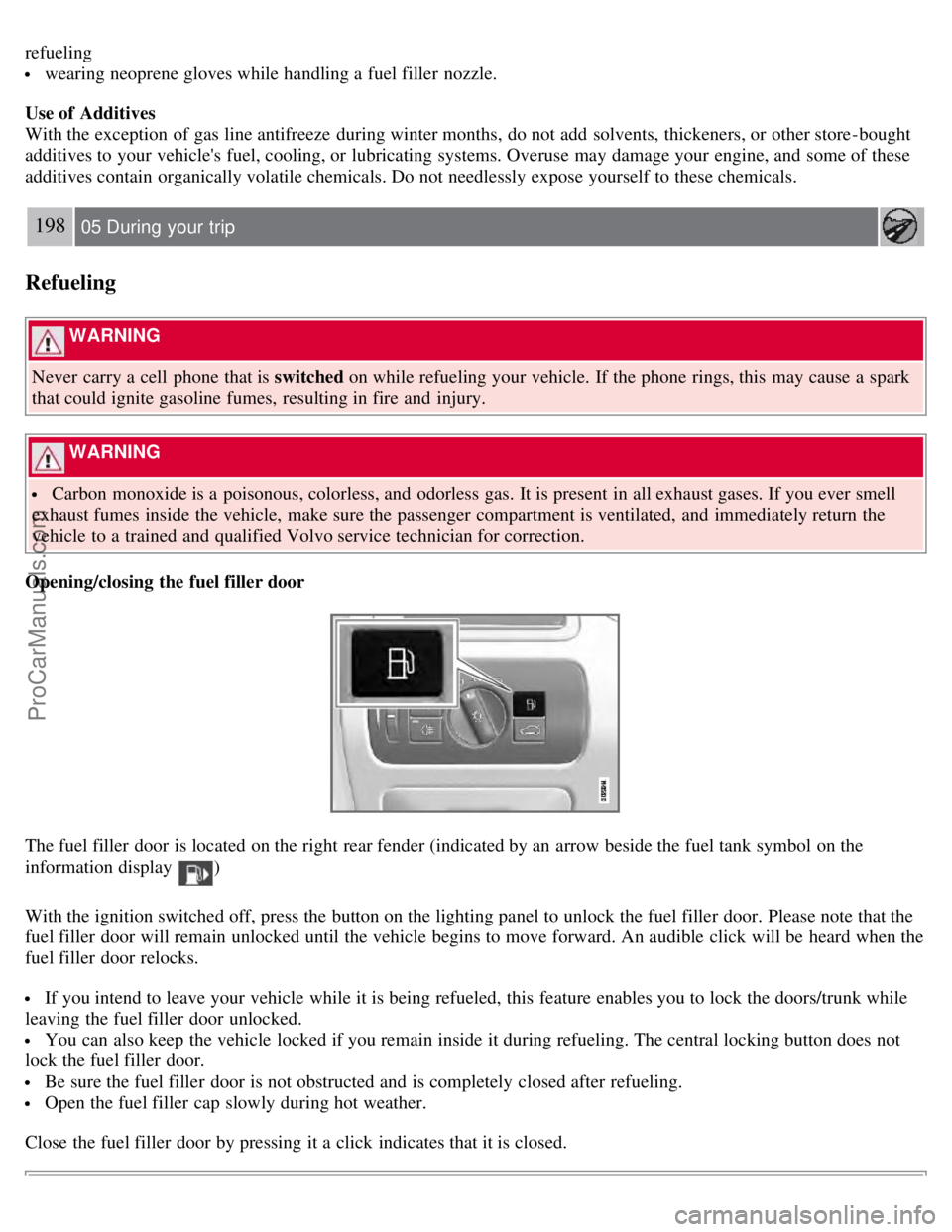
Opening/closing the fuel filler door
The fuel filler door is located on the right rear fender (indicated by an arrow beside the fuel tank symbol on the
information display
)
With the ignition switched off, press the button on the lighting panel to unlock the fuel filler door. Please note that the
fuel filler door will remain unlocked until the vehicle begins to move forward. An audible click will be heard when the
fuel filler door relocks.
If you intend to leave your vehicle while it is being refueled, this feature enables you to lock the doors/trunk while
leaving the fuel filler door unlocked.
You can also keep the vehicle locked if you remain inside it during refueling. The central locking button does not
lock the fuel filler door.
Be sure the fuel filler door is not obstructed and is completely closed after refueling.
Open the fuel filler cap slowly during hot weather.
Close the fuel filler door by pressing it a click indicates that it is closed.
ProCarManuals.com
Page 186 of 274
CAUTION
Avoid spilling gasoline during refueling. In addition to causing damage to the environment, gasolines containing
alcohol can cause damage to painted surfaces, which may not be covered under the New Vehicle Limited Warranty.
199 05 During your trip
Refueling
Manually opening the fuel filler door
If necessary, the fuel filler door can be opened manually.
Open the side hatch in the cargo area (on the same side as the fuel filler door).
Grasp the green cord with a handle.
Pull the cord straight rearward until the fuel filler door clicks open
200 05 During your trip
Refueling
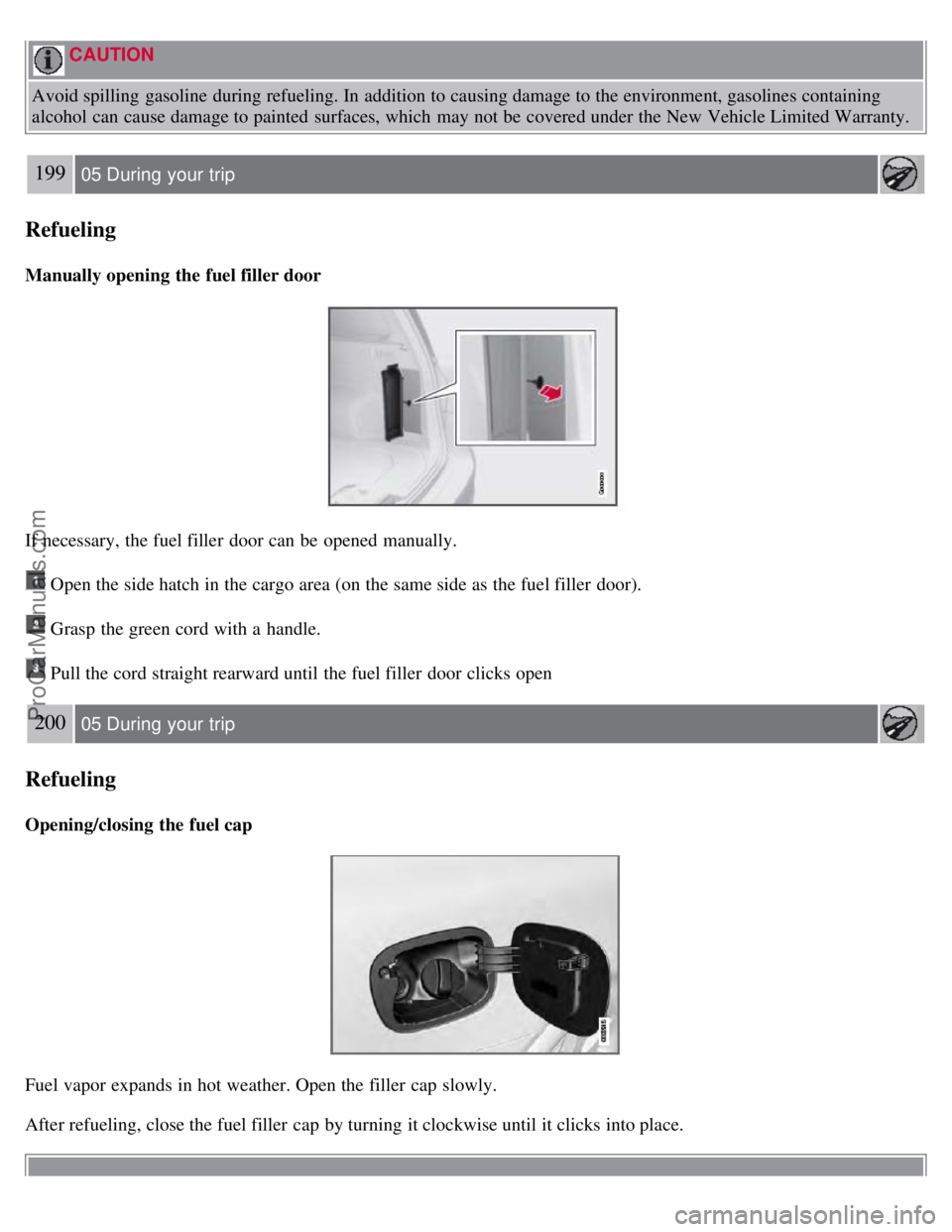
Opening/closing the fuel cap
Fuel vapor expands in hot weather. Open the filler cap slowly.
After refueling, close the fuel filler cap by turning it clockwise until it clicks into place.
ProCarManuals.com
Page 190 of 274
205 05 During your trip
Loading
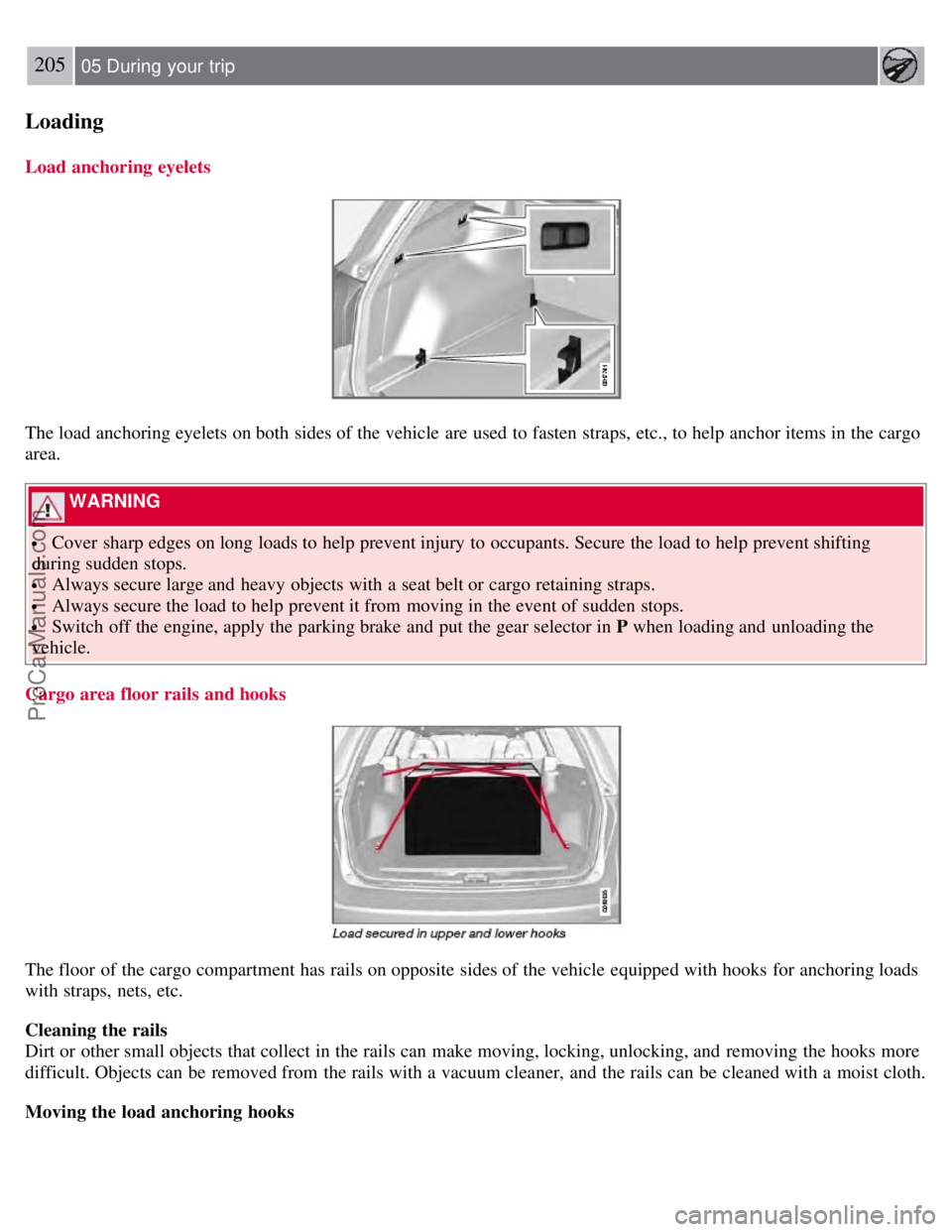
Load anchoring eyelets
The load anchoring eyelets on both sides of the vehicle are used to fasten straps, etc., to help anchor items in the cargo
area.
WARNING
Cover sharp edges on long loads to help prevent injury to occupants. Secure the load to help prevent shifting
during sudden stops.
Always secure large and heavy objects with a seat belt or cargo retaining straps.
Always secure the load to help prevent it from moving in the event of sudden stops.
Switch off the engine, apply the parking brake and put the gear selector in P when loading and unloading the
vehicle.
Cargo area floor rails and hooks
The floor of the cargo compartment has rails on opposite sides of the vehicle equipped with hooks for anchoring loads
with straps, nets, etc.
Cleaning the rails
Dirt or other small objects that collect in the rails can make moving, locking, unlocking, and removing the hooks more
difficult. Objects can be removed from the rails with a vacuum cleaner, and the rails can be cleaned with a moist cloth.
Moving the load anchoring hooks
ProCarManuals.com
Page 191 of 274
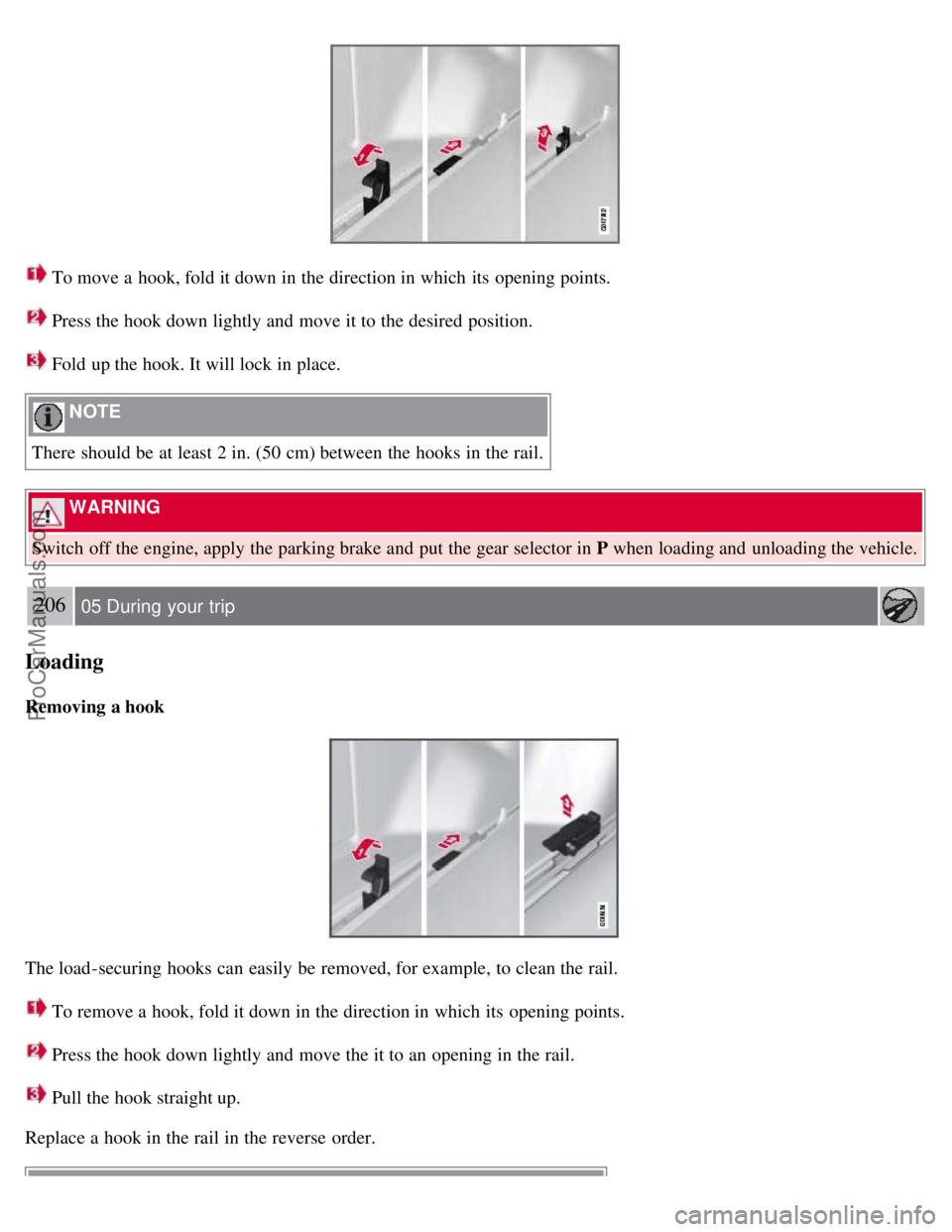
To move a hook, fold it down in the direction in which its opening points.
Press the hook down lightly and move it to the desired position.
Fold up the hook. It will lock in place.
NOTE
There should be at least 2 in. (50 cm) between the hooks in the rail.
WARNING
Switch off the engine, apply the parking brake and put the gear selector in P when loading and unloading the vehicle.
206 05 During your trip
Loading
Removing a hook
The load-securing hooks can easily be removed, for example, to clean the rail.
To remove a hook, fold it down in the direction in which its opening points.
Press the hook down lightly and move the it to an opening in the rail.
Pull the hook straight up.
Replace a hook in the rail in the reverse order.
ProCarManuals.com
Page 195 of 274
Use
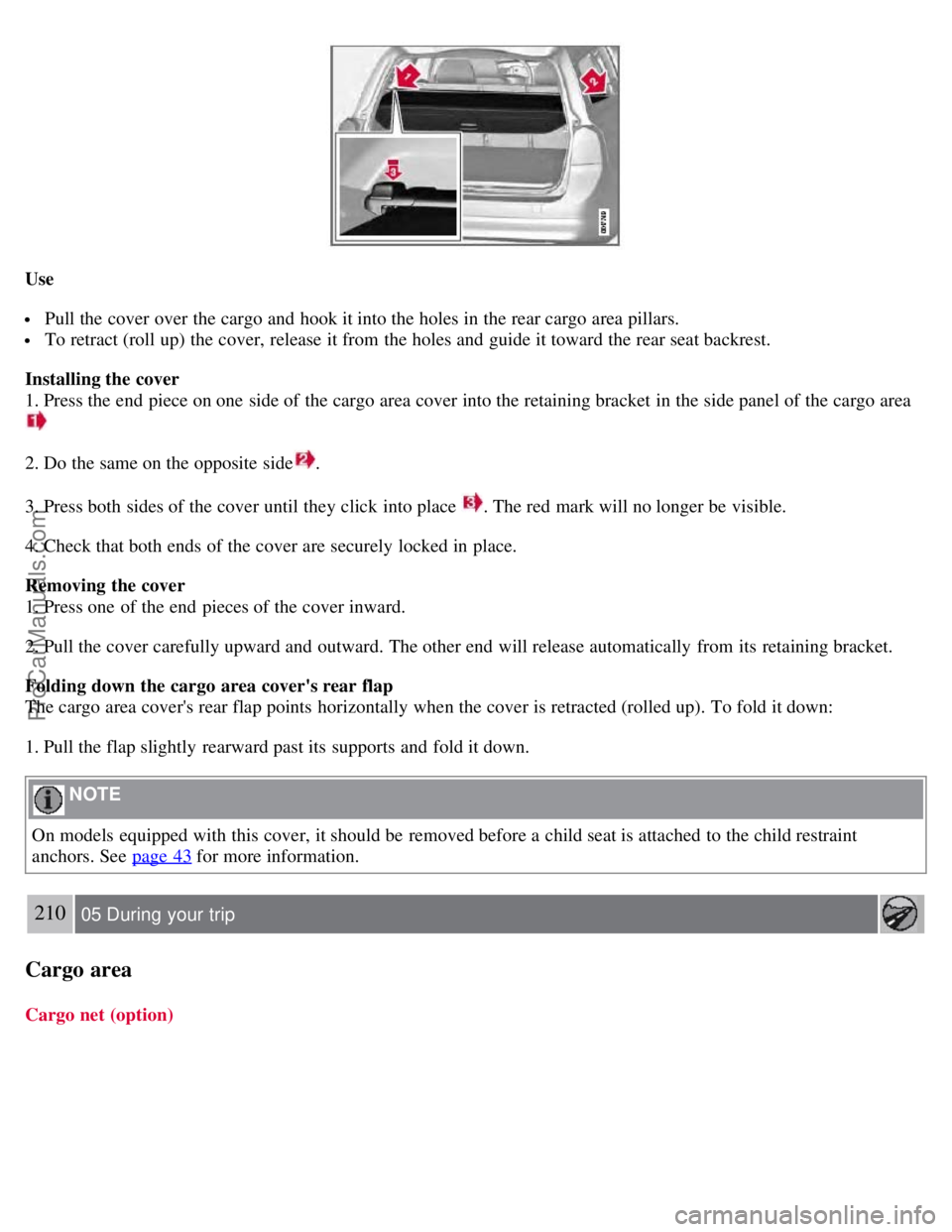
Pull the cover over the cargo and hook it into the holes in the rear cargo area pillars.
To retract (roll up) the cover, release it from the holes and guide it toward the rear seat backrest.
Installing the cover
1. Press the end piece on one side of the cargo area cover into the retaining bracket in the side panel of the cargo area
2. Do the same on the opposite side.
3. Press both sides of the cover until they click into place
. The red mark will no longer be visible.
4. Check that both ends of the cover are securely locked in place.
Removing the cover
1. Press one of the end pieces of the cover inward.
2. Pull the cover carefully upward and outward. The other end will release automatically from its retaining bracket.
Folding down the cargo area cover's rear flap
The cargo area cover's rear flap points horizontally when the cover is retracted (rolled up). To fold it down:
1. Pull the flap slightly rearward past its supports and fold it down.
NOTE
On models equipped with this cover, it should be removed before a child seat is attached to the child restraint
anchors. See page 43
for more information.
210 05 During your trip
Cargo area
Cargo net (option)
ProCarManuals.com
Page 196 of 274
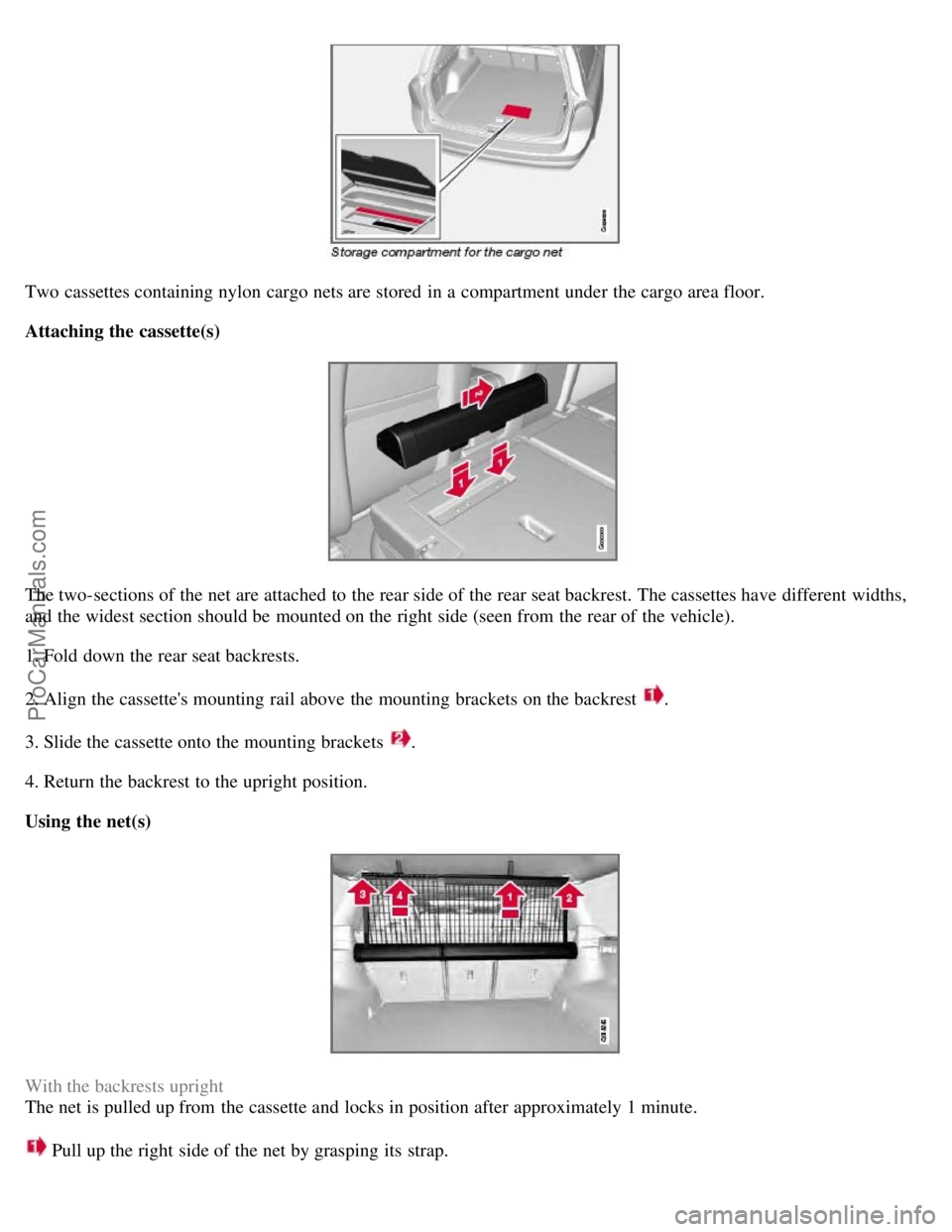
Two cassettes containing nylon cargo nets are stored in a compartment under the cargo area floor.
Attaching the cassette(s)
The two-sections of the net are attached to the rear side of the rear seat backrest. The cassettes have different widths,
and the widest section should be mounted on the right side (seen from the rear of the vehicle).
1. Fold down the rear seat backrests.
2. Align the cassette's mounting rail above the mounting brackets on the backrest
.
3. Slide the cassette onto the mounting brackets
.
4. Return the backrest to the upright position.
Using the net(s)
With the backrests upright
The net is pulled up from the cassette and locks in position after approximately 1 minute.
Pull up the right side of the net by grasping its strap.
ProCarManuals.com
Page 200 of 274
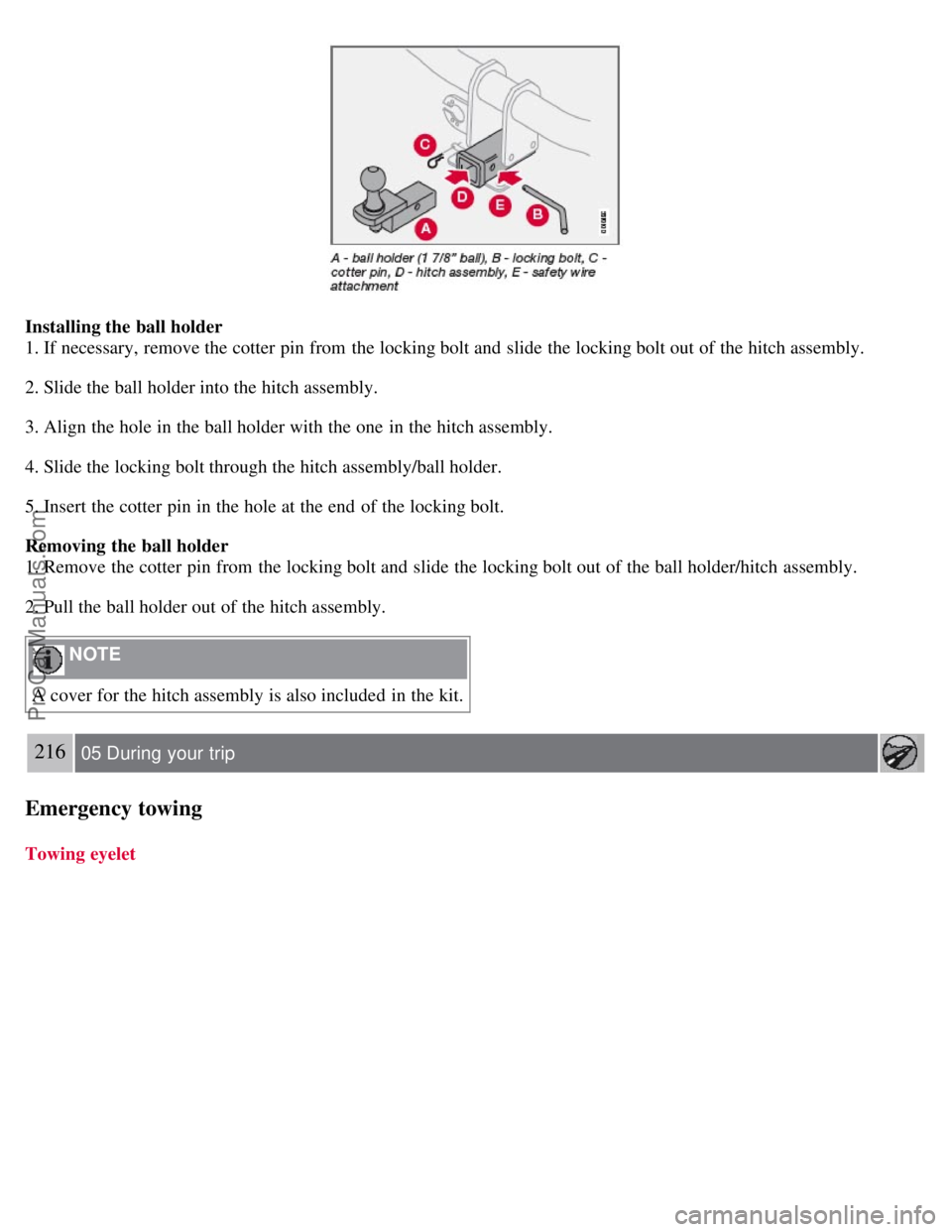
Installing the ball holder
1. If necessary, remove the cotter pin from the locking bolt and slide the locking bolt out of the hitch assembly.
2. Slide the ball holder into the hitch assembly.
3. Align the hole in the ball holder with the one in the hitch assembly.
4. Slide the locking bolt through the hitch assembly/ball holder.
5. Insert the cotter pin in the hole at the end of the locking bolt.
Removing the ball holder
1. Remove the cotter pin from the locking bolt and slide the locking bolt out of the ball holder/hitch assembly.
2. Pull the ball holder out of the hitch assembly.
NOTE
A cover for the hitch assembly is also included in the kit.
216 05 During your trip
Emergency towing
Towing eyelet
ProCarManuals.com
Page 201 of 274
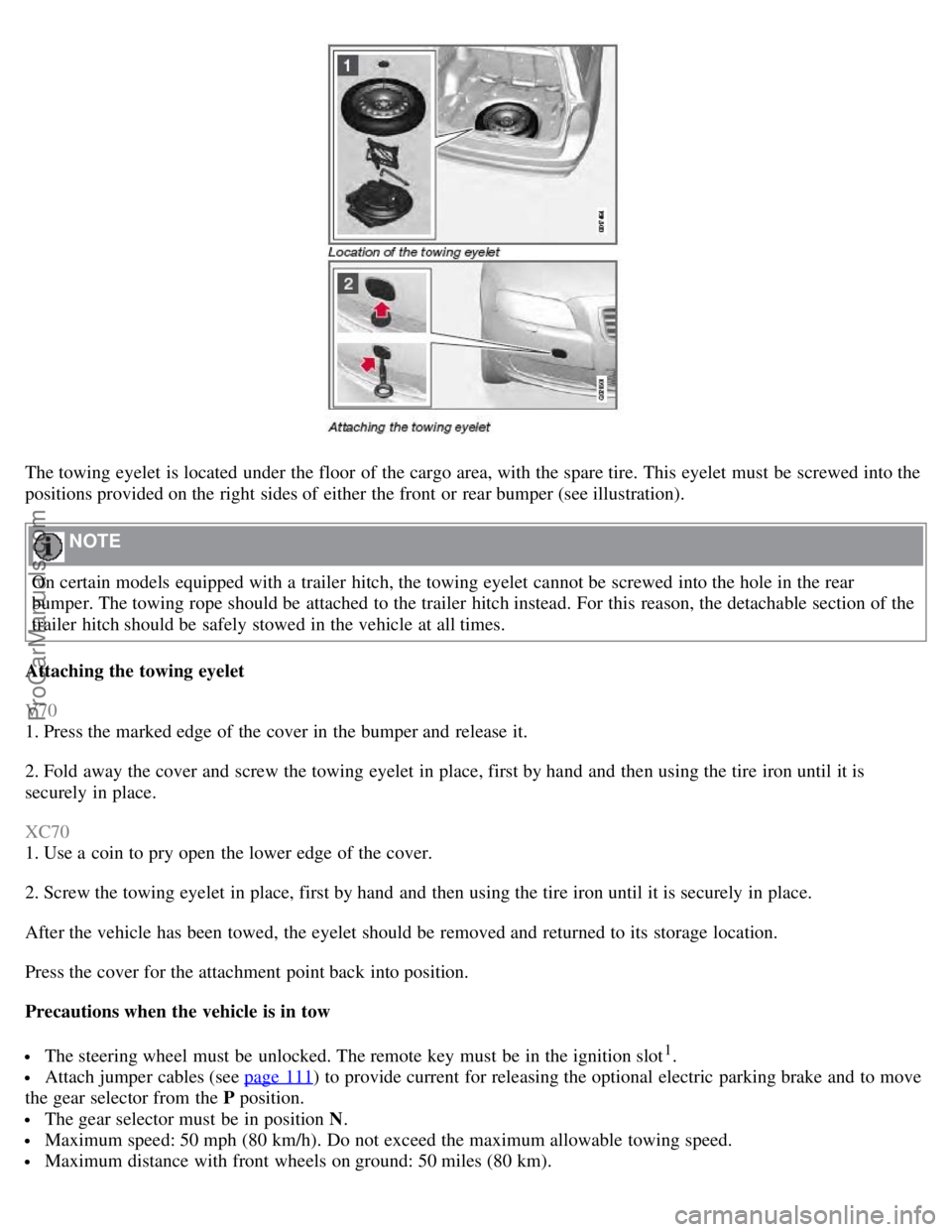
The towing eyelet is located under the floor of the cargo area, with the spare tire. This eyelet must be screwed into the
positions provided on the right sides of either the front or rear bumper (see illustration).
NOTE
On certain models equipped with a trailer hitch, the towing eyelet cannot be screwed into the hole in the rear
bumper. The towing rope should be attached to the trailer hitch instead. For this reason, the detachable section of the
trailer hitch should be safely stowed in the vehicle at all times.
Attaching the towing eyelet
V70
1. Press the marked edge of the cover in the bumper and release it.
2. Fold away the cover and screw the towing eyelet in place, first by hand and then using the tire iron until it is
securely in place.
XC70
1. Use a coin to pry open the lower edge of the cover.
2. Screw the towing eyelet in place, first by hand and then using the tire iron until it is securely in place.
After the vehicle has been towed, the eyelet should be removed and returned to its storage location.
Press the cover for the attachment point back into position.
Precautions when the vehicle is in tow
The steering wheel must be unlocked. The remote key must be in the ignition slot1.
Attach jumper cables (see page 111) to provide current for releasing the optional electric parking brake and to move
the gear selector from the P position.
The gear selector must be in position N .
Maximum speed: 50 mph (80 km/h). Do not exceed the maximum allowable towing speed.
Maximum distance with front wheels on ground: 50 miles (80 km).
ProCarManuals.com
Page 206 of 274
If your Check Engine (MIL) light is lit - or was lit but went out without service, have your vehicle diagnosed and, if
necessary, serviced by a qualified Volvo technician.
If you recently had service for a lit Check Engine light, or if you had service that required disconnecting the battery,
a period of driving is necessary to bring the OBD II system to "ready" for inspection. A half-hour trip of mixed stop-
and -go/highway driving is typically needed to allow OBD II to reach readiness. Your Volvo retailer can provide you
with more information on planning a trip.
Maintain your vehicle in accordance with your vehicle's maintenance schedule.
223 06 Maintenance and specifications
Hood and engine compartment
Opening and closing the hood
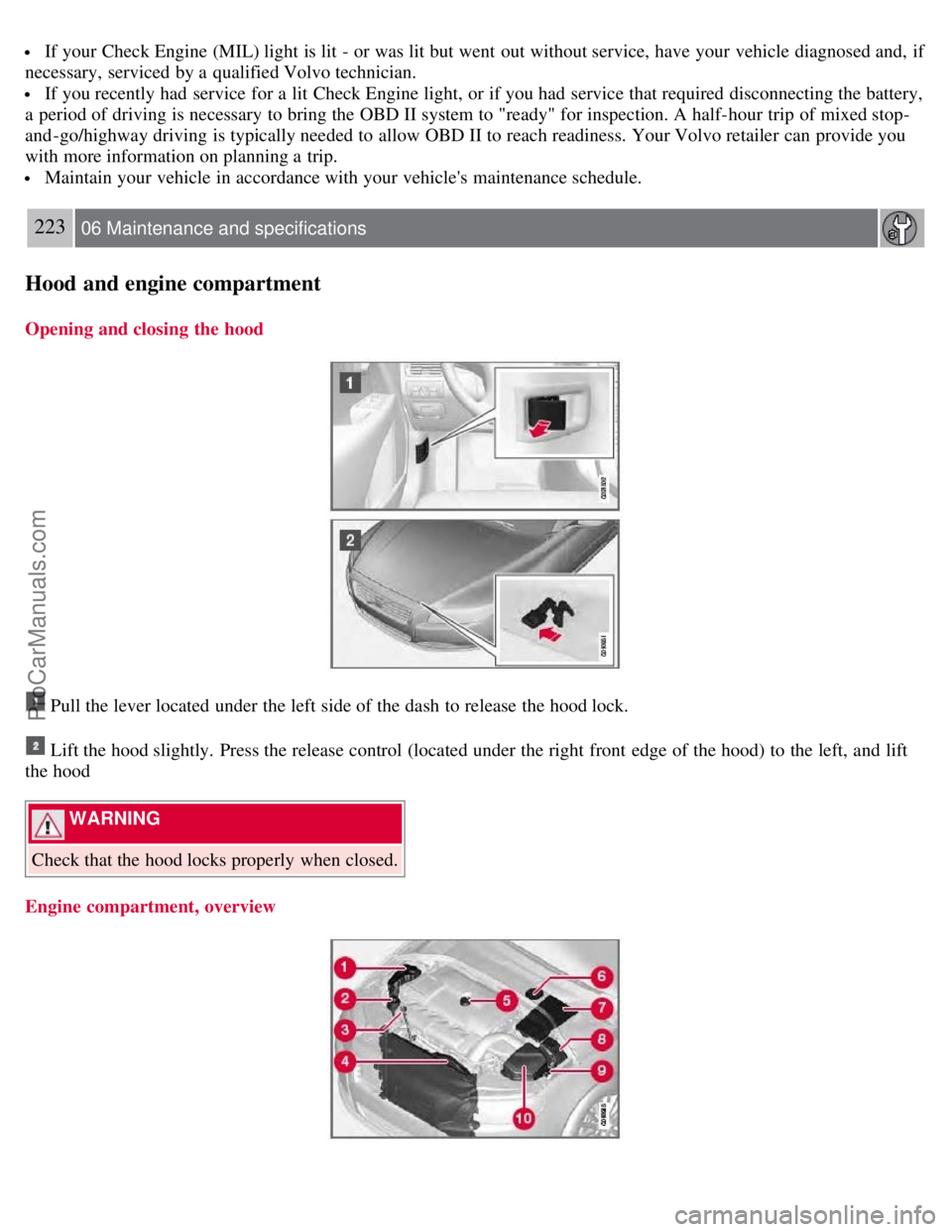
Pull the lever located under the left side of the dash to release the hood lock.
Lift the hood slightly. Press the release control (located under the right front edge of the hood) to the left, and lift
the hood
WARNING
Check that the hood locks properly when closed.
Engine compartment, overview
ProCarManuals.com
Page 212 of 274

The entire headlight housing must be lifted out when replacing all front bulbs (except for the fog lights).
CAUTION
Never touch the glass of bulbs with your fingers. Grease and oils from your fingers vaporize in the heat and will
leave a deposit on the reflector, which will damage it.
NOTE
Always switch off the ignition before starting to replace a bulb.
The optional Bi -Xenon® headlight bulbs contain trace amounts of mercury. These bulbs should always be
disposed of by a trained and qualified Volvo service technician.
Removing the headlight housing
1. Switch off the ignition by pressing quickly on the START/STOP ENGINE button and remove the remote key from
the ignition slot
1.
2. (Upper illustration)
Withdraw the headlight housing's locking pins.
Pull the headlight housing straight out.
3. (Lower illustration)
Unplug the wiring connector by holding down the clip with your thumb.
Pull out the connector with the other hand.
CAUTION
Pull the connector, not the wiring.
1Does not apply to vehicles with the optional keyless drive.
229 06 Maintenance and specifications
Replacing bulbs
ProCarManuals.com