light VOLVO V70 2008 Manual Online
[x] Cancel search | Manufacturer: VOLVO, Model Year: 2008, Model line: V70, Model: VOLVO V70 2008Pages: 274, PDF Size: 7.82 MB
Page 189 of 274
CAUTION
Be sure that there is adequate space above and behind the vehicle before opening the tailgate automatically.
NOTE
If the tailgate has been opened and closed continuously for more than 90 seconds, the automatic function will be
deactivated to avoid overloading the electrical system. The automatic function can be used again after approximately
10 minutes.
Automatic closing
The power tailgate can be closed by pressing the
button on the tailgate (see the illustration), or by pressing it
down.
NOTE
If the tailgate is pressed down e.g., by the weight of snow or strong wind, it will close automatically.
WARNING
Be sure that no one is near the tailgate when it is opened or closed automatically. The tailgate should never be
obstructed in any way when it is operated.
Interrupting automatic opening/closing
Automatic opening or closing the tailgate can be interrupted in four ways:
By pressing the button on the lighting panel (see page 65).
By pressing the remote key (see page 65) for several seconds.
By pressing the button on the lower edge of the tailgate.
By pulling the outer handle on the tailgate. If one of these actions is taken:
While the tailgate is being opened, the electrical function will be switched off and the tailgate will be released from
the electrical system.
While the tailgate is being closed, it will return to the fully open position.
Pinch protection
If the tailgate is obstructed while it is being operated, the pinch protection function is activated.
204 05 During your trip
Loading
If the tailgate is being opened , the electrical function will be switched off and the tailgate will be released from the
electrical system.
If the tailgate is being closed , it will move in the opposite direction.
Operating the tailgate manually
The power tailgate can be disconnected from the vehicle's electrical system by quickly pulling the outer handle twice.
The tailgate can then be opened/closed manually.
ProCarManuals.com
Page 191 of 274
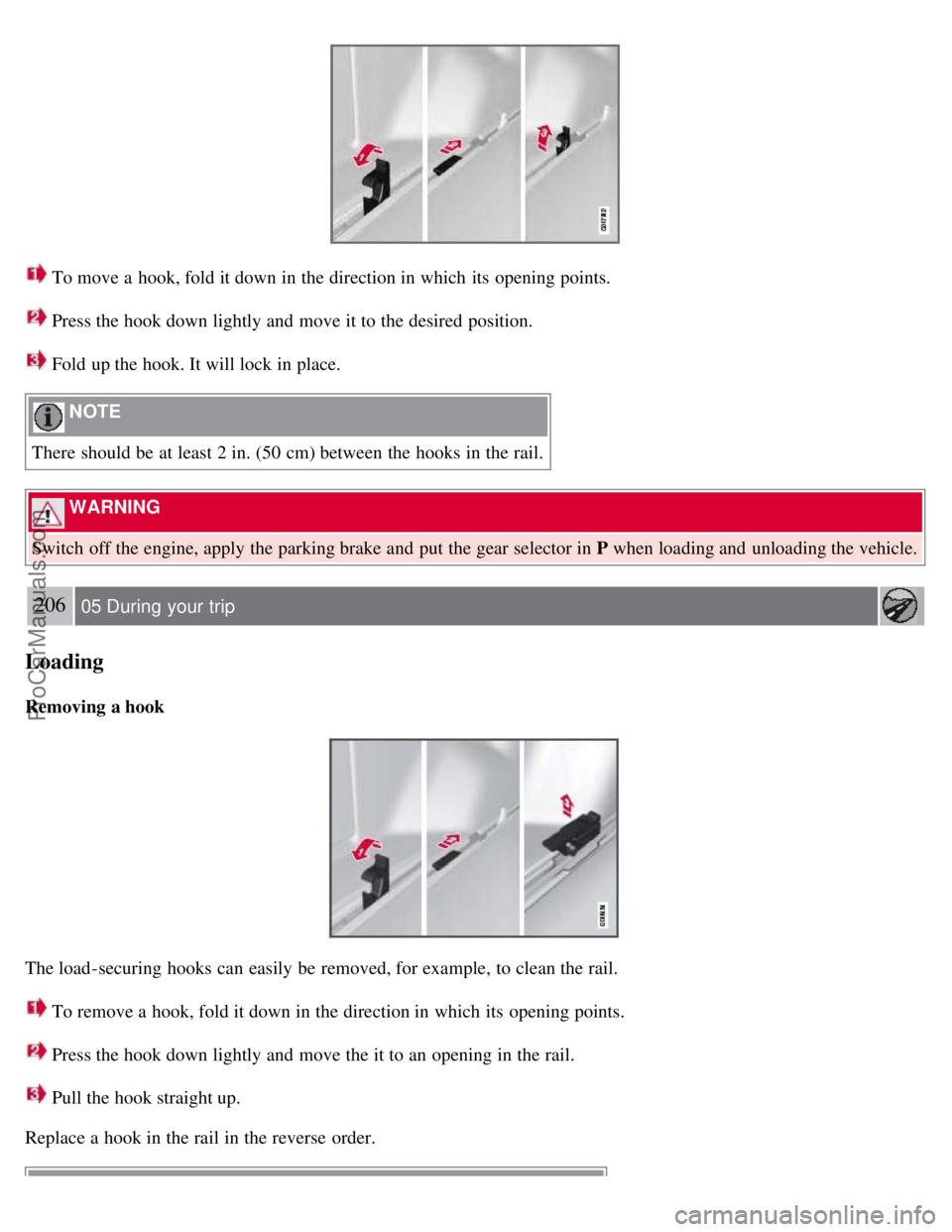
To move a hook, fold it down in the direction in which its opening points.
Press the hook down lightly and move it to the desired position.
Fold up the hook. It will lock in place.
NOTE
There should be at least 2 in. (50 cm) between the hooks in the rail.
WARNING
Switch off the engine, apply the parking brake and put the gear selector in P when loading and unloading the vehicle.
206 05 During your trip
Loading
Removing a hook
The load-securing hooks can easily be removed, for example, to clean the rail.
To remove a hook, fold it down in the direction in which its opening points.
Press the hook down lightly and move the it to an opening in the rail.
Pull the hook straight up.
Replace a hook in the rail in the reverse order.
ProCarManuals.com
Page 192 of 274
NOTE
In order to return a removed hook into a rail, it must be press down lightly.
Reinserting a hook
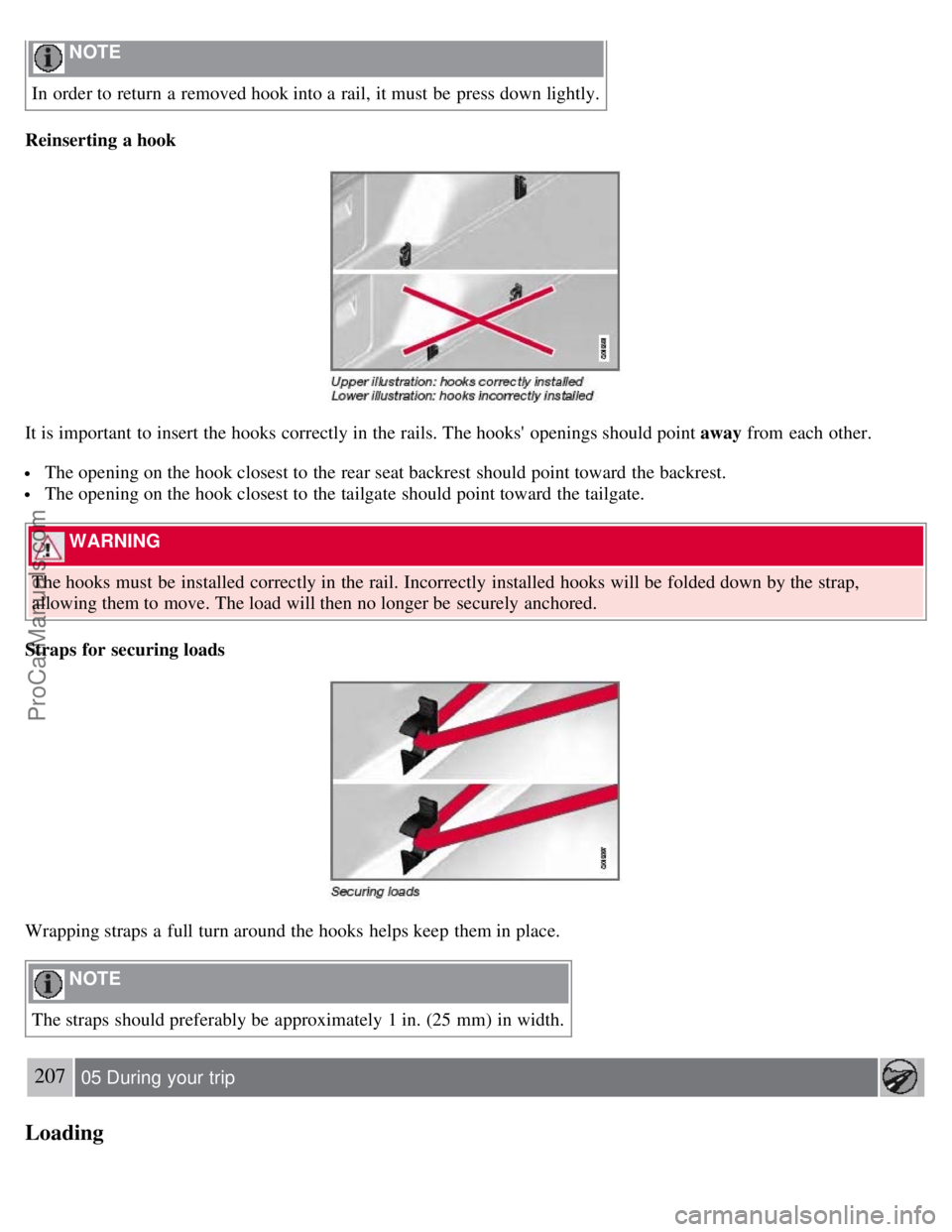
It is important to insert the hooks correctly in the rails. The hooks' openings should point away from each other.
The opening on the hook closest to the rear seat backrest should point toward the backrest.
The opening on the hook closest to the tailgate should point toward the tailgate.
WARNING
The hooks must be installed correctly in the rail. Incorrectly installed hooks will be folded down by the strap,
allowing them to move. The load will then no longer be securely anchored.
Straps for securing loads
Wrapping straps a full turn around the hooks helps keep them in place.
NOTE
The straps should preferably be approximately 1 in. (25 mm) in width.
207 05 During your trip
Loading
ProCarManuals.com
Page 194 of 274
NOTE
The steel cargo grid is easiest to install by two people, and should be folded down.
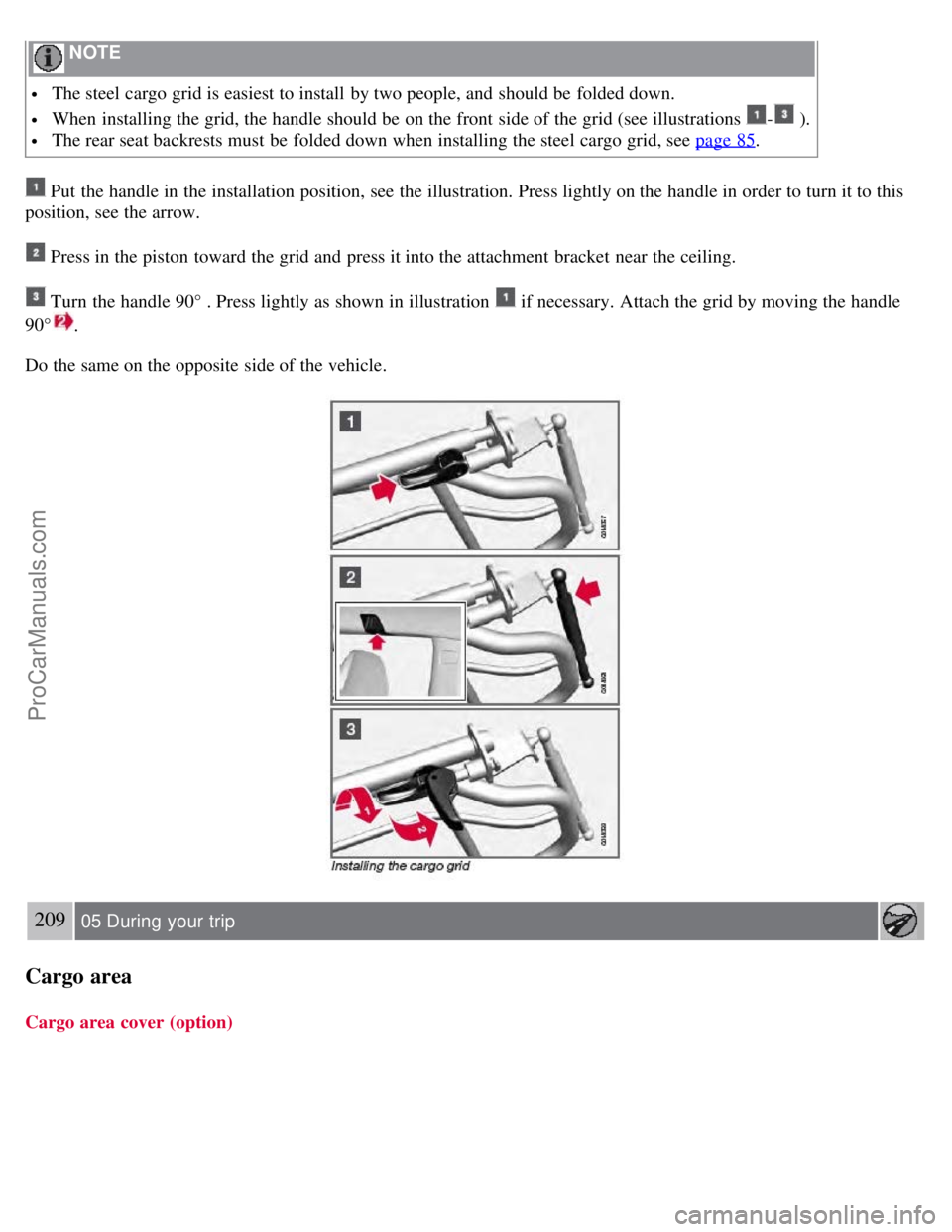
When installing the grid, the handle should be on the front side of the grid (see illustrations - ).
The rear seat backrests must be folded down when installing the steel cargo grid, see page 85.
Put the handle in the installation position, see the illustration. Press lightly on the handle in order to turn it to this
position, see the arrow.
Press in the piston toward the grid and press it into the attachment bracket near the ceiling.
Turn the handle 90° . Press lightly as shown in illustration if necessary. Attach the grid by moving the handle
90°
.
Do the same on the opposite side of the vehicle.
209 05 During your trip
Cargo area
Cargo area cover (option)
ProCarManuals.com
Page 195 of 274
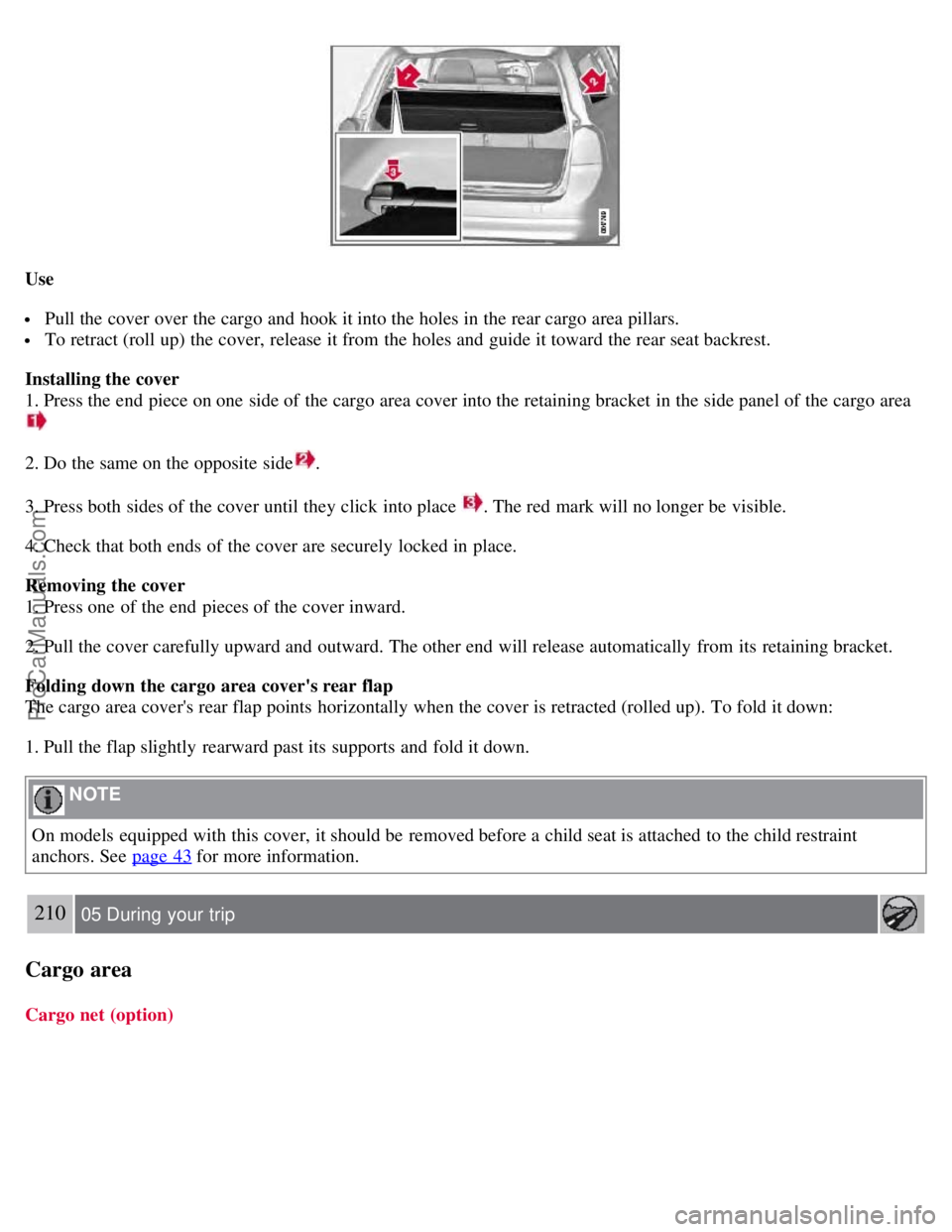
Use
Pull the cover over the cargo and hook it into the holes in the rear cargo area pillars.
To retract (roll up) the cover, release it from the holes and guide it toward the rear seat backrest.
Installing the cover
1. Press the end piece on one side of the cargo area cover into the retaining bracket in the side panel of the cargo area
2. Do the same on the opposite side.
3. Press both sides of the cover until they click into place
. The red mark will no longer be visible.
4. Check that both ends of the cover are securely locked in place.
Removing the cover
1. Press one of the end pieces of the cover inward.
2. Pull the cover carefully upward and outward. The other end will release automatically from its retaining bracket.
Folding down the cargo area cover's rear flap
The cargo area cover's rear flap points horizontally when the cover is retracted (rolled up). To fold it down:
1. Pull the flap slightly rearward past its supports and fold it down.
NOTE
On models equipped with this cover, it should be removed before a child seat is attached to the child restraint
anchors. See page 43
for more information.
210 05 During your trip
Cargo area
Cargo net (option)
ProCarManuals.com
Page 199 of 274
More frequent vehicle maintenance is required.
Remove the ball and drawbar assembly when the hitch is not being used.
Volvo recommends the use of synthetic engine oil when towing a trailer over long distances or in mountainous
areas.
WARNING
Bumper-attached trailer hitches must not be used on Volvos, nor should safety chains be attached to the bumper.
Trailer hitches attaching to the vehicle rear axle must not be used.
Never connect a trailer's hydraulic brake system directly to the vehicle brake system, nor a trailer's lighting system
directly to the vehicle lighting system. Consult your nearest authorized Volvo retailer for correct installation.
When towing a trailer, the trailer's safety wire must be correctly fastened to the hole or hook provided in the
trailer hitch on the vehicle. The safety wire should never be fastened to or wound around the drawbar ball.
214 05 During your trip
Towing a trailer
NOTE
When parking the vehicle with a trailer on a hill, apply the parking brake before putting the gear selector in P .
Always follow the trailer manufacturer's recommendations for wheel chocking.
When starting on a hill, put the gear selector in D before releasing the parking brake. See also page 120 for more
detailed information about starting off on a hill while towing a trailer.
If you use the manual (Geartronic) shift positions while towing a trailer, make sure the gear you select does not
put too much strain on the engine (using too high a gear).
The drawbar assembly/trailer hitch may be rated for trailers heavier than the vehicle is designed to tow. Please
adhere to Volvo's recommended trailer weights.
Avoid driving with a trailer on inclines of more than 15 %.
Trailer cable
An adapter is required if the vehicle's trailer hitch has a 13-pin connector and the trailer has 7 pins. Use an adapter
cable approved by Volvo. Make sure the cable does not drag on the ground.
215 05 During your trip
Towing a trailer
Detachable trailer hitch (accessory)
ProCarManuals.com
Page 202 of 274
While the vehicle is being towed, try to keep the tow rope taut at all times.
1On vehicles with the optional keyless drive, the remote key must be in the passenger compartment.
217 05 During your trip
Emergency towing
The vehicle should only be towed in the forward direction.
CAUTION
Please check with state and local authorities before attempting this type of towing, as vehicles being towed are
subject to regulations regarding maximum towing speed, length and type of towing device, lighting, etc.
If the vehicle's battery is dead, do not attempt to start the vehicle by pushing or pulling it as this will damage the
three-way catalytic converter(s). The engine must be jump started using an auxiliary battery (see page 111
).
If the vehicle is being towed on a flat bed truck, the towing eyelets must not be used to secure the vehicle on the
flat bed. Consult the tow truck operator.
Towing vehicles with front wheel drive/All Wheel Drive
Volvo recommends the use of flat bed equipment.
If wheel lift equipment must be used, please use extreme caution to help avoid damage to the vehicle. In this case,
the vehicle should be towed with the rear wheels on the ground if at all possible.
If it is absolutely necessary to tow the vehicle with the front wheels on the ground, please refer to the towing
information on the page 216
.
CAUTION
Sling-type equipment applied at the front will damage radiator and air conditioning lines.
It is equally important not to use sling -type equipment at the rear or apply lifting equipment inside the rear
wheels; serious damage to the rear axle may result.
If the vehicle is being towed on a flat bed truck, the towing eyelets must not be used to secure the vehicle on the
flat bed. Consult the tow truck operator.
Contents | Top of Page
ProCarManuals.com
Page 205 of 274
Each time the car is refueled:
Check the engine oil level.
Clean the windshield, windshield wipers, headlights, and tail lights.
Monthly:
Check cold tire pressure in all tires. Inspect the tires for wear.
Check that engine coolant and other fluid levels are between the indicated "min" and "max" markings.
Clean interior glass surfaces with a glass cleaner and soft paper towels.
Wipe driver information displays with a soft cloth.
Visually inspect battery terminals for corrosion. Corrosion may indicate a loose terminal connector, or a battery near
the end of its useful service life. Consult your Volvo retailer for additional information.
As needed:
Wash the car, including the undercarriage, to reduce wear that can be caused by a buildup of dirt, and corrosion that
can be caused by salt residues.
Clean leaves and twigs from air intake vents at the base of the windshield, and from other places where they may
collect.
NOTE
Complete service information for qualified technicians is available online for purchase or subscription at
www.volvotechinfo.com
.
222 06 Maintenance and specifications
Maintaining your car
Emission inspection readiness
What is an Onboard Diagnostic System (OBD II)?
OBD II is part of your vehicle's computerized engine management system. It stores diagnostic information about your
vehicle's emission controls. It can light the Check Engine light (MIL) if it detects an emission control "fault." A "fault"
is a component or system that is not performing within an expected range. A fault may be permanent or temporary.
OBD II will store a message about any fault.
How do states use OBD II for emission inspections?
Many states connect a computer directly to a vehicle's OBD II system. The inspector can then read "faults." In some
states, this type of inspection has replaced the tailpipe emission test.
How can my vehicle fail OBD II emission inspection?
Your vehicle can fail OBD II emission inspection for any of the following reasons.
If your Check Engine (MIL) light is lit, your vehicle may fail inspection.
If your vehicle's Check Engine light was lit, but went out without any action on your part, OBD II will still have a
recorded fault. Your vehicle may pass or fail, depending on the inspection practices in your area.
If you had recent service that required disconnecting the battery, OBD II diagnostic information may be incomplete
and "not ready" for inspection. A vehicle that is not ready may fail inspection.
How can I prepare for my next OBD II emission inspection?
ProCarManuals.com
Page 206 of 274
If your Check Engine (MIL) light is lit - or was lit but went out without service, have your vehicle diagnosed and, if
necessary, serviced by a qualified Volvo technician.
If you recently had service for a lit Check Engine light, or if you had service that required disconnecting the battery,
a period of driving is necessary to bring the OBD II system to "ready" for inspection. A half-hour trip of mixed stop-
and -go/highway driving is typically needed to allow OBD II to reach readiness. Your Volvo retailer can provide you
with more information on planning a trip.
Maintain your vehicle in accordance with your vehicle's maintenance schedule.
223 06 Maintenance and specifications
Hood and engine compartment
Opening and closing the hood
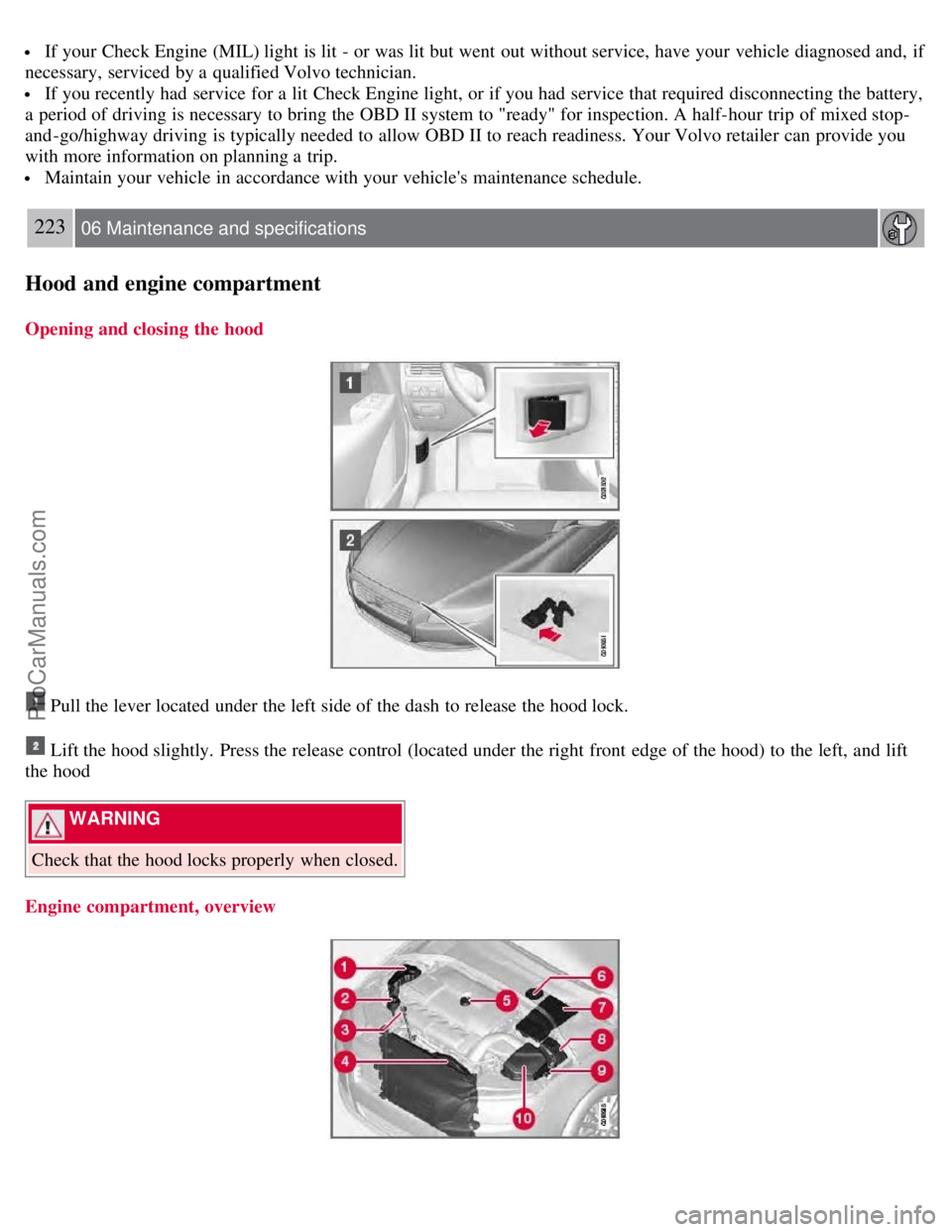
Pull the lever located under the left side of the dash to release the hood lock.
Lift the hood slightly. Press the release control (located under the right front edge of the hood) to the left, and lift
the hood
WARNING
Check that the hood locks properly when closed.
Engine compartment, overview
ProCarManuals.com
Page 211 of 274

marks. For capacities and recommended fluid grade, see page 279.
WARNING
If a problem should occur in the power steering system or if the vehicle has no electrical current and must be towed,
it is still possible to steer the vehicle. However, keep in mind that greater effort will be required to turn the steering
wheel.
CAUTION
Keep the area around the power steering fluid reservoir clean when checking.
228 06 Maintenance and specifications
Replacing bulbs
Introduction
All bulb specifications are listed on page 234
. The following bulbs should only be replaced by a trained and qualified
Volvo service technician:
Dome lighting
Reading lights
Glove compartment lighting
Turn signals in the door mirror
Approach lighting in the door mirror
Brake/fog/taillights
Rear side parking lights
Active Bi -Xenon® and LED bulbs
WARNING
Active Bi -Xenon® headlights (option) - due to the high voltage used by these headlights, these bulbs should only
be replaced by a trained and qualified Volvo service technician.
Turn off the lights and remove the remote key from the ignition before changing any bulbs.
Headlight housing
ProCarManuals.com