ESP VOLVO V90 1998 User Guide
[x] Cancel search | Manufacturer: VOLVO, Model Year: 1998, Model line: V90, Model: VOLVO V90 1998Pages: 175, PDF Size: 4.45 MB
Page 85 of 175
1998 Volvo S90
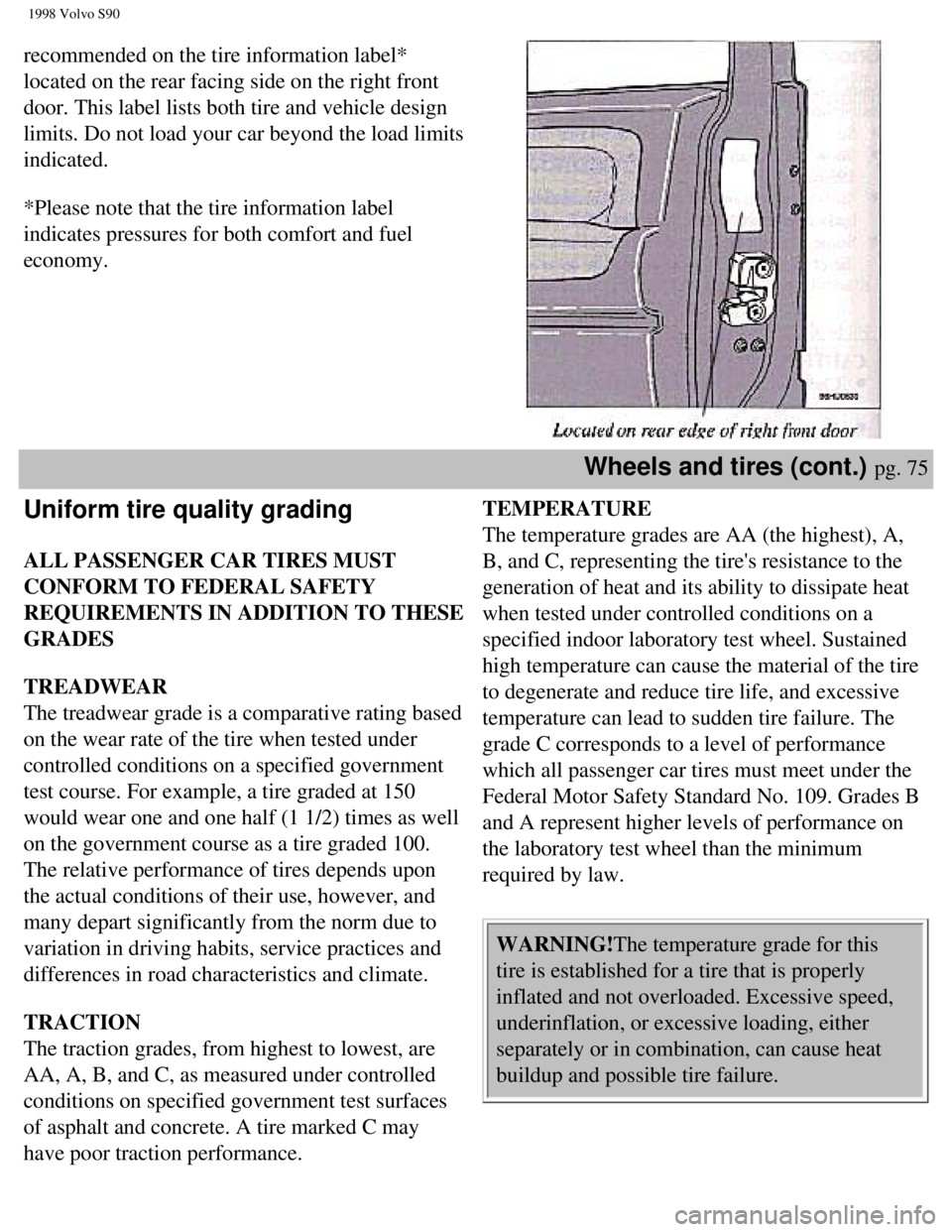
recommended on the tire information label*
located on the rear facing side on the right front
door. This label lists both tire and vehicle design
limits. Do not load your car beyond the load limits
indicated.
*Please note that the tire information label
indicates pressures for both comfort and fuel
economy.
Wheels and tires (cont.) pg. 75
Uniform tire quality grading
ALL PASSENGER CAR TIRES MUST
CONFORM TO FEDERAL SAFETY
REQUIREMENTS IN ADDITION TO THESE
GRADES
TREADWEAR
The treadwear grade is a comparative rating based
on the wear rate of the tire when tested under
controlled conditions on a specified government
test course. For example, a tire graded at 150
would wear one and one half (1 1/2) times as well
on the government course as a tire graded 100.
The relative performance of tires depends upon
the actual conditions of their use, however, and
many depart significantly from the norm due to
variation in driving habits, service practices and
differences in road characteristics and climate.
TRACTION
The traction grades, from highest to lowest, are
AA, A, B, and C, as measured under controlled
conditions on specified government test surfaces
of asphalt and concrete. A tire marked C may
have poor traction performance. TEMPERATURE
The temperature grades are AA (the highest), A,
B, and C, representing the tire's resistance to the
generation of heat and its ability to dissipate heat
when tested under controlled conditions on a
specified indoor laboratory test wheel. Sustained
high temperature can cause the material of the tire
to degenerate and reduce tire life, and excessive
temperature can lead to sudden tire failure. The
grade C corresponds to a level of performance
which all passenger car tires must meet under the
Federal Motor Safety Standard No. 109. Grades B
and A represent higher levels of performance on
the laboratory test wheel than the minimum
required by law.
WARNING!The temperature grade for this
tire is established for a tire that is properly
inflated and not overloaded. Excessive speed,
underinflation, or excessive loading, either
separately or in combination, can cause heat
buildup and possible tire failure.
file:///K|/ownersdocs/1998/1998_SV90/98S90_071.htm (4 of 5)12/30/2006 \
1:52:44 PM
Page 89 of 175
1998 Volvo S90
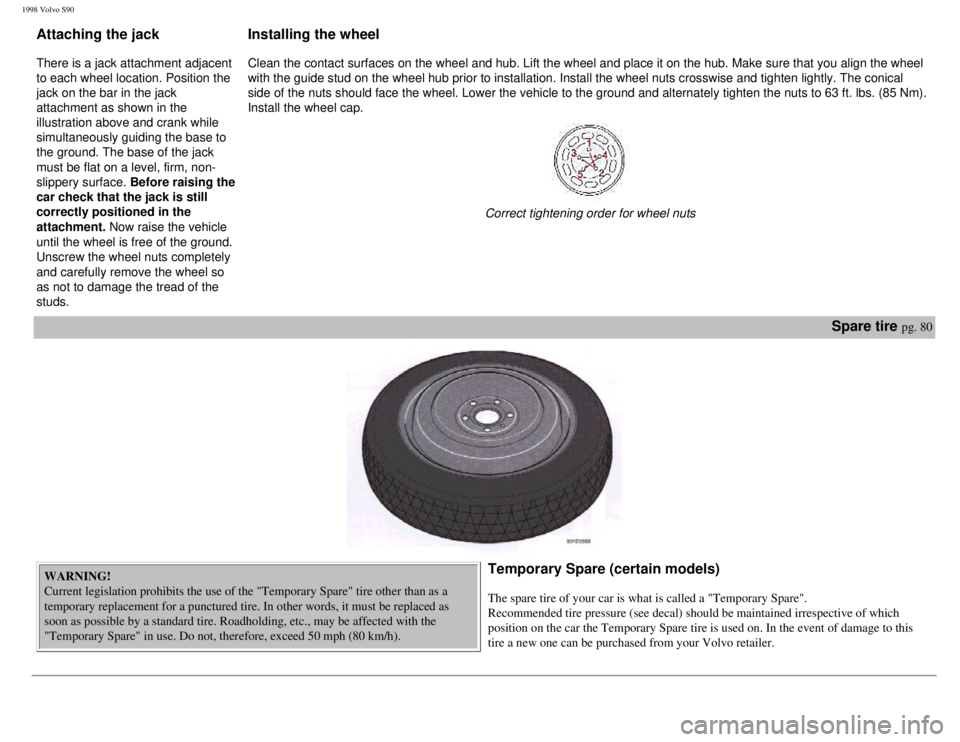
Attaching the jack
There is a jack attachment adjacent
to each wheel location. Position the
jack on the bar in the jack
attachment as shown in the
illustration above and crank while
simultaneously guiding the base to
the ground. The base of the jack
must be flat on a level, firm, non-
slippery surface. Before raising the
car check that the jack is still
correctly positioned in the
attachment. Now raise the vehicle
until the wheel is free of the ground.
Unscrew the wheel nuts completely
and carefully remove the wheel so
as not to damage the tread of the
studs. Installing the wheel
Clean the contact surfaces on the wheel and hub. Lift the wheel and plac\
e it on the hub. Make sure that you align the wheel
with the guide stud on the wheel hub prior to installation. Install the \
wheel nuts crosswise and tighten lightly. The conical
side of the nuts should face the wheel. Lower the vehicle to the ground \
and alternately tighten the nuts to 63 ft. lbs. (85 Nm).
Install the wheel cap.
Correct tightening order for wheel nuts
Spare tire pg. 80
WARNING!
Current legislation prohibits the use of the "Temporary Spare" tire othe\
r than as a
temporary replacement for a punctured tire. In other words, it must be r\
eplaced as
soon as possible by a standard tire. Roadholding, etc., may be affected \
with the
"Temporary Spare" in use. Do not, therefore, exceed 50 mph (80 km/h). \
Temporary Spare (certain models)
The spare tire of your car is what is called a "Temporary Spare".
Recommended tire pressure (see decal) should be maintained irrespectiv\
e of which
position on the car the Temporary Spare tire is used on. In the event of\
damage to this
tire a new one can be purchased from your Volvo retailer.
file:///K|/ownersdocs/1998/1998_SV90/98S90_077.htm (3 of 4)12/30/2006 \
1:52:45 PM
Page 91 of 175
1998 Volvo S90
Chapter 6 - (cont.)
Replacing bulbs
pg. 81
Replacing bulbs
The method for replacement of bulbs in
the various lighting units is shown on the
following pages. Make sure when
installing bulbs, that the guide pin on the
socket fits into its corresponding recess.
When installing Halogen bulbs, do not
touch the glass with your fingers because
grease, oil or any other impurities can be
carbonized onto the bulb and damage the
reflector.
Use bulbs of correct type and voltage.
Failure to do so could cause the bulb
failure warning light to activate.
NOTE: Turn the ignition and light
switch off before replacing any bulbs.
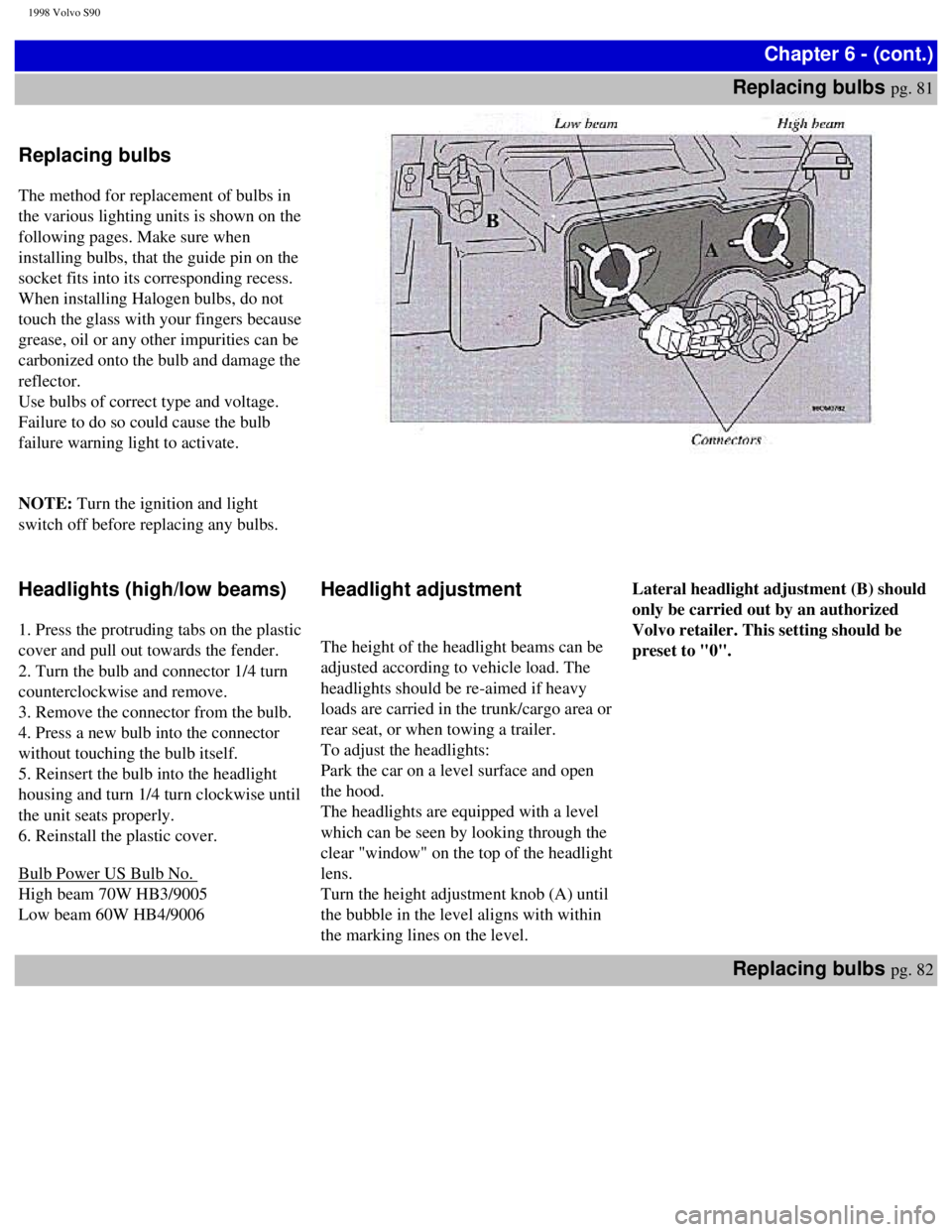
Headlights (high/low beams)
1. Press the protruding tabs on the plastic
cover and pull out towards the fender.
2. Turn the bulb and connector 1/4 turn
counterclockwise and remove.
3. Remove the connector from the bulb.
4. Press a new bulb into the connector
without touching the bulb itself.
5. Reinsert the bulb into the headlight
housing and turn 1/4 turn clockwise until
the unit seats properly.
6. Reinstall the plastic cover.
Bulb Power US Bulb No.
High beam 70W HB3/9005
Low beam 60W HB4/9006
Headlight adjustment
The height of the headlight beams can be
adjusted according to vehicle load. The
headlights should be re-aimed if heavy
loads are carried in the trunk/cargo area or
rear seat, or when towing a trailer.
To adjust the headlights:
Park the car on a level surface and open
the hood.
The headlights are equipped with a level
which can be seen by looking through the
clear "window" on the top of the headlight
lens.
Turn the height adjustment knob (A) until
the bubble in the level aligns with within
the marking lines on the level.
Lateral headlight adjustment (B) should
only be carried out by an authorized
Volvo retailer. This setting should be
preset to "0".
Replacing bulbs pg. 82
file:///K|/ownersdocs/1998/1998_SV90/98S90_081.htm (1 of 6)12/30/2006 \
1:52:45 PM
Page 100 of 175

1998 Volvo S90
compartment.
Location * Amperage
1 Engine control module, Automatic transmission control module 5
2 AC relay 5
3 Relay, air pump, Heated oxygen sensor 15
4 Fuel pump 15
5 Fuel injection, Mass air flow (MAF) sensor, Idle air control system,\
Engine control module 15
6 Automatic transmission control module 15
7 Ignition coil, 25
8 Fog lights 25
9 Spare
10 Positioning/parking lights, left 15
11 Positioning/parking lights, right 15
12 Left high beam 15
13 Right high beam, Instrument panel 15
14 Left low beam 15
15 Right low beam 15
16 A/C compressor 15
17 Horn 15
18 Accessories (see respective accessories instructions)
*Some of the equipment/systems listed may be available on certain models\
only and/or as optional items
only.
Fuses pg. 92
Fuse box in the passenger compartment (Box C)
These fuses generally protect the electrical components in the passenger\
compartment.
The fuses are located inside the cover on the left side of the dash .A n\
umber of spare fuses can also be
found here. Fuses are replaced in the same way as in the relay/fuse box \
in the engine compartment (see
previous page).
file:///K|/ownersdocs/1998/1998_SV90/98S90_089.htm (4 of 9)12/30/2006 \
1:52:46 PM
Page 107 of 175
1998 Volvo S90
Cleaning floor mats
The floor mats should be vacuumed or brushed
clean regularly, especially during the winter when
they should be taken out for drying. Spots on
textile mats can be removed with a mild detergent.
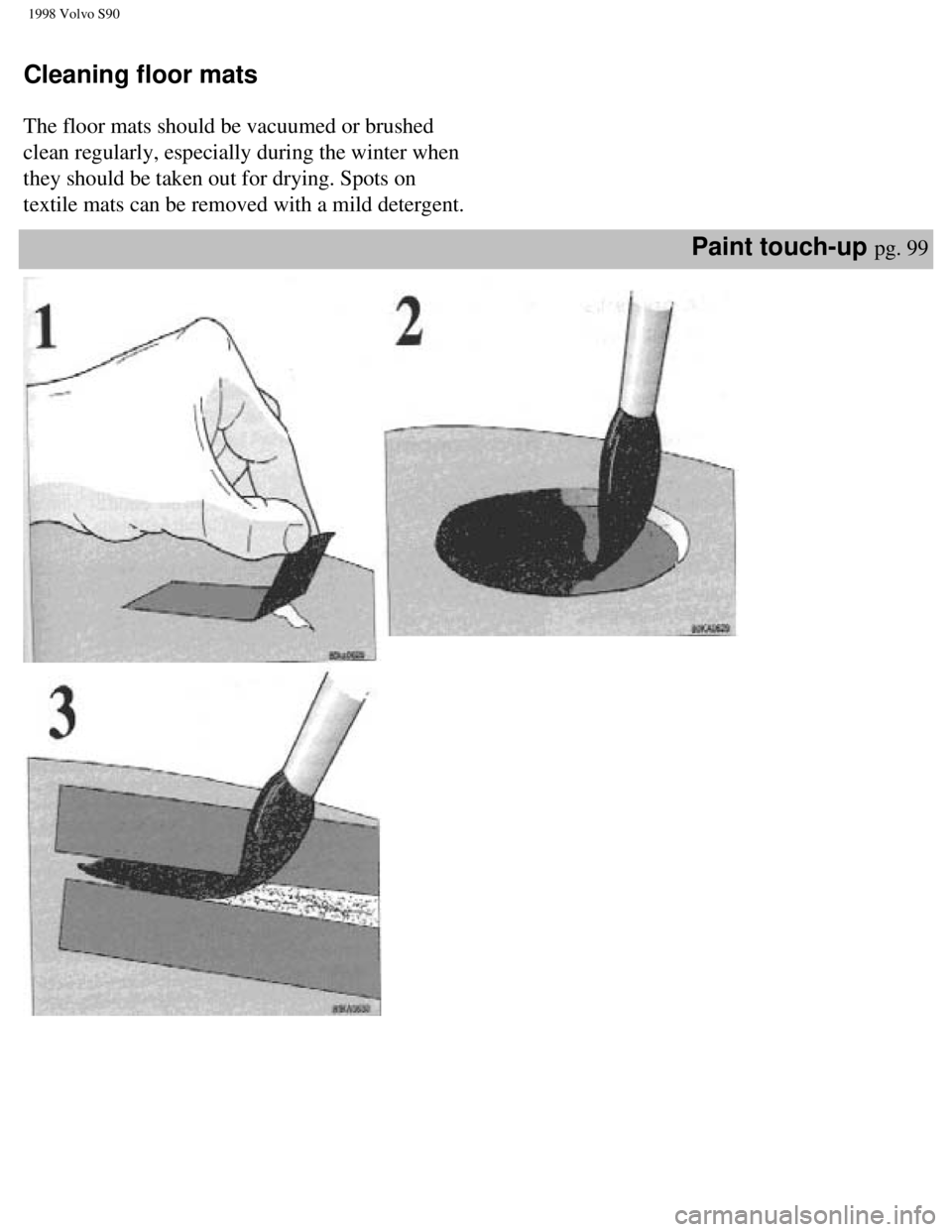
Paint touch-up pg. 99
file:///K|/ownersdocs/1998/1998_SV90/98S90_097.htm (2 of 6)12/30/2006 \
1:52:47 PM
Page 110 of 175

1998 Volvo S90
components or toward the rear side
of the engine.
Automatic car washing, Polishing and waxing, Chromed parts pg. 101
Automatic washing - simple and
quick
An automatic wash is a simple and quick way to
clean your car, but it is worth remembering that it
may not be as thorough as when you go over the
with sponge and water. Keeping the underbody
clean is most important, especially in the winter.
Some automatic washers do not have the facilities
for washing the underbody.
Before driving into an automatic wash, make sure
that the side-view mirrors, auxiliary lamps, etc.,
are secure, otherwise there is risk of the machine
dislodging them. You should also lower the
antenna.
We recommend that you do not wash your car in
an automatic wash during the first six months
(because the paint will not have hardened
sufficiently).
Polishing and waxing
Normally, polishing is not required during the
first year after delivery, however, waxing may be
beneficial.
Before applying polish or wax the car must be
washed and dried. Tar spots can be removed with
kerosene or tar remover. Difficult spots may
require a fine rubbing compound.
After polishing use liquid or paste wax.
Several commercially-available products contain
both polish and wax. Waxing alone does not
substitute for polishing of a dull surface.
Awide range of polymer-based car waxes can be
purchased today. The waxes are easy to use and
produce a long-lasting, high-gloss finish that
protects the bodywork against oxidation, road dirt
and fading.
Chromed parts
Chromium-plated and anodized parts should be
washed with clean water as soon as they become
dirty. This is particularly important if you drive on
gravel roads or on roads where salt is used during
the winter. After the car has been washed, apply
wax or an anti-rust preparation.
Stains on chrome trim can be removed with
commercially-available chrome cleaner. Do not
use abrasive compounds or steel wool.
file:///K|/ownersdocs/1998/1998_SV90/98S90_097.htm (5 of 6)12/30/2006 \
1:52:47 PM
Page 113 of 175
1998 Volvo S90
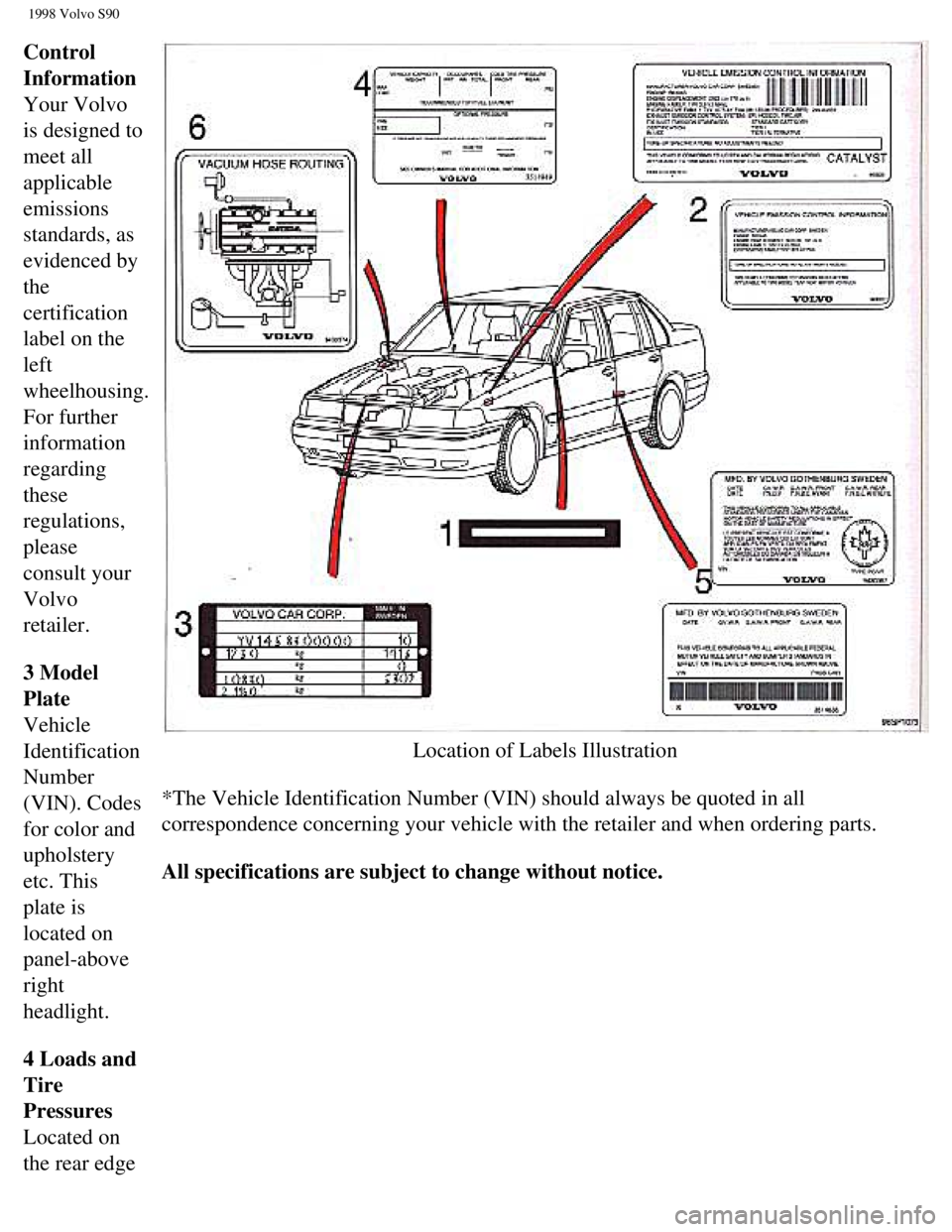
Control
Information
Your Volvo
is designed to
meet all
applicable
emissions
standards, as
evidenced by
the
certification
label on the
left
wheelhousing.
For further
information
regarding
these
regulations,
please
consult your
Volvo
retailer.
3 Model
Plate
Vehicle
Identification
Number
(VIN). Codes
for color and
upholstery
etc. This
plate is
located on
panel-above
right
headlight.
4 Loads and
Tire
Pressures
Located on
the rear edge
Location of Labels Illustration
*The Vehicle Identification Number (VIN) should always be quoted in al\
l
correspondence concerning your vehicle with the retailer and when orderi\
ng parts.
All specifications are subject to change without notice.
file:///K|/ownersdocs/1998/1998_SV90/98S90_103.htm (2 of 7)12/30/2006 \
1:52:48 PM
Page 119 of 175
1998 Volvo S90
Chapter 8 - (cont.)Engine oil
pg. 108
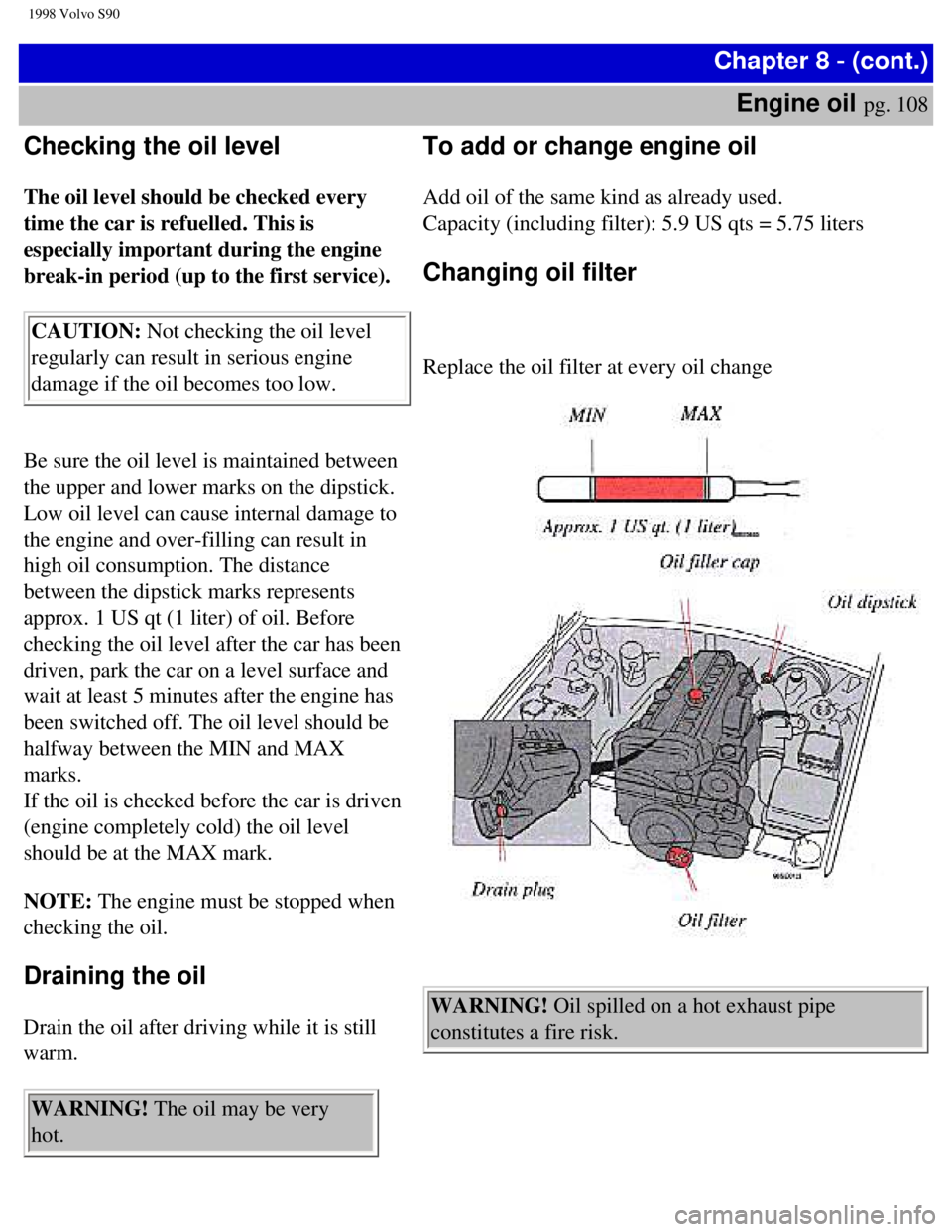
Checking the oil level
The oil level should be checked every
time the car is refuelled. This is
especially important during the engine
break-in period (up to the first service).
CAUTION: Not checking the oil level
regularly can result in serious engine
damage if the oil becomes too low.
Be sure the oil level is maintained between
the upper and lower marks on the dipstick.
Low oil level can cause internal damage to
the engine and over-filling can result in
high oil consumption. The distance
between the dipstick marks represents
approx. 1 US qt (1 liter) of oil. Before
checking the oil level after the car has been
driven, park the car on a level surface and
wait at least 5 minutes after the engine has
been switched off. The oil level should be
halfway between the MIN and MAX
marks.
If the oil is checked before the car is driven
(engine completely cold) the oil level
should be at the MAX mark.
NOTE: The engine must be stopped when
checking the oil.
Draining the oil
Drain the oil after driving while it is still
warm.
WARNING! The oil may be very
hot.
To add or change engine oil
Add oil of the same kind as already used.
Capacity (including filter): 5.9 US qts = 5.75 liters
Changing oil filter
Replace the oil filter at every oil change
WARNING! Oil spilled on a hot exhaust pipe
constitutes a fire risk.
file:///K|/ownersdocs/1998/1998_SV90/98S90_108.htm (1 of 6)12/30/2006 \
1:52:49 PM
Page 126 of 175
1998 Volvo S90
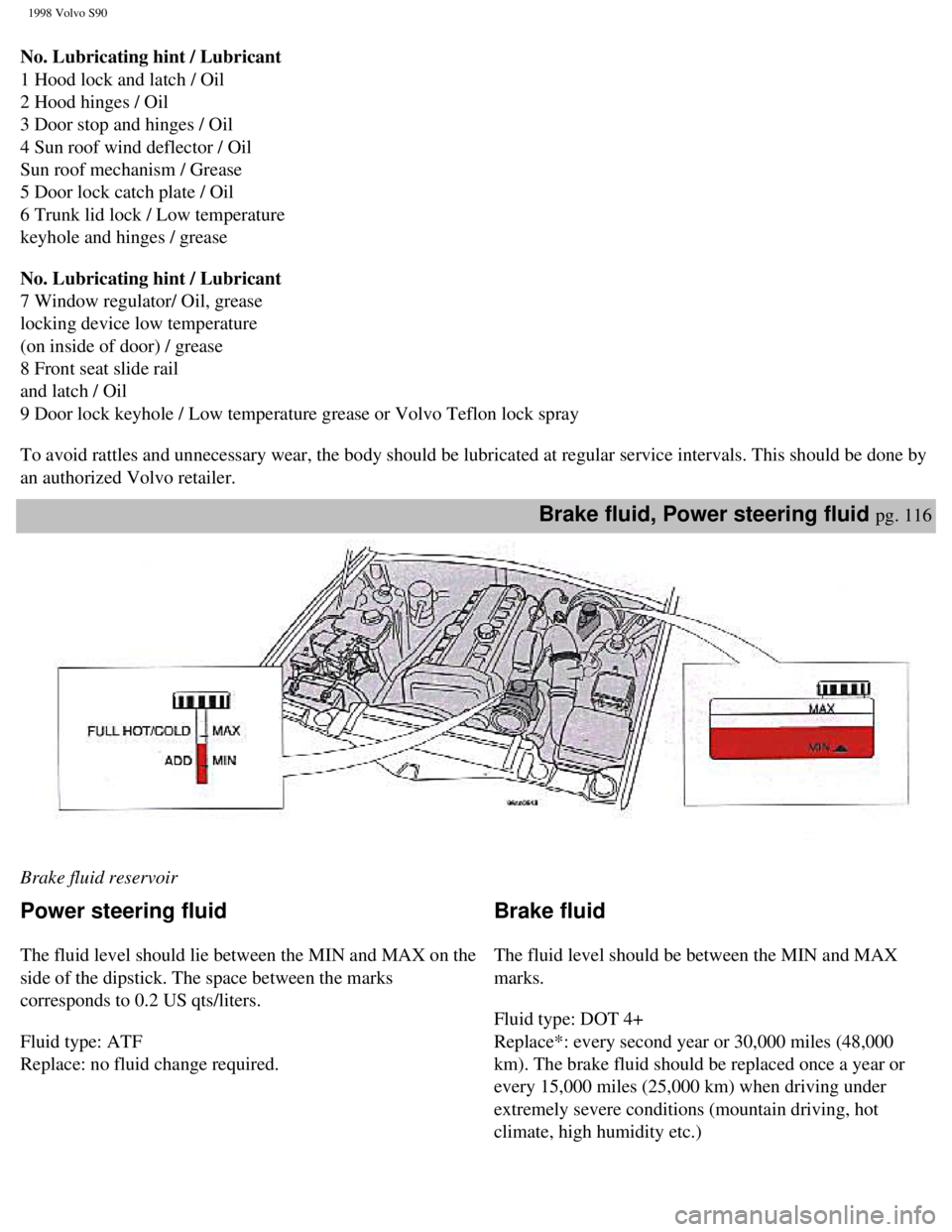
No. Lubricating hint / Lubricant
1 Hood lock and latch / Oil
2 Hood hinges / Oil
3 Door stop and hinges / Oil
4 Sun roof wind deflector / Oil
Sun roof mechanism / Grease
5 Door lock catch plate / Oil
6 Trunk lid lock / Low temperature
keyhole and hinges / grease
No. Lubricating hint / Lubricant
7 Window regulator/ Oil, grease
locking device low temperature
(on inside of door) / grease
8 Front seat slide rail
and latch / Oil
9 Door lock keyhole / Low temperature grease or Volvo Teflon lock spray \
To avoid rattles and unnecessary wear, the body should be lubricated at \
regular service intervals. This should be done by
an authorized Volvo retailer.
Brake fluid, Power steering fluid pg. 116
Brake fluid reservoir
Power steering fluid
The fluid level should lie between the MIN and MAX on the
side of the dipstick. The space between the marks
corresponds to 0.2 US qts/liters.
Fluid type: ATF
Replace: no fluid change required.Brake fluid
The fluid level should be between the MIN and MAX
marks.
Fluid type: DOT 4+
Replace*: every second year or 30,000 miles (48,000
km). The brake fluid should be replaced once a year or
every 15,000 miles (25,000 km) when driving under
extremely severe conditions (mountain driving, hot
climate, high humidity etc.)
file:///K|/ownersdocs/1998/1998_SV90/98S90_114.htm (2 of 5)12/30/2006 \
1:52:50 PM
Page 145 of 175
1998 Volvo S90
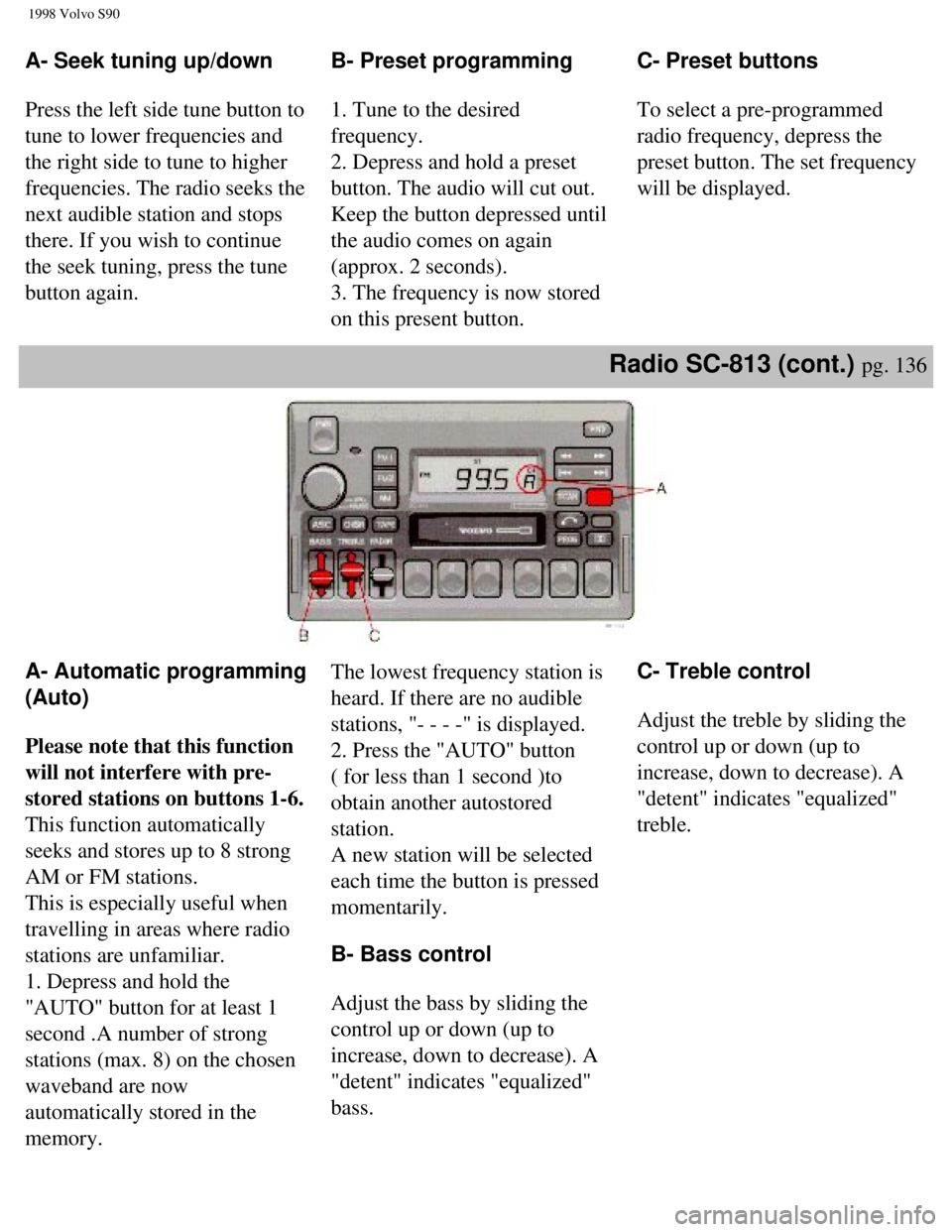
A- Seek tuning up/down
Press the left side tune button to
tune to lower frequencies and
the right side to tune to higher
frequencies. The radio seeks the
next audible station and stops
there. If you wish to continue
the seek tuning, press the tune
button again. B- Preset programming
1. Tune to the desired
frequency.
2. Depress and hold a preset
button. The audio will cut out.
Keep the button depressed until
the audio comes on again
(approx. 2 seconds).
3. The frequency is now stored
on this present button. C- Preset buttons
To select a pre-programmed
radio frequency, depress the
preset button. The set frequency
will be displayed.
Radio SC-813 (cont.) pg. 136
A- Automatic programming
(Auto)
Please note that this function
will not interfere with pre-
stored stations on buttons 1-6.
This function automatically
seeks and stores up to 8 strong
AM or FM stations.
This is especially useful when
travelling in areas where radio
stations are unfamiliar.
1. Depress and hold the
"AUTO" button for at least 1
second .A number of strong
stations (max. 8) on the chosen
waveband are now
automatically stored in the
memory.The lowest frequency station is
heard. If there are no audible
stations, "- - - -" is displayed.
2. Press the "AUTO" button
( for less than 1 second )to
obtain another autostored
station.
A new station will be selected
each time the button is pressed
momentarily.
B- Bass control
Adjust the bass by sliding the
control up or down (up to
increase, down to decrease). A
"detent" indicates "equalized"
bass.
C- Treble control
Adjust the treble by sliding the
control up or down (up to
increase, down to decrease). A
"detent" indicates "equalized"
treble.
file:///K|/ownersdocs/1998/1998_SV90/98S90_131.htm (5 of 6)12/30/2006 \
1:52:52 PM