automatic transmission VOLVO V90 1998 User Guide
[x] Cancel search | Manufacturer: VOLVO, Model Year: 1998, Model line: V90, Model: VOLVO V90 1998Pages: 175, PDF Size: 4.45 MB
Page 73 of 175
1998 Volvo S90
Chapter 4 (cont)
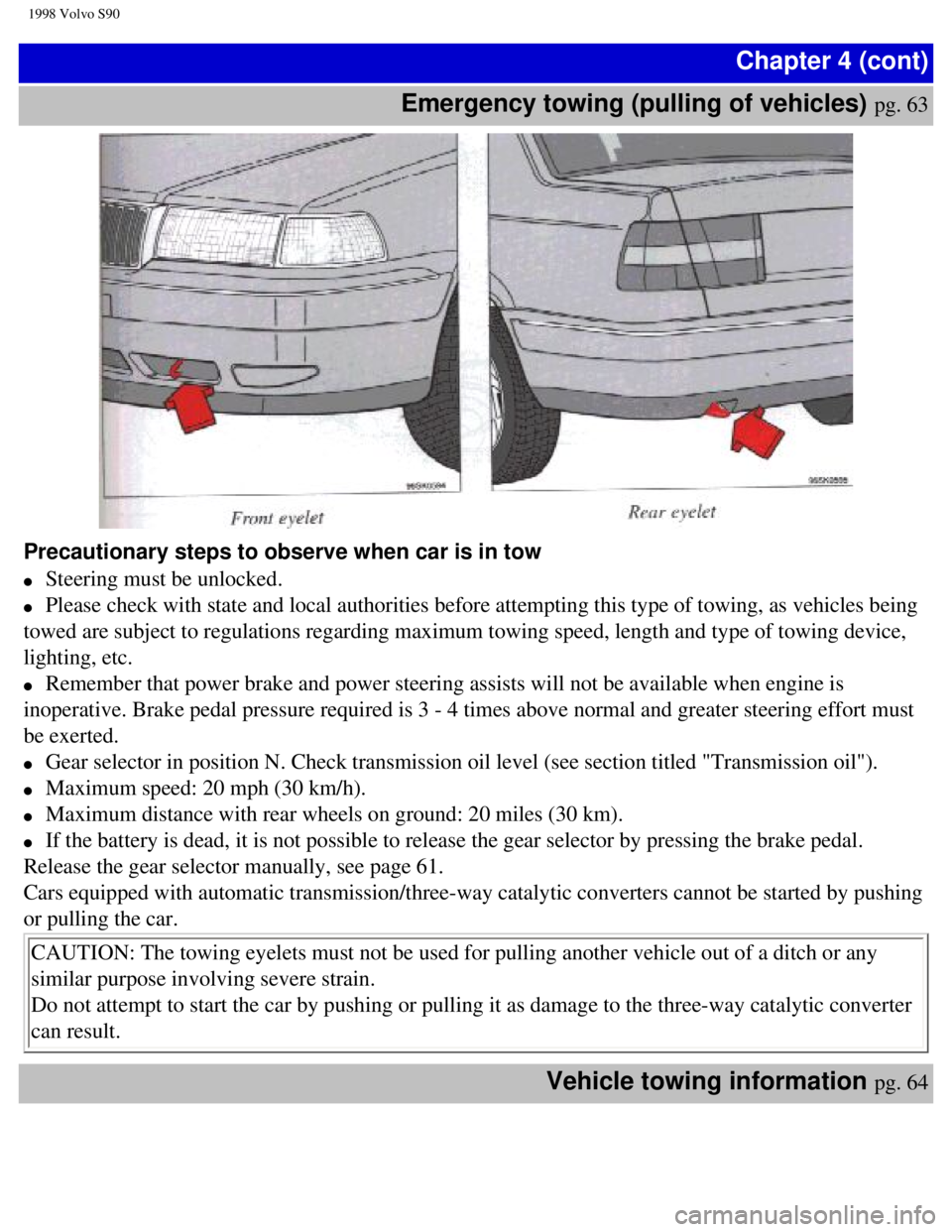
Emergency towing (pulling of vehicles)
pg. 63
Precautionary steps to observe when car is in tow
l Steering must be unlocked.
l Please check with state and local authorities before attempting this typ\
e of towing, as vehicles being
towed are subject to regulations regarding maximum towing speed, length \
and type of towing device,
lighting, etc.
l Remember that power brake and power steering assists will not be availab\
le when engine is
inoperative. Brake pedal pressure required is 3 - 4 times above normal a\
nd greater steering effort must
be exerted.
l Gear selector in position N. Check transmission oil level (see section \
titled "Transmission oil").
l Maximum speed: 20 mph (30 km/h).
l Maximum distance with rear wheels on ground: 20 miles (30 km).
l If the battery is dead, it is not possible to release the gear selector \
by pressing the brake pedal.
Release the gear selector manually, see page 61.
Cars equipped with automatic transmission/three-way catalytic converters\
cannot be started by pushing
or pulling the car.
CAUTION: The towing eyelets must not be used for pulling another vehicle\
out of a ditch or any
similar purpose involving severe strain.
Do not attempt to start the car by pushing or pulling it as damage to th\
e three-way catalytic converter
can result.
Vehicle towing information pg. 64
file:///K|/ownersdocs/1998/1998_SV90/98S90_063.htm (1 of 4)12/30/2006 \
1:52:43 PM
Page 78 of 175
1998 Volvo S90
function) and the vehicle should
be driven to a Volvo retailer for
inspection.
The Anti-lock Braking System
(ABS) helps to improve vehicle
control (stopping and steering)
during severe braking conditions
by limiting brake lock-up. When
the system "senses" impending
lock-up, braking pressure is
automatically modulated in
order to help prevent lockup,
which could lead to a skid. brake application feels normal.
This should also be done after
washing or starting in very damp
or cold weather.
Trailer towing pg. 68
When preparing for
trailer towing, observe
the following:
l Volvo recommends the use of
Volvo trailer hitches which are
specially designed for the car.
For trailer weights exceeding
2000 lbs. (908 kg), use only a
trailer hitch offered as a
Genuine Volvo accessory.
NOTE: Models with automatic
transmission are equipped with
a transmission oil cooler as
standard equipment. This cooler
helps prevent overheating of the
transmission during times of
increased load, as when towing
a trailer.
l Maximum trailer weight
recommended by Volvo is:
Trailers without brakes: 1100
lbs (500kg)
Trailers with brakes: 2" ball -
3300 lbs (1500 kg), 1 7/8" ball -
2000 lbs (908 kg).
WARNING! Never connect a
trailer's hydraulic brake
system directly to the vehicle
brake system, nor a trailer's
lighting system directly to the
vehicle lighting system.
Consult your nearest
authorized Volvo retailer for
correct installation.
All Volvo models are equipped
with energy-absorbing shock-
mounted bumpers. Trailer hitch
installation should not interfere
with the proper operation of this
bumper system. Trailer towing
does not normally present any
particular problems, but take
into consideration:
l Recommended hitch tongue
load is 110 lbs (50 kgs) for
trailer weights below 2,650 lbs
(1,200 kgs) and 165 lbs (75 kgs)
for trailer weights above 2,650
lbs (1,200 kgs).
l For trailer weights between
2,650-3,300 lbs (1,200-1,500
l Avoid overload and other
abusive operation.
l Hauling a trailer affects
handling, durability, and
economy.
l It is necessary to balance
trailer brakes with the towing
vehicle brakes to provide a safe
stop (check and observe State/
Local regulations).
l Do not connect the trailer's
brake system directly to the
vehicle's brake system.
l More frequent vehicle
maintenance is required.
l Remove the ball and drawbar
assembly when the hitch is not
being used.
l Volvo recommends the use of
synthetic engine oil when towing
a trailer over long distances or in
mountainous areas.
l The trailer hitch tongue load
(110/165 lbs - 50/75 kg) is part
of the vehicle's capacity weight.
It may be necessary to reduce the
trunk/cargo area load when
file:///K|/ownersdocs/1998/1998_SV90/98S90_067.htm (2 of 5)12/30/2006 \
1:52:43 PM
Page 79 of 175
1998 Volvo S90
Observe legal requirements of
the state in which the vehicles
are registered.
WARNING! Bumper-
attached trailer hitches must
not be used on Volvos, nor
should safety chains be
attached to the bumper.
Trailer hitches attaching to
the vehicle rear axle must
not be used. kgs) a top speed of 50 mph (80
km/h) should never be
exceeded.
l Increase tire pressure to
recommended full-load
pressure. See section "Wheels
and tires".
l Engine and transmission are
subject to increased loads.
Therefore, engine coolant
temperature should be closely
watched when driving in hot
climates or hilly terrain. Use
lower gear and turn off air
conditioner if temperature gauge
pointer enters the red range.
towing a trailer to ensure that the
max. permissible axle load or
gross vehicle weight are not
exceeded.
NOTE: Refer to section
"Automatic transmission" for
additional trailer hauling tips.
Winter driving pg. 69
Cold weather precautions
l If you wish to check your car before the
approach of cold weather, the following advice is
worth noting:
Make sure that the engine coolant contains at least
50 percent antifreeze: that is, 5.3 qts. (5 liters)
Volvo Genuine Coolant/Antifreeze. This gives
protection against freezing down to -31°F (-35°
C). See section "Coolant".
The use of "recycled" antifreeze is not approved
by Volvo. Different types of antifreeze may not be
mixed.
l Try to keep the fuel tank well filled - this
prevents the formation of condensation in the
tank.
In addition in extremely cold weather conditions it
is worthwhile to add fuel line de-icer before
refueling.
l The viscosity of the engine oil is important. Oil
with low viscosity (thinner oil) improves cold-
weather starting as well as decreasing fuel
consumption while the engine is warming up. For
winter use, 5W-30 oil, particularly the synthetic
type, is recommended.
Be sure to use good quality oil but do not use this
l The Volvo Washer Solvent should be diluted as
follows:
Down to 14°F (-10°C): 1 part anti-freeze and 4
parts water
Down to 5°F (-15°C): 1 part anti-freeze and 3
parts water
Down to 0°F (-18°C): 1 part anti-freeze and 2
parts water
Down to -18°F (-28°): 1 part anti-freeze and 1
part water
l Use lock spray or grease in the locks.
NOTE: Avoid the use of de-icing spray as they
can cause damage to the locks.
Automatic differential lock (certain
models)
The differential automatically locks at speed
between 3 - 25 mph (5 - 40 km/h) if either of the
drive wheels begins to lose traction. The
differential lock improves power distribution to
the drive wheels in slippery conditions, shifting
power to the wheel with best traction. It also
file:///K|/ownersdocs/1998/1998_SV90/98S90_067.htm (3 of 5)12/30/2006 \
1:52:43 PM
Page 88 of 175

1998 Volvo S90
Changing a wheel
On sedans the spare wheel, jack and toolbag are located in the trunk, be\
neath the carpet. The jack must be completely retracted to fit into the holder.
On wagons, the spare tire and the jack are located beneath the floor mat\
in the large storage bin. Always secure the spare tire and the jack to prevent them from rattling.
l Remove the wheel cap, using the screwdriver in the tool kit.
l With the car still on the ground, use the box wrench from the tool kit t\
o loosen the wheel nuts 1/2 - 1 turn. Turn the nuts counterclockwise to loosen.
NOTE:
To avoid excessive wear and the necessity of rebalancing, mark and reins\
tall wheels in same location and position as before removal. To lessen the chance of imbalance, each
wheel hub is equipped with a guide stud to ensure that a removed wheel c\
an be reinstalled in its original position (as when changing over to winter tires/wheels).
Wheel changing (cont.) pg. 79
WARNING!
l The jack attachment must engage the bar in the jack attachment (A). Th\
e car's weight must not rest on the jack's attachment (B).
l Be sure the jack is on a firm, level, non-slippery surface.
l Never allow any part of your body to be extended under a car supported b\
y a jack.
l Use the jack intended for the car when replacing a wheel. For any other \
job, use stands to support the end of the car being worked
on.
l Apply the parking brake, select position P (automatic transmission). \
l Block the wheels standing on the ground. Use rigid wooden blocks or larg\
e stones.
l The jack should be kept well-greased.
file:///K|/ownersdocs/1998/1998_SV90/98S90_077.htm (2 of 4)12/30/2006 \
1:52:45 PM
Page 100 of 175

1998 Volvo S90
compartment.
Location * Amperage
1 Engine control module, Automatic transmission control module 5
2 AC relay 5
3 Relay, air pump, Heated oxygen sensor 15
4 Fuel pump 15
5 Fuel injection, Mass air flow (MAF) sensor, Idle air control system,\
Engine control module 15
6 Automatic transmission control module 15
7 Ignition coil, 25
8 Fog lights 25
9 Spare
10 Positioning/parking lights, left 15
11 Positioning/parking lights, right 15
12 Left high beam 15
13 Right high beam, Instrument panel 15
14 Left low beam 15
15 Right low beam 15
16 A/C compressor 15
17 Horn 15
18 Accessories (see respective accessories instructions)
*Some of the equipment/systems listed may be available on certain models\
only and/or as optional items
only.
Fuses pg. 92
Fuse box in the passenger compartment (Box C)
These fuses generally protect the electrical components in the passenger\
compartment.
The fuses are located inside the cover on the left side of the dash .A n\
umber of spare fuses can also be
found here. Fuses are replaced in the same way as in the relay/fuse box \
in the engine compartment (see
previous page).
file:///K|/ownersdocs/1998/1998_SV90/98S90_089.htm (4 of 9)12/30/2006 \
1:52:46 PM
Page 116 of 175
 I= Inspect (Correct or Replace if ne\
cessary)
R= Replace L= Lubricate
Maintenance Operation thousand
miles
(thousand km")
1998 Volvo S90
Maintenance schedule
A= Adjust (Correct if necessary) I= Inspect (Correct or Replace if ne\
cessary)
R= Replace L= Lubricate
Maintenance Operation thousand
miles
(thousand km) 5
(8)
10
(16) 15
(25) 20
(32) 25
(40) 30
(48) 35
(56) 40
(64) 45
(72) 50
(80) 55
(88) 60
(96)
EMISSION SYSTEM
MAINTENANCE
Engine oil and filter R R R R R R R R R R R R
Engine drive belt (accessory belt) I R
Air cleaner filter R R
Spark plugs R R
Automatic transmission fluid I I I I I I
Timing belt - B 6304 S
4
1) See section "Engine oil" for detailed information.
NOTE: The oil should be changed at these intervals or after 750 hours of\
driving or after 12 months
which ever occurs first. See "Service Reminder indicator", page 19.
2) For services beyond 60,000 miles (96,000 km), consult your "Mainte\
nance Records booklet".
3) These intervals may apply, depending on actual driving conditions (\
see page 109 for details)
4) For proper functioning of the vehicle and its emission control syste\
m, Volvo recommends that the
file:///K|/ownersdocs/1998/1998_SV90/98S90_103.htm (5 of 7)12/30/2006 \
1:52:48 PM
Page 131 of 175
1998 Volvo S90
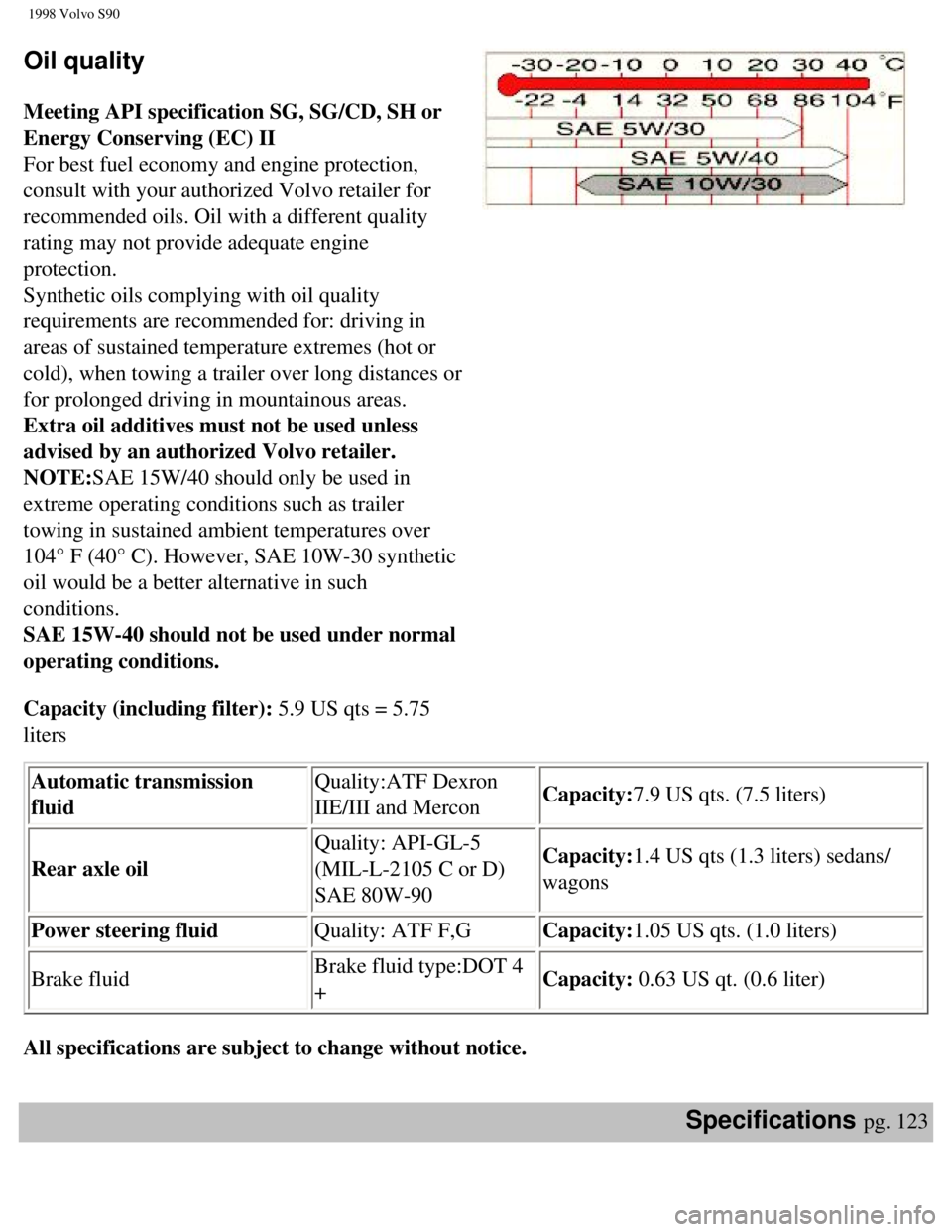
Oil quality
Meeting API specification SG, SG/CD, SH or
Energy Conserving (EC) II
For best fuel economy and engine protection,
consult with your authorized Volvo retailer for
recommended oils. Oil with a different quality
rating may not provide adequate engine
protection.
Synthetic oils complying with oil quality
requirements are recommended for: driving in
areas of sustained temperature extremes (hot or
cold), when towing a trailer over long distances or
for prolonged driving in mountainous areas.
Extra oil additives must not be used unless
advised by an authorized Volvo retailer.
NOTE:SAE 15W/40 should only be used in
extreme operating conditions such as trailer
towing in sustained ambient temperatures over
104° F (40° C). However, SAE 10W-30 synthetic
oil would be a better alternative in such
conditions.
SAE 15W-40 should not be used under normal
operating conditions.
Capacity (including filter): 5.9 US qts = 5.75
liters
Automatic transmission
fluid Quality:ATF Dexron
IIE/III and Mercon
Capacity:7.9 US qts. (7.5 liters)
Rear axle oil Quality: API-GL-5
(MIL-L-2105 C or D)
SAE 80W-90Capacity:1.4 US qts (1.3 liters) sedans/
wagons
Power steering fluid Quality: ATF F,GCapacity:1.05 US qts. (1.0 liters)
Brake fluid Brake fluid type:DOT 4
+Capacity: 0.63 US qt. (0.6 liter)
All specifications are subject to change without notice.
Specifications pg. 123
file:///K|/ownersdocs/1998/1998_SV90/98S90_121.htm (2 of 4)12/30/2006 \
1:52:50 PM
Page 134 of 175
1998 Volvo S90
Chapter 9 - (cont.)
Specifications
pg. 125
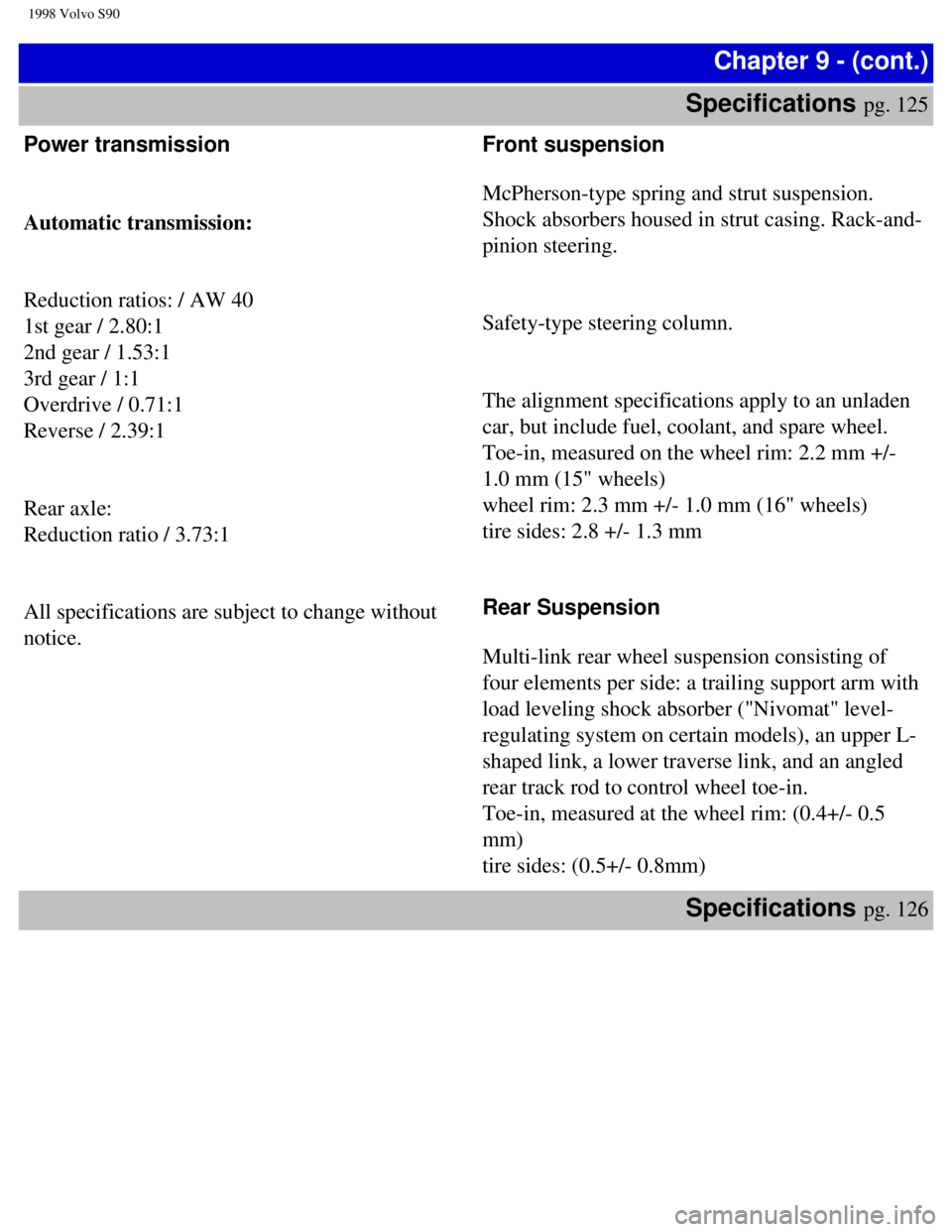
Power transmission
Automatic transmission:
Reduction ratios: / AW 40
1st gear / 2.80:1
2nd gear / 1.53:1
3rd gear / 1:1
Overdrive / 0.71:1
Reverse / 2.39:1
Rear axle:
Reduction ratio / 3.73:1
All specifications are subject to change without
notice. Front suspension
McPherson-type spring and strut suspension.
Shock absorbers housed in strut casing. Rack-and-
pinion steering.
Safety-type steering column.
The alignment specifications apply to an unladen
car, but include fuel, coolant, and spare wheel.
Toe-in, measured on the wheel rim: 2.2 mm +/-
1.0 mm (15" wheels)
wheel rim: 2.3 mm +/- 1.0 mm (16" wheels)
tire sides: 2.8 +/- 1.3 mm
Rear Suspension
Multi-link rear wheel suspension consisting of
four elements per side: a trailing support arm with
load leveling shock absorber ("Nivomat" level-
regulating system on certain models), an upper L-
shaped link, a lower traverse link, and an angled
rear track rod to control wheel toe-in.
Toe-in, measured at the wheel rim: (0.4+/- 0.5
mm)
tire sides: (0.5+/- 0.8mm)
Specifications pg. 126
file:///K|/ownersdocs/1998/1998_SV90/98S90_125.htm (1 of 7)12/30/2006 \
1:52:51 PM
Page 137 of 175
1998 Volvo S90
Ashtray rear 1.2 W Volvo P/
N966326 1
Seat belt lock 1.2 W Volvo P/
N966326 1
Instrument
warning/
indicator lights 1.2 W Volvo P/
N966326 –
All specifications are subject to change without
notice
Specifications pg. 127
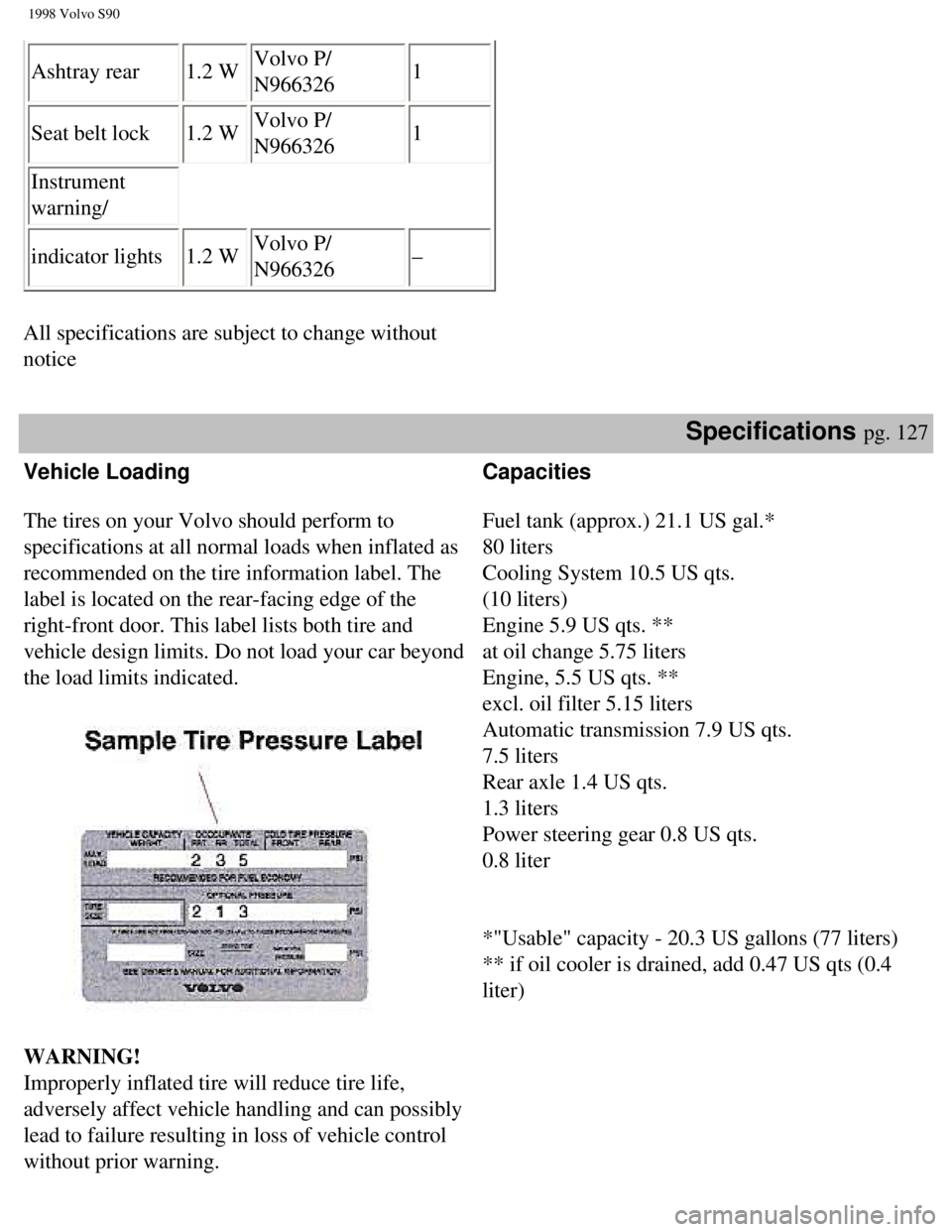
Vehicle Loading
The tires on your Volvo should perform to
specifications at all normal loads when inflated as
recommended on the tire information label. The
label is located on the rear-facing edge of the
right-front door. This label lists both tire and
vehicle design limits. Do not load your car beyond
the load limits indicated.
WARNING!
Improperly inflated tire will reduce tire life,
adversely affect vehicle handling and can possibly
lead to failure resulting in loss of vehicle control
without prior warning.
Capacities
Fuel tank (approx.) 21.1 US gal.*
80 liters
Cooling System 10.5 US qts.
(10 liters)
Engine 5.9 US qts. **
at oil change 5.75 liters
Engine, 5.5 US qts. **
excl. oil filter 5.15 liters
Automatic transmission 7.9 US qts.
7.5 liters
Rear axle 1.4 US qts.
1.3 liters
Power steering gear 0.8 US qts.
0.8 liter
*"Usable" capacity - 20.3 US gallons (77 liters)
** if oil cooler is drained, add 0.47 US qts (0.4
liter)
file:///K|/ownersdocs/1998/1998_SV90/98S90_125.htm (4 of 7)12/30/2006 \
1:52:51 PM