engine oil VOLVO V90 1998 User Guide
[x] Cancel search | Manufacturer: VOLVO, Model Year: 1998, Model line: V90, Model: VOLVO V90 1998Pages: 175, PDF Size: 4.45 MB
Page 79 of 175
1998 Volvo S90
Observe legal requirements of
the state in which the vehicles
are registered.
WARNING! Bumper-
attached trailer hitches must
not be used on Volvos, nor
should safety chains be
attached to the bumper.
Trailer hitches attaching to
the vehicle rear axle must
not be used. kgs) a top speed of 50 mph (80
km/h) should never be
exceeded.
l Increase tire pressure to
recommended full-load
pressure. See section "Wheels
and tires".
l Engine and transmission are
subject to increased loads.
Therefore, engine coolant
temperature should be closely
watched when driving in hot
climates or hilly terrain. Use
lower gear and turn off air
conditioner if temperature gauge
pointer enters the red range.
towing a trailer to ensure that the
max. permissible axle load or
gross vehicle weight are not
exceeded.
NOTE: Refer to section
"Automatic transmission" for
additional trailer hauling tips.
Winter driving pg. 69
Cold weather precautions
l If you wish to check your car before the
approach of cold weather, the following advice is
worth noting:
Make sure that the engine coolant contains at least
50 percent antifreeze: that is, 5.3 qts. (5 liters)
Volvo Genuine Coolant/Antifreeze. This gives
protection against freezing down to -31°F (-35°
C). See section "Coolant".
The use of "recycled" antifreeze is not approved
by Volvo. Different types of antifreeze may not be
mixed.
l Try to keep the fuel tank well filled - this
prevents the formation of condensation in the
tank.
In addition in extremely cold weather conditions it
is worthwhile to add fuel line de-icer before
refueling.
l The viscosity of the engine oil is important. Oil
with low viscosity (thinner oil) improves cold-
weather starting as well as decreasing fuel
consumption while the engine is warming up. For
winter use, 5W-30 oil, particularly the synthetic
type, is recommended.
Be sure to use good quality oil but do not use this
l The Volvo Washer Solvent should be diluted as
follows:
Down to 14°F (-10°C): 1 part anti-freeze and 4
parts water
Down to 5°F (-15°C): 1 part anti-freeze and 3
parts water
Down to 0°F (-18°C): 1 part anti-freeze and 2
parts water
Down to -18°F (-28°): 1 part anti-freeze and 1
part water
l Use lock spray or grease in the locks.
NOTE: Avoid the use of de-icing spray as they
can cause damage to the locks.
Automatic differential lock (certain
models)
The differential automatically locks at speed
between 3 - 25 mph (5 - 40 km/h) if either of the
drive wheels begins to lose traction. The
differential lock improves power distribution to
the drive wheels in slippery conditions, shifting
power to the wheel with best traction. It also
file:///K|/ownersdocs/1998/1998_SV90/98S90_067.htm (3 of 5)12/30/2006 \
1:52:43 PM
Page 80 of 175
1998 Volvo S90
cold-weather oil for hard driving or in warm
weather. See section "Engine oil" for more
information.
l The load placed on the battery is greater during
the winter since the heater, windshield wipers,
lighting etc. are used more often. Moreover, the
capacity of the battery decreases as the
temperature drops. In very cold weather, a poorly
charged battery can freeze and be damaged. It is
therefore advisable to check the state of charge
more frequently and spray an anti-rust oil on the
battery posts.
l Volvo recommends the use of snow tires on all
four wheels for winter driving - see section
"Wheels and tires".
l To prevent the washer reservoir from freezing,
add washer solvents containing antifreeze. This is
important since dirt is often splashed on the
windshield during winter driving, thus requiring
frequent use of the washers and wipers.
functions when the transmission is in reverse.
Also see "Winter/Wet" mode on page 59.
Winter/Wet mode
Enhanced Vehicle Traction
This mode may be selected for starting/moving
off on slippery roads or to lower downshift speeds
if the transmission is in "L".
Mode W
*In position D, the gearbox starts in third gear and
changes up to fourth gear.
*In position 3, second gear is locked and there is
no change up to third gear. In position L, first gear
is locked.
*These positions always offer the kick-down
feature.
Long distance trip pg. 70
Before a long distance trip
It is always worthwhile to have your car checked at a Volvo retailer
before driving long distances. Your retailer will also be able to supply\
you with bulbs, fuses, spark plugs and wiper blades for your use in the \
event that problems occur.
If you prefer to check the car yourself, please note the following:
l Check that the engine runs smoothly and that fuel consumption is
normal.
l Check engine oil, coolant levels, and for possible fuel leakage.
l Check transmission oil level and rear axle for leakage.
l Check condition of drive belts.
l Check state of charge of battery.
l Examine tires carefully (the spare tire as well), and replace those
that are worn. Check tire pressures.
l The brakes, front wheel alignment, and steering gear should be
checked by your Volvo retailer only.
l Check all lights, including high beams.
file:///K|/ownersdocs/1998/1998_SV90/98S90_067.htm (4 of 5)12/30/2006 \
1:52:43 PM
Page 100 of 175

1998 Volvo S90
compartment.
Location * Amperage
1 Engine control module, Automatic transmission control module 5
2 AC relay 5
3 Relay, air pump, Heated oxygen sensor 15
4 Fuel pump 15
5 Fuel injection, Mass air flow (MAF) sensor, Idle air control system,\
Engine control module 15
6 Automatic transmission control module 15
7 Ignition coil, 25
8 Fog lights 25
9 Spare
10 Positioning/parking lights, left 15
11 Positioning/parking lights, right 15
12 Left high beam 15
13 Right high beam, Instrument panel 15
14 Left low beam 15
15 Right low beam 15
16 A/C compressor 15
17 Horn 15
18 Accessories (see respective accessories instructions)
*Some of the equipment/systems listed may be available on certain models\
only and/or as optional items
only.
Fuses pg. 92
Fuse box in the passenger compartment (Box C)
These fuses generally protect the electrical components in the passenger\
compartment.
The fuses are located inside the cover on the left side of the dash .A n\
umber of spare fuses can also be
found here. Fuses are replaced in the same way as in the relay/fuse box \
in the engine compartment (see
previous page).
file:///K|/ownersdocs/1998/1998_SV90/98S90_089.htm (4 of 9)12/30/2006 \
1:52:46 PM
Page 109 of 175
1998 Volvo S90
plenty of water, to avoid scratching.
l Bird droppings: Remove from
paintwork as soon as possible.
Otherwise the finish may be
permanently damaged.
l A detergent can be used to
facilitate the softening of dirt and
oil.
l A water-soluble grease solvent
may be used in cases of sticky dirt.
However, use a washplace equipped
with a drainage separator.
l Dry the car with a clean chamois
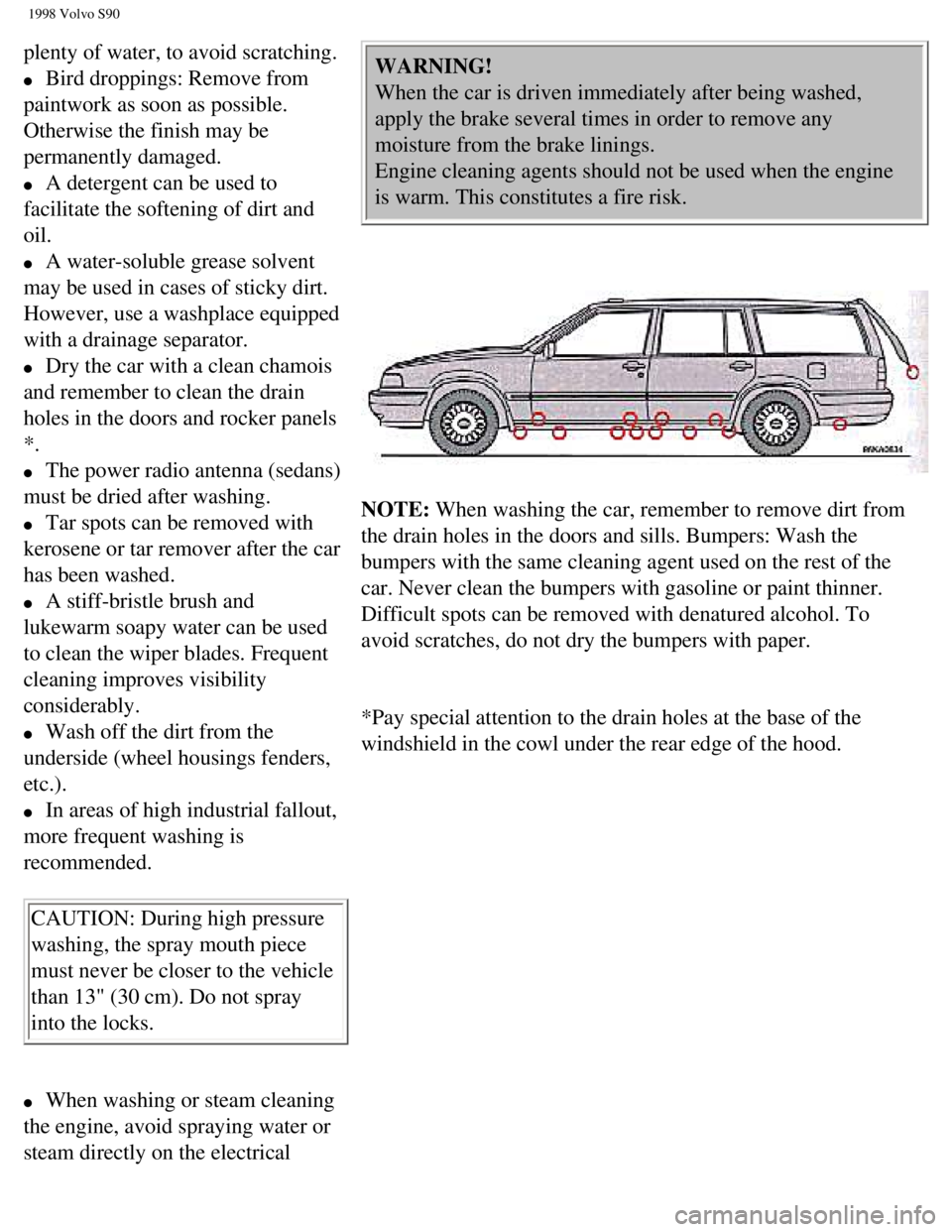
and remember to clean the drain
holes in the doors and rocker panels
*.
l The power radio antenna (sedans)
must be dried after washing.
l Tar spots can be removed with
kerosene or tar remover after the car
has been washed.
l A stiff-bristle brush and
lukewarm soapy water can be used
to clean the wiper blades. Frequent
cleaning improves visibility
considerably.
l Wash off the dirt from the
underside (wheel housings fenders,
etc.).
l In areas of high industrial fallout,
more frequent washing is
recommended.
CAUTION: During high pressure
washing, the spray mouth piece
must never be closer to the vehicle
than 13" (30 cm). Do not spray
into the locks.
l When washing or steam cleaning
the engine, avoid spraying water or
steam directly on the electrical
WARNING!
When the car is driven immediately after being washed,
apply the brake several times in order to remove any
moisture from the brake linings.
Engine cleaning agents should not be used when the engine
is warm. This constitutes a fire risk.
NOTE: When washing the car, remember to remove dirt from
the drain holes in the doors and sills. Bumpers: Wash the
bumpers with the same cleaning agent used on the rest of the
car. Never clean the bumpers with gasoline or paint thinner.
Difficult spots can be removed with denatured alcohol. To
avoid scratches, do not dry the bumpers with paper.
*Pay special attention to the drain holes at the base of the
windshield in the cowl under the rear edge of the hood.
file:///K|/ownersdocs/1998/1998_SV90/98S90_097.htm (4 of 6)12/30/2006 \
1:52:47 PM
Page 112 of 175

1998 Volvo S90
Chapter 8 - Volvo Service
pg. 103
Service - an investment
An investment which will pay dividends in the form of improved reliabili\
ty,
durability, and resale value.
Label information pg. 104
Maintenance service, Warranty pg. 105
Maintenance schedule pg. 106
Engine oil pg. 108
Servicing pg. 110
Fuel/emissions systems pg. 112
Engine compartment pg. 114
Lubrication, body pg. 115
Power steering fluid, brake fluid pg. 116
Drive belt pg. 117
Cooling system pg. 118
Washer fluid reservoir/nozzles pg. 119
Label information
pg. 104
1 Vehicle
Identification
Number
(VIN)*
VIN plate is
located on
top left
surface of
dashboard.
The VIN is
also stamped
on the right
hand door
pillar.
2 Vehicle
Emission
file:///K|/ownersdocs/1998/1998_SV90/98S90_103.htm (1 of 7)12/30/2006 \
1:52:48 PM
Page 116 of 175
 I= Inspect (Correct or Replace if ne\
cessary)
R= Replace L= Lubricate
Maintenance Operation thousand
miles
(thousand km")
1998 Volvo S90
Maintenance schedule
A= Adjust (Correct if necessary) I= Inspect (Correct or Replace if ne\
cessary)
R= Replace L= Lubricate
Maintenance Operation thousand
miles
(thousand km) 5
(8)
10
(16) 15
(25) 20
(32) 25
(40) 30
(48) 35
(56) 40
(64) 45
(72) 50
(80) 55
(88) 60
(96)
EMISSION SYSTEM
MAINTENANCE
Engine oil and filter R R R R R R R R R R R R
Engine drive belt (accessory belt) I R
Air cleaner filter R R
Spark plugs R R
Automatic transmission fluid I I I I I I
Timing belt - B 6304 S
4
1) See section "Engine oil" for detailed information.
NOTE: The oil should be changed at these intervals or after 750 hours of\
driving or after 12 months
which ever occurs first. See "Service Reminder indicator", page 19.
2) For services beyond 60,000 miles (96,000 km), consult your "Mainte\
nance Records booklet".
3) These intervals may apply, depending on actual driving conditions (\
see page 109 for details)
4) For proper functioning of the vehicle and its emission control syste\
m, Volvo recommends that the
file:///K|/ownersdocs/1998/1998_SV90/98S90_103.htm (5 of 7)12/30/2006 \
1:52:48 PM
Page 118 of 175
 Replace at 100,000 miles (160,000 km).
2) Brake fluid should be changed at owner request every second year (o\
nce a year if the car is driven in
mountainous areas or in areas wi")
1998 Volvo S90
1) Replace at 100,000 miles (160,000 km).
2) Brake fluid should be changed at owner request every second year (o\
nce a year if the car is driven in
mountainous areas or in areas with high humidity).
The following items should be checked weekly by the driver (it takes on\
ly a few minutes):
Engine oil level Windshield wipers
Brake fluid level Level of windshield washer fluid
Radiator coolant level
Tire pressure (all five tires)
Operation of all lights
Horns
The following should also be carried out at regular intervals:
Washing
Polishing
Cleaning
Contents | Top of Page
file:///K|/ownersdocs/1998/1998_SV90/98S90_103.htm (7 of 7)12/30/2006 \
1:52:48 PM
Page 119 of 175
1998 Volvo S90
Chapter 8 - (cont.)Engine oil
pg. 108
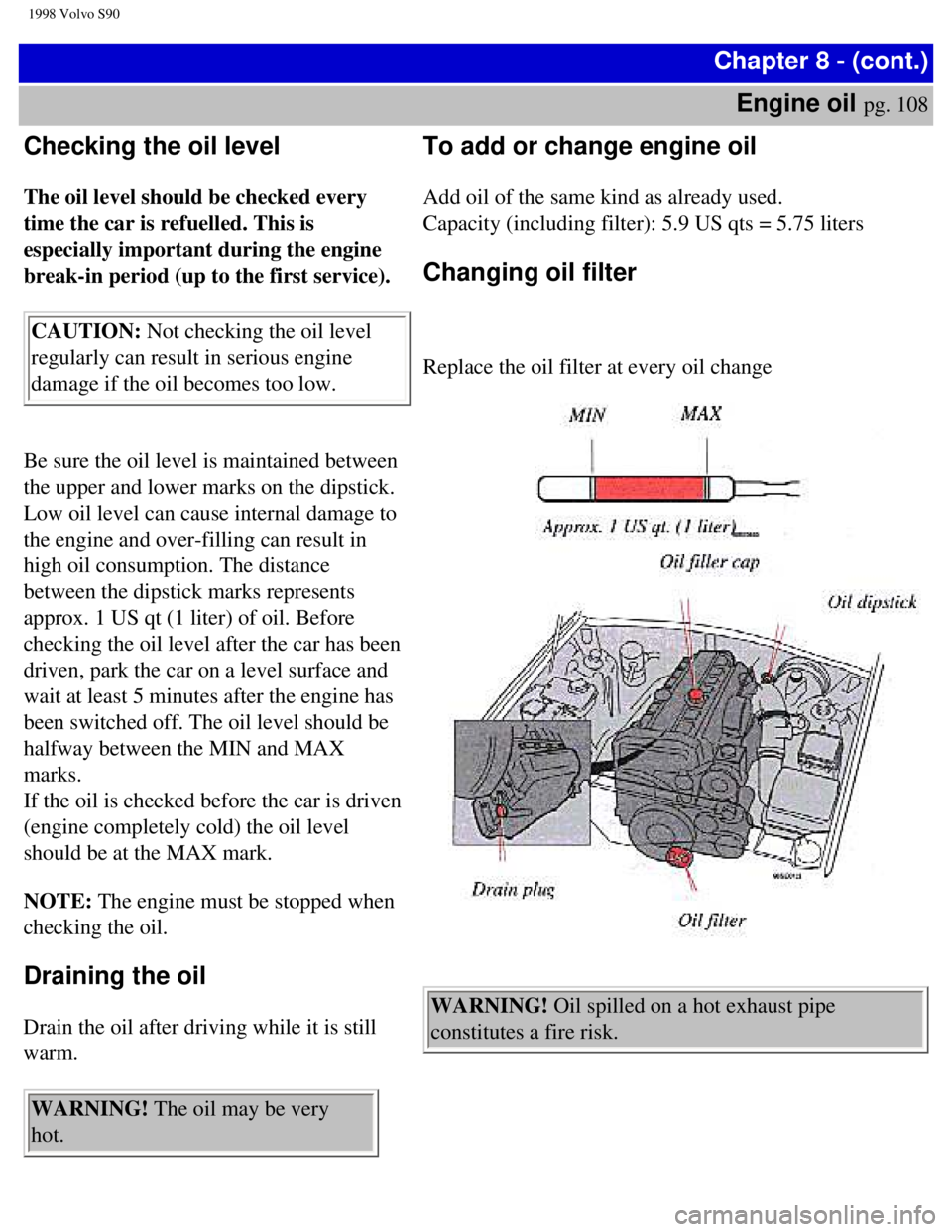
Checking the oil level
The oil level should be checked every
time the car is refuelled. This is
especially important during the engine
break-in period (up to the first service).
CAUTION: Not checking the oil level
regularly can result in serious engine
damage if the oil becomes too low.
Be sure the oil level is maintained between
the upper and lower marks on the dipstick.
Low oil level can cause internal damage to
the engine and over-filling can result in
high oil consumption. The distance
between the dipstick marks represents
approx. 1 US qt (1 liter) of oil. Before
checking the oil level after the car has been
driven, park the car on a level surface and
wait at least 5 minutes after the engine has
been switched off. The oil level should be
halfway between the MIN and MAX
marks.
If the oil is checked before the car is driven
(engine completely cold) the oil level
should be at the MAX mark.
NOTE: The engine must be stopped when
checking the oil.
Draining the oil
Drain the oil after driving while it is still
warm.
WARNING! The oil may be very
hot.
To add or change engine oil
Add oil of the same kind as already used.
Capacity (including filter): 5.9 US qts = 5.75 liters
Changing oil filter
Replace the oil filter at every oil change
WARNING! Oil spilled on a hot exhaust pipe
constitutes a fire risk.
file:///K|/ownersdocs/1998/1998_SV90/98S90_108.htm (1 of 6)12/30/2006 \
1:52:49 PM
Page 120 of 175
1998 Volvo S90
If you change the engine oil and filter
yourself, your Volvo retailer can assist you
in disposing of the used oil. Engine oil can
be harmful to your skin - gloves should
worn when performing this work.
Engine oil pg. 109
Oil quality
Meeting API specification SG, SG/CD, SH or
Energy Conserving (EC) II
For best fuel economy and engine protection
consult with your authorized Volvo retailer for
recommended oils. Oils with a different quality
rating may not provide adequate engine
protection.
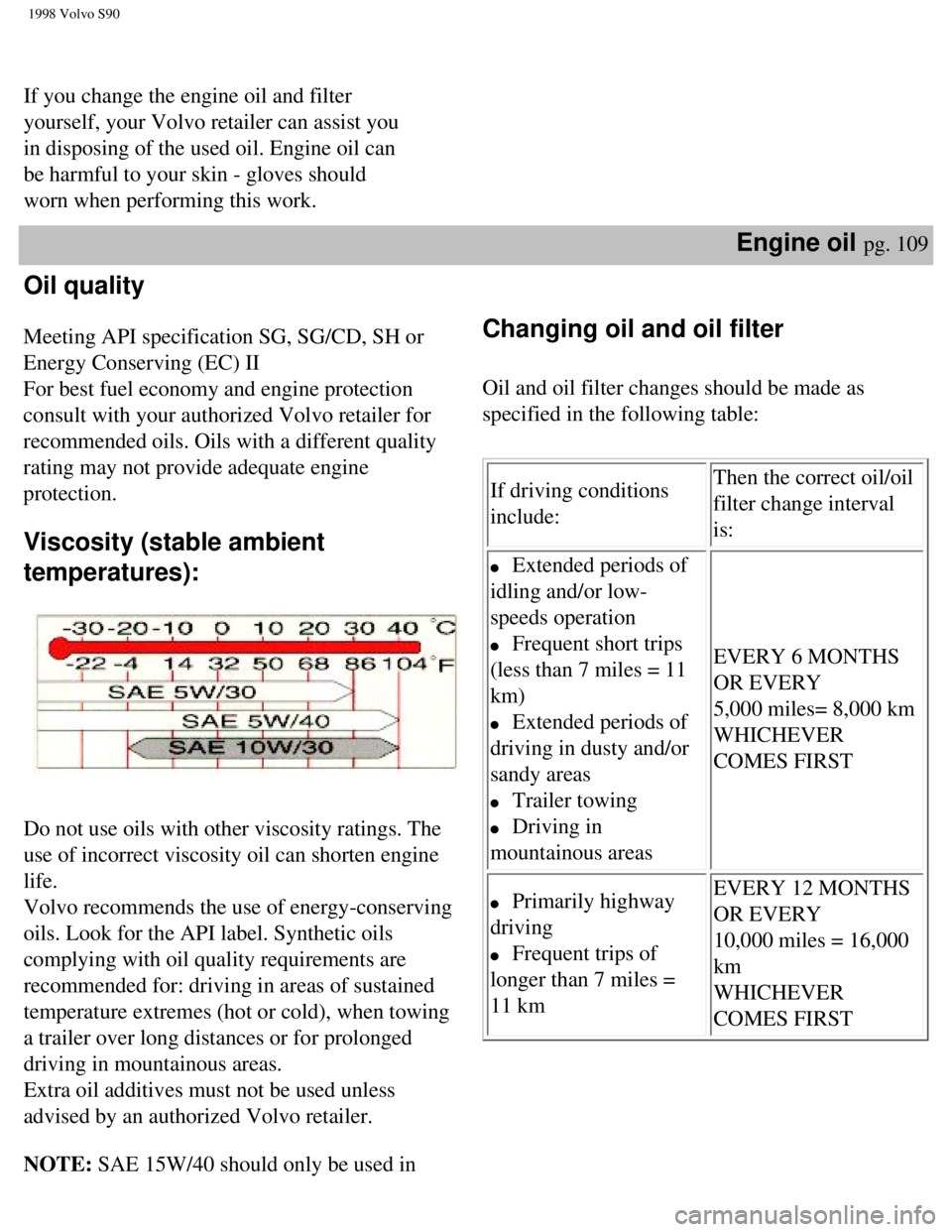
Viscosity (stable ambient
temperatures):
Do not use oils with other viscosity ratings. The
use of incorrect viscosity oil can shorten engine
life.
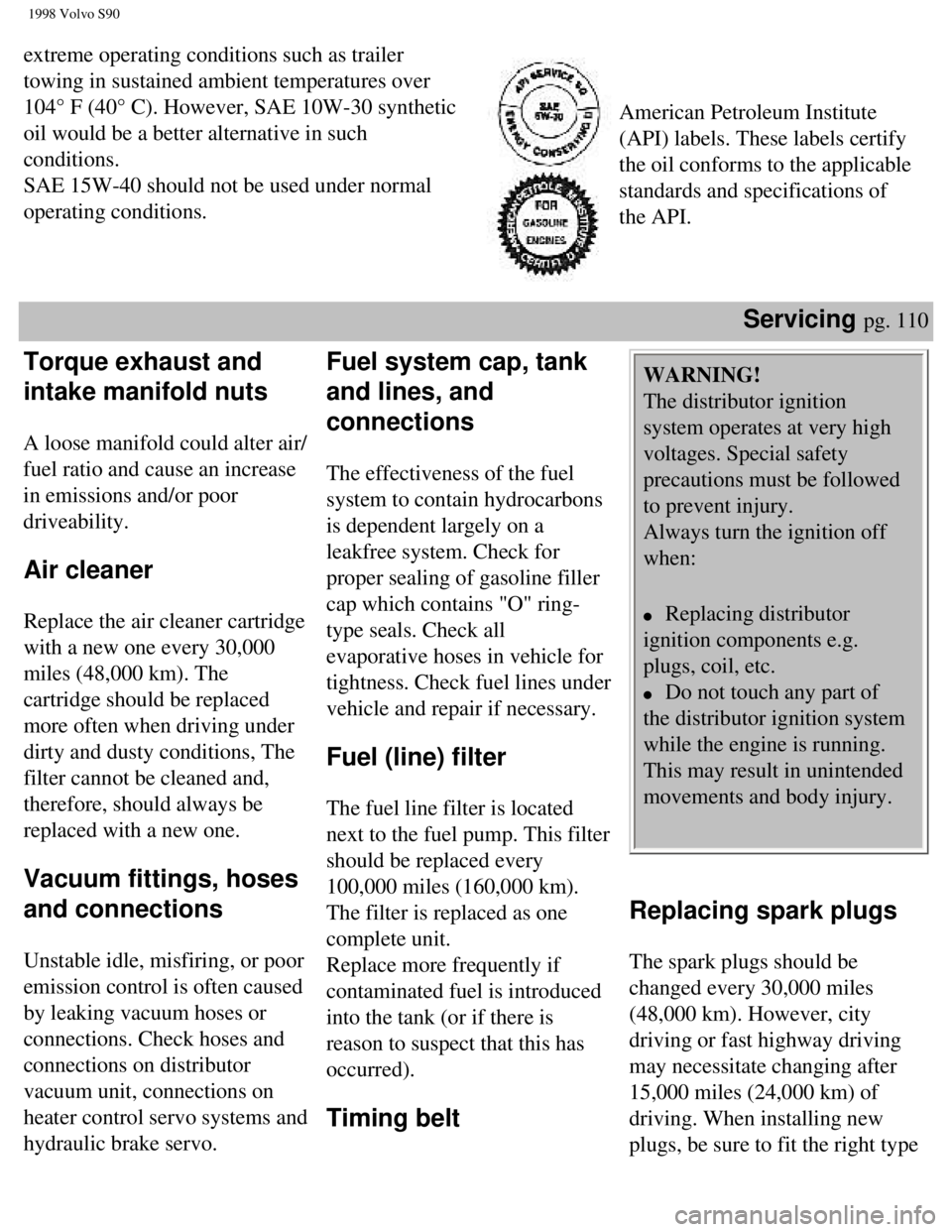
Volvo recommends the use of energy-conserving
oils. Look for the API label. Synthetic oils
complying with oil quality requirements are
recommended for: driving in areas of sustained
temperature extremes (hot or cold), when towing
a trailer over long distances or for prolonged
driving in mountainous areas.
Extra oil additives must not be used unless
advised by an authorized Volvo retailer.
NOTE: SAE 15W/40 should only be used in
Changing oil and oil filter
Oil and oil filter changes should be made as
specified in the following table:
If driving conditions
include: Then the correct oil/oil
filter change interval
is:
l Extended periods of
idling and/or low-
speeds operation
l Frequent short trips
(less than 7 miles = 11
km)
l Extended periods of
driving in dusty and/or
sandy areas
l Trailer towing
l Driving in
mountainous areas EVERY 6 MONTHS
OR EVERY
5,000 miles= 8,000 km
WHICHEVER
COMES FIRST
l Primarily highway
driving
l Frequent trips of
longer than 7 miles =
11 km EVERY 12 MONTHS
OR EVERY
10,000 miles = 16,000
km
WHICHEVER
COMES FIRST
file:///K|/ownersdocs/1998/1998_SV90/98S90_108.htm (2 of 6)12/30/2006 \
1:52:49 PM
Page 121 of 175
1998 Volvo S90
extreme operating conditions such as trailer
towing in sustained ambient temperatures over
104° F (40° C). However, SAE 10W-30 synthetic
oil would be a better alternative in such
conditions.
SAE 15W-40 should not be used under normal
operating conditions.
American Petroleum Institute
(API) labels. These labels certify
the oil conforms to the applicable
standards and specifications of
the API.
Servicing pg. 110
Torque exhaust and
intake manifold nuts
A loose manifold could alter air/
fuel ratio and cause an increase
in emissions and/or poor
driveability.
Air cleaner
Replace the air cleaner cartridge
with a new one every 30,000
miles (48,000 km). The
cartridge should be replaced
more often when driving under
dirty and dusty conditions, The
filter cannot be cleaned and,
therefore, should always be
replaced with a new one.
Vacuum fittings, hoses
and connections
Unstable idle, misfiring, or poor
emission control is often caused
by leaking vacuum hoses or
connections. Check hoses and
connections on distributor
vacuum unit, connections on
heater control servo systems and
hydraulic brake servo.
Fuel system cap, tank
and lines, and
connections
The effectiveness of the fuel
system to contain hydrocarbons
is dependent largely on a
leakfree system. Check for
proper sealing of gasoline filler
cap which contains "O" ring-
type seals. Check all
evaporative hoses in vehicle for
tightness. Check fuel lines under
vehicle and repair if necessary.
Fuel (line) filter
The fuel line filter is located
next to the fuel pump. This filter
should be replaced every
100,000 miles (160,000 km).
The filter is replaced as one
complete unit.
Replace more frequently if
contaminated fuel is introduced
into the tank (or if there is
reason to suspect that this has
occurred).
Timing belt
WARNING!
The distributor ignition
system operates at very high
voltages. Special safety
precautions must be followed
to prevent injury.
Always turn the ignition off
when:
l Replacing distributor
ignition components e.g.
plugs, coil, etc.
l Do not touch any part of
the distributor ignition system
while the engine is running.
This may result in unintended
movements and body injury.
Replacing spark plugs
The spark plugs should be
changed every 30,000 miles
(48,000 km). However, city
driving or fast highway driving
may necessitate changing after
15,000 miles (24,000 km) of
driving. When installing new
plugs, be sure to fit the right type
file:///K|/ownersdocs/1998/1998_SV90/98S90_108.htm (3 of 6)12/30/2006 \
1:52:49 PM