fuel VOLVO V90 1998 User Guide
[x] Cancel search | Manufacturer: VOLVO, Model Year: 1998, Model line: V90, Model: VOLVO V90 1998Pages: 175, PDF Size: 4.45 MB
Page 71 of 175
1998 Volvo S90
disconnected, the code must
be re-entered before the radio
will function properly.
Points to remember pg. 62
Weight distribution affects
handling
At the specified curb weight
your car has a tendency to
understeer, which means that the
steering wheel has to be turned
more than might seem
appropriate for the curvature of
a bend. This ensures good
stability and reduces the risk of
rear wheel skid. Remember that
these properties can alter with
the vehicle load. The heavier the
load in the trunk, the less the
tendency to understeer.
Handling, roadholding
Vehicle load, tire design, and
inflation pressure, all affect
vehicle handling. Therefore,
check that the tires are inflated
to the recommended pressure
according to the vehicle load.
See "Tire pressure" section.
Loads should be distributed so
that capacity weight or
maximum permissible axle loads
are not exceeded.
WARNING!
An extra mat on the driver's
floor can cause the
accelerator pedal to catch.
Check that the movement of
the accelerator pedal is not
impeded. Not more than one
protective floor covering may
be used at one time.
CAUTION: Drive slowly and
carefully if going through
standing water (i.e. flooded
roadways, etc.). Damage to
engine could result if excess
water is ingested through the air
intake system. Never drive the
vehicle in water deeper than 1
foot (300 mm). See the flood
warning on page 7.
WARNING! Do not drive
with trunk lid or tailgate
open!
Poisonous exhaust gases may
enter via the trunk lid or
tailgate.
If the trunk lid/tailgate must
be kept open for any reason,
proceed as follows:
l Close the windows.
l Set the ventilation system
Roof rails/racks
Roof rails are standard
equipment on wagon models.
Load bars are available as a
retailer installed option on the
sedan models. Observe the
following points when is use:
l Avoid single-point loads.
Distribute the load evenly.
l Place heavier cargo at bottom
of load.
l Observe that center of gravity
and handling are influenced by
load weight.
l Increasing load size increases
wind resistance and, thus,
adversely affects fuel economy.
l Anchor the cargo correctly
with appropriate tie-down
equipment.
l Drive carefully. Avoid rapid
starts, fast cornering and hard
braking.
l Max. roof load is 220 lbs.
(100 kg) for removable racks.
For permanent roof racks, check
the manufacturers weight
specifications.
file:///K|/ownersdocs/1998/1998_SV90/98S90_058.htm (6 of 7)12/30/2006 \
1:52:42 PM
Page 74 of 175
1998 Volvo S90
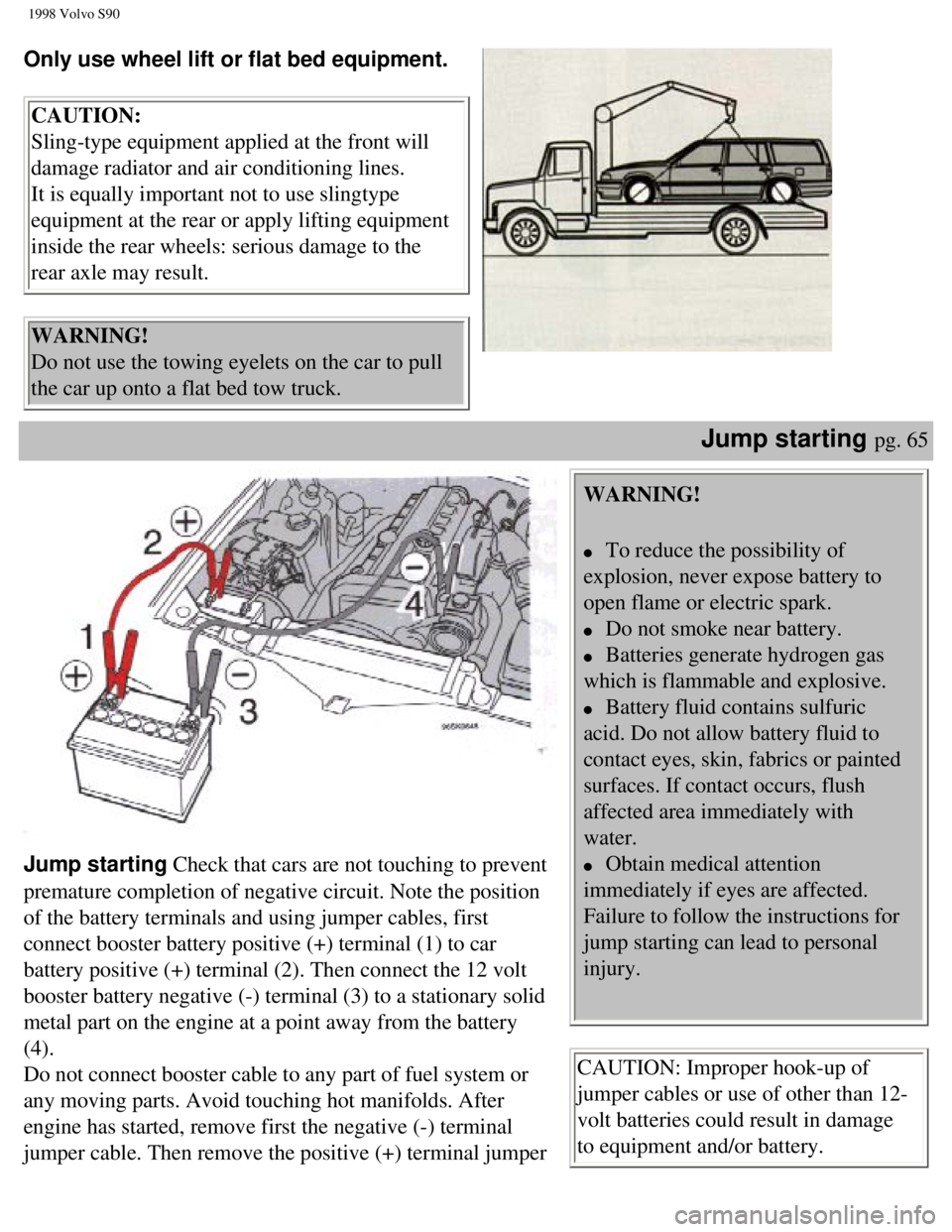
Only use wheel lift or flat bed equipment.
CAUTION:
Sling-type equipment applied at the front will
damage radiator and air conditioning lines.
It is equally important not to use slingtype
equipment at the rear or apply lifting equipment
inside the rear wheels: serious damage to the
rear axle may result.
WARNING!
Do not use the towing eyelets on the car to pull
the car up onto a flat bed tow truck.
Jump starting pg. 65
Jump starting Check that cars are not touching to prevent
premature completion of negative circuit. Note the position
of the battery terminals and using jumper cables, first
connect booster battery positive (+) terminal (1) to car
battery positive (+) terminal (2). Then connect the 12 volt
booster battery negative (-) terminal (3) to a stationary solid
metal part on the engine at a point away from the battery
(4).
Do not connect booster cable to any part of fuel system or
any moving parts. Avoid touching hot manifolds. After
engine has started, remove first the negative (-) terminal
jumper cable. Then remove the positive (+) terminal jumper
WARNING!
l To reduce the possibility of
explosion, never expose battery to
open flame or electric spark.
l Do not smoke near battery.
l Batteries generate hydrogen gas
which is flammable and explosive.
l Battery fluid contains sulfuric
acid. Do not allow battery fluid to
contact eyes, skin, fabrics or painted
surfaces. If contact occurs, flush
affected area immediately with
water.
l Obtain medical attention
immediately if eyes are affected.
Failure to follow the instructions for
jump starting can lead to personal
injury.
CAUTION: Improper hook-up of
jumper cables or use of other than 12-
volt batteries could result in damage
to equipment and/or battery.
file:///K|/ownersdocs/1998/1998_SV90/98S90_063.htm (2 of 4)12/30/2006 \
1:52:43 PM
Page 75 of 175
1998 Volvo S90
cable.
Three-way catalytic converter cautions pg. 66
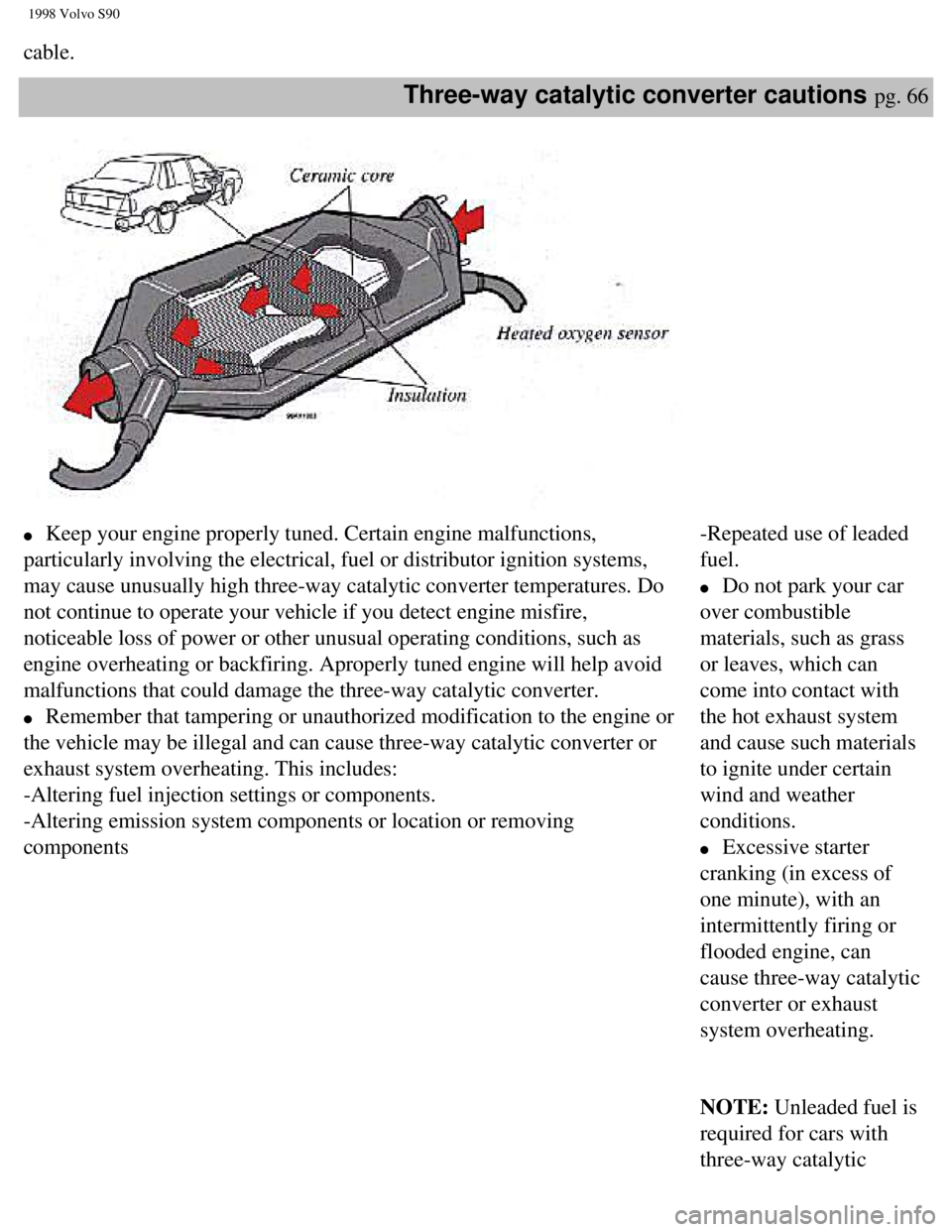
l Keep your engine properly tuned. Certain engine malfunctions,
particularly involving the electrical, fuel or distributor ignition syst\
ems,
may cause unusually high three-way catalytic converter temperatures. Do \
not continue to operate your vehicle if you detect engine misfire,
noticeable loss of power or other unusual operating conditions, such as \
engine overheating or backfiring. Aproperly tuned engine will help avoid\
malfunctions that could damage the three-way catalytic converter.
l Remember that tampering or unauthorized modification to the engine or
the vehicle may be illegal and can cause three-way catalytic converter o\
r
exhaust system overheating. This includes:
-Altering fuel injection settings or components.
-Altering emission system components or location or removing
components -Repeated use of leaded
fuel.
l Do not park your car
over combustible
materials, such as grass
or leaves, which can
come into contact with
the hot exhaust system
and cause such materials
to ignite under certain
wind and weather
conditions.
l Excessive starter
cranking (in excess of
one minute), with an
intermittently firing or
flooded engine, can
cause three-way catalytic
converter or exhaust
system overheating.
NOTE: Unleaded fuel is
required for cars with
three-way catalytic
file:///K|/ownersdocs/1998/1998_SV90/98S90_063.htm (3 of 4)12/30/2006 \
1:52:43 PM
Page 79 of 175
1998 Volvo S90
Observe legal requirements of
the state in which the vehicles
are registered.
WARNING! Bumper-
attached trailer hitches must
not be used on Volvos, nor
should safety chains be
attached to the bumper.
Trailer hitches attaching to
the vehicle rear axle must
not be used. kgs) a top speed of 50 mph (80
km/h) should never be
exceeded.
l Increase tire pressure to
recommended full-load
pressure. See section "Wheels
and tires".
l Engine and transmission are
subject to increased loads.
Therefore, engine coolant
temperature should be closely
watched when driving in hot
climates or hilly terrain. Use
lower gear and turn off air
conditioner if temperature gauge
pointer enters the red range.
towing a trailer to ensure that the
max. permissible axle load or
gross vehicle weight are not
exceeded.
NOTE: Refer to section
"Automatic transmission" for
additional trailer hauling tips.
Winter driving pg. 69
Cold weather precautions
l If you wish to check your car before the
approach of cold weather, the following advice is
worth noting:
Make sure that the engine coolant contains at least
50 percent antifreeze: that is, 5.3 qts. (5 liters)
Volvo Genuine Coolant/Antifreeze. This gives
protection against freezing down to -31°F (-35°
C). See section "Coolant".
The use of "recycled" antifreeze is not approved
by Volvo. Different types of antifreeze may not be
mixed.
l Try to keep the fuel tank well filled - this
prevents the formation of condensation in the
tank.
In addition in extremely cold weather conditions it
is worthwhile to add fuel line de-icer before
refueling.
l The viscosity of the engine oil is important. Oil
with low viscosity (thinner oil) improves cold-
weather starting as well as decreasing fuel
consumption while the engine is warming up. For
winter use, 5W-30 oil, particularly the synthetic
type, is recommended.
Be sure to use good quality oil but do not use this
l The Volvo Washer Solvent should be diluted as
follows:
Down to 14°F (-10°C): 1 part anti-freeze and 4
parts water
Down to 5°F (-15°C): 1 part anti-freeze and 3
parts water
Down to 0°F (-18°C): 1 part anti-freeze and 2
parts water
Down to -18°F (-28°): 1 part anti-freeze and 1
part water
l Use lock spray or grease in the locks.
NOTE: Avoid the use of de-icing spray as they
can cause damage to the locks.
Automatic differential lock (certain
models)
The differential automatically locks at speed
between 3 - 25 mph (5 - 40 km/h) if either of the
drive wheels begins to lose traction. The
differential lock improves power distribution to
the drive wheels in slippery conditions, shifting
power to the wheel with best traction. It also
file:///K|/ownersdocs/1998/1998_SV90/98S90_067.htm (3 of 5)12/30/2006 \
1:52:43 PM
Page 80 of 175
1998 Volvo S90
cold-weather oil for hard driving or in warm
weather. See section "Engine oil" for more
information.
l The load placed on the battery is greater during
the winter since the heater, windshield wipers,
lighting etc. are used more often. Moreover, the
capacity of the battery decreases as the
temperature drops. In very cold weather, a poorly
charged battery can freeze and be damaged. It is
therefore advisable to check the state of charge
more frequently and spray an anti-rust oil on the
battery posts.
l Volvo recommends the use of snow tires on all
four wheels for winter driving - see section
"Wheels and tires".
l To prevent the washer reservoir from freezing,
add washer solvents containing antifreeze. This is
important since dirt is often splashed on the
windshield during winter driving, thus requiring
frequent use of the washers and wipers.
functions when the transmission is in reverse.
Also see "Winter/Wet" mode on page 59.
Winter/Wet mode
Enhanced Vehicle Traction
This mode may be selected for starting/moving
off on slippery roads or to lower downshift speeds
if the transmission is in "L".
Mode W
*In position D, the gearbox starts in third gear and
changes up to fourth gear.
*In position 3, second gear is locked and there is
no change up to third gear. In position L, first gear
is locked.
*These positions always offer the kick-down
feature.
Long distance trip pg. 70
Before a long distance trip
It is always worthwhile to have your car checked at a Volvo retailer
before driving long distances. Your retailer will also be able to supply\
you with bulbs, fuses, spark plugs and wiper blades for your use in the \
event that problems occur.
If you prefer to check the car yourself, please note the following:
l Check that the engine runs smoothly and that fuel consumption is
normal.
l Check engine oil, coolant levels, and for possible fuel leakage.
l Check transmission oil level and rear axle for leakage.
l Check condition of drive belts.
l Check state of charge of battery.
l Examine tires carefully (the spare tire as well), and replace those
that are worn. Check tire pressures.
l The brakes, front wheel alignment, and steering gear should be
checked by your Volvo retailer only.
l Check all lights, including high beams.
file:///K|/ownersdocs/1998/1998_SV90/98S90_067.htm (4 of 5)12/30/2006 \
1:52:43 PM
Page 81 of 175

1998 Volvo S90
l Reflective warning triangles are legal requirement in some
countries.
l Have a word with your Volvo retailer concerning engine
adjustments if you intend to drive in countries where it may be difficul\
t
to obtain correct fuel.
Contents | Top of Page
file:///K|/ownersdocs/1998/1998_SV90/98S90_067.htm (5 of 5)12/30/2006 \
1:52:43 PM
Page 84 of 175
1998 Volvo S90
chain information.
CAUTION:
l Check local regulations regarding the use of
snow chains before installing.
l Always follow the chains manufacturer's
installation instructions carefully. Install
chains as tightly as possible and re-tighten
periodically.
l Never exceed the chain manufacture's
specified maximum speed limit. (Under no
circumstances should that limit be higher than
30 mph (50 km/h).
l Avoid bumps, holes or sharp turns when
driving with snow chains.
l The handling of the vehicle can be adversely
affected when driving with chains. Avoid fast
or sharp turns as well as locked wheel braking.
Winter tires wear more quickly on dry roads in
warm weather. They should be removed when the
winter driving season has ended.
Studded tires should be run-in 300-600 miles
(500-1000 km) during which the car should be
driven as smoothly as possible to give the studs
the opportunity to seat properly in the tires. The
car tires should have the same rotational direction
throughout their entire lifetime. In other words, if
you wish to rotate the wheels, make sure that the
same wheels are always on the same side of the
car.
NOTE: Please consult state or local regulations
restricting the use of studded winter tires before
installing such tires.
WARNING! Special wheel rims for air dams
Only special wheel rims, tested and approved
by Volvo, are suitable for use with the air dam
installed on the S90/V90.
*Where permitted.
Wheels and tires (cont.) pg. 74
Checking and correcting tire
pressure
Check the tire pressure when refueling.
The tire pressure should be corrected only when
the tires are cold. With warm tires, correct only
when the pressure is too low. The tire temperature
rises after driving just a few miles.
Vehicle Loading
The tires on your Volvo will perform to
specifications at all normal loads when inflated as
file:///K|/ownersdocs/1998/1998_SV90/98S90_071.htm (3 of 5)12/30/2006 \
1:52:44 PM
Page 85 of 175
1998 Volvo S90
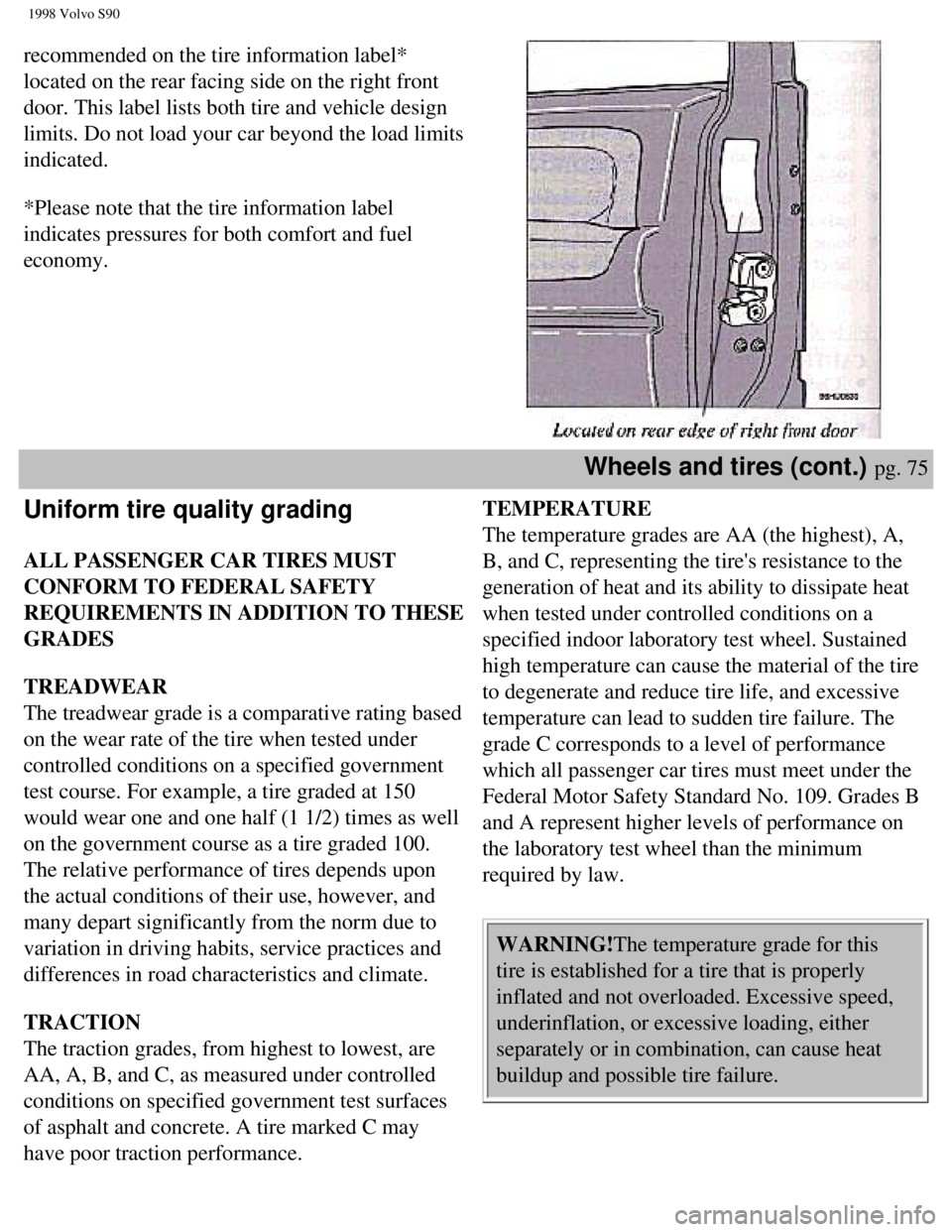
recommended on the tire information label*
located on the rear facing side on the right front
door. This label lists both tire and vehicle design
limits. Do not load your car beyond the load limits
indicated.
*Please note that the tire information label
indicates pressures for both comfort and fuel
economy.
Wheels and tires (cont.) pg. 75
Uniform tire quality grading
ALL PASSENGER CAR TIRES MUST
CONFORM TO FEDERAL SAFETY
REQUIREMENTS IN ADDITION TO THESE
GRADES
TREADWEAR
The treadwear grade is a comparative rating based
on the wear rate of the tire when tested under
controlled conditions on a specified government
test course. For example, a tire graded at 150
would wear one and one half (1 1/2) times as well
on the government course as a tire graded 100.
The relative performance of tires depends upon
the actual conditions of their use, however, and
many depart significantly from the norm due to
variation in driving habits, service practices and
differences in road characteristics and climate.
TRACTION
The traction grades, from highest to lowest, are
AA, A, B, and C, as measured under controlled
conditions on specified government test surfaces
of asphalt and concrete. A tire marked C may
have poor traction performance. TEMPERATURE
The temperature grades are AA (the highest), A,
B, and C, representing the tire's resistance to the
generation of heat and its ability to dissipate heat
when tested under controlled conditions on a
specified indoor laboratory test wheel. Sustained
high temperature can cause the material of the tire
to degenerate and reduce tire life, and excessive
temperature can lead to sudden tire failure. The
grade C corresponds to a level of performance
which all passenger car tires must meet under the
Federal Motor Safety Standard No. 109. Grades B
and A represent higher levels of performance on
the laboratory test wheel than the minimum
required by law.
WARNING!The temperature grade for this
tire is established for a tire that is properly
inflated and not overloaded. Excessive speed,
underinflation, or excessive loading, either
separately or in combination, can cause heat
buildup and possible tire failure.
file:///K|/ownersdocs/1998/1998_SV90/98S90_071.htm (4 of 5)12/30/2006 \
1:52:44 PM
Page 99 of 175
1998 Volvo S90
2 Audio, Power seats, Hazard warning flashers,
Compartment Lights,
Power Antenna, Trailer Power, 50
3 Power Supply Relay "A" 50
4 Fuel System Relay, Ignition System Relay 50
5ABS-unit 50
6 Air pump, Starter Solenoid, Horn 50
7 Electric Cooling Fan 50
8 Pos./parking Light Relay, Headlight Relay, Fog light
relay 50
*Some of the equipment/systems listed may be
available on certain models only and/or as optional
items only.
Brake system pg. 91
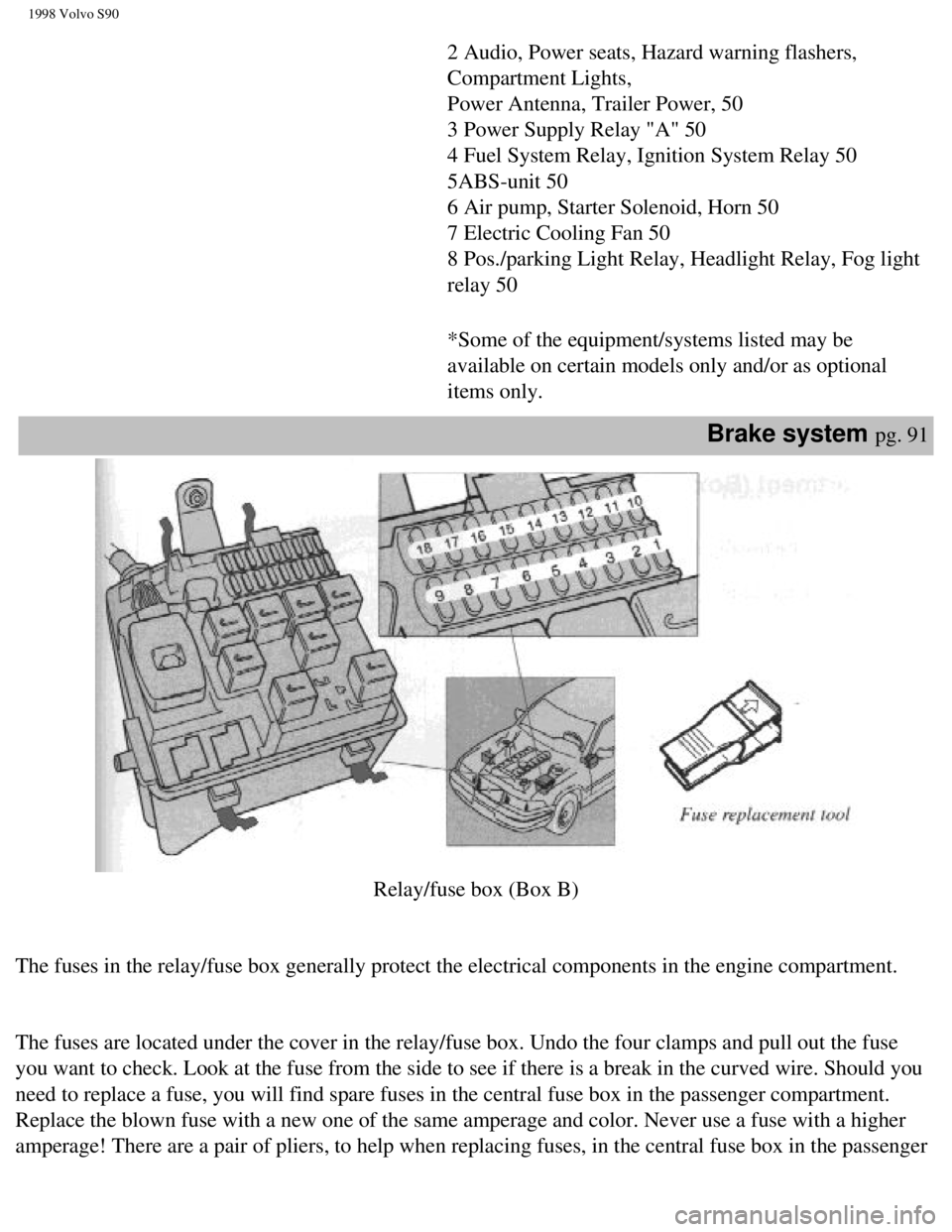
Relay/fuse box (Box B)
The fuses in the relay/fuse box generally protect the electrical compone\
nts in the engine compartment.
The fuses are located under the cover in the relay/fuse box. Undo the fo\
ur clamps and pull out the fuse
you want to check. Look at the fuse from the side to see if there is a b\
reak in the curved wire. Should you
need to replace a fuse, you will find spare fuses in the central fuse bo\
x in the passenger compartment.
Replace the blown fuse with a new one of the same amperage and color. Ne\
ver use a fuse with a higher
amperage! There are a pair of pliers, to help when replacing fuses, in t\
he central fuse box in the passenger
file:///K|/ownersdocs/1998/1998_SV90/98S90_089.htm (3 of 9)12/30/2006 \
1:52:46 PM
Page 100 of 175

1998 Volvo S90
compartment.
Location * Amperage
1 Engine control module, Automatic transmission control module 5
2 AC relay 5
3 Relay, air pump, Heated oxygen sensor 15
4 Fuel pump 15
5 Fuel injection, Mass air flow (MAF) sensor, Idle air control system,\
Engine control module 15
6 Automatic transmission control module 15
7 Ignition coil, 25
8 Fog lights 25
9 Spare
10 Positioning/parking lights, left 15
11 Positioning/parking lights, right 15
12 Left high beam 15
13 Right high beam, Instrument panel 15
14 Left low beam 15
15 Right low beam 15
16 A/C compressor 15
17 Horn 15
18 Accessories (see respective accessories instructions)
*Some of the equipment/systems listed may be available on certain models\
only and/or as optional items
only.
Fuses pg. 92
Fuse box in the passenger compartment (Box C)
These fuses generally protect the electrical components in the passenger\
compartment.
The fuses are located inside the cover on the left side of the dash .A n\
umber of spare fuses can also be
found here. Fuses are replaced in the same way as in the relay/fuse box \
in the engine compartment (see
previous page).
file:///K|/ownersdocs/1998/1998_SV90/98S90_089.htm (4 of 9)12/30/2006 \
1:52:46 PM