service VOLVO V90 1998 User Guide
[x] Cancel search | Manufacturer: VOLVO, Model Year: 1998, Model line: V90, Model: VOLVO V90 1998Pages: 175, PDF Size: 4.45 MB
Page 43 of 175
1998 Volvo S90
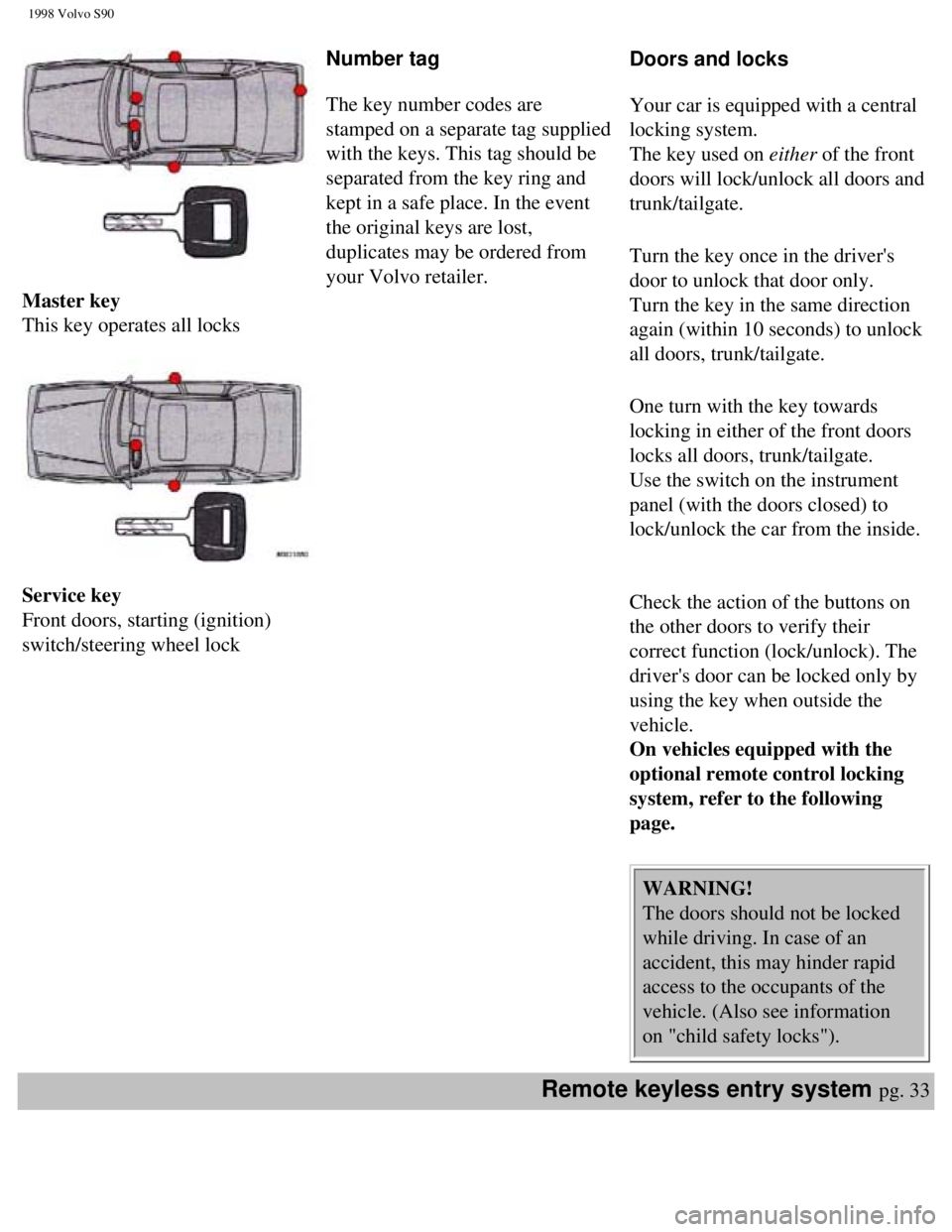
Master key
This key operates all locks
Service key
Front doors, starting (ignition)
switch/steering wheel lock Number tag
The key number codes are
stamped on a separate tag supplied
with the keys. This tag should be
separated from the key ring and
kept in a safe place. In the event
the original keys are lost,
duplicates may be ordered from
your Volvo retailer.
Doors and locks
Your car is equipped with a central
locking system.
The key used on either of the front
doors will lock/unlock all doors and
trunk/tailgate.
Turn the key once in the driver's
door to unlock that door only.
Turn the key in the same direction
again (within 10 seconds) to unlock
all doors, trunk/tailgate.
One turn with the key towards
locking in either of the front doors
locks all doors, trunk/tailgate.
Use the switch on the instrument
panel (with the doors closed) to
lock/unlock the car from the inside.
Check the action of the buttons on
the other doors to verify their
correct function (lock/unlock). The
driver's door can be locked only by
using the key when outside the
vehicle.
On vehicles equipped with the
optional remote control locking
system, refer to the following
page.
WARNING!
The doors should not be locked
while driving. In case of an
accident, this may hinder rapid
access to the occupants of the
vehicle. (Also see information
on "child safety locks").
Remote keyless entry system pg. 33
file:///K|/ownersdocs/1998/1998_SV90/98S90_031.htm (2 of 6)12/30/2006 \
1:52:39 PM
Page 44 of 175
1998 Volvo S90
Remote keyless entry
system
As an option, your car can be
equipped with a remote
control transmitter. This
transmitter uses a radio
frequency which will allow
"keyless" entry into the
passenger compartment or the
trunk. You will be supplied
with two coded key ring
transmitters, which will
enable you to lock/unlock all
doors and the trunk/tailgate
from a distance of 10-15 feet
(3-5 meters).
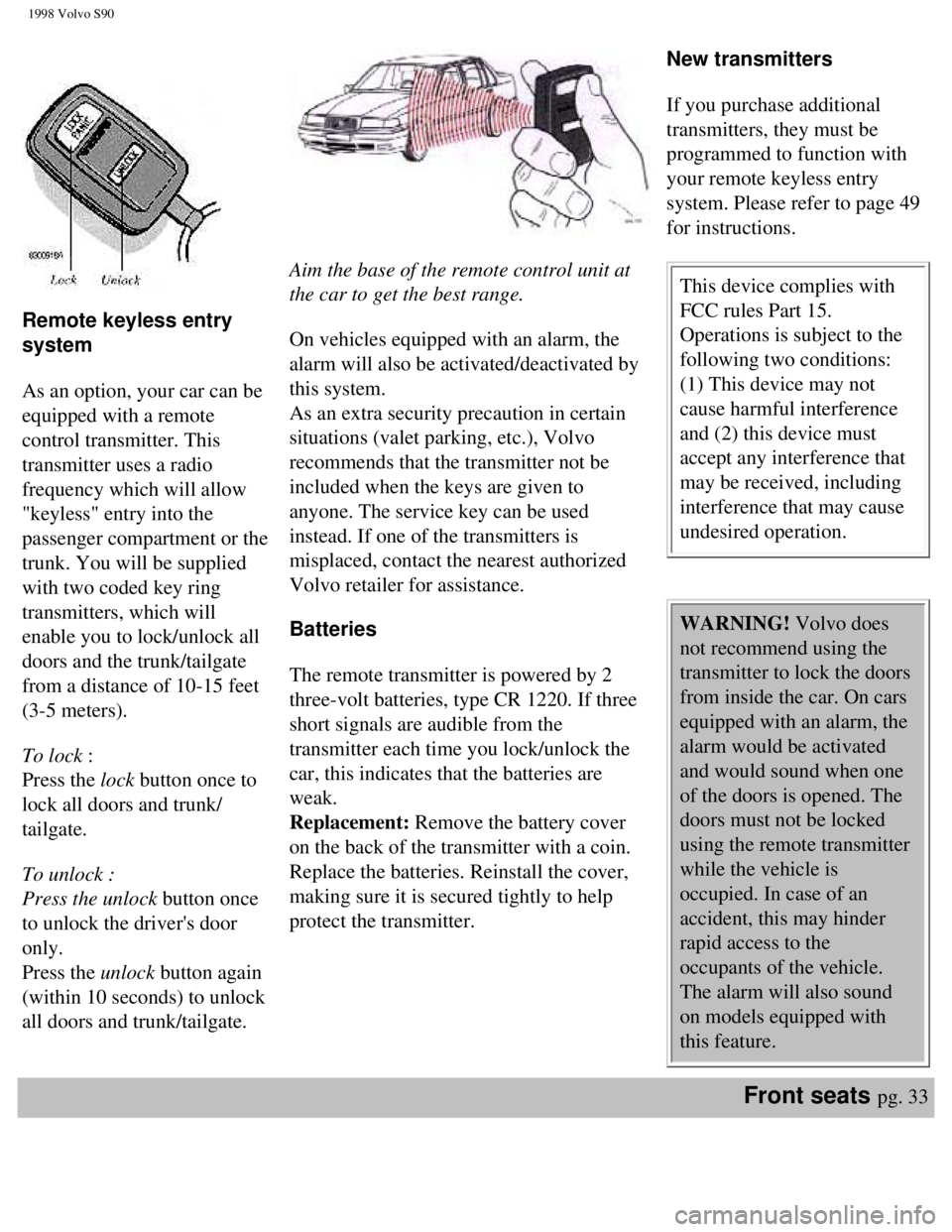
To lock :
Press the lock button once to
lock all doors and trunk/
tailgate.
To unlock :
Press the unlock button once
to unlock the driver's door
only.
Press the unlock button again
(within 10 seconds) to unlock
all doors and trunk/tailgate.
Aim the base of the remote control unit at
the car to get the best range.
On vehicles equipped with an alarm, the
alarm will also be activated/deactivated by
this system.
As an extra security precaution in certain
situations (valet parking, etc.), Volvo
recommends that the transmitter not be
included when the keys are given to
anyone. The service key can be used
instead. If one of the transmitters is
misplaced, contact the nearest authorized
Volvo retailer for assistance.
Batteries
The remote transmitter is powered by 2
three-volt batteries, type CR 1220. If three
short signals are audible from the
transmitter each time you lock/unlock the
car, this indicates that the batteries are
weak.
Replacement: Remove the battery cover
on the back of the transmitter with a coin.
Replace the batteries. Reinstall the cover,
making sure it is secured tightly to help
protect the transmitter. New transmitters
If you purchase additional
transmitters, they must be
programmed to function with
your remote keyless entry
system. Please refer to page 49
for instructions.
This device complies with
FCC rules Part 15.
Operations is subject to the
following two conditions:
(1) This device may not
cause harmful interference
and (2) this device must
accept any interference that
may be received, including
interference that may cause
undesired operation.
WARNING! Volvo does
not recommend using the
transmitter to lock the doors
from inside the car. On cars
equipped with an alarm, the
alarm would be activated
and would sound when one
of the doors is opened. The
doors must not be locked
using the remote transmitter
while the vehicle is
occupied. In case of an
accident, this may hinder
rapid access to the
occupants of the vehicle.
The alarm will also sound
on models equipped with
this feature.
Front seats pg. 33
file:///K|/ownersdocs/1998/1998_SV90/98S90_031.htm (3 of 6)12/30/2006 \
1:52:39 PM
Page 48 of 175
1998 Volvo S90
Chapter 3 - Body and interior (cont.)
Child safety locks, Trunk lid (sedan)
pg. 37
Child safety locks
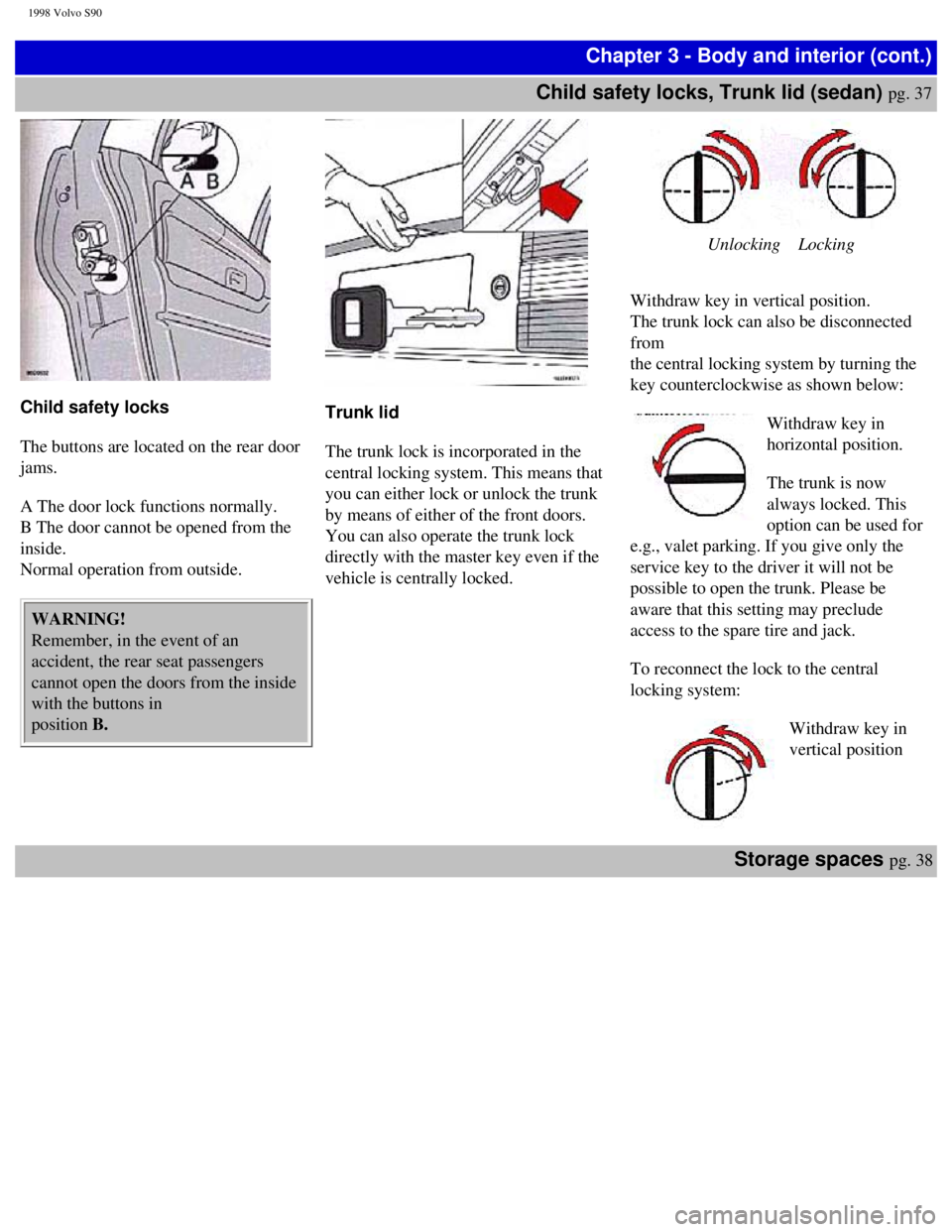
The buttons are located on the rear door
jams.
A The door lock functions normally.
B The door cannot be opened from the
inside.
Normal operation from outside.
WARNING!
Remember, in the event of an
accident, the rear seat passengers
cannot open the doors from the inside
with the buttons in
position B.
Trunk lid
The trunk lock is incorporated in the
central locking system. This means that
you can either lock or unlock the trunk
by means of either of the front doors.
You can also operate the trunk lock
directly with the master key even if the
vehicle is centrally locked.
Unlocking Locking
Withdraw key in vertical position.
The trunk lock can also be disconnected
from
the central locking system by turning the
key counterclockwise as shown below:
Withdraw key in
horizontal position.
The trunk is now
always locked. This
option can be used for
e.g., valet parking. If you give only the
service key to the driver it will not be
possible to open the trunk. Please be
aware that this setting may preclude
access to the spare tire and jack.
To reconnect the lock to the central
locking system:
Withdraw key in
vertical position
Storage spaces pg. 38
file:///K|/ownersdocs/1998/1998_SV90/98S90_037.htm (1 of 4)12/30/2006 \
1:52:39 PM
Page 61 of 175

1998 Volvo S90
A new car should be broken-in!
Refrain from utilizing your car's full driving
potential, e.g. full-throttle acceleration, during the
first 1,200 miles (2,000 km).
Automatic transmission
Do not use "kick-down" during the first 1,200
miles (2,000 km).
NOTE - ENGINE OIL:
Although some oil consumption during normal
engine operation, more oil is consumed when the
engine is new as the internal parts generate higher
friction while wearing-in to each other. From the
time the engine is new until the first service is
performed, the oil consumption could be
higher than normal. For this reason, it is
especially important to check the oil every time
you refuel your car during this period. See
page 108.
In general, the rate of oil consumption depends on
such factors as: engine temperature, length of trip,
driving conditions, oil viscosity and quality,
engine speed and acceleration/deceleration.
Checking your engine oil level each time the car
is refuelled is one of the most important items
you can perform to help keep your car in good
running order.
Deposit control gasoline (detergent
additives)
Volvo recommends the use of gasoline containing
deposit control additives. These additives have
shown to be efficient in keeping injectors and
intake valves clean. Consistent use of deposit
control gasolines will help ensure good
driveability and fuel economy. If you are not sure
whether the gasoline contains deposit control
additives, check with the service station operator.
Unleaded Fuel
Each Volvo has a three-way catalytic converter
and must use only unleaded gasoline. U.S. and
Canadian regulations require that pumps
delivering unleaded gasoline be labeled
"UNLEADED". Only these pumps have nozzles
which fit your car's filler inlet. It is unlawful to
dispense leaded fuel into a vehicle labeled
"unleaded gasoline only". Leaded gasoline
damages the three-way catalytic converter and the
heated oxygen sensor system. Repeated use of
leaded gasoline will lessen the effectiveness of
the emission control system and could result in
loss of emission warranty coverage. State and
local vehicle inspection programs will make
detection of misfueling easier, possibly resulting
in emission test failure for misfueled vehicles.
NOTE: Some U.S. and Canadian gasolines
contain an octane enhancing additive called
methyl-cyclopentadienyl manganese tricarbonyl
(MMT). If such fuels are used, your Emission
Control System performance may be affected,
and the Malfunction Indicator Lamp located on
your instrument panel may light. If this occurs,
please return your vehicle to an authorized Volvo
retailer for service.
file:///K|/ownersdocs/1998/1998_SV90/98S90_053.htm (2 of 6)12/30/2006 \
1:52:41 PM
Page 62 of 175
1998 Volvo S90
NOTE: Do not add additives yourself to the
gasoline, unless you are recommended to do so
by an authorized Volvo retailer.
Fuel requirements, Refueling pg. 55
Octane Rating
Volvo engines are designed for
optimum performance on
unleaded premium gasoline
with an octane rating, AKI of
91, or above. AKI (ANTI
KNOCK INDEX) is an average
of the Research Octane
Number, RON, and the Motor
Octane Number, MON, (RON
+ MON/ 2).
The minimum octane
requirement is AKI 87 (RON
91).
Gasoline Containing
Alcohol and Ethers
"Oxygenated fuels"
Some fuel suppliers sell
gasoline containing
"oxygenates" which are usually
alcohols or ethers. In some
areas, state or local laws
require that the service pump
be marked indicating use of
alcohol or ethers. However,
there are areas in which the
pumps are unmarked. If you are
not sure whether there is
alcohol or ethers in the gasoline
you buy, check with the service
station operator. To meet
seasonal air quality restrictions,
some states require the use of
"oxygenated" fuel in certain
areas.
Alcohol -- Ethanol
Fuels containing up to 10%
ethanol by volume may be
used.
Ethanol may also be referred to
as Ethyl alcohol, or "Gasohol".
Ethers -- MTBE
Fuels containing up to 15%
MTBE may be used.
Refueling
The fuel tank filler cap is
located behind the door on the
left rear fender. Open cap
slowly during hot weather
conditions.
When filling, position the cap
in the special bracket on the
door.
After filling the tank, install the
cap and turn until a "click" is
heard.
The fuel tank is designed to
hold approximately 21.1 US
gals (80 liters) with sufficient
volume left over to
accommodate possible
expansion of the fuel in hot
weather. The "usable" capacity
is 20.3 US gallons (77 liters).
When the fuel level is low,
such factors as ambient
temperature, the fuel's "vapor
pressure" characteristics, and
terrain can affect the fuel
pumps' ability to supply the
engine with an adequate supply CAUTION:
l Avoid spilling gasoline during
refueling. Gasolines containing
alcohol can cause damage to
painted surfaces, which may not
be covered under the New
Vehicle Limited Warranty.
l Do not use gasoline
containing methanol (methyl
alcohol, wood alcohol). This
practice can result in vehicle
performance deterioration and
can damage critical parts in the
fuel system. Such damage may
not be covered under the New
Vehicle Limited Warranty.
l Allow for fuel expansion by
not overfilling the tank.
Overfilling could also cause
damage to the emission control
systems.
file:///K|/ownersdocs/1998/1998_SV90/98S90_053.htm (3 of 6)12/30/2006 \
1:52:41 PM
Page 64 of 175
1998 Volvo S90
(check when tires are cold). items and others are checked at
the standard Maintenance
Service intervals.
NOTE: Since using (D)rive
improves fuel economy, it
should be used as often as
possible.
Starting the engine pg. 57
Starting and stopping a
car equipped with
automatic transmission
1 Fasten the seat belt.
WARNING! Before
starting, check that the seat
is adjusted properly. Make
sure the brake pedal can be
depressed completely. Move
the seat closer if necessary.
Refer to section "Front
seats".
2 Apply the parking brake, if
not already set. The gear
selector is locked in the (P)ark
position (SHIFTLOCK).
3Without touching the
accelerator pedal ,turn the
ignition key to the starting
position. Allow the starter to
operate for 5-10 seconds.
Release the key as soon as the
engine starts. If the engine fails
to start, repeat step 3.
5 Select desired gear. The gear
engages after a slight delay,
especially noticeable when
selecting R.
CAUTION: Engine should
be idling; never accelerate
until after you feel the gear
engage! Too rapid
acceleration immediately
after selecting a gear will
cause harsh engagement and
premature transmission
wear.
NOTE:Your car is equipped
with a KEYLOCK system.
When the engine is switched
off, the gear selector must be in
the (P)ark position before the
key can be removed from the
ignition switch.
Engine warm-up - initial
driving procedure
Engines in vehicles driven short
distances are subject to
abnormally rapid wear because
the engine never reaches normal
operating temperature. It is
therefore beneficial to reach
normal operating temperature as
soon as possible. This is best
achieved by driving with a light
foot on the accelerator pedal for
a few minutes after starting,
rather than prolonged idling.
B6304 S Engine
This engine features hydraulic
valve lifters which means that
valve clearance is adjusted
automatically. It is possible that
the valve lifters will produce a
ticking sound for the first few
seconds after the engine is
started, while the oil pressure is
increasing.
If the car has not been used for a
long period of time, this ticking
sound may last for up to 15
minutes. This is entirely normal.
file:///K|/ownersdocs/1998/1998_SV90/98S90_053.htm (5 of 6)12/30/2006 \
1:52:41 PM
Page 85 of 175
1998 Volvo S90
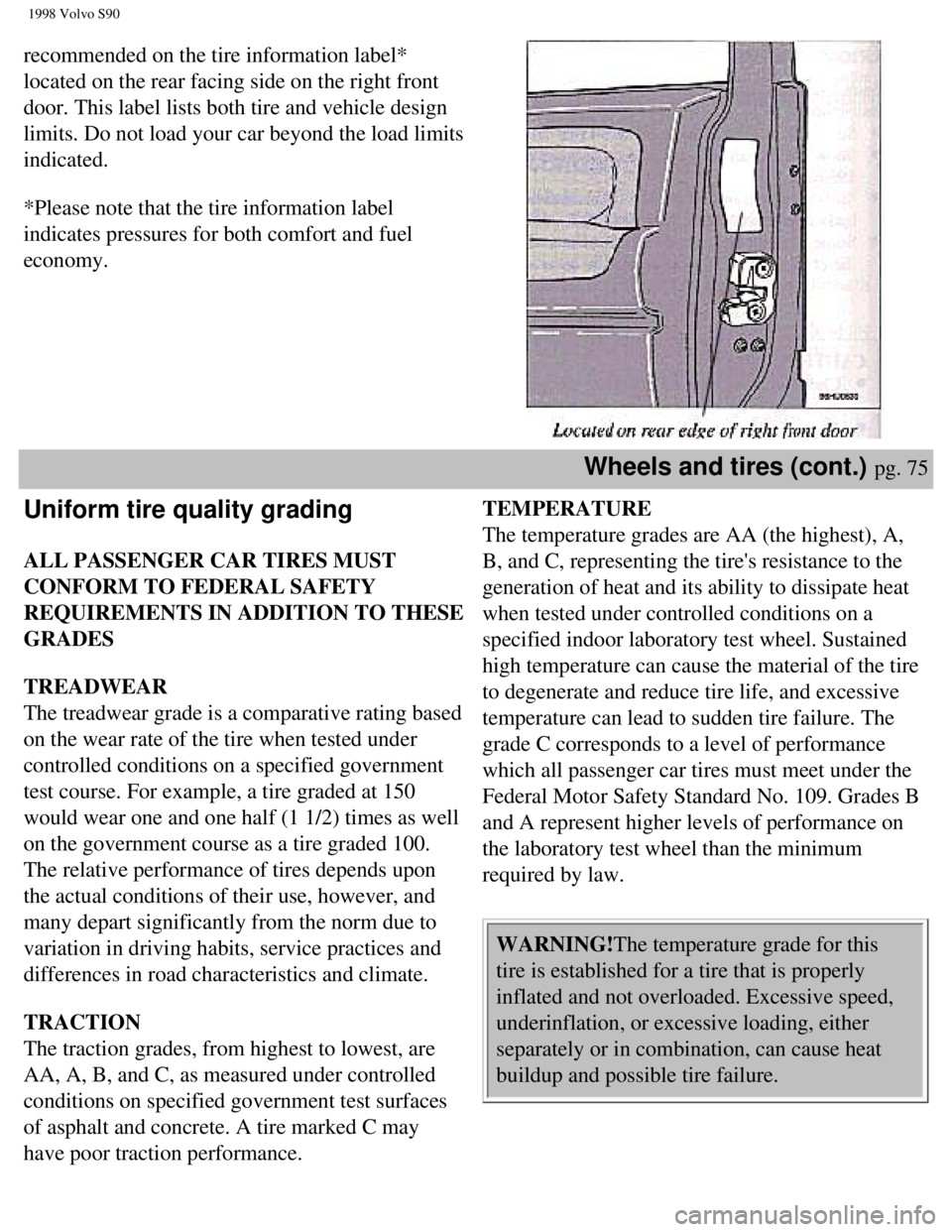
recommended on the tire information label*
located on the rear facing side on the right front
door. This label lists both tire and vehicle design
limits. Do not load your car beyond the load limits
indicated.
*Please note that the tire information label
indicates pressures for both comfort and fuel
economy.
Wheels and tires (cont.) pg. 75
Uniform tire quality grading
ALL PASSENGER CAR TIRES MUST
CONFORM TO FEDERAL SAFETY
REQUIREMENTS IN ADDITION TO THESE
GRADES
TREADWEAR
The treadwear grade is a comparative rating based
on the wear rate of the tire when tested under
controlled conditions on a specified government
test course. For example, a tire graded at 150
would wear one and one half (1 1/2) times as well
on the government course as a tire graded 100.
The relative performance of tires depends upon
the actual conditions of their use, however, and
many depart significantly from the norm due to
variation in driving habits, service practices and
differences in road characteristics and climate.
TRACTION
The traction grades, from highest to lowest, are
AA, A, B, and C, as measured under controlled
conditions on specified government test surfaces
of asphalt and concrete. A tire marked C may
have poor traction performance. TEMPERATURE
The temperature grades are AA (the highest), A,
B, and C, representing the tire's resistance to the
generation of heat and its ability to dissipate heat
when tested under controlled conditions on a
specified indoor laboratory test wheel. Sustained
high temperature can cause the material of the tire
to degenerate and reduce tire life, and excessive
temperature can lead to sudden tire failure. The
grade C corresponds to a level of performance
which all passenger car tires must meet under the
Federal Motor Safety Standard No. 109. Grades B
and A represent higher levels of performance on
the laboratory test wheel than the minimum
required by law.
WARNING!The temperature grade for this
tire is established for a tire that is properly
inflated and not overloaded. Excessive speed,
underinflation, or excessive loading, either
separately or in combination, can cause heat
buildup and possible tire failure.
file:///K|/ownersdocs/1998/1998_SV90/98S90_071.htm (4 of 5)12/30/2006 \
1:52:44 PM
Page 112 of 175

1998 Volvo S90
Chapter 8 - Volvo Service
pg. 103
Service - an investment
An investment which will pay dividends in the form of improved reliabili\
ty,
durability, and resale value.
Label information pg. 104
Maintenance service, Warranty pg. 105
Maintenance schedule pg. 106
Engine oil pg. 108
Servicing pg. 110
Fuel/emissions systems pg. 112
Engine compartment pg. 114
Lubrication, body pg. 115
Power steering fluid, brake fluid pg. 116
Drive belt pg. 117
Cooling system pg. 118
Washer fluid reservoir/nozzles pg. 119
Label information
pg. 104
1 Vehicle
Identification
Number
(VIN)*
VIN plate is
located on
top left
surface of
dashboard.
The VIN is
also stamped
on the right
hand door
pillar.
2 Vehicle
Emission
file:///K|/ownersdocs/1998/1998_SV90/98S90_103.htm (1 of 7)12/30/2006 \
1:52:48 PM
Page 114 of 175

1998 Volvo S90
of right front
door.
5 Federal
Motor
Vehicle
Safety
Standards
(FMVSS)
specifications
(USA) and
Ministry of
Transport
(CMVSS)
Standards
(Canada)
Your Volvo
is designed to
meet all
applicable
safety
standards, as
evidenced by
the
certification
label on the
rear facing
side of the
driver's door.
For further
information
regarding
these
regulations,
please
consult your
Volvo
retailer.
6. Vacuum
hose routing
Maintenance service, Warranty pg. 105
file:///K|/ownersdocs/1998/1998_SV90/98S90_103.htm (3 of 7)12/30/2006 \
1:52:48 PM
Page 115 of 175

1998 Volvo S90
Maintenance service
Volvo advises you to follow the
service program which is
outlined in the "Maintenance
Records Manual". This
maintenance program contains
inspections and services
necessary for the proper
function of your car.
The maintenance services
contain several checks which
require special instruments and
tools and therefore must be
performed by a qualified
technician.
To keep your Volvo in top
condition, specify time tested
and proven Genuine Volvo Parts
and Accessories.
The Federal Clean Air
Act - U.S.
The Clean Air Act requires
vehicle manufacturers to furnish
written instructions to the
ultimate purchaser to assure the
proper functioning of those
components that control
emissions.
The maintenance instructions
listed in the "Servicing" section
of this Manual represent the
minimum maintenance required.
These services are not covered
by the warranty. You will be
required to pay for labor and
material used. Refer to your
Warranty booklet for further
details.
Maintenance services
Your Volvo has passed several
major inspections before being
delivered to you, according to
Volvo specifications. The
maintenance services outlined in
this book should be performed
as indicated. The extended
maintenance service intervals
make it even more advisable to
follow this program. Inspection
and service should also be
performed any time a
malfunction is observed or
suspected.
It is recommended that receipts
for vehicle emission services be
retained in the event that
questions arise concerning
maintenance. See your
"Maintenance Records Manual".Applicable warranties -
U.S.
In accordance with U.S. Federal
Regulations, the following list of
applicable U.S. warranties is
provided. For Canadian
specification vehicles, see your
separate warranty booklet.
l New Car Limited Warranty
l Parts and Accessories Limited
Warranty
l Corrosion Protection Limited
Warranty
l Seatbelt and Supplemental
Restraint Systems Limited
Warranty
l Emission Design and Defect
Warranty
l Emission Performance
Warranty
These are the Federal warranties;
other warranties are provided as
required by state law.
Refer to your separate Warranty
booklet for detailed information
concerning each of the warranties.
Maintenance Schedule pg. 106
file:///K|/ownersdocs/1998/1998_SV90/98S90_103.htm (4 of 7)12/30/2006 \
1:52:48 PM